
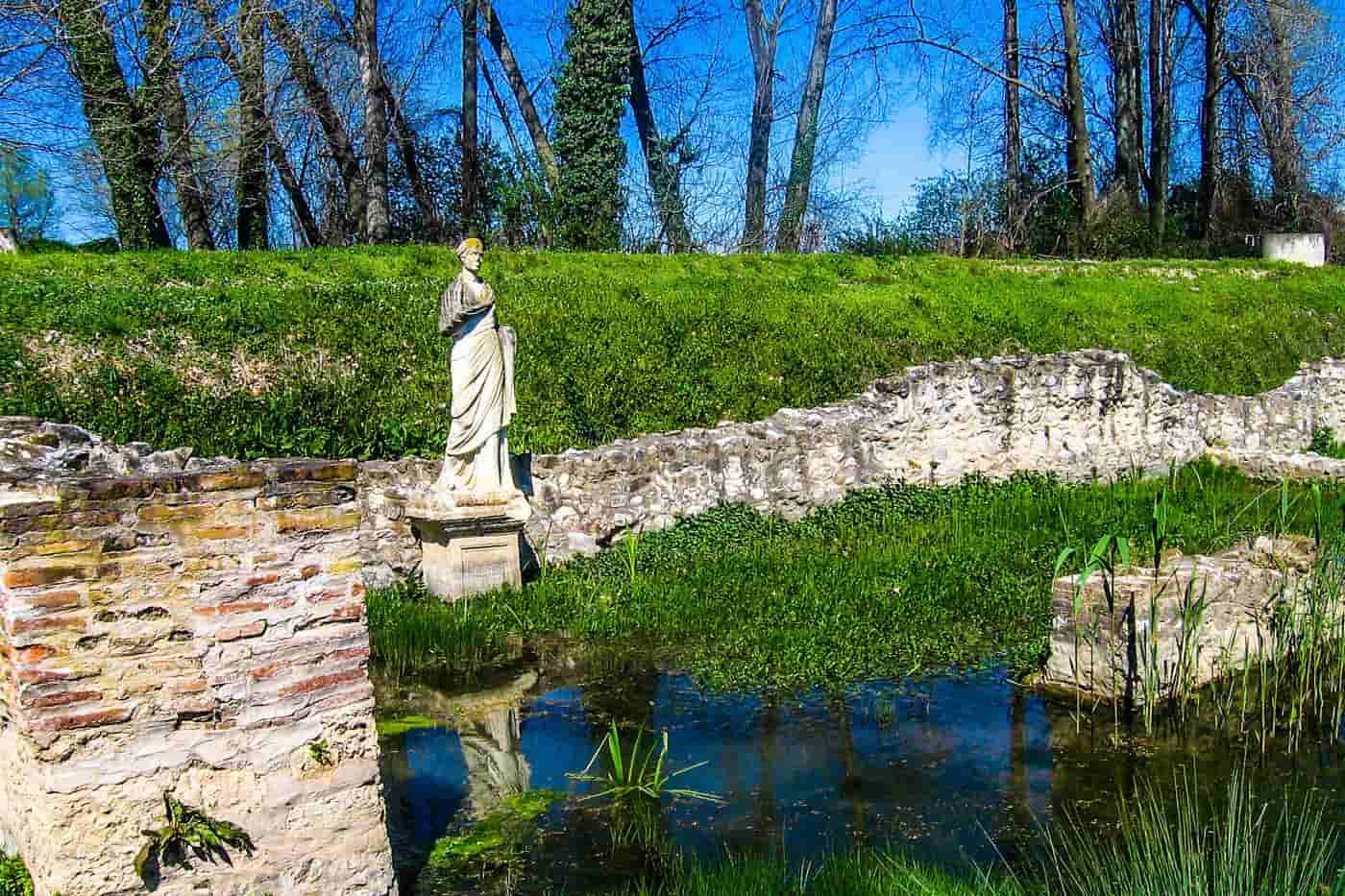
Dion tours start at the sacred city of the ancient Macedonians, in Pieria at the north-east foot of Mount Olympus, 15 km south of Katerini. The routes cover the sanctuaries of Olympian Zeus, Isis and Demeter, the theatres, the walled ancient city, the Archaeological Museum of Dion and the trails that climb into Mount Olympus. Greece Tours lists the day tours that pair Dion with Olympus and Litochoro.
This page covers what Dion tours see in the archaeological park and the museum, which trips continue to Mount Olympus, Vergina and the Pieria coast, how visitors reach Dion, and which season suits each route. The tours below are checked on GetYourGuide and leave from Thessaloniki, Katerini, Litochoro and Dion.
What do Dion tours cover?
Dion tours cover the Archaeological Park of Dion at the north-east foot of Mount Olympus in Pieria, the modern village of Dion beside it and the municipality of Dion-Olympos. Ancient Dion took its name from Zeus and was the sacred place of the Macedonians.
The park covers 150 hectares: nearly 50 for the ancient city, 50 for the sanctuaries and the rest still unexplored. It lies 5 km from the sea and 15 km south of Katerini, at a spot that controlled the passes between Thessaly and Macedonia.
Dion tours also pass through the modern village, built at 30 m on the ruins of the ancient city, with 1,268 residents at the 2021 census. It was called Malathria, after the local fennel, until 1961. Since 2011 Dion has been a municipal unit of Dion-Olympos, formed from Dion, East Olympos and Litochoro. Litochoro, the seat, is the starting point for climbs to the summit of Olympus and for Litochoro tours.
- Sanctuaries: Dion tours find the sanctuaries, the theatres and the cemetery outside the ancient city.
- Museum: the Archaeological Museum of Dion, built in 1983, stands half a kilometre west of the park, in the village.
- Rediscovery: the English traveller William Martin Leake identified the ruins beside Malathria in December 1806.
What do Dion tours see at the sanctuary of Olympian Zeus?
Dion tours see the sanctuary of Zeus Olympios, the religious centre of the Macedonian kingdom, near the Roman theatre. A temple rose in a sacred grove of Zeus, and a 22 m altar filled the central square, where sacrifices of 100 cattle took place.
Dion tours reach a site that took decades to find: the search began in June 1928, and the sanctuary came to light only in 2000. Tradition says that Deucalion, king of Thessaly, set up an altar to Zeus here, at a spot chosen for its springs and its old trees, struck by lightning in summer storms.
The kings sacrificed here for the Macedonian new year at the end of September and held purification rites for the army in spring. Gilded statues of the kings stood in the sanctuary, with 25 bronze horsemen by Lysippos for the companions of Alexander the Great who fell at the Granicus in 334 BC. The Aetolians destroyed the sanctuary in 219 BC, and Philip V rebuilt it at once.
- Royal archive: the kings stored their decrees in the temple; one stele records the alliance of King Perseus with the Boeotians in 172 BC.
- Zeus Hypsistos: Dion tours also follow a sacred road lined with small columns and marble eagles to the shrine of Zeus Hypsistos, where his cult statue lay in the mud.
- Summit cult: finds on the Agios Antonios peak, 2,817 m high, show that Zeus was worshipped on Olympus as well.
What do Dion tours see at the sanctuary of Isis?
Dion tours see the sanctuary of Isis beside the Vaphyras river, the newest of the sanctuaries at Dion. A channel that stands for the Nile crosses the complex, and springs still flow inside the small temples of Isis Tyche and Aphrodite Hypolympidia.
Dion tours enter a sanctuary built in the second century AD on the site of an older fertility sanctuary, where Artemis was first worshipped as goddess of childbirth. From the second century BC the cult of Isis began to replace hers. The main entrance faces east, towards the sea.
Dion tours find the temple and altar of Isis Lochia, the guardian of childbirth, in the western part, between the two smaller temples. Water had a sacred meaning in the cult of Isis. Two rooms in the north of the complex served for healing through sleep and for figures of the sanctuary’s patrons.
Spring water and mud kept collapsing the trenches, so a dam was built to continue the dig, which ended in 1984. After the Vaphyras flooded the sanctuary in 2002, the river was moved a short distance west.
- Aphrodite Hypolympidia: a marble statue 113 cm tall, made around 150–100 BC and commissioned by the freedwoman Anthestia Iucunda.
- Votive relief: a marble relief of Isis with features of Demeter, offered by Callimachus and Cleta to Serapis, Isis and Anubis.
- Other finds: statues of Isis Tyche and Isis Lochia, statuettes of Harpokrates and stone slabs with footprints of different sizes.
What do Dion tours see at the sanctuary of Demeter and the theatres?
Dion tours see the sanctuary of Demeter, the oldest at Dion, with finds from the 6th century BC, and two theatres: the Hellenistic theatre, the largest building in the park, and the Roman theatre of the second century AD, near the sanctuary of Zeus.
Dion tours reach the sanctuary of Demeter south of the ancient city. At the end of the 4th century BC two Doric temples replaced two Archaic ones. Small one-room temples served earth deities such as Baubo and Kourotrophos, asked for rich harvests. Two round wells rank among the oldest structures. A Mycenaean ring stone carved with a lion before a tree points to an earlier settlement.
Dion tours find the Hellenistic theatre about 180 m south of the park entrance. Philip V built it in place of the classical theatre where the Bacchae of Euripides had its premiere. Today wooden boards cover the rebuilt seats, and the Olympus Festival has staged performances here since 1991.
The Roman theatre, southeast of the Hellenistic one, reused stone from it. It had 24 rows of seats over 14 brick vaults, and a statue of Hermes came from its ruins.
- Asklepios: the healing sanctuary of the 4th century BC lies beside the shrine of Demeter.
- Hellenistic orchestra: it measures about 26 m across, with a drain crossed by two bridges and an underground corridor below.
- Stadium: the third festival venue, excavated in 1995 under Giorgos Karadedos, with rows of seats beside the playing field.
Visitors based in Thessaloniki reach the sanctuaries and theatres on a Dion archaeological park day trip from Thessaloniki.
What do Dion tours see in the ancient city?
Dion tours in the ancient city follow the main street past houses, shops, baths and an odeon inside a stone circuit wall. Cassander built the wall from Olympus limestone between 306 and 304 BC, on a flat plain with no acropolis.
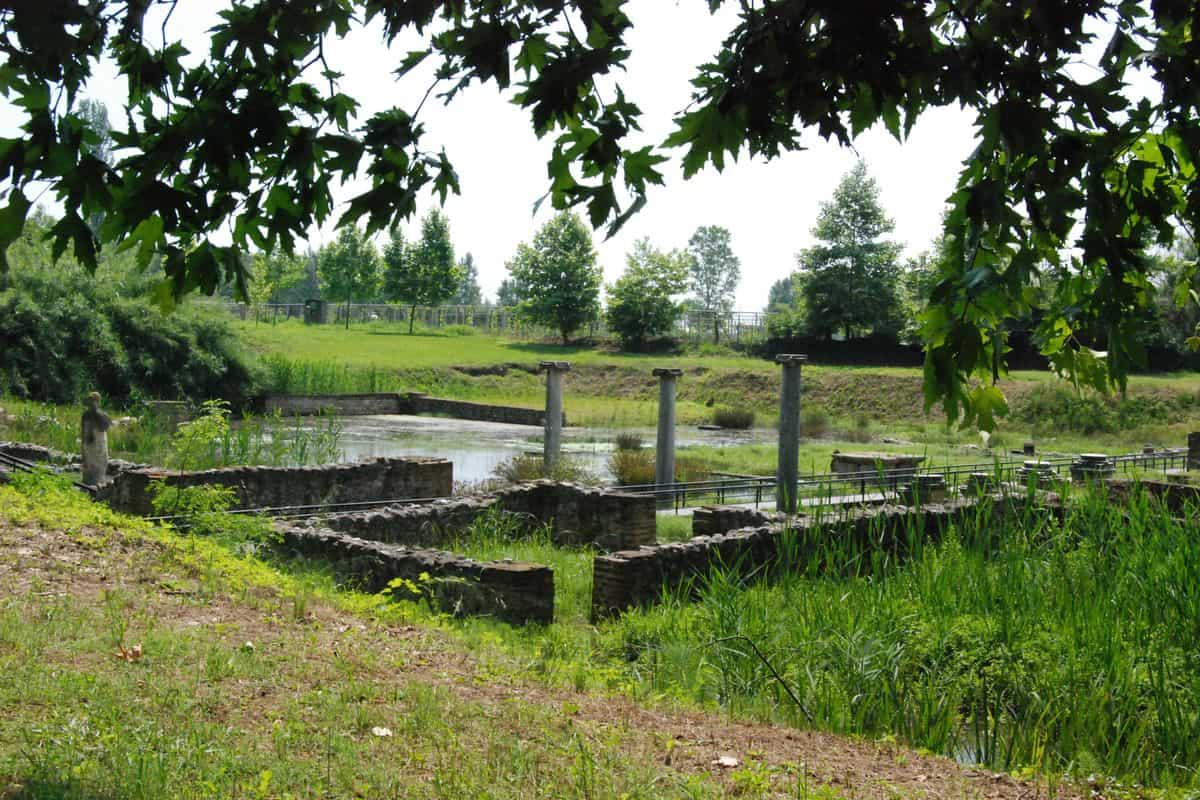
The wall ran for 2,625 metres, three metres thick and seven to ten metres high, with towers every 33 metres. In 2006 a statue of Hera, 2,200 years old, came to light inside it, used by early Christians as filling.
Dion tours walk a grid of streets that cross at right angles, paved in Roman imperial times. West of the main street stands a frieze of stone armour and shields from a Roman basilica.
The Villa of Dionysus lies east of the main road. In June 1987 its dining hall gave up the Dionysus mosaic, the largest mosaic preserved at Dion: the god rides a chariot drawn by two panthers, and two centaurs hold the reins. In 2015 the mosaic moved to the Archaeotheke behind the museum.
- Great baths: built in the 2nd century AD and heated by a hypocaust under the floor.
- Odeon: a hall inside the great baths, with 400 seats around a semicircular orchestra.
- Polygonal building: about 1,400 square metres around a twelve-sided court, with a mosaic of two wrestlers.
Dion tours at the odeon see a restored building, its cracks closed with fresh mortar and its walls capped with bricks made to match the ancient ones.
What do Dion tours see in the Archaeological Museum of Dion?
Dion tours in the Archaeological Museum of Dion see statues, coins, grave monuments and tools from the city, Olympus, Leivithra and the rest of Pieria. The museum opened in 1983, half a kilometre west of the park, in the modern village of Dion.
The ground floor holds statues from the great baths, among them the daughters of Asclepius: Hygieia, Panakeia, Akeso and Iaso. Coin cases show a gold stater of Philip II with the head of Apollo and a two-horse racing chariot, and a silver tetradrachm of Alexander the Great.
The basement covers daily life, with vases and jugs, ancient keys and locks, hammers and chisels. A model of the hypocaust shows how the city baths were heated.
Dion tours then climb to the upper floor, where the hydraulis, a water organ, has a room of its own. Archaeologists found its copper pipes on 19 August 1992, in a building opposite the Villa of Dionysus. It is the oldest organ of its kind found to date anywhere in the world.
- Size: 120 cm high and 70 cm wide.
- Pipes: 24 pipes of 18 mm and 16 narrow pipes of about 10 mm in two rows, ringed in silver.
- Decoration: silver stripes and coloured rectangular glass ornaments on the body.
- Replica: the European Cultural Centre of Delphi built a reconstruction between 1995 and 1999.
Dion tours also enter the Archaeotheke west of the museum, where a gallery shows the Dionysus mosaic from all sides.
What history do Dion tours tell?
Dion tours tell the story of the sacred city of the Macedonians, from the Olympian games of Archelaus I to Alexander the Great, the Roman colony and the bishops. Earthquakes and floods emptied the city, and excavation began in 1928.
Diodorus credits Archelaus I, king of Macedon from 413 to 399 BC, with a nine-day festival of athletic and dramatic contests for Zeus and the Muses. Philip II and Alexander the Great held these games with great splendour.
Dion tours retell how Alexander gathered his armies and made sacrifices here on the eve of his campaign to Asia in 334 BC. Lysippos made a bronze group of the 25 mounted companions who fell at the Granicus, and Metellus later took it to Rome. Aetolian invaders destroyed Dion in 219 BC, and Philip V rebuilt it at once.
Dion tours follow the city into Roman times: Rome took it in 169 BC, and in 32/31 BC Octavian founded the colony of Colonia Julia Augusta Diensis. Dion flourished again under emperors of the 2nd and 3rd centuries AD who were fond of Alexander, and in the 4th and 5th centuries AD it was the seat of a bishop.
- Rediscovery: William Martin Leake identified the ruins beside the village of Malathria in December 1806.
- First digs: Georgios Sotiriadis worked from 1928 to 1931 and found a 4th-century BC Macedonian tomb.
- Later work: Professor Dimitrios Pandermalis directed the research from 1973, and the University of Thessaloniki continues it.
Which Dion tours continue to Mount Olympus?
Dion tours that continue to Mount Olympus drive about 8 km south to Litochoro, the usual base for the climb, and then up the road to Prionia. The hike to Mytikas, at 2,918 metres the highest peak in Greece, starts there.
Inscriptions, pottery and charcoal of Hellenistic and Roman date on the summit of Agios Antonios, at 2,817 metres, show that the cult of Zeus reached the mountain too. Olympus became the first national park in Greece in 1938.
Dion tours with a walking day skip the drive and enter the Enipeas gorge at Myloi in Litochoro, 300 metres above sea level. The path follows the river 12.5 km to its springs at Prionia, a walk of 5 to 7 hours. At Vythos the gorge opens around a waterfall with a view of Mytikas and Stefani.
- Old monastery: founded by Saint Dionysios in 1542 and blown up by German troops in April 1943; its ruins stand just off the Prionia road.
- Stavros refuge: 9.5 km up the asphalt road from Litochoro, at 930 metres, open all year round.
- Kakkalos refuge: a shelter for 25 people at 2,650 metres, on the eastern edge of the Plateau of the Muses.
The refuge is named after Christos Kakkalos of Litochoro, who stood on Mytikas ahead of his two Swiss companions on the first recorded ascent, on 2 August 1913. Dion tours that add a summit day follow the Mount Olympus hike from Prionia.


Which Dion tours combine Vergina, Pydna and the Pieria coast?
Dion tours pair the site with the royal tombs of Aigai at Vergina, the battlefield of ancient Pydna, the Leivithra park, about 9 km south of Litochoro, and Paralia, the closest beach to Katerini, 8 km east of the city centre.
Vergina, 13 km southeast of Veria, holds the site of Aigai, the first capital of Macedon. Philip II was assassinated in its theatre in 336 BC. In 1977, Manolis Andronikos dug the Great Tumulus and found four buried tombs, two of them never disturbed. Vergina tours enter the museum of the tumulus, opened in 1993 over the tombs.
At Pydna, in 168 BC, the consul Aemilius Paullus defeated Perseus, the last king of Macedonia. Leivithra, near Skotina, keeps the myth of Orpheus, whom the Muses buried there. Its acropolis rises to 130 m, and the park paths follow the shape of a lyre.
Paralia grew from a settlement that fishermen founded after 1922, and it keeps a fishing port. The Pieria Riviera day trip from Thessaloniki follows this shore, where Pieria beaches hold Blue Flag awards. The ruins of Dion stand about 4 km from the sea, so Dion tours join the site and the coast in a single day.
- Vergina: a UNESCO World Heritage Site since 1996, about 80 km southwest of Thessaloniki.
- Pydna: 16 km from Katerini, on the Thermaic Gulf between Makrygialos and Kitros.
- Leivithra: 27 km from Katerini, at the eastern foot of Mount Olympus.
- Paralia: 5 km south of Korinos, on the Thermaic Gulf.
How do visitors reach Dion for Dion tours?
Dion tours reach a village 17 km from Katerini, the capital of Pieria, which lies 68 km from Thessaloniki. The A1 motorway serves Katerini through three interchanges, trains stop at Katerini and Litochoro, and urban KTEL buses run from Katerini to Dion.
The A1 is the principal north–south road connection in Greece and forms part of European route E75. Its first section, Larissa–Katerini, opened in 1959. Litochoro, about 8 km south of Dion, uses exits 70A and 71 and lies 90 km from Thessaloniki.
Katerini station opened on 2 September 1916. Intercity trains between Athens and Thessaloniki call there, and so does Thessaloniki Regional Railway Line T1, with up to eight weekday trains each way between Thessaloniki and Larissa. Line T1 also stops at Litochoro station, where Intercity trains do not call. Dion tours by train therefore end at Katerini, where the urban buses to Dion start.
KTEL Pieria coaches link Katerini directly with Thessaloniki and Athens, and urban KTEL Katerini buses continue to Dion and Platanakia. Thessaloniki Airport “Makedonia”, the main airport of Northern Greece, lies 13 km southeast of Thessaloniki in Thermi. The A1 connects to it through the A2 and the A24 Thessaloniki Ring Road.
- Car: the Katerini South, East or North interchange, or Litochoro exits 70A and 71.
- Train: Intercity or Line T1 to Katerini, Line T1 only to Litochoro.
- Bus: a KTEL Pieria coach to Katerini, then the urban line to Dion.
- Air: Thessaloniki (SKG), the third-largest airport in Greece.
When do Dion tours run best?
Dion tours run best in spring and autumn. Katerini averages a high of 20.0 °C in April and 22.4 °C in October, against 33.3 °C in July. The Olympus Festival stages its shows mainly at Dion in July and August.
Katerini has a humid subtropical climate, Köppen type Cfa, with warm to hot, dry summers and cool, more humid winters. Rain totals 448 mm a year, and November and December each collect 53 mm.
The Olympus Festival, an annual event of music and theatre, first took place in 1972. Its official site calls it the leading cultural event in Pieria. Venues include the Hellenistic Greek theatre of Dion, the Leivithra park and the Pydna excavation site. The programme lists ballet, classical concerts, ancient drama and free guided tours of the archaeological parks of Dion and Leivithra. Each year, the Center of Mediterranean Mosaics in Dion hosts a mosaic exhibition within the festival.
Dion tours at the end of spring meet the Diia, cultural events dedicated to Olympian Zeus, with running races from Dion to Katerini. Each June, the Olympus Marathon, an international mountain race, starts at Dion, climbs to about 2,700 m at the Plateau of the Muses and ends in Litochoro.
- Spring: April averages a low of 8.5 °C and 33 mm of rain.
- Summer: August brings 18 mm of rain, the lowest monthly total.
- Autumn: September averages a high of 28.5 °C and a low of 15.7 °C.
- Winter: January averages a high of 9.0 °C and a low of 0.8 °C.
Frequently Asked Questions
Which castle do Dion tours add on the Pieria coast?
Dion tours add Platamon Castle, a Crusader castle built between 1204 and 1222 southeast of Mount Olympus. It controls the exit of the Tempe valley, on the main road from Macedonia to Thessaly. The ancient city of Herakleion used the same hill in pre-Christian times.
Where do Dion tours find hotels near the sea?
Dion tours find over 230 hotels in the municipality of Katerini, with room for more than 8,600 guests. Tens of tavernas and cafés line Paralia and Olympiaki Akti. On the Dion-Olympos coast, Platamonas, Plaka Litochorou and Leptokarya offer hotels, rented rooms and campsites.
Which local products do Dion tours taste around Katerini?
Dion tours run past kiwi orchards, since kiwi is the main crop of Dion village. Pieria grew the first kiwis in Greece in 1973, and the Aktinidio Pierias holds Protected Geographical Indication status. Villages near Katerini also produce Greek mountain tea, known in Pieria as “Tea of Olympus”, honey and feta.
Which medieval churches do Dion tours pass?
Dion tours pass the church of the Dormition of the Virgin at Kontariotissa, a 10th-century building and the oldest monument of its kind in Pieria. At the edge of the archaeological site stands Agios Dimitrios, a post-Byzantine single-nave church of the 15th century with an 18th-century fresco of the Last Judgement.