
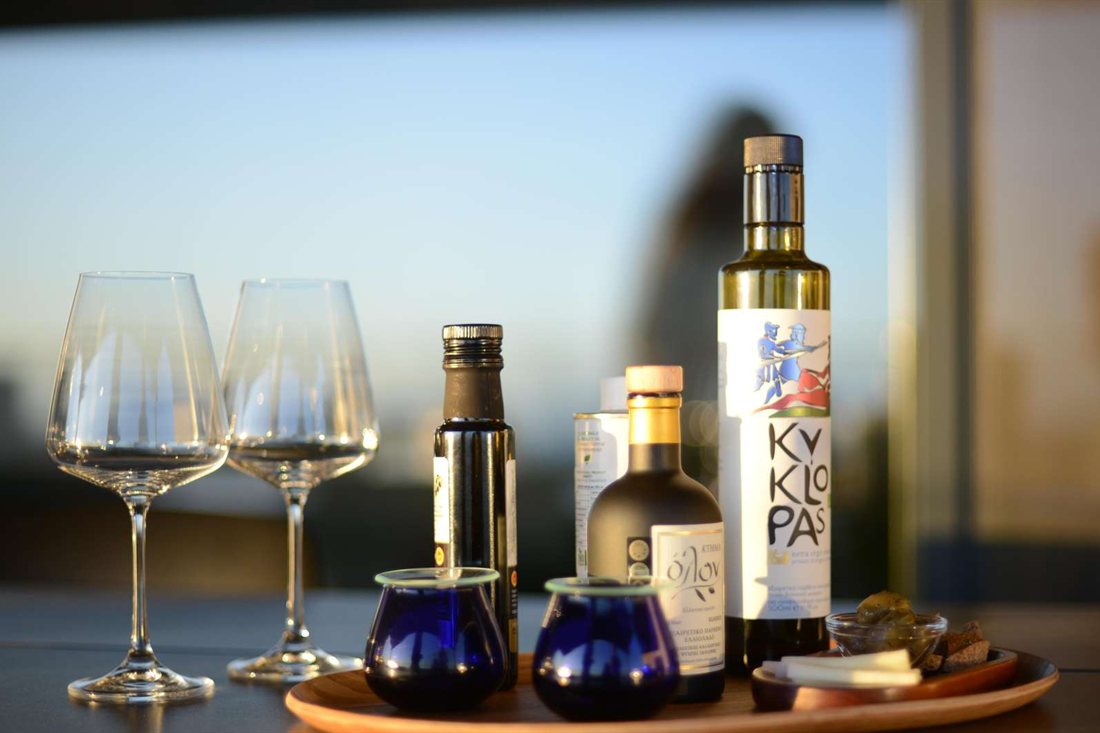
A Dion olive oil tasting joins a guided oil tasting at an olive estate in Pieria with a visit to ancient Dion, the sacred city of the Macedonians below Mount Olympus. Start any trip plan on Greece Tours.
The answers below follow a Dion olive oil tasting from the booking to the ancient sanctuaries, the tasting glass and the harvest.
What is a Dion olive oil tasting?
Guests book a Dion olive oil tasting as a guided tasting of Pieria oil, planned around a visit to Dion. Dion is a village at the foot of Mount Olympus. GetYourGuide files the two Pieria tastings under Platamon and Palaios Panteleimonas, not under Dion.
Wikipedia calls Dion a village and municipal unit of Pieria, a regional unit of Central Macedonia. It lists the elevation as 40 metres and the community population as 1,268. The community has two settlements: the village of Dion and Platanakia.
Wikipedia adds that Dion is known above all for its sanctuary of Zeus and the ancient city around it. Neither of the two Pieria listings names Dion in its title. One is called a Mount Olympus tasting and the other a Pieria experience.
A Dion olive oil tasting is therefore a plan you build yourself. You choose a tasting, then fit it around the ancient city that our Dion tours page describes.
Dion, Platamon and Palaios Panteleimonas share one municipality. Wikipedia says Dion merged with East Olympos and Litochoro to form Dion-Olympos. Platamon and Palaios Panteleimonas both belong to East Olympos.
Platamon is a town and seaside resort in south Pieria. Wikipedia gives it 1,896 permanent inhabitants. Platamon sits on the Aegean coast. The same source calls Palaios Panteleimonas a mountain village. It lies 6 km from Neos Panteleimonas, a settlement with a beach.
Starting from either place turns a Dion olive oil tasting into a trip within one municipality. The next section sets the listings side by side.
Which Dion olive oil tasting can you book near the archaeological park?
GetYourGuide lists two Pieria tastings that pair with Dion. One is a 1.5-hour grove tour filed under Platamon, the other a one-day trip filed under Palaios Panteleimonas. Two more olive outings run in Thessaloniki and Halkidiki.
The first listing is the Mount Olympus grove tour and tasting, which runs 1.5 hours. GetYourGuide labels it a small group and lists English as its language. Free cancellation applies, and the booking must be made at least 2 hours before the start.
GetYourGuide files this Dion olive oil tasting under Platamon and classes it as a guided tour. Its abstract opens with the culture of Greek olive oil in Pieria near Mount Olympus.
Wikipedia places Platamon 25 km southeast of Mount Olympus. Jet2holidays lists the Dion Archaeological Park at 20.8 km from Platamonas Castle. The castle stands in Platamon, so that figure gives a listed distance from the park to the start town.
The second listing is the Pieria olive oil and sunset experience in Palaios Panteleimonas. As a Dion olive oil tasting, it lasts 1 day, runs as a small group and offers pick-up. The listing offers English and Greek. Free cancellation applies, and booking must close at least 10 hours before the start. GetYourGuide marks it as a new activity.
Pick-up changes the plan. Ask the operator for the pick-up point and the drive time to Dion before you book. That answer tells you whether the day leaves room for the park.
The two other olive outings sit outside Pieria, one line each:
- From Thessaloniki: The Ultimate Sunset & Olive Experience is an 8-hour Halkidiki day trip with an olive mill visit, a tasting session and free time by the sea. It offers pick-up, English and Greek, and free cancellation.
- Metaggitsi, Halkidiki: Olive Oil Quality & Tasting Seminar is a 2-hour session where guests compare oils and meet the local Galani variety. It offers English and German, and free cancellation.
Only the Platamon tour and the Palaios Panteleimonas trip start in Pieria. Pick the Platamon tour when you want a short slot that leaves the rest of the day free. Pick the Palaios Panteleimonas trip when you want to give the whole day to a Dion olive oil tasting.
How did people in ancient Dion use olive oil?
Ancient Greeks used olive oil as food, as lamp fuel, in rituals and on the skin. Dion backs this up. Its sanctuary of Demeter yielded oil lamps, and its museum shows pottery vessels for oil or wine.
A Dion olive oil tasting serves a food with deep roots in Greek life. Ancient Greek cooking rested on a Mediterranean triad of cereals, olives and grapes. Cooks seasoned boiled or mashed vegetables with olive oil, vinegar and herbs.
Olive oil went into breakfast too. Tagenites were pancakes made from wheat flour, olive oil, honey and curdled milk. Olives themselves were a common appetizer. A Dion olive oil tasting draws on a crop gathered wild as early as the 8th millennium BC.
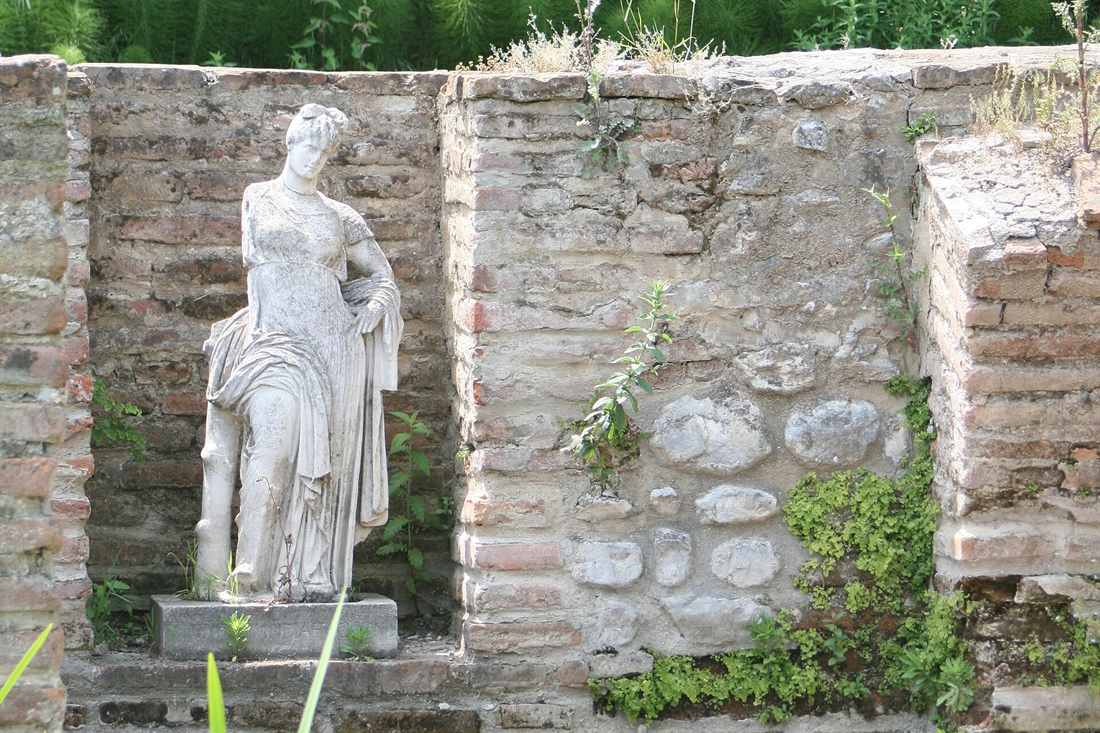
Oil also gave light. People burned olive oil as fuel in oil lamps. Archaeologists found oil lamps among the statues, pottery and jewellery in the sanctuary of Demeter at Dion. That sanctuary is the oldest in Dion and dates to the 6th century BC.
Religion used oil as well. Olive oil served in religious rituals, and the Minoans used it in their religious ceremonies. A Dion olive oil tasting joins a long trade, since olive oil was already a major export of Mycenaean Greece.
Clay vessels kept the oil. The Archaeological Museum of Dion says household pots for oil or wine were shaped on wheels and fired in kilns. Our guide to Ancient Dion tickets explains how to enter the park and the museum.
The olive tree stood as a symbol of peace between nations. A Dion olive oil tasting at the foot of Mount Olympus carries that symbol into the present.
The lamps and jars tell you how ancient hands handled oil. A tasting adds the flavour that objects cannot show.
How does a Dion olive oil tasting connect to Zeus and the athletic games of ancient Dion?
King Archelaus I gave Dion a festival of athletic and musical contests for Olympian Zeus and the Muses. Greek athletes trained with olive oil on their skin, and Athens paid winners in jars of it. Oil and the games shared one world.
A Dion olive oil tasting belongs to a region with a sporting past. Archelaus reorganised a festival called the Olympia at Dion. It held music and athletic contests for Olympian Zeus and the Muses. The greatest athletes and artists of Greece came to Macedon for it.
The name Dion comes from Zeus. Hesiod’s Catalogue of Women says Thyia bore Zeus two sons, Magnes and Makedon. Their peoples, the Magnetes and the Makedones, lived in Pieria at the foot of Mount Olympus.
The cosmetic use of olive oil began early in the 7th century BC. It spread to all the Hellenic city-states, together with athletes who trained in the nude. It lasted close to a thousand years despite its great expense.
In the Greek gymnasium, oil met sport. Athletes undressed, trained naked, rubbed their bodies with olive oil and then cleaned off with a strigil. Helpers called aleiptae oiled and dusted the bodies of the youths.
The strigil was a curved metal blade with a handle. It scraped off dirt, sweat and the oil applied before bathing. Makers used bronze and iron. Men used it, and male athletes above all. Hippias, a Greek sophist, made his own strigil with a small channel for sweat to drain through.
Homer says that oil went on after bathing and stayed on. Literature names the strigil only from the later 5th century BC. Vases show strigils from the 6th century BC. Strigils also went into graves, and a bottle of oil lay beside one in certain burials.
Prizes show how much oil was worth. At the Panathenaic Games, boys and youths won amphorae of olive oil. The winner of the chariot race received 140 amphorae full of it. The Olympic Games gave olive leaf wreaths instead.
Four settings link Greek sport to the olive, and a Dion olive oil tasting sits within that pattern.
- Dion: contests for Zeus and the Muses under Archelaus I
- Gymnasium: olive oil on the skin, then the strigil
- Athens: amphorae of olive oil as prizes
- Olympia: olive leaf wreaths for victors
A Dion olive oil tasting gives you the product that Greek athletes wore on their skin. Athenian champions won it in jars. The Zeus festival at Dion supplies the setting, and the oil supplies the taste.
How do you join a Dion olive oil tasting and the archaeological park in one day?
Plan the day around the opening hours of the Archaeological Park of Dion. Then place the Dion olive oil tasting before or after the visit. The Ministry of Culture lists summer hours from 08:00 to 20:00 and winter hours from 08:30 to 15:30.
The Ministry of Culture site odysseus.culture.gr gives the park two seasons. Summer opening runs from Wednesday to Monday, 08:00 to 20:00. Winter opening runs from 1 November until 15 April, 08:30 to 15:30. The Hellenic Heritage ticket page ends its winter list on 31 March, so confirm your date before you book.
The Ministry page adds that the last visitor enters 20 minutes before closing. In winter that means 15:10. A winter Dion olive oil tasting therefore follows the park, not the other way round. In summer the park stays open until 20:00, so the tasting can come first.
Hellenic Heritage puts the park 20 minutes by car from Katerini. The Ministry gives the road distance as 17 km south of Katerini. On foot, the park lies 5 minutes from the settlement of Dion. The Platamon Castle page gives 25 minutes by car from Katerini and 1 hour 30 minutes from Thessaloniki.
Hellenic Heritage lists Platamon Castle as open from 08:30 to 15:30 in both seasons, with Tuesday closed. In summer the castle shuts while the Dion park stays open until 20:00. A morning at the castle then leads into the park. A Dion olive oil tasting fits the hours around them.
The Ministry page also lists holiday hours:
- 6 January, Shrove Monday, Easter Monday, Holy Spirit Day, 15 August and 28 October: 08:00 to 15:00.
- Holy Saturday: 08:30 to 16:00.
- Good Friday: 12:00 to 17:00.
- Easter Sunday: closed.
On the 08:00 to 15:00 days, the park closes before the evening starts. A late-afternoon Dion olive oil tasting then follows the visit without a rush.
Which villages near Dion suit a Dion olive oil tasting stop?
Platamon, Paleos Panteleimonas and Litochoro each work as a stop on a Dion olive oil tasting day. Platamon adds a castle on a rocky promontory. Paleos Panteleimonas adds a restored stone village at 700 metres. Litochoro adds farmland and the start of the Olympus climbing routes.
Platamon Castle stands on a rocky promontory where Mount Olympus reaches the Aegean Sea, according to Hellenic Heritage. The Roman historian Livy placed the site between Dion and Tembi, on a rock. The castle hill and Dion appear side by side in his account.
The Athenians took the place in 430 BC to control the Thermaic Gulf. Around 360 BC, Skylax described it as the first Macedonian city behind the river Peneios. Wikipedia adds that a Bronze Age settlement on the hill is proven. A railway tunnel through the hill turned up more ground plans of the old city of Herakleion.
The castle wall carries battlements and a wall-walk, with eight rectangular towers. The gate in the middle of the southern side has a double entrance. The main tower, the donjon, is closed to visitors. The castle opens at 08:30, which fits a morning stop before a Dion olive oil tasting.
Neos Panteleimonas lies by the sea at the foot of Olympus, 10 minutes on foot from the castle. Its Wikipedia entry says the museum and the archaeological site of Dion are worth a visit. The village therefore pairs with a Dion olive oil tasting.
Paleos Panteleimonas sits at 700 metres on the slopes of Lower Olympus, with a view of the Thermaic Gulf. The Pieria Tourism guide says its buildings keep one uniform style, which sets the village apart from other settlements. The paved central square holds the restored old school and traditional tavernas.
The guide says the tavernas serve local dishes, spicy mezedes, local wine and tsipouro made from Olympus arbutus berries. That menu suits the end of a Dion olive oil tasting. The area’s only environmental school stands just outside the village.
The guide lists hiking, paragliding, hang-gliding, mountain biking and 4×4 routes around the village. It gives easy access by the E75 motorway and by rail at Platamon station. The motorway exit is the Neos Panteleimonas and Platamon junction.
Dion lies 8 km north of Litochoro, according to Wikipedia. The same entry says farmland is predominant north of the town. Much of the land to the south remains uncultivated. On the Dion side the land is farmland, which suits a Dion olive oil tasting stop.
Almost all climbing routes on Olympus begin southwest of the town. Our Litochoro tours page covers the town and its trails.
How do you taste oil like a panel judge at a Dion olive oil tasting?
Follow the International Olive Council method. Smell the covered glass, take a small sip and draw air through your mouth. Then rate three marks: fruity, bitter and pungent. The panel holds each sample at 28 degrees Celsius.
The International Olive Council, or IOC, writes the world method for judging the taste of virgin olive oil. A group of tasters, selected, trained and monitored as a panel, applies it. You can borrow its steps at a Dion olive oil tasting.
A real test uses 8 to 12 tasters. The IOC recognises more than 100 sensory panels. Each taster sets personal likes aside and reports only the sensations the oil causes. The method places sessions between 10 in the morning and noon.
Tasters prepare before a session. They skip smoking and coffee for at least 30 minutes and fast for at least one hour. They use no fragrance or scented soap. Do the same before a Dion olive oil tasting, so no smell masks the oil.
The IOC glass is dark, so the taster cannot see the colour of the oil. The standard says this removes prejudice from the judgement. The mouth is narrow, which concentrates the smells. A watch-glass cover keeps the aroma in and the dust out. At a Dion olive oil tasting, judge smell and taste before colour.
The temperature is fixed at 28 degrees Celsius, plus or minus 2. At that warmth, differences between oils are easier to see than at room temperature. Colder oil releases its aroma poorly. Hotter oil forms the smells of heated oil.
Step one is the smell. The taster tilts the covered glass gently and turns it to wet the inside. Then the cover comes off, and the taster breathes slowly and deeply. Smelling lasts no longer than 30 seconds. At a Dion olive oil tasting, the same order works: smell first, sip second.
Step two is the sip, about 3 ml. The taster moves the oil over the whole mouth, then slowly over the back of the tongue toward the throat. Short breaths, drawing air in through the mouth, carry the aroma to the back of the nose. Copy this breathing at a Dion olive oil tasting.
Rate three positive marks at a Dion olive oil tasting: fruity, bitter and pungent. Fruity is the smell of sound, fresh olives, ripe or unripe, and it depends on the variety. Bitter is a primary taste, felt on the V-shaped area of the tongue. Pungent is a biting feeling, felt through the mouth and especially in the throat.
The panel also hunts for faults. Learn these before a Dion olive oil tasting, because the same method lists them:
- Fusty or muddy: oil from olives piled or stored until they fermented without air.
- Musty or earthy: oil from olives stored damp for days or gathered with earth on them.
- Winey or vinegary: a flavour that recalls wine or vinegar.
- Rancid: the flavour of oil that has oxidised intensely.
- Metallic: a flavour that recalls metal, from long contact with metal surfaces.
You can use the panel words at a Dion olive oil tasting. A mark is robust above a median score of 6.0, medium from 3.0 to 6.0 and delicate below 3.0. Each panel glass carries a random code, and only the test leader knows which oil it holds.
Which health claims about olive oil rest on evidence?
Two claims won EU approval after an EFSA review. Olive oil polyphenols contribute to the protection of blood lipids from oxidative damage. Oleic acid supports normal LDL cholesterol when it replaces saturated fat. EFSA found no proven link to triglycerides, HDL cholesterol or blood glucose.
Polyphenols sit behind the first claim. Olive oil holds about 0.5% polyphenols, such as esters of tyrosol, hydroxytyrosol, oleocanthal and oleuropein. They give the oil a slightly bitter taste and its characteristic aroma. A peppery or bitter taste points to higher polyphenol content. A bitter note at a Dion olive oil tasting therefore signals more polyphenols.
EFSA found a cause-and-effect link between hydroxytyrosol and related compounds and the protection of blood lipids from oxidative damage. The derivatives named are the oleuropein complex and tyrosol.
The claim sets a dose. It covers oil with at least 5 mg of hydroxytyrosol and its derivatives per 20 g. The wording says olive oil polyphenols contribute to the protection of blood lipids from oxidative damage, if consumed daily.
The second claim concerns oleic acid. The oil poured at a Dion olive oil tasting carries its monounsaturated fat mainly as oleic acid. The claim covers the maintenance of normal blood LDL-cholesterol levels when oleic acid replaces saturated fats in the diet.
EFSA also checked three more links and was not convinced. It noted that no definitive cause-and-effect link has been adequately established. The checks covered olive oil and normal blood triglycerides, HDL cholesterol and blood glucose.
In the United States, the FDA allows one qualified claim on olive oil labels. Its own wording calls the evidence limited and not conclusive. It ties the possible benefit for coronary heart disease to about 2 tablespoons (23 g) a day. The oil must replace a similar amount of saturated fat.
Reviews of studies add support, and also limits. One meta-analysis linked higher olive oil intake to a lower risk of death from any cause, cardiovascular events and stroke. Another found that high-polyphenol oil was associated with better total cholesterol, HDL cholesterol and oxidised LDL than low-polyphenol oil.
Polyphenols are a large, diverse group, so their effects on the body are hard to measure. Clinical trials on polyphenol-rich diets are limited. Polyphenols are not counted as nutrients and have no recommended daily intake. Judge flavour at a Dion olive oil tasting, and read the claim wording above for the health side.
When does the olive harvest change a Dion olive oil tasting?
The harvest date sets the style of the oil in your glass. Olives picked green, from September in parts of Greece, give a bitter oil called agourelaio. Olives picked in November or later give a milder oil and a larger yield.
Wikipedia states that olives in the Mediterranean region are harvested in the autumn, from October onwards. Neos Kosmos puts the start of the Greek season in November and says it lasts until mid-January. Early-harvest oils are picked before this season opens, in September or October. The calendar matters for a Dion olive oil tasting.
Agourelaio is the Greek word for early harvest oil. Producers press unripe olives to make it. Unripe olives give less oil than ripe ones, so the yield is smaller. Their chlorophyll makes the oil greener. Olive Oil Times lists a bitter taste and low acidity as its marks.
Halkidiki sits in the northern province of Macedonia, just east of Thessaloniki. A producer quoted by Olive Oil Times says the first oil of the year comes from there. The PDO Agoureleo Chalkidikis sets milling by October 15 among its requirements. Eleones Early Harvest, bottled in Halkidiki, uses olives handpicked from as early as mid-September.
Ripening depends on the olive variety and on the elevation of the grove. The harvest therefore falls on different dates across Greece. Olive Oil Times adds that the term early harvest itself covers different times in different parts of the country.
Sources link a green, bitter oil to an early pick and a milder oil to a late one. Ask the producer which pick the oil of your Dion olive oil tasting comes from.
Who can join a Dion olive oil tasting?
Age rules depend on the listing. The Platamon grove tour counts adults as age 13 to 99 and children as age 12 and younger. Hidden Nature rates its Forelia olive oil tour with a Paleos Panteleimonas walk as suitable for ages 4 to 85.
The Platamon listing says children 12 and younger join for free. They must still be added to the booking. The Metaggitsi olive oil seminar in Halkidiki sets its own ages. Adults are age 8 to 99, and children are age 7 and younger.
Hidden Nature sets more rules for its tour. Children must be accompanied by an adult. The tour is not suitable for pregnant women or for people with heart problems. The operator keeps child seats available upon request.
Mobility terms for a Dion olive oil tasting differ by listing. The Platamon grove listing carries a wheelchair-accessible label, and so does the Thessaloniki olive oil and sunset day trip. Hidden Nature rates its tour low difficulty.
Check the age line on your own Dion olive oil tasting listing before you book. Families who want a longer walk the same day can read about the Dion hiking tour.
Which questions come up before a Dion olive oil tasting?
Six questions about a Dion olive oil tasting cover the grove side of the trip. They deal with raw olives, olive colour, hand picking, harvest length, clothing and the oil share of the crop. Each answer rests on a named source.
Can you eat olives straight from the tree on a Dion olive oil tasting?
Raw olives taste very bitter and astringent, according to Wikipedia. Curing and fermenting removes substantial amounts of the bitter compounds, especially oleuropein, and makes table olives palatable.
What colour are olives when workers pick them?
The International Olive Council sorts table olives by ripeness. Green olives are picked at full size, while still unripe. Ripe olives are picked at full maturity and show purple, brown or black colours. Early harvest oil starts with unripe green olives.
Do workers pick olives by hand in Greece?
Olive trees in Greece grow on rough ground such as rocky hillsides and mountainsides, where giant harvesting machines cannot work. Workers use hand-held aids and knock the olives onto nets. Wikipedia adds that where the terrain is too mountainous for machines, hand picking leaves the fruit unbruised.
How long does the olive harvest take?
One grove can take from days to months. Greek Liquid Gold names four factors: the harvest method, the number of workers, the number of trees and the terrain.
What do you wear to a Dion olive oil tasting?
Forelia, an estate in Leptokarya that runs grove tastings, lists comfortable shoes, a hat and sunscreen. Hidden Nature recommends hiking shoes, a light jacket, sunglasses, a hat and sunscreen for its walk through Paleos Panteleimonas.
What share of the olive crop becomes oil?
About 80% of harvested olives are processed into oil, according to Wikipedia. The rest are cured and fermented as table olives.