
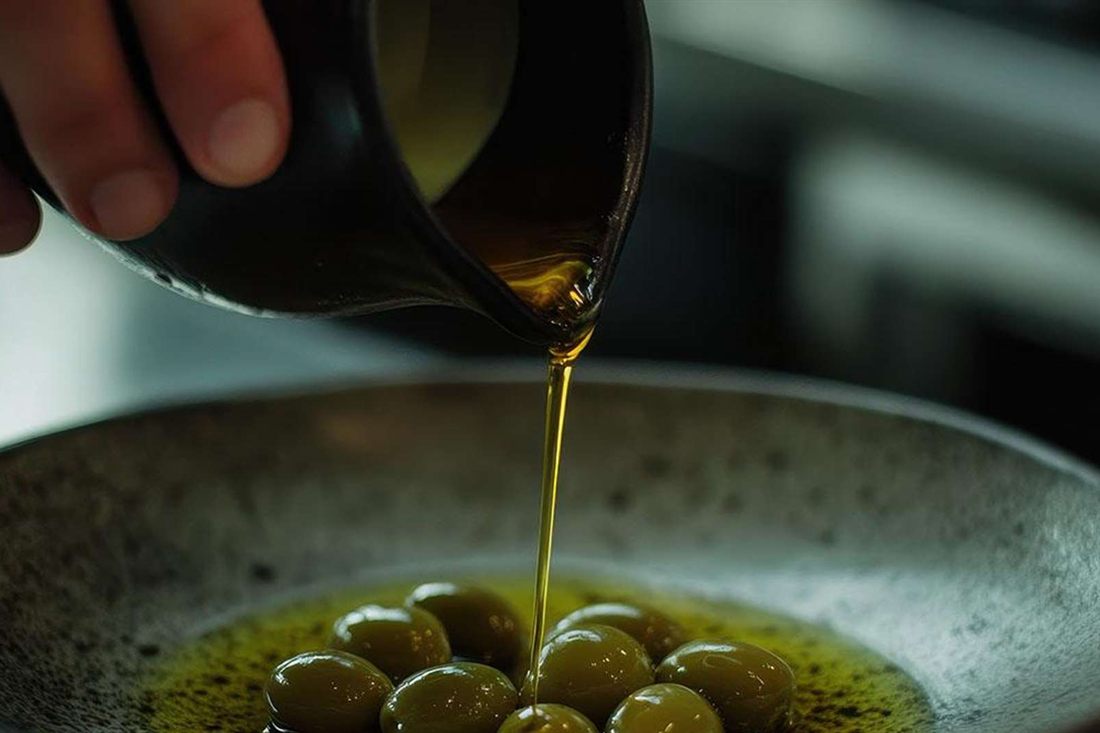
A Mount Olympus olive oil tasting takes you into the groves of Pieria to taste fresh oil under the mountain of the gods. Find more food and farm visits across the country on Greece Tours.
This page covers the tastings you can book, the grove walk, how the oil is made, the grades, the tasting method, the local variety, storage, the nearby sights and common questions.
What is a Mount Olympus olive oil tasting?
A Mount Olympus olive oil tasting takes you into an olive grove in Pieria, at the foot of Greece’s highest mountain. You walk among the trees, learn how extra virgin olive oil is made and taste oils side by side with a producer.
Mount Olympus rises on the border of Thessaly and Macedonia, about 80 km south-west of Thessaloniki. Its highest peak, Mytikas, reaches 2,917 metres and is the highest point in Greece. The olive groves grow on its foothills, close to the shore of the Thermaic Gulf.
A Mount Olympus olive oil tasting brings this farm country to the visitor. A producer leads the group through the grove, explains how the trees are grown and shows how the fruit becomes oil. The visit ends with a tasting that trains the palate to tell a good oil from an ordinary one.
The grove visits sit in the regional unit of Pieria, part of Central Macedonia. Its capital is Katerini, and most of its people live along the coast known as the Olympian Riviera. Mount Olympus stands in the southern part of Pieria, so every Mount Olympus olive oil tasting has the mountain as its backdrop.
Plan the rest of a trip to the mountain with our Dion tours page, which covers the ancient sanctuary at the foot of Olympus.
Which Mount Olympus olive oil tasting can you book?
GetYourGuide lists two olive oil experiences near Olympus: a 1.5-hour grove tour and tasting near Platamon, and a full-day olive oil and sunset trip to Paleos Panteleimonas. A third Pieria tour pairs a hike with wine tasting in Ano Milia.
The main Mount Olympus olive oil tasting on GetYourGuide is titled “Mount Olympus: Greek Olive Oil Tasting & Olive Grove Tour”. It promises a walk through a traditional olive grove, a lesson on how extra virgin olive oil is made and a guided tasting. The listing gives 1.5 hours and runs as a small group.
This listing is wheelchair accessible and allows free cancellation. It must be booked at least 2 hours ahead, so it suits a same-day plan. It accepts adults and infants. GetYourGuide files it under Platamon, the seaside town in the south of Pieria.
The second option is “Pieria: Olive Oil & Sunset Experience in Paleos Panteleimonas”. It describes an authentic side of Pieria through olive oil, nature and tradition, with a walk in the old mountain village. It runs as a small group, offers pick-up and must be booked at least 10 hours ahead.
The third tour, “Pieria: Path of Love and Wine Tasting in Ano Milia”, swaps oil for wine. It combines nature, a hike and a wine tasting away from mass tourism, over 4.5 hours, with pick-up available. It makes a second day out for food lovers after a Mount Olympus olive oil tasting.
What happens in the grove on a Mount Olympus olive oil tasting?
The grove walk covers the life cycle of the olive tree, the old and new ways of growing it and the story of the trees on the estate. A producer leads it, so guests hear about the land from the people who farm it.
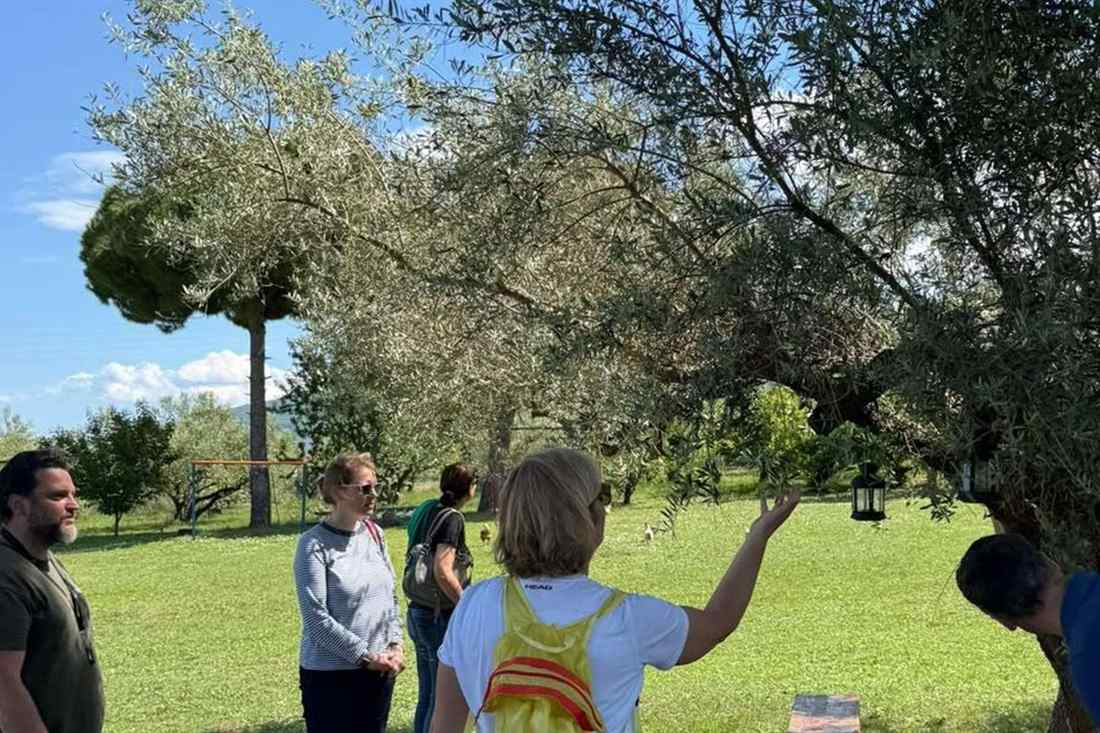
Forelia, an olive oil producer at the foothills of Mount Olympus, describes its grove walk in three parts. The first is the life cycle of the olive tree. The second covers traditional and modern ways of growing olives. The third tells the story of the estate’s own trees and land.
The producers lead the walk themselves. On a Mount Olympus olive oil tasting at Forelia, guests taste the oil in the shade of the same trees that produced it. The company calls it a connection with nature, not just a walk.
The trees here grow between the mountain and the sea. Terra & Tree, another Pieria producer, explains that its groves sit at the foothills of Pieria. There, the mountain microclimate meets the breeze from the Aegean. The producer says this altitude puts a positive stress on the trees.
That stress changes the oil. According to Terra & Tree, it gives an oil with an intense emerald colour and a rich aromatic profile. A Mount Olympus olive oil tasting lets guests see and taste that colour and aroma against other oils.
How is olive oil made, as shown on a Mount Olympus olive oil tasting?
The olives are crushed and the oil is separated by mechanical means only, with no heat and no chemicals. A Mount Olympus olive oil tasting compares the old and new extraction methods and explains what makes an oil extra virgin.
Forelia’s programme includes a lesson on extraction methods, traditional against modern. The producer says that by the end of it, guests never look at olive oil the same way again. The lesson leads into the question at the heart of every Mount Olympus olive oil tasting: what really defines an extra virgin oil.
Temperature is the key to the method. Terra & Tree states that it extracts its oil below 27 °C, a few hours after harvest, by mechanical methods alone. This keeps the antioxidants in the fruit intact. The producer then bottles the oil at the source in dark glass that blocks light.
The words “cold pressed” appear on labels, but they have no strict meaning. Wikipedia notes that pressing temperatures need to stay as low as possible, ideally below 25 °C, yet no reliable international definition of cold pressed exists. The term “first press” means little too, since virgin oil never gets a second press.
The fruit itself shapes the result. The make-up of an olive oil varies with the variety of tree, the altitude, the time of harvest and the extraction process. A Mount Olympus olive oil tasting shows how these choices change the colour and taste in the glass.
What makes an oil extra virgin on a Mount Olympus olive oil tasting?
Extra virgin is the top grade of olive oil. It comes from fresh fruit by mechanical means only, has a free acidity of no more than 0.8% and shows no flaws in taste or smell. A Mount Olympus olive oil tasting teaches guests to spot it.
Acidity here does not mean sourness. It is the share, by weight, of free oleic acid in the oil. As oil breaks down and oxidises, more fatty acids come free, and the acidity rises. So a low figure means the oil has broken down less.
The limit for extra virgin is 0.8%. Terra & Tree reports an acidity of 0.19% for its own oil, a figure it calls the proof of purity. It also tests the K indices, purity markers that show the oil was extracted without chemical solvents.
Taste counts as much as the lab result. The International Olive Council requires an extra virgin oil to show some fruitiness and no sensory defects. Virgin olive oil, the grade below, reaches a free acidity of up to 2%. Neither grade can contain any refined oil.
The top grades also hold the most goodness. Virgin olive oils contain the highest levels of polyphenols, the antioxidants linked with better health. A Mount Olympus olive oil tasting explains this link and the role of olive oil in the Mediterranean diet, as Forelia’s programme describes.
How does the guided Mount Olympus olive oil tasting work?
Guests taste different types of olive oil, learn to recognise quality at once and describe the aromas, textures and flavours they find. Local foods that show off the oil come with the tasting.
Forelia calls its tasting a hands-on session designed to train your palate. Guests taste different types of olive oil and learn to recognise quality quickly. They look for aroma, texture and flavour, and they learn what makes an oil exceptional rather than merely good.
The method follows the one used by wine tasters. Forelia compares it to the way sommeliers judge wine. Guests observe the colour, take in the aroma and then taste, from fruity notes to a peppery finish. A Mount Olympus olive oil tasting works through each step in turn.
The peppery finish is a sign of quality. Terra & Tree lists a lively aroma of fresh grass and a light, spicy, peppery feeling in the throat among the marks of a good oil. Guests on a Mount Olympus olive oil tasting learn to notice that catch in the throat.
Food comes with the oil. Forelia pairs its tasting with local goods chosen to bring out the flavour of the oil. No prior knowledge is needed, and the producer suits the session to couples, families, groups and food lovers alike.
Which olive variety grows on a Mount Olympus olive oil tasting estate?
Terra & Tree, a producer in Pieria, presses its oil only from the Koroneiki olive, grown in its family groves at Kolindros. The variety gives an oil with low acidity, a fruity aroma and a high level of polyphenols.
Kolindros lies in the foothills of Pieria. Terra & Tree calls its oil 100% monovarietal, which means it comes from one single variety. Every bottle is single-estate Koroneiki, cold-extracted and sent straight from the Olympus area.
The producer contrasts its oil with industrial oils, which it calls anonymous blends from different countries and old harvests. It lists low acidity, a rich fruity aroma and a high content of polyphenols as the strengths of Koroneiki. Ask the producer on your Mount Olympus olive oil tasting which varieties its own grove holds.
Harvest timing changes each batch. Olive trees tend to crop well every other year, with a lighter yield in the year in between. Weather matters too: a drought during flowering can lower the grade of the oil from extra virgin to virgin. A Mount Olympus olive oil tasting in a different season can taste different for this reason.
Each bottle from Terra & Tree carries a laboratory certificate. Every batch is tested in accredited food laboratories, and the result confirms its purity and grade.
How do you choose and store oil after a Mount Olympus olive oil tasting?
Choose an oil that names its harvest year and source, comes from one variety and sits in dark glass. Keep it in a cool, dark place at 14 to 18 °C, and use it within 2 to 3 months of opening.
Terra & Tree lists four signs of a quality oil. The label shows the harvest year and the exact place of origin. The oil comes from a single variety. The bottle is dark glass, to protect it from light and oxidation. The taste carries fresh grass and a light peppery sting.
Storage keeps those qualities. The producer advises a dark, cool place at 14 to 18 °C, not the refrigerator. An unopened bottle lasts 18 to 24 months. Once opened, the oil is best used within 2 to 3 months.
Extra virgin oil is also a cooking oil. Terra & Tree gives its smoke point as 190 to 210 °C and calls it stable under heat, thanks to its monounsaturated fats and antioxidants. Guests on a Mount Olympus olive oil tasting can fry and bake with the bottle they take home.
Taking oil home is easy. After the tasting, guests can visit the small shop Forelia keeps inside its olive grove, with its olive oil and other local products. The bottles come in travel-friendly packaging that is safe in a suitcase.
Why does the olive matter on a Mount Olympus olive oil tasting?
The olive tree has been sacred to the Greeks since ancient times. Myth says Athena gave the first olive tree to Athens, and olive oil was used by athletes in the gymnasium. A Mount Olympus olive oil tasting sits under the mountain of the gods themselves.
Greek myth tells how Athena and Poseidon competed for the city of Athens. Athena offered an olive tree, and Poseidon a salt spring. The Athenians judged the olive the more precious gift and named their city after the goddess.
Olive oil was part of daily life in ancient Greece. The Spartans and other Greeks rubbed it on their bodies while exercising in the gymnasia. Forelia notes that olive oil was present at the Olympic Games and used in rituals, in medicine and in every Greek kitchen.
The olive is old in Greece. The tree reached Greece around the 28th century BC, spread west by the Phoenicians, and olive oil became a major export of Mycenaean Greece. Today, Greece has the highest olive oil consumption per person in the world, around 24 litres a year.
Mount Olympus adds its own legend. In Greek myth, it was the home of the gods, and it has been a national park, the first in Greece, since 1938. A Mount Olympus olive oil tasting joins these two strands of Greek culture in one afternoon.
Where does a Mount Olympus olive oil tasting take place?
The grove tastings sit on the Olympian Riviera, the coast of Pieria below the mountain. Forelia is listed at Leptokarya, and GetYourGuide files its grove tour under Platamon. Both towns lie on the Aegean shore under Olympus.
Leptokarya is a town of about 3,600 people in Pieria, on the Aegean coast under Mount Olympus. It lies 26 km from Katerini. It draws summer visitors for its beaches and for its closeness to the mountain. The town also holds the Olympus Geological History Museum, which explains the rocks of the area.
Platamon lies a little further south, 25 km south-east of the summit of Mount Olympus. It sits 33 km south of Katerini and 43 km north-east of Larissa. The town is known for its natural springs and spas, and for the castle on the hill above it. Either town makes a good base for a Mount Olympus olive oil tasting.
Rail makes the trip easy without a car. Leptokarya has a railway station with local trains to Thessaloniki, Kalambaka and Palaiofarsalos, and suburban trains to Larissa and Thessaloniki. Platamon also has bus and rail links to Katerini and Larissa.
The coast here has a run of beaches. Pieria’s main beaches include Paralia, Olympiaki Akti, Leptokarya, Platamonas and Neoi Poroi, and Pieria’s beaches have won Blue Flag awards. A Mount Olympus olive oil tasting fits easily around a beach day on this shore.
What is the olive oil and sunset trip to Paleos Panteleimonas?
It is a small-group day in Paleos Panteleimonas, a mountain village of the lower Olympus, built around olive oil, nature and tradition. The village looks over the Thermaic Gulf from forests of chestnut, oak and arbutus.
Paleos Panteleimonas lies 43 km from Katerini and just 6 km from the beach village of Neos Panteleimonas, which has places to stay and eat. The path up to the village runs through the forest of the lower slopes of Olympus. Wikipedia calls the view of the Thermaic Gulf from the area unique.
The GetYourGuide listing pairs this setting with olive oil. It promises an authentic side of Pieria through oil, nature and tradition, and a walk in the old village. It runs as a small group with pick-up, and it must be booked 10 hours ahead. This Mount Olympus olive oil tasting ends with the sunset.
The village sits close to a summer festival. The International Olympus Festival stages its cultural events at the Castle of Platamon each summer. A Mount Olympus olive oil tasting at Paleos Panteleimonas pairs well with a festival event at the castle.
What can you pair with a Mount Olympus olive oil tasting?
Pair the tasting with the Castle of Platamon, a hike on Mount Olympus or a visit to ancient Dion. The ancient site of Leivithra, linked with Orpheus, also lies near Leptokarya.
The Crusaders raised the Castle of Platamon between 1204 and 1222. It guards the exit of the Tempe valley, the route that linked Macedonia with Thessaly and southern Greece. Its walls rise between 7.5 and 9.5 metres. A footpath leads from the car park to the gate.
The mountain itself is the main draw. Olympus is the most popular hiking summit in Greece, with refuges and marked routes. Most climbers set off from Litochoro, a town on the eastern slopes. Our Mount Olympus hike page covers the trails, and a Mount Olympus olive oil tasting makes a gentle second day after a climb.
History lies close to the groves. Leptokarya sits near ancient Leivithra, said to be the home of Orpheus, the poet and musician of Greek myth. Pieria also holds the sites of Dion and Pydna. The Litochoro tours page covers the town at the start of the main trails.
How do you reach a Mount Olympus olive oil tasting from Thessaloniki?
Mount Olympus lies about 80 km south-west of Thessaloniki, so a Mount Olympus olive oil tasting works as a day out from the city. Trains run from Thessaloniki to Leptokarya, and day tours from the city cover Dion and the mountain.
The railway is the simplest way without a car. Leptokarya station has local trains to Thessaloniki and suburban trains on the line to Larissa. From the station, the coast towns of the Olympian Riviera are close at hand for a Mount Olympus olive oil tasting.
By road, the drive runs south along the Thermaic Gulf past Katerini, the capital of Pieria. Litochoro, where the main trails begin, lies some 100 km from Thessaloniki. Leptokarya and Platamon sit further south on the same coast.
Day tours from Thessaloniki cover the sights around the groves. Viator lists a bus trip to Dion and the Mount Olympus National Park, and a cultural day to ancient Dion with a wine tasting. Our Mount Olympus day trip from Thessaloniki page covers the routes and timings.
A Mount Olympus olive oil tasting adds a slower stop to these city trips. Combine the grove with a beach on the Pieria coast, or stay a night in Leptokarya or Platamon and climb into the mountain villages the next morning.


Who suits a Mount Olympus olive oil tasting?
The tasting suits couples, families, groups and food lovers, and no prior knowledge is needed. The GetYourGuide grove tour is wheelchair accessible and accepts infants, and the groups stay small.
Forelia names couples, families, groups and food lovers as its guests. The session needs no experience with olive oil. Groups stay small for a more personal visit, and the company gives a maximum of 20 guests per session.
Families find the format easy. The 1.5-hour GetYourGuide Mount Olympus olive oil tasting is short enough for children and accepts infants. Forelia’s own session lasts about 60 minutes, which leaves the rest of the day free for the beach or the mountain.
Access is good. The GetYourGuide listing marks the grove tour as wheelchair accessible. The 2-hour booking window also suits travellers who decide on the day, after checking the weather on the mountain.
What do travellers ask about a Mount Olympus olive oil tasting?
How long is a Mount Olympus olive oil tasting?
The GetYourGuide grove tour lasts 1.5 hours. Forelia gives about 60 minutes for its own session. The olive oil and sunset trip to Paleos Panteleimonas is listed as a full day.
Can you buy olive oil after a Mount Olympus olive oil tasting?
Yes. Forelia keeps a small shop inside its olive grove, with olive oil and local products in packaging that is safe for a suitcase.
Do you need to know about olive oil before the tasting?
No. Forelia states that no prior knowledge is needed, and the producer explains each step from the grove to the glass.
Is there pick-up for a Mount Olympus olive oil tasting?
The olive oil and sunset trip to Paleos Panteleimonas offers pick-up. Check the grove tour near Platamon for its meeting point when you book.