
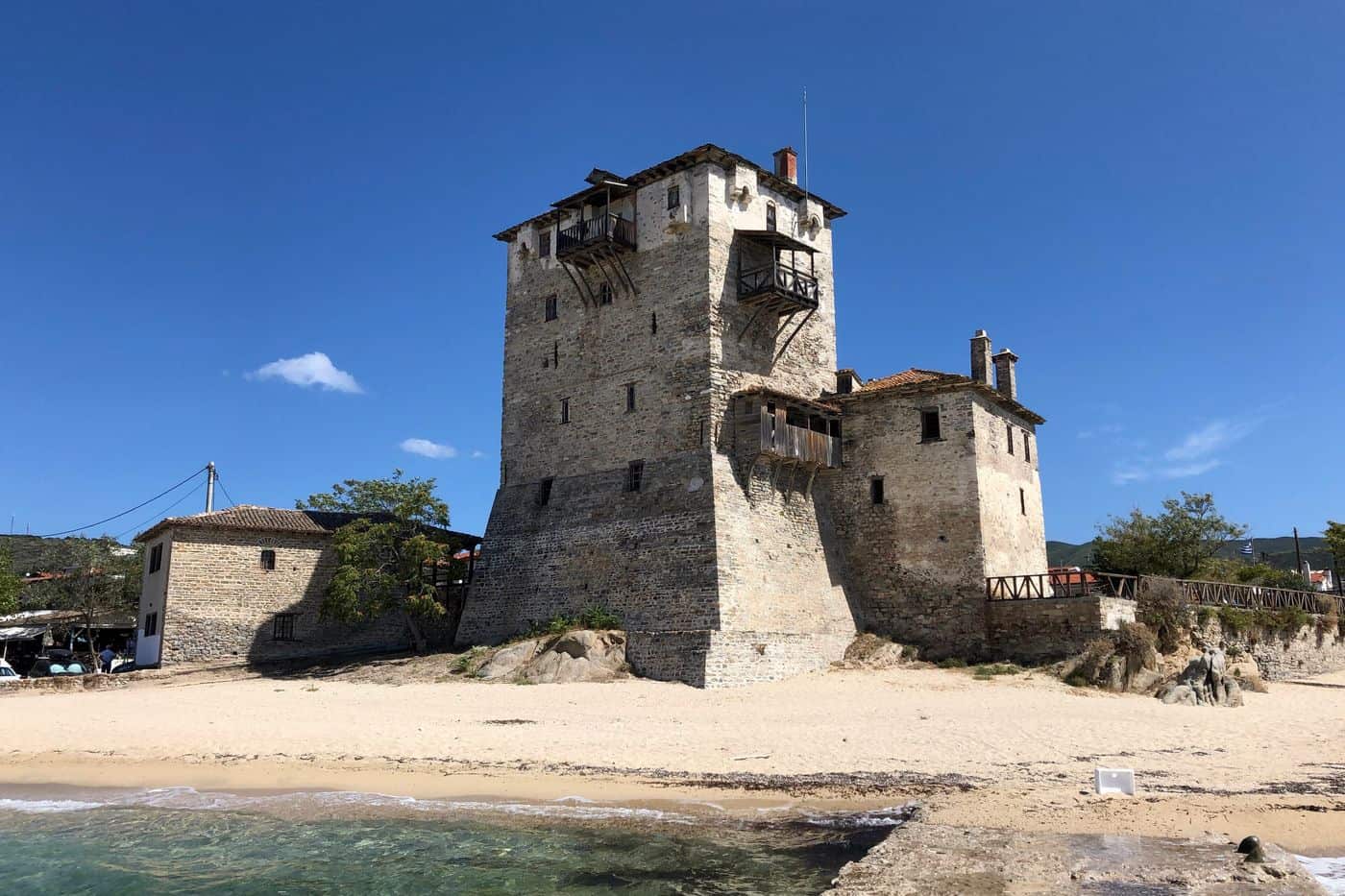
Ouranoupoli tours start in the last village outside the monastic state of Mount Athos, on the Singitic Gulf of Halkidiki, where the Byzantine tower of Prosphorion stands beside the harbour. The routes cover the tower, the cruises along the Athos coast, the pilgrim route for men, the island of Ammouliani and the Drenia islets. Greece Tours lists the boat trips and Athos tours that start in the village.
This page covers what Ouranoupoli tours see in the village and at the tower, which boats sail along the Athos coast, how men visit the monasteries, the history of the village, the beaches and islets, the day trips, how visitors reach Ouranoupoli and which season suits each route. The tours below are checked on GetYourGuide and leave from Ouranoupoli and Thessaloniki.
What do Ouranoupoli tours cover?
Ouranoupoli tours cover the last settlement outside the monastic state of Mount Athos, on the Singitic Gulf of Chalkidiki in the municipality of Aristotelis. The community counted 801 residents at the 2021 census, and its harbour serves the boats to the Athos coast.
The village stands on the shore at the very start of the Athos peninsula, the easternmost of the three large parts of Chalkidiki. Its Greek name means Sky City. Ouranoupoli tours begin at the small harbour beside the Byzantine tower, the symbol of the village. Residents earn their living mainly from tourism and fishing. A fence about 9 km long marks the land border between the municipality and the monastic state.
Ouranoupoli tours on foot follow two mapped walking routes, an archaeological walk and a religious walk, along the Athos border line. The archaeological walk starts at the Prosphorion tower and ends at the ruins of the Zygou monastery. In the village streets, Ouranoupoli tours pass shops with goods from the Athonite monasteries: wine and tsipouro, olive oil and olives, honey, herbs, soaps and spoon sweets. Other windows hold icons by Athonite icon painters and jewellery with Byzantine motifs.
- Population: 826 residents at the 2011 census and 801 at the 2021 census.
- Administration: the community belongs to the municipal unit of Stagira-Akanthos, and the municipality of Aristotelis has its seat in Ierissos.
- Services: a medical office, a coastguard station, a police station, a kindergarten, a primary school and a Pilgrims’ Office.
- Cathedral: the church of Saints Constantine and Helen.
The island of Ammouliani lies opposite the village, and the Ammouliani tours page covers it in full.
What do Ouranoupoli tours see at the Byzantine tower?
Ouranoupoli tours see the Prosphorion tower, which guarded an estate of Vatopedi monastery and stands as the largest and best-kept tower of Chalkidiki. Written sources first name it in 1344. The complex now belongs to the Ministry of Culture and houses a museum.
The complex joins the tower with a fortified yard, the barbakas, and a boathouse, the arsanas, built in 1865. Ouranoupoli tours trace its story back to 1018, when Vatopedi already held the core of the Prosphorion estate. In 1379 the despot of Thessaloniki, John Palaiologos, stayed in the tower and freed it from taxes. An earthquake in 1585 caused heavy damage, and in 1858 the building stood empty.
Ouranoupoli tours look at a building with at least three phases. The lower stone part dates from the Byzantine period, the 11th to 12th century. Three more floors followed under Ottoman rule, and two of them survive. A reconstruction that ended in 1862 gave the tower its wooden interior and its roof.
Refugees, mainly from the Propontis, lived in the tower after 1922. Ouranoupoli tours also recall its foreign residents: in 1928 the Australian writer Joice NanKivell Loch and her husband Sydney made it their home for a token rent and a promise of repairs. Joice set up a rug-weaving co-operative with refugee women, and Pyrgos rugs used Byzantine motifs and natural dyes. Sydney died in the tower in 1954, and Joice died in the village in 1982, aged 95.
- Barbakas: the fortified yard on the eastern side of the tower, an addition of the early Ottoman period.
- Arsanas: the boathouse north-west of the tower, built with a pier that no longer exists.
- Christian Chalkidiki Exhibition: set up by the 10th Ephorate of Byzantine Antiquities next to the tower, with icons from the 18th to the early 20th century and finds from excavations across Chalkidiki.
Which Ouranoupoli tours sail along the Athos coast?
Ouranoupoli tours along the Athos coast are summer sightseeing cruises that sail down the western shore of the peninsula, past one monastery after another. The boats stay out of a 500-metre zone around the coast, so women travel on board as well.
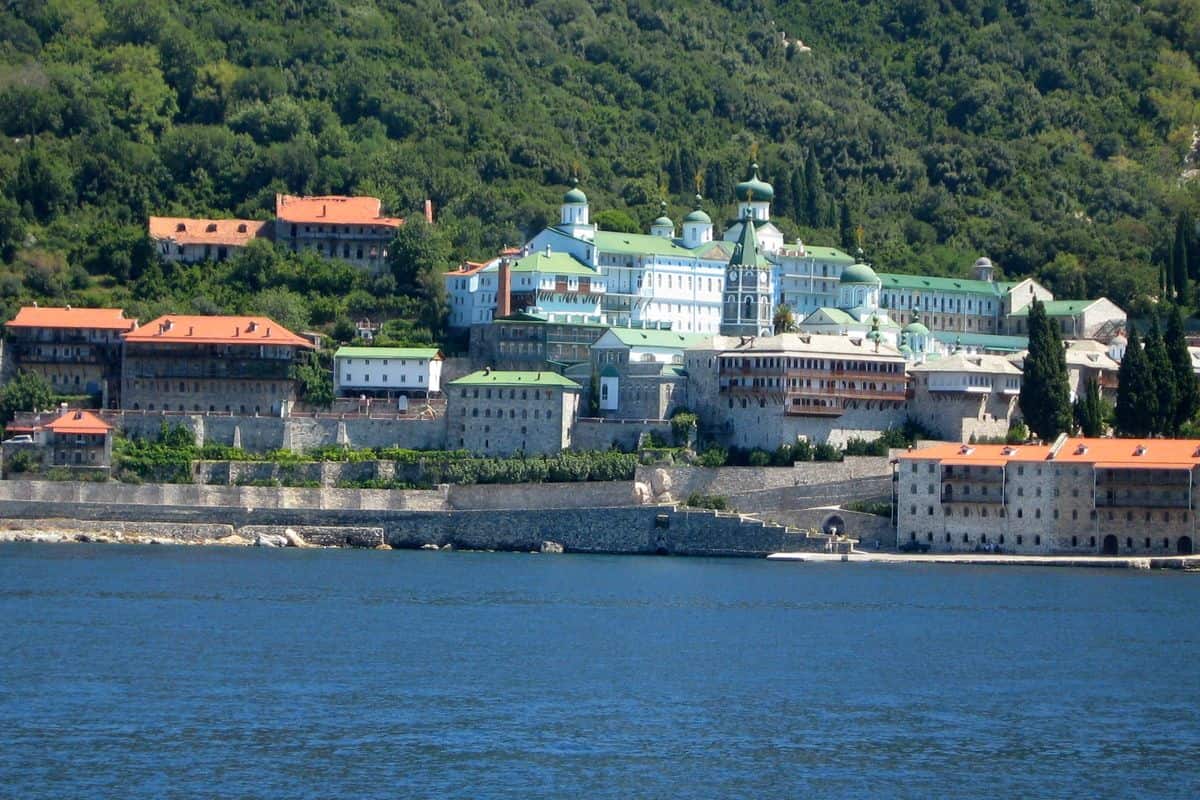
The cruise boats leave the harbour of Ouranoupoli and follow the side of the peninsula that faces the Singitic Gulf. The Athos peninsula covers 335.6 square kilometres and rises to the 2,033-metre summit of Mount Athos, with dense forest on its steep slopes. The area is protected under the Natura 2000 network. Ouranoupoli tours on the water show the parts of each monastery that face the sea: tall defensive towers and the arsanas, a shore complex with a boat shelter and storerooms.
Docheiariou sits by the sea between Xenophontos and Konstamonitou. Xenophontos lies on the western shore, and St Panteleimon, the Russian monastery, stands on the south-western side. Ouranoupoli tours pass every one of them outside the 500-metre zone.
- Docheiariou: its name recalls the post of docheiarios, or storekeeper, that Euthymios, the founder named by tradition, held at Great Lavra, and it keeps the icon of the Virgin Gorgoepikoos, She Who is Quick to Hear.
- Xenophontos: 11 chapels stand inside its walls and 6 outside, and frescoes of the Cretan school from 1544 decorate its old main church.
- St Panteleimon: the largest monastery on the peninsula, with buildings of different heights and clusters of domes that give it the look of a small town.
- Dafni: the main port, between Xeropotamou and Simonopetra, with the only working customs office of Athos.
Ouranoupoli tours start in the village itself, and visitors based in the city find the same shoreline on the Mount Athos cruise from Thessaloniki.
How do men visit Mount Athos on Ouranoupoli tours?
Ouranoupoli tours for male pilgrims start with a diamonitirion, the entry permit of the Pilgrims’ Office. Holders collect it in Ouranoupoli, board the daily ferry to Dafni, the port of the monastic state, and stay for 3 nights unless Karyes extends the permit.
Article 176 of the Charter of Mount Athos requires visitors to obtain this permit from the Holy Epistasia. Its Pilgrims’ Office has branches in Thessaloniki, on Egnatia Street, and in Ouranoupoli. Applicants fix the date of entry and send their full name, father’s name, date of birth and identity card or passport number. Applications open up to 6 months before the visit, and Ouranoupoli tours for pilgrims depend on that early booking.
Seats on the ship are booked with Athos Lines, the company that links Ouranoupoli with Dafni every day. On the day of departure, Ouranoupoli tours for pilgrims begin at the office in the village, where each man collects the permit with an identity card or passport, then picks up the ticket. The ferry also serves the coastal monasteries and stops at the arsanas of Zografou. From Dafni, a bus runs to Karyes, the administrative centre, on the only paved road of Athos, which covers 17 km from Dafni through Karyes to Iviron.
- General permit: the genikon diamonitirion admits 100 Orthodox and 10 non-Orthodox visitors per day.
- Individual permit: the idikon diamonitirion comes from a monastery that invites the pilgrim, who then stays only in that monastery.
- Clergy: Orthodox monks and clerics also need written permission, the evlogia, from the Ecumenical Patriarchate.
- Vehicles: private cars and motorcycles do not enter the monastic state.
Residents of the peninsula are Orthodox men aged 18 and over, either monks or workers, and Ouranoupoli tours for women stay on the boats offshore.
What history do Ouranoupoli tours tell?
Ouranoupoli tours tell the story of Ouranopolis, the city that Alexarchus, brother of King Cassander of Macedonia, founded in 315 BC, and of the refugees from the Marmara islands who settled around the tower after 1922. The buried canal of Xerxes lies nearby.
Alexarchus, a son of Antipater, was a Macedonian scholar and officer who coined new words for his utopian town, such as orthroboas, “morning-shouter”, for a rooster. Coins of the city carry the words Ouranias Poleos and show Urania Aphrodite seated on a sphere. The city rose on the ruins of Sani, a colony of Andros, and an earthquake later destroyed it. The village, and Ouranoupoli tours with it, take their name from this ancient city.
Ouranoupoli tours that stop on the isthmus reach the line of the canal that King Xerxes of Persia cut from today’s Nea Roda to Trypiti, linking the Gulf of Ierissos with the Singitic Gulf. Two Persians, Bubares and Artachaees, led the work. Artachaees fell ill and died before the end, and he was buried at Akanthos. At Provlakas, the spot on the Nea Roda beach where the canal began, ancient walls show in the sea.
The Greek state confiscated the land from Vatopedi in 1922 to settle refugees from Turkey, and the first families sheltered in the tower, nearby buildings and tents. A German company built the first houses in 1926. Ouranoupoli tours walk streets that grew from this refugee settlement, which a road reached in 1956 along the old pilgrim route.
- Village names: the settlement was called Prosphorion, then Pyrgos, after the Greek word for tower, and took the name Ouranoupoli around 1960.
- Sanctuary of Sani: a temple of the late 6th century BC near Trypiti, which Alexarchus repaired when he founded his city.
- Zygou monastery: founded in the mid-10th century, it served a Frankish lord as a castle, hence the name Frangokastro, and stands open to women outside the Athos border.
Which beaches and islets do Ouranoupoli tours reach?
Ouranoupoli tours reach the 5 km sandy shore between Tripiti harbour and the village, Arsanas pebble beach at the Mount Athos land border, Ammouliani, the only permanently inhabited island of Chalkidiki, and the six Drenia islets that lie southeast of the island.
The Aristotelis municipality lists three Blue Flag beaches at Ouranoupoli, and the shore from Tripiti is fully organised. Arsanas lies at the border of Mount Athos, where the old naval station of the Chromitsa monastery separates the monastic community from the rest of the region. The beach is known for its white pebbles and its view of Athos. Boat-based Ouranoupoli tours head out into the Singitic Gulf, also called the Gulf of Mount Athos, where Ammouliani and the islets lie.
Drenia, also called Gaidouronisia, is a group of six uninhabited islets. The largest one gives the group its name, and the smaller ones include Penna, Feti and Artemis. Their shores are shallow and sandy, the water around them is blue-green, and the area carries the name Blue Lagoon of Chalkidiki. The largest islet holds a café, a tavern and the only beach with umbrellas. Boats for Ouranoupoli tours to the islets leave from the village and from the landing on Ammouliani.
Ammouliani covers about 4.5 square kilometres and measures 6 km in length. Refugee families from the islands of the Sea of Marmara settled there in 1925. A folk museum in the centre of the island displays belongings that the refugees carried from their homes.
- Alykes: the Blue Flag beach of Ammouliani, with fine white sand and an organised camping site.
- Megali Ammos: a beach on Ammouliani with whitish sand and rock formations, facing the Drenia islets.
- Agios Georgios: a beach on Ammouliani with golden sand and a wooden pier.
- Tigani: a white sandy beach on the islet of the same name in the Drenia group, reached by boat.
Boat trips on the other gulfs of the peninsula appear under Halkidiki boat tours.
Which day trips combine with Ouranoupoli tours?
Ouranoupoli tours combine with day trips to Ancient Stagira, the birthplace of Aristotle, to Aristotle Park in modern Stagira, to the mountain town of Arnaia, to the buried Xerxes Canal at Nea Roda and to the beaches of the Sithonia peninsula.
Ancient Stagira, a history stop for Ouranoupoli tours on the mainland, stands on the Liotopi peninsula, 500 metres southeast of Olympiada. Ionian settlers from Andros founded the city in 655 BC, and Aristotle was born there in 384 BC. Philip II of Macedon destroyed Stagira in 348 BC and later rebuilt it. Visitors walk past a walled acropolis, an agora, a classical stoa with a paved road, a sanctuary of Demeter and a Hellenistic house.
Modern Stagira sits at 510 metres on the main road between Thessaloniki and Ouranoupoli. Aristotle Park, at the entrance of the village, holds a statue of the philosopher. Arnaia stands at 600 metres on the northern slopes of the Cholomontas mountains. The Ministry of Culture declared it a historic site in 1986 for its traditional architecture. The town keeps a history and folklore museum in an 18th-century mansion and a weaving museum in a two-storey house from 1870.
The Xerxes Canal crossed the Athos isthmus near Nea Roda. In 492 BC a storm off Athos sank 300 ships of the Persian fleet, and in 483 BC King Xerxes ordered the canal so that his fleet avoided the same disaster. The channel ran 2 km, with a width of 30 metres and a depth of 3 metres. Sediment covers it today, but its outline shows on air photos. The mapped Xerxes hiking trail runs from the port of Nea Roda to the port of Tripiti.
- Aristotle’s tomb: archaeologist Kostas Sismanidis identifies one building at Ancient Stagira as the tomb and heroon of Aristotle.
- Sidirokafsia: the early Ottoman mining centre of the area, with its own mint; its towers and ruins stand in Aristotle Park and on the hill opposite.
- Agios Stefanos: the cathedral of Arnaia dates from 1812, and its bell tower from 1889.
- Sithonia: the middle peninsula of Chalkidiki, with Mount Itamos at 817 metres and Porto Koufo, the largest natural harbour in Greece.
Ouranoupoli tours and a Sithonia day share the Singitic Gulf, since Sithonia lies west of the Athos peninsula across it. Its villages and beaches feature in Sithonia tours.
How do visitors reach Ouranoupoli for Ouranoupoli tours?
Ouranoupoli tours start in a village 132 km from Thessaloniki. A single asphalt road links the village with the city, Thessaloniki Airport lies 13 km southeast of the city, and KTEL Chalkidikis runs regular daily buses to Ouranoupoli from its Thessaloniki station.
Drivers take National Road 16 from Thessaloniki towards Ierissos, the seat of the Aristotelis municipality, or the Egnatia Odos motorway with the Rentina or Asprovalta exit. Ouranoupoli lies 17 km from Ierissos. National Road 16 passes through Arnaia, and modern Stagira stands on the main road to Ouranoupoli, so both towns fit the drive to Ouranoupoli tours.
Thessaloniki Airport Makedonia (SKG) stands in Thermi and serves Chalkidiki as well as the city. It connects directly with National Road 16 and with the A25 motorway towards Chalkidiki. A car rental service operates in the terminal building.
KTEL Chalkidikis keeps its Thessaloniki station at the 9th kilometre of the Thessaloniki–Nea Moudania road, in the southern part of the city. Visitors on Ouranoupoli tours without a car buy tickets in cash at the counters, or as e-tickets online and through the company’s mobile app. An open return ticket stays valid for use within the following month.
- Arnaia: 68 km from Thessaloniki.
- Stagira: 73 km from Thessaloniki, at the foot of Mount Stratoniko.
- Ierissos: about 100 km from Thessaloniki, on the east coast facing the Strymonian Gulf.
- Nea Roda: 115 km southeast of Thessaloniki, at the narrowest point of the Athos peninsula.
- Tripiti: 120 km from Thessaloniki, with the ferry to Ammouliani.
Day plans that start in the city appear on the Halkidiki day trip from Thessaloniki page.
When do Ouranoupoli tours run best?
Ouranoupoli tours run best from June to September, when the mean daily high on the Chalkidiki coast stays above 27 °C and rainfall stays low. The summer season in eastern Chalkidiki lasts six months, and boats to the Drenia islets run daily in summer.
Chalkidiki has a Mediterranean climate with cool, wet winters and hot, relatively dry summers. Figures from the National Observatory of Athens station at Neos Marmaras, on the Sithonia coast, show a mean high of 32.1 °C in July. August is the hottest month for Ouranoupoli tours, with a mean high of 32.4 °C and 11.6 mm of rain, against 62.4 mm in January. The mean January low is 6.5 °C, and winter snowfalls do not last long.
Sightseeing cruises along the Athos coast operate in summer. The boat service from the port of Ouranoupoli to Mount Athos, by contrast, runs every day of the year.
- April: Ammouliani honours Saint George every year.
- July: the Ouranoupoli cultural association holds the Ouranopolitika festival, and Nea Roda holds its Sardine Feast on the last Monday of the month.
- August: the association organises full-moon night events in Ouranoupoli, and Nea Roda celebrates a religious festival on 23 August.
- 8 September: Stagira celebrates the feast of the Panagouda church, which is carved into a rock at the top of the village.
In winter, Arnaia draws visitors for its architecture and mountain scenery, which gives off-season Ouranoupoli tours an inland option.
Frequently Asked Questions
Do Ouranoupoli tours include snorkelling and diving?
Yes. Ouranoupoli tours by boat reach the Drenia islets, where the seabed holds rich marine life and a large number of fish. Snorkellers also visit the rocky islet of Faka, north of Ammouliani. Divers find a sea horse colony at Paraty beach in the Stratoni area, the only beach in the region with such fauna.
Can Ouranoupoli tours use a rented boat without a licence?
No licence is needed for small boats for hire, according to the Aristotelis municipality. Ouranoupoli tours by rented boat explore the Gulf of Mount Athos, the Drenia islets and the beaches of Ammouliani one by one. Tratovoli beach on Ammouliani, for example, is accessible only from the sea.
Which ferry do Ouranoupoli tours use for Ammouliani?
Ouranoupoli tours to Ammouliani use the ferry boat from the Tripiti shore, which covers 2 nautical miles to the island. Ammouliani has 521 permanent residents who work in fishing and tourism, and its fishing fleet ranks second in size in Central Macedonia. The central church of Agios Nikolaos dates from 1865.
Which Ouranoupoli tours suit families with young children?
Ouranoupoli tours to the Drenia islets suit families, since the water off their sandy shores stays shallow. On the mainland, Xiropotami beach in the Gomati area has golden sand, shallow water and views of Mount Athos and Ammouliani. The municipality lists Xiropotami as an ideal beach for young children.