
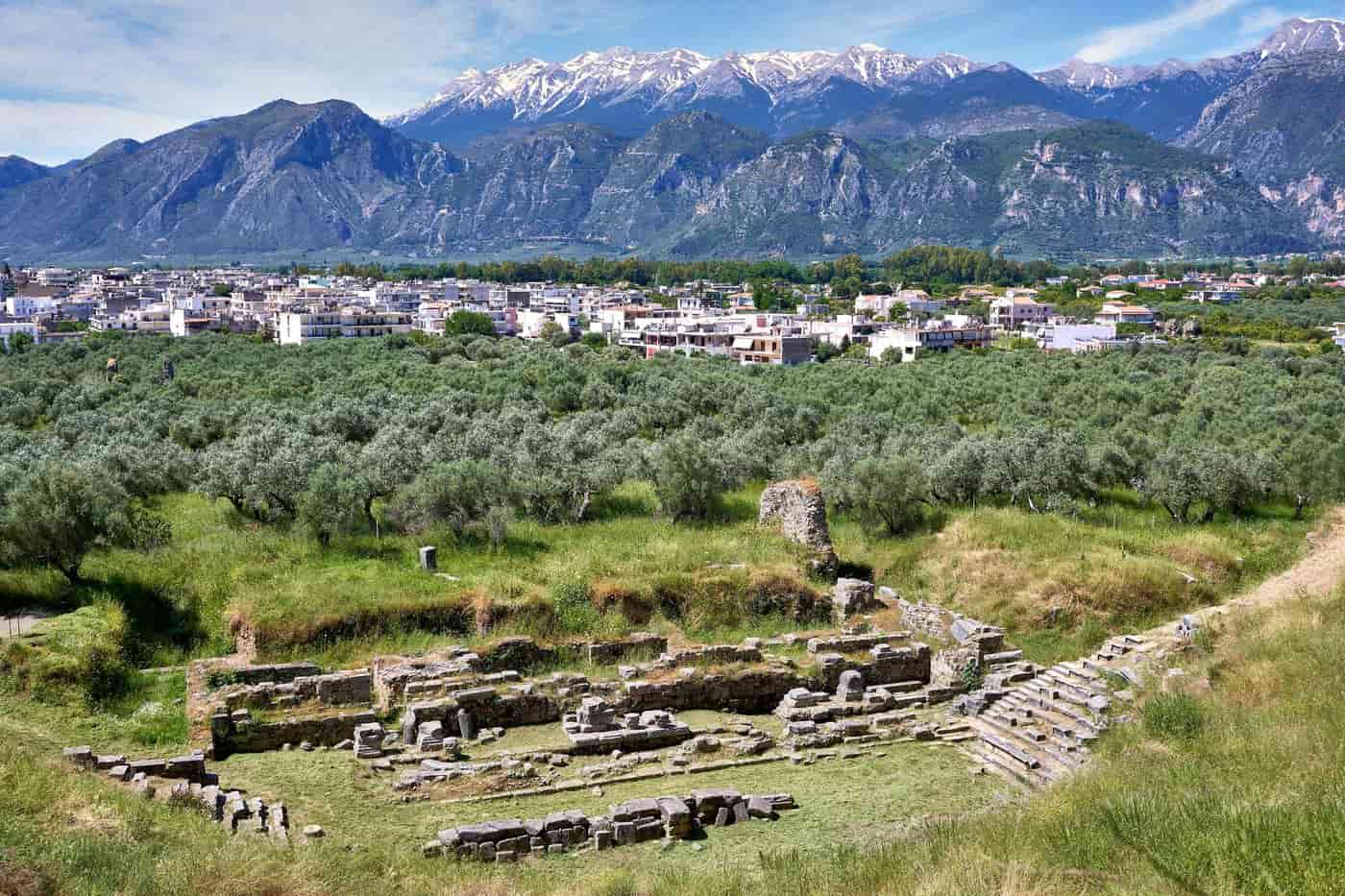
Sparta tours start in the capital of Laconia, a town in the Evrotas valley below Mount Taygetos, built over the ancient city of King Leonidas. The routes cover the acropolis and its theatre, the Sanctuary of Artemis Orthia, the museums and the Byzantine town of Mystras on the slope to the west. Greece Tours lists the day trips that reach Sparta from Athens and Kalamata.
This page covers what Sparta tours see in the town and on the ancient sites, how the routes reach Mystras, Mount Taygetos, Monemvasia and the Mani, what the valley grows, how visitors reach Sparta and which season suits each route. The tours below are checked on GetYourGuide and leave from Sparta, Mystras, Kalamata, Monemvasia, Nafplio and Athens.
What do Sparta tours cover?
Sparta tours cover the capital of Laconia, a city of 17,773 residents in 2021, set in the Evrotas valley on the eastern foothills of Mount Taygetos. The route joins the ancient acropolis, two sanctuaries, the town museums and the Leonidas statue.
Modern Sparta stands on the site of the ancient city, at 180 to 210 metres above sea level. The ancient acropolis lies north of the modern centre. The municipality took its present form in 2011, when seven former municipalities merged.
Sparta tours start in a planned town. King Otto decreed the new city on 20 October 1834. Bavarian planners led by Friedrich Stauffert drew a grid of symmetrical blocks that point toward the ancient acropolis, for a future city of 100,000 people. The new Sparta was the first city in Greece laid out on a town plan.
Sparta tours cross the main square, where the neoclassical City Hall of 1909 by the architect G. Katsaros stands. Wide streets lined with trees, parks and large squares still mark the centre.
- Region: Sparta is the capital of the Laconia regional unit in the south-eastern Peloponnese.
- Valley: The Evrotas valley lies between Taygetos (2,407 m) to the west and Parnon (1,935 m) to the east.
- Population: In 2021, the city had 17,773 residents and the municipality 32,786.
- Town plan: The neoclassical grid of 1834 was designed for a city of 100,000 inhabitants.
What do Sparta tours see on the ancient acropolis and at the theatre?
Sparta tours climb the low, broad acropolis hill north of the modern city. The hill holds the Roman theatre for 16,000 spectators, the Sanctuary of Athena Chalkioikos, a round retaining wall and a late Roman wall built after the earthquake of 375 AD.
The acropolis was the political, religious and economic centre of the ancient city. Sparta tours enter by the South Gate, with the Rotunda, the theatre and the Temple of Athena Chalkioikos to the west.
The theatre sits on the southwest slope of the hill. It dates to around 30 to 20 BC, the time of Eurycles, a friend of the emperor Augustus. Its cavea measures about 140 metres across and seated up to 16,000 spectators, like the theatre at Epidaurus. A wooden stage on wheels served it at first. At the end of the 1st century AD, the emperor Vespasian gave it a marble stage of the Corinthian order. The theatre stayed in use until the 4th century AD.
Above the theatre, Sparta tours reach the Sanctuary of Athena Chalkioikos, Athena “of the Bronze House”. Bronze sheets with relief scenes covered its inner walls. A small temple rose here in the 6th century BC and held the statue of the city goddess. The British School at Athens located the site in 1907, and it produced the longest surviving archaic inscription in Laconia.
- Orchestra: The horseshoe-shaped orchestra of the theatre measures 25 metres across.
- Rotunda: A semicircular retaining wall of Hellenic origin, partly restored in the Roman period.
- Late Roman wall: After the earthquake of 375 AD and the threat of Gothic raids, residents walled the acropolis alone.
- Basilica: The ruins of the 7th-century Basilica of Christ the Saviour stand beside the theatre.
Sparta tours pass a theatre site that is still not fully excavated, after British School digs in 1906, 1924 to 1927, 1992 to 1998 and 2008.
What do Sparta tours show at the Sanctuary of Artemis Orthia and the Menelaion?
Sparta tours show the Sanctuary of Artemis Orthia beside the Evrotas, with its 24-metre altar and 3rd-century Roman theatre, and the Menelaion at Therapne, 5 km away, a hero shrine to Menelaus and Helen built over Bronze Age mansions.
The Orthia sanctuary lies 1 km east of the acropolis, in the old district of Limnae. The first sanctuary dates to around 700 BC. A second temple followed around 570 BC and was rebuilt in the 2nd century BC. In the 3rd century AD, the Romans added a horseshoe-shaped theatre, with the temple as the stage and the altar in the orchestra.
Crowds came to watch the diamastigosis, the ritual flogging of young men. Sparta tours explain the rite: cheeses lay on the altar, guarded by adults with whips, and the youths tried to take them. The British School at Athens dug the site from 1906 to 1910 under R. M. Dawkins.
The Menelaion stands on the hill of Profitis Ilias at ancient Therapne, 5 km southeast of the city. In the 8th century BC, the Spartans built a hero shrine there for Menelaus and Helen. The page on King Menelaus of Sparta tells his story. Ludwig Ross excavated the area in 1834 and recognised the shrine. A bronze aryballos of the 7th century BC carries a dedication to Helen, wife of Menelaus.
- Orthia altar: The Roman-era altar measures 24 metres long and 7 metres wide.
- Orthia finds: Over 100,000 lead offerings, clay masks and carved ivories came from the dig.
- Menelaion platform: A stone base of 23.8 by 16.6 metres carried the temple.
- Bronze Age level: Mansion 1 below the shrine dates to about 1450 BC.
Sparta tours pair the two sites because both stand by the Evrotas: one served Artemis, the other honoured Menelaus and Helen, the royal pair of the Iliad.
Which museums do Sparta tours visit?
Sparta tours visit the Archaeological Museum of Sparta, built in 1874 to 1876 as the first Greek museum in a provincial city, and the Museum of the Olive and Greek Olive Oil, opened in December 2002 in the old Electric Company building.
The Archaeological Museum stands in the city centre, in a neoclassical building by G. Katsaros. Seven rooms cover about 500 square metres, with finds from the Neolithic to the late Roman era. Sparta tours see finds from the Sanctuary of Artemis Orthia, Roman mosaics and parts of the temple of Apollo at Amyclae.
The clay masks from the Orthia sanctuary date to the 7th and 6th centuries BC. Young victors set up inscribed stelae at the same sanctuary. The oldest, of the 4th century BC, shows five sickles, the prize for young men. The marble hoplite known as “Leonidas” also stands here. In July 2020, the Minister of Culture and Sports Lina Mendoni approved plans for a new Archaeological Museum of Sparta.
The Olive Museum belongs to the Piraeus Bank Group Cultural Foundation. Its upper floor holds fossil leaves from the Santorini caldera, dated to 50,000 BC, and Linear B records of olive trees from Knossos and Pylos. The ground floor shows olive press technology up to the first half of the 20th century. Sparta tours also see three olive presses outdoors: prehistoric, ancient and Byzantine.
- Archaeological Museum: Room II holds finds from the shrine of Artemis Orthia, and Room VII holds Laconian sculpture.
- Olive Museum: Two floors and an outdoor area explain olive growing and oil production in Greece.
- Koumantareios Art Gallery: Opened in 1982 as an annex of the National Gallery, it shows 14 oil paintings by Western European artists.
- Ecclesiastical Art Museum: It occupies the Metropolis building opposite the Evangelistria cathedral.
What history do Sparta tours tell?
Sparta tours tell the story of the city-state of Lacedaemon, the leading land military power of Greece from the 7th century BC until its defeat at Leuctra in 371 BC, with two kings, the agoge and the laws of Lycurgus.
Ancient writers credit the lawgiver Lycurgus with the Spartan order, called eunomia, set up in line with the Delphic oracle. Two hereditary kings from the Agiad and Eurypontid families held equal authority. The Gerousia held 28 elders over 60 plus the two kings, and five ephors were elected each year.
Boys of citizen families entered the agoge at age seven. Besides weapons training, they studied reading, writing, music and dancing.
Sparta tours then follow the wars. In 480 BC, King Leonidas led 300 Spartans at Thermopylae against the Persian army of Xerxes. In 479 BC, Sparta led the Greek alliance to victory at Plataea under Pausanias. Sparta won the Peloponnesian War of 431 to 404 BC after the naval victory of Lysander at Aegospotami. Defeat by Epaminondas of Thebes at Leuctra in 371 BC began the decline. The Visigoth king Alaric sacked the city in 396 AD, and King Otto refounded the town in 1834.
- Lycurgus: The legendary lawgiver behind the Great Rhetra, honoured by the Spartans as a god.
- Kings and ephors: Over time, power passed to the ephors and the Gerousia, and the kings led mainly as generals.
- Agoge: Training ran in three age groups: paides, paidiskoi and hebontes.
- Decline: Defeat at Leuctra in 371 BC, entry into the Achaean League and the sack by Alaric in 396 AD.
Sparta tours tell this history on the ground, at the acropolis, the Orthia sanctuary and the museum.
What does the Leonidas statue mean on Sparta tours?
Sparta tours treat the bronze Leonidas statue by Vasos Falireas, erected in 1969, as the symbol of the city. It honours King Leonidas, who died at Thermopylae in 480 BC, and carries the words ΜΟΛΩΝ ΛΑΒΕ, “come and take them”.
The statue stands at the end of K. Palaiologou Avenue, in front of the national stadium. The king wears clothing in this statue.
Falireas made an earlier, naked bronze Leonidas in 1955. Sparta objected to the nude figure, so it went to the pass of Thermopylae, where a Thermopylae day trip from Athens reaches it. Both statues follow the marble “Leonidas” torso found on the acropolis in 1925, a hoplite in a Corinthian helmet.
Sparta tours also stop at the “Tomb of Leonidas”, or Leonidaion, a two-chamber limestone building of the late 5th century BC. It took the name of Leonidas in the 19th century. The bones of Leonidas came back from Thermopylae and were buried further north, near the theatre. The Leonideia, a yearly festival in his honour, took place opposite the theatre, and only Spartans took part.
- Dates: Falireas designed the statue in 1966, the inscription dates to 1968, and the unveiling took place in 1970.
- Inscription: ΜΟΛΩΝ ΛΑΒΕ was the reply of Leonidas when Xerxes demanded the Spartan arms.
- Leonidaion: The only ancient monument inside the limits of the town planned in 1834.
- Spartathlon: Since 1983, an ultramarathon over the 250 km from Athens ends at the statue each September.
Sparta tours close at the statue, where the modern city and the ancient king meet.
How do Sparta tours reach Mystras?
Sparta tours reach Mystras after a drive of about 8 km west of the modern city, on a slope of the Taygetus range. The fortified town served as capital of the Byzantine Despotate of the Morea and joined the UNESCO World Heritage List in 1989.
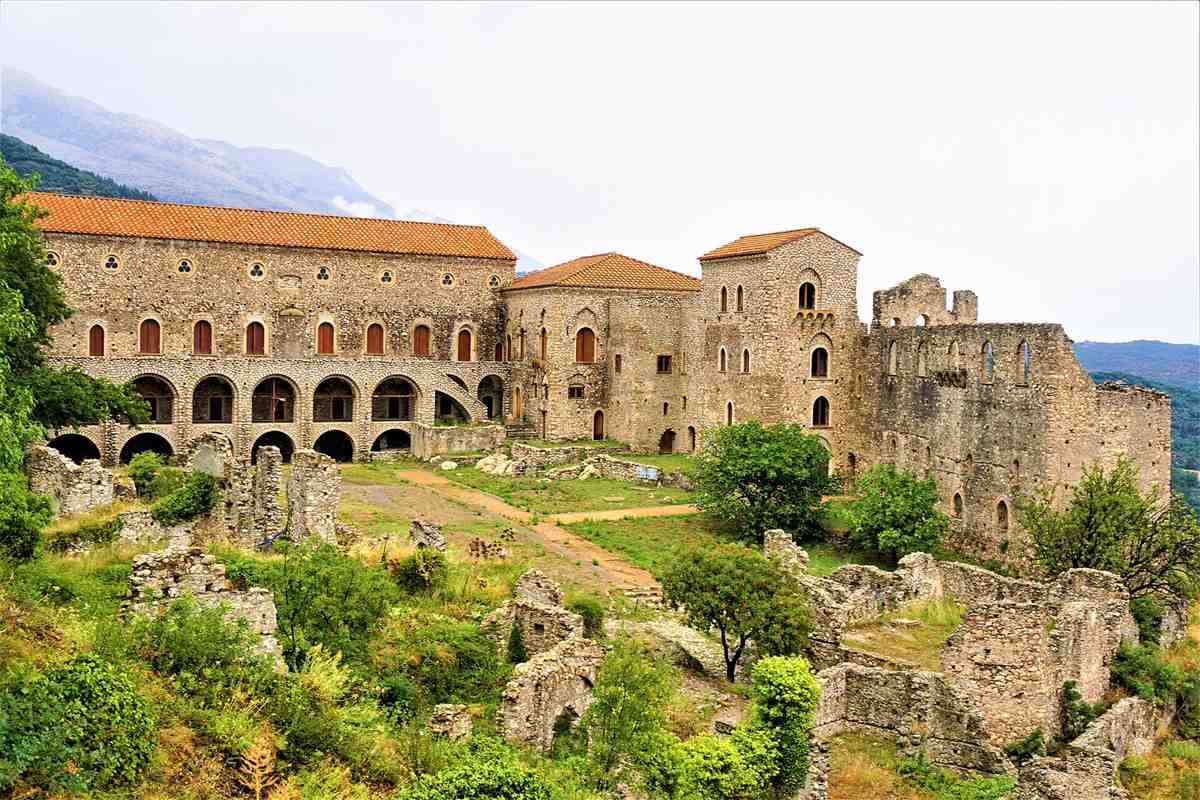
William II of Villehardouin, the Frankish prince of Achaea, built the first fortress in 1249 on a 620 m hill above Sparta. The Franks handed the castle to the Byzantines in 1262. From 1349 a despot ruled the Byzantine Morea from Mystras, and the city fell to the Ottomans in 1460.
The town grew in an upper and a lower zone. The slope made wheeled traffic impractical, so its streets serve mainly as footpaths. Sparta tours on foot climb from the main entrance toward the Palace of the Despots, the only Byzantine palace that still stands. Its final main building has three stories, with a large audience hall on the top floor.
During the Palaeologan Renaissance, frescoes covered the walls of its churches. The philosopher Gemistos Plethon lived in the city until his death in 1452.
- Hagioi Theodoroi: built 1290–1295 with an octagonal dome, part of the Brontochion monastery.
- Hodegetria: built around 1310, with a chapel painted with angels who hold chrysobulls.
- Hagia Sophia: built 1350–1365 in the upper town by Manuel Kantakouzenos, the first despot.
- Peribleptos: dated to the third quarter of the 14th century.
- Pantanassa: built around 1430, home to the nuns who form the only community on the site today.
The Mystras tours page sets out the full visit.
Which Sparta tours climb Mount Taygetos?
Sparta tours that climb Mount Taygetos aim for Profitis Ilias, the 2,405 m summit and the highest point of the Peloponnese. The massif runs about 100 km from the center of the peninsula to Cape Matapan, and European walking route E4 follows its lower slopes.
The summit is an ultra-prominent peak, and it rises as a pyramid above the ridges around it. The range carries the nickname “dome of the Morea”. In Byzantine times it went by the name Pentadaktylos, or “five-fingered”, after the five peaks of its central group. A small chapel to the Prophet Elias stands near the top and gives the peak its name.
From the summit, the view takes in the Evrotas Valley and the Parnon range to the east, and Kalamata with the eastern half of Messenia to the west. Greek fir and black pine cover the slopes, and the mountain belongs to the Natura 2000 network. Sparta tours on Taygetus walk through four zones of vegetation, from Mediterranean scrub up to 700–800 m to a treeless alpine zone above 2,000 m.
- Summit: Profitis Ilias at 2,405 m, also listed as 2,407 m.
- Mountain village: Anavryti, at 850 m above the Evrotas Valley, on the E4 route.
- Village museum: the Geological Museum of Anavryti, with an exhibit on Mount Taygetus.
- Gorges: Rindomo, Vyros and Vardounia, which cut into the range.
What food and drink do Sparta tours taste?
Sparta tours taste the farm products of Laconia: olives and olive oil, oranges from the Evrotas Valley, wine from the Dafni area, Sfela cheese and the sweet Malvasia wine of Monemvasia. Sfela and Malvasia both carry Protected Designation of Origin status.
Farming drives the Laconian economy. Oranges, olives, oil and wine lead the list of crops. The Evrotas Valley holds citrus groves, olive groves and pasture, and it produces the largest orange harvest in the Peloponnese. The Lakonia brand of orange juice has its base in Amykles.
Kalamata olives take their name from the region around Kalamata, which includes Messenia and nearby Laconia. The almond-shaped, dark purple fruit cannot be harvested green, and pickers gather it by hand to avoid bruising. Sfela is a semi-hard white brine cheese made from goat and sheep milk, and its production is allowed only in Messenia and Laconia. It is eaten with bread or with Maniot lalangia, and its reheated curd gives it the name “feta of the fire”.
Malvasia is a sweet wine made from sun-dried grapes in the Monemvasia area. The Italian form of the town’s name was Malvasia, and the wine trade spread that name across Europe. Sparta tours that reach Areopoli on a Saturday find an open-air market of local producers in the main square.
- Olive oil: the Peloponnese ranks second in Greek olive oil output, with 26% of the national total.
- Table olives: Kalamata olives, protected by PDO status within the EU.
- Cheese: Sfela, on the EU PDO register since 1996.
- Wine: Malvasia of Monemvasia, a PDO sweet wine, plus wine from the Dafni area.
Which day trips combine with Sparta tours?
Sparta tours combine with day trips to Gytheio, 40 km southeast on National Road 39, to the Mani and the Diros Caves beyond Areopoli, and to Monemvasia, a tied island off the east coast, reached on National Road 86 from Dafni.
Gytheio served as the seaport of ancient Sparta. Today it is the largest town in the Mani and the seat of East Mani. A causeway links the islet of Cranae to the shore. On Cranae, the Tzannetakis Tower houses the Historical and Cultural Museum of Mani, beside a lighthouse of solid marble.
Sparta tours that continue to Areopoli, 20 km southwest of Gytheio, reach the town where the Greek War of Independence began on 17 March 1821. Pyrgos Dirou stands about 4 km south of Areopoli, and three caves open on Dirou Bay: Alepotrypa, Glyfada (also called Vlychada) and Katafygi. The known length of Glyfada passes 15 km. Alepotrypa, 220 m to the east, held Neolithic burials with remains of at least 170 people. The Diros Caves in the Mani page covers the cave visit.
People who left ancient Sparta founded Monemvasia in the 6th century. A tombolo 400 m long joins the rock to the mainland, and a bridge built in 1971 links the town to the EO86 road. The rock also features as a Monemvasia day trip from Athens.
- Gytheio: 40 km southeast of Sparta.
- Areopoli: 20 km southwest of Gytheio, with stone tower houses.
- Pyrgos Dirou: about 4 km south of Areopoli.
- Monemvasia: on National Road 86, via Krokees and Molaoi.
How do visitors reach Sparta for Sparta tours?
Sparta tours start in a city served by the A71 motorway, a toll branch that runs 45.5 km from Lefktro near Megalopoli. From Athens, the route joins the A7 just west of the Isthmus of Corinth and runs via Tripoli. From Kalamata, National Road 82 crosses Taygetus.
The A7, also called the Moreas Motorway, links Corinth with Kalamata via Tripoli. The stretch from Corinth to Tripoli covers 74 km. The A71 branch opened on 18 April 2016 and leaves the A7 at Lefktro. National Road 39 gives a more direct link from Tripoli to Sparta than the tolled motorway, and it continues south to Gytheio.
National Road 82 links Kalamata with Sparta and separates Northern Taygetus from the Central Range. Kalamata lies 243 km from Athens and has an international airport with charter and scheduled flights from European cities in summer. Sparta tours that begin on the west side of the mountain connect with Kalamata tours.
By bus, KTEL coaches leave from the Kifissos Bus Station in Peristeri, the busiest intercity terminal in Athens, with routes to the Peloponnese. Bus X93 links Athens International Airport directly with the station.
- Motorway: the A7 via Tripoli to Lefktro near Megalopoli, then the A71 to Sparta.
- West road: National Road 82 over Taygetus to Kalamata.
- South road: National Road 39 to Gytheio, largely part of European route E961.
- Bus: KTEL from Kifissos Bus Station in Athens, with airport bus X93 to the station.
When do Sparta tours run best?
Sparta tours run best between the winter snow of Taygetus and the July and August heat, when highs in the city pass 36°C. January highs stay near 15°C, and Sparta records 6 days a year above 40°C.
Sparta has a Mediterranean climate, Köppen type Csa, and records among the highest summer maximum temperatures in Greece. The record stands at 45.7°C, set in August 2021. Laconia as a whole has mild winters, with rain falling mainly on the plains, and a long, hot, dry summer.
Mount Taygetus has a continental climate with heavy snowfall in winter. On the coast the pattern changes. Monemvasia has very mild winters, records 133 tropical nights a year, the highest count in mainland Europe, and has seen no snow cover for over 80 years.
Two events fix dates on the calendar for Sparta tours. On 20 July, the feast of the Prophet Elias, the chapel on the summit of Taygetus holds a festival with a large bonfire, visible from Kardamyli and from any spot with a clear view of the peak. The Spartathlon, a 246 km ultramarathon from Athens to Sparta, has run every September since 1983.
- January: highs near 15°C in the city.
- July and August: highs above 36°C.
- 20 July: feast of the Prophet Elias, with a bonfire on the Taygetus summit.
- September: the Spartathlon finishes in Sparta.
Frequently Asked Questions
Which wildlife do Sparta tours find on Taygetus?
Sparta tours on Taygetus cross a range with over 1,000 plant species, 33 of them endemic to the area. Records list 87 bird species, among them golden eagles and short-toed snake eagles, plus 100 butterfly species and 19 mammal species such as the fox, the badger and the jackal.
Do Sparta tours cross the Parnon range?
Sparta tours east of the city face Parnon, a 1,961 m range that separates Laconia from Arcadia and stands visible from Athens. Greek fir covers its slopes, and UNESCO named it a biosphere reserve. The Spartatrail, over 100 km long, crosses Parnon from Kosmas in Arcadia, passes Sparta and ends at Mystras.
Which coasts do Sparta tours reach in Laconia?
Sparta tours reach the Myrtoan Sea to the east and the Laconian Gulf to the south. Laconia takes in Cape Malea, Cape Tainaron and the island of Elafonisos. Beaches near Gytheio at Mavrovouni, Valtaki and Selinitsa serve as major nesting sites for loggerhead sea turtles, Caretta caretta.
Do Sparta tours connect with ferries at Gytheio?
Sparta tours connect with ferries at Gytheio, which sail to Kythera, Antikythera, Crete and Piraeus, the port of Athens. The Peloponnese section of the E4 long-distance path also runs through Sparta and Kastania to Gytheio, then continues by ferry to Crete.