
Olympia Cooking Class
An Olympia cooking class is a hands-on Greek cooking lesson in the countryside of Elis around Ancient Olympia, where a local host teaches village recipes in an olive grove, a farmhouse or a home kitchen and the group shares the finished dishes at the table. Greece Tours lists every Olympia cooking class on sale, from lessons under the olive trees to tours that add the ancient sanctuary and its museum.
Cruise passengers docking at Katakolo and travellers staying in the village of Archaia Olympia book the same five experiences. An Olympia cooking class covers dips, salads, hand-rolled pies, stuffed vegetables and slow-cooked vegetables in olive oil, seasoned with mountain herbs and finished with local honey at a shared meal.
What is an Olympia cooking class?
An Olympia cooking class is a hands-on Greek cooking lesson in the countryside of Elis (Ilia) around Ancient Olympia. A local cook teaches village recipes in an olive grove, a farmhouse or a village kitchen, and the class ends with a shared meal of the dishes.
Elis, also written Ilia, is the regional unit of the western Peloponnese that holds the sanctuary of Zeus and the modern village of Archaia Olympia. The farmland around the site is a patchwork of olive groves, vineyards, orange orchards and vegetable plots along the Alfeios valley. An Olympia cooking class takes place on this land, so most of the produce on the worktable comes from nearby farms. The page on visiting Olympia sets out the site and villages around each lesson.
The lesson follows a clear pattern. The host names the dishes of the day and sets out the ingredients on a shared worktable. Guests chop, mix, stuff and roll under direction, then the trays go into the oven while the table is laid. Every Olympia cooking class ends with the group eating what it made, and each tour listing gives the menu and length. Overnight guests find tavernas and bakeries in Archaia Olympia town beside the ancient site.
Which Olympia cooking classes are on sale?
Five Olympia cooking classes are on sale. One pairs a guided tour of Ancient Olympia and its museum with a cooking class, three centre on cooking in an olive grove, and one adds an olive mill visit to Greek home cooking.
Four of the five titles begin with Katakolo, the cruise port on the coast of Elis where ships call for a single day. These four fit a port day: cruise passengers join from Katakolo port, and the tour listing states the pickup point and return time. The fifth title begins in Ancient Olympia itself and suits travellers staying in the village. Each Olympia cooking class is booked online, and each listing shows the language and inclusions.
The five differ in how much sightseeing comes with the food. Three titles add a tour of Olympia before the cooking, and one of those adds the museum. One title is a cooking class alone, held in an olive grove for a small group. One swaps the grove for an olive mill and a family kitchen. Choose an Olympia cooking class by the hours free on the day and the setting, grove or home. The list below gives each title.
- Ancient Olympia: Guided Tour and Food with Cooking Class and Museum – the site, the museum, then cooking and a meal.
- Katakolo/Olympia: Tour, Olive Grove and Greek Cooking – a tour, then Greek cooking in a grove.
- Katakolo/Olympia: Olive Grove Cooking Class, Small Group – grove cooking for a small group.
- Katakolo/Olympia: Olive Mill and Greek Home Cooking Experience – an olive mill, then a home kitchen.
- Katakolo: Olympia Tour with Olive Grove Cooking Class – a tour of Olympia, then grove cooking.
How does the guided tour with cooking class and museum work?
The Ancient Olympia: Guided Tour and Food with Cooking Class and Museum joins three parts in one booking: a guided walk through the sanctuary, a visit to the Archaeological Museum, and an Olympia cooking class that ends with a shared meal.
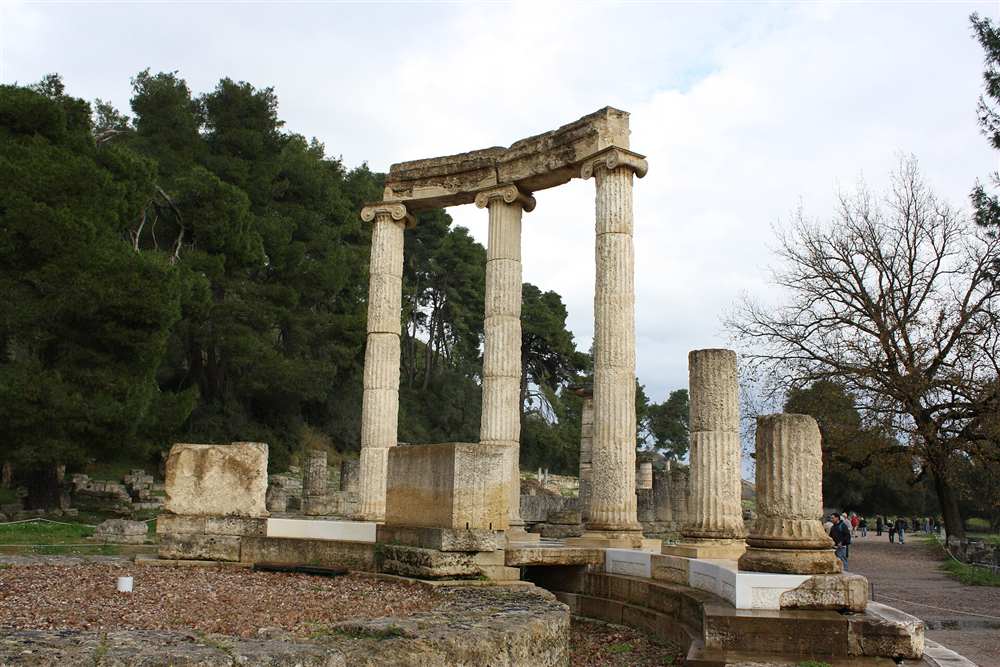
The guided part covers the Altis, the sacred grove of the sanctuary, with the Temple of Zeus, the Temple of Hera, the workshop of Pheidias and the vaulted tunnel into the ancient stadium. The guide explains the ancient Games and the olive wreath each victor received. The Ancient Olympia guided tour page sets out this route stop by stop. Meeting point and start times vary, so check the tour listing before booking this Olympia cooking class.
The museum visit follows the site. The Archaeological Museum of Olympia holds the pediment sculptures of the Temple of Zeus, the Nike of Paionios and the Hermes of Praxiteles. After the museum, the group moves to the kitchen, where the host has the ingredients ready. The group cooks the typical dishes of the region, and this Olympia cooking class closes with the meal at the table, where talk of the Games carries on over the food.
What happens at an olive-grove cooking class?
At an olive-grove cooking class, the group cooks outdoors under the olive trees at a shared worktable. Three Olympia cooking classes use this setting: the Tour, Olive Grove and Greek Cooking, the Olive Grove Cooking Class, Small Group, and the Olympia Tour with Olive Grove Cooking Class.
Katakolo/Olympia: Tour, Olive Grove and Greek Cooking combines a tour with the grove lesson. Katakolo/Olympia: Olive Grove Cooking Class, Small Group keeps the booking on the kitchen, and the listing states the group size. Katakolo: Olympia Tour with Olive Grove Cooking Class adds a visit to Olympia before the cooking. All three carry Katakolo in the title, so each olive-grove Olympia cooking class fits a cruise port day. Check the listing for pickup times.
Cooking outdoors changes the feel of the lesson. The worktable stands in the shade of old trees, with outdoor burners, a grill or a wood-fired oven, depending on the farm. Guests use village kitchen tools: wooden boards, knives, mixing bowls and the long thin rolling pin for pastry. Between steps, the host explains how the family works the grove through the year. An Olympia cooking class in a grove also means cicadas, open air and the smell of wild herbs.
What is the olive mill and Greek home cooking experience?
The Katakolo/Olympia: Olive Mill and Greek Home Cooking Experience pairs a visit to an olive mill with a cooking lesson in a Greek family home. The Olympia cooking class part takes place in the host’s own kitchen and ends with the meal.
The mill visit shows where the fruit of the local groves goes after the harvest, while the page on Olympia olive oil tasting covers the oil itself. The rest of the experience moves indoors to a home kitchen, where the host cooks the dishes she or he grew up with and teaches them at the family table. This Olympia cooking class is the only one of the five with home cooking in its title, which gives it a more personal pace.
A home kitchen teaches what recipe books leave out. The group uses the family’s own pots and oven and picks up the small habits of a Greek household: how much salt goes into the tomato base, how long the onions soften before the rice goes in, and when the herbs go in. Guests see how a Greek family cooks on an ordinary day. The listing for this Olympia cooking class gives the meeting point, the typical dishes and the timing.
Which Greek dishes do you cook?
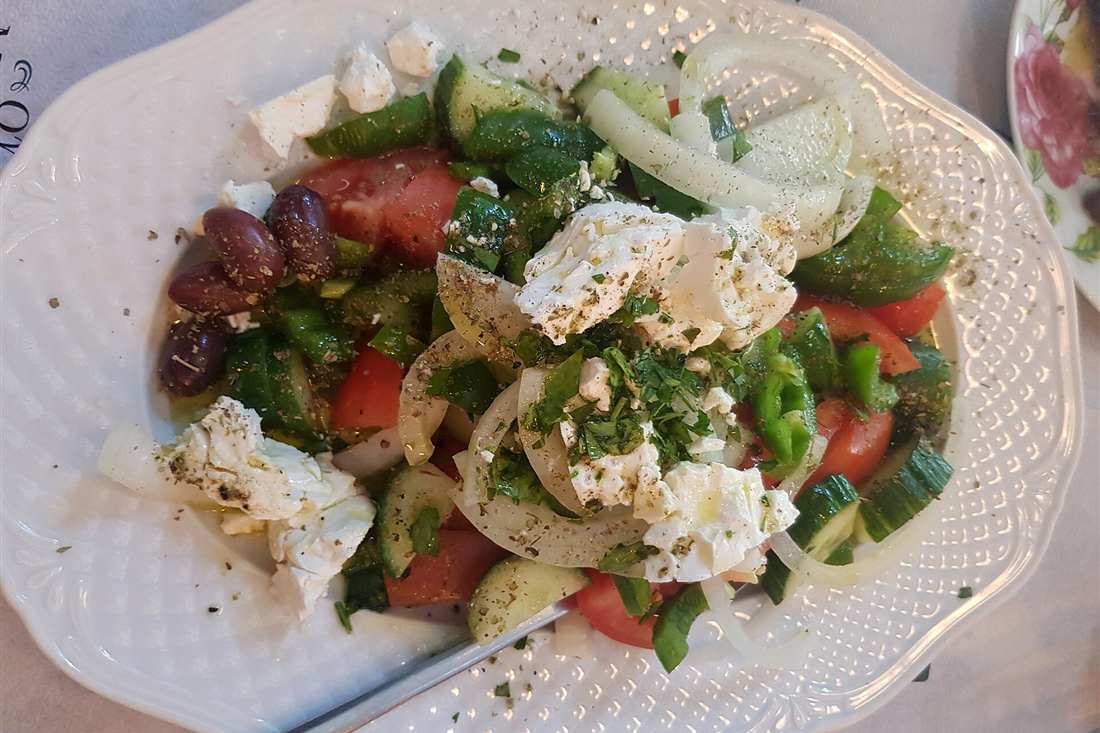
An Olympia cooking class covers the typical dishes of a Peloponnese village table: tzatziki, horiatiki village salad, spanakopita or hortopita in hand-rolled filo, gemista, dolmades, keftedes and briam, finished with a dessert made with honey. The exact menu appears on each tour listing.
Each host picks dishes from this core set by the season and the setting, and the tour listing names the dishes for each date. The set covers a full village meal: a dip, a salad, a pie, stuffed vegetables, a meat dish, baked vegetables and a sweet. Every Olympia cooking class also teaches the Greek way of eating, with dips, salads and pies set in the middle of the table and shared by everyone.
Most of the core set carries no meat. Tzatziki, horiatiki, the pies, rice-filled dolmades and gemista, and briam all suit vegetarians, and keftedes is the one meat dish. Travellers who eat no meat tell the operator at booking. Gluten-free diets meet a harder test, because the filo, the bread and the keftedes all contain wheat. Check the tour listing for dietary options before booking an Olympia cooking class; the list below gives each dish.
- Dips and salads – tzatziki of yogurt, cucumber and garlic, and horiatiki of tomato, cucumber, olives and feta.
- Pies – spanakopita with spinach and feta, or hortopita with wild greens, in hand-rolled filo.
- Stuffed vegetables – gemista of tomatoes and peppers filled with rice, and dolmades of vine leaves around rice.
- Meat and baked vegetables – keftedes meatballs with mint, and briam vegetables baked in olive oil.
- Dessert – a sweet made with honey, such as loukoumades or yogurt with honey and walnuts.
How is filo pastry rolled by hand?
An Olympia cooking class teaches filo rolled by hand from a soft dough of flour, water, olive oil, vinegar and salt. The cook rolls small balls into thin sheets with a plasti, the long thin Greek rolling pin, and brushes olive oil between the layers.
The dough is kneaded until smooth, then rests under a cloth so it stretches without tearing. The cook divides it into balls, dusts the board with flour and flattens one ball by hand. The plasti does the rest: the sheet wraps around the pin, the cook rolls it forward with palms moving outward, unrolls it, turns it and repeats. Each pass stretches the sheet thinner. On an Olympia cooking class, guests watch the host’s hands before taking a turn.
Village filo is thicker than factory sheets, and that thickness gives the pie a crisp, flaky top. The cook oils a round tin, lays in a sheet, brushes it with olive oil and adds the next. The filling goes in the middle: spinach or wild greens with feta, spring onion, dill and egg. More oiled sheets cover it and the top is scored. An Olympia cooking class bakes the pie in the same session, so the group eats it warm.
What is ladera, the Greek way of cooking vegetables in olive oil?
Ladera, from the Greek word ladi for oil, are vegetable dishes cooked slowly in olive oil with onion, tomato and herbs until soft. Green beans in tomato, briam and gemista are the ladera an Olympia cooking class teaches most.
Fasolakia ladera is the model dish: green beans, onion, garlic, grated tomato, potato and olive oil simmer in one pot until the beans turn soft and the sauce thickens. Briam is the oven version, with potatoes, courgettes, aubergines, peppers and tomatoes baked in one tray with oil and oregano. Gemista are tomatoes and peppers filled with rice, their own pulp and herbs. An Olympia cooking class teaches all three as one family of dishes.
Ladera follow the season. Spring brings artichokes with peas and dill, summer brings beans, courgettes, aubergines and okra, and winter brings cabbage, leeks and spinach with rice. The dishes grew from the fasting days of the Orthodox calendar, when meat stays off the table. Greek families serve them warm or at room temperature with bread and feta, and the meal at the end of an Olympia cooking class follows the same custom.
What herbs and local produce go into the dishes?
Dried oregano, thyme, fresh mint and dill season the dishes, alongside wild greens (horta), feta and local cheese, ripe tomatoes and Peloponnese honey. An Olympia cooking class draws most of this produce from the farm, the garden or the village market around the kitchen.
Greek oregano grows wild on the dry hillsides of the Peloponnese and goes, dried and crumbled, into the salad, the briam and the meatballs. Thyme covers the same slopes and feeds the bees that make thyme honey. Mint flavours keftedes and dolmades, and dill lifts spinach pies. Horta, wild greens picked in winter and spring, fill hortopita or come boiled with oil and lemon. An Olympia cooking class names each herb as it goes in.
Most hosts cook with what the farm or the village market holds that week, so a spring class leans on greens and artichokes and a summer class on tomatoes, peppers and aubergines. The same herbs and cheeses turn up at a Crete cooking class, where the island adds its own greens and sheep’s cheeses, but an Olympia cooking class keeps to the produce of Elis. The list below sets out the main local produce.
- Feta – brined cheese of sheep’s and goat’s milk, crumbled into pies and salad.
- Myzithra – soft whey cheese, mixed into pie fillings.
- Tomatoes – summer fruit of the Elis plain, used in salad, gemista and sauces.
- Honey – thyme, pine and fir honey of the Peloponnese, poured over the dessert.
What did ancient Olympic athletes eat?
Ancient Olympic athletes ate the plain food of the Greek countryside: barley bread, olives and olive oil, figs, cheese, honey, lentils and beans, with wine mixed with water. The dishes on an Olympia cooking class grow from the same short list of ingredients.
Barley was the base of the diet in ancient Greece. Cooks ground it into meal and kneaded it with water into a cake called maza, or baked it into a coarse loaf, while wheat bread belonged to wealthier tables. Olives and olive oil came from groves like the ones that still line the valley of the Alfeios river, and figs, grapes and pears filled the summer months. Soft cheese from sheep and goats, honey from hillside hives, and pulses such as lentils, chickpeas and broad beans gave protein through the year. An Olympia cooking class keeps these foods at the centre of the table.
Wine was part of daily life, but Greeks drank it mixed with water in a wide bowl called a krater, and drinking it unmixed counted as bad manners. Athletes trained on this simple fare for most of the history of the Games. One story from ancient writers tells of Charmis of Sparta, a winner of the stadion footrace, who trained on dried figs. Meat became more common in the diet of athletes in later centuries, when trainers began to link strength with larger portions of meat. An Olympia cooking class follows the older, plant-based pattern of the Greek table.
- Barley – the grain behind maza cakes and coarse loaves.
- Olives and oil – the fat for cooking, dressing and lamps.
- Figs – the fruit eaten fresh in summer and dried for winter.
- Cheese and honey – the protein and sweetener of country kitchens.
- Pulses – the lentils, chickpeas and broad beans of daily meals.
How does an Olympia cooking class work from Katakolo cruise port?
An Olympia cooking class from Katakolo runs as a shore excursion: transport collects passengers at the port, drives about 35 km to Olympia, pairs the ancient site with a class and lunch, and returns before the ship’s all-aboard time.
Katakolo is the cruise port on the west coast of the Peloponnese that serves Olympia, and the ancient site lies about 35 km inland. Ships dock for a single day, so every shore excursion works to a fixed clock. Tours that combine the site with an Olympia cooking class collect passengers at the port, drive through the farmland of Elis and split the day between the ruins and the kitchen. The exact order, pick-up point and length of each stop differ between listings, so check the listing before booking.
Timing is the key point for cruise passengers. The ship’s all-aboard time sets the end of the day, and a shore excursion built for cruise guests plans the return with a margin. An Olympia cooking class booked as a separate activity has no tie to the ship’s schedule, so a late class or a slow transfer leaves no room for error. Check the listing for the return time and compare it with the all-aboard time printed in the ship’s daily programme. The Katakolo to Olympia page sets out the transfer options for independent travellers.
Who is an Olympia cooking class for?
An Olympia cooking class suits families, couples, cruise passengers and food lovers. No cooking experience is needed: the host shows each step, guests work at their own pace, and children join in with simple tasks such as mixing, shaping and setting the table.
Families with children find a hands-on break on an Olympia cooking class. Children stir bowls, knead dough and shape small pies, while adults handle the knives and the hot oven. The class gives young visitors a change from the heat and the stones of the ancient site, and the shared meal at the end turns the morning into a family lunch. Age limits and places for children vary by tour, so check the listing. The Olympia with kids page covers the rest of a family visit to the valley.
Couples book an Olympia cooking class as a slow, shared break after the crowds of the site, cruise passengers use it to see the countryside of Elis in a single port day, and food lovers come for the recipes and the local produce. No skills are needed, because the host explains each step. Vegetarian dishes are common on the table, since the local menu leans on vegetables, pulses, cheese and olive oil. Vegan, gluten-free and allergy needs depend on the menu of the day, so tell the host at booking.
What do you wear and bring to an Olympia cooking class?
Wear comfortable clothes and closed shoes to an Olympia cooking class, and bring a sun hat for outdoor groves, a camera and a notebook for recipes. The host supplies the ingredients and kitchen tools, so the packing list stays short.
An Olympia cooking class in the countryside mixes kitchen work with time outdoors, so clothes need to handle flour, oil and sun at once. Light cotton or linen stays cool in the heat and washes clean after a splash of sauce. Closed shoes protect the feet from dropped knives and hot pans in the kitchen and from stones and dry grass in the groves. Long hair tied back stays clear of the food and the flame, and rings and watches come off before kneading dough.
A camera records each step of the dishes on an Olympia cooking class, which helps when the recipe comes out again at home. A small notebook holds the quantities, the herb names and the host’s tips, since measures in a Greek kitchen go by hand and by eye more than by scale. Guests arriving straight from the ancient site carry the same kit they used on the ruins: a hat, sunscreen and a water bottle. Check the listing for anything the tour asks guests to bring.
- Comfortable clothes – light cotton or linen that copes with flour and heat.
- Closed shoes – flat soles for kitchen floors and grove paths.
- Sun hat – shade for the outdoor parts of the class in the groves.
- Camera – photos of each step, the dishes and the valley.
- Notebook – space for quantities, herb names and the host’s tips.
When is the best season for an Olympia cooking class?
Spring and autumn are the best seasons for an Olympia cooking class, with mild days, green groves and fresh produce. Summer brings strong heat, so classes move into shaded groves or later hours, and the olive harvest fills late autumn and winter.
From March to May, the valley of the Alfeios turns green, wild greens fill the fields, and mild days suit both the ancient site and a class in the open air. June to August brings strong heat, and the open parts of the site offer little shade by midday. Hosts plan around it: an Olympia cooking class in summer runs in shaded groves, indoors, or later in the day once the sun drops. Visit the site early and check the listing for the start time.
Autumn brings grapes, figs and pomegranates, and the heat eases from late September. The olive harvest in the Peloponnese starts in about November and runs into the winter months, when nets spread under the trees and families work the groves. An Olympia cooking class in harvest season shows the working side of olive country, while winter classes move into warm kitchens. The ancient site is quieter in winter, so check the listing for classes that run out of season.
- Spring – mild days, green fields and wild greens.
- Summer – strong heat, shaded classes and garden vegetables.
- Autumn – cooler days, grapes, figs and pomegranates.
- Winter – olive harvest, warm kitchens and quiet ruins.
How do you fit an Olympia cooking class into a visit to the site?
Spend the morning at the ancient site and the Archaeological Museum of Olympia, then join an Olympia cooking class for the afternoon and eat the dishes as a late lunch. An overnight stay in the village keeps the day unhurried.
The sanctuary opens in the morning, when the air is cool and the tour groups have not yet filled the paths. Walk the Altis, the temples of Zeus and Hera, the workshop of Pheidias and the stadium tunnel, then cross to the museum beside the site for the pediment sculptures and the Hermes of Praxiteles. The Olympia tickets page explains entry to the site and the museum. An Olympia cooking class after the museum turns the heat of the early afternoon into time at a shaded table.
An overnight stay turns the visit into two unhurried days. The modern village of Archaia Olympia sits within walking distance of the site, with hotels and guesthouses along its main street and on the hills above, and the where to stay in Olympia page lists the options. With a night in the village, an Olympia cooking class fits in the afternoon or the next morning, and the site can wait for the quiet hour after opening. A same-day trip from Athens leaves little room for a class after the long drive.
How does an Olympia cooking class compare with cooking classes elsewhere in Greece?
An Olympia cooking class stands apart through its setting: a farm or grove in the countryside of Elis, a short drive from the birthplace of the Olympic Games. City classes in Athens and Nafplio and island classes in Crete trade that link for other strengths.
Crete has a large cooking-class scene of its own, with village kitchens, mountain herbs, barley rusks and raki, and a menu shaped by the Cretan diet. An Athens cooking class works from a city kitchen, some with a walk through the central market first, and suits travellers with no time to leave the capital. A Nafplio cooking class sits in the Argolida, a plain of citrus and olive groves beside an old port town with a Venetian fortress.
What sets Elis apart is the link between the kitchen and the ancient site. An Olympia cooking class runs in open farmland, far from city traffic, and the olives, cheese, honey and pulses of the local kitchen are the same foods the ancient athletes ate at the sanctuary a short drive away. The class fits the same day as the ruins and the museum, so a single trip joins history and food in one place. For travellers who visit only one region, Olympia gives both at once.
Is an Olympia cooking class worth it?
Yes, an Olympia cooking class is worth it for travellers who want more than a walk around the ruins. It adds a hands-on meal, time in the countryside of Elis and recipes to cook at home, all within reach of the ancient site.
The ancient site and the museum fill a morning, and the rest of the day in the village is open. An Olympia cooking class fills that time with something the ruins cannot give: the taste of the food the region has grown since antiquity. Families get a hands-on activity for children, cruise passengers see farmland beyond the port, and couples share a long lunch at a shaded table. The recipes go home in a notebook and return at the next dinner with friends.
The class is less suited to travellers on a tight cruise schedule who want to see every corner of the site, since the kitchen takes time from the ruins. For them, a site-only tour and a meal in the village cover the day. For everyone else, an Olympia cooking class booked ahead, timed around the site and matched to the season turns a single visit to the birthplace of the Olympic Games into a full day in Elis, with history in the morning and a home-cooked meal in the afternoon.
Frequently Asked Questions
Is cooking experience needed for an Olympia cooking class?
No cooking experience is needed. The host shows each step first, beginners handle the chopping, mixing and stuffing, and experienced cooks pick up village techniques such as hand-rolled filo and slow ladera cooking at an Olympia cooking class.
Can vegetarians join an Olympia cooking class?
Yes. Most dishes in the core set carry no meat: tzatziki, horiatiki, the pies, dolmades, gemista and briam. Keftedes is the one meat dish, so vegetarians tell the operator at booking and the Olympia cooking class host plans a swap.
Can cruise passengers from Katakolo book a cooking class?
Yes. Four of the five Olympia cooking classes on sale carry Katakolo in the title and fit a cruise port day. The tour listing states the pickup point, the start time and the return time, so check it against the ship’s departure.
Do children take part in the cooking?
Rules for children differ by tour, so check the listing of each Olympia cooking class before booking. Simple tasks such as mixing tzatziki, shaping meatballs and stuffing vine leaves suit older children working beside a parent at the shared worktable.
What do guests wear to an olive-grove cooking class?
Light clothes, closed shoes, a hat and sunscreen suit an olive-grove Olympia cooking class in the warm months, because the farm ground is uneven and the sun is strong outside the shade. Long hair tied back keeps it clear of the stove.