
Athens Pottery Class
An Athens pottery class is a hands-on ceramics lesson in a city studio, where a potter teaches travellers to shape clay on the wheel or by hand and then paint a mug, a cup or an evil eye charm. The craft has deep roots here: the word ceramic comes from the Kerameikos, the ancient potters’ quarter of Athens. At Greece Tours, five classes are on sale, from wheel throwing to charm making.
Every Athens pottery class suits complete beginners, needs no experience and runs indoors, away from the midday heat. The finished piece is fired after the session, so booking an Athens pottery class early in the trip leaves time for drying, glazing and collection or shipping.
What is an Athens pottery class?
An Athens pottery class is a guided, hands-on session in a working ceramics studio, where a potter shows beginners how to prepare clay, shape a piece on the wheel or by hand, and decorate it before the studio fires it in a kiln.
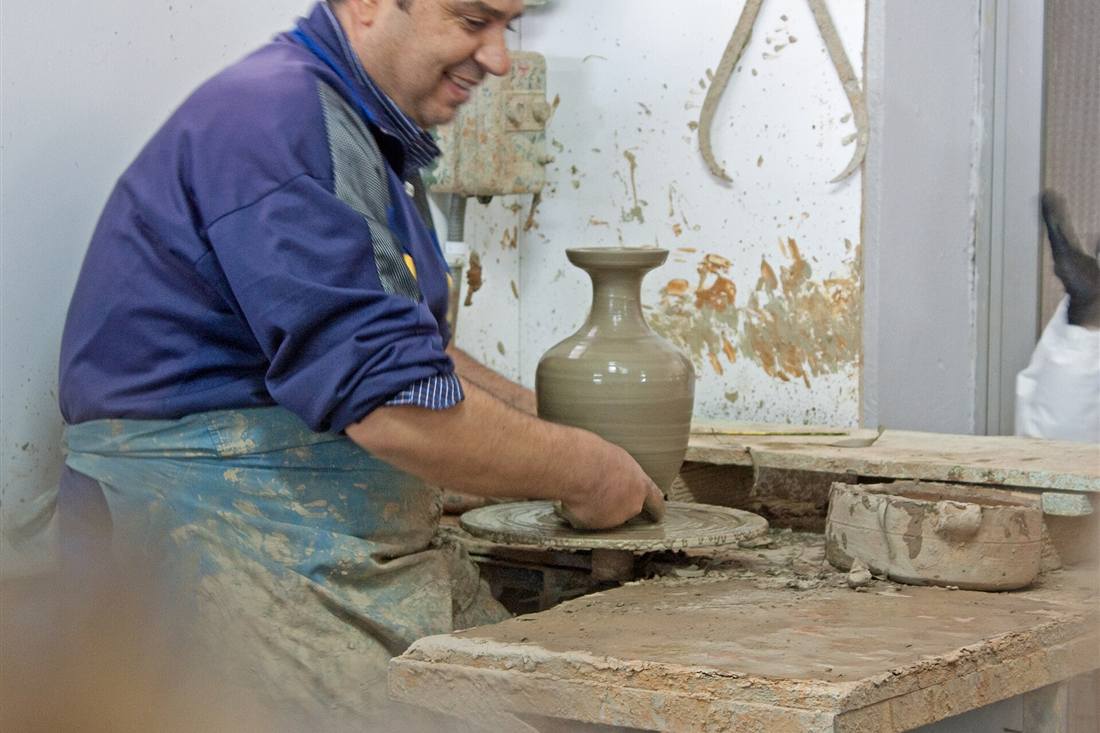
The format is simple. A potter demonstrates each step, then every guest repeats it at a wheel or a bench of their own. An Athens pottery class focuses on one object, such as a mug, a cup, a small bowl or a charm, so the lesson stays clear and the result is something usable. The teacher corrects posture, hand position and wheel speed while guests work, which is the fastest way to learn a craft that relies on touch more than theory.
The setting adds meaning. Athens gave the world the word ceramic, and Athenian potters produced the black-figure and red-figure vases now shown in museums across Europe. An Athens pottery class links that history to a modern studio, where the tools are an electric wheel, a sponge, a wire cutter and a wooden rib instead of the hand-turned wheels painted on ancient vases. The clay, the centring and the patience remain the same.
Which Athens pottery classes are on sale?
Five Athens pottery classes are on sale: a wheel class with mug painting, a hand-building workshop in Koukaki, a create-your-own class on the wheel, a ceramic cup workshop and an evil eye charm workshop. Each one ends with a piece the guest shaped.
The five formats split into two groups. Three classes centre on the pottery wheel, where clay spins and the hands raise the walls of a cup or bowl. Two classes stay at the table, where guests shape clay with their fingers and simple tools. Durations, group sizes, start times and meeting points differ from class to class, so check the tour listing for each detail before choosing an Athens pottery class.
The titles describe the core activity of each Athens pottery class on sale. The list below restates them in plain terms, so the choice comes down to the object a guest wants to take home and the technique a guest wants to learn.
- Pottery Wheel Class and Mug Painting – wheel throwing plus painting a mug with colour.
- Hand-Building Pottery Workshop in Koukaki – shaping clay by hand in the neighbourhood south of the Acropolis.
- Create Your Own Ceramic Pottery Class on the Wheel – a wheel session built around a piece of the guest’s own design.
- Create a Ceramic Cup in a Pottery Workshop – a workshop built around making one ceramic cup.
- Evil Eye Ceramic Charm Workshop – shaping and painting the blue Greek charm against envy.
How does wheel throwing work in an Athens pottery class?
Wheel throwing in an Athens pottery class follows five steps: wedging the clay, centring it on the spinning wheel head, opening the centre, pulling up the walls and shaping the profile. The potter demonstrates each step before guests try it at their own wheel.
Wedging comes first. The clay is kneaded on a table to push out air bubbles, because trapped air expands in the kiln and cracks the piece. Centring is the hardest step for beginners: wet hands press the spinning lump until it runs true, with no wobble. An Athens pottery class spends real time on centring, since every later step depends on a clay body that sits dead centre on the wheel head.
Once the clay is centred, the thumbs open a well in the middle and the fingers pull the walls upward in slow, even passes. The teacher sets the wheel speed and shows guests how to brace their elbows against their body for control. First attempts collapse at times, and that is part of the lesson. A collapsed pot goes back into the clay bag, and the guest starts again with a fresh ball.
- Wedging – kneading the clay to remove air and even out moisture.
- Centring – pressing the spinning clay until it turns without wobble.
- Opening – pressing the thumbs down to form the floor and the inner well.
- Pulling – lifting the walls upward in thin, even passes.
- Shaping – curving the wall into a cup, bowl or mug profile.
Is hand-building easier than wheel throwing?
Yes, hand-building is easier for most first-timers. A hand-building Athens pottery class uses pinch pots, coil building and slab building, and the clay stays still on the table, so children and cautious beginners get results without the balance and pressure the wheel demands.
A pinch pot starts as a ball of clay pressed open with the thumb and thinned by turning it in the palm. Coil building rolls long ropes of clay and stacks them in rings, smoothing each join so the wall holds together. Slab building rolls clay flat like pastry, cuts panels and joins them into boxes, plates or tiles. The Koukaki workshop on sale teaches this table-based approach to shaping clay.
The choice between the two comes down to goals. The wheel gives round, symmetrical forms and the thrill of clay rising under the hands, but it demands focus and some upper-body strength. Hand-building gives more freedom of form, a quieter pace and fewer failed attempts. First-timers who want a usable mug pick a wheel-based Athens pottery class, and those who want a sculptural object or a relaxed session pick hand-building.
- Pinch pot – a ball of clay opened and thinned between thumb and fingers.
- Coil building – rolled ropes of clay stacked in rings and smoothed together.
- Slab building – flat sheets of clay cut to shape and joined at the edges.
How do glazing, painting and firing finish a pot?
A pot from an Athens pottery class is finished in three stages: a bisque firing at about 900–1,000 °C hardens the dry clay, glaze or underglaze colour goes on next, and a glaze firing melts the glaze into a glassy, waterproof surface.
Underglaze painting is the decorating method in a mug painting session. Underglaze colours go onto the clay before the clear glaze, so the design sits under a glassy coat and survives daily washing. In the wheel class with mug painting, guests brush patterns, names or motifs onto a mug, and an Athens pottery class of this type is a chance to borrow ancient designs such as the meander band.
Clay type sets the firing heat. Earthenware fires at low temperatures and stays slightly porous under its glaze. Stoneware fires at about 1,200–1,300 °C and becomes dense and strong, which suits mugs in daily use. Porcelain is the finest and whitest clay body, and the hardest for a beginner to throw. The studio chooses the clay and glazes for each Athens pottery class, so check the tour listing for the materials used.
What happens to your piece after an Athens pottery class?
After an Athens pottery class, the piece stays at the studio to dry, then goes through a bisque firing, glazing and a glaze firing. The finished object is collected later or shipped, and the tour listing states which option applies.
The clay-to-kiln timeline explains the wait. Freshly thrown clay is soft and full of water. It dries slowly to the leather-hard stage, when a potter trims the foot and cleans the base, and then to bone-dry. Firing damp clay turns the water to steam, which cracks or bursts the piece, so drying takes days and firing takes more time. That is why most studios fire each piece after an Athens pottery class ends.
For travellers, this timeline is the most important practical detail. A visitor with a short stay needs an Athens pottery class that ships, or one that lets a friend in the city collect the finished piece. Booking the class early in the trip leaves the most time for drying and firing, and the tour listing sets out the collection or shipping terms.
- Drying – the wet piece loses water until it reaches the leather-hard stage.
- Trimming – the leather-hard piece is turned and its foot is carved clean.
- Bisque firing – the bone-dry piece is fired at about 900–1,000 °C.
- Glaze firing – the glazed piece is fired again to melt the glaze.
- Collection or shipping – the finished piece is picked up or sent on.
Why did the Kerameikos give its name to ceramics?
The Kerameikos was the potters’ quarter of ancient Athens, and its name comes from keramos, the Greek word for potter’s clay. The English word ceramic shares that root, so every Athens pottery class carries the name of this district.
The quarter lies north-west of the Acropolis, by the Dipylon Gate and the Eridanos stream. Potters worked there from the Geometric period onward, turning out storage jars, drinking cups and grave vessels. The same ground held the ancient cemetery of the city, and the large painted vases found in its graves are key evidence for the history of Athenian pottery. The Kerameikos archaeological site is open to visitors today, with its own site museum.
Visiting the site before or after an Athens pottery class gives the lesson context. The site museum displays vases, grave markers and finds from the cemetery, and the walk from the Acropolis passes through Monastiraki and Thissio. Standing where Athenian potters worked turns the modern wheel into part of a long local line rather than a holiday novelty.
What are Attic black-figure and red-figure vases?
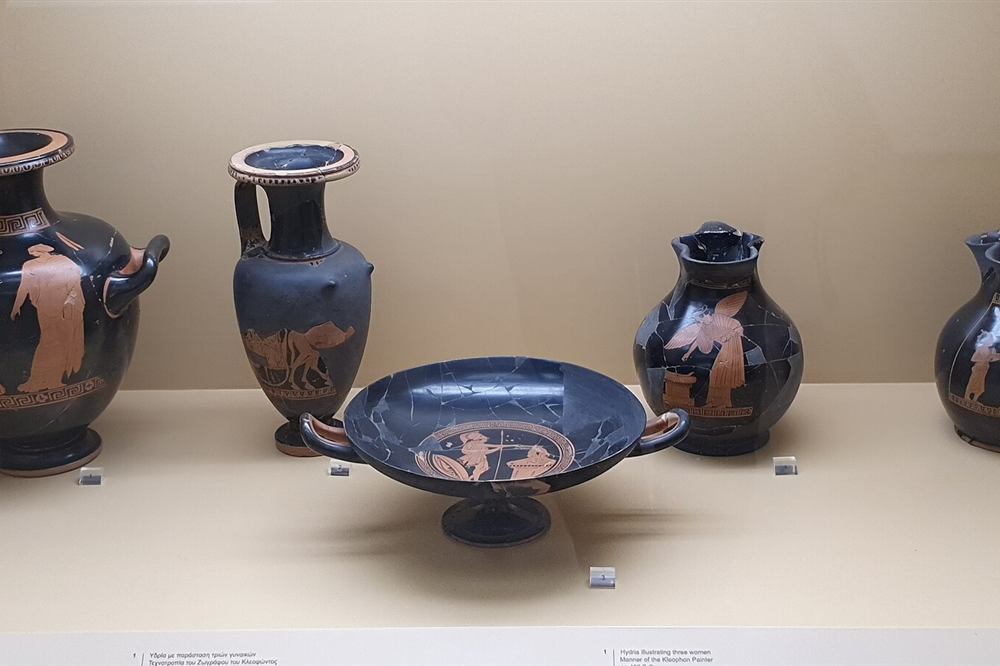
Black-figure and red-figure are the two main painting techniques of Attic pottery. Black-figure paints figures in black slip and incises the details, while red-figure, invented in Athens about 530 BC, leaves the figures in the red colour of the clay against a black background.
The sequence began earlier with the Geometric style of the 8th century BC, when the large Dipylon amphorae and kraters carried meander bands and stylised funeral scenes. Black-figure followed and peaked in the 6th century BC with painters such as Exekias. Red-figure then reversed the scheme, which let painters draw anatomy and drapery with a brush instead of scratching lines. The meander bands painted on mugs in an Athens pottery class come straight from this tradition.
Each vase shape had a job. The amphora stored wine, oil or grain, and Panathenaic amphorae filled with olive oil were the prizes at the Panathenaic Games. The krater mixed wine with water, the kylix was a wide drinking cup, the hydria carried water, the lekythos held oil and the oinochoe served as a jug. White-ground lekythoi were made for graves. Knowing these forms turns an Athens pottery class into a lesson in reading museum cases.
Does a modern Athens pottery class use ancient technique?
Yes, in its basics. A modern Athens pottery class keeps the ancient steps of wedging, throwing and trimming, but it replaces the three-stage firing and iron-rich black slip of Athenian workshops with an electric kiln, commercial glazes and underglaze colours.
Athenian potters made their black gloss from a fine, iron-rich slip and a single firing in three stages. An oxidising stage turned the whole pot red, a reducing stage with the air cut off turned it black, and a final re-oxidising stage turned the coarser clay red again while the dense slip stayed black. That chemistry produced the contrast of black-figure and red-figure vases without any glaze at all.
A studio today fires twice, first to bisque and then to melt a glaze, and it controls the heat with an electric kiln rather than wood and draught. The wheel spins on a motor, and underglaze colours replace slip painting. The hands, however, repeat the old work of the Kerameikos: an Athens pottery class still teaches centring, pulling and trimming, the same movements an ancient apprentice learned.
Where can you see ancient Greek pottery in Athens?
Athens has five main places to see ancient pottery: the National Archaeological Museum, the Kerameikos site museum, the Museum of Cycladic Art, the Acropolis Museum and the Ancient Agora Museum in the Stoa of Attalos. Each one pairs well with an Athens pottery class.
The National Archaeological Museum holds the largest collection, from Geometric Dipylon vases to black-figure and red-figure work. The Museum of Cycladic Art adds early Aegean vessels and marble figurines. The Acropolis Museum and the Ancient Agora Museum show pottery found on the sites themselves, including the plain cups, jugs and cooking pots of ordinary Athenians, the same everyday forms a beginner shapes in an Athens pottery class.
A museum visit the day before an Athens pottery class sharpens the eye for shape and proportion, and a visit after it shows how much skill a thin, even wall demands. The painted scenes also give ideas for decoration: a meander band, an olive branch or a simple wave pattern transfers well from an ancient vase to a modern mug.
- National Archaeological Museum – the largest collection of Geometric, black-figure and red-figure vases.
- Kerameikos site museum – grave vases and finds from the ancient potters’ quarter.
- Museum of Cycladic Art – early Aegean vessels and marble figurines.
- Acropolis Museum – pottery and finds from the Acropolis and its slopes.
- Ancient Agora Museum – everyday Athenian pottery shown in the Stoa of Attalos.
Which Greek pottery traditions continue today?
Greek pottery remains a living craft. Marousi in north Athens was known for its potteries and water jugs, Sifnos keeps a long potters’ tradition, and Thrapsano in Crete makes the large pithoi storage jars. An Athens pottery class joins this line.
The roots run deeper than Athens. Minoan pottery from Bronze Age Crete and Mycenaean pottery from the mainland are older traditions than the Attic ware behind an Athens pottery class, each with its own shapes and painted motifs. The pithos, the tall storage jar still made in Thrapsano, is a shape that Minoan palaces already used for oil, grain and wine.
For travellers, these places offer a second pottery stop after an Athens pottery class. Sifnos lies in the western Cyclades and has a long potters’ tradition. Thrapsano sits inland from Heraklion in central Crete. Marousi, on the metro line north of the centre, was a pottery town before it became a busy suburb. Each place shows how Greek clay work moved from ancient vases to kitchen pots and garden jars.
What does the evil eye charm mean?
The evil eye, called mati in Greek, is a blue eye charm that wards off envy and bad luck. The Evil Eye Ceramic Charm Workshop turns this common Greek souvenir into an Athens pottery class, where guests shape and paint a charm of their own.
The belief holds that an envious look causes harm, and the blue eye turns that harm away. Greeks hang the mati in homes, cars and shops, pin it to baby clothes and wear it as jewellery. Shops in Plaka and Monastiraki sell it in glass, ceramic and metal, and souvenirs from Athens include ceramics and charms from the same streets.
A charm workshop is the gentlest entry into clay for most guests. The shapes are small, the rings of dark blue, light blue, white and black are simple to paint, and the fired piece is light to carry home. An Athens pottery class of this kind suits families, groups of friends and anyone who wants a personal gift rather than a shop-bought one.
Who is an Athens pottery class suited to?
An Athens pottery class suits complete beginners, couples, families, solo travellers and groups of friends. No experience is needed, and the indoor studio makes it a strong choice for hot afternoons and rainy days, when outdoor sightseeing is hard.
For couples, the wheel class is a shared activity, and each partner leaves with a matching mug or cup. Solo travellers join other guests and a teacher in a group class, which makes the lesson social without effort. Families pick hand-building for younger children, since the clay stays still, while wheel work suits children from about 8 years old with an adult beside them. Check the tour listing for the exact age limits of each Athens pottery class.
Weather is the other reason to book an Athens pottery class. Summer afternoons in Athens are hot, and the hours after lunch are the hardest time for walking the Acropolis or the Ancient Agora. A studio keeps guests indoors and out of the sun in that window. On the rainy days of winter, a class replaces an outdoor plan without losing a day of the trip, and the Athens travel hub covers the rest of the city.
What do you wear and bring to a pottery studio?
Wear old clothes to an Athens pottery class, because wet clay and glaze stain fabric. Short nails help on the wheel, long hair goes up and rings come off. Most studios provide aprons, but check the tour listing before the session.
Clay work is messy by design. On the wheel, water and slip spray from the spinning clay onto forearms, laps and shoes, so dark, washable clothes and closed shoes work well. Long nails cut into the soft wall as it rises, which is why potters keep them short. Rings and bracelets scratch the clay and trap slip, so a pocket or bag for jewellery is useful at the start of an Athens pottery class.
Guests bring little else. The studio supplies the clay, the tools, the glazes and the kiln, and a phone for photos and a bottle of water cover the rest. Travellers with limited time in Greece note the collection or shipping terms on the listing before arrival, so the finished piece reaches them after the trip.
- Old clothes – dark, washable layers that tolerate clay and glaze stains.
- Short nails – trimmed nails that do not cut into the rising clay wall.
- Tied-back hair – long hair kept clear of the spinning wheel.
- Closed shoes – footwear that tolerates splashes of water and slip.
- Water bottle – drinking water for a session of focused work.
How does a pottery class compare with other Athens craft workshops?
An Athens pottery class is the most hands-on and the messiest of the city’s craft workshops. Mosaic, painting, jewellery and marble carving sessions teach different skills, and each one produces a different handmade object to take home.
An Athens mosaic workshop sets small pieces of stone or glass into a design, a craft rooted in ancient and Byzantine floors. An Athens painting class works with brush and colour, and an Athens jewelry workshop ends with a wearable piece. Each of these shares the teacher-led format of an Athens pottery class.
The Athens marble carving workshop uses chisels on marble, the stone of the Parthenon, and it is the closest match to clay for physical effort. Clay stands apart in two ways: it is the only one of these crafts where the hands follow material spinning on a wheel, and the only one where a kiln finishes the work after the session. An Athens pottery class suits travellers who enjoy the feel of making and accept a wait for the result.
When does a pottery class fit best into an Athens trip?
An Athens pottery class fits best early in the trip, so the studio has time to dry, glaze and fire the piece before departure, and in the hot early afternoon of the day, when outdoor sightseeing is at its hardest.
Class durations are not stated in the titles, so check the tour listing for the length, the start times and the cancellation terms. Summer is the busiest season in Athens, and booking ahead secures the preferred slot. Booking at the start of the trip also protects the drying, firing and collection timeline for an Athens pottery class, which matters more than the exact day of the week.
A simple day plan puts sightseeing in the cool morning, the class in the early afternoon and a walk or dinner in the evening. Koukaki, the neighbourhood just south of the Acropolis, makes one walkable example: the Acropolis and its museum in the morning, the hand-building workshop there after lunch and a sunset stroll through Plaka. Travellers who spend daylight hours on day trips check the listing for later start times.
Is an Athens pottery class worth it?
An Athens pottery class is worth it for travellers who want a hands-on, indoor activity tied to the history of the city. It teaches a real skill in one session, links directly to the Kerameikos and Attic vases, and leaves a handmade piece.
The value lies in the combination. Museum visits show what Athenian potters made, and an Athens pottery class shows how hard it is to make it. After one session on the wheel, a red-figure kylix with walls as thin as a fingernail reads as a feat of skill rather than an old cup behind glass. That shift turns every later museum visit into a closer look.
The practical case is strong too. A class needs no experience, works in any weather and ends with a personal object instead of a mass-made souvenir. The one condition is time: travellers confirm collection or shipping on the tour listing before booking, so the finished piece from an Athens pottery class reaches home safely.
Frequently Asked Questions
Do you need experience for an Athens pottery class?
No experience is needed. The teacher demonstrates every step, from wedging and centring to shaping and painting, and corrects hand position during the session, so complete beginners leave the studio with a piece they shaped themselves.
Can children join a pottery class in Athens?
Children can join an Athens pottery class with an adult. Hand-building and the evil eye charm workshop suit younger children because the clay stays still, while wheel work suits children from about 8 years old. Check the tour listing for the exact age limits.
Do you take your pottery home the same day?
No, the piece stays at the studio after an Athens pottery class, because wet clay needs days to dry before its bisque firing, glazing and glaze firing. Check the tour listing for the collection or shipping terms that apply to each class.
What is the difference between wheel throwing and hand-building?
Wheel throwing shapes spinning clay into round, symmetrical forms such as mugs and bowls. Hand-building shapes still clay with pinch, coil and slab methods. An Athens pottery class on the wheel demands more balance and focus, while hand-building is calmer and freer in form.
Is a pottery class a good rainy-day activity in Athens?
Yes. An Athens pottery class takes place indoors in a studio, so rain, wind and summer heat do not affect it. That makes it a strong choice for a wet winter day or a hot summer afternoon, when outdoor sightseeing is at its hardest.