
Athens Mosaic Workshop
An Athens mosaic workshop is a hands-on art class in which beginners cut marble, glass and ceramic pieces and set them into a small mosaic to keep. Greece Tours covers the three Athens mosaic workshop formats on sale: an evil-eye piece with a souvenir, an art session in the Gazi neighbourhood and a 2.5-hour class joined to a Byzantine walking tour.
Mosaic in Greece runs from the pebble floors of the 4th century BC to the gold-ground Byzantine mosaics of Daphni Monastery, west of the city centre. Each Athens mosaic workshop teaches the same core steps of design, cutting, setting and grouting, and no art experience is needed.
What is an Athens mosaic workshop?
An Athens mosaic workshop is an instructor-led craft session where each participant designs a small mosaic, cuts stone, glass or ceramic pieces to shape, sets them in adhesive and grouts the surface, then keeps the finished piece.
The class takes place in a studio or workshop space, and an instructor guides every step, from the first sketch to the final polish. Mosaic is the art of building an image from small pieces called tesserae, set close together so that the eye reads colour, line and shape as one picture. An Athens mosaic workshop turns that ancient technique into a practical session that fits into a day of sightseeing in the capital.
The session sits easily beside the monuments, museums and neighbourhoods of Athens, since it needs no fair weather. Check each listing for the tools, materials and base that come with the class. An Athens mosaic workshop also changes how a visitor reads the ancient and Byzantine mosaics of the city, because the hands-on work shows how each tessera is cut, placed and grouted into a line, a face or a pattern.
Which mosaic workshop formats are on sale in Athens?
Three Athens mosaic workshop formats are on sale: an evil-eye mosaic class that ends with a souvenir to take home, a mosaic art workshop in the Gazi neighbourhood, and a 2.5-hour mosaics workshop joined to a Byzantine walking tour.
The evil-eye format centres on the mati, the blue eye charm of Greek tradition, and participants set a round eye design in coloured tesserae. Its listing title adds a souvenir to take home, so check the listing for what that souvenir is. This Athens mosaic workshop suits first-timers, because the eye design uses four colours and a clear outline that a beginner completes in one session without prior art training.
The Gazi format is a mosaic art workshop held in the former gasworks district beside the Kerameikos archaeological site. The Byzantine format pairs a 2.5-hour mosaics workshop with a walking tour of Byzantine sites, so the craft and the history sit in one outing. Check the listing for the stops on the route. Every Athens mosaic workshop listing shows the meeting point and the language, and most show the group size.
Who does an Athens mosaic workshop suit?
An Athens mosaic workshop suits beginners with no art experience, couples, families with children, solo travellers and anyone planning a rainy day in the city. The instructor demonstrates each step, so no drawing or craft skill is needed before the class.
Beginners gain the most, since the instructor teaches cutting, setting and grouting from the first tile. Couples work side by side and plan matching designs in the same colours, which turns the two pieces into a pair. Solo travellers join the other participants at the table and leave with a handmade object in place of a shop-bought one. An Athens mosaic workshop also fills a rainy afternoon, because the mosaic work itself runs indoors.
Families with children use the class as a quiet, seated break from walking between ruins, and the Athens with kids page lists more ideas for the same trip. Cut glass and tile have sharp edges, so the youngest participants work under close adult supervision at the table. Each listing sets its own minimum age, so check the details before booking an Athens mosaic workshop for a family with young children or teenagers.
How is a mosaic made step by step?
In an Athens mosaic workshop, a piece is made in seven steps: choosing a design, drawing it on the base, cutting tesserae with wheeled nippers, setting them in adhesive, following the flow of the lines, grouting the gaps and cleaning the surface.
The work in an Athens mosaic workshop starts with the design. Participants pick a motif, such as an evil eye, a fish or a geometric border, and draw its outline on the base board. The instructor shows how to hold wheeled nippers, a hand tool with two cutting wheels that snap glass and tile along a line. Squares become halves, quarters, triangles and curves, and each cut piece is a tessera ready for setting.
Setting follows the direct method: each tessera goes face up into a thin layer of adhesive on the final base, so the maker sees the image grow in real time. The flow of the lines matters as much as the colour. Mosaic makers call this flow andamento, the Italian term for the movement of the rows, and the rule is to lay tesserae along the outline first and fill the background after.
Grouting and cleaning close the work. Once the adhesive holds, the maker spreads grout across the surface and presses it into every gap between the tesserae. A damp sponge lifts the excess from the tiles, and a dry cloth buffs away the last haze until the colours show clean. The grout then cures for about a day, so check the Athens mosaic workshop listing for how the piece dries and travels.
What materials and tools does a mosaic need?
A mosaic needs pieces of marble, stone, glass smalti, ceramic tile or pebble, a base board or frame, adhesive and grout, plus wheeled nippers to cut the pieces. Smalti are coloured glass tesserae, and Byzantine gold tesserae hold gold leaf between layers of glass.
Marble and natural stone give the matt, earthy tones of ancient Greek and Roman floors, from white and grey to ochre and deep red. Glass smalti add bright, saturated colour and a slight sparkle, and they are the main material of Byzantine wall mosaics. Ceramic tiles cut cleanly with nippers, which suits a first piece, while smooth river pebbles recall the oldest Greek floors, laid before makers learned to cut stone into cubes.
The base carries the whole piece. Mosaic classes set tesserae on a wooden board, on a tile or inside a frame, and the adhesive matches the base, from white craft glue on wood to cement-based mortar on stone. Grout comes in white, grey and darker shades, and its colour changes the look of the finished image. Check the listing for the base and the finished size, since each Athens mosaic workshop sets its own format.
- Wheeled nippers – cut glass and ceramic into halves, quarters and curves.
- Hammer and hardie – split marble and smalti over a fixed blade.
- Tweezers – place the smallest tesserae in tight corners.
- Rubber float – spread grout across the surface and into every gap.
Why does the evil eye suit a first mosaic?
The evil eye suits a first mosaic because it uses simple rings in four colours: a black pupil, light blue and white circles and a dark blue outer ring. The mati is also the Greek charm against envy, so the piece carries meaning.
In Greek tradition, the evil eye is harm caused by an envious glance, and the mati is the blue eye charm that turns it away. Greeks hang the mati by front doors and in cars, pin it to clothes and wear it as jewellery, and the charm fills the souvenir streets of Plaka and Monastiraki. The evil-eye Athens mosaic workshop joins that tradition to a craft more than two thousand years old.
The design teaches the basic skills of an Athens mosaic workshop. Each ring calls for tesserae cut into curves, so participants practise with the wheeled nippers on a clear, repeated shape, and the round outline shows where the flow of the lines breaks. The small palette of black, white and two blues keeps the choices simple. The finished eye hangs on a wall or sits on a shelf, and keeps its meaning back home.
When did mosaic art take shape in Greece?
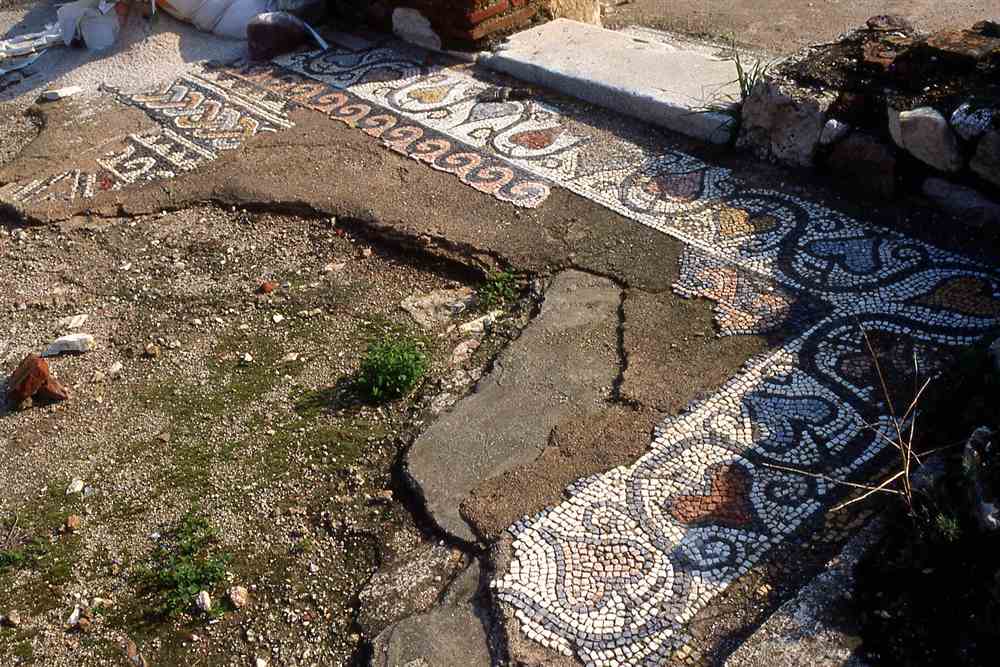
Greek mosaic art took shape with the pebble floors of the 4th century BC, moved to cut tesserae in the Hellenistic and Roman periods, and reached gold-ground wall mosaics under Byzantium, with Daphni Monastery near Athens as a UNESCO-listed example.
Athens keeps evidence of the later ancient stages close to its centre. The ruins of Hadrian’s Library beside Monastiraki Square hold sections of mosaic floor from an early Christian church that stood in the courtyard, and the National Archaeological Museum holds ancient mosaics. An Athens mosaic workshop uses the same basic unit as those floors, the tessera, so a visit to either site after the class shows the technique at full scale.
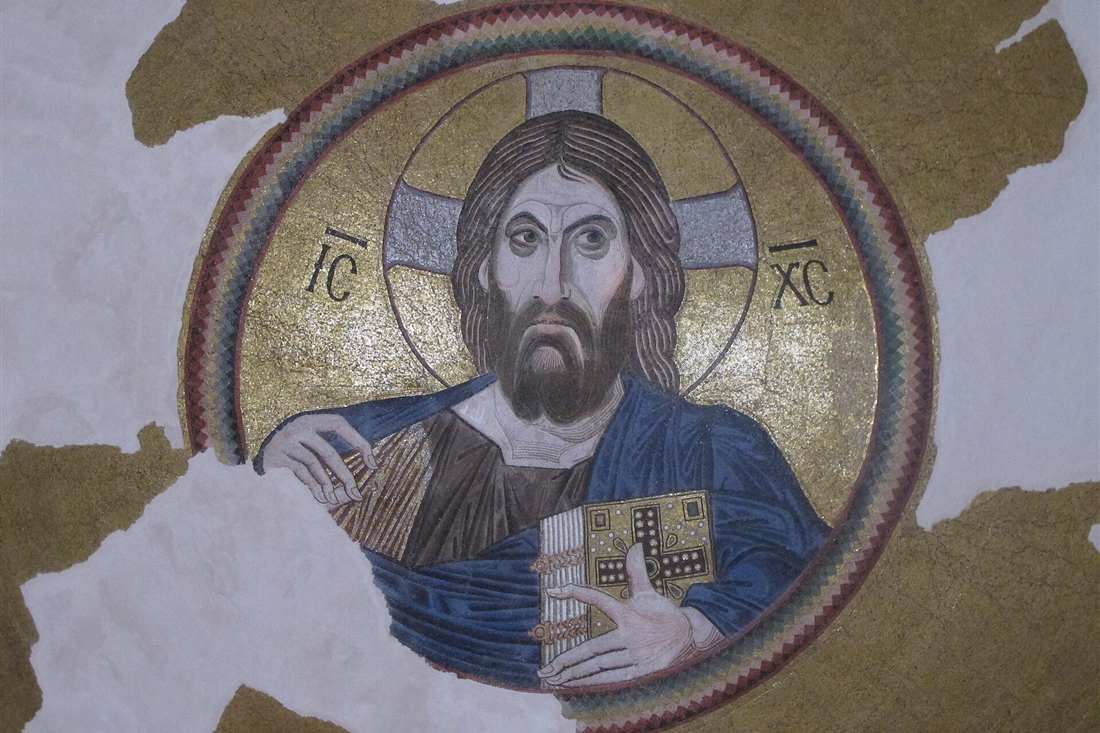
The Byzantine stage moved mosaic from floors to walls and domes, set on gold backgrounds. Daphni Monastery lies about 11 km west of central Athens on the Sacred Way to Eleusis, and its dome holds the Christ Pantokrator mosaic, the image of Christ as ruler of all. Daphni forms one UNESCO World Heritage Site with Hosios Loukas and Nea Moni on Chios, three monasteries whose churches carry gold-ground mosaics of the middle Byzantine period.
- Pebble floors – natural pebbles in light and dark tones, 4th century BC.
- Hellenistic floors – cut tesserae of stone and glass for finer shading.
- Roman floors – tesserae pavements in houses, baths and public buildings.
- Byzantine walls – glass and gold tesserae across church walls and domes.
Where are Gazi and Kerameikos in Athens?
Gazi lies west of the historic centre, just past the western end of Ermou Street, and the Kerameikos archaeological site sits directly beside it. The district is named after its 19th-century gasworks, which now house the Technopolis cultural centre.
The Gazi district grew around the old city gasworks, and its brick buildings, chimneys and gas tanks survive inside Technopolis, which hosts exhibitions, concerts, theatre and festivals. Bars, restaurants and galleries fill the surrounding streets, and Kerameikos metro station on Line 3 opens onto the district. The Gazi format of the Athens mosaic workshop places the class in this former industrial setting, a short walk from Psiri, Monastiraki and the Ancient Agora.
Kerameikos was the ancient cemetery of Athens, and its name comes from the potters, the kerameis, who worked in the quarter; the English word ceramic shares the same root. The Sacred Way to Eleusis began at the Sacred Gate in the city walls there and ran west past the site of Daphni Monastery. An Athens mosaic workshop in Gazi therefore sits beside the old potters’ quarter and the start of the road to Daphni.
How does a finished mosaic travel home?
A finished mosaic travels home once the grout has cured, which takes about a day, wrapped flat in padding inside hand luggage or at the centre of a suitcase. Check the Athens mosaic workshop listing for drying time and packing.
Grout needs time to harden, so a piece grouted at the end of a session stays fragile at the joints for the rest of that day. Booking an Athens mosaic workshop early in the trip leaves a full day for curing before the flight, while a class on the final afternoon leaves no margin. Check the listing for when the piece is ready to carry and how it leaves the studio before choosing a date.
Weight matters as much as timing. Marble, glass and a wooden or stone base make a mosaic heavier than a painted souvenir of the same size, so the piece counts toward the luggage allowance. A small piece fits flat in hand luggage, which keeps it away from the rough handling that checked bags receive, and a double layer of padding protects the tesserae at the edges, where chips and cracks start.
- Cure first – allow about a day for the grout to harden.
- Cover the face – wrap the tesserae in bubble wrap or a towel.
- Add a board – lay stiff cardboard over the front against pressure.
- Pack flat – lay the piece between soft clothes in the bag.
Do Athens mosaic workshops need advance booking?
Yes. Booking an Athens mosaic workshop ahead through the tour listing secures a seat on the chosen date and time. Check the listing for the group size, the language, the session length and the meeting point before confirming the booking.
Workshops run on set dates and times, so the calendar on the listing shows which sessions still have seats. Reserving an Athens mosaic workshop well before the trip gives the widest choice of dates in the summer months, when Athens receives the most visitors. A date in the first half of a trip leaves room to rebook if plans or weather change, and the booking confirmation carries the meeting point and the start time.
On the day of an Athens mosaic workshop, arrive at the meeting point ahead of the start time on the listing. Grout and adhesive stain fabric, so wear clothes that can take a mark and remove rings before grouting. Small glass chips fly from the nippers during cutting, so wear glasses or safety goggles at the table. The Byzantine format adds a walk through the city, which calls for comfortable shoes and a bottle of water.
- Group size – the number of participants in each session.
- Language – the language of the instructor and the walking tour.
- Length – stated in the title only for the 2.5-hour Byzantine format.
Can a mosaic session be combined with museums and a painting class?
Yes. An Athens mosaic workshop combines with visits to the Byzantine and Christian Museum, the National Archaeological Museum and Hadrian’s Library, which all hold mosaics, and with a painting class for a second creative session on another day.
The Byzantine and Christian Museum holds mosaic floors from early Christian churches alongside Byzantine icons and frescoes, and it makes a direct follow-up to the Byzantine format of the class. Seeing these pieces after an Athens mosaic workshop turns each room into a lesson in cutting, colour and the flow of the lines, because the eye now picks out every row of tesserae and every change of shade in the stone and glass.
A painting class in Athens uses the same seated studio format with an instructor at the table, and it adds colour and brushwork to the cutting and setting learned in mosaic. Pairing the Athens mosaic workshop with a museum visit on the same date builds a cultural outing around one craft. The combination also covers a rainy day in the city, since the mosaic work, the museums and the painting session all take place indoors.
- Byzantine and Christian Museum – floor mosaics and Byzantine art on Vasilissis Sofias Avenue.
- Hadrian’s Library – floor fragments in their original setting beside Monastiraki.
- Daphni Monastery – the gold-ground Christ Pantokrator in the dome, west of the centre.
Is an Athens mosaic workshop worth it?
Yes. An Athens mosaic workshop is worth it for travellers who want a handmade keepsake, a seated break from sightseeing and a practical grasp of the mosaics in the city’s museums and churches. It suits beginners, couples, families and solo travellers alike.
The value lies in what the class leaves behind: an object and a skill. A shop souvenir arrives ready-made, while a mosaic made in Athens carries the maker’s own cuts, colours and small flaws. The skills learned in an Athens mosaic workshop also change later sightseeing, because the floor fragments at Hadrian’s Library and the gold dome at Daphni now read as thousands of single decisions made by hand.
Each format answers a different aim. The Byzantine format suits travellers who want history and craft in one outing, the evil-eye format suits a first piece with a clear meaning, and the Gazi format places the class beside Technopolis and the Kerameikos site. The mosaic work itself runs indoors and needs no prior skill, so an Athens mosaic workshop fits a rainy day, a hot afternoon or the gap between two museum visits.
Frequently Asked Questions
Does an Athens mosaic workshop require art experience?
No. An Athens mosaic workshop is built for beginners: the instructor demonstrates the design, the cutting with wheeled nippers, the setting in adhesive and the grouting, and participants copy each step at the table. Drawing skill helps with the design but is not required.
What does a participant take home from an Athens mosaic workshop?
Each participant takes home the mosaic made in class, and the evil-eye format adds a souvenir named in its listing title. The grout cures for about a day, so check the listing for when the piece is ready to carry and how it is packed.
Can children join an Athens mosaic workshop?
Yes. Families with children join the class, and the seated, indoor format suits young makers. Cut glass and tile have sharp edges, so children work under adult supervision, and each listing sets its own minimum age, so check it before booking.
How long does an Athens mosaic workshop last?
The Byzantine format names a 2.5-hour mosaics workshop in its title, joined to a walking tour. The evil-eye and Gazi formats of the Athens mosaic workshop set their own lengths, so check the listing for the length, the start time and the meeting point.
What are tesserae and smalti?
Tesserae are the small cut cubes of stone, glass or ceramic that make up a mosaic. Smalti are coloured glass tesserae, and Byzantine gold tesserae hold gold leaf between layers of glass. Pebbles, the oldest mosaic material, are natural stones and not cut tesserae.