
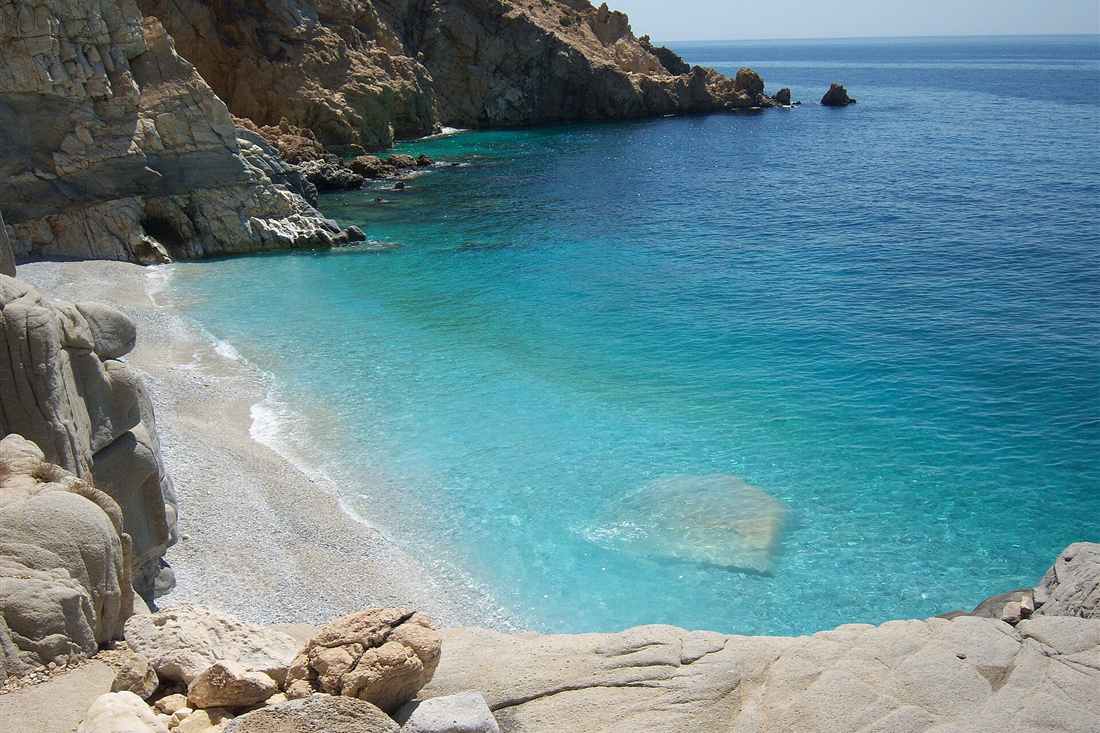
Ikaria tours cross the Blue Zone island of the eastern Aegean in full-day guided trips: the hot springs of Therma and the capital Agios Kirykos on the east side, Christos Raches, Nas and Armenistis on the west, family wineries, a longevity day, forest hikes and boat rides to Seychelles beach. Plan the rest of the trip with Greece Tours.
This page covers the Ikaria tours you can book, the villages, springs, wineries, beaches and museums they reach, the history and customs guides explain on the way, and how to reach and move around the island.
Which Ikaria tours can you book?
Ikaria tours run as full-day guided trips with pick-up and lunch: an east-side day with village stops and the Therma springs, a west-side day of villages and beaches, a longevity day, a two-winery day, a forest hike with a boat ride, and a spring hike.
Every morning a different full-day excursion leaves from a base in Evdilos, so a week on the island covers the main routes one day at a time. The east-side day stops in villages, bathes in the Therma springs and ends with lunch. The west-side day covers the Raches villages and beaches, with lunch in a village.
The longevity day combines forest yoga or pilates, a monastery visit and a family winery. The wine day visits two family-run wineries in one day, with pick-up. The hiking days walk Randi’s forest and reach Seychelles beach by boat, or follow the trail to the Alama spring, with a surf class in one version.
A winery tour with a tasting led by the winemaker is bookable on GetYourGuide as well. Ikaria tours on the regular programme take at most 8 people, while private options have no limit on group size.
Where is Ikaria and how big is the island?
Ikaria is a Greek island in the eastern Aegean, 10 nautical miles (19 km) south-west of Samos, in the North Aegean region. It covers 255 square kilometres, with 164 km of coastline and 8,312 inhabitants.
Samos lies to the east, the Fournoi islands to the south-east, Chios and the Anatolian coast to the north, and the Cyclades to the west and far south. The island forms its own municipality, made up of three units: Agios Kirykos, Evdilos and Raches.
The Aitheras range crosses the island from east to west. Its highest summit reaches 1,037 metres and splits Ikaria into a northern and a southern side, which is why Ikaria tours split into east-side and west-side days rather than one loop.
The climate is Mediterranean, with hot summers, wet winters and snow on the higher peaks in some winters. Ikaria tours run mainly in the warm months, when the springs, the beaches and the village festivals are open.
How do Ikaria tours cross the mountains?
Ikaria tours cross the island on mountain roads, because there is no way from one side to the other without climbing over the Aitheras range. The roads are good but steep in places.
The two sides of the island look different. The north is greener and more fertile, with large forests of Aleppo pine and oak and very few olive trees. The south is rockier and drier, with cliffs hundreds of metres high above the sea.
The central part of the island, which locals call Mesaria, is its most fertile area and its ancient centre; it covers the area of the Evdilos unit. To the west lies the Raches region, the part of Ikaria most visited for its traditional villages and cultural events.
Local operators run their island tours on alternate days for guests staying around Agios Kirykos and Therma and for guests staying in Armenistis. The drive back from Armenistis to Therma at the end of a west-side day takes one hour and forty-five minutes.
Which villages do Ikaria tours pass on each side of the island?
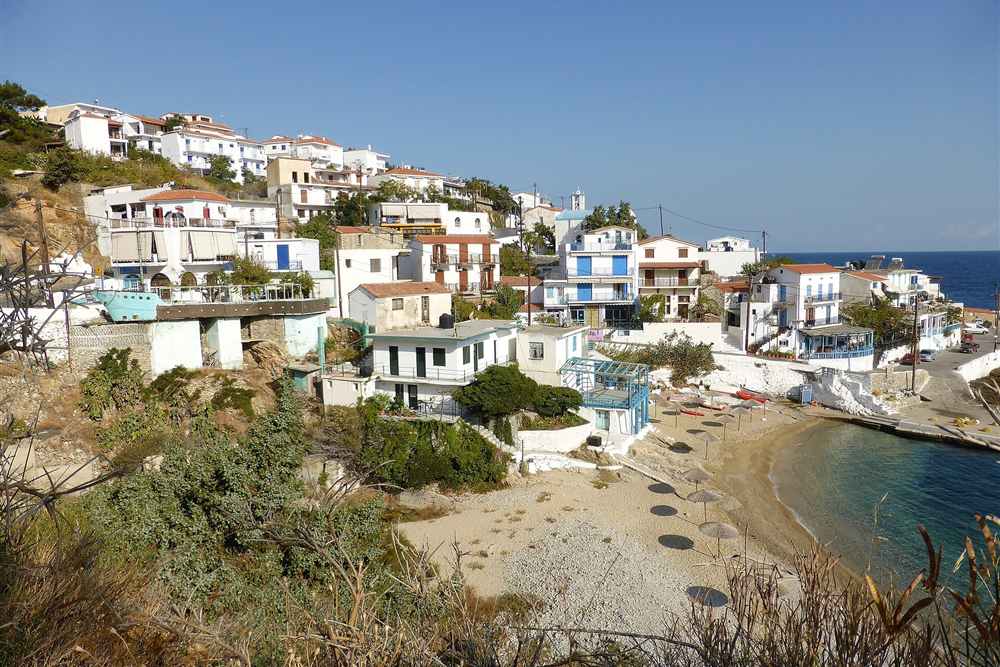
Ikaria tours pass villages grouped in three municipal units: Agios Kirykos and Therma in the south-east, Evdilos with Kampos, Karavostamo and Akamatra in the centre and north, and Raches with Christos, Armenistis and Nas in the west.
The Agios Kirykos unit takes in Therma, Xylosyrtis and Faros, and the communities of Perdiki and Chrysostomos. The Evdilos unit takes in Kampos, Arethousa, Dafni with Akamatra and Kosoikia, Karavostamo, Manganitis, and Frantato with Pigi and Maratho.
Frantato, with 728 people, lies west of Evdilos on the border with Raches, and the Theoktisti monastery stands near its village of Pigi. The Raches unit includes Christos, Armenistis, Vrakades, Nas, Proespera, Profitis Ilias, Gialiskari, Agios Polykarpos, and Karkinagri with Pezi.
The GetYourGuide Ikaria tours are listed under the island itself, under Nas for the west-side day and under Gialiskari for the longevity, wine and forest days.
What does the east-side Ikaria tour include?
The east-side Ikaria tour stops in the villages around the capital, Agios Kirykos, bathes in the hot springs of Therma and ends with lunch. It is the day that shows the southern coast and the spa tradition of the island.
Therma is a spa town 3 km east of the port of Agios Kirykos and 12 km from the island’s airport. Three springs are in use there, with water between 45 and 52.8 degrees Celsius. The springs are open to visitors from May to November.
A study by the University of Thessaloniki found that the saline hot mineral springs of Ikaria contain the largest concentration of radon in Greece, and they are among the most radioactive springs in the world. The island’s thermal spas have long been used as an aid to good health.
About ten minutes’ walk east along the coast from Therma, a marked path leads to a cove where hot springs rise straight into the sea. The start of the path climbs steps that look as if they lead to a house. In the evening, a water taxi carries the last visitors from the beach at Therma back to Agios Kirykos.
What do Ikaria tours show in Agios Kirykos?
Agios Kirykos is the capital and main port of Ikaria, a hillside town of 2,958 people named after Saint Kirykos. Ikaria tours on the east side pass its square, its cathedral and its two museums.
Saint Kirykos, or Quiricus, is the youngest martyr of the Eastern Orthodox Church; he died at the age of three in Asia Minor, and the cathedral of the town is dedicated to him. The town is the administrative capital of both the island and the Ikaria regional unit, which includes the Fournoi islands.
The Archaeological Museum fills the former high school, a neoclassical building paid for by Ikarians living in America. It holds the island’s most important finds, with multimedia displays and films on the history and trade of Ikaria. The Folk and Historical Museum shows over 1,500 objects, from dresses and textiles to farm tools, photographs and the flag of the Free State of Ikaria.
The town also has the statue called Skepsi, the “thinking woman”, and a brass band that plays on feast days. Every July, Agios Kirykos hosts the International Chess Tournament “Ikaros”. The Archaeological Museum also keeps finds from an ancient tower outpost on a nearby mountain, from pottery shards to jewellery and arrowheads, and the medieval monastery of the Annunciation stands at Lefkada near the town.
What is the evening like in Agios Kirykos after Ikaria tours?
Evenings in Agios Kirykos centre on the plateia, the town square, which fills again from eight to eleven at night after the afternoon nap. Bars stay open late, and the square is where the capital eats and meets after the day’s Ikaria tours.
The square is busiest in the morning from ten to one, when residents start their day. After lunch most locals nap, and the square fills again in the evening with dinner and with younger locals meeting before the town’s club. Some bars close only at five in the morning.
Agios Kirykos lies 25 minutes from the airport, 5 minutes from Therma and about an hour from Evdilos. In summer, clear skies and calm water set the rhythm; in winter, storms hit the town, and a breakwater of massive tetrapods protects it from the waves.
The winter storms sweep the sand away, so the beaches of Agios Kirykos are rocky. The town also has the Patela stadium, which hosted the Pan-Aegean Games, and the altar of the flame for the international IKARIADA air-sports games.
What does the west-side Ikaria tour include?
The west-side Ikaria tour links the villages and beaches of the Raches region, with stops such as Nas, Armenistis and Christos Raches and a lunch in a village. It is the side of the island with the most traditional settlements.
Raches is the largest of the three municipal units in area and the smallest in population, with 2,282 people, which makes it the least densely settled part of Ikaria. Its villages include Christos, Armenistis, Nas, also called Kato Raches, Vrakades, Proespera, Profitis Ilias and Gialiskari.
On the way west, Ikaria tours pass through country that guides describe as rock-climbing territory. The west-side tour on GetYourGuide starts from Nas and runs as a full day with lunch.
Guests staying on the east side reach the west on the days their local operator runs the Armenistis route. Guests staying in Armenistis join the east-side day on the alternate days.
Why do Ikaria tours start in Evdilos?
Evdilos is the second port of Ikaria and the centre of the north, centre and west of the island, so daily Ikaria tours leave from a base there. It sits 40 km north-west of Agios Kirykos and was the island’s first capital.
The name Evdilos means “visible”, a clear, open horizon. It is a seaside settlement built once piracy had ended on the island, when people returned to live on the coast. Together with nearby villages it forms the Evdilos municipal unit, with 2,996 permanent inhabitants.
The small port, the pier lined with old mansions, the narrow lanes and the paved steps make Evdilos the most architecturally traditional settlement on Ikaria. Kyparissi, the small sandy beach just before the town, has clear water, no facilities and a mostly local crowd.
George Spanos of Evdilos, the only Ikarian killed in the uprising that expelled the Ottoman garrison, is honoured as the hero of that uprising. His bust stands at the memorial in Chrysostomos, where he fell.
What do Ikaria tours see at Kampos, the ancient capital?
Kampos is the fertile, low-lying village in the north-central part of Ikaria where the ancient capital, Oenoe, stood. Ikaria tours stop there for the Archaeological Museum, the island’s oldest standing church and the wine country around it.
Greeks from Miletus, a naval city of Asia Minor, settled here and founded Oenoe. Later tradition names four ancient cities on the island: Oenoe, Thermae, Drakanon, now Faros, and Tauropolion, now Nas. When Samos colonised the island again, a temple of Artemis Tauropolos was built at Oenoe, and the city’s coins showed Artemis and a bull.
The Archaeological Museum of Kampos stands on the hill of ancient Oenoe, right next to Agia Irini, the oldest standing church on Ikaria. It holds over 250 finds: Neolithic tools, pottery, clay statuettes, columns, coins and carved headstones.
The road beyond Kampos climbs through vineyards, and one of the wineries on this stretch opens its doors to visitors. In antiquity, wine was the main income of Oenoe, which paid part of it to the Athenian treasury. The odeion, the city walls and other buildings of the old town are still visible, and Agia Irini was built on the ruins of a classical temple of Dionysus. The museums of Ikaria are free to enter, and their opening hours vary.
What is the story of the Theoktisti monastery on Ikaria tours?
The Theoktisti monastery sits high in the pine forests above Kampos, with a small church full of Byzantine frescoes and a chapel built into a cave. Ikaria tours stop there for its history, its views over the valley and its shop.
Guides tell the story of a community that lived in these mountains to escape pirates. When an Ottoman army found the church among the rocks, the priest asked to finish the service before the people gave themselves up. The villagers escaped through tunnels under the floor, lifted by the circles still visible in the marble, while the priest carried on alone and paid with his life.
Above the main church, a few steps lead to the chapel of Theoskepasti, set inside a cave under a flat, curved rock that locals nickname “the Mushroom”. The doorway is low, so visitors bend their heads to enter. The monastery was founded in the Byzantine era and at its peak housed around 100 monks; it is no longer inhabited, and the courtyard has seating areas and flower pots.
The monastery shop fries loukoumades topped with local honey and sells herbs, preserves and honey, with cheese curds hanging to dry. Our page on the Theoktisti monastery covers the site in more detail.
What happens on the Ikaria longevity tour?
The Ikaria longevity tour spends a full day on the habits behind the island’s long lives: yoga or pilates in the forest, a visit to a monastery and a meal and tasting at a family winery. It is one of the daily Ikaria tours with pick-up.
The tour sets out to show the secrets behind the long lives of Ikarians. Researchers link that longevity to a simple diet, a low-stress routine with movement built into daily work, and an active social life, and the day touches each of them: movement in the forest, the quiet of the monastery and the food and wine of a family table.
On multi-day wine and wellness tours, guests also learn to make fresh cheese with a local cheesemaker, bathe in the hot springs and visit the ancient temple of Artemis. Meals on those tours use whatever has just been caught or harvested, with high-polyphenol olive oil, unfiltered wine and local honey.
Yoga has become a reason to visit in its own right. The island’s seasonal yoga centre, The Egg, takes drop-in classes in June and July, and hotels arrange other classes around the island.
Why is Ikaria called a Blue Zone?
Ikaria is one of the world’s five Blue Zones, places where people regularly live to a great age. One in three Ikarians reaches their nineties, and the island has the highest population of people aged 90 and over in the world.
Researchers point to diet, lifestyle and genetics. The Ikarian diet uses small amounts of natural foods such as olive oil, red wine, herbal tea, fruit and vegetables, with limited meat, sugar and dairy. Daily life keeps stress low and exercise high through ordinary work, with an active social life around it.
The Ikaria Study examined these factors in detail and found a high rate of sexual activity among older men: 80 percent of Ikarian men aged between 65 and 100 still had sex on a regular basis.
Ikaria tours guides repeat the island’s own saying: Ikaria is the place where people forget to die. They add that locals take an afternoon nap, eat well from their own land and gardens, and that cases of dementia and depression are rare on the island.
What do guides tell about Ikarian life on Ikaria tours?
Guides on Ikaria tours describe a society with little difference between men and women or between old and young, where showing off wealth has no place and music and singing fill the evenings. They explain part of it through the island’s history.
When invaders reached the coast, the people moved into the mountains and lived through hard years there, which made them a stoic people. Guides say the island was never abandoned, even in its hardest centuries.
Ikarian girls receive the same education as boys, and guides point out that the island has the highest share of women university graduates in Greece. Old and young socialise together, and people who display their wealth are looked down on.
In the evenings, women sit on their doorsteps in the villages, playing music and singing along. Ikarians are not strongly religious, and at the monastery a guide waves away the question of covering up before entering the church.
Why do Ikaria tours visit Christos Raches in the evening?
Christos Raches is the village that never sleeps: its shops open at eight in the evening and stay busy late into the night. Ikaria tours on the west side stop in its square, its stone lanes and its shops of local products.
Visitors enter through one of three slate gateways, and a path leads past shops and tavernas. The Women’s Association of Raches sells homemade desserts, and small shops sell handmade natural products and pure local honey.
Beyond the main square and the large church, the village drops so steeply that some lanes have handrails. Dense forest surrounds Christos on all sides.
Every August, on the feast of the Transfiguration, Christos Raches holds a big village festival. Our page on Christos Raches covers the village in more detail.
What do Ikaria tours find in Armenistis?
Armenistis is the most visited resort on Ikaria and the last stop of the west-side Ikaria tours, with clear, deep turquoise water, the island’s largest share of rooms and a relaxed village pace. Tours stop there for a long afternoon on the beach.
A stream runs down from the mountain into Armenistis and forms a freshwater pool where terrapins live. Beaches lie within walking distance of the village.
Car rental companies operate in Armenistis, and in peak season a hire car has to be booked a few days ahead. Buses between Evdilos and Armenistis run only on alternate days, so the tours are the simplest way to reach the village without a car.
Guests who stay in Armenistis join the island tours on the days the local operator runs its Armenistis route, and reach the east side, Therma and Agios Kirykos that way.
What do Ikaria tours show of the temple of Artemis at Nas?
At Nas, on the north-west tip of Ikaria, a temple to Artemis Tauropolos stood on high ground inside a sheltered cove. The cove was sacred to the pre-Hellenic people of the Aegean and was the last port before the rough seas around the island.
Artemis Tauropolos, goddess of the hunt and the wild, was a patron of seafarers, which suited a harbour where ships waited before facing the Ikarian Sea. The temple stood in good condition until local villagers took its marble to build their church.
The Greek archaeologist Leon Politis excavated the site, and finds from his dig disappeared during the wartime occupation. Local legend says marble pieces of the temple still lie under the sand of the beach at Nas.
Nas is also called Kato Raches. The beach at Nas is one of the swimming stops of the west side, and the west-side Ikaria tours on GetYourGuide start from Nas.
Which Ikaria tours hike the Randi forest?
The Randi forest tour is a full-day hike through Randi’s forest, followed by a boat ride to Seychelles beach and lunch in a traditional village. It is one of the Ikaria tours for guests who want to walk.
Seychelles is one of the swimming beaches of Ikaria, and on this day the group reaches it by boat. A second version of the day swims at Seychelles after the forest walk.
The forests of Ikaria grow mainly on the north side of the Aitheras range, where Aleppo pine and oak cover the slopes.
The tour is bookable on GetYourGuide with pick-up. Our page on the Randi forest covers the walk in more detail.
Which hiking Ikaria tours follow the island’s old paths?
Ikaria has over 300 km of footpaths, and hiking Ikaria tours follow marked trails to hidden villages, waterfalls, old windmills, stone paths and a protected forest. The Alama spring hike is one of the guided day routes.
The Alama spring hike runs as a full day, and one version adds a surf class and a traditional dinner. Some of the island’s oldest footpaths, centuries old, have grown wild, so guided walks stick to paths known to be safe.
For guided hiking, the local group Ikarian Footprints leads walks on the island. Walking guidebooks to Ikaria describe the routes suited to day hikers and the history of the paths.
The Ikaria Surf School at Messakti beach gives surf lessons and paddleboarding, and its groups are out on the water through the season.
Which wineries do Ikaria wine tours visit?
Ikaria wine tours visit family-run wineries in the mountains, among them Karimalis at Pigi, Afianes and Tsantiris. One day tour covers two family wineries in a single day, and another is a tasting led by the winemaker.
The wineries sit on mountainside sites and welcome visitors to small, family settings, with tours built around Ikaria’s own grape varieties. At Afianes, a winery tour can include lunch, and at Karimalis an open kitchen hosts cooking lessons.
Visitors to Afianes learn the old way of making wine on the island: natural wines are left in clay amphorae buried beneath the earth for months, and the grapes are still trodden by foot. Wine tours built around this winery add seminars, cellar tastings and tastings of aged wines.
The vineyards grow mainly around Evdilos, Raches and Proespera, where mountain soil and sea winds shape the grapes. Our page on Ikaria wine tasting covers the tastings winery by winery.
What is Pramnian wine, the wine of Ikaria’s past?
Pramnian wine is the ancient wine of Ikaria, named after Mount Pramnos, today’s Atheras. Homer mentions it in both the Iliad and the Odyssey, and Ikaria tours to the wineries tell its story on the same slopes.
The ancient historian Semos wrote that on Ikaria there is a rock called Pramnos, next to a high mountain where Pramnian wine is made, and that some called the wine Pharmakites, “medicine”. The wine was tied to the worship of Dionysus.
According to local legend, Dionysus was born on Ikaria, in a cave near Drakano. Wine has kept its place at the centre of local celebrations, where it stands for joy and life in common.
The traditional Ikarian red is strong, dark and dry, and some reach over 16 percent alcohol without any added spirit. Wine tours on the island connect the ancient name with the natural wines of the family wineries.
Which dishes do Ikaria food tours taste?
Ikaria food tours taste a mountain kitchen built on goat, cheese, wild greens and olive oil: kathoura goat’s cheese, goat cooked for feasts, pies of wild greens, soufiko vegetable stew and honey from heather. Cooking with local families is part of the experience.
Isolation and the threat of pirates taught islanders to live from what they had. Curing meat, fermenting vegetables and making olive oil and cheese kept families fed, and these methods still shape Ikarian cooking.
The free-range goats of the mountains, called rasca locally, give lean meat that is boiled, roasted or stuffed with rice and herbs for festivals and family gatherings. Goat meat was also salted and air-dried in summer as pasto. Kathoura, or kathouritsa, is the signature cheese: goat’s cheese, soft and unsalted, with spicy and salted versions as well.
Local olive oil goes into nearly every dish, and the island produces enough for its own needs. Mountain village food on a self-made food day includes goat soup, horta (boiled greens), stews, fish, souvlaki and salads dressed with olive oil and fresh herbs, with Ikarian yogurt, fruit and honey.
Which vegetable dishes and sweets do Ikaria food tours include?
Ikaria food tours include soufiko, a vegetable stew served with kathoura cheese, courgette and chickpea fritters, pies of wild greens, gamopilafo rice, the root vegetable kolokasi, heather honey called anama and spoon sweets made by women’s cooperatives.
Soufiko is the island’s classic stew of summer vegetables. Kolokythokeftedes and revithokeftedes are fritters of courgette and chickpea, and kolokythopita and hortopita are pies filled with courgette and wild greens. Gamopilafo is a festive rice dish cooked in a rich broth.
Kolokasi is a sweet root vegetable that Greece grows almost only on Ikaria. Cooks serve it as a salad with skordalia garlic sauce, cook it with beans or pair it with meat.
Anama, the local honey, comes mainly from heather and is thick with a strong aroma. Spoon sweets of apricot, cherry, citrus, bergamot or rose are part of Ikarian hospitality, and women’s cooperatives now sell them beyond the island.
Which herbs and local products do Ikaria tours find?
The hillsides of Ikaria grow oregano, thyme, sage, chamomile, fennel, rosemary, mint, heather and balsam, and Ikaria tours stop at shops that sell them with local wine, beer, honey, mountain tea and natural face creams.
The herbs season everyday cooking and make the traditional teas and remedies that Ikarians link to their long lives. Herbal tea is one of the foods that researchers name in the Ikarian diet.
New small shops across the island sell local products, and some of those products are also sold online. Local wine, beer, honey, herbs and mountain tea are all on sale.
In Christos Raches, the Women’s Association sells homemade desserts, and the monastery shop at Theoktisti sells herbs, preserves and honey.
Which seafood do Ikaria tours serve by the sea?
The clear waters around Ikaria give sea bream, scorpionfish, mullet, cod, octopus and squid, and seaside tavernas on Ikaria tours grill them simply with lemon and olive oil. The Fournoi islands nearby are known for their fish restaurants.
Small fishing boats supply the tavernas with fresh fish and seafood each day. The cooking stays simple: the fish goes on the grill and comes to the table with lemon and olive oil.
In antiquity the island was also called Ichthyoessa, “rich in fish”, a name that points to the same sea. One theory derives the name Ikaria from a Phoenician word for fish, ikor.
At the seaside at Therma, one taverna serves saganaki cheese with rose-petal jam and gemista, stuffed vegetables, before the water taxi back to Agios Kirykos.
What is an Ikarian panigyri?
A panigyri is an Ikarian village festival of music, dancing, wine and shared food that lasts through the night. Ikaria tours in summer point guests to the panigyria, which have become famous far beyond the island.
Locals and hotels know where each panigyri takes place, so asking in the village is the way to find one. A violinist and other local musicians play through the night while locals and visitors link arms and dance.
The food is plentiful, so guests arrive hungry. Wine and communal meals turn the festival into a night of community that lasts until sunrise.
Learning the Ikarian dance before the festival helps visitors join the circle.
How do you dance the Ikariotikos on Ikaria tours?
The Ikariotikos, or Kariotikos as locals say, is the traditional dance and song of Ikaria. It starts with a small kick of the left foot, a step back and a light hip movement, then two steps to the right.
The traditional dance is slow and follows island tunes such as “Rachiotikos” and “Sympethera”. Each village dances its own version, with movement in both the legs and the body.
The song “My love in Ikaria”, written by Giorgos Konitopoulos and made popular by Yiannis Parios, carried the dance beyond the island. His version is faster than the traditional one.
Another Ikarian dance, the “Ampelokoutsoura”, is danced as a prelude to the Ikariotikos. Multi-day Ikaria tours include a Greek dance lesson with a local teacher.
What legend of Icarus do Ikaria tours tell?
Tradition says the island is named after Icarus, the son of Daedalus, who flew too close to the sun on wax wings, fell into the sea near Ikaria and was buried on the island. Ikaria tours point out the Rock of Icarus at the southern tip.
Daedalus, the master craftsman who built the labyrinth of Crete, made wings for himself and his son from feathers, thread, leather straps and beeswax to escape King Minos. He warned Icarus to fly neither too low nor too high; Icarus flew too close to the sun, the wax melted, and he fell into the sea.
The sea around the island took the name Icarian Sea. Legend says Helios, the sun god, named it after the fallen boy. Homer compared a stirred assembly to the long waves of the Icarian Sea, which had a fearsome name among sailors. At the port of Agios Kirykos stands a statue of Icarus by the sculptor Nikos Ikaris.
The island has had other names: Dolichi and Makri for its long, narrow shape, and Ichthyoessa and Anemoessa for its fish and its strong winds. Another theory takes the name from a Phoenician word for sheep, kara.
Which ancient history do Ikaria tours cover?
Ikaria has been inhabited since the Neolithic period, first by the people the ancient Greeks called Pelasgians. Greek settlers from Miletus founded Oenoe at Kampos, and Ikaria tours follow the island’s story from there through the Samian and Athenian eras.
Finds in the central and eastern parts of the island show the early settlements. The Milesian colony grew into Oenoe, the ancient capital, and later sources list four cities on the island: Oenoe, Thermae, Drakanon and Tauropolion.
Ikaria became part of the sea empire of Polycrates, tyrant of Samos. Later, Oenoe and Thermae joined the Athenian-led Delian League.
Samos colonised the island again in a later period, when the Tauropolion, the temple of Artemis, was built at Oenoe. A second, smaller sanctuary of Artemis Tauropolos stood at Nas on the north-west coast.
What was the Century of Invisibility that Ikaria tours explain?
The Century of Invisibility was the period after the Ottoman conquest when Ikarians abandoned the coast, hid their villages in the highlands and made the island look empty to pirates. It lasted around eighty years and explains the inland villages that Ikaria tours visit today.
Piracy reached new heights once the Ottomans took the island from the Knights Hospitaller. Islanders kept watchtowers and hidden communal stores for hard times, and stealing from those stores was punishable by death. They attacked unwanted visitors on their coast, even shipwrecked sailors.
The method worked: it protected the island from pirate raids, including those of the corsair Hayreddin Barbarossa. The isolation eased during the reign of Suleiman the Magnificent and came to an end about eighty years after it began.
Local tales from the period say the Ikarians lynched the first Ottoman tax collector to arrive and escaped punishment. Another tells of an Agha who made two locals carry him on a seat on their shoulders; unable to bear the humiliation, they threw him off a cliff at Kako Katavasidi, deep in the highlands.
How did Byzantine Ikaria defend itself from pirates?
In Byzantine times, piracy pushed Ikarians inland, a Byzantine fort called Koskinas castle guarded the old capital, and a chain of seven coastal watchtowers passed warnings by fire and water signals. Ikaria tours to the Mesaria area pass these defences.
Koskinas castle, also called Nikaria or Mesaria castle, stands on a steep hilltop near the village of Kosoikia. It held a small garrison to guard Oenoe, which by then was called Dolichi, “long and slender”.
When a strange ship appeared, the guards lit a fire on top of their tower and pulled a wooden plug from a tank of water. The other towers saw the fire and did the same, and marks inside each tank, like the marks on a measuring flask, carried a coded message as the water fell.
The island was also a place of exile for members of the imperial families. Ikarians of that time avoided mixing with outsiders and called themselves “of purple blood”, the colour of Byzantine nobility. The Genoese Republic later held the island, followed by the Knights Hospitaller of Rhodes.
What do Ikaria tours see at Faros and the Drakano tower?
Faros, on the site of the ancient city of Drakanon, is a sand-and-pebble beach with tavernas, cafés and a small pier, close to the Drakano tower. Ikaria tours of the east side combine the beach, the ancient site and the legend of Dionysus.
Drakanon was one of the four ancient cities of the island, and local legend places the birth of Dionysus in a cave near Drakano. Our page on the Drakano tower covers the site in detail.
Faros is a favourite weekend spot for swimming, and windsurf and kayak rentals are available on the beach in some seasons. The water is calm enough for easy swimming.
From Faros, an unpaved road runs towards Agios Giorgis, a remote sandy beach in a sheltered cove at the far northern tip of the island. The road ends at a footpath, and the walk down to the beach takes about 20 minutes.
What was the Free State of Ikaria?
The Free State of Ikaria was the short-lived independent state that Ikarians declared after they rose up and expelled the Ottoman garrison. It lasted five months, with its own government, army, flag, coat of arms, stamps and anthem, before the island joined Greece.
Ikaria had broken away from Ottoman rule during the Greek War of Independence, but it was left outside the new Greek state and fell back under Ottoman control. The locals rose again and drove out the Turkish garrison, and the Free State was declared the next day, with the Fournoi islands included.
Doctor Ioannis Malachias was its first and only president. Its only “warship”, the Cleopatra, carried food and supplies to Samos and Chios during the First Balkan War.
The five months of independence were hard for the island’s economy, with food shortages. On Ikaria tours to the museums, the flag of the Free State hangs in the folk museum of the capital, and documents from the period fill the Folklore Museum of Vrakades.
Why do Ikaria tours call the island the Red Rock?
Ikaria is called the Red Rock because the Greek state exiled about 13,000 people there during the Civil War, and the island has voted strongly for the left ever since. It is the only municipality in Greece to have elected a Communist Party mayor.
The island suffered heavy losses under the Italian and then the German occupation in the Second World War. In the village of Karavostamo alone, more than 100 people are said to have died of hunger.
Isolation and poverty had already made Ikaria a place of exile under the Metaxas regime, and its role grew during the Civil War. Left-wing parties have won 60 to 70 percent of the vote for years in a row.
Tourism began in earnest after the island’s roads and ports were improved, and the first visitors included young travellers of the hippie years, whom locals nicknamed grouvaloi. The airport, the Pezi dam and better ferry links came later.
Where do Ikarians live beyond the island?
Ikarians, or Icariots, live across Greece and abroad: on nearby Thymaina and Fournoi, in large numbers in Athens and Piraeus, and in Australia, the United States, Canada, Egypt and the United Kingdom.
Ikarians are closely related to the islanders of Samos, Chios, Fournoi and Patmos and to the Greeks of Anatolia, the same eastern Aegean islands that the day trips from Ikaria reach.
Ikaria tours meet the mark of the diaspora in Agios Kirykos: Ikarians in America paid for the neoclassical high school that now holds the island’s Archaeological Museum.
How is Ikaria powered by wind and water?
Ikaria runs a hybrid power plant that combines wind and hydroelectric power and is designed to cover half of the island’s electricity needs. The Pezi dam, at Pezi in the Karkinagri area, was built in the same decade as the island’s airport.
Summer tourism, on which the island’s economy depends, helps to fund these works, along with asphalt main roads, hospitals and the hybrid energy project. Ferry links to other islands and the mainland have become regular only in recent decades.
Which museums do Ikaria tours visit?
Ikaria tours visit four main museums: the Archaeological Museum of Kampos, the Archaeological Museum and the Folk and Historical Museum of Agios Kirykos, and the Folklore Museum of Vrakades. A folklore museum in Perdiki completes the list, and entry is free.
The Folklore Museum of Vrakades stands in the village of Vrakades, 650 metres above sea level on the north-west side of the island. The village has old stone houses and the villas of sea captains.
The museum holds documents and memorabilia of the Free State, clay and wooden tools used by housewives, beekeepers and farmers, church relics, books by Ikarian writers and records over 500 years old. It also shows the lanari, a cutter used to process wool and goat hair for local clothing, and the lisgos, a simple tool for making rope.
The Folk and Historical Museum of Agios Kirykos arranges some of its exhibits by theme and period, to show social and economic life on Ikaria until traditional ways faded. Its founder, Professor Themistocles Katsaros, worked for years to open it.
What do Ikaria tours find in Karavostamo and the north-coast villages?
Karavostamo is a seaside village on the north coast, east of Evdilos, with an upper and a lower village of houses built in tiers, an old spring, watermills and one of the last charcoal kilns on Ikaria. Its 503 people keep the old farming year going.
The Halika Spring stands just off the main road. It was once the central meeting place of the village, where people filled their pitchers, washed clothes, rested and talked over village matters.
In the upper village, farmhouses sit among terraces, some farmed and some left wild. Villagers dry figs in the sun, braid onions for winter and shell and dry nuts and almonds.
The village also has two churches, chapels, a school, a modern olive press and beaches. Its kamini, a place for making charcoal, is one of the few left on the island, where charcoal-making is an old trade.
Which beaches do Ikaria tours stop at?
Ikaria tours stop at beaches such as Seychelles, Nas, Faros, Xylosyrtis, Karkinagri, Messakti, Kyparissi near Evdilos and the beaches around Armenistis. The island has long sandy stretches, pebble coves, busy beaches and quiet ones, with spots for snorkelling and surfing.
On the Randi forest day, the group reaches Seychelles by boat. Nas lies below the site of the temple of Artemis. Xylosyrtis and Karkinagri lie on the south coast.
Messakti is the home of the Ikaria Surf School, and Iero beach is a favourite for snorkelling. Kyparissi, just before Evdilos, is small and sandy with clear water and no facilities.
Visitors choose their base by the beach they like and join the island tours from there.
Which Ikaria tours go by boat?
Boat tours from Ikaria reach Seychelles beach from the sea and cross to the Fournoi islands, a cluster of about 20 islands, rocks and islets to the south-east, half an hour away by boat. Fournoi is known for its fish tavernas and its underwater shipwrecks.
Fournoi lies between Ikaria, Samos and Patmos. The main island covers 31 square kilometres and Thymaina 10 square kilometres, and both are inhabited, as is the small island of Agios Minas to the east.
Fournoi is an island of fishermen, and in summer they also run rooms and restaurants. The main island has beaches such as Vlychada, Vitsilia, Petrokopio, Elidaki and Bali, and the ferry harbour sits in Fournoi town; Chrysomilia in the north is the second largest village of the main island.
Fournoi was part of the Free State of Ikaria. Our page on the Fourni islands from Ikaria covers the crossing in detail.
Which Ikaria tours reach other islands?
Ikaria is a starting point for day and multi-day trips to Fournoi, Samos, Patmos and Chios, and to the Turkish coast. Samos lies two to three hours away and Patmos about three hours, so these trips take a full day.
Samos is the capital of the wider area and the island most closely linked to Ikaria, with daily ferries that take around two and a half hours. Patmos, the Island of the Revelation, is tied to Christianity and the Orthodox Church.
Chios draws visitors for its natural scenery, and daily tours for visitors to Ikaria run to the coast of Turkey. Ferries to Kos run more than once a week, and a weekly summer ferry links Ikaria with Limnos, Lesvos and Kavala.
Eight-day small-ship cruises from Lavrion and Athens also include Ikaria, with a stop to visit the Blue Zone island and swim in its waters.
Can you dive and snorkel on Ikaria tours?
Yes. Ikaria has two diving centres, one in Agios Kirykos and one in Therma, and the clear water makes snorkelling easy from the beaches. Iero beach is a favourite snorkelling spot, and Fournoi nearby is known for its shipwrecks.
Visitors bring their own snorkel sets, because sets are hard to find on the island. A good set lasts through repeated trips to Greece.
The waters around the island are clear and rich in sea life, the same waters that supply the tavernas with octopus, squid and fish. Visitors without a dive centre explore the shallows on their own.
Which arts and wellness experiences do Ikaria tours offer?
Ikaria tours offer yoga and pilates, ceramic workshops, writing classes, artistic retreats and cooking lessons. The Blue Zone reputation draws people who want to slow down, release stress and live a longer, healthier life.
At the Artemis studio, visitors work with clay in a ceramic art workshop. Writing classes and art retreats are also growing on the island.
Cooking classes run around the island, and the open kitchen at the Karimalis winery in Pigi is one of the settings. Farm produce, herbs, goat, lamb, fresh fish and traditional dishes fill the lessons.
Team events for companies bring treasure hunts, long hikes and group challenges, and multi-day excursions handle all the planning for groups and families.
How long do Ikaria tours last?
Most Ikaria tours on the daily programme run as full days with lunch, and half-day tours cover the nearer sights. Multi-day excursions and tailor-made trips handle every detail for longer stays, and small-ship cruises stop on the island.
A west-side day of Ikaria tours ends with the drive back to Therma, which takes one hour and forty-five minutes. The east-side day stays closer to the capital, with the springs of Therma and the villages around Agios Kirykos.
Multi-day wine and wellness tours work with the Afianes family winery and add hot springs, cheese-making, dance lessons and the temple of Artemis.
How do you get to Ikaria for Ikaria tours?
Ikaria is reached by air or by sea. Flights from Athens take about 35 minutes, and ferries land at the two ports of Agios Kirykos and Evdilos, with daily crossings from Samos of around two and a half hours.
The airport, Ikaria Island National Airport “Ikaros”, stands on the south-east of the island, 12 km from Agios Kirykos. Flights also run from Thessaloniki with one stop on Limnos, and from Crete in summer.
Ferries reach Ikaria from Piraeus and the Aegean islands, and cars can come on the boats. Our page on how to get to Ikaria covers the routes in detail.
The choice of port matters for Ikaria tours: Evdilos sits near the tour base and the west, and Agios Kirykos near Therma and the east.
How do you get around Ikaria between tours?
Buses on Ikaria are infrequent, so visitors rent a car or motorbike, join guided Ikaria tours with pick-up, or hitchhike, which is common among young people on the island. Car rentals book out in peak season.
Buses from Evdilos to Armenistis run only on alternate days. In high summer, hire cars need booking a few days ahead.
The mountain roads are good but steep and exposed in places. Guided days with pick-up remove the need to drive them.
Between Therma and Agios Kirykos, a water taxi runs along the coast until the evening.
When is the best time for Ikaria tours?
The best time for Ikaria tours is from late spring to early autumn: the hot springs of Therma open from May to November, the yoga centre runs in June and July, and the village festivals of summer peak with the Christos Raches feast in August.
Summers are hot and winters wet, with snow on the higher peaks in some years. The chess tournament of Agios Kirykos takes place every July.
The island’s economy depends heavily on summer tourism, and most daily Ikaria tours run in that season.
Winter brings its own celebrations on the island, but the tour programme, the springs and the beaches work best in the warm months.
What makes Ikaria tours different from tours elsewhere in Greece?
Ikaria tours stay small, at most 8 people on the regular days, and put local people at the centre: village restaurants, family wineries, cafés and room owners. The Ikarian word “pareaki”, good company, sums up the idea.
Personal relationships sit at the heart of Ikarian culture, so operators keep groups small enough to build a bond. Private options have no size limit, and tailor-made days serve families and groups of friends.
Local businesses in Evdilos and Akamatra host the tour groups for lunch and coffee. Tourism on Ikaria keeps to an “Ikarian balance” between nature, freedom, time and development.
Our page on things to do in Ikaria covers the island’s sights for visitors who plan their own days between the tours.
Frequently Asked Questions
How many people join Ikaria tours?
At most 8 people on the regular daily tours; private tours have no limit on group size.
Where do daily Ikaria tours start?
A different full-day excursion leaves every morning from a base in Evdilos, with pick-up.
When are the Therma hot springs open?
From May to November, with three springs between 45 and 52.8 degrees Celsius.
Why is Ikaria a Blue Zone?
One in three Ikarians reaches their nineties, thanks to a simple diet, a low-stress active life, strong social ties and genetics.
What is Pramnian wine?
The ancient wine of Ikaria, named after Mount Pramnos and mentioned by Homer in the Iliad and the Odyssey.
When is the Christos Raches festival?
Every August, on the feast of the Transfiguration.
How long is the flight from Athens to Ikaria?
About 35 minutes, to the airport 12 km from Agios Kirykos.
How far is Fournoi from Ikaria?
Half an hour by boat to the south-east.
Do you need a car on Ikaria?
Buses are infrequent, so visitors rent a car or motorbike or join Ikaria tours with pick-up.
Which winery tours run on Ikaria?
A day at two family-run wineries, and a tasting with the winemaker; Karimalis, Afianes and Tsantiris welcome visitors.
What is kathoura?
Ikaria’s signature goat’s cheese, soft and unsalted, with spicy and salted versions.
Where is the Rock of Icarus?
At the southern tip of Ikaria, where it rises straight from the sea.