
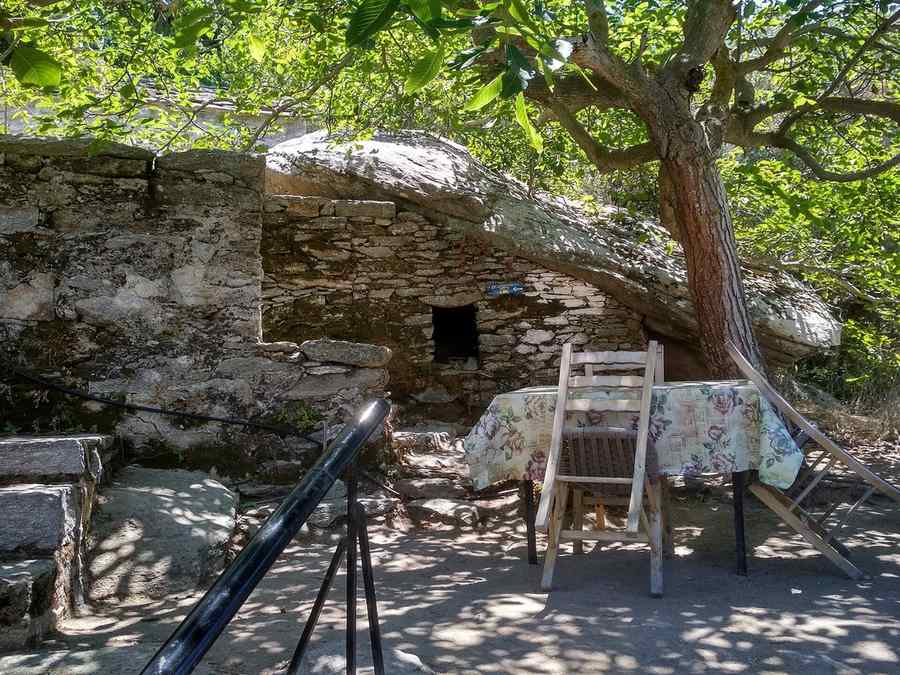
The Monastery of Theoktisti sits deep in the granite interior of Ikaria, near the villages of Pigi and Frantato. Panagia Theoktisti gives the monastery its name, and the church anchors one of the island’s oldest religious landscapes. Enormous granite boulders surround the site, and oak woodland shades the courtyard. Pilgrims and hikers reach it by a drive into the mountains and a short walk to the church door. The setting feels timeless, quiet, and rooted in centuries of devotion. A modest dress code applies at the church. Plan the visit into a broader island itinerary, book transfers and guided routes, and arrange your trip across the north Aegean with My Greece Tours.
Theoktisti rewards travelers who want more than beaches. The monastery pairs a Byzantine-era church with a landscape of colossal rocks that shape every chapel and path around it. Nearby stands the tiny chapel of Theoskepasti, sheltered under a single massive boulder that forms its roof. Read our Ikaria travel guide for context on the island’s geography and seasons. The sections below cover what the monastery is, its Byzantine history and frescoes, the granite-boulder setting and Theoskepasti, its role as a pilgrimage site with a summer feast, and the practical details of getting there, dressing respectfully, and combining the trip with the mountainous interior.
What is the Theoktisti Monastery in Ikaria?
Theoktisti is a mountain monastery near Pigi and Frantato dedicated to Panagia Theoktisti. It centers on a small Byzantine-era church set among granite boulders and oaks, and remains an active place of pilgrimage on Ikaria.
The Monastery of Theoktisti stands in the granite heartland of Ikaria, reached by a mountain road that climbs from the coast toward Pigi and Frantato. Moni Theoktistis takes its dedication from Panagia Theoktisti, the Mother of God, and the church forms the spiritual core of the whole complex. The building is modest in scale, built to sit within the rock rather than dominate it. A small courtyard, a few monastic cells, and a stone church make up the grounds. Oak trees and moss-covered boulders frame every approach. The place feels enclosed and calm. Visitors who explore the wider region find Theoktisti listed among the essential things to do in Ikaria for anyone drawn to culture and quiet.
The monastery serves both worshippers and travelers curious about the island’s older layers. Locals maintain the church and gather here for services and the annual feast. The atmosphere stays devotional rather than touristic, and the setting demands a measured, respectful pace. The surrounding granite plateau holds a scatter of chapels, hermitages, and small shrines, several built directly beneath or into single boulders. Theoktisti anchors that constellation of sacred rock sites. The stone-and-timber church, the shaded courtyard, and the mountain silence together define what makes the monastery memorable. A visit rewards slow observation of the masonry, the icons, and the way the architecture yields to the boulders that came first and still hold the ground.
What is the Byzantine history behind Theoktisti and its frescoes?
Theoktisti belongs to Ikaria’s Byzantine religious heritage, with a church of that era preserving old wall frescoes. The site reflects centuries of monastic and pilgrimage tradition rooted in the island’s medieval Christian past.
The church at Theoktisti carries the marks of the Byzantine centuries that shaped religious life across the Aegean. Its walls hold old frescoes, painted in the devotional styles of the medieval Orthodox tradition, showing saints and sacred scenes rendered in earth tones softened by age. The masonry follows the compact, sturdy forms common to island churches built to endure isolation and weather. This monastery fits within a long arc of Christian settlement in the mountainous interior, where communities sought refuge and prayer away from exposed coasts. Readers exploring the history of Ikaria will find Theoktisti a tangible link to that period, a stone witness to how faith took shape in the island’s remote uplands.
The frescoes deserve unhurried attention. Their pigments have faded, yet the figures and their gestures still convey the theological program of the church interior. Conservation of such island monuments proceeds carefully, respecting original surfaces. The building’s continuity matters as much as any single image; generations have prayed beneath these walls, and the church has held its role through changing rulers and hard eras. The dedication to Panagia Theoktisti ties the site to a wider Orthodox veneration of the Mother of God. Scholars and pilgrims read the monastery as a small but genuine expression of Byzantine sacred art surviving in a place shaped more by granite than by empire.
The result is a quiet, authentic encounter with the island’s medieval Christian identity.
Why is Theoktisti built among granite boulders near Frantato?
Ikaria’s interior is strewn with vast granite boulders, and religious builders used them as walls and roofs. Theoktisti sits within this landscape, and the nearby Theoskepasti chapel nestles entirely beneath one enormous rock.
The interior of Ikaria near Frantato is a landscape of granite, where rounded boulders the size of houses litter the slopes and ridges. Builders here worked with the rock rather than against it, tucking chapels beneath overhangs and raising walls between standing stones. Theoktisti sits amid this terrain, its church and cells woven into the granite so the natural and the built blur together. The most striking example nearby is the chapel of Theoskepasti, whose roof is formed by a single colossal boulder resting above its small interior. The name itself points to shelter given by God through stone. Walkers who enjoy hiking in Ikaria can trace paths linking these rock sanctuaries across the plateau.
The granite setting is not incidental; it shaped the whole monastic geography of this part of the island. Boulders provided ready-made shelter, defensible seclusion, and a sense of the sacred bound to the land. Small hermitages and shrines cluster where the stone offered a natural roof or hidden chamber. Theoskepasti stands out because the boulder above it does the work of an entire roof, and worshippers step beneath tons of rock to reach the altar. The effect is humbling and unmistakably Ikarian. This union of faith and geology gives Theoktisti and its neighbors a character found in few other places.
The rocks came first, endure longest, and still dictate how each chapel sits, breathes, and faces the mountain light.
What is the pilgrimage and feast-day tradition at Theoktisti?
Theoktisti remains an active pilgrimage site, drawing worshippers to its summer feast day honoring Panagia Theoktisti. Villagers and visitors gather for the liturgy, and the celebration blends Orthodox devotion with Ikaria’s communal panigiri spirit.
Theoktisti keeps its role as a living place of pilgrimage, not a museum. The high point of its year is the summer feast day dedicated to Panagia Theoktisti, when worshippers climb into the interior to attend the liturgy and honor the Mother of God. The church fills, candles multiply, and the granite courtyard hosts the faithful who come from Pigi, Frantato, and villages beyond. This gathering reflects the deep Orthodox rhythm that still governs island life. Feast days on Ikaria carry a communal weight, and the mountain monasteries draw families back to ancestral devotions.
Travelers who want to grasp local culture find the feast a window into traditions that also animate villages like Christos Raches during the celebrated summer season.
The pilgrimage tradition connects Theoktisti to Ikaria’s famous panigiria, the village festivals that combine worship, food, and music. The religious core comes first: the vespers, the liturgy, the veneration of the icon. Shared meals and communal warmth often follow in the island manner. The feast reaffirms the monastery’s place at the center of local identity, binding generations to the same sacred rock. Pilgrims light candles, leave offerings, and pause before the old frescoes. The mountain setting lends the occasion a solemn beauty, with the boulders and oaks as a natural sanctuary.
Anyone present feels the continuity of a devotion carried across centuries, still practiced with sincerity, and still able to fill a small church deep in the granite hills.
How do you visit Theoktisti Monastery in the Ikaria interior?
Drive into Ikaria’s interior toward Pigi and Frantato, then walk a short path to the church. Dress modestly, respect the quiet, and combine the visit with nearby boulder chapels and mountain villages.
Reaching Theoktisti means heading inland from the coast along the mountain roads that serve Pigi and Frantato. A rental car or a guided transfer handles the winding climb best, and signage in the villages points toward the monastery. From the parking area a short walk on a stone path leads to the church, passing between boulders and beneath oaks. The route is gentle and suits most visitors, though sturdy shoes help on the uneven ground. Modest dress is expected at the church: covered shoulders and knees show respect for an active place of worship. Keep voices low and photography discreet inside.
Planning the drive into a wider loop of the interior turns the trip into one of the richer things to do in Ikaria.
The visit pairs naturally with the granite sanctuaries nearby, above all the boulder-roofed chapel of Theoskepasti a short distance away. Both sites sit within the same rocky plateau and reward an unhurried morning. Combine them with a stop in Frantato or Pigi for a coffee, and consider linking the outing to marked trails for those keen on hiking in Ikaria. Spring and early autumn offer mild weather and green surroundings; summer brings the feast and its crowds. Bring water, sun protection, and time to sit quietly in the courtyard. A visit to Theoktisti works best as a cultural counterpoint to the island’s beaches, grounding the trip in Ikaria’s older, mountain-bound sense of place and faith.
Frequently Asked Questions
What is the Theoktisti monastery?
The Theoktisti monastery is a small Orthodox monastery in the granite interior of Ikaria, near the villages of Pigi and Frantato. Moni Theoktistis is dedicated to Panagia Theoktisti, a title of the Mother of God. Its core is a Byzantine-era church that preserves old wall frescoes, set within a courtyard shaded by oaks and framed by enormous granite boulders. The monastery has served as a place of prayer and pilgrimage for centuries, and it remains active today. Locals maintain the church and gather here for services and an annual summer feast. The complex includes monastic cells and a stone church built to sit among the rocks rather than above them.
It anchors a wider landscape of boulder chapels and hermitages. Travelers value Theoktisti as a quiet, authentic window into Ikaria’s medieval Christian heritage and its distinctive union of faith and mountain granite.
Why is Theoktisti built among boulders?
Theoktisti sits among boulders because the interior of Ikaria near Frantato is a granite landscape strewn with massive rounded stones. Builders across the island learned to work with this terrain, using boulders as walls, roofs, and natural shelters for chapels and hermitages. The rocks offered seclusion, defensible refuge, and a sense of the sacred tied directly to the land. Theoktisti was raised within this rocky setting, its church and cells woven into the granite. The nearby chapel of Theoskepasti shows the principle at its most dramatic: a single colossal boulder forms its entire roof, so worshippers step beneath tons of stone to reach the altar. The name Theoskepasti points to shelter given through the rock.
This tradition shaped the whole monastic geography of the plateau, where the granite came first, endures longest, and still dictates how each sanctuary sits and faces the mountain light.
How do you visit Theoktisti monastery?
You visit Theoktisti by driving into Ikaria’s interior toward the villages of Pigi and Frantato, then walking a short stone path to the church. A rental car or a guided transfer handles the winding mountain roads best, and village signage points the way. From the parking area the walk passes between boulders and beneath oaks; sturdy shoes help on the uneven ground, though the route suits most visitors. Modest dress is expected at the church, meaning covered shoulders and knees, since it is an active place of worship. Keep voices low and photography discreet inside. Pair the visit with the boulder-roofed chapel of Theoskepasti nearby and a stop for coffee in Frantato or Pigi.
Bring water, sun protection, and time to sit in the courtyard. Spring and early autumn bring mild weather; the summer feast draws the largest crowds. Guided island tours can arrange the whole outing.