
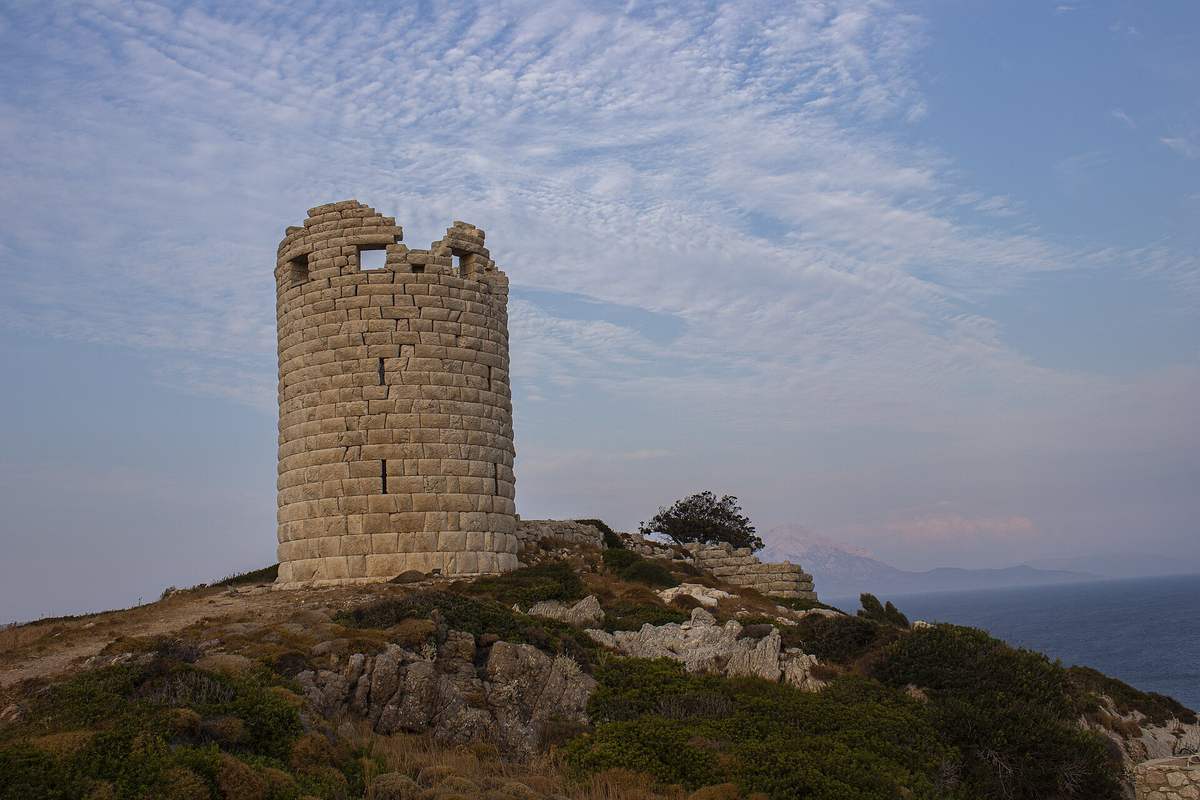
Drakano Tower stands at the far southeastern tip of Ikaria, on a windswept cape above the Aegean Sea. The round stone tower dates to the Hellenistic period and ranks among the best-preserved ancient towers in the region. Its circular drum still rises tall against open water and bare hillsides. The structure guarded the sea lanes between Ikaria, Fourni, and Samos, and protected the ancient settlement of Drakanon nearby. Travelers who reach Cape Drakano find a monument shaped by centuries of maritime defense. The site rewards a short walk with wide horizons and clear views across the strait. Plan your visit with My Greece Tours.
This guide explains what the tower is, why it was built, and how the cape around it looks today. Cape Drakano pairs the ancient tower with a small whitewashed chapel, a nearby beach, and a working lighthouse. The setting anchors the tower within a broader story you can follow in our Ikaria travel guide. The sections below cover the tower itself, its Hellenistic purpose, the Cape Drakano landscape, its place in the island’s past, and practical visiting advice. Each part gives concrete detail so you arrive prepared. The tower stays open to the sky, and the walk out delivers some of the finest coastal scenery on the island.
What is the Drakano Tower on Ikaria?
The Drakano Tower is a round Hellenistic watchtower at Cape Drakano, the southeastern tip of Ikaria. Its circular stone drum still stands tall and ranks among the best-preserved ancient round towers in the Aegean region.
The tower carries the Greek name Pyrgos Drakanou, meaning the tower of Drakano. Builders raised it as a solid circular drum of dressed stone, a form typical of defensive towers across the ancient Aegean. The masonry fits closely, and the walls retain much of their original height. Visitors see a genuine ancient structure rather than a later reconstruction. The tower once formed part of the fortified settlement of Drakanon, which sat on this same cape. Local guides and travelers on our things to do in Ikaria circuit list it among the island’s key ancient sites. The round plan gave defenders a strong, stable shape with no corners to weaken under attack.
Its position on high ground above the sea made it a natural lookout for approaching vessels.
The tower’s survival sets it apart from many ancient structures in the wider Aegean. Round towers of this type often collapsed or were quarried for later building stone. This one kept its drum largely intact, which lets modern visitors read its scale and craft directly. The stonework shows the skill of Hellenistic masons who cut and stacked large blocks without mortar. Researchers into the history of Ikaria treat the tower as prime physical evidence of the island’s ancient coastal defense. The structure stands alone on the cape now, stripped of the town that once surrounded it. That isolation gives the monument a stark presence.
The tower reads clearly as a fortress designed to watch the sea and warn of danger.
How old is the tower and why was it built?
The tower dates to the Hellenistic period, the era after Alexander the Great. Builders raised it to guard the strait between Ikaria, Fourni, and Samos, watching sea lanes and protecting the coastal settlement of Drakanon from raiders.
The Hellenistic dating places the tower within a well-documented age of Aegean fortification. Coastal towers of this kind rose across many islands to control shipping and defend harbors. The Drakano Tower served the settlement of Drakanon, which occupied the cape in ancient times. Its garrison scanned the horizon for pirate craft and hostile fleets. The strait below carried heavy traffic between the islands and the coast of Asia Minor. Control of that passage meant control of trade and safety for local ships. The tower gave watchers a raised, sheltered post from which to signal warnings. Fires or beacons lit on the drum could pass alerts along the coast.
The structure combined defense, observation, and communication in a single stone form built for the demands of its age.
The tower’s purpose stayed tied to the sea throughout its working life. Ikaria sat on routes that linked the Aegean’s larger centers, and raiders threatened those routes often. A strong tower at the island’s southeastern point closed a clear gap in coastal defense. The garrison could shelter behind thick walls and hold out against small raiding parties. The round form resisted battering and gave archers a full field of view. The tower’s builders drew on generations of military design perfected across the Greek world. The strategic logic connects to the deep Ikaria mythology and history that mark this coast as a place of passage and peril.
The monument still reads as a practical answer to a real threat from the sea.
What does the Cape Drakano setting look like today?
Cape Drakano is the bare southeastern point of Ikaria. The ancient tower shares the cape with a small whitewashed chapel of Agios Georgios, the nearby Faros beach, and a working lighthouse, all set above open water.
The cape presents a rugged, treeless landscape shaped by wind and salt. The tower stands as the dominant feature, its stone drum visible from a distance. A short walk from the tower brings visitors to the small chapel of Agios Georgios, painted the bright white typical of Greek island churches. The chapel adds a quiet, living note to the ancient ground. Faros beach lies close by, a stretch of sand and pebble against clear water. The name Faros points to the lighthouse that marks this navigational point for ships passing the strait. The combination of ancient tower, chapel, beach, and lighthouse gives the cape a layered character.
Each element speaks to the same theme of watching and guiding traffic across a busy and sometimes dangerous sea.
The views from Cape Drakano rank among the widest on the island. The horizon opens toward Fourni and Samos across the strait the tower once guarded. Sea and sky dominate the scene, with the rocky cape falling away to the water on several sides. The light here is sharp and clean, and the setting stays quiet outside peak visiting hours. Many travelers pair the cape with a swim at Faros beach after visiting the tower. The nearest town, Agios Kirykos, serves as the usual base for the trip and lies within a short drive. The lighthouse continues its old duty of marking the point for modern shipping.
The cape holds ancient and working landmarks side by side above the same restless water.
How does the tower fit Ikaria’s wider history?
The tower shows Ikaria’s ancient role as a guarded stepping stone across the Aegean. It marks the island’s coastal defense during the Hellenistic period and connects Drakanon to the broader network of fortified island settlements.
Ikaria carried settlement and traffic long before the Hellenistic tower rose. The island held several ancient communities, and Drakanon was one of the more important on its southeastern coast. The tower stands as the clearest surviving proof of that town’s strength and reach. Its scale suggests a settlement able to fund and man a serious defensive work. The broader history of Ikaria runs through waves of Greek, Roman, Byzantine, and later rule. The Drakano Tower anchors the earliest well-preserved chapter of that story on the ground. It gives visitors a physical link to the island’s classical past. The monument grounds the island’s long timeline in stone that anyone can see and touch on the cape today.
The tower also ties Ikaria to the myth and legend that color its identity. The island took its name from Icarus, who fell into the surrounding sea in the ancient tale. That story of flight and fall over these waters shapes the local sense of place, as our page on Ikaria mythology explains. The tower’s watch over the same sea gives the myth a hard, real edge. The strait it guarded framed both trade and danger for the ancient island. The monument stands where legend and recorded history meet on a single cape. It reminds visitors that Ikaria was never remote in the ancient world but sat on a watched and traveled sea road between larger powers.
How do you visit the Drakano Tower and what can you see?
Drive to the southeastern tip of Ikaria from Agios Kirykos, then take a short walk to the tower. You can see the ancient drum, the Agios Georgios chapel, Faros beach, the lighthouse, and wide sea views.
The trip starts from Agios Kirykos, the island’s main southern town and port. A drive southeast leads toward the tip of the island along coastal roads. The final approach reaches a point near the cape, where visitors leave the car and continue on foot. The walk is short but crosses open, rocky ground, so sturdy shoes help. Bring water, sun protection, and a hat, since the cape offers little shade. Morning or late afternoon light gives the best conditions for photographs and comfort. The route forms a natural part of many things to do in Ikaria itineraries focused on the island’s south.
The site stays open and free, with no ticket office or fixed hours, so plan your own timing around the weather and the heat.
The reward on arrival is a close look at a genuine Hellenistic tower in a dramatic setting. Visitors can walk around the stone drum and study its masonry from several angles. The nearby chapel of Agios Georgios makes a natural second stop on the cape. Faros beach lies within easy reach for a swim after the walk, and the lighthouse marks the point above the strait. The wide views toward Fourni and Samos frame the whole visit. Travelers often combine the cape with other stops near Agios Kirykos to fill a half day in the island’s southeast. The lack of crowds and the raw scenery make the tower a memorable stop.
The site rewards curiosity with real ancient stone and some of Ikaria’s finest coastal views.
Frequently Asked Questions
What is the Drakano Tower?
The Drakano Tower, known in Greek as Pyrgos Drakanou, is a round ancient watchtower at Cape Drakano on the southeastern tip of Ikaria. Builders raised it during the Hellenistic period as a solid circular drum of dressed stone. The tower guarded the strait between Ikaria, Fourni, and Samos, and it protected the ancient settlement of Drakanon on the same cape. Its garrison watched the sea lanes for pirates and hostile ships and could signal warnings along the coast. The tower ranks among the best-preserved ancient round towers in the wider Aegean region, and its drum still stands tall today. Visitors see a genuine ancient structure rather than a reconstruction.
The round plan gave defenders a strong shape with a full field of view over the water. The monument stands alone now on the bare cape, stripped of the town it once served, above open Aegean water.
How old is the Drakano Tower?
The Drakano Tower dates to the Hellenistic period, the era of Greek history that followed the conquests of Alexander the Great. That places its construction within a well-documented age of Aegean coastal fortification, when many islands built towers to control shipping and defend their harbors. The tower belonged to the ancient settlement of Drakanon, which occupied Cape Drakano at the time. Its precise construction date rests on the widely accepted Hellenistic dating rather than a single recorded year. The masonry style, with large dressed blocks stacked without mortar, matches the building methods of that age. The tower has survived far better than most structures of its kind, which lets researchers study its form directly.
Its endurance makes it a key piece of physical evidence for Ikaria’s ancient history. The monument stands as one of the oldest well-preserved buildings on the island, a direct link to its classical past on the cape.
How do you get to the Drakano Tower?
You reach the Drakano Tower by traveling to the far southeastern tip of Ikaria, past the town of Agios Kirykos. Most visitors drive southeast along the coastal roads until the route nears Cape Drakano, then leave the car and continue on foot. The walk to the tower is short but crosses open, rocky ground, so wear sturdy shoes and bring water, sun protection, and a hat. The cape offers little shade, and the heat can build through midday. Morning or late afternoon gives the most comfortable conditions and the best light. The site stays open and free, with no ticket office or set opening hours, so you plan your own timing.
The trip pairs well with a swim at nearby Faros beach and a look at the small chapel of Agios Georgios and the lighthouse. Many travelers base themselves in Agios Kirykos and treat the cape as a half-day outing on the island’s south coast.