
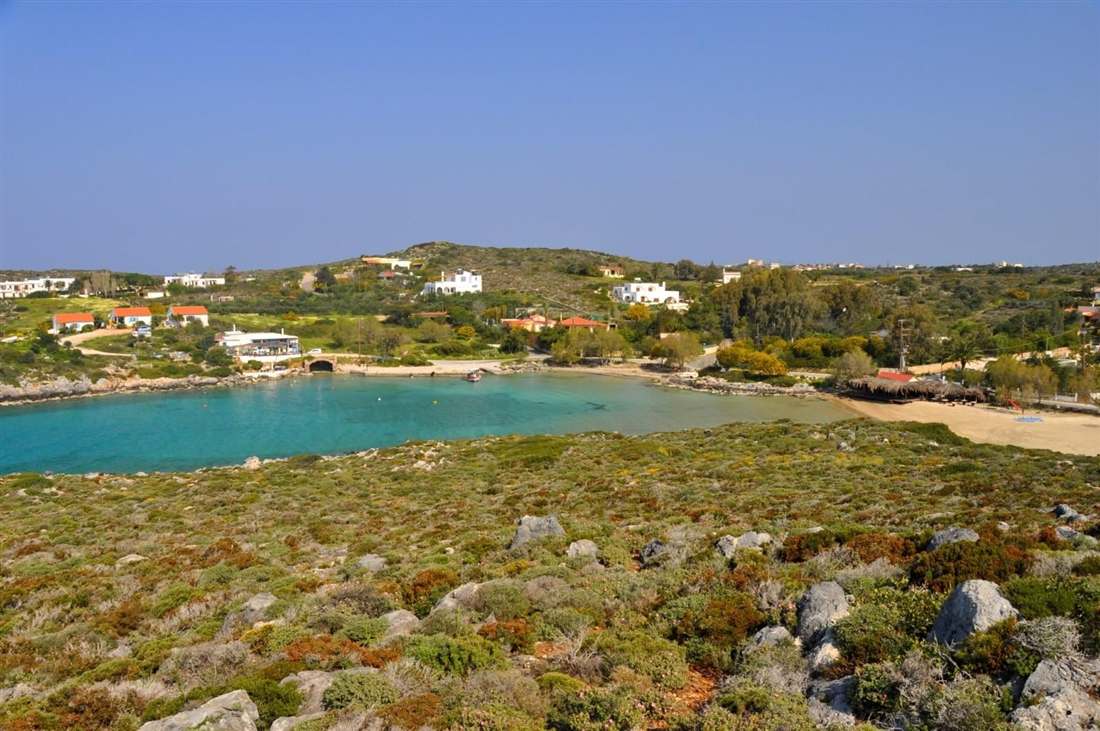
Tersanas beach is a small sheltered cove on the north side of the Akrotiri peninsula, about 15 kilometres north-east of Chania in Crete, with shallow turquoise water, a tiny islet you wade to and two tavernas behind the sand. Plan the whole trip with Greece Tours.
This guide covers Tersanas beach in full: where it is, what the cove is like, the shallow calm water and the wade-to islet, whether it suits families, how to get there from Chania, what there is to do, the facilities, the nearby Akrotiri beaches at Stavros and Kalathas, the best time to visit, and whether Tersanas beach is worth visiting among the quiet coves near Stavros.
Where is Tersanas beach in Crete?
Tersanas beach sits on the north coast of the Akrotiri peninsula in western Crete, about 15 km north-east of Chania town and 2 km west of Stavros. The cove opens off a short side road that drops from the Akrotiri villages down to the shore.
The beach belongs to the Chania regional unit, the westernmost of Crete’s four regional units. Akrotiri is the blunt headland that shelters Souda Bay to its south and pushes north into the Cretan Sea. Tersanas fills a narrow inlet on that northern edge, tucked between the larger resort of Kalathas to the west and the deep bay of Stavros to the east.
Chania Airport (Ioannis Daskalogiannis) stands 6 km south-east of the cove on the same peninsula, which puts Tersanas within a 15-minute transfer of arriving flights. The Monastery of Agia Triada lies 5 km to the south-east, and the port of Souda, where the ferries from Piraeus dock, is 12 km south. This clustering of the airport, the monasteries and three separate coves inside one small headland makes Akrotiri a self-contained corner of the Chania coastline.
Tersanas names both the inlet and the small settlement of holiday houses that climbs the slope behind it. The Greek word marks a sheltered anchorage, and the geography earns it: the two rocky arms of the cove close in around the water and cut the swell before it reaches the sand.
What is Tersanas beach like?
Tersanas is a compact cove roughly 80 metres wide, floored with soft sand and fine pebble and filled with shallow, calm, turquoise water. A tiny rocky islet sits 30 metres offshore, reachable on foot through waist-deep water. Two tavernas and a row of sunbeds back the sand.
The two headlands that frame the inlet block the north-westerly wind that scours Crete’s exposed beaches through the summer, so the surface here stays flat while nearby open shores chop up. The seabed shelves gently from the waterline, holding depth under one metre for the first 15 metres out, then deepening slowly towards the islet.
The islet is the cove’s landmark. Swimmers and waders cross to it in a couple of minutes, scramble onto its low rocks and jump back into the clear water. The bottom stays visible to a depth of 3 metres, and the shelter keeps the water clear of seaweed and stirred sand.
Behind the beach, two family-run tavernas serve grilled fish, Cretan salads and cold drinks from terraces that overlook the water. Sunbeds and straw umbrellas line the sand in two rows, and a freshwater tap and basic changing space sit at the back. There is no large hotel, no beach bar strip and no water-sports operator, which keeps the noise down and the crowd thin even at midday.
Is Tersanas beach good for families?
Tersanas ranks among the strongest family beaches on Akrotiri. The shallow calm water, the gentle sandy entry, the shelter from wind and waves, and the little islet that gives children a clear swimming target combine to make a safe, contained bay with tavernas a few steps behind the sand.
Small children paddle for 15 metres from the shore before the water reaches an adult’s waist, and the absence of swell removes the pull of breaking waves and undertow. Parents watch the whole cove from a single sunbed, since the beach measures under 100 metres end to end and the two headlands frame it like a natural pool.
The islet turns a swim into a goal. Children strike out for the rocks, rest on them and return, building confidence over a short, guarded distance rather than an open stretch of sea. The clear water lets them track the sandy bottom the whole way across.
Practical support sits close at hand. The tavernas behind the sand feed and shade a family through the hottest hours, the parking above the cove keeps the walk to the water short, and the quiet setting away from the resort crowds of Chania town lowers the stress of a day at the beach. The lack of a road along the waterline means no traffic runs beside the sand.
How do you get to Tersanas beach from Chania?
Drive from Chania town to Tersanas in 20 to 25 minutes over about 15 km. Head north-east across the Akrotiri peninsula past the airport turn-off towards Stavros, then take the signed left turn that drops down to the cove, where a parking area sits on the slope above the sand.
The route climbs out of Chania on the airport road, crosses the plateau of Akrotiri past the Venizelos Graves viewpoint, and follows the signs for Stavros and Kalathas. Roughly 2 km before Stavros, a marked side road branches left and descends to Tersanas. The final stretch is a narrow paved lane that ends at the parking above the beach; the walk from the cars to the water takes two minutes down a short path.
A hire car or taxi is the direct way in. A taxi from Chania town covers the distance in the same 20 to 25 minutes. Public buses from Chania’s central station run to Stavros and Kalathas across the day, and from either stop the walk to Tersanas covers 2 km along the coast road.
Tersanas pairs naturally with the neighbouring coves. Kalathas beach lies about 4 km south-west and Stavros beach, the bay used as the backdrop for the film Zorba the Greek, sits about 3 km north-east, so a single drive onto Akrotiri reaches all three within a few minutes of each other.
What is there to do at Tersanas beach?
Tersanas beach delivers calm-water swimming in a sheltered cove, snorkelling around its offshore islet and rocky edges, paddling in ankle-deep shallows, meals at two seafront tavernas, and a short coastal walk toward Stavros, 3 kilometres north.
The bay faces the water through a narrow mouth, so the sea holds flat and turquoise on days when open coasts churn. Swimmers cross the 40 metres of clear water to the small islet in the middle of the cove, and wade back on a sandy bed that stays below waist height for most of the crossing. Families settle children on the fine sand at the shoreline, where the gradient drops a single metre over the first 10 metres out.
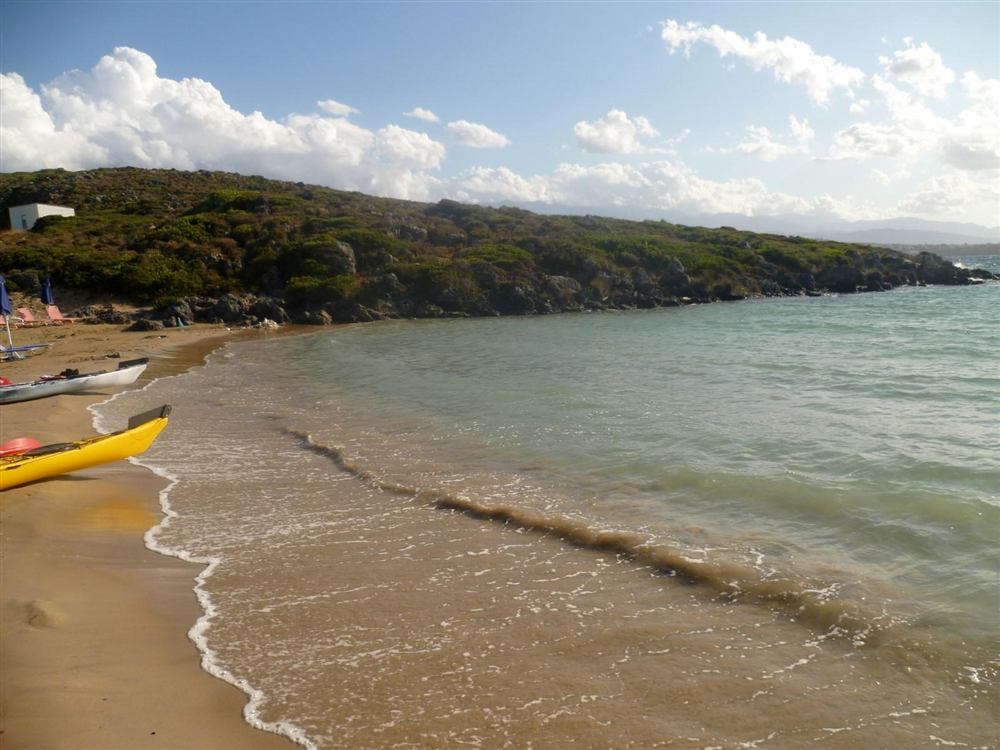
Snorkellers work the rocky flanks on both sides of the cove and the base of the islet, where sea bream and wrasse hold over patches of seagrass. The rock ledges sit 1 to 2 metres deep, close enough to the surface for clear viewing without a boat. Paddleboarders and kayakers launch straight off the sand and round the islet in under 10 minutes.
Two tavernas front the sand and serve grilled fish, Cretan salads and cold drinks through the swimming season. A relaxed beach day here runs on sunbathing on the sheltered strand, a swim to the islet, lunch at a taverna table above the water, and a walk along the shore path. The wider Akrotiri peninsula puts monasteries, viewpoints and further coves within a 15-minute drive.
Which beaches are near Tersanas on Akrotiri?
Stavros sits 3 kilometres north under the rock face from Zorba the Greek; Kalathas lies 4 kilometres south; Marathi is 7 kilometres east; and Loutraki is 1 kilometre away. All cluster on the Akrotiri peninsula within a 10-minute drive of Tersanas.
Stavros wraps a near-circular lagoon beneath the 300-metre limestone crag that framed the closing dance of Zorba the Greek. The water there holds as flat as a pool, and a taverna row lines the sand. Full detail on that cove sits in the Stavros beach guide. Loutraki, the next inlet west of Tersanas, gives a second small sheltered bay a 12-minute walk along the coast.
Kalathas opens a broader arc of pale sand with a tiny islet a short swim offshore, backed by tavernas and a car park. Marathi splits into two sandy coves on the peninsula’s east side, both shallow and family-graded, with a sailing club at the larger one. These four beaches plus Tersanas form a tight beach-hopping cluster, each reachable from the next in under 10 minutes by car.
Base yourself at Tersanas and the peninsula’s whole northern shore falls within reach for a morning-to-evening circuit. The full run of coves and their access, parking and facilities is mapped in the Chania beaches guide, which sets Akrotiri’s bays against the longer western strands of Falassarna and Elafonisi.
When is the best time to visit Tersanas beach?
June to September brings sea temperatures of 22 to 26 degrees and warm calm swimming at Tersanas. The sheltered cove stays swimmable across the season, mornings before 11am stay quiet, and spring and autumn hold the water peaceful with thinner crowds.
The cove’s narrow mouth and rock walls block the prevailing northerly wind, so Tersanas turns flat while exposed north-coast beaches whip up chop. On a windy day this bay serves as a refuge: the swell breaks outside the entrance and the inner water stays glassy. That shelter is the single strongest reason to point here when the meltemi runs.
Arrive before 11am and the sand carries a handful of early swimmers and the tavernas run empty tables. Midday in July and August fills the small strand, and the two tavernas book out their front rows by 1pm. An early start secures a shaded taverna table and a clear stretch of sand.
May and October hold sea temperatures near 20 degrees, warm enough for a swim and cool enough for the coast path to Stavros without heat. Those shoulder weeks strip the crowds back to a dozen bathers and keep the tavernas open on reduced hours. The town base for any of these visits is Chania, a 20-minute drive west.
What facilities does Tersanas beach have?
Tersanas beach carries the basics: sunbeds and straw umbrellas in two rows, two family-run tavernas on the sand, a freshwater tap and a simple changing space, and a parking area on the slope above the cove. There is no large hotel, beach bar strip or watersports operator.
The two tavernas behind the sand supply the food, the drinks and the sunbeds, hiring the loungers by the day and serving grilled fish and Cretan salads from terraces above the water. A freshwater tap and a basic changing corner sit at the back of the beach, enough to rinse off and change after a swim without the full apparatus of a resort.
Parking sits on the slope above the cove, a two-minute walk down a short path to the sand, and the spaces fill from mid-morning in high summer. The narrow access lane keeps traffic light, and no road runs along the waterline, so the beach stays quiet and free of passing cars.
What Tersanas lacks is as much the point as what it holds. No lifeguard is posted, no beach bar pumps music, and no jet-skis cross the bay, so the cove keeps the calm that draws families and quiet-seekers. Visitors who want a fully serviced resort beach head to Kalathas or Marathi; those who want a low-key swim with a taverna behind them choose Tersanas for exactly this pared-back setup. The trade-off runs both ways: the pared-back cove asks visitors to bring their own snorkel gear, shade extras for the youngest children and cash for the tavernas, since the nearest shops sit up in the Akrotiri villages rather than on the sand. What the beach gives back is quiet, clean water and a sense of a small local corner rather than a packaged resort, the reason regulars return to Tersanas across the summer while the larger organised bays fill with day-trippers.
Is Tersanas beach worth visiting?
Yes. Tersanas rewards a quiet family swim with sheltered shallow turquoise water, a wade-to islet, two seafront tavernas and a 20-minute reach to Chania. The trade-off is a small low-key cove of 80 metres of sand, not a long open strand.
The draw is concentration: calm water, safe shallows for children, a snorkelling islet and lunch on the sand, all in one compact inlet. Swimmers who want length, dunes or a wide sweep of coast head west to Falassarna instead. Tersanas trades scale for shelter, and that shelter is what makes it a dependable swim on a rough-sea day.
Set it inside a peninsula circuit and the cove earns its place. Pair a Tersanas morning with the Zorba rock at Stavros 3 kilometres north, the broad sand at Kalathas to the south, and an afternoon in Chania’s old harbour. The Akrotiri monasteries and the airport road sit within the same 15-minute radius, so the beach slots into a full day out.
Plan the wider trip around it through the Akrotiri peninsula guide for the monasteries and viewpoints, and match the cove against the region’s other shores in the Chania beaches guide before choosing where the day starts.
Frequently Asked Questions
What is Tersanas beach in Crete?
Tersanas beach is a small sheltered cove on the north side of the Akrotiri peninsula, about 15 kilometres north-east of Chania and 3 kilometres from Stavros. A compact sandy bay of shallow turquoise water with a tiny wade-to islet, two tavernas and sunbeds.
Is Tersanas beach good for families?
Tersanas ranks among the strongest family coves on Akrotiri. The shallow calm water, the gentle sandy entry, the shelter from wind and waves, and the little islet that gives children a swimming target make a safe, contained bay with tavernas behind the sand.
How do you get to Tersanas beach from Chania?
Drive from Chania town to Tersanas in 20 to 25 minutes over about 15 kilometres, north-east across the Akrotiri peninsula past the airport towards Stavros, then take the signed turn down to the cove, where a parking area sits on the slope above the sand.