
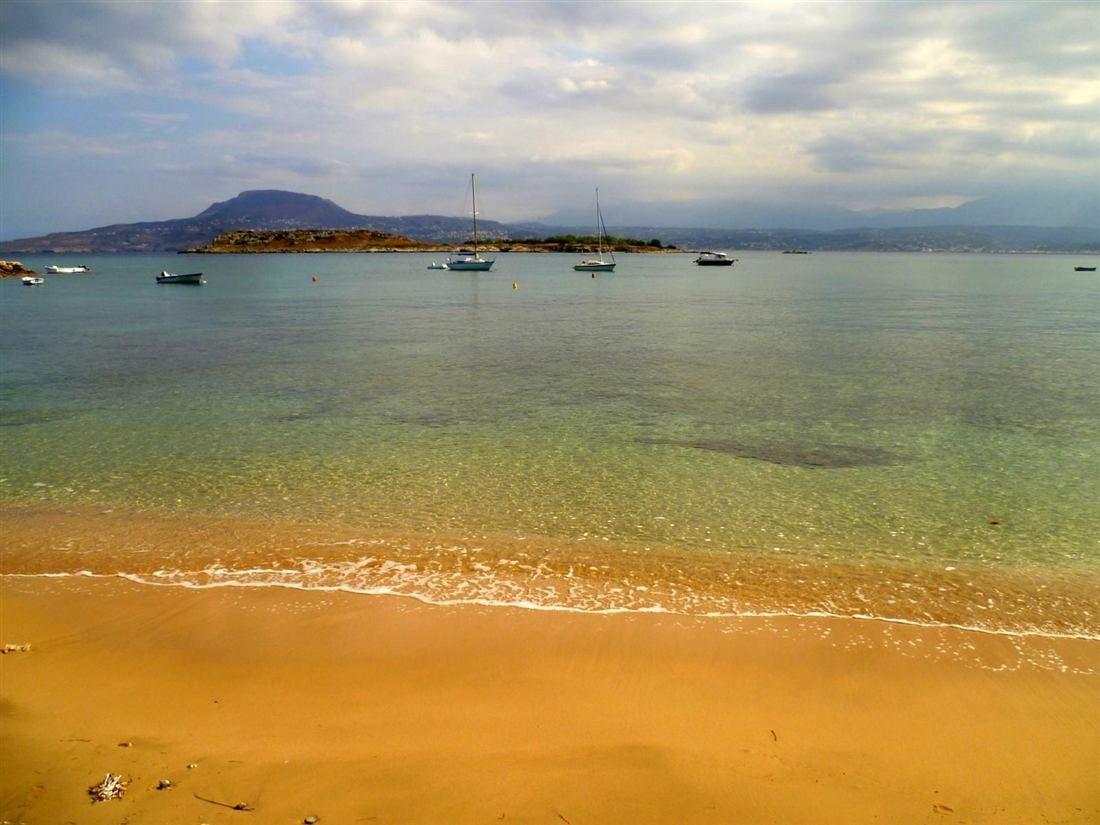
Marathi beach is a sheltered pair of sandy coves on the east side of the Akrotiri peninsula, about 12 kilometres north-east of Chania in Crete, with shallow calm Souda Bay water, fish tavernas on the sand and a diving base. Plan the whole trip with Greece Tours.
This guide covers Marathi beach in full: where it is, what the twin coves are like, the shallow calm water, whether it suits families, how to get there from Chania, what there is to do, the diving and snorkelling, where to eat, the sunbeds and facilities, the shelter from the wind, how busy it gets, the sailing, the nearby Akrotiri beaches, where to stay, the best time, the history around it, and whether Marathi beach is worth visiting.
Where is Marathi beach in Crete?
Marathi beach, also written Marathi bay, sits on the east side of the Akrotiri peninsula in the Chania region of west Crete, about 12 to 13 km north-east of Chania town. It faces the sheltered Souda Bay, past the airport turn and the village of Kounoupidiana.
The beach belongs to the Akrotiri peninsula, the broad headland that closes the north-eastern edge of Chania and shields the deep natural harbour of Souda Bay. Marathi lies on the inner, southern flank of that headland, so it looks across the water towards the Souda naval base and the mountains behind Kalives rather than out to the open Cretan Sea. This inland-facing position is the reason the water stays calm through the summer.
From the centre of Chania the route climbs onto the Akrotiri plateau, passes Chania International Airport (the Ioannis Daskalogiannis airport that serves the region), and drops down towards the coast past Kounoupidiana, the largest village on the peninsula and the seat of the Technical University of Crete. The Hellenic Naval Academy stands a short distance along the same coastline, and the small settlement around the bay carries the beach’s own name.
Marathi is built as two small sandy coves set side by side, split by a low rocky spur that runs a few metres into the sea. The eastern cove and the western cove each hold their own patch of sand, their own line of sunbeds and their own tavernas, and a short walk over the spur links the two. Because the coves open onto Souda Bay and not the exposed north coast, the prevailing summer meltemi wind passes over the headland and leaves the water flat.
What is Marathi beach like?
Marathi beach is two organised sandy coves of fine pale sand, backed by tavernas that stand steps from the water. The sea is shallow, clear and calm, the bottom shelves gently, and a small jetty runs out from the sand. The headland shelters both coves from the north wind.
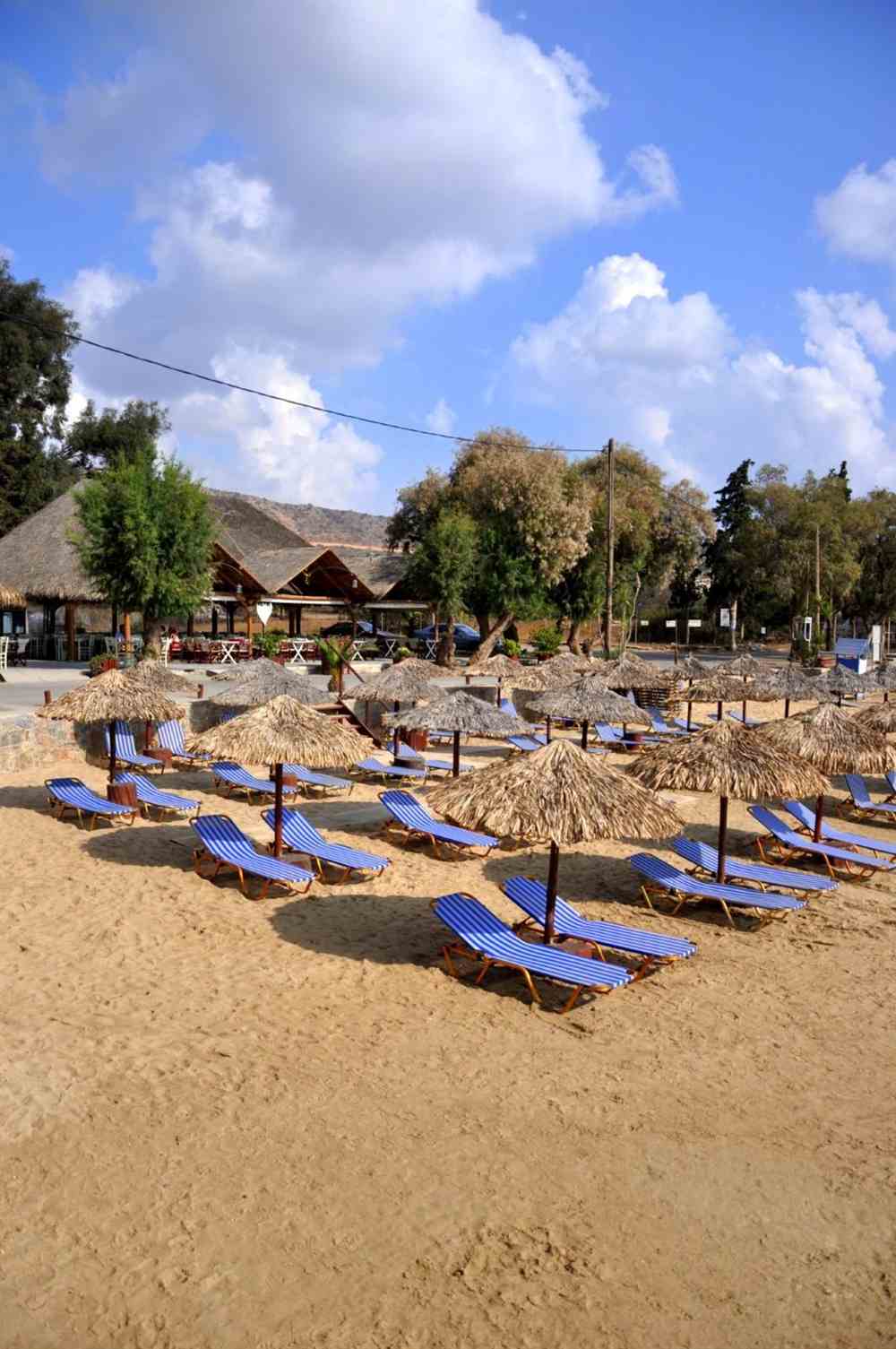
The sand at Marathi is soft and pale, the grains fine underfoot rather than pebbly, and it runs in a smooth strip down to the waterline in each of the two coves. The seabed continues the same sand well past the shallows, so the water reads as clear turquoise close in and deepens to blue further out. Rows of sunbeds and straw umbrellas cover the front of both coves, hired from the tavernas that back the sand.
A short concrete jetty and a small pier reach out into the eastern cove, used by fishing boats and swimmers who walk to the deeper water at its end. The low rocky spur between the two coves carries clumps of rock that break the surface, a natural boundary that also gives the bay its double-cove shape. Behind the sand the tavernas open straight onto the beach, their terraces set under tamarisk trees and awnings that throw shade across the back of the sand.
The defining feature of Marathi is its shelter. The Akrotiri headland stands between the bay and the open sea to the north, so the wind that whips the beaches of the north Chania coast passes overhead and the surface of Souda Bay stays flat. The water shelves at a gentle gradient, reaching adult waist depth 15 to 20 metres out, which keeps the swimming zone wide and untroubled by waves.
Is Marathi beach good for families?
Marathi beach suits families with young children. The shallow, gently shelving water holds no waves inside the sheltered bay, the sand is soft, sunbeds and tavernas stand a few steps from the shoreline, shade sits behind the sand, and a lifeguard watches the beach through the peak-season months.
The gradient of the seabed is the quality that parents notice first. The water reaches only knee depth three to four metres out and rises slowly from there, so toddlers paddle and small children swim within sight and within reach. The absence of waves inside Souda Bay removes the shore-break and undertow that unsettle children on open-sea beaches, and the flat surface makes the bottom easy to read through the clear water.
The layout of the two coves puts everything a family needs within a short walk. Sunbeds and umbrellas give a fixed base on the sand, the tavernas behind serve food and cold drinks a few steps from the towels, and toilets and freshwater showers stand at the back of each cove. Tamarisk trees and taverna awnings supply shade for prams and for the middle of the day, which matters on a beach that faces south and holds the sun.
Both coves are compact, which keeps a whole group in one field of view, and a lifeguard is posted at Marathi through the high-summer weeks. The calm, contained water also draws pedal boats and stand-up paddleboards that children ride close to shore. The combination of shelter, soft sand, shallow shelving water and food within reach is the reason Marathi ranks as one of the steadiest family beaches on the Akrotiri side of Chania.
How do you get to Marathi beach from Chania?
Marathi beach lies 12 to 13 km from Chania town, a 20-minute drive north-east over the Akrotiri peninsula. The road climbs past Chania International Airport and Kounoupidiana, then drops to the bay. A KTEL Akrotiri bus serves the route, and a car park sits behind the sand.
By car, the drive leaves Chania on the Akrotiri road, climbs onto the peninsula plateau and passes the airport junction before reaching Kounoupidiana. From the village the road bears east and descends to the twin coves at Marathi. The 12 to 13 km run takes about 20 minutes in normal traffic, and signposts for Marathi and for the Naval Academy mark the final stretch down to the water.
By bus, the Chania KTEL network runs an Akrotiri service from the central bus station towards the peninsula villages and the coast. The route threads through Kounoupidiana and the Akrotiri settlements, and the ride from Chania town to the Marathi area covers the 12 to 13 km in roughly 30 to 40 minutes depending on stops. Timetables tighten outside the summer season, so travellers check the KTEL Akrotiri schedule before the trip.
Parking sits directly behind both coves, on the flat ground between the tavernas and the road, and the spaces fill from mid-morning through the summer. Marathi also stands closer to Chania International Airport than the town beaches do: the airport is 5 to 6 km up on the same plateau, a 10-minute drive, which puts the bay within easy reach of an arriving or departing flight.
What is there to do at Marathi beach?
Marathi beach offers swimming in calm water, snorkelling over the rocky spur between the coves, and diving from a dive centre that runs dives and courses in the bay. Pedal boats and stand-up paddleboards launch from the sand, the fish tavernas serve lunch, and the small jetty draws swimmers to deeper water.
Swimming is the core activity, and the sheltered flat water makes Marathi a base for beginners and children as much as for confident swimmers. The rocky spur that divides the two coves holds the bay’s marine life, so snorkellers work the rock edges and the shallow reef around it, where the clear water carries good visibility over the pale sand bottom. The jetty in the eastern cove gives a fixed point to swim out to and dive from.
A diving centre operates at Marathi, using the calm bay as training water. The base runs guided dives, try-dives for first-timers and certification courses, and the protected conditions inside Souda Bay give a steady, waveless site for early open-water dives. The same shelter suits the pedal boats and stand-up paddleboards hired on the sand, which stay stable on the flat surface and stay close to shore.
Away from the water, the two tavernas terraces make the bay a place to sit through the afternoon over Cretan food and a view of Souda Bay, and the small harbour and jetty give the coves the feel of a working fishing corner rather than a resort strip. The compact scale means the whole of Marathi is walkable in a few minutes, from the western cove over the spur to the eastern cove and its pier.
Where do you eat at Marathi beach?
Marathi beach is lined by traditional fish tavernas and beach cafes that stand directly behind the two coves. The kitchens serve fresh seafood, Cretan mezes and the produce of the Akrotiri, and the south-facing terraces set dinner over Souda Bay for casual beach-taverna meals.
The tavernas at Marathi trade on the fishing harbour beside them, so grilled fish, fried small fish, octopus and prawns lead the menus, brought to terraces that sit a few metres from the sand. Fresh catch from the boats moored at the jetty reaches the plate the same day, and the Souda Bay setting ties the food to the water in front of it.
Alongside the seafood the kitchens serve Cretan mezes: dakos rusks with tomato and mizithra cheese, horta greens dressed in Akrotiri olive oil, gigantes beans, stuffed courgette flowers and the local cheeses and rusks that define the island table. The Akrotiri peninsula grows its own olives, herbs and vegetables, and the tavernas draw on that produce, which anchors the menus in the region rather than in a generic beach-bar list.
Because the coves face south-west across Souda Bay, the terraces catch the evening light, and dinner runs into a sunset over the water and the hills behind Kalives. The dining stays casual and set on the beach, tables under tamarisk trees and awnings, families and swimmers moving straight from the sand to a taverna chair, and the two coves between them hold enough tavernas and cafes to feed the whole beach through the day.
What is the history around Marathi and Akrotiri?
The Akrotiri peninsula around Marathi carries the tombs of statesman Eleftherios Venizelos, the monasteries of Agia Triada, Gouverneto and Katholiko, the Souda Bay Allied War Cemetery, and the ground of the Battle of Crete landings. The Hellenic Naval Academy stands on the same coastline.
On the ridge above Chania, a short drive from Marathi, stand the Venizelos graves, where Eleftherios Venizelos, the Cretan-born prime minister who shaped modern Greece, and his son Sofoklis are buried. The hilltop looks back over Chania town and the whole of Souda Bay, and the site draws visitors for both the tombs and the wide view across the peninsula and the coast that holds Marathi.
Inland from the beach the Akrotiri holds a line of monasteries. Agia Triada (the Tzagarolon monastery) sits on the plateau behind ochre walls, a Venetian-era foundation that still produces olive oil and wine. Beyond it the road runs to Gouverneto monastery and, on the gorge below, the abandoned monastery of Katholiko cut into the rock near the sea, one of the oldest monastic sites on the island.
The peninsula also carries the mark of the Second World War. The Souda Bay Allied War Cemetery, on the shore of the bay, holds the graves of Commonwealth servicemen who fell in the Battle of Crete, when German airborne forces landed across the Akrotiri and the wider Chania area. The Hellenic Naval Academy trains officers on the coastline near Marathi, keeping the peninsula tied to the sea it looks over.
Does Marathi beach have sunbeds and facilities?
Marathi beach is a fully organised beach with sunbeds and umbrellas for hire across both sandy coves, freshwater showers, tavernas and cafes on the sand, a car park behind the bay, a diving centre, and a small pier for boats.
Two rows of sunbeds and straw umbrellas line each of the twin coves, rented by the day from the beachfront tavernas that own them. Freshwater showers stand at the back of the sand, and the tavernas set tables a few metres from the waterline, so lunch, frappe and a swim sit within one short walk. The layout gives the bay a compact resort feel rather than a stretch of empty shore.
Parking runs along the road behind the beach and in a gravel lot beside the larger cove, a 30-second walk from the sunbeds. A short concrete pier and jetty juts from the eastern side, used by small fishing boats and the diving centre’s craft, and swimmers push off from its steps into deeper water. The pier marks the divide between the two coves and doubles as a jumping platform for older children.
The tavernas serve grilled fish, Cretan meze and cold drinks through the swimming season, and a beach bar keeps the eastern cove supplied with coffee and snacks. Marathi is an organised, serviced beach, not a wild one, which is precisely why families with young children and older visitors choose it over the exposed strands on the north coast.
When is the best time to visit Marathi beach?
Visit Marathi beach from June to September for warm-sea swimming, and arrive before 11am to claim sunbeds and space before the afternoon crowds. Its sheltered Souda Bay position keeps the water calm when the north wind shuts other Chania beaches.
The sea warms to comfortable swimming temperatures from early June and holds that warmth through September. July and August bring the fullest sand and the busiest tavernas, with day-trippers from Chania and the cruise passengers who dock in Souda arriving through the middle of the day. Families who reach the bay in the morning swim in still water and eat lunch before the peak.
Marathi faces south-east into Souda Bay, screened from the meltemi, the north wind that whips up waves and closes the beaches of the north Akrotiri coast and the town front. When Stavros and the exposed strands turn choppy, Marathi stays flat and swimmable, which makes it the reliable calm-water choice on a windy day. This shelter is the single strongest reason to pick the bay.
May and October bring quieter sand, thinner crowds and water that stays swimmable through the shoulder season, though the tavernas trim their hours as the season winds down. Spring adds wildflowers on the headland above the coves, and autumn keeps the sea warm from the long summer. For a peaceful swim, the edges of the season reward an early or late visit.
Which beaches are near Marathi on Akrotiri?
Kalathas, Tersanas, Stavros and the Loutraki cove all sit within a short drive of Marathi on the Akrotiri peninsula, forming a tight beach-hopping cluster of sheltered sandy bays reachable in ten to fifteen minutes each by car.
Kalathas lies a few minutes north, a wide sandy bay with shallow water and a tiny islet a short swim offshore, popular with families and served by tavernas above the sand. Our Kalathas beach guide covers its layout and facilities in full. Tersanas sits in the next inlet, a small enclosed cove with a sandy floor and calm water that suits toddlers.
Stavros, at the northern tip of the peninsula, curls beneath the dramatic bare mountain that framed the closing dance of the film Zorba the Greek, its lagoon-like inner bay almost fully ringed by rock. Loutraki adds a further quiet cove nearby. The four beaches string along a single peninsula road, so a driver hops between them across one day, testing each in turn for wind and mood.
The whole cluster belongs to a compact corner of west Crete, and our Akrotiri guide maps the peninsula’s beaches, monasteries and villages together. For the broader picture across the region, the Chania beaches guide ranks Marathi against the famous pink-sand lagoons of Elafonissi and Balos further west. Marathi anchors the sheltered, family end of that spectrum.
Can you dive and snorkel at Marathi beach?
Yes. A PADI diving centre operates from Marathi bay, running try-dives, certification courses and guided dives from the pier, while the calm, shallow, sheltered water and the rocky spur between the two coves give snorkellers clear conditions and easy entry.
The dive centre bases its boat at the bay’s jetty and uses the still water inside Souda Bay as a training ground. First-timers start with a supervised try-dive in the shallows, students work through open-water certification over the sheltered seabed, and qualified divers join guided trips to reefs and drop-offs along the peninsula. The flat water and gentle gradient make the bay a natural classroom for beginners.
Snorkellers head for the rocky spur and the pier pilings that separate the twin coves, where the seabed shifts from sand to rock and draws small fish, sea urchins and the occasional octopus. Visibility stays high in the protected water, and the shallow entry lets children float and look down with a mask within a few metres of the shore. Bring your own gear, as rental is limited to the dive centre.
Because the bay sits out of the north wind, dive and snorkel days hold when rougher exposed sites wash out, so the diving season runs long and steady here. The combination of a resident PADI base, clear sheltered water and an easy sandy entry makes Marathi one of the friendliest introductions to Cretan diving on the Akrotiri side of Chania.
Where do you stay near Marathi beach?
Stay in Kounoupidiana or the Akrotiri villages for apartments, studios and villas within ten minutes of Marathi beach, a quieter base than Chania town yet minutes from both the old harbour and the airport, with family rooms and full village amenities.
Kounoupidiana, the largest Akrotiri village and home to the Technical University of Crete, holds the densest cluster of studios, apartments and family rooms, backed by supermarkets, bakeries, pharmacies and tavernas that run year-round rather than closing after summer. The university town keeps services open and prices below the old-town rates, which suits families and longer stays.
The smaller settlements of Chorafakia, Kambia and the hamlets above the coast add villas with pools and self-catering apartments a short drive from Marathi, Stavros and Kalathas. A base on Akrotiri puts every peninsula beach within a ten to fifteen-minute drive and the airport barely five minutes away, which trims transfer time on arrival and departure days to almost nothing.
Chania town itself lies twenty minutes west by car, so a stay on Akrotiri trades the buzz of the Venetian harbour for calm nights and quick beach access, while keeping the old town within easy reach for dinner and sightseeing. Visitors who want the town at the doorstep book in Chania and drive out to the beach; those who prize quiet and sea proximity base on the peninsula.
Is Marathi beach suitable for a day trip from Chania?
Yes. Marathi beach sits twenty minutes east of Chania by car, an easy half-day or full-day trip that pairs with the Akrotiri monasteries or Stavros beach and offers calm, shallow water as a sheltered alternative to the busy town beaches.
The drive from the old harbour runs out across the Akrotiri peninsula in under twenty minutes, past the airport and Kounoupidiana to the bay, with parking behind the sand at the end. That short hop turns Marathi into a straightforward morning escape or a full lazy day, close enough to return to Chania town for an evening meal in the Venetian streets.
A full day on the peninsula strings the beach together with the monasteries of Agia Triada and Gouverneto, the cave of Saint John the Hermit, and the film-famous cove at Stavros, all within the same fifteen-minute radius. Families swim at Marathi in the morning, lunch at a taverna on the sand, and tour a monastery in the cooler afternoon light.
Against the crowded town beaches of Nea Chora and the exposed strands west of the harbour, Marathi delivers flat, shallow, wind-sheltered water and free parking close to the sand. Our Chania beaches guide sets out the wider menu of day trips, from the lagoons of Balos and Elafonissi to the sheltered bays of Akrotiri, and Marathi rates as the calm, low-effort pick.
What are the two coves at Marathi beach?
Marathi splits into an eastern cove and a western cove, divided by a low rocky spur that runs a few metres into Souda Bay. The eastern cove holds the jetty, the fishing boats and the diving base; the western cove keeps a quieter strip of sand and its own tavernas.
The rocky spur is the hinge of the beach. A low ridge of dark rock reaches out from the shore, breaking the bay into two pockets of sand that share the same sheltered water. A short path over the spur links the two, so a swimmer or a family crosses from one cove to the other in a couple of minutes without leaving the sand.
The eastern cove is the busier of the pair. Its concrete jetty carries the fishing boats and the diving centre’s craft, swimmers walk to the end of the pier for the deeper water, and the tavernas cluster close behind. This cove reads as the working heart of Marathi, the fishing corner where the boats moor and the day-boats load.
The western cove runs quieter. Its sand sits a step removed from the jetty traffic, backed by its own line of sunbeds and a taverna terrace under the tamarisk trees. Families who want the calmest corner drift west, while snorkellers work the rocks of the dividing spur that both coves share. Together the two coves give Marathi its double-bay shape and spread the crowd across two patches of sand.
Is Marathi beach sandy or pebbly?
Marathi beach is sandy. Both coves carry fine, pale, soft sand from the back of the beach down to the waterline, and the seabed continues in the same sand well past the shallows, broken only by the rocky spur that divides the two coves.
The grains at Marathi run fine and soft underfoot, closer to the sand of a sheltered bay than the coarse pebble of an exposed Cretan shore. Bare feet cross the sand without the shingle that lines the north-coast beaches, and children sit and dig at the waterline in soft ground.
The sand carries on beneath the surface. The seabed stays sandy from the shore out through the swimming zone, so the water reads as clear turquoise over the pale bottom and the footing stays soft where swimmers stand. This sand floor is part of why the water looks so clear: little silt lifts from a firm sandy bed in the windless bay.
The one break in the sand is the rocky spur between the coves and the low rocks at the edges of each pocket. Those rocks hold the marine life that snorkellers come for, while the open middle of each cove stays clean sand. The mix, soft sand underfoot and rock at the margins, gives easy paddling for children and a snorkelling edge for adults on the same short beach. The sand also drains and warms fast, so the shallows sit a degree warmer than the open sea, and the shore dries firm underfoot within minutes of a wave, a small comfort that families with young children notice across a long beach day.
Does Marathi beach get windy?
Marathi beach stays sheltered from the wind. It faces south into Souda Bay behind the Akrotiri headland, so the meltemi, the strong north wind of the Aegean summer, passes over the peninsula and leaves the bay flat when the exposed north-coast beaches turn rough.
The meltemi is the defining wind of the Greek summer, a dry northerly that builds through the afternoon and drives waves onto every north-facing shore. Chania’s town beaches and the north Akrotiri coves at Stavros and Kalathas catch the full force of it, and on a strong meltemi day their water churns and their sunbeds empty.
Marathi sits on the wrong side of the headland for that wind. The bulk of the Akrotiri peninsula rises between the bay and the open sea to the north, so the meltemi blows over the top and the surface of Souda Bay below stays still. The bay swaps the exposed north coast for the sheltered inner shore, and the difference on a windy day is stark.
This shelter is the practical reason to choose Marathi. When the forecast shows a strong north wind and the north-coast beaches are written off, Marathi holds calm, swimmable water and a usable beach. Families and swimmers who track the wind pick the bay on exactly the days the open strands close, which makes it the reliable fallback of the Chania coast. Local knowledge runs the same way: when a north wind is forecast, the tavernas at Marathi fill while the town front empties, and the car park behind the sand takes the overflow of drivers turned back from Stavros and Kalathas. The rule of thumb across the peninsula is simple, north wind sends the beach day to the sheltered south side, and Marathi is the largest organised bay on that side.
How busy does Marathi beach get?
Marathi beach fills through the middle of July and August, when Chania day-trippers, Akrotiri residents and cruise passengers from Souda arrive from mid-morning. An early start before 11am secures sunbeds and sand; May, June, September and October stay quiet.
The bay is compact, so it reads as full sooner than a long strand does. The two coves hold a fixed number of sunbeds, and by midday in high summer the front rows fill and the taverna terraces book out. The crowd is a family crowd rather than a party one, drawn by the calm water and the food on the sand.
Three streams feed the peak. Day-trippers drive out from Chania town twenty minutes away, Akrotiri residents from Kounoupidiana and the university villages walk or drive down, and cruise passengers berthed at Souda reach the sheltered bay on the same side of the peninsula. Together they fill the sand from mid-morning through the afternoon.
The timing solves the crowd. Arrive before 11am and the coves carry a handful of early swimmers, the sunbeds stand free and the tavernas run empty tables; the same beach at 1pm is a different, fuller place. The shoulder months strip the numbers back further, leaving the bay calm and the tavernas quiet on reduced hours.
Is there a sailing club at Marathi beach?
Marathi bay hosts sailing and watersports on its sheltered water. The larger cove runs a nautical base where dinghies and small craft launch, and the flat, windless conditions of the inner bay make it a training water for beginners in sailing, paddling and diving alike.
The calm surface that suits families also suits learning on the water. The inner bay stays flat behind the headland, so instructors run dinghies, stand-up paddleboards and pedal boats off the sand without the chop that unsettles beginners on the open coast. The bay works as a natural classroom for first lessons afloat.
The nautical activity centres on the larger cove, where small craft launch from the sand and the jetty and the diving centre shares the same sheltered water. Children learn to handle a dinghy or a paddleboard close to shore, within sight of the tavernas, and the short, protected bay keeps every craft in view.
The mix of a resident diving base, hire boards and boats, and dinghy sailing on the same small bay gives Marathi more on the water than its size suggests. The shelter is the common thread: swimming, snorkelling, diving, paddling and sailing all lean on the windless inner bay, which is why the coves stay active while exposed beaches sit idle on a blowy day.
Is Marathi beach worth visiting?
Yes. Marathi beach rewards families and calm-water swimmers with sheltered shallow water, soft sand, tavernas on the beach and a resident diving base, twenty minutes from Chania. The trade-off is a small organised bay rather than a wild, empty shore.
For parents of young children, for older swimmers and for anyone chasing flat water on a windy day, Marathi delivers exactly what it promises: two protected sandy coves out of the north wind, a gentle shelving seabed, showers and sunbeds, and grilled fish served a few steps from the water. The bay works hardest as a safe, serviced swim close to town.
Visitors who want a vast wild strand, dramatic dunes or the pink sand of Elafonissi and Balos look elsewhere, because Marathi is compact and fully organised, its two coves ringed by tavernas and parking. That character is the whole point: it trades scale and wilderness for shelter, ease and reliable calm water within twenty minutes of the old harbour.
Put together with the neighbouring beaches, the peninsula monasteries and the Venetian town, Marathi slots into a full west-Crete itinerary rather than standing alone. Read our Akrotiri peninsula guide for the surrounding beaches and sights, the Chania beaches guide for the full coastal picture, and plan the swim, the dive and the monastery run as one sheltered, family-friendly day out. Set against the wild lagoons of the far west, Marathi trades drama for dependability, a calm sandy bay twenty minutes from the old harbour that delivers a safe swim, a taverna lunch and a diving lesson on the days the exposed coast turns rough.
Frequently Asked Questions
What is Marathi beach in Crete?
Marathi beach is a sheltered pair of small sandy coves on the east side of the Akrotiri peninsula, about 12 kilometres north-east of Chania. Facing Souda Bay behind the headland, it holds shallow calm water, fish tavernas on the sand and a diving centre.
Is Marathi beach good for families?
Marathi beach suits families well. The shallow, gently shelving water holds no waves inside the sheltered bay, the sand is soft, sunbeds and tavernas stand a few steps from the shoreline, and a lifeguard watches the beach through the peak-season months.
How do you get to Marathi beach from Chania?
Marathi beach lies 12 to 13 kilometres from Chania town, a 20-minute drive north-east over the Akrotiri peninsula past the airport and Kounoupidiana. A KTEL Akrotiri bus serves the route, and a car park sits directly behind the twin coves.