
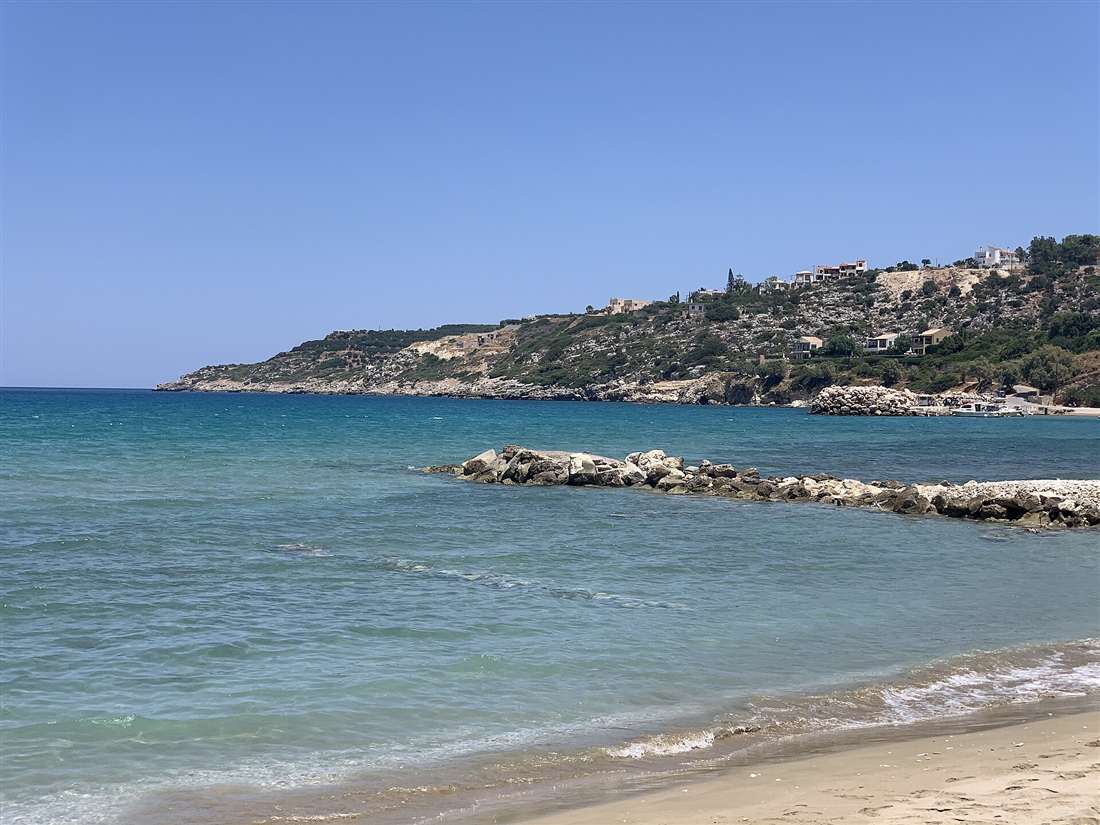
Almyrida is a relaxed family beach-resort village on the Apokoronas coast, about 25 kilometres east of Chania in Crete, with shallow blue-flag beaches, an afternoon breeze for windsurfing, seafront tavernas, and the green Apokoronas hills behind. Plan the whole trip with Greece Tours.
This guide covers Almyrida in full: what and where it is, the shallow sandy beach, the windsurfing and watersports, the ancient basilica mosaic, whether it suits families, neighbouring Kalyves and the Apokoronas, what there is to do, the tavernas and the quiet evenings, where to stay, the day trips to Kournas Lake and the Chania old town, how to get there, and whether Almyrida is worth visiting near the Akrotiri and Souda coast.
What is Almyrida in Crete?
Almyrida is a relaxed family beach-resort village on the Apokoronas coast about 25 km east of Chania, in the Chania region of western Crete. It fronts two shallow blue-flag beaches on Souda Bay, backed by tavernas, watersports centres and low-rise studios.
The village sits at the mouth of a fertile coastal plain where the green hills of the Apokoronas district meet the sea. Almyrida grew from a small fishing and farming settlement into a compact resort that keeps a village scale: a single seafront road, a cluster of tavernas and cafes at the waterline, and a spread of family-run apartments climbing the slope behind. The White Mountains rise inland, and the long line of the Akrotiri peninsula closes the western horizon across the bay.
Almyrida draws visitors who want calm water, easy access and a slower pace than the busy strips west of Chania town. The resort suits couples, families with young children and windsurfers who chase the reliable afternoon breeze. English, German and Dutch signage sits alongside Greek, and the season runs from late April to the middle of October. For a wider view of the region and its towns, the Chania hub at Chania maps the destinations around Almyrida.
The name Almyrida derives from the Greek word for salt, a reference to the brackish springs and the shallow, salt-warmed shallows that define the shoreline. That geography shapes the whole resort: the water stays waist-deep for a long stretch offshore, the seabed is soft sand and fine shingle, and the bay funnels a steady thermal wind that turns Almyrida into a windsurfing base in the afternoons. The result is a village that reads as two places in one day: a placid family beach until lunch, and a breezy watersports bay from mid-afternoon.
Accommodation in Almyrida sets the tone of the resort. Studios, apartments and small hotels spread across the slope behind the beach, most family-run and built low against the hillside so that the village keeps its human scale. Self-catering units with kitchenettes and sea-view balconies outnumber the larger hotels, which suits families and long-stay windsurfers who cook their own meals and settle in for a week. A ribbon of shops, bakeries, car-hire desks and mini-markets threads the single main street, and the whole resort walks end to end in fifteen minutes. Almyrida trades the scale and nightlife of the western strips for quiet evenings, a short walk to the water and a strong sense of a real Cretan village behind the tourist front.
Where is Almyrida and how far is it from Chania?
Almyrida lies on the Apokoronas coast of western Crete, next to the village of Kalyves, about 25 km east of Chania town and roughly 19 km from Chania International Airport on the Akrotiri peninsula. The drive from Chania takes 30 minutes on the national road.
The route runs east from Chania along the E75 national road that traces the northern coast of Crete. Drivers exit at the Kalyves and Almyrida junction, drop down through Kalyves village on the shore of Souda Bay, then follow the coast road a further 3 km east to Almyrida. The final stretch hugs the waterline past the neighbouring hamlet of Kokkino Chorio turn-off, delivering the first view of the resort’s twin bays. Souda port, the ferry gateway of the Chania region, sits 15 km west of the village.
Public buses link Chania’s central KTEL station to Kalyves and Almyrida through the summer season, with the last kilometres covered on the Vamos and Kalyves service. The bus journey takes about 45 minutes. Taxis run from Chania town and from the airport, and a hire car gives the freedom to explore the Apokoronas villages and the beaches strung along Souda Bay. Almyrida makes a practical base because it stands within a 40-minute radius of Chania old town, Georgioupoli, Vamos and the mountain village of Vryses.
The position on Souda Bay matters. The bay is a deep, sheltered inlet guarded to the west by the Akrotiri headland, so Almyrida faces protected water rather than the open Cretan Sea. That shelter keeps the swell down and the water clear, while the funnel shape of the bay accelerates the afternoon wind. Drivers reach the wilder open-coast beaches west of Chania, catalogued at Chania beaches, within an hour, so a stay at Almyrida pairs calm home water with day trips to the dramatic sands of the western shore.
The village earns its keep as a touring base. Chania old town, with its Venetian harbour, lighthouse and covered market, sits a 30-minute drive west. Georgioupoli and its long river-fed beach lie 20 km east. The mountain gorge country of the White Mountains, including the trailheads that feed the Samaria and Imbros gorges, opens up on a day trip south. Souda port, 15 km west, handles the overnight ferries to Piraeus, so Almyrida connects to mainland Greece within a short hop. This central position on the Apokoronas coast puts the calm resort at the heart of a wheel whose spokes reach the harbour towns, the gorges and the beaches of the entire Chania region.
What is Almyrida beach like?
Almyrida beach is a shallow, sheltered stretch of soft sand and fine shingle that holds a Blue Flag for water quality and safety. The sea stays waist-deep far offshore, sunbeds and umbrellas line the sand, and tavernas sit steps from the water.
The resort fronts two adjoining bays separated by a low rocky spur. The main western bay is the busier one, a curve of pale sand fringed by organised sunbed rows, showers and a lifeguard presence in high season. The eastern bay is quieter and narrower, mixing sand with smooth pebbles and a shallow reef that draws snorkellers. Both bays share the same defining trait: the gently shelving seabed that lets small children and hesitant swimmers walk out a long way while the water stays chest-high.
The sand is soft underfoot near the shoreline and firms into fine grey-gold shingle at the tideline. The water reads turquoise over the pale bed and stays exceptionally clear because the sheltered bay carries little swell. Sunbeds and straw umbrellas rent by the day from the beachfront tavernas, and a free public stretch runs at each end of the sand for those who bring their own towel. Freshwater showers, a handful of beach bars and a shaded promenade back the main bay.
The beach changes character through the day and the season. Early mornings bring glass-flat water and a quiet sand before the first sunbeds fill, the ideal window for a long swim or a paddleboard. Midday packs the organised rows with families under straw umbrellas. Mid-afternoon the thermal wind ruffles the surface and the windsurfers take over the eastern flats while swimmers hold the sheltered western corner. The season runs warm from June to September, when the sea holds a swimming temperature into the evening, and the bay stays usable from late April to mid-October. Tamarisk trees along the back of the sand throw natural shade for those who skip the sunbeds, and the promenade links the beach to the seafront tavernas end to end.
Facilities cluster tight against the beach. The taverna terraces along the seafront serve fresh fish, Cretan mezes and cold drinks a few metres from the sunbeds, so a swim, a lunch and an afternoon coffee happen without leaving the sand. Parking sits behind the beach and along the approach road. The Blue Flag status, awarded for clean water, safe bathing and on-site amenities, confirms what the calm bay makes obvious: Almyrida is built for unhurried days by gentle water rather than for surf or seclusion.
Why is Almyrida good for windsurfing and watersports?
Almyrida is a leading windsurf base because Souda Bay funnels a steady thermal wind every afternoon while the mornings stay flat. Windsurf and kitesurf schools rent gear and teach on site, and the shallow bay also supports paddleboarding, kayaking and diving.
The wind is the draw. Through the summer the sun heats the Apokoronas plain, warm air rises, and cooler sea air pulls in across Souda Bay to replace it. The bay’s shape accelerates that thermal breeze into a reliable side-onshore wind that builds from late morning and peaks in the afternoon, then drops at dusk. Force 4 to 5 conditions arrive on a schedule that windsurfers plan a day around, which is why Almyrida ranks among the most dependable windsurfing spots in western Crete.
Windsurf centres on the beach rent boards and rigs by the hour, day or week and run graded courses from first-timer to advanced. The shallow, obstacle-free bay makes a forgiving learning ground: a beginner who falls stands up in waist-deep water, and the side-onshore direction carries a stray board back to the beach rather than out to sea. Kitesurf schools operate from the wider eastern flats when the wind sets, and rental stand-up paddleboards and sit-on kayaks serve the calmer morning hours.
The bay serves gentler watersports too. Morning paddleboarders cross the glassy water before the wind rises, kayakers follow the coast toward Kalyves and the rocky headlands, and snorkellers explore the reef off the eastern bay. Dive operators run trips from Almyrida and neighbouring Kalyves to the reefs and drop-offs of Souda Bay, where clear water and the sheltered coastline give reliable visibility. The single village supplies the full spread of sea activity, from a first windsurf lesson to a guided scuba dive, without a car journey.
The rhythm of the wind shapes the day for watersports visitors. The flat morning belongs to paddleboarders, kayakers, snorkellers and swimmers who want still water. As the breeze builds through the early afternoon, the windsurf and kite crowd rig up, and the bay fills with sails cutting across the side-onshore wind. By evening the wind drops back to a whisper and the sea flattens again for a sunset paddle. This dependable daily cycle lets a mixed group split the day: gentle water sports before lunch, board sports after, and a taverna dinner at the waterline as the wind dies. The reliability of the Almyrida breeze, more than its strength, is what keeps windsurfers returning to this corner of Souda Bay.
What is the ancient history at Almyrida?
Almyrida holds the remains of an early Christian basilica with a preserved mosaic floor, set just behind the beach, alongside Roman-era building foundations and submerged ancient ruins visible in the shallow water offshore. The site marks a settlement that traded across Souda Bay in antiquity.
The early Christian basilica stands a short walk inland from the seafront, protected under a shelter beside the road. Its floor carries a geometric mosaic in coloured tesserae, laid in interlocking patterns that survive across a large section of the nave. The three-aisled plan and the mosaic date the church to the early Christian centuries, when the coast of the Apokoronas supported a network of small ports and Christian communities. The basilica ranks among the notable early Christian monuments of the Chania region.
The wider ground around Almyrida yields Roman-period remains. Foundations of walls and buildings mark an ancient coastal settlement that used the sheltered bay as a harbour for trade in salt, produce and pottery. The salt springs that gave the village its name fed a saltworks that supplied the settlement, tying the ancient economy to the same geography that shapes the modern resort. Fragments of amphorae and worked stone turn up across the fields behind the beach.
The most striking traces lie in the sea. Off the shore of Almyrida, low walls and cut blocks rest in shallow water, submerged by the slow subsidence of this stretch of the Cretan coast over the centuries. Snorkellers pick out the straight lines of ancient masonry a few strokes from the beach, a reminder that the shoreline stood lower in antiquity. The combination of the mosaic basilica, the Roman foundations and the underwater ruins gives Almyrida a layer of deep history beneath its holiday surface.
The history extends across the Apokoronas coast around the village. The wider district carried a chain of ancient settlements that used the sheltered inlets of Souda Bay as harbours, linked by roads that ran inland to the mountain villages. The salt trade tied Almyrida into a coastal economy that reached across Crete and beyond, and the early Christian basilica marks the point where that Roman coast passed into the Byzantine world. Visitors combine the mosaic with the archaeological sites of the greater Chania region, from the Minoan and Roman remains near Chania town to the Venetian and Ottoman monuments of the harbour. At Almyrida the past sits close to the surface: a mosaic beside the road, a wall in the fields, a line of blocks under the waves.
Is Almyrida good for families?
Almyrida is well suited to families because the shallow, warm, gently shelving water lets small children wade and paddle in safety, the Blue Flag beach carries a lifeguard in high season, and tavernas, shops and studios sit within a short flat walk of the sand.
The shallow bay is the core of the appeal. The seabed drops away so slowly that a young child walks out ten metres and the water reaches only the waist, and the sheltered position keeps waves to a ripple on most days. The soft sand entry has no sudden shelf or rip, and the summer sun warms the shallows to a bath-like temperature. Parents watch from a sunbed a few metres away while children build sandcastles and paddle within easy reach.
The village layout supports family days. The beachfront tavernas welcome children, serve early dinners and offer the plain grilled fish, chips and Cretan dishes that suit young palates, all a few steps from the sand. Mini-markets stock nappies, sun cream and beach toys, and the flat seafront promenade takes a pushchair with ease. Family-run apartments and studios with kitchenettes cluster on the slope behind the beach, putting self-catering accommodation within a five-minute walk of the water.
The calm scale of the resort adds to its family credentials. Almyrida stays small and low-rise, traffic moves slowly through the single village, and the safe bay means older children swim and snorkel with a long leash. Pedalos and paddleboards give teenagers something to do, while the neighbouring beaches at Kalyves broaden the choice. The village delivers the combination families rank first: safe water, food and shelter close together, and a gentle pace that suits a holiday with children.
The surrounding coast widens the choice for a family week. Kalyves, 3 km west, adds a longer beach, a river mouth where children paddle in fresh water, and full-size supermarkets for the weekly shop. The Apokoronas hill villages give a cool inland outing on hot afternoons, with village squares, playgrounds and shaded tavernas. Day trips reach the water parks and the zoo of the Chania plain within 40 minutes, and the calm evenings in Almyrida itself let parents linger over dinner while children play safely on the traffic-light seafront. The absence of a loud club scene and the low-rise, walkable layout make the resort a place where a young family relaxes rather than negotiates, which is the quality that brings the same households back year after year.
What is Kalyves and the Apokoronas near Almyrida?
Kalyves is the larger neighbouring village 3 km west of Almyrida, a working coastal town with a long sandy beach, a river mouth and a full range of shops. Both villages sit in the Apokoronas, the green, spring-fed district of low hills, olive groves and stone villages east of Chania.
Kalyves spreads along its own bay on Souda Bay, where the Xydas river meets the sea beside a broad sandy beach. The village keeps a year-round life beyond tourism, with a high street of bakeries, butchers, pharmacies and tavernas, a small fishing quay and a promenade that fills on summer evenings. The beach runs longer than Almyrida’s and the town supplies the supermarkets and services that the smaller resort lacks, so visitors base in Almyrida and drive the short distance to Kalyves for shopping and a change of beach.
The Apokoronas is the fertile hinterland that gives the whole coast its character. Fed by mountain springs off the White Mountains, the district stays green through the dry Cretan summer, its hills carpeted in olive groves, orange orchards and cypress. Stone villages such as Vamos, Gavalochori, Douliana and Kokkino Chorio sit in the folds of the hills within a 15-minute drive of Almyrida, each with a village square, a kafeneio and traditional houses restored as guesthouses. Walking trails link them through the groves.
The district rewards a day inland from the beach. Gavalochori keeps a folklore museum and a tradition of silk lacework, Vamos anchors a network of restored stone lodgings and Cretan cookery, and the hill villages give long views back across Souda Bay to the Akrotiri peninsula, whose monasteries and beaches are described at Akrotiri. This blend of a calm resort beach, a working neighbour village and a green mountain hinterland is what sets Almyrida and the Apokoronas apart from the busier resorts on the open coast west of Chania.
The two coastal villages share a single sheltered stretch of Souda Bay and complement each other in use. Almyrida draws the windsurfers and the families who prize its shallow blue-flag bays, while Kalyves supplies the depth of services, the longer beach and the harbour life of a town that works year round. A footpath and the coast road connect the two in a fifteen-minute walk along the shore, past the rocky headland and a run of small coves where quiet swims wait for those who wander from the main sand. Between them the villages cover every holiday need on one short arc of coast.
The Apokoronas rewards a slow week. A morning on the Almyrida sand, a lunch of Cretan cheese and mountain greens in a Vamos taverna, an afternoon among the silk lace of Gavalochori and a sunset watched from a hill village terrace map a day that touches beach, food, craft and view without a long drive. The district’s springs keep it green when the rest of Crete burns brown, its villages keep the stone and the pace of an older island, and its coast keeps water clean enough to fly a blue flag. Almyrida sits at the meeting point of all three, a beach resort with a working hinterland at its back and the whole Chania region within reach.
What is there to do in Almyrida?
Almyrida packs a shallow blue-flag bay, windsurfing and kitesurfing off the eastern point, coastal walks along the Drapanos peninsula, boat trips to hidden coves and a strip of seafront tavernas into one compact Apokoronas resort 25 km east of Chania.
The day starts on the sand. The main bay faces south-west, so the water warms early and stays glassy through the morning before the afternoon breeze arrives. Sunbeds and umbrellas line the central stretch, and the shallow entry lets non-swimmers wade out a long way before the seabed drops. A rocky islet sits a short swim offshore, and snorkellers cross to it to trace the reef of sea grass and small fish that gathers around its base.
Beyond the swimming, Almyrida runs a full menu of on-water activity. The watersports base rents stand-up paddleboards, kayaks and pedalos by the hour, and the windsurf and kitesurf school on the eastern side reads the thermal wind that funnels across the Gulf of Almyros each afternoon. Small boats leave the jetty for coastal cruises to the neighbouring inlets and to the quieter beaches under the cliffs, and a walk along the shore path connects Almyrida to Kalyves in under an hour on foot. For a wider tour of the region, the sights around Chania reach the village in a half-day loop by car.
The land side matches the water for options. A walking trail climbs the Drapanos peninsula behind the village toward Plaka and Kokkino Chorio, opening long views back over the Gulf and out to the Rodopou headland. The mini-markets and gift shops of the seafront fill the gap between beach and dinner, the bakery turns out fresh bougatsa each morning, and the diving centre runs guided dives on the reefs and drop-offs of the peninsula. Almyrida holds a full day without the traveller starting the car, then hands over a ring of Apokoronas outings for the days that follow.
Where do you eat in Almyrida?
Almyrida eats by the water. A row of family fish tavernas lines the seafront, each grilling the day’s catch, serving Cretan mezes and pouring local wine and raki, with tables set close enough to the sand that the sunset colours the plates.
Fish leads the menu. Boats land red mullet, bream, sardines and octopus, and the tavernas hang the octopus to dry in the sun before charring it over coals. The classic Almyrida order is a whole grilled fish weighed at the table, a plate of fried marides, a Cretan salad heavy with barrel-aged graviera and a carafe of chilled white from the Apokoronas vineyards. Prices track the weight of the fish rather than a fixed figure, so diners pick their catch at the ice counter.
The Cretan side of the menu holds its own against the seafood. Dakos, the rusk soaked in grated tomato and crowned with mizithra, opens most meals, and mains run to lamb baked with potatoes, snails in rosemary, boiled wild greens dressed in Apokoronas olive oil, and kalitsounia, the small cheese pies of the region. Every table ends with raki and a plate of fruit or spoon sweets on the house. Dinner in Almyrida stretches long past sunset, and the seafront tavernas keep serving while the lights of the bay reflect on the water.
Timing shapes the experience. Lunch runs light and long, a plate of grilled octopus and a cold beer with the feet almost in the sand, while dinner turns into the main event of the day. The west-facing bay puts the sun down over the water at the tavernas’ front tables, so a booking for the golden hour lands the meal against a sky of orange and pink. Beyond the seafront fish houses, the lanes behind the beach hide a bakery, a couple of coffee bars for morning frapp\u00e9, and grill tavernas that lean toward the meat and pie side of Cretan cooking for the nights the appetite turns from fish.
What is the nightlife and evening like in Almyrida?
Almyrida keeps its evenings calm. Beach bars mix cocktails to a low soundtrack, families fill the tavernas until late, and the village runs on a gentle rhythm with no nightclubs, no loud strips and no party crowd chasing the small hours.
The evening centres on the seafront. As the sun drops behind the Drapanos headland, the beach bars set cushions on the sand and pour cocktails, cold beer and Cretan wine while the sky turns orange over the Gulf. The pace stays slow. Couples nurse a drink at the water’s edge, children run on the beach in the last of the light, and the tavernas fill with the clatter of long shared dinners.
Almyrida draws a family and couples crowd rather than a clubbing one. The bars close in good order, the music stays at conversation volume, and the loudest sound after midnight is the sea. Visitors who want louder nights drive the 25 km to Chania old town, where the harbour bars and the Splantzia squares run late. In Almyrida itself the reward of the evening is a still, dark bay and a table full of food, and the village guards that quiet as its main asset.
The evening stroll ties the day together. After dinner, families walk the seafront from end to end, the ice-cream and cr\u00eape stands stay open for the children, and the beach bars keep a low pulse of music going for the couples who linger over a nightcap. The clear Apokoronas sky brings out the stars over the Gulf, and the far lights of Chania trace the coastline to the west. Almyrida ends its nights early and gently, which is the exact trade the families and couples who choose it come to make.
Where do you stay in Almyrida?
Almyrida stays are low-rise and personal. Self-catering apartments, small family-run hotels, studio complexes with pools and stone villas scattered across the Apokoronas hills form the accommodation base, with no high-rise resorts and most beds a short walk from the sand.
The village core holds apartment blocks and studio complexes built for a beach week. These sit within a five-minute walk of the bay and the tavernas, come with kitchenettes and shared pools, and suit families who want the beach and the seafront on their doorstep. Small hotels and guesthouses fill the gaps, run by the families who own them, and trade the anonymity of a big resort for a first-name welcome.
The hills above the coast hold the villas. Apokoronas is villa country, and the slopes behind Almyrida, Plaka, Kokkino Chorio and Gavalochori carry stone-built houses with private pools and views down to the Gulf. These reward a group or a family travelling with a car, putting the beach ten minutes below and the mountain villages ten minutes above. For a wider picture of the region’s beds, the guide to where to stay in Chania sets Almyrida against the city, the west coast and the other Apokoronas villages.
The choice comes down to how the group plans to spend its days. A family set on the beach and the tavernas takes an apartment or studio in the village core and walks everywhere, trading a pool view for the sea on the doorstep. A group after privacy and space books a hillside villa in Plaka or Kokkino Chorio, drives down to the bay for the day and returns to a private pool and a mountain sunset. Both sit inside a ten-minute radius of Almyrida beach, and both draw on the same seafront for dinner, so the decision turns on the pace of the holiday rather than the distance to the sand.
What day trips are near Almyrida?
Almyrida sits inside easy reach of Chania old town at 25 km, Kournas Lake at 20 km, the traditional villages of Vamos and Gavalochori next door, the mountain descent of the Imbros Gorge, and the crossroads market town of Vryses.
Chania is the headline trip. The Venetian harbour, the lighthouse, the covered market and the maze of the old town lie half an hour west, and the drive tracks the coast for most of the way. The old town rewards a full day, and the archive of day trips from Chania lays out the routes that fan out from the city, most of which pass within reach of Almyrida.
Closer to base, the Apokoronas villages carry the day. Vamos, the old regional capital, restores stone houses and runs a cooperative of tavernas and workshops. Gavalochori keeps a folklore museum and the sunken Venetian wells. Kournas Lake, the island’s only freshwater lake, sits 20 km south for a pedal-boat afternoon. The Imbros Gorge, an 8 km walk down a limestone ravine to the Libyan Sea, opens the mountain south, and Vryses, the tree-shaded town on the old national road, serves yoghurt with honey under the plane trees on the way through.
Two longer runs stretch the range on a car day. The south coast at Frangokastello, with its lone Venetian fortress standing on an empty beach, lies an hour and a quarter through the mountains, and the palm-backed lagoon of Georgioupoli sits 15 minutes west along the coast for a change of sand. Each trip returns to Almyrida by dinner, which keeps the seafront tavernas as the fixed point of the day and turns the village into a base for touring the whole of western Crete rather than a single stop on it.
What is Kournas Lake near Almyrida?
Kournas Lake is the only natural freshwater lake on Crete, a turquoise oval ringed by mountains 20 km south of Almyrida. Pedal boats cross its warm shallows, tavernas line the shore, and terrapins bask at the water’s edge.
The lake fills a basin below the village of Kourna, fed by mountain springs, and its colour shifts from green to deep blue as the water deepens toward the far bank. A rim of shallow warm water at the near shore draws paddlers and families, who wade out over the soft sand, and the pedal-boat and rowing-boat hire on the bank sends visitors round the full circuit in an hour. Terrapins and the odd water snake share the shallows, and a footpath tracks part of the shoreline for walkers.
The drive from Almyrida runs 20 km through Vryses and up to the lake in half an hour, which puts a morning swim in the sea and an afternoon on the lake inside one day. Tavernas above the water grill and serve on terraces that look straight down onto the blue, and the low light of late afternoon turns the whole basin gold. Kournas ranks as the standout inland trip from the Apokoronas coast, and its short distance from Almyrida makes it a repeat outing rather than a one-off.
The seasons redraw the lake. Summer shrinks the water back from the shore and widens the warm sandy margin that families wade across, while the wetter half of the year lifts the level and floods the reed beds at the western end. Birds work the shallows year round, and the walking path on the quiet side of the basin trades the boat noise for the sound of the springs feeding in from the rock. A visit pairs the pedal boats and a lakeside lunch with a slow circuit on foot, a full inland day 20 km from the Almyrida sand.
How do you get to Almyrida from Chania and the airport?
Almyrida lies 25 km east of Chania town and roughly 40 km from Chania International Airport at Akrotiri. The drive from the city takes 30 minutes on the national road, and a taxi or pre-booked transfer covers the airport run in about 45 minutes.
Drivers take the E75 national road east from Chania, exit for Kalyves and Almyrida, and drop down the coast road into the village. The route is fast and well signed, and the last stretch from Kalyves hugs the shore. From the airport at Akrotiri, the road loops round the head of Souda Bay and joins the national road east, and the whole transfer runs under an hour outside peak traffic.
Public buses connect Chania’s central KTEL station with Kalyves and Almyrida through the day, and the ride takes around 45 minutes with stops. Buses run less frequently than the city routes, so a timetable check before travel saves a wait. For door-to-door ease, most visitors book a private transfer or take a taxi from the rank at the airport, which delivers straight to the accommodation with luggage and avoids the change at Kalyves.
Souda port adds a third arrival point. Ferries from Piraeus dock at Souda overnight, and the quay sits 20 km west of Almyrida on the same national road, a 25-minute transfer from the ship to the village. Travellers who cross by sea step off the boat, collect a hire car or a waiting taxi, and reach the bay before breakfast. Whichever gate the journey uses, the last leg funnels through Kalyves and drops onto the Almyrida coast road, so the sea comes into view in the final minutes of the trip.
Do you need a car in Almyrida?
Almyrida functions without a car for a beach-and-tavernas week, since the bay, the shops and the seafront restaurants all sit within a short walk. A hire car unlocks the other Apokoronas beaches, the mountain villages and the day trips to Chania and Kournas.
The village core is walkable end to end. The beach, the mini-markets, the bakery, the watersports base and the row of tavernas cluster around the seafront, and the walk from the apartment blocks to the sand takes minutes. A stay built purely around swimming, eating and evening drinks needs no wheels, and the coast path to Kalyves adds a car-free outing on foot.
A car changes the trip from a single village to the whole of Apokoronas and beyond. The quieter beaches at Kalives, Kalami and along the peninsula, the villages of Vamos, Gavalochori and Vryses, the lake at Kournas and the old town of Chania all sit within a half-hour drive, and reaching them by bus costs time and connections. Families who plan to range beyond the bay hire a car for the week; those who plan to stay put leave the driving to the transfer in and out.
Parking rarely troubles the driver. The village runs free roadside spaces near the beach and larger lots on the approach, and the mountain villages sit small enough to park at the edge and walk in. Hire desks operate at Chania airport, at Souda port and in Chania town, and a car delivered to the accommodation for the week costs less than a run of taxis to Kournas and back. The split is clean: no car for a pure beach week, a car for a touring one.
When is the best time to visit Almyrida?
Almyrida runs its season from late spring to early autumn. July and August bring the hottest sea and the busiest sand, June and September deliver warm water with room to breathe, and the steady afternoon breeze makes the shoulder months the pick for windsurfers.
High summer heats the bay to its warmest and fills every sunbed. The village hums, the tavernas run at full tilt, and the afternoon thermal wind cools the beach even as the temperature climbs. Families who travel to the school holidays land here, and booking ahead secures the beds close to the sand. The heat peaks inland, so the coastal breeze of Almyrida reads as a relief against the still air of the mountain villages.
The shoulder months trade a degree of sea warmth for space and calm. The last weeks of spring, June and September keep the water swimmable and the days long while thinning the crowds, and the tavernas serve without a wait. Windsurfers and kitesurfers favour these edges of the season, when the Gulf breeze blows clean and steady across the eastern point. Winter empties the resort, and most tavernas and apartments close until spring, so the village suits a warm-season visit rather than an off-season one.
The wind itself sets the calendar for the active traveller. The afternoon thermal that crosses the Gulf of Almyros builds through the warm months, and the eastern point of the bay catches it cleanest, which puts the windsurf and kitesurf schools at their busiest from June to September. Morning stays glassy for swimmers and paddlers, the wind rises after lunch for the board sports, and the two share the same water on opposite ends of the clock. A traveller who reads the day this way swims and snorkels before noon, then hands the afternoon to the breeze.
Is Almyrida worth visiting?
Almyrida rewards travellers who want a calm, family-friendly beach base within half an hour of Chania. The shallow blue-flag bay, the seafront fish tavernas, the windsurf breeze and the ring of Apokoronas day trips add up to an easy, unshowy Cretan holiday.
The village trades scale for quality. There is no high-rise strip, no club circuit and no crowd chasing a party, and in their place stand a sheltered swimming bay, a genuine fishing-taverna seafront and a pace that suits children and couples alike. The shallow water, the safe entry and the short walks make it a natural choice for a family week, and the windsurf and kitesurf schools give the active traveller a reason to stay on the water.
Location seals the case. Almyrida sits at the centre of Apokoronas, 25 km from Chania old town, 20 km from Kournas Lake, and a short drive from Vamos, Gavalochori, Vryses and the mouth of the Imbros Gorge. That puts a full spread of Cretan experiences, from Venetian harbour to freshwater lake to mountain gorge, within a half-day loop of a quiet home base. For a beach holiday that stays relaxed without cutting off the rest of western Crete, Almyrida earns the trip.
Frequently Asked Questions
What is Almyrida in Crete?
Almyrida is a relaxed family beach-resort village on the Apokoronas coast about 25 kilometres east of Chania. It has a shallow sandy blue-flag beach, windsurfing and watersports, seafront tavernas, and an ancient early-Christian basilica mosaic beside the sea.
Is Almyrida good for families?
Almyrida suits families well. The main beach shelves gently into shallow, calm, warm water, backed by sunbeds and tavernas, and the village stays quiet and walkable. The afternoon breeze adds windsurfing for older children and adults.
How far is Almyrida from Chania?
Almyrida lies about 25 kilometres east of Chania on the Apokoronas coast, a 30-minute drive past Souda and Kalyves. Chania International Airport sits about 30 kilometres west, a 35 to 45 minute transfer.