
Explore Kastellorizo Island with our expert travel guide—discover the best time to visit, how to get there, top activities, and authentic local dining tips.
The tours below reach Kastellorizo from the Turkish coast at Kaş or sail around the island itself.
The Turkish town itself, with Kekova and its sunken city, the Lycian tombs of Antiphellos and the beaches of Kaputas and Patara, has its own Kas tours page.
Kastellorizo Travel Guide: Discover Greece’s Tiny Jewel — What To See, Do, And How To Plan Your Trip
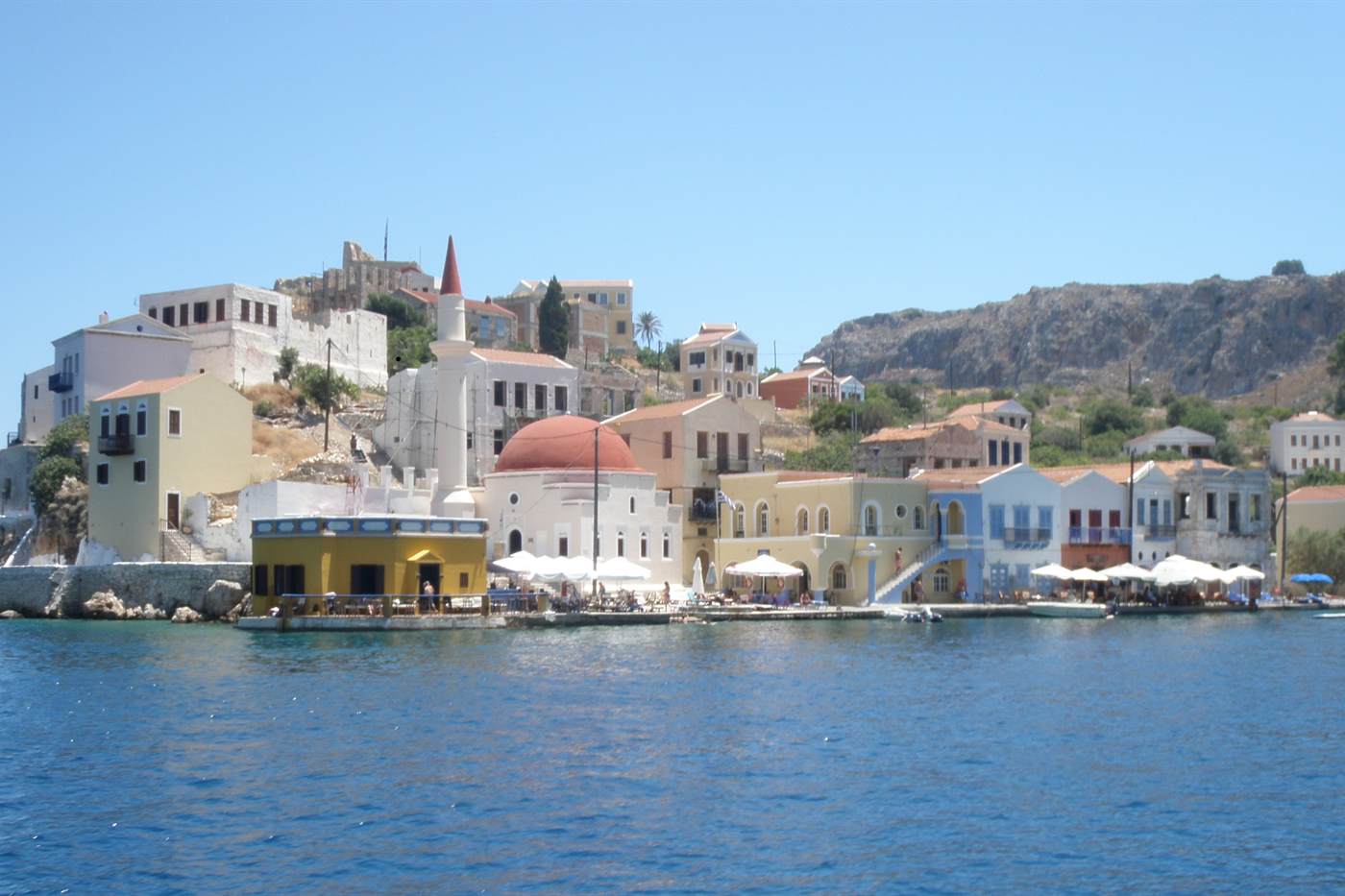
We’ve fallen for islands before, but Kastellorizo, also called Megisti, earns a special place on any Greek itinerary. Tucked at the eastern edge of the Aegean Sea, a hair’s breadth from the Turkish coast, this tiny island feels like a step back in time: pastel harbors, car-free lanes, and dramatic limestone cliffs punctuated by a luminous sea. In this guide, we’ll explain why Kastellorizo deserves a spot on your travel plans, when to go, how to arrive, what to do once you’re there, and practical tips for where to eat and sleep. Whether you’re after a slow island escape, dramatic coastal photography, or a boat-packed adventure around the Blue Cave, we’ll help you plan a trip that makes the most of Kastellorizo’s unique charms.
On Greece Tours, Kastellorizo joins Rhodes, Symi and Chalki among the Dodecanese island pages.
Why Visit Kastellorizo? What Makes This Island Special
Kastellorizo is one of those rare places where scale becomes a feature: the island is small (about 9 km²), and the main harbor village fits neatly into a single postcard view. That compactness is its strength. We visit to slow down, the island’s pace, narrow alleys, and absence of heavy tourism let us appreciate authentic island life rather than a curated resort experience.
Three elements make Kastellorizo stand out. First, it’s dramatic coastline. Towering limestone cliffs, hidden coves, and sea caves create landscapes that feel cinematic; no wonder parts of the island were used as locations for award-winning films. Second, its proximity to Turkey and its centuries-long maritime history give Kastellorizo a multicultural flavor: you can sense Venetian, Ottoman, and Greek influences in the architecture and cuisine. And third, the underwater and coastal environment is superb: crystal-clear water, interesting reefs, and the famous Blue Cave (Grotto), which glows an otherworldly turquoise when sunlight hits at the right angle.
Beyond scenery, the island has cultural depth. Chorio (the main village) has a handful of small museums, colourful neoclassical houses, and a resilient local community of fishermen and restaurateurs who welcomed visitors long before Instagram discovered the place. For travelers who want quiet evenings, meaningful local encounters, and dramatic natural beauty without big crowds, Kastellorizo hits the sweet spot.
Practical note: the island’s population is small (a few hundred residents), which means fewer services than on larger islands. We see this as part of the charm, but it does mean planning, especially accommodation and transport, should start early in high season.
Where is Kastellorizo, and how close does it lie to Turkey?
Kastellorizo, officially Megisti, is a Dodecanese island in the Levantine Sea, about 2 km off the south coast of Turkey. Its north cape lies 2.25 km from Kaş, Rhodes lies 125 km to the west, and the island holds the easternmost town in Greece.
Kastellorizo sits close to halfway between Rhodes and Antalya. By the municipality’s figures, Kastellorizo lies 72 nautical miles from Rhodes, 150 from Cyprus and 328 from Piraeus. Athens lies about 570 km to the north-west. Kaş, the ancient Antiphellos, stands in clear view from the harbour. Kastellorizo and its islets form the eastern end of the Dodecanese, and the rest of the chain appears under Dodecanese tours.
The island measures 6 km from end to end and 3 km across, with a surface of 9.2 square kilometres and 19.5 km of coastline. Its outline forms a triangle on a north-east to south-west axis. Three capes mark the corners: Agios Stefanos in the north, Nifti in the east and Pounenti in the south-west.
Kastellorizo is mountainous. Its rock is almost entirely limestone, laid down at the boundary of the Mesozoic and Cenozoic eras. With little plant cover, the landscape shows clear karst features. The coast rises high and steep, and it grows harder to reach towards the west. The summit, Mount Vigla, reaches 273 m. In March 2006, cavers of the SELAS club surveyed vertical caves across Kastellorizo, the deepest to 60 m. The island has no source of drinking water, and its limestone soil yields only small crops of olives, grapes and beans.
Kastellorizo has one town, also named Megisti, built around a natural harbour in the wide bay between Cape Agios Stefanos and Cape Nifti. The 2021 census counted 594 residents, all of them in this town. Its quarters are Pigadia, Chorafia and Mandraki, and the small bay of Mandraki serves as a second harbour. The quay runs along three sides of the main harbour. The town holds listed status as a traditional settlement.
- Climate: Kastellorizo has a hot-summer Mediterranean climate, class Csa, with 158 tropical nights a year and a mean annual temperature of 21.9 °C, second in Greece only to Lindos.
- Winter lows: Average lows stay at 12.0 °C or above even in the coldest months, and the coastal record low is 4.5 °C, set on 25 January 2022.
- Municipality: The Municipality of Megisti covers 11.98 square kilometres and takes in Ro, Strongyli and a group of smaller islets.
- Wildlife: Within Greece, Luschan’s salamander lives only on Kastellorizo and its islets, and the Egyptian fruit bat was first recorded in the country on Kastellorizo in 2017.
- Sea zone: Kastellorizo, Ro and Strongyli form the easternmost territory of Greece, which gives the group weight in Greek claims to an Exclusive Economic Zone.
Which islets surround Kastellorizo, and who was the Lady of Ro?
Thirteen islets surround Kastellorizo, led by Ro to the west and Strongyli to the south-east, the easternmost point of Greece. The Lady of Ro, Despina Achladiotou, lived on Ro from 1927 and raised the Greek flag there each morning until her death in 1982.
Eight of the islets lie in the bay of Kastellorizo: Agios Georgios, Agrielaia, Megalo Mavro Poini, Mikro Mavro Poini, Polifados Ena, Polifados Dio, Psoradia and Psomi. Flat Psoradia lies closest to Kastellorizo, opposite the castle and the Lycian tomb. Psomi lies closest to Turkey and covers just 0.0035 square kilometres, yet it is the only place in Greece where a lizard of the genus Anatololacerta has been found. Agios Georgios, facing Mandraki, has a tiny beach and a chapel of its saint, and shrub-covered Agrielaia lies a short swim from it.
Ro, the ancient Rhoge, lies 2.8 nautical miles west of Kastellorizo and 3 nautical miles south of the Lycian coast. It covers 1.486 square kilometres, with 8.8 km of shoreline, and the rock islets of Tragonera and Savoura sit beside it. Strongyli, also called Ypsili, lies about 4 km south-east of Kastellorizo. The islet runs 1.5 km long and up to 700 m wide and marks the easternmost point of Greek territory. Its lighthouse, first lit in 1910, is the easternmost building in Greece, and an army cargo cableway built in 2015 runs to it from a small east harbour. Strongyli also lies closer to Cyprus than any other Greek island, at 141 nautical miles.
Despina Achladiotou, born Despina Saria on Kastellorizo around 1890, married Kostas Achladiotis, a shepherd from Astypalaia. In 1927 the couple settled on Ro and lived on goats, chickens and a vegetable garden. In 1929 she woke to see a Turkish flag on the summit of Ro. She sewed a Greek flag from a white sheet and a blue curtain and raised it in its place. When Kostas fell gravely ill, she lit signal fires to call for help from Kastellorizo, but he died in the fishing boat that came for him. She then brought her blind mother to live with her on Ro.
Through the Second World War she stayed on Ro, even when Kastellorizo stood almost empty, and gave help to soldiers of the Sacred Band. She raised the flag every morning and lowered it at sunset. In August 1975, while she was away for health reasons, a Turkish journalist and two companions landed and set their flag on a 4 m pole; she took it down on her return. She died in a Rhodes hospital in 1982, aged 92, and her funeral took place on Kastellorizo the next day at public expense. She lies buried on Ro, beneath the mast where she raised the flag.
- Ro today: Her grave, the two small houses she lived in and the chapel of Agios Georgios stand on the islet, and the soldiers posted there keep raising the flag each day.
- Honours: The Academy of Athens honoured her in 1975, and on 23 November that year the Ministry of National Defence gave her the medal for the war period 1941–1944.
- Statue: A statue of the Lady of Ro stands on Panagia square in the Chorafia quarter of Kastellorizo, across from the cathedral.
- Border line: The 1932 convention between Italy and Turkey kept Ro, Strongyli and the bay islets with Italian-held Kastellorizo and gave every other islet nearby to Turkey.
What remains of ancient Megisti on Kastellorizo?
Kastellorizo keeps a 4th-century BC Lycian rock-cut tomb below the castle, the walled acropolis of Palaiokastro with its cisterns and Doric inscription, and Cyclopean walls on Vigla. Its cathedral reuses twelve granite columns from the temple of Apollo at Patara.
The Lycian tomb of Kastellorizo is cut into the rock at the foot of the castle hill and dates to the 4th century BC. Tombs of this type belong to Lycia, the ancient land on the facing coast, where burial chambers were carved into rock faces, rose in two storeys and carried a triangular roof. Across the strait, the cliffs above Kaş still hold rock tombs. The municipality explains the Lycian name through Lycian Apollo, a god worshipped there in the form of a wolf.
In antiquity Kastellorizo carried two names, Megiste and Cisthene. Strabo describes Cisthene as the biggest island opposite Antiphellus, which points to Kastellorizo. A Doric inscription cut into the castle rock records a fortress on the same spot in antiquity.
Palaiokastro, the ancient acropolis, crowns a height west of the town, beyond the summit of Vigla, 2 km from the houses. It served as the central fortified site of Kastellorizo, and the municipality dates it to the 4th century BC. The walls enclose a rectangle of 60 by 80 m. Inside stand an ancient tower of squared limestone blocks and large water cisterns. A Doric inscription of the 4th or 3rd century BC, carved at the base of the fortress, names Megiste and its dependence on Rhodes. The remains of a gateway, or propylaea, survive on the east side.
Finds on Kastellorizo reach back to the Neolithic. Islanders call the prehistoric stone axes found here astropelekia. Cyclopean walls of the Mycenaean era stand on the hill of Vigla, at the site of Limenari. In 1913, a marble sarcophagus in an ancient tomb on the Agios Georgios plateau held a gold wreath of the Mycenaean era, which the community gave to the National Archaeological Museum in Athens. On Ro, a ceramic tomb of the 11th century BC has come to light.
- Later layers: Medieval repairs reshaped the Palaiokastro walls, and newer churches, machine-gun posts, bomb damage and Ottoman-period cisterns mark the hill; the chapels of Panagia tou Kastrou and Agios Stefanos stand at its foot.
- Ro fort: A Rhodian fort of the 4th century BC keeps a rectangular tower about 4 m high in isodomic masonry, a double outer wall and a cistern lined with hydraulic mortar.
- Watchtower chain: Rhodes built a chain of Hellenistic watchtowers to guard the coast and the sea lanes, and the towers on Kastellorizo, Ro and Strongyli were its chief links.
- Cathedral columns: The roof of Saints Constantine and Helena, built around 1835 above Mandraki, rests on twelve monolithic granite columns brought from the temple of Apollo at Patara in Lycia.
- Agios Georgios tou Vounou: 401 steps climb from the Kastellorizo harbour to this monastery, whose church dates from 1759; ten steps down lies a crypt of Agios Charalambos.
- Early Christian floors: Agios Georgios tou Santrape and Agios Georgios tou Vounou both keep remains of basilicas with mosaic floors from the 4th to 6th centuries AD.
In the Kastellorizo cathedral, the columns carry pointed arches and divide the church into three aisles. Patara held a temple and oracle of Apollo ranked second only to Delphi, yet the site of that temple has not been found.
What is the history of Kastellorizo from antiquity to the Ottomans?
Dorian Greeks settled Kastellorizo and called it Megiste, and Rhodes ruled it in the Hellenistic era. The Knights Hospitaller seized it in 1306, an Egyptian sultan occupied it around 1440, Aragon and Naples followed, and Ottoman rule began under Suleiman the Magnificent.
Its Dorian name, Megiste, means “greatest”, since it is the largest island in its small group. Inscriptions at the foot of the castle confirm Rhodian rule in the Hellenistic period, when Rhodes sent an overseer, the epistates, to watch local affairs.
Megiste struck its own coins from 333 BC to 304 BC, then fell back under full Rhodian control in the time of Demetrius Poliorcetes. Cassius Longinus later made it a Roman fleet base against Carian and Cilician pirates. In the Byzantine period Kastellorizo belonged to the Province of the Islands, governed from Rhodes.
In 1306 the Knights Hospitaller under Foulques de Villaret took Kastellorizo during their campaign to conquer Rhodes, restored the castle and turned it into a jail for disobedient knights. Nicola de Martoni, a visitor in 1395, recorded islanders crossing to the mainland to tend their vineyards under a truce with the Turks. Around 1440 the Egyptian sultan Sayf ad-Din Jaqmaq occupied the island and destroyed the castle. Ten years later Alfonso V of Aragon, king of Naples, took it, rebuilt the castle in 1461 and sent a Catalan governor.
Venice seized Kastellorizo during the Siege of Candia, on 22 September 1659, and destroyed the castle again, but the Ottomans soon won it back. In July 1788 Lambros Katsonis besieged the island for two days until its defenders raised a white flag. Islanders sided with the Greek insurgents between 1828 and 1833, yet Ottoman rule returned when the war ended. Under the sultans Kastellorizo paid an annual tax, kept its faith and language, and built a merchant fleet:
- Fleet: Islanders sailed 500 ships, buying goods in the East and selling them in Egypt, Palestine, Cyprus, the Aegean islands and Italy.
- Cargo: Ships took Anatolian coal, timber, valonia and pine bark to Egypt and brought back rice, sugar, coffee, cloth and yarn.
- Harbour: Kastellorizo was the only safe harbour on the sea route from Makri, now Fethiye, to Beirut.
- Colonies: Islanders founded settlements on the Anatolian coast, among them Kalamaki, Antifillo, Kakava and Myra.
- Population: An Ottoman census of 1881/82 to 1893 counted 4,871 people in the district, 4,635 of them Greeks, and the total reached an estimated 9,000 in 1908.
Sponge fishing added a second trade. The people of Symi were the first Greeks to fish for sponges and taught the trade to other islanders, and Chalki and Kastellorizo took it up after them. In 1841 the English traveller Fellows found a harbour full of boats, busy shipbuilding and a strong trading spirit.
What happened on Kastellorizo in the 20th century?
Kastellorizo revolted against Ottoman rule on 14 March 1913, France occupied it on 28 December 1915, and Italy ruled it from 1 March 1921. British commandos landed in 1941, the last islanders fled in 1943, and union with Greece came on 7 March 1948.
In 1912 islanders asked Giovanni Battista Ameglio, head of the Italian forces on Rhodes, to annex the island to Italy, and the request was refused. On 14 March 1913 residents locked up the Ottoman governor and his garrison and declared a provisional government. Greece sent a governor and gendarmes from Samos in August 1913, but the Great Powers decided in early 1914 to return Kastellorizo to the Ottomans.
During the First World War, a French squadron under the cruiser Jeanne d’Arc took over Kastellorizo on 28 December 1915 at the request of residents who feared Ottoman reprisals. The French blocked a landing by Greek Evzones on the same day. Guns on the facing coast shelled the town and, on 11 January 1917, sank the British seaplane carrier HMS Ben-my-Chree in the harbour. In October 1920 France awarded Kastellorizo the War Cross for the help of its people.
On 1 March 1921 France handed the island to the Italian navy, and the Treaty of Lausanne confirmed Italian rule under the name Castelrosso. Italian rule kept Kastellorizo out of the 1923 population exchange, but the forced departure of the Greeks of the nearby Anatolian coast hit its economy hard. A strong earthquake destroyed houses in 1926.
On 25 February 1941 about 200 British commandos landed in Operation Abstention to set up a motor torpedo boat base. Italian ships landed 258 troops and 80 marines, and the British withdrew by 28 February. The Italian garrison surrendered to a British detachment on 8 September 1943, and on 13 September the destroyer Navarchos Kountouriotis entered the harbour, making Kastellorizo the first Greek land freed. German air raids in October and November 1943 drove the remaining residents to the Turkish coast and to the Nuseirat refugee camp in Gaza.
- Fuel dump fire: A fire at a fuel dump in July 1944 spread to an ammunition dump and burned half the homes on Kastellorizo.
- Looting: Greek sources state that British Empire troops looted the empty houses and that a fire set to cover the looting destroyed 1,400 houses.
- Return: Islanders came home in three groups in 1945; a fire on the ship Empire Patrol on the last voyage left 33 people drowned, and a plaque in the cathedral of Saints Constantine and Helena lists the dead.
- Union: Greek administration began on 15 September 1947, and Kastellorizo formally joined the Greek state with the other Dodecanese on 7 March 1948.
- Archive: The Historic Collection, housed since July 2007 in the mosque built in 1775, records the island from the 19th century to the 1943 destruction and the 1948 union.
The municipality of Megisti was founded on 28 September 1948, with its seat in the town of Kastellorizo.
Why does Kastellorizo have a large community in Australia?
Emigration from Kastellorizo began in 1904 and 1905, when the Ottomans prepared to conscript young men, and grew with economic decline, Italian rule and two world wars. By the late 1920s about 8,000 islanders lived abroad, and those in Australia are known as Kazzies.
After the population peak of 1908 the economy of Kastellorizo declined as the Ottoman Empire weakened. Under Italian rule residents left for Australia, Egypt, Athens and Rhodes. In the late 1920s the island had 3,000 residents while about 8,000 islanders lived abroad, above all in Australia, Egypt, Greece and the United States. The town then had 730 inhabited houses and 675 empty ones.
Bombing of Kastellorizo in both world wars drove away the larger part of the remaining population, again above all to Australia. The census recorded 584 residents in 1951 and a low of 222 in 1981, before a slow rise to 594 in 2021. Island tradition marked each departure: friends sang gentle, sorrowful songs to a man about to emigrate.
In Perth, settlers from the island formed the Castellorizian Association of WA in 1912 and bought land on Parker Street, Northbridge, on 28 July 1922. The Cathedral of Saints Constantine and Helene there, consecrated on 18 April 1937, was the first Greek Orthodox church in Western Australia. Its design follows the church of the same saints on Kastellorizo, and Castellorizian-born artist Vlase Zanalis helped paint its iconostasis. In Sydney, island migrants settled in Kingsford in the 1940s and in 1973 opened the Castellorizian Club on Anzac Parade.
- Twin city: Kastellorizo is twinned with Perth in Western Australia and with Antalya in Turkey.
- Governor: Ken Michael, born in Perth to immigrants from Kastellorizo, served as the 30th Governor of Western Australia from 2006 to 2011.
- Mayor: Basil Zempilas, whose mother was born on Kastellorizo, became Lord Mayor of Perth and married on the island on 6 September 2009.
- Pearls: The Paspalis family, migrants from Kastellorizo, founded Paspaley, the largest and oldest pearling company in Australia.
- Seafood: Michael Kailis, whose parents came from the island, founded the MG Kailis Group, based in Fremantle.
- History: Sydney solicitor Nick Pappas, whose parents came from Kastellorizo, has written books on its history.
How did the film Mediterraneo put Kastellorizo on screen?
Mediterraneo, a 1991 Italian film by Gabriele Salvatores, was shot on Kastellorizo and in 1992 won the Academy Award for Best Foreign Language Film. It follows a group of Italian soldiers posted to the island, called Megisti, in 1941 and left behind by the war.
Enzo Monteleone wrote the script, loosely based on Sagapò, the 1954 autobiographical novel by Renzo Biasion. The film opened in Italy on 31 January 1991 and reached American cinemas in March 1992, seven days ahead of the Oscar ceremony.
In the plot, the soldiers land for four months of lookout duty, find the town empty and learn by radio that the ship meant to collect them has been destroyed. The villagers return, the Orthodox priest asks the lieutenant, an amateur painter, to restore the church murals, and Sergeant Lo Russo takes up folk dancing. Private Farina marries Vasilissa and stays to open a restaurant, while the rest go home to Italy. In old age, three of the men meet again on the island after visiting her tomb. The line “One face, one race” recurs throughout the story.
The 1941 setting matches the year of Operation Abstention, the real battle for Kastellorizo between British and Italian forces. Historians cite the film as an example of the “Italiani brava gente” myth, the belief that Italian soldiers in the war acted with humanity and took no part in war crimes.
- Director: Gabriele Salvatores, born in Naples on 30 July 1950, founded the Teatro dell’Elfo in Milan before his film career.
- Awards: Besides the Oscar, Mediterraneo won three David di Donatello awards and a Nastro d’Argento.
- Cast: Diego Abatantuono plays Sergeant Nicola Lo Russo, Claudio Bigagli plays Lieutenant Raffaele Montini, and Vana Barba plays Vasilissa.
- Earlier film: In The Guns of Navarone, from 1961, a team of saboteurs under Anthony Quayle receives its mission briefing at Castelrosso, the Italian name of Kastellorizo.
- Music: David Gilmour, who stayed on Kastellorizo in the early 1990s, named the instrumental “Castellorizon” on his 2006 album On an Island after it, and the municipality made him an honorary citizen in 2008.
The film gave Kastellorizo worldwide exposure.
Best Time To Visit & What The Weather Is Like
Choosing when to visit Kastellorizo depends on what we want from the trip. The island has a classic Mediterranean climate: hot, dry summers and mild, wetter winters. Here’s how the seasons shape the experience.
- Late Spring (May–June): This is our favorite window. Temperatures are warm (typically 20–28°C / 68–82°F), wildflowers are blooming, and the sea is often warm enough for comfortable swimming by late May. Ferries and flights ramp up, but crowds remain modest. It’s ideal for walking, photography, and boat trips.
- High Summer (July–August): Expect heat (28–34°C / 82–93°F) and the highest visitor numbers. Kastellorizo still feels quieter than the big islands, but accommodation sells out earlier, and prices climb. Sea conditions are usually calm, perfect for long swims and boat excursions, though midday sun can be intense.
- Early Autumn (September–October): Sea temperature peaks in September, making it another excellent time for swimming and snorkeling. Temperatures are pleasant (22–30°C / 72–86°F), and crowds thin after August. October can be unpredictable, but it often offers extended warm weather.
- Winter (November–April): Winters are mild but wetter and windier. Many hotels and restaurants close for the season; services are reduced. If we’re after solitude, winter provides a raw, local feel, but we should plan carefully and confirm openings.
Practical weather tips: always carry sunscreen and a light layer for evenings outside in the summer. Winds can pick up in spring and autumn: if we’re planning boat trips, we’ll check sea forecasts a day in advance. Expect the same seasonal patterns: climate anomalies are possible, so we’ll keep an eye on short-term forecasts before travel.
Getting To Kastellorizo: Ferries, Flights, And Practical Arrival Tips
Getting to Kastellorizo requires a bit more planning than hopping between larger islands, but that travel effort is part of the payoff. There are two main approaches: by sea (ferry or boat) or by air (regional flights). We’ll break down the options and share practical arrival tips to make the journey smooth.
Ferry Routes, Schedules, And Booking Tips
Ferries are the classic way to reach Kastellorizo. The primary route connects Kastellorizo with Rhodes during the spring–autumn season: services can be daily or several times per week depending on demand. The trip from Rhodes is scenic and usually takes around 3–4 hours on conventional ferries: faster catamarans or high-speed services (when available) cut travel time but are more weather-dependent.
There’s also a seasonal international link with Kaş (Turkey) and other nearby Turkish ports on some schedules, but cross-border services can vary year to year, so we verify current timetables and border requirements in advance.
Booking tips:
- Reserve early in high season (July–August), ferries can sell out, and seating or cabin options are limited.
- Use reputable booking platforms or the ferry operator’s website. If you prefer human help, local travel agencies in Rhodes will often assist with tickets.
- Allow extra time in Rhodes to transfer between the airport and the ferry port: traffic, ferry check-in, and luggage checks can add delays.
- If sea sickness is a concern, choose more stable conventional ferries over smaller, faster boats, and bring medication or wristbands.
Check cancellation and refund policies, and keep paper or digital copies of tickets and passports handy when boarding, especially for international routes.
Local Transport, Walking Routes, And Getting Around The Island
Kastellorizo is delightfully walkable. The main village clusters around the harbor, and most attractions are reachable on foot. Narrow lanes, stairs, and uneven stone paths mean we usually leave big suitcases behind in favor of smaller bags we can manage up steps.
Local transport options:
- Taxis: A handful of local taxis operate on arrival, useful for luggage or quick trips to hotels outside the harbor area. They’re not plentiful, so prearranging a pick-up with your hotel can save waiting time.
- Rental scooters/ATVs: Available in season but limited. Roads are short and sometimes steep: we recommend renting only if you’re comfortable on narrow lanes.
- Boat taxis: For access to remote coves or nearby islets, small boat taxis operate from the harbor. They’re ideal for one-way drops to secluded beaches or for bespoke half-day tours.
Recommended walking routes:
- Harbor to Chorio loop (easy, 20–40 minutes total): Start at the harbor, stroll past waterfront tavernas, climb toward Chorio to see neoclassical houses and the local church, then circle back along the shoreline. This is the heart of daily island life.
- Castle and viewpoint walk (moderate, 30–50 minutes): From the harbor, take the path up to Castello Rosso for sweeping views of the harbor and neighbouring islets. Bring water and good shoes: sections can be steep and exposed to the sun.
Practical tips: wear comfortable shoes with grip, carry water and a hat, and be ready for steps and rough paving. If we plan to explore more remote parts of the island, coordinate with local guides or boat operators, as paths are unmarked in places.
Top Attractions And Activities On Kastellorizo
Kastellorizo’s attractions are compact but varied: natural wonders, historical sites, and relaxed cultural experiences. We’ll highlight the must-sees and suggest ways to pace your time so you don’t try to do too much in a short visit.
Boat Trips, The Blue Cave, And Coastal Excursions
Boat trips are the island’s signature activity. With a short coastline and dramatic sea caves, the best way to experience Kastellorizo is from the water.
- The Blue Cave (or Blue Grotto): This is the jewel in Kastellorizo’s crown. A boat ride takes us to a cave where sunlight refracted through an underwater cavity turns the water an intense electric blue. Timing and sea conditions matter; calm seas and mid-morning light usually produce the best glow. Small rowing boats can sometimes enter the cave directly, while larger excursion boats anchor outside and allow swimmers to enter.
- Coastal circuits: Half-day boat tours often circle the island, stopping for swims in clear coves, snorkel breaks, and photo ops at towering cliffs. Routes vary by operator but typically include highlights like sea arches, hidden beaches accessible only by boat, and dramatic limestone formations.
- Day trips to nearby islets: Short excursions to surrounding islets let us explore quieter coves, go deep-water snorkeling, and sometimes spot marine life like groupers and sea bream. Some itineraries include crossings to the Turkish coastline (Kaş), a good option if we’re prepared with passports and have time for a multi-destination day.
Practical boating tips: book a smaller-group boat for a more intimate experience, bring reef-safe sunscreen, water shoes, and a waterproof bag, and ask operators about cave entry rules, conservation measures, or sea conditions that sometimes limit access.
Castello Rosso, Chorio Village, And Museums To Visit
Kastellorizo’s land-based attractions are concentrated but rewarding. We recommend setting aside several unhurried hours to soak them in.
- Castello Rosso (the Red Castle): Perched above the harbor, the castle ruins offer panoramic views that make the climb worthwhile. The structure dates to the medieval and Venetian periods and provides historical context for the island’s strategic maritime role. The walk up is scenic: at the top, spend time taking in the harbor’s postcard perspective and photographing the colour contrasts at golden hour.
- Chorio Village: Wandering Chorio’s alleys reveals neoclassical mansions, painted shutters, shaded courtyards, and quiet churches. Unlike crowded resort towns, Chorio invites slow exploration: stop at a café and watch fishermen mend nets or elders chat in doorways.
- Local museums: Kastellorizo has a small but informative Maritime Museum and a Folk Museum (check seasonal opening hours). These institutions are modest but well-curated, offering insight into emigration, shipping traditions, and everyday island life. If museums are closed during the off-season, local guides and residents are often happy to share stories and point out architectural highlights.
- Contemporary cultural points: Keep an eye out for cultural events (film screenings, exhibitions) that sometimes take place in summer; the island’s creative scene is small but lively.
Practical visit tips: museums may have irregular hours; confirm times in advance. Bring cash for small entrance fees and buy local guides or postcards to support community initiatives.
Where To Stay, Eat, And Drink: Accommodation And Dining Guide
Accommodation on Kastellorizo ranges from family-run guesthouses to a few boutique hotels. Options are limited, which makes booking early essential in peak months. We prefer places within a short walk of the harbor for convenience, but some lovely rooms sit higher in Chorio with balcony views over the bay.
Accommodation tips:
- Family pensions and guesthouses: These offer personal service, local breakfasts, and great locations. They’re usually our first choice for authenticity and value.
- Small hotels and boutique stays: If we want added comfort or sea-view rooms, a handful of boutique hotels provide upgraded amenities while retaining charm.
- Apartments and self-catering: For longer stays or those who want to cook, a small number of apartments are available, ideal when we plan a slow pace and grocery stops.
Dining and drinking:
- Waterfront tavernas: The harbor-line restaurants serve fresh fish, grilled octopus, and classic Greek meze. Eating by the water at sunset is a must-do: we recommend trying local specialties like fried small fish, grilled swordfish, and simple salads with island-fresh olive oil.
- Family-run spots: Venturing a couple of lanes away often unveils small family-run restaurants where portions are generous, and prices are friendly. These places are great for discovering local hospitality and homemade recipes.
- Cafés and light bites: For daytime, café culture is relaxed, coffee (Greek frape or espresso), light pastries, and sandwiches fuel our explorations.
- Nightlife: Kastellorizo isn’t a party island. Evenings are quiet, centered on dining and seaside walks. A few waterfront bars serve cocktails and local wines for a mellow nightcap.
Practical dining tips: bring cash (small establishments may not accept cards), ask for the catch of the day, and make reservations for dinner during July–August. If you’re keen to try local wines or loukoumi sweets, ask proprietors for recommendations; they’re often glad to point out traditional producers.
Conclusion
Kastellorizo is the kind of destination that rewards patience and curiosity. We’ve found it’s best approached without a packed checklist: let the harbor draw us in, take boat trips into hidden caves, climb to the castle for light that photographers dream about, and eat slowly at family tavernas. Practicalities matter, limited services, seasonal schedules, and careful transport planning, but they’re part of the island’s character rather than obstacles.
Travel plans, aim for late spring or early autumn for the best combination of weather and fewer crowds. Book transport and lodging early, bring sensible shoes and a sense of leisure, and be ready to trade hurried sightseeing for long, sunlit afternoons by a crystalline sea. Kastellorizo won’t overwhelm you with attractions, but it will offer a memorable, intimate island experience we’ll be glad we made time for.
Kastellorizo Travel Guide: Frequently Asked Questions
What makes Kastellorizo Island special for travelers?
Kastellorizo offers a slow-paced, authentic Greek island experience with its compact harbor village, dramatic limestone cliffs, crystal-clear waters like the Blue Cave, and a rich multicultural history influenced by Venetian, Ottoman, and Greek cultures.
When is the best time to visit Kastellorizo for comfortable swimming and fewer crowds?
Late spring (May–June) and early autumn (September–October) are ideal for visiting Kastellorizo. During these months, temperatures are warm, the sea is pleasant for swimming, and crowds are modest, making it perfect for walking, photography, and boat tours.
How can I get to Kastellorizo Island from Rhodes?
Ferries run from Rhodes to Kastellorizo mainly during spring to autumn, taking 3–4 hours on conventional boats. High-speed catamarans are faster but more weather-dependent. Booking early is recommended, especially in high season, to secure your spot.
What are the top activities to enjoy on Kastellorizo?
Popular activities include boat trips around the island, visiting the Blue Cave for its glowing turquoise water, exploring coastal cliffs and hidden coves, hiking to Castello Rosso for panoramic views, and wandering through the quaint alleys of Chorio village.
Are there accommodations and dining options available on Kastellorizo?
Yes, Kastellorizo offers family-run guesthouses, small boutique hotels, and a few apartments usually near the harbor. Dining features waterfront tavernas serving fresh local seafood, family-run restaurants with homemade recipes, and cafés perfect for light meals and coffee.
Is Kastellorizo a good island to explore on foot, or should I rent transportation?
Kastellorizo is very walkable with its compact harbor and village. Most attractions are reachable on foot. Taxis and limited scooter rentals are available, but walking is preferred due to narrow lanes and steps. Boat taxis offer access to remote coves and nearby islets.
Find more experiences in My Greece Tours: