
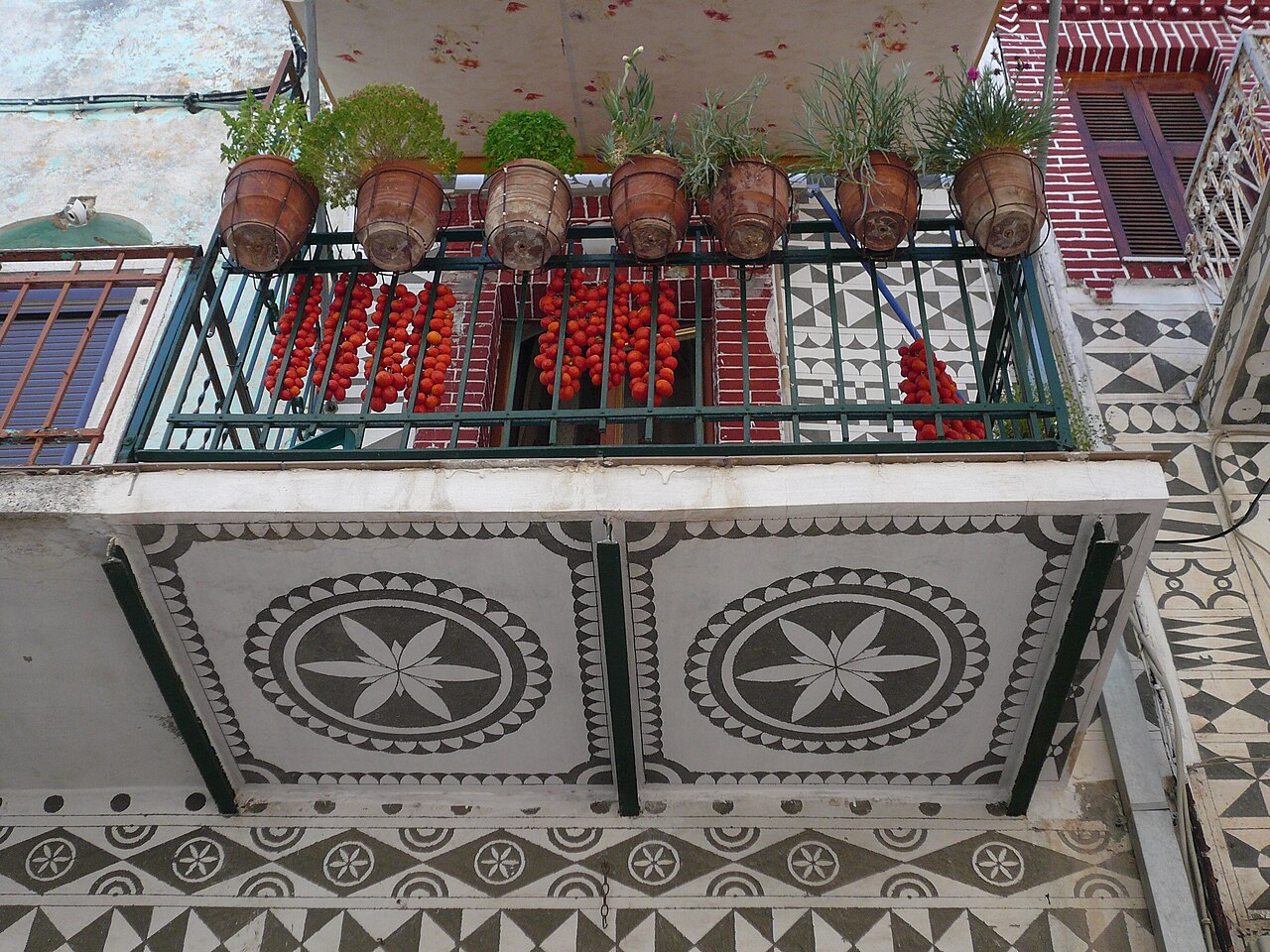
Pyrgi is the most photographed village on Chios, and no other village in Greece looks like it. Every house front in its medieval core is covered from ground to eaves in the black-and-white geometric patterns called xysta, scratched into the plaster in triangles, diamonds, zigzags and rosettes, so that the whole village reads as a single decorated surface. Set among the mastic groves of the south, this fortified maze of a village is both a working community and the island’s most striking sight, and its façades draw visitors from across the world. Plan the whole trip with Greece Tours.
This guide covers Pyrgi in full: what the xysta are and how they are made, the fortified medieval plan of the village, the frescoed Byzantine church of Agioi Apostoloi, the main square and the tomato-hung façades, and where Pyrgi is and how to visit. Read it beside the guide to the Chios mastic villages and the full Chios travel guide.
What is Pyrgi, the painted village of Chios?
Pyrgi is a medieval mastic village in the south of Chios, about 25 kilometres from Chios Town, famous for the black-and-white geometric patterns called xysta that cover its house fronts. The largest of the mastic villages, it is a fortified, maze-like settlement and the island’s most distinctive sight.
Pyrgi is one of the mastichochoria. It belongs to the cluster of medieval villages in southern Chios built around the cultivation of mastic, the aromatic resin grown only here, and it is the largest and best known of them, its economy still tied to the mastic groves that surround it.
Its fame rests on its decoration. Where the other mastic villages are plain stone, Pyrgi’s houses are covered in the intricate xysta patterns that give it the name of the painted village, a decorative tradition found in this concentration nowhere else in Greece, which makes the village unique.
It remains a living place. For all its fame, Pyrgi is a working village rather than a museum, its lanes busy with residents, its square lined with tavernas and shops, and its façades hung with drying tomatoes in late summer, so a visit combines the spectacle of the xysta with the everyday life of the south, as the guide to the villages of Chios describes.
What are the xysta decorations of Pyrgi?
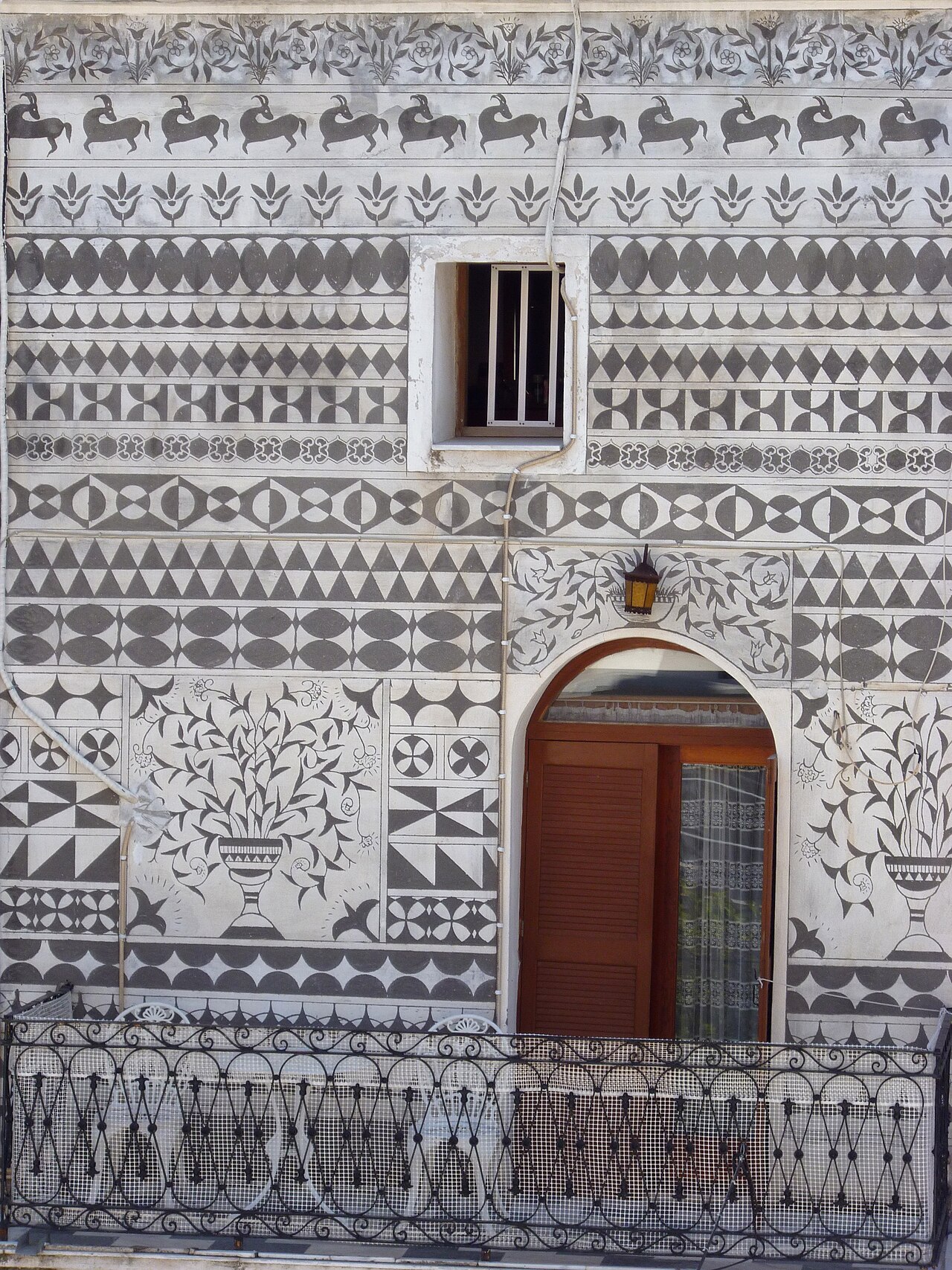
The xysta are black-and-white geometric patterns that cover the house fronts of Pyrgi, made up of repeating triangles, diamonds, zigzags, semicircles, rosettes and stylised plants and birds. They give the village its unmistakable decorated appearance and its name of the painted village.
The patterns are geometric and dense. Bands of triangles, diamonds, chevrons and semicircles run across the façades in horizontal registers, framing doors and windows, so that every surface of the village core is covered, and the effect is of a single continuous decoration wrapping the streets.
The motifs draw on a shared vocabulary. Alongside the geometric shapes appear stylised flowers, cypress and other trees, and birds such as storks, drawn from a decorative tradition with roots in Byzantine and Genoese design, and repeated with variation from house to house across the village.
The result is unique in Greece. Although scratched-plaster decoration exists elsewhere, nowhere else is it applied so completely and to a whole village, which is why Pyrgi stands apart even from its neighbours in the mastic country and draws visitors specifically to see its façades.
How are the xysta made?
The xysta are made by coating a wall in dark volcanic sand and lime, applying a layer of white lime plaster on top, and then scratching away the white with a fork or knife to reveal the dark layer beneath in geometric patterns. The word xysta means scratched in Greek.
The technique is a form of sgraffito. The name itself, xysta, comes from the Greek for scratched, describing exactly how the patterns are made: not painted on, but cut into the plaster so that the design is revealed rather than applied, a method related to the sgraffito of Italian and Byzantine architecture.
It works in two layers of contrasting tone. A dark base of volcanic sand and lime is spread on the wall, a coat of white lime plaster is laid over it, and while the white is still workable the craftsman scratches away the pattern with a fork or fine tool, exposing the dark layer beneath to draw the black lines of the design.
The skill is handed down. Making the xysta is a craft passed through generations of the village, and the patterns are maintained and renewed by hand, so the façades are living decoration rather than a fixed historical relic, kept up by the residents as part of the identity of Pyrgi.
What is the history and layout of Pyrgi?
Pyrgi was built in the medieval period as a fortified mastic village under Byzantine and Genoese rule. It has an oval plan enclosed by an outer wall with gates, a central defensive tower, and a maze of narrow alleys linked by arches, designed to protect the mastic growers from pirate raids.
Defence shaped the village. Like the other mastichochoria, Pyrgi was laid out to guard the valuable mastic crop and its growers against the pirates and raiders who swept the Aegean, so its outer houses formed a continuous wall, its plan was a defensive oval, and a tower at the centre gave a final refuge.
The plan is a deliberate maze. Within the walls the streets twist in a labyrinth of narrow, often covered alleys, many spanned by arches that brace the houses and carry rooms overhead, a layout meant to confuse and slow any attacker who breached the outer ring, and which still disorients the first-time visitor.
The Genoese period left its mark. Pyrgi grew under the rule of Genoa, whose company ran Chios on the mastic trade from the fourteenth century, and the medieval core, its tower, gates and the decorative tradition of the xysta all belong to this age, as the guide to the Chios mastic villages sets out.
What is the church of Agioi Apostoloi in Pyrgi?
The church of Agioi Apostoloi, the Holy Apostles, is a small Byzantine church in the heart of Pyrgi, a miniature of the island’s great monastery church of Nea Moni. Built in the medieval period, its interior is covered with vivid seventeenth-century frescoes.
It is a jewel hidden in the lanes. Tucked into the maze of the old village near the main square, the little church of Agioi Apostoloi is easy to miss from outside, but its interior is one of the finest small Byzantine spaces on the island, modelled on the design of the church at Nea Moni.
Its frescoes are the draw. The walls and dome are covered with brightly coloured wall paintings of the seventeenth century, filling the small interior with figures and scenes, a concentration of Byzantine-style painting rare in a village church and well worth seeking out among the decorated houses.
It links Pyrgi to Nea Moni. As a scaled-down echo of the great eleventh-century monastery church in the mountains, Agioi Apostoloi ties the painted village to the island’s most important monument, and seeing both deepens the picture of Chios’s Byzantine heritage, as the guide to Nea Moni describes.
What else can you see and do in Pyrgi?
In Pyrgi you can wander the xysta-covered lanes, sit in the main square among the tavernas and cafés, see the façades hung with drying tomatoes in late summer, buy mastic and local produce, and visit a house said by tradition to be linked to Christopher Columbus.
The square is the heart of village life. The central plaza, itself lined with decorated façades, holds tavernas, cafés and shops selling mastic and its products, and it is the natural place to pause, watch village life and take in the concentration of xysta before exploring the surrounding lanes.
Late summer adds a splash of colour. In the harvest season the villagers hang strings of ripe tomatoes to dry on the decorated house fronts, so the black-and-white geometry is set against bright red, a seasonal sight that draws photographers and shows the village at its most characterful.
A local tradition links Pyrgi to Columbus. The village claims a connection to Christopher Columbus, whose family some traditions tie to Chios, and a house associated with the story is pointed out to visitors, one of several local legends that add to the atmosphere of a wander through the painted streets.
Where is Pyrgi and how do you get there?
Pyrgi lies in the south of Chios, about 25 kilometres from Chios Town, a drive of roughly thirty minutes on good road. It is reached most easily by hire car, with a municipal car park on the edge of the village, and by bus or organised tour from the capital.
The village sits in the mastic south. It stands among the groves about 25 kilometres from Chios Town, and the drive down the east coast and inland takes around half an hour on well-surfaced road, making it one of the more accessible of the southern villages from the capital.
A car is the easiest way. Driving gives the freedom to combine Pyrgi with the other mastic villages and the southern beaches, and there is a municipal car park on the south-east edge of the village, since the medieval core, like all the mastichochoria, is closed to cars and explored on foot.
Buses and tours also serve it. Public buses run from Chios Town to Pyrgi, and organised coach and taxi tours of the mastic villages include it, so the painted village can be reached without a car, as the guides to car rental in Chios and day trips from Chios explain.
When is the best time to visit Pyrgi?
The best time to visit Pyrgi is spring and autumn for mild weather and thin crowds, or the early morning and late afternoon in summer to avoid the heat and the coaches. Late summer adds the tomato-drying façades, and the low light flatters the xysta patterns.
The shoulder seasons are the most comfortable. In spring and autumn the weather is mild for walking the lanes, the light is good and the crowds are thin, so the village can be enjoyed at leisure, and these months suit a wider tour of the mastic country and the southern beaches.
Summer calls for good timing. Pyrgi is one of the most visited villages on the island, and coaches arrive through the middle of the day in high summer, so an early-morning or late-afternoon visit finds the lanes quieter and cooler, with the added benefit of softer light on the decorated walls.
Late summer brings the tomatoes. From around August the drying tomatoes hung on the façades give the village its most photographed look, so travellers who want that particular sight time their visit for the harvest season, as the guide on the best time to visit Chios notes.
What is near Pyrgi worth combining?
Pyrgi combines naturally with the other mastic villages of Mesta and Olympi, the black-pebble beach of Mavra Volia at Emporios, and the Chios Mastic Museum nearby, making a full southern day out from Chios Town by hire car.
Mesta and Olympi complete the mastic villages. The best-preserved fortress village of Mesta and the quieter Olympi with its cave lie close by, so a southern day easily takes in all three of the main mastichochoria, each with its own character, as the guide to Mesta describes.
The coast is minutes away. The dramatic black volcanic pebbles of Mavra Volia below Emporios and the sandy family beach at Komi lie a short drive from Pyrgi, so a morning among the villages can end with an afternoon swim, as the guide to the best beaches in Chios sets out.
The Mastic Museum adds the context. The Chios Mastic Museum, on a hillside near Pyrgi, explains the crop that shaped the whole south, so pairing it with the painted village links the spectacle of the xysta to the mastic economy that built the mastichochoria, as the guide to the museums of Chios notes.
Frequently Asked Questions
Why is Pyrgi called the painted village?
Pyrgi is called the painted village because every house front in its medieval core is covered from ground to eaves in the black-and-white geometric patterns known as xysta. These consist of repeating triangles, diamonds, zigzags, semicircles, rosettes and stylised plants and birds, applied so completely that the whole village reads as a single continuous decoration. No other village in Greece carries this decoration so fully or on such a scale, which is why Pyrgi stands out even among the other mastic villages of southern Chios, which are built of plain stone. Strictly speaking the patterns are not painted but scratched: the word xysta means scratched in Greek, and the designs are made by cutting through a white lime coat to reveal a dark layer of volcanic sand and lime beneath, a form of sgraffito. The effect, though, is of a village entirely covered in pattern, which is how it earned its name.
How are the xysta patterns in Pyrgi made?
The xysta patterns are made using a scratched-plaster technique, a form of sgraffito. First a dark base layer of volcanic sand mixed with lime is spread over the wall. A coat of white lime plaster is then applied on top, and while it is still workable the craftsman scratches away the white in the lines of the design, using a fork or a fine tool, so that the dark layer beneath shows through as the black of the pattern. The result is the crisp black-and-white geometry seen across the village. The word xysta itself comes from the Greek for scratched, describing the method exactly. The craft is handed down through generations of the village and the façades are renewed by hand, so the decoration is living rather than a fixed historical relic, kept up by the residents as part of Pyrgi’s identity.
Is Pyrgi worth visiting?
Yes, Pyrgi is one of the essential sights of Chios and among the most distinctive villages in all of Greece. Its house fronts, covered entirely in the black-and-white geometric xysta patterns, look like nowhere else, and the medieval fortified plan of the village, with its maze of narrow arched lanes, its central square and the little frescoed Byzantine church of Agioi Apostoloi, rewards an unhurried wander. It is a working village rather than a museum, so its lanes are busy with everyday life, and in late summer the façades are hung with drying tomatoes for a particularly photogenic scene. Pyrgi sits about 25 kilometres south of Chios Town among the mastic groves, and it combines naturally with the other mastic villages of Mesta and Olympi and the black-pebble beach of Mavra Volia, making a full southern day. Visiting early or late in the day avoids the summer coaches.
How far is Pyrgi from Chios Town?
Pyrgi lies about 25 kilometres south of Chios Town, a drive of roughly thirty minutes on good, well-surfaced road down the east coast and inland into the mastic country. The easiest way to reach it is by hire car, which also allows you to combine the village with the other mastic villages of Mesta and Olympi, the Chios Mastic Museum and the southern beaches. There is a municipal car park on the south-east edge of the village, since the medieval core, like all the mastic villages, is car-free and explored on foot. Public buses run from Chios Town to Pyrgi, and organised coach and taxi tours of the mastic villages include it, so it can be visited without a car, though a hire car gives the most freedom to explore the south at your own pace.