
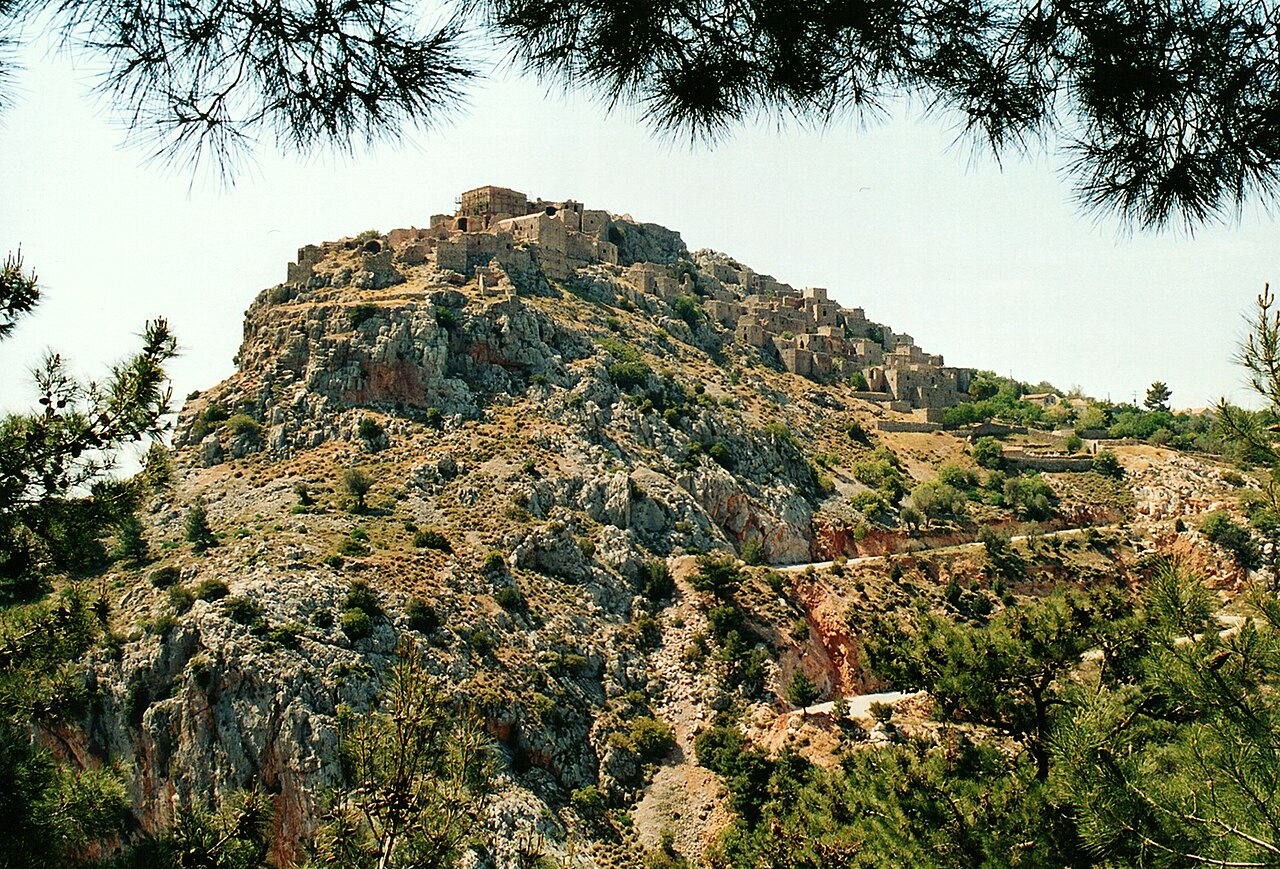
Anavatos is the most haunting place on Chios, a medieval village of grey stone stacked up a cliff that falls away almost vertically on three sides. Its houses climb in tiers to a ruined church at the summit, their walls merging so completely with the rock that from a distance the village is hard to tell from the crag it stands on. It has stood empty for the better part of two centuries, since the catastrophe of 1822 emptied it of life, and today its silent lanes and sweeping views make it one of the island’s most memorable sights. Plan the whole trip with Greece Tours.
This guide covers Anavatos in full: what it is and where it stands, its founding by the builders of Nea Moni, the tragedy of 1822, its stone architecture, the Taxiarchis church and the three-storey building at its heart, and how to reach and visit the ghost village today. Read it beside the guide to the villages of Chios and the full Chios travel guide.
What is Anavatos, the ghost village of Chios?
Anavatos is an abandoned medieval fortress-village in the central mountains of Chios, built on a granite peak about 450 metres high. Its stone houses climb the cliff to a ruined church at the summit, and it has stood empty since the massacre of 1822, earning it the name of the island’s ghost village.
The village is a monument to defence. Built high on a near-vertical rock in the island’s interior, its houses were packed tightly together and constructed of the local grey stone so as to blend with the crag and hide the settlement from pirates and invaders approaching from the sea, a camouflage that still makes it hard to pick out from a distance.
Its name tells its story. Anavatos means “inaccessible” or “the ascended”, a fitting description for a village reached only by a single steep approach and defended on its other sides by sheer drops, so that in its medieval heyday it was among the most secure refuges on Chios.
Today it is a preserved ruin rather than a living village. Only a handful of people remain in the lower settlement, while the upper town stands wholly abandoned, its roofless stone houses climbing to the church at the top, protected as a historical monument and open to visitors who make the drive into the mountains.
Where is Anavatos and how do you get there?
Anavatos stands in the central mountains of Chios, about 19 kilometres west of Chios Town near the monastery of Nea Moni and the village of Avgonyma. It is reached by a winding mountain road, most easily by hire car, in around thirty to forty minutes from the capital.
The village sits deep in the interior. It lies west of Chios Town in the mountainous heart of the island, a short distance beyond the stone village of Avgonyma and close to the great monastery of Nea Moni, so the three form a natural cluster in the central heights.
A hire car is the practical way to reach it. The road climbs and winds through pine forest from the capital, taking roughly half an hour to forty minutes, and while organised coach and taxi tours include Anavatos, a car gives the freedom to combine it with Nea Moni and Avgonyma at your own pace, as the guide to car rental in Chios explains.
Parking sits at the foot of the village. Cars stop at the edge of the lower settlement, where a taverna and a small gallery stand, and from there the visit is on foot, climbing the stepped path up through the ruined houses to the summit, so sturdy shoes are worth having.
What is the history of Anavatos?
Anavatos was founded in the Byzantine period, and tradition links its origins to the workers who built the nearby monastery of Nea Moni in the eleventh century. Fortified against pirate raids under Byzantine and Genoese rule, it grew into a secure medieval village of some four hundred houses.
Its beginnings lie with Nea Moni. A long tradition holds that Anavatos was first settled by the labourers and craftsmen who built the great monastery of Nea Moni in the eleventh century, who established a village on the defensible peak nearby, and the settlement grew through the Byzantine centuries into a fortified community.
Piracy shaped its form. Like the mastic villages of the south, Anavatos was built for defence in an age when raiders swept the Aegean, its houses crowded together behind the natural walls of the cliff and camouflaged in local stone, so that under Byzantine and then Genoese rule it served as a stronghold of the island’s interior.
At its height it was a substantial village. Some four hundred stone houses, each of two storeys, climbed the hill in tiers, along with churches, an olive press, a school and a cistern, supporting a community that farmed the surrounding land and sheltered behind the peak’s natural defences, until the events of the nineteenth century brought its life to an abrupt end.
What happened at Anavatos in 1822?
Anavatos was destroyed in the massacre of Chios in 1822, when Ottoman forces crushed the island’s part in the Greek revolution. Tradition holds that many of its people threw themselves from the cliffs rather than be captured, and the village never recovered, standing empty ever since.
The massacre of 1822 marked the whole island. In reprisal for the Greek uprising, Ottoman forces killed or enslaved the greater part of the population of Chios, an atrocity that shocked Europe and inspired Delacroix’s famous painting, and the villages of the interior, Anavatos among them, were caught up in the destruction.
The cliff gave Anavatos its darkest chapter. As the Ottoman forces reached the village, tradition holds that many of its inhabitants, rather than fall into the hands of the attackers, threw themselves and their children from the sheer rock on which their houses stood, a tragedy remembered in the same breath as other mass sacrifices of the Greek revolution.
The village did not recover. Emptied by the massacre and further damaged by the great earthquake of 1881, Anavatos dwindled over the following century to the ruin seen today, its houses roofless and its lanes silent, a memorial in stone to one of the most terrible episodes in the island’s history.
What does Anavatos look like?
Anavatos is built entirely of grey local stone, its two-storey houses packed tightly together and climbing the cliff in tiers to a church at the summit. The houses are now roofless but keep their walls, and the whole village merges with the rock, giving the impression of a complete medieval ghost town.
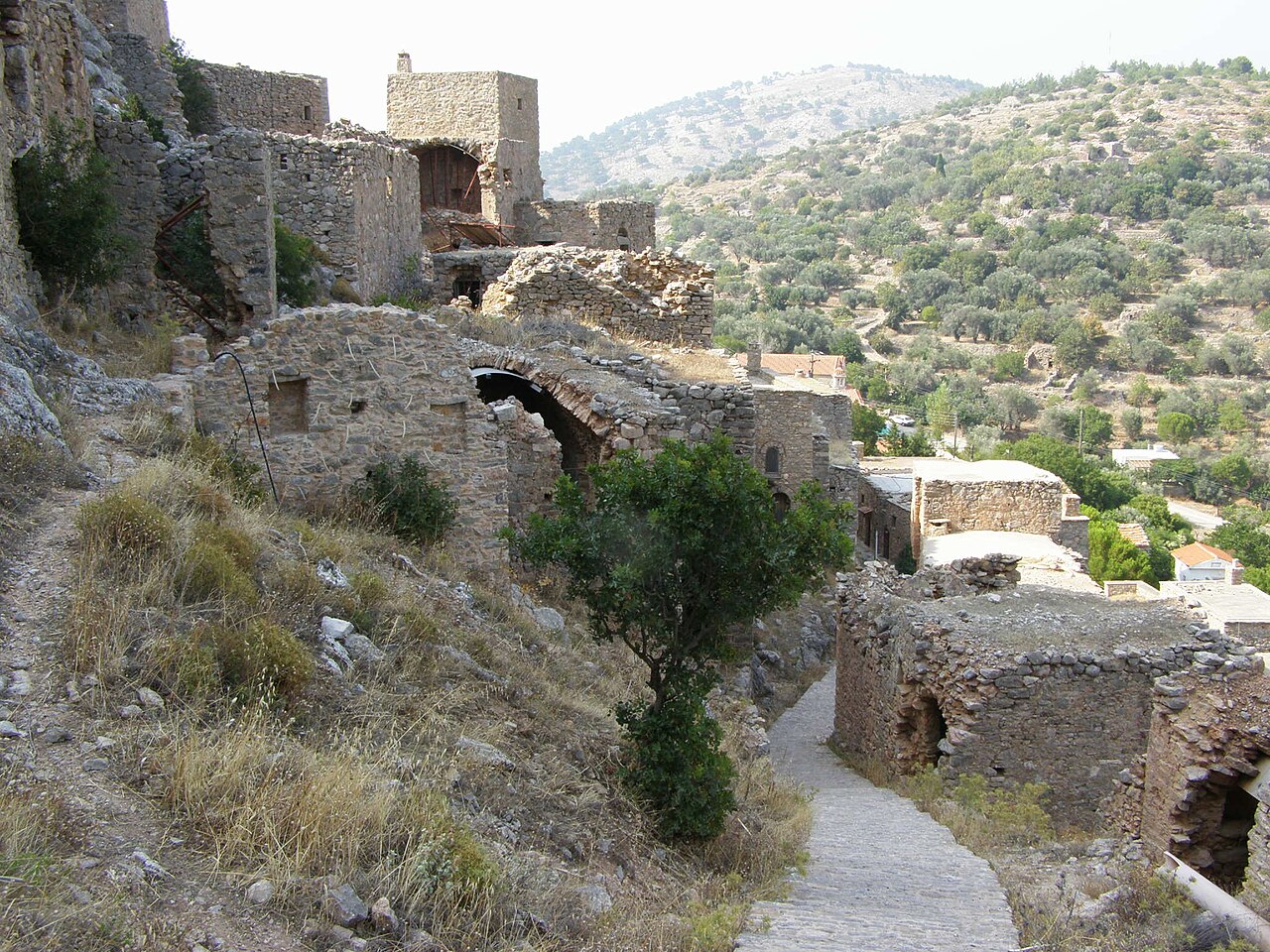
The architecture is defensive and organic. There are no wide streets or squares, only a maze of narrow stepped lanes threading between the houses, which were built one against another so that their outer walls formed a continuous barrier, and the grey stone was chosen to blend the settlement into the crag.
The village climbs in three levels. It rises from the lower settlement, still just inhabited, through the largely empty middle town, to the ruined upper village crowned by its church, and the higher you climb the more complete the abandonment, until at the summit only walls, doorways and the church remain against the sky.
Its condition is that of a preserved ruin. The houses lost their roofs and floors long ago, but many keep their walls to full height, their windows and doorways framing the drop beyond, so that walking the lanes gives a vivid sense of the living village this once was, as the guide to the villages of Chios describes.
What can you see in Anavatos today?
In Anavatos you can see the ruined stone houses and lanes, the well-preserved Church of the Taxiarchis, and a three-storey building that once held an olive press, a school, a water reservoir and a chapel. A taverna and a small art gallery stand at the entrance to the village.
The Taxiarchis church is the landmark. Dedicated to the Archangel, the church stands out amid the roofless houses as one of the better-preserved buildings in the village, a reminder of the religious life that once centred the community, and it is a focal point of the climb through the ruins.
The three-storey building shows the village’s workings. This substantial structure combined an olive press, a school, a water reservoir and the church of the Theotokos under one roof, a multi-purpose building that served the practical and communal needs of the settlement and remains one of the most telling ruins in the upper town.
Life lingers at the foot of the village. At the entrance, where the road ends, a taverna serves traditional Greek food and an artist’s studio and gallery occupy a restored building, so a visit can combine the silence of the ruins above with a meal or a browse below, a small living presence at the edge of the ghost town.
What is it like to climb and visit Anavatos?
Visiting Anavatos means climbing a stepped stone path up through the ruined lanes to the summit church, a walk of about an hour that gains height steadily with sheer drops nearby. The reward is a sweeping view across the island’s wooded interior to the distant sea.
The visit is a walk rather than a tour. From the parking and taverna at the foot, a path climbs through the empty houses, and there are no barriers or signs to speak of, so the exploration is free and quiet, taking around an hour to reach the top and return at an unhurried pace.
Care is needed on the climb. The path is stony and uneven, the drops beside it are real and unfenced, and the upper ruins are exposed, so sturdy shoes, a steady footing and caution near the edges are essential, particularly for families with children and in windy or wet weather.
The summit is the payoff. From the top, beside the ruined church, the view opens across the pine-clad mountains of central Chios to the sea beyond, and the silence of the abandoned village combined with the sweep of the landscape makes the climb one of the most atmospheric experiences on the island.
When is the best time to visit Anavatos?
The best time to visit Anavatos is spring and autumn, when the weather is mild for the climb and the hills are green, or early morning and late afternoon in summer to avoid the heat. The low light of morning and evening also flatters the grey stone and deepens the atmosphere.
The shoulder seasons are ideal. In spring the surrounding hills are green and wildflowers soften the approach, and in autumn the air is cool and clear, so the climb through the exposed ruins is comfortable and the light is good, making these the finest months to visit the ghost village.
Summer calls for timing. The upper village offers no shade and the stone radiates heat, so a midsummer visit is best made in the early morning or the late afternoon rather than the middle of the day, both for comfort on the climb and for the softer light that suits photography.
The time of day shapes the mood. Anavatos is at its most haunting in the low, raking light of morning or evening, when shadows fill the empty doorways and the grey stone glows, and outside the busiest summer hours the village is often silent and empty, which is when its atmosphere is strongest, as the guide on the best time to visit Chios notes.
What is near Anavatos worth combining?
Anavatos combines naturally with the monastery of Nea Moni and the stone village of Avgonyma, both minutes away in the central mountains, and with a swim and a fish lunch at Lithi on the west coast, making a full and varied day out from Chios Town.
Nea Moni is the essential pairing. The eleventh-century monastery, whose Byzantine mosaics carry UNESCO World Heritage listing, stands close by and shares its history with Anavatos through the tradition of the village’s founding, so the two are almost always seen together, as the guide to Nea Moni describes.
Avgonyma adds a living village. The compact, restored stone village of Avgonyma, minutes from Anavatos on the same road, offers tavernas on its square and a view across the island, a lively contrast to the ghost town and a good place for lunch on a mountain day.
The west coast completes the circuit. From the mountains the road drops to Lithi and the west coast, where a fish lunch by the water and a swim round off the day, so a single loop from Chios Town can take in monastery, ghost village, living village and beach, as the guide to the things to do in Chios sets out.
Frequently Asked Questions
Why was Anavatos abandoned?
Anavatos was abandoned as a result of the massacre of Chios in 1822. When the Ottoman forces crushed the island’s part in the Greek War of Independence, killing or enslaving most of the population, the fortified village in the mountains was caught up in the destruction, and tradition holds that many of its inhabitants threw themselves from the sheer cliffs on which their houses stood rather than be captured. The village never recovered from the loss of its people, and further damage in the great earthquake of 1881 hastened its decline. Over the following century it dwindled to the ruin seen today, its houses roofless and its lanes silent, with only a handful of residents remaining in the lower settlement. It is now protected as a historical monument and stands as a memorial to one of the darkest episodes in the island’s history.
Can you visit Anavatos, and is it free?
Yes, you can visit Anavatos, and there is generally no admission charge to walk up through the ruined village. It is an open historical site rather than a fenced monument, so visitors are free to climb the stepped stone path through the empty lanes to the church at the summit at any reasonable hour. There are no formal facilities within the ruins themselves, but at the entrance, where the road ends and cars park, a taverna serves food and a small art gallery occupies a restored building. Because the paths are stony and uneven and the drops beside them are real and unfenced, sturdy shoes and care are essential, especially with children and in poor weather. Allow about an hour to climb to the top and return at an unhurried pace, and time the visit for the cooler, softer light of morning or late afternoon.
How do you get to Anavatos from Chios Town?
Anavatos lies about 19 kilometres west of Chios Town in the central mountains, and the drive takes roughly thirty to forty minutes on a winding road that climbs through pine forest. The easiest way to reach it is by hire car, which also allows you to combine the village with the nearby monastery of Nea Moni and the stone village of Avgonyma, both minutes away. Organised coach excursions and licensed taxi tours from Chios Town include Anavatos, usually as part of a central-mountains itinerary, so it can be visited without your own car, though a hire car gives the most freedom. Public buses do not serve the village conveniently. Cars park at the foot of the lower settlement, beside the taverna and gallery, and the visit continues on foot up the stepped path through the ruins.
What does the name Anavatos mean?
The name Anavatos comes from the Greek and means “inaccessible” or “the ascended”, a description of a village reached only by a single steep approach and protected on its other sides by sheer cliffs. The name captures both the physical character of the settlement, perched high on a granite peak about 450 metres above the surrounding country, and its original purpose as a place of refuge and defence in an age of pirate raids. Built entirely of grey local stone so as to blend with the rock and hide from raiders approaching from the sea, the village was among the most secure on Chios in its medieval heyday. That same inaccessibility, which once protected its people, is what gives the abandoned village its dramatic setting today, its roofless houses climbing the cliff to the ruined church at the summit.