

Spetses packs an unusual range of experiences into a small, largely car-free island in the Saronic Gulf, from cannon-lined quays and shipbuilding yards to pine-backed swimming coves. This My Greece Tours guide gathers the top things to do in Spetses into one plan, covering the historic Dapia waterfront, the Old Harbour boatyards, the island’s museums, the famous school, the coast road, the best beaches. The September festival that lights up the sea.
Sightseeing here runs at the gentle pace of footsteps, bicycle wheels, and horse-drawn carriages. You can fill a single day with the town’s landmarks or spread days across the beaches and boat trips that ring the coast. Whichever you choose, Spetses rewards slow exploration, and this itinerary links its history, its swimming, and its evening dining into one satisfying circuit of the island.
What are the top things to do in Spetses?
Spetses combines history and coast in a compact space: explore the Dapia and its cannons, tour the Bouboulina Museum, walk the Old Harbour boatyards, cycle the coast road, and swim at Agioi Anargyroi, Zogeria, and Agia Paraskevi.
The island’s headline attractions divide neatly into town sights and coastal experiences, which makes planning straightforward. In the capital, the Dapia waterfront, the Old Harbour of Baltiza, the Bouboulina Museum, the Spetses Museum. The Poseidonion Grand Hotel form a walkable cluster of landmarks steeped in the story of 1821. Around the coast, a roughly twenty-six-kilometre road links a string of beaches, from the wide sands of Agioi Anargyroi to the sheltered bays of Zogeria and Agia Paraskevi. Between the two lies the pleasure of movement itself: a horse-drawn carriage ride, a bicycle circuit, or a boat trip around the island.
Setting a base near the Dapia keeps you close to the ferries, the museums, and the evening scene while everything else stays within easy reach.
A sensible first day concentrates on the town, since almost everything sits within a fifteen-to-twenty-minute walk of the main quay. Start at the Dapia among its bronze cannons, follow the seafront west past the Poseidonion, then double back east toward the church of Agios Nikolaos and the boatyards of the Old Harbour. Fold in the Bouboulina Museum and the Spetses Museum to anchor the history, and finish with dinner at a waterside taverna in Baltiza. This loop needs no vehicle and suits families, since the car-free streets are safe and the distances short. Comfortable shoes help on the pebble-mosaic lanes, some of which climb the hillside behind the port toward the quieter residential quarters and their captains’ mansions.
Allow a couple of hours for the museums and time for coffee stops, and the essentials of the old town are covered.
A second day is best given to the coast. The perimeter road and a network of beaches invite a slower, sun-led pace, whether you cover the ground by bicycle, by scooter, or by the small boats and water taxis that fan out from the port in summer. Agioi Anargyroi offers the island’s largest organised beach, Zogeria a deep pine-fringed inlet, and Agia Paraskevi a chapel-backed cove with literary associations. Our guide to Spetses beaches maps the full run of swimming spots so you can match each to your plans. Rounding the whole island by boat adds sea caves and otherwise hard-to-reach coves, and it reveals just how green the protected pine forest keeps the interior.
Spread over an afternoon, the beaches become a relaxed counterpoint to the historical focus of the town.
Beyond the obvious sights, Spetses rewards curiosity with cultural depth. The Anargyrios and Korgialenios School, a grand institution endowed by the same benefactor who built the Poseidonion, shaped the island’s reputation and inspired the setting of a celebrated English novel. The Armata festival in early September stages a mock naval battle off the Old Harbour, one of the most dramatic events in the Saronic calendar. Traditional black-and-white pebble-mosaic courtyards, small neighbourhood chapels, and the surviving craft of wooden boatbuilding all reward attentive walking.
Taken together, the town’s heritage and the coast’s beaches let you build an itinerary that ranges from serious history to unhurried swimming, all on an island small enough to cross in a single scenic circuit of the coast road.
What can you do at the Dapia waterfront and its cannons?
The Dapia is Spetses Town’s fortified main quay, ringed with old bronze cannons, where you can watch boats arrive, take coffee among the arcades, hire a carriage, and begin any tour of the town’s landmarks.
The Dapia takes its name from the Greek word for a fortified gun battery. The cannons set around its paved terrace recall the island’s role in the 1821 War of Independence. During the revolution Spetses armed this quay to defend its harbour, and the guns now point harmlessly over the water toward anchored yachts and the wooded islet of Spetsopoula. Underfoot, the traditional black-and-white pebble mosaic that is a Spetsiot speciality turns the whole terrace into a kind of open-air stage. A slow circuit of the quay takes only minutes, yet it rewards a longer pause.
Our guide to Spetses Town and the Dapia covers the square’s history and layout in fuller detail for those who want the background.
This is the island’s front door, so much of what you do here is practical as well as scenic. Hydrofoils and catamarans from Piraeus tie up at the Dapia. Small water taxis leave from the same quay for beaches and for the mainland ports of Kosta and Porto Heli just across the channel. Ticket agencies, kiosks, and travel offices cluster along the back of the square, making it the natural place to confirm return times or arrange onward travel. A line of horse-drawn carriages waits nearby for fares, and bicycle and scooter hire sit within a short walk.
Arriving here, you can settle your logistics for the whole trip before wandering deeper into town, which keeps the rest of your day relaxed and unhurried.
The Dapia doubles as the town’s living room, busy from early morning until well after dark. Cafés and ouzeries occupy the shaded arcades behind the cannons, their chairs turned outward so patrons can watch the constant theatre of the harbour. Fishermen mend nets nearby, day-trippers weigh their beach options over a frappé, and carriage horses wait patiently in the sun. In the evening the light softens over the water and the terrace fills for the ritual stroll and drink that Greeks call the volta. Because the quay is car-free like the rest of the centre, this social scene unfolds without traffic, a rare calm for such a central square in a Greek port.
Watching the boats come and go from a waterside table is itself one of the simple pleasures of Spetses.
The Dapia also fixes your bearings for everything else. From here the main shopping street runs inland past bakeries, jewellers, and tavernas, while the seafront promenade heads in two directions. Turn west and you reach the Poseidonion Grand Hotel and the relaxed Kounoupitsa waterfront. Turn east and the coast road leads gradually past Agios Nikolaos toward the Old Harbour and its boatyards. Signposts and the curve of the coastline make orientation easy, and most of the town’s principal sights lie within a fifteen-to-twenty-minute walk of this square. Treating the quay as your starting point, you can plan a loop that gathers the mansions, the museums, and the boatyards without retracing your steps.
It is hard to stay lost for long in the old town.
Why should you visit the Old Harbour and its boatyards?
The Old Harbour, known as Baltiza, is where wooden boats are still built by hand in traditional open-air yards, and by night its waterside tavernas and bars make it the town’s most atmospheric quarter.
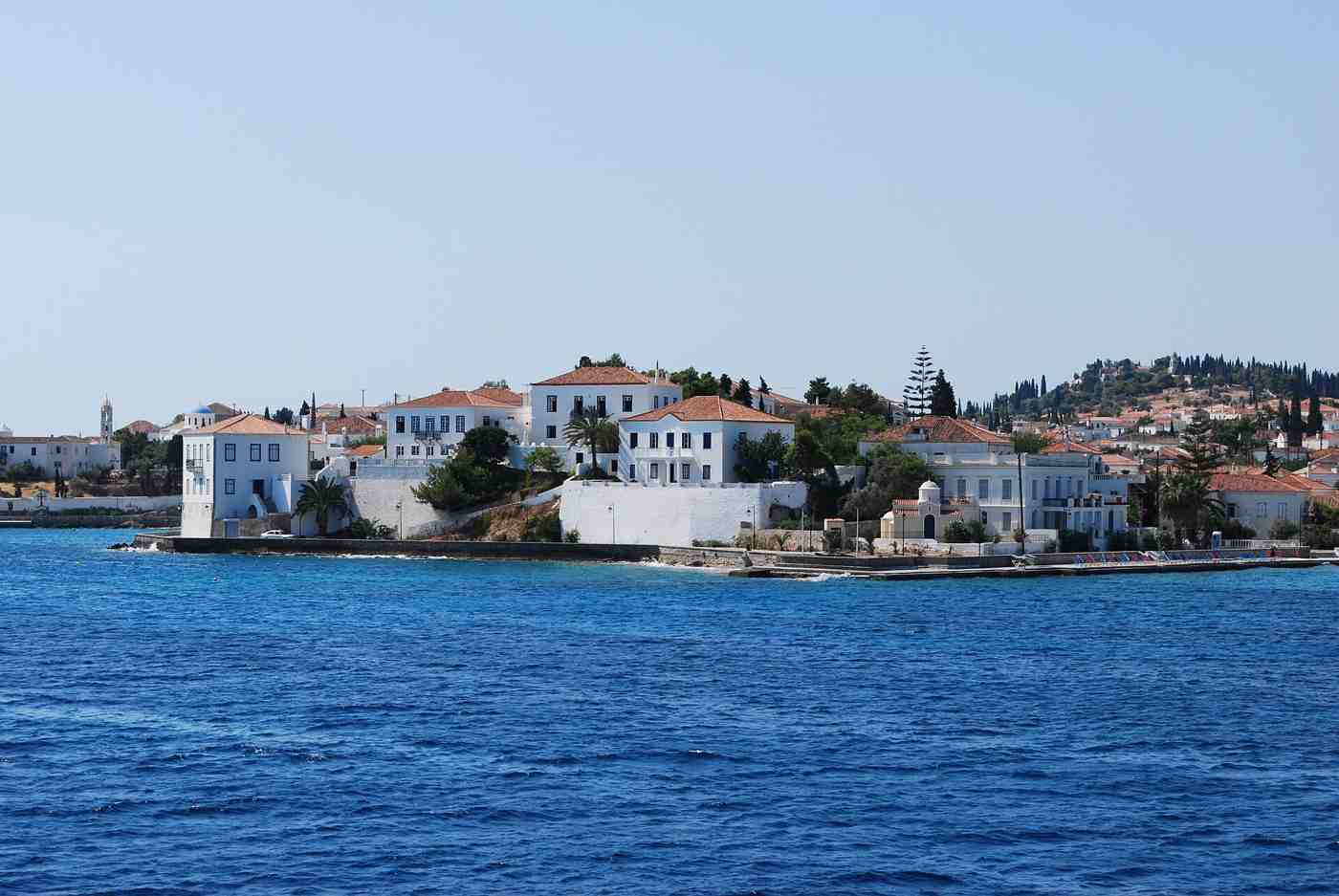
The Old Harbour lies east of the Dapia, reached by a pleasant coastal walk of roughly twenty minutes or a short carriage ride along the seafront. It was the island’s original commercial port in the age of sail, when Spetsiot shipowners built the fleets that made them wealthy and later fought the Ottomans. Today the inlet still shelters yachts, fishing caiques, and traditional wooden vessels, giving it a lived-in maritime character quite different from the polished arrival quay. Stone mansions, small chapels, and a lighthouse rise around the water, and the whole basin feels like a survival from an earlier century.
Arriving on foot, you sense the shift from the bustle of the Dapia to a quieter, more romantic corner where the island’s shipbuilding heritage is still visibly at work along the shore.
What sets Baltiza apart is that boatbuilding continues here in open-air yards along the waterfront. Craftsmen shape hulls and repair vessels using techniques handed down over generations, and the scent of timber and varnish drifts along the quay. These traditional shipyards, known as tarsanades, are among the last of their kind in Greece. Watching a wooden hull take shape is a genuine link to the island’s seafaring past. The scene is entirely unforced, a working environment rather than a museum display, which makes it all the more compelling to walk through slowly.
Boats sit propped on wooden frames in every stage of construction and repair, a vivid reminder that Spetses built its fame and fortune on the sea long before it welcomed its first summer visitors from Athens.
The Old Harbour becomes the town’s liveliest social scene after dark. Tavernas set their tables at the water’s edge, seafood is the natural choice, and small bars and cafés fill with a relaxed evening crowd. The reflections of moored yachts and harbour lights on the dark water give the quarter a distinctly romantic mood. Because it sits a little apart from the arrival bustle of the Dapia, Baltiza feels like a discovery. Many visitors rate an evening here among the highlights of their stay. For the pick of waterside kitchens and the local specialities to order, our guide to Spetses restaurants sets out where to eat around the harbour and across the town.
Booking a waterside table on a summer evening is wise, since the best spots fill quickly once the light begins to fade over the moored boats.
The Old Harbour also anchors two of the town’s most striking landmarks. The lighthouse and the church of Panagia Armata stand near the mouth of the inlet, and the surrounding headland offers fine views back across the water toward the town. It is here, in the bay off the Old Harbour, that the Armata festival re-enacts the naval victory of 1822 each September, complete with a mock battle, the burning of a model Ottoman flagship. Fireworks over the sea. Even outside the festival, the combination of working boatyards, waterfront dining, historic chapels, and open sea views makes Baltiza essential to any visit.
Set aside time to walk out here slowly, ideally arriving before sunset so you can watch the quarter change character as the evening settles in over the water.
What is the Bouboulina Museum in Spetses?
The Bouboulina Museum occupies the former mansion of Laskarina Bouboulina, the Spetsiot naval commander and heroine of the 1821 War of Independence, and its guided tours display her weapons, portraits, and personal belongings.
Laskarina Bouboulina remains one of the most celebrated figures of the Greek War of Independence and the pride of Spetses. Born in the late eighteenth century into a seafaring family, she inherited and expanded a shipping fortune and poured it into the revolutionary cause. She famously commanded her own armed corvette, the Agamemnon, and took part in naval blockades and operations against Ottoman forces, an extraordinary role for a woman of her era. Her leadership, wealth, and daring made her a legend in her own lifetime. On the island her memory is inseparable from local identity, and monuments and place names across the town keep her story present.
A visit to the Bouboulina Museum brings that biography vividly to life inside her own home.
The museum sits in the heroine’s former mansion, a handsome building a short walk back from the Dapia. The house itself is a fine surviving example of a wealthy Spetsiot captain’s residence, with carved wooden ceilings, period furniture, and family heirlooms arranged much as they once were. Guided visits lead you through rooms that display weapons, portraits, maritime instruments, and personal effects connected to Bouboulina and her family. Because the museum is run by her descendants, the tour carries a strong personal thread that brings the history close. The combination of a genuine historic interior and the drama of her life makes this one of the most rewarding indoor sights in the town.
It pairs naturally with a wider look at the island’s role in the revolution at the nearby Spetses Museum.
Practical details reward a little planning. Visits usually run on a schedule of guided tours rather than free wandering. It is worth checking the day’s tour times when you arrive, since these vary by season and are posted at the mansion. The tour lasts under an hour and suits all ages, offering a compact but vivid introduction to the revolution as it played out at sea. Because Spetses contributed so ships and sailors to the war effort, understanding Bouboulina’s role also illuminates the wider importance of the island in 1821.
Set against the neoclassical streets outside, the mansion helps you picture the prosperous merchant society that produced such figures and funded the fleet, making the statues and monuments elsewhere in town far more meaningful.
Bouboulina’s presence extends well beyond the museum walls, and tracing it makes a rewarding half-day theme. A prominent statue of her stands on the waterfront, gazing out to sea, and it is one of the town’s most photographed monuments. Relics associated with her are also kept at the Spetses Museum, housed in the grand Hatzigiannis Mexis mansion a short walk uphill. Her story is central, too, to the island’s great annual celebration, the Armata, held in early September to commemorate the decisive naval victory of 1822. Seeing the museum, the statue on the waterfront.
The September festival together gives a full sense of how deeply the War of Independence is woven into everyday Spetses, and why locals speak of that period with such evident and enduring pride.
Why is the Anargyrios and Korgialenios School worth seeing?
The Anargyrios and Korgialenios School is a grand early twentieth-century boarding school modelled on English public schools, endowed by benefactor Sotirios Anargyros, and it inspired the setting of a celebrated English novel.
The Anargyrios and Korgialenios School stands among the pine woods on the edge of Spetses Town, an imposing complex of neoclassical buildings set in landscaped grounds. It was founded in the early twentieth century through the endowment of Sotirios Anargyros, the same Spetsiot benefactor who built the Poseidonion Grand Hotel and planted much of the island’s protective pine forest. Conceived as a boarding school on the model of the English public schools, it was ambitious in scale for a small Greek island and drew pupils from across the country. The buildings, avenues, and open grounds reflect that ambition, and even a walk around the exterior conveys the confidence of the era that produced them.
The school belongs to the same wave of civic investment that shaped modern Spetses in the early years of the last century.
The school’s literary fame rests on its connection to the English novelist John Fowles, who taught here in the early nineteen-fifties. His experience of the island and its landscape fed directly into his novel The Magus, in which a thinly disguised Spetses appears under a fictional name. For many literary travellers, seeking out the settings that inspired the book is itself a reason to visit. The pine-scented grounds and coastal paths around the school still evoke the atmosphere Fowles described.
This association has given Spetses a quiet place on the map of literary pilgrimage, adding a layer of cultural interest to the island’s more obvious historical draws and rewarding visitors who enjoy connecting a place to the pages it inspired.
Architecturally, the complex is a fine example of early twentieth-century institutional building in the classical manner, with symmetrical facades, colonnades, and formal grounds that open toward the sea. Its scale and setting distinguish it from anything else on the island, and the surrounding pine forest, also part of Anargyros’s legacy, frames it handsomely. The grounds have hosted conferences and cultural events over the years, and the buildings remain a landmark on the western approach to the town. Because the school lies a short walk or carriage ride from the centre, it fits easily into a wider exploration of the Anargyros legacy, which links the hotel, the forest.
This institution into a single story of one benefactor’s transformative investment in his home island.
For visitors, the school works best as part of a themed walk through the western side of town. From the Dapia you can follow the seafront past the Poseidonion, then continue toward the pine woods and the school grounds, taking in the coastal views along the way. The route pairs the island’s grandest hotel with its grandest school, both funded by the same man, and shows how deliberately Spetses was shaped into a refined destination. A guide to the Poseidonion Grand Hotel fills in the other half of that legacy.
Round off the walk in the shade of the pines, where the air is cooler and the atmosphere that once inspired a novelist still lingers over the paths and the sea beyond.
How do you cycle or tour the Spetses coast road?
You can circle Spetses on a coastal road of roughly twenty-six kilometres by bicycle, scooter, or quad, passing beaches, pine forest, and sea views, since private cars are banned and the loop stays quiet.
The perimeter road is one of the great pleasures of Spetses and the easiest way to reach the coast beyond the town. Running roughly twenty-six kilometres around the island, it hugs the shore for much of its length, threading between the sea on one side and the pine-clad slopes on the other. Because private cars are banned, the road carries only bicycles, scooters, quad bikes, the occasional service vehicle, and pedestrians, so the ride feels calm rather than hectic. The circuit passes a string of beaches, small chapels, and viewpoints, with the mainland hills across the water for company. Tackled in either direction from the town, it makes a rewarding half-day outing.
The near-absence of traffic is a large part of what makes the experience so relaxed and safe.
Cycling suits the flatter coastal stretches especially well, and bicycle hire is easy to find near the port. A leisurely rider can reach the popular western beaches within a comfortable spell in the saddle, stopping to swim along the way, while fitter cyclists complete the full loop at their own pace. The route is not entirely level, so there are gentle climbs where the road rounds a headland, but the rewards are constant sea views and the scent of the pines. Carrying water, sunscreen, and a swimsuit turns the ride into a beach-hopping day.
For a fuller picture of hire options and getting to the more distant coves, our guide to getting around Spetses sets out the choices in detail.
For those who prefer not to pedal, scooters and quad bikes cover the same ground more quickly and are widely available near the Dapia. They make light work of the perimeter road and let you reach the far side of the island and back within a morning, with stops for swimming. Riders should note that a valid licence and helmets are expected. That the road is shared with cyclists, pedestrians, and carriages, so a cautious pace is wise, particularly on blind bends near the beaches. Within the town centre itself, motorised hire vehicles are left at the edge of the car-free zone, and you continue on foot into the lanes.
Used sensibly, a scooter opens up the whole coast while keeping the calm that defines the island.
The coast road also rewards those who simply want the scenery. Along the way you pass the sheltered bay of Zogeria, the wide sands of Agioi Anargyroi. The chapel-backed cove of Agia Paraskevi, each a natural place to break the journey for a swim. The forested interior, another legacy of the island’s great benefactor, keeps much of the route green and shaded, an unusual quality among the drier Saronic islands. Sunset viewpoints on the western side make the late-afternoon circuit especially memorable. Whether you cover it by bicycle, scooter, or on an organised tour, the loop stitches together the island’s coastal highlights into a single scenic thread.
It explains why so visitors say the road itself becomes one of their favourite things to do.
Which beaches should you swim at in Spetses?
Agioi Anargyroi is the island’s largest organised beach, Zogeria a deep pine-fringed bay with clear water, and Agia Paraskevi a smaller chapel-backed cove, and all three sit along the western and southern coast road.
Agioi Anargyroi is the best-known beach on Spetses and the natural first choice for a full day by the sea. Set in a wide bay on the south-western coast, it offers a long stretch of sand and shingle, gently shelving into clear water that suits families and strong swimmers alike. Sunbeds, umbrellas, and beach tavernas make it the island’s most organised swimming spot, and watersports are usually available in summer. A path leads from one end toward a sea cave in the rocks, a popular small adventure for confident swimmers. Reached by the coast road, by bicycle, or by the small boats that serve the beaches from the port, it earns its reputation as the island’s flagship beach.
Our guide to Agioi Anargyroi beach covers it in full.
Zogeria lies on the north-western coast in a deep, sheltered inlet ringed by pine trees that come almost to the water’s edge. The setting is greener and more secluded than the busier southern beaches. The water is notably clear and calm, which makes it a favourite for swimming and for quiet days away from the crowds. Facilities are simpler here, typically a single taverna among the pines rather than a full beach operation, so the mood stays low-key and natural. The bay is a common stop on boat trips around the island, and it can also be reached along the coast road.
For a full description of its two coves and how to get there, see our guide to Zogeria beach before you set out for the day.
Agia Paraskevi is a smaller, pine-backed cove on the south-western coast, close to Agioi Anargyroi and easily combined with it on the same outing. A little whitewashed chapel gives the beach its name and its picturesque character, standing just behind the sand among the trees. The cove is quieter than its larger neighbour, with clear water and a relaxed atmosphere that appeals to those seeking a calmer swim. It carries a literary footnote, too, as one of the settings associated with John Fowles’s time on the island.
Reached by the coast road, by bicycle, or by boat, it makes an ideal second stop on a beach-hopping day, letting you pair the organised facilities of Agioi Anargyroi with the gentler, more intimate feel of this chapel-side cove nearby, a restful place to settle for the middle of the day.
Beyond these three, the coast holds further options for different moods and abilities. Nearer the town, small beaches and swimming platforms along the Kounoupitsa waterfront and toward the Old Harbour let you cool off without travelling far, which suits a short break between sightseeing. Some of the finest coves on the northern and western shores are reached most easily by boat. Joining a trip around the island opens up water that the road cannot reach. Whichever you choose, the clear Saronic water and the pine-scented backdrop are constants.
Our overview of Spetses beaches ranks the full run of swimming spots so you can plan a day, or several, around the coast according to how far you want to travel from the port.
What is the Armata festival in Spetses?
The Armata is the island’s great festival in early September, when a mock naval battle re-enacts the Spetsiot victory of 1822 off the Old Harbour, ending with the burning of a model Ottoman flagship and fireworks.
The Armata is the most important celebration in the Spetses calendar and one of the most spectacular festivals in the Saronic Gulf. Held in early September, it commemorates a decisive naval victory won by the Greek fleet off the island in September 1822, during the War of Independence. Over days the town fills with concerts, exhibitions, and cultural events, building toward the great re-enactment on the water. The whole community takes part, and the celebration draws visitors from across Greece who time their trip to catch it. The festival ties together the strands of history that run through the island: the seafaring tradition, the heroism of the revolutionary generation.
The pride Spetses still takes in its part in the birth of the modern Greek state.
The climax is a staged naval battle in the bay off the Old Harbour, performed after dark for crowds gathered along the waterfront and on the surrounding headlands. Boats manoeuvre in the darkness to recreate the engagement. The spectacle culminates in the burning of a full-scale model of the Ottoman flagship, set ablaze on the water to represent the enemy’s defeat. Fireworks then light the sky over the harbour, reflected in the sea below. The church of Panagia Armata near the harbour mouth, built in thanksgiving for the victory, gives the festival its focus and its name.
Watching the mock battle from the shore, with the burning ship and the fireworks together, is a genuinely memorable experience and the emotional high point of the island’s year.
For visitors, the Armata is worth building a trip around, but it calls for some planning. Because it draws large numbers, accommodation on the island fills well ahead, so booking early is essential if you want to stay overnight for the main event. The waterfront and the headlands around the Old Harbour offer the best vantage points for the sea battle and the fireworks, and arriving early secures a good spot. A visit to the Armata festival rewards anyone interested in the living memory of 1821, since it shows history celebrated not in a museum but out on the water where it happened, with the whole town taking part in the commemoration.
Timing a visit to coincide with the festival turns an island break into a front-row seat at one of the most vivid living-history events in the Saronic Gulf.
Even outside festival week, the Armata leaves its mark on the island and deepens a visit at any time of year. The church of Panagia Armata stands permanently by the Old Harbour, and the events of 1822 are woven through the town’s museums, monuments, and place names. Understanding the festival makes the Bouboulina Museum, the statue on the waterfront. The guns of the Dapia far more meaningful, since all of them connect to the same revolutionary chapter. If your visit falls in early September, the Armata is unmissable.
Tracing its story through the sites around town is the next best way to appreciate why this single naval victory still defines how Spetses sees itself, generation after generation.
What boat trips and carriage rides can you take in Spetses?
You can circle the island on a boat trip to reach secluded coves and sea caves, hop to beaches by water taxi, or ride a traditional horse-drawn carriage along the waterfront, all departing from near the Dapia.
A boat trip around Spetses is one of the most rewarding things to do, opening up coast that the road cannot easily reach. Small tour boats and water taxis leave from near the Dapia, and a circuit of the island reveals hidden coves, sea caves, and pine-fringed bays best appreciated from the water. Along the way you pass the private islet of Spetsopoula, the sheltered inlet of Zogeria. Beaches such as Agioi Anargyroi and Agia Paraskevi, with chances to stop and swim in water of exceptional clarity. Seeing the island from offshore also reveals how thoroughly the pine forest cloaks the interior.
Our guide to Spetses boat tours sets out the routes, the beach-hopping options, and how to arrange a trip when you arrive.
Water taxis are the workhorses of the local coast and a practical pleasure in their own right. Operating from beside the main quay, they whisk you around the shore to individual beaches or across the narrow channel to the mainland ports of Kosta and Porto Heli far faster than the land route. Because Spetses is car-free, this water network functions almost like a bus service for the beaches, and in summer scheduled small boats also serve the most popular coves. Hiring a taxi boat for a private circuit lets you set your own pace, choosing where to swim and how long to linger.
The short crossing to the mainland is also how visitors arrive, leaving their cars on the far shore before stepping onto the island by sea.
Horse-drawn carriages are the town’s signature form of transport and a genuine part of daily life rather than a tourist novelty. A line of them waits at the Dapia. A driver will take you along the waterfront to the Old Harbour, up to a mansion district, or on a scenic circuit of the town. The pace is leisurely and the experience atmospheric, well suited to arriving with luggage or to a relaxed sightseeing loop with children. Because carriages have long served the island, they blend naturally into the streetscape rather than feeling staged. Fares vary by route and season.
It is sensible to agree the price with the driver before setting off, and an evening ride along the seafront makes a memorable way to end a day.
Together these ways of moving over land and water give Spetses an unusually gentle relationship with travel, and choosing among them is part of the fun. A morning boat trip to a distant cove, an afternoon water taxi to a beach. An evening carriage ride along the Dapia can fill a day without a single car journey. The absence of ordinary traffic keeps every option calm and safe, from the clip-clop of hooves in the lanes to the wake of a caique rounding the coast.
For dinner afterward, the waterside tavernas of the Old Harbour reward the short walk or ride out to Baltiza, closing the loop on an island where getting around is itself one of the memorable things to do.
Frequently Asked Questions
What are the must-see things to do in Spetses in one day?
With a single day on Spetses, focus on the walkable town and its immediate coast. Begin at the Dapia among its bronze cannons, take a coffee by the water, then follow the seafront west past the Poseidonion Grand Hotel toward the Kounoupitsa waterfront. Double back east along the coast road, pausing at the church of Agios Nikolaos. Continue to the Old Harbour of Baltiza to see the traditional boatyards where wooden vessels are still built by hand. Fold in the Bouboulina Museum, set in the heroine’s former mansion near the quay, and the Spetses Museum in the Hatzigiannis Mexis mansion to anchor the island’s role in 1821.
Finish with dinner at a waterside taverna in the Old Harbour, the town’s most atmospheric quarter after dark. Because the centre is car-free and compact, this whole loop is done on foot, with a horse-drawn carriage as an optional treat for the longer stretches between sights.
Is Spetses good for families with children?
Spetses suits families well, largely because the ban on private cars makes the town centre quiet and safe for children to explore. The compact old town keeps distances short, so young legs are rarely overtaxed, and horse-drawn carriage rides along the waterfront are a reliable hit with children of all ages. The beaches add to the appeal: Agioi Anargyroi has a long sandy bay that shelves gently into clear water, with sunbeds, a beach taverna. Watersports in summer, while smaller coves such as Agia Paraskevi offer calmer, more sheltered swimming. Boat trips and water taxis turn getting to the beaches into part of the adventure.
Older children often enjoy the drama of the Bouboulina story and, in early September, the mock naval battle of the Armata festival with its fireworks. Bicycles suit families on the flatter coastal stretches. Comfortable shoes help on the pebble-mosaic lanes, and shade is easy to find among the pines and the arcades.
How do you get around Spetses without a car?
You get around Spetses on foot, by bicycle, by scooter or quad, by horse-drawn carriage. By water taxi, since private cars are banned in the centre and the island is small. Walking is the most rewarding way to see the town, with nearly all the main sights within a fifteen-to-twenty-minute stroll of the Dapia. Horse-drawn carriages wait at the main quay and carry visitors along the waterfront to the Old Harbour or on a scenic loop of the town. For the coast, bicycles suit the flatter stretches of the roughly twenty-six-kilometre perimeter road, while scooters and quad bikes cover the full circuit more quickly. A valid licence and helmets are expected.
Water taxis operate from beside the Dapia and reach beaches around the coast or the mainland ports of Kosta and Porto Heli much faster than the land route. This mix of feet, hooves, wheels, and water is a large part of why the island feels so relaxed and unhurried.
What are the best beaches to visit in Spetses?
The best-known beaches on Spetses lie along the western and southern coast, reached by the perimeter road, by bicycle, or by boat. Agioi Anargyroi is the island’s flagship beach, a wide bay with sand and shingle, clear shelving water, sunbeds, a beach taverna. Summer watersports, plus a sea cave at one end for confident swimmers. Zogeria, on the north-western coast, is a deep, sheltered inlet ringed by pines, greener and quieter than the southern beaches, with simple facilities and notably calm, clear water. Agia Paraskevi is a smaller chapel-backed cove close to Agioi Anargyroi, easily combined with it on one outing and quieter in mood.
Nearer the town, small beaches and swimming platforms along the Kounoupitsa waterfront let you cool off without travelling far. Some of the finest northern and western coves are reached most easily by boat, so joining a trip around the island opens up water the road cannot reach. Clear Saronic water and pine-scented settings are the constant across all of them.
When is the Armata festival held in Spetses?
The Armata festival is held in early September, commemorating the naval victory won by the Greek fleet off Spetses in September 1822 during the War of Independence. The celebration runs over days, with concerts, exhibitions, and cultural events building toward the main spectacle. The climax is a staged naval battle after dark in the bay off the Old Harbour, in which boats recreate the engagement and a full-scale model of the Ottoman flagship is set ablaze on the water, followed by fireworks over the harbour. The church of Panagia Armata near the harbour mouth, built in thanksgiving for the victory, gives the festival its name and focus.
Accommodation on the island fills well ahead, so booking early is essential if you plan to stay overnight. The waterfront and the headlands around the Old Harbour offer the best vantage points for the sea battle and the fireworks. Arriving early secures a good spot along the shore.
Are boat trips around Spetses worth doing?
Boat trips around Spetses are well worth doing, because they open up coast that the perimeter road cannot easily reach. Small tour boats and water taxis leave from near the Dapia, and a circuit of the island reveals hidden coves, sea caves, and pine-fringed bays best appreciated from the water. Along the way you pass the private islet of Spetsopoula, the sheltered inlet of Zogeria. Beaches such as Agioi Anargyroi and Agia Paraskevi, usually with chances to stop and swim in exceptionally clear water. Seeing the island from offshore also shows how thoroughly the protected pine forest cloaks the interior, an unusual sight among the drier Saronic islands.
You can join a scheduled trip, share a caique, or hire a water taxi for a private circuit and set your own pace, choosing where to swim and how long to linger. The same water taxis also connect the island quickly to the mainland ports of Kosta and Porto Heli across the narrow channel.
How days do you need in Spetses?
You can see the main highlights of Spetses in a single well-planned day, but two or three days let you enjoy the island at its proper pace. One day covers the town: the Dapia and its cannons, the seafront walk to the Poseidonion, the Old Harbour boatyards. The Bouboulina and Spetses museums, finishing with dinner in Baltiza. A second day is best given to the coast, whether you cycle part of the twenty-six-kilometre perimeter road, hire a scooter, or take a boat trip to the beaches, swimming at Agioi Anargyroi, Zogeria, and Agia Paraskevi. A third day adds time to linger, combining a lazy beach morning with an evening carriage ride and a relaxed harbour dinner.
Allow an extra night for the Armata festival, which draws crowds and rewards an unhurried stay. Because the island is car-free and compact, even a short visit feels restful rather than rushed, and it is easy to slow down.