
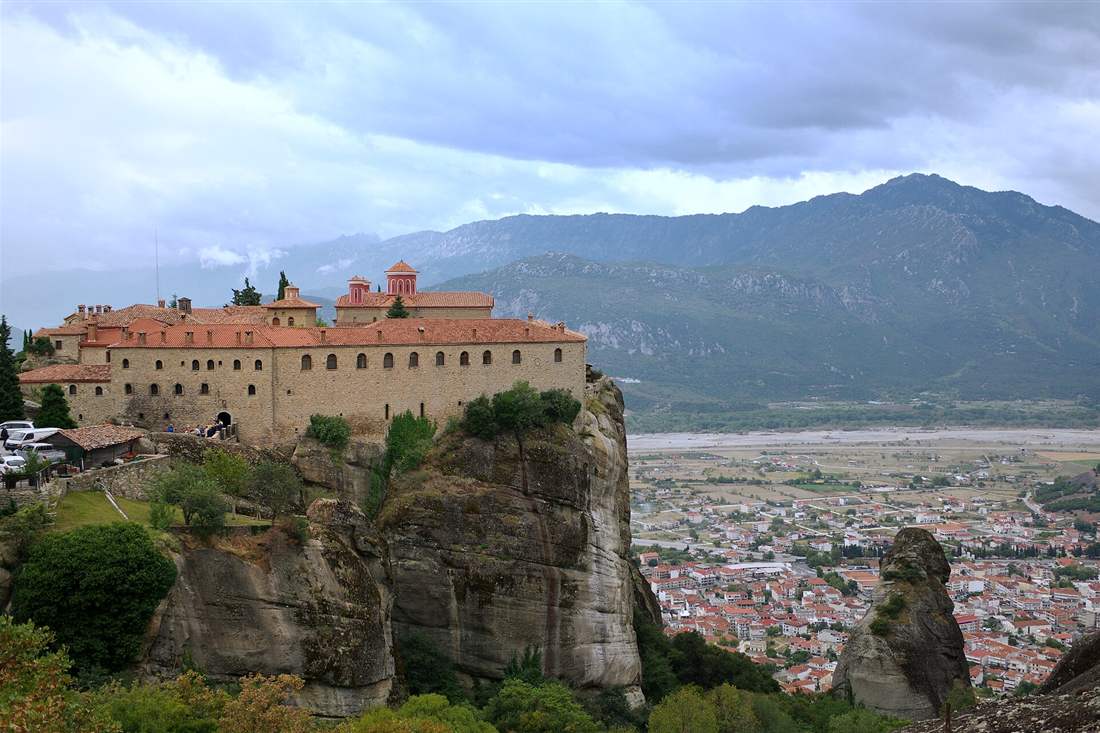
The 3-day trip to Meteora from Athens joins tours of the centuries-old monasteries, a museum visit and hotel nights below the rocks. Tours across the rest of the country are listed on Greece Tours.
The sections below cover what the trip to Meteora from Athens includes, the comparison with day trips, how three days fit, the monastic day, the named rock pillars, season and booking, with links into the Meteora day trips from Athens pages. The tours shown are checked on GetYourGuide and Viator.
What is the 3-day trip to Meteora from Athens?
The 3-day trip to Meteora from Athens is a packaged tour that starts in the Greek capital. It heads north to the UNESCO World Heritage Site of Meteora in Thessaly. The site holds rock monasteries built from the 14th century.
Meteora lies about 350 km northwest of Athens by road. The road north crosses Boeotia and Phthiotis before entering Thessaly. The rocks rise where the Thessaly plain meets the foothills of the Pindus mountains. The Pinios river flows past their southern side. A 3-day trip to Meteora from Athens covers about 700 km out and back.
Kalambaka is the main town at the southern foot of the rocks. Its railway station sits at the end of the branch line from Palaiofarsala. Kastraki is a smaller village about 2 km northwest, set right under the cliffs. A paved road climbs from both places to the monastery gates.
The rocks are pillars of sandstone and conglomerate. The rock formed about 60 million years ago from layers of an ancient river delta. In Greek, the name Meteora means “suspended in the air”. Hermit monks settled in caves on these rocks from the 11th century. Twenty-four monasteries rose on the rocks in the centuries that followed.
UNESCO added Meteora to the World Heritage List in the late 20th century. The inscription covers both cultural and natural criteria, so Meteora counts as a mixed site. A 3-day trip to Meteora from Athens reaches one of just two mixed sites in Greece. The other is Mount Athos in northern Greece.
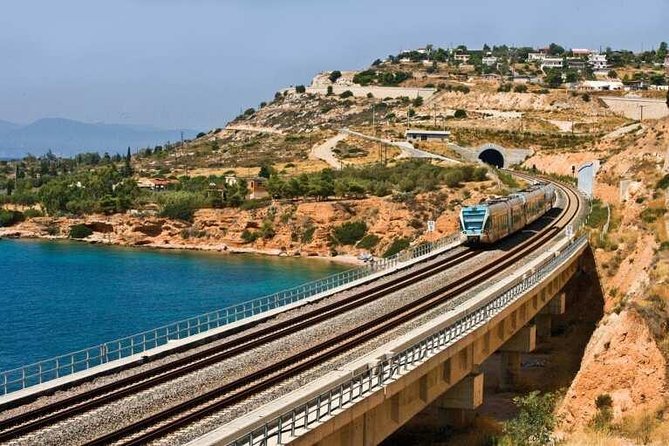
Independent travellers reach Kalambaka by train, KTEL coach or car from the capital. Each of those routes is laid out on the page about getting from Athens to Meteora. Each route ends at Kalambaka, the base town for the monasteries. The 3-day trip to Meteora from Athens wraps the hotel stay into one package instead.
What does the 3-day trip to Meteora from Athens include?
The 3-day trip to Meteora from Athens names tours, a museum and a hotel in its title. Its description adds centuries-old monasteries, panoramic views and the “secrets of Meteora”. Entry fees, meals and the nightly hotel fee need a separate budget.
Six centuries-old monasteries stay active on the rocks and open to visitors. They are the Great Meteoron, Varlaam, Roussanou, St Nicholas Anapafsas, Holy Trinity and St Stephen. The Great Meteoron is the largest, and Varlaam ranks second. Roussanou and St Stephen are convents run by nuns. Any 3-day trip to Meteora from Athens works within this set of six.
The title of the 3-day trip to Meteora from Athens names a museum but not which one. An unnamed museum in a package counts as a separate ticket line in the budget. A question to the operator before departure settles it. Greek state museums sell entry at the desk and through the official Ministry of Culture e-ticket site.
Nights on the 3-day trip to Meteora from Athens are spent at the hotel listed in the title. Greece charges a climate resilience fee for every room and every night of stay. The rate rises with the hotel’s star rating, and guests pay it at the hotel. A higher rate applies from April to October.
The tour title lists no meal plan. Food on a 3-day trip to Meteora from Athens is a separate cost. Tavernas in Kalambaka and Kastraki serve lunch and dinner below the rocks. Both places sit within a 15-minute drive of the monastery car parks. Bakeries in Kalambaka sell spinach and cheese pies for a quick lunch between monasteries.
Each monastery sells its own entry ticket at the gate, so six visits mean six separate tickets. Inside, women wear skirts below the knee and men wear long trousers. Wrap skirts are handed out at the gates for visitors who arrive without one. Photography is banned inside the painted churches.
- In the title: tours linked to the UNESCO site and its monasteries
- In the title: one museum, with no museum name given
- In the title: a hotel, with no hotel name or star rating given
- Separate cost: the entry ticket at each of the six monastery gates
- Separate cost: a museum ticket, unless the package names the museum
- Separate cost: lunches and dinners, as the title lists no meal plan
- Separate cost: the climate resilience fee, per room and per night
How does it compare with Meteora day trips from Athens?
A day trip to Meteora from Athens packs 8 to 10 hours of travel into one day. The 3-day format spreads that travel over three days. Its hotel nights also bring sunset and sunrise over the rocks within reach.
On a day trip to Meteora from Athens, the outbound leg starts early in the morning. The return reaches the capital late at night, 13 to 15 hours after departure. Neither version includes a night away from the capital. Same-day versions run by train or by coach.
Time at the rocks on a day trip to Meteora from Athens runs to about 4 hours. That window fits two or three monastery interiors. The climb to the Great Meteoron alone takes about 300 rock-cut steps. Train passengers add a minibus or taxi ride from Kalambaka station up to the rocks.
Hours on the road stay close to equal for both formats, as the distance does not change. The 3-day trip to Meteora from Athens adds hotel nights, so no single day carries both legs. Any day without a transfer frees its daylight for the monasteries. On a day trip, transfers fill more than half of the day.
Same-day tours head back south in the afternoon, before sunset from spring to autumn. The 3-day trip to Meteora from Athens includes hotel nights, which put evenings near the rocks. Low evening sun turns the grey rock faces orange. From the cliff-top road, the view takes in Kalambaka and the Thessaly plain below.
Sunrise stays out of reach on a same-day visit. The earliest arrival from Athens comes in late morning. A hotel night near the rocks changes that. Local sunrise tours leave Kalambaka and Kastraki before dawn. Dawn viewpoints and start times appear on the page about sunrise at Meteora.
- Nights away from Athens: none on a day trip, two on the 3-day format
- Hours on the road: 8 to 10 on a day trip, the same total spread over three days
- Monasteries within reach: two or three interiors on a day trip, all six over the longer stay
- Sunset: missed on same-day tours from spring to autumn, within reach on an evening near the rocks
- Sunrise: out of reach on a day trip, within reach after a hotel night near the rocks

How do three days at Meteora fit together?
Travellers can shape a 3-day trip to Meteora from Athens into three blocks of their own. Day one fits arrival and sunset, and day two fits the monasteries. Day three fits a walk or a museum before the return to Athens.
Kalambaka and Kastraki both hold hotels below the rocks. Kalambaka is the larger town, with shops, tavernas and the railway station. Kastraki is quieter and sits closer to the cliffs. The hotel on a 3-day trip to Meteora from Athens stands near these rocks.
- Day one: arrival, hotel check-in and sunset at Psaropetra, the “Fish Rock” viewpoint on the main road.
- Day two: the monasteries, matched to the weekdays when the chosen houses stay open.
- Day three, morning: a trail from Kastraki or a museum in Kalambaka.
- Day three, afternoon: the return to Athens.
A trail leaves the central square of Kastraki and climbs to the plateau of the monasteries. Higher up it splits, with the north branch to Great Meteoron and the east branch to Varlaam. The climb takes over an hour on foot. Walkers on a 3-day trip to Meteora from Athens can pick from a network of marked trails.
Each of the six open monasteries closes on one weekday, and the days differ from house to house. Planning around those closures keeps a 3-day trip to Meteora from Athens free of locked gates. The page on Meteora monasteries tickets lists the entry details.
The Holy Trinity Monastery lies at the end of a steep walk. St Stephen Monastery sits above Kalambaka and has easy access over a short bridge. Those two houses suit different fitness levels on a 3-day trip to Meteora from Athens.
Varlaam crowns a cliff that rises 373 metres over the valley. Roussanou stands at 484 metres above sea level. St Nicholas Anapafsas sits on a lower rock and needs a steep walk. Great Meteoron, founded in the mid-14th century, is the largest of the six houses.
A short path from Kastraki climbs to the Holy Spirit chapel. It starts in the village centre and heads east. Firm shoes suit its exposed final stretch on a 3-day trip to Meteora from Athens. Kalambaka, seat of the Meteora municipality, holds the Natural History Museum of Meteora.

How does the monastic day run at Meteora?
The monastic day at Meteora opens in the late afternoon with Vespers. The night office, Matins before dawn and the morning Divine Liturgy follow in turn. A 3-day trip to Meteora from Athens reaches the monasteries in daytime visiting hours.
The call to prayer comes from the semantron, a long wooden board struck with a wooden mallet. Greeks also call it the talanto. Before each service a monk strikes three firm blows at the west end of the main church. He then walks around the church, facing the four quarters, and ends with three more blows.
A fixed board hangs on chains near the church. A smaller iron or brass semantron sounds after the wooden one, with a tone close to a gong. Ottoman limits on church bells kept the wooden board in use across southeastern Europe. Its rhythm still opens the services on the rocks.
- Vespers: the first service of the church day.
- Compline: at bedtime.
- Midnight Office: at midnight.
- Matins (Orthros): through the night watches, ending at dawn.
- First Hour: near 06:00.
- Third and Sixth Hours: near 09:00 and noon.
- Divine Liturgy: the morning Eucharist, in the form of St John Chrysostom on ordinary days.
- Ninth Hour: near 15:00, before the next Vespers.
The candle-lighter, or kandilaptis, calls the monks to the night offices. Matins, named Orthros in Greek, is the longest service of the daily cycle. On Sundays, it runs up to three hours when sung in full. These offices end before the gates open on a 3-day trip to Meteora from Athens.
Vespers opens with Psalm 103 in praise of God. The hymn O Gladsome Light, or Phos Hilaron, follows the Entrance. The church is censed during the psalms. Great Vespers marks Sundays and major feasts, and daily Vespers serves the other evenings. Sunset over the rocks on a 3-day trip to Meteora from Athens marks the hour of this office.
Wednesdays and Fridays are fast days across the Orthodox Church. Wednesday recalls the betrayal of Christ by Judas, and Friday recalls the Crucifixion. The fast rules out meat, fish, dairy, eggs, wine and olive oil. A 3-day trip to Meteora from Athens that includes Wednesday or Friday shares a monastic fast day.
What are the named rock pillars of Meteora?
Local people and climbers give the pillars names such as Adrachti, Holy Spirit, Alysos, Doupiani and Ypsilotera. Named summits stand 390 to 630 metres above sea level. The names let travellers on a 3-day trip to Meteora from Athens read the skyline above Kastraki.
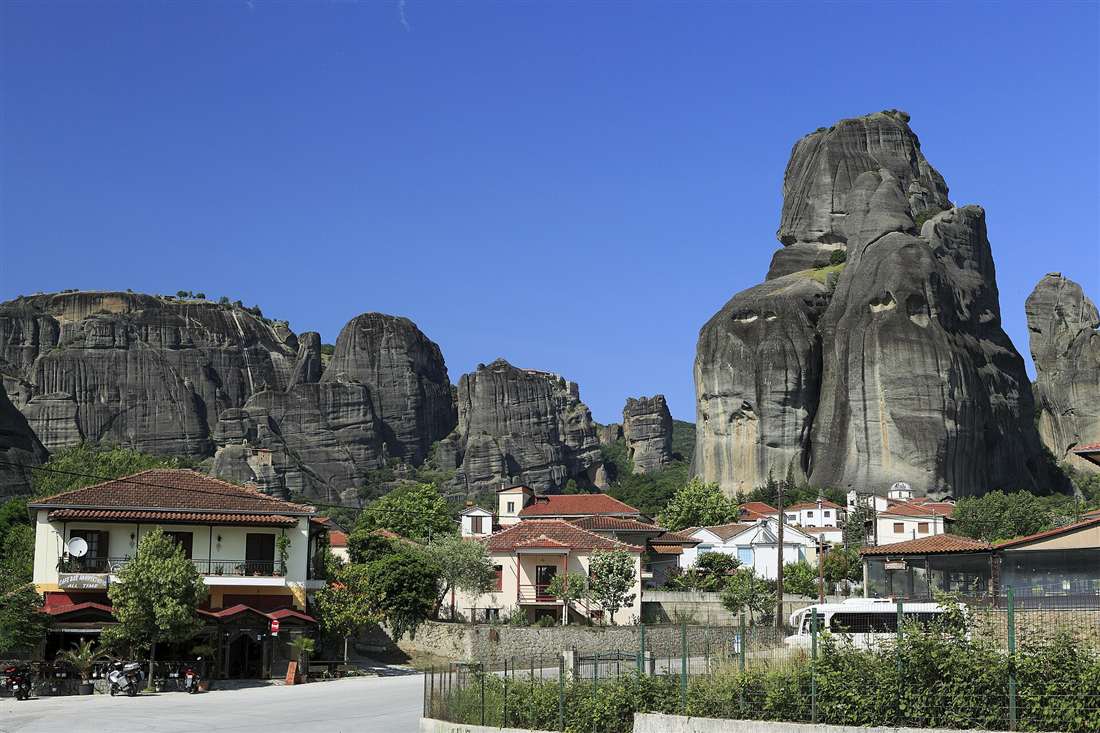
Adrachti is the Greek word for a spindle, the tool once used to spin wool. Climbing maps print it as Spindel, the German form of the same name. Hikers on a 3-day trip to Meteora from Athens reach its base on a trail from Kastraki. The trail climbs wooden steps to the Cell of Constantius before the final rise.
An iron cross stands on top of the Holy Spirit Rock. The Monks’ Prison fills a long vertical crevice on the rock’s eastern side. Kerchiefs hang at the mouth of the Cave of St George of Mandila on the same rock. Only rock climbing reaches the cave itself.
- Adrachti: a long, thin pillar with its tip at 474 metres.
- Holy Spirit Rock (Agio Pneuma): 600 metres, on the north flank of the Kastraki valley.
- Alysos: 588 metres, with the ruins of the Monastery of the Apostle Peter’s Chains.
- Doupiani: 390 metres, rising inside Kastraki beside hotels and restaurants.
- Ypsilotera: 586 metres, with a ruined 14th-century monastery beside the Devil’s Tower.
- Agia: 630 metres, the highest summit among the named rocks.
- Modi: 585 metres, with the ruins of the Monastery of St Modestus.
The Skete of the Holy Virgin on Doupiani keeps a chapel that still holds services. Doupiani, Sourloti, Ambaria and the Delta Spur carry the routes used for rock climbing at Meteora. These walls fill the panoramic views around Kastraki on a 3-day trip to Meteora from Athens.
Sourloti, Modi, Alysos, Agia and Pyxari ring Adrachti, clockwise from the north. Alysos also goes by Altsos and Alsos. Agia carries the longer name Megali Agia and the ruins of the Monastery of the Holy Apostles. Sourloti reaches 600 metres, and its east side carries the rock-cut Staircase of St Eustratius.
The pillars are sandstone and conglomerate, a rock of stones, sand and mud from an ancient delta. Toichos, the Greek word for wall, splits into four summits named Alpha to Delta. They rise from 480 to 540 metres above sea level. From Kastraki, travellers on a 3-day trip to Meteora from Athens face this wall to the east.
Pyxari, at 524 metres, Badovas, at 447 metres, and Ambaria, at 400 metres, stand south of Kastraki. Ambaria marks the southwest edge of the whole complex. Kumaries, at 497 metres, rises east of the village near Toichos. The Holy Spirit chapel path passes the base of Kumaries before its last climb.

Which season suits the 3-day trip to Meteora from Athens?
Late spring and early autumn suit the 3-day trip to Meteora from Athens. Daytime highs in Trikala then sit between 25 °C and 31 °C. Those weeks avoid the peak summer heat and the cold, wet winter months.
Rain in Trikala peaks from October to March, with February the wettest month at about 80 mm. July and August stay driest, at 17 to 18 mm each. March rain of about 76 mm feeds the spring wildflowers around Meteora. Pack a light rain jacket for a 3-day trip to Meteora from Athens in spring or autumn.
- Spring (March to late spring): highs of 17 to 27 °C, lows of 6 to 13 °C.
- Summer (June to August): highs of 33 to 35 °C, lows of 19 to 20 °C.
- Autumn (September to November): highs fall from 31 to 17 °C, lows from 17 to 9 °C.
- Winter (December to February): highs of 11 to 15 °C, lows of 2 to 6 °C.
Midday heat from June to August makes long stair climbs tiring, so carry water, a hat and sunscreen. Winter mornings near freezing call for a warm jacket, gloves and shoes with firm grip. Wet stone steps turn slippery after rain or frost. Spring and autumn days swing widely between cool dawns and warm afternoons, so pack layers.
Snow covers the Pindus peaks west of Meteora through winter and into early spring. Snowfall in Trikala itself stays light and rare. Fog fills the Pineios valley on autumn and winter mornings. Early risers on a 3-day trip to Meteora from Athens can watch the monasteries rise above it.
Sunset over Kalambaka comes near 21:05 in late June and near 17:10 in late December. It falls near 20:00 in early April and near 18:45 in mid-October. Daylight lasts about 15 hours at midsummer and about 9 hours 20 minutes at midwinter.
Sunset time on a 3-day trip to Meteora from Athens shifts by nearly four hours across the year. Low winter sun casts long shadows across the valley through the whole afternoon. Read these photography tips for Meteora before packing a camera.
Monasteries shorten their visiting hours from November to March and add closing days. The larger monasteries shut their doors by mid-afternoon in winter. Check each monastery’s winter timetable before a 3-day trip to Meteora from Athens in the cold months.
How do you book and cancel the trip to Meteora from Athens?
Book the 3-day trip to Meteora from Athens by picking a date and the number of travelers. Free cancellation runs up to 24 hours before the start on listings that show that label. Hotels add a climate crisis resilience fee per room per night.
One listing covers tours, a museum and a hotel. It starts in Athens and runs for 3 days. Online booking of the 3-day trip to Meteora from Athens follows six steps. Each step runs on the listing page or in the app. The listing page also shows the tour languages before checkout.
- Open the tour listing and pick a travel date.
- Select the number of travelers and check availability.
- Read the cancellation terms and the included and not-included lists.
- Enter the lead traveler’s name, email address and phone number.
- Pay by card or another listed method to confirm the booking.
- Save the voucher from the confirmation email or the app.
Greek hotels charge a climate crisis resilience fee per room per night. The rate depends on star rating and rises from April to October. Hotels collect it directly from guests on site. Read the not-included list of the 3-day trip to Meteora from Athens for this fee.
The fee counts rooms, not guests, so two travelers sharing one room pay it once per night. Children in the same room add nothing to it. Payment in cash or by card depends on the hotel’s front desk.
Cancellations go through the booking page or the app. The 24-hour window counts back from the start time in Athens. Cancelling a 3-day trip to Meteora from Athens before that point brings a full refund. Later cancellations follow the terms printed on the listing. A phone reminder set two days ahead leaves time to decide.
Questions about rooms, timings or dietary needs go to the local operator through the app’s messages. Name or phone changes go through the same booking page. Keep the booking reference at hand for each message to the operator.
The voucher lists the meeting point in Athens and the local operator’s contact number. Greek hotels register every guest, so carry a passport or national ID card for check-in. Show the voucher on a phone or paper when the 3-day trip to Meteora from Athens starts. Arrive at the meeting point 15 minutes before the start time.
Frequently Asked Questions
How long is the trip?
It runs for three days in total. Each 3-day trip to Meteora from Athens packs tours, a museum and a hotel into that span. A one-day visit from Athens fits in only two or three monasteries. The tour page shows its cancellation terms, so check them before paying.
Where does it start?
It starts in Athens. Meteora lies to the north, at the edge of the Thessaly plain above the town of Kalambaka. The tour page does not name a meeting point, so guests confirm the exact spot after booking. Athens International Airport sits about 30 km east of the city centre.
Is a hotel included?
Yes. The title of this 3-day trip to Meteora from Athens names a hotel alongside tours and a museum. The tour page does not give the hotel name or its star rating. Kalambaka and the village of Kastraki sit under the rocks, with the closest rooms to the monasteries.
Which museum does the title mean?
The title does not name one. Kalambaka, the town at the foot of the rocks, has a Natural History Museum and a Mushroom Museum. The Great Meteoron also keeps a museum of icons and manuscripts. Guests confirm which museum the 3-day trip to Meteora from Athens includes after booking.
Are monastery entry fees included?
The tour page does not say whether entry fees are covered. Each of the six monasteries charges its own fee at the gate. Guests ask the operator about fees before booking the 3-day trip to Meteora from Athens. Carrying small cash for the six gates speeds up entry.
What is the monastery dress code?
Women wear skirts that cover the knees, and women in trousers wrap a skirt over them. Men wear long trousers. Shorts and sleeveless tops are refused at the door for everyone. Wrap skirts are lent free at the monastery entrances. Modest clothes for each day save time at the gates.
How far is Meteora from Athens?
Meteora lies about 350 km northwest of Athens by road. The drive takes about four and a half hours without long stops. Trains also link Athens with Kalambaka, the rail stop below the monasteries. That distance explains why the 3-day trip to Meteora from Athens includes a hotel stay.
Which monasteries are still active?
Six are active today, out of 24 once built. They are the Great Meteoron, Varlaam, Rousanou, St Nicholas Anapafsas, Holy Trinity and St Stephen. Nuns live at Rousanou and St Stephen, and monks run the other four. These centuries-old houses anchor the UNESCO site on the trip to Meteora from Athens.
Can children join?
Families check the tour page for any age limits before booking the 3-day trip to Meteora from Athens. The Great Meteoron alone has about 300 steps cut into the rock. Strollers do not work on these stairs, so a baby carrier helps. School-age children who climb stairs well handle the visits.
Is Meteora accessible for wheelchair users?
Access is limited, because every monastery is reached by steps. St Stephen has the smallest number, since a short bridge links it to the road. Holy Trinity sits atop a long stairway cut into the cliff. Wheelchair users still see the pillars and monastery walls from roadside viewpoints.
Which days do the monasteries close?
Each house closes on one weekday. In summer, St Stephen shuts on Monday, the Great Meteoron on Tuesday and Rousanou on Wednesday. Holy Trinity shuts on Thursday, and Varlaam and St Nicholas on Friday. All six open at weekends. Dates for the trip to Meteora from Athens set which houses open.
Can photos be taken inside the churches?
No, photos are not allowed inside the main churches of the monasteries. Their walls carry frescoes, including work by Theophanes the Cretan at St Nicholas. Monks and nuns enforce the rule. Courtyards and terraces stay open to cameras. The cliff-edge terraces of Varlaam and the Great Meteoron face the other rock pillars.
What is the sunset like at Meteora?
At sunset the grey rock pillars turn gold, then orange. The sun drops behind the Pindus mountains to the west. The monasteries close in the afternoon, so sunset is watched from rock ledges along the road. The hotel stay on this trip to Meteora from Athens keeps guests close to those spots.
Does the trip suit a winter visit?
Yes, and winter brings smaller crowds at the monastery gates. Opening hours are shorter, and days are cold. Snow can cover the rock tops, and fog can hide the pillars for hours. Warm layers and shoes with grip help on icy steps during a 3-day trip to Meteora from Athens.
What do travellers pack for the trip?
Pack shoes with firm grip and modest clothes for the monasteries. A light rain jacket helps in spring or autumn. Cash in small notes covers each monastery gate. A passport or ID card is needed at hotel check-in on a 3-day trip to Meteora from Athens.
Can travellers walk between the monasteries?
Yes. Marked trails link Kastraki and Kalambaka with the monastery summits. The paved road also loops past all six active houses. Walkers on a 3-day trip to Meteora from Athens wear firm shoes and carry water.
Does the trip include a guide?
The title names tours, so guided visits form part of the package. Read the listing for the guide languages and the number of guided outings. Questions about the guide go to the local operator through the app’s messages before the trip starts.
What is Psaropetra?
Psaropetra, the “Fish Rock”, is a viewpoint on the main road between the monasteries. It looks out over the rocks and the Thessaly plain. On a 3-day trip to Meteora from Athens, it makes a sunset stop on day one.