
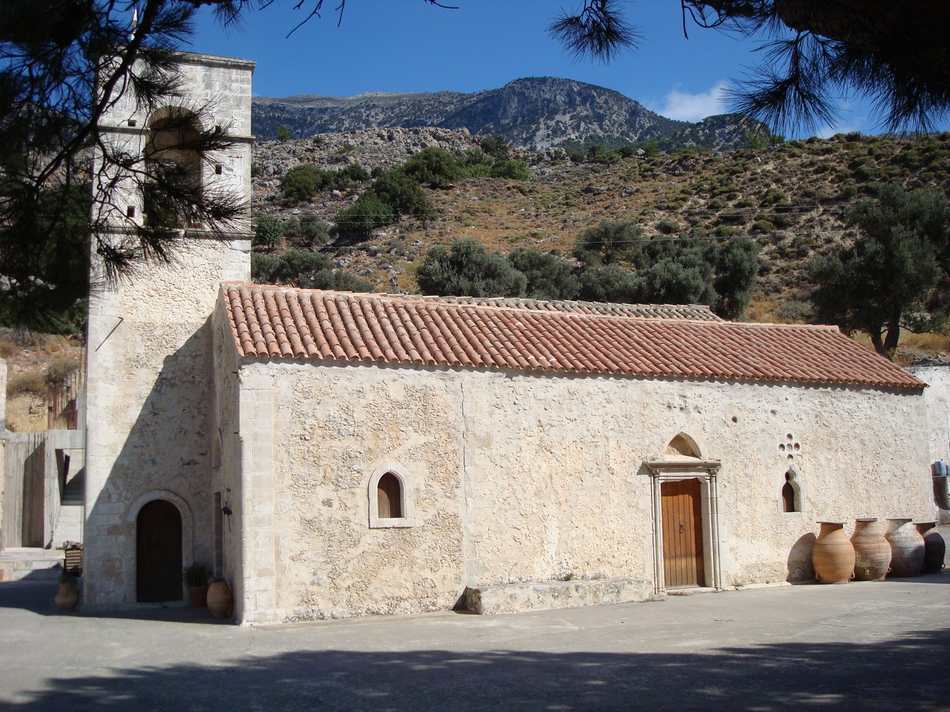
Vrondisi Monastery rests on the southern slopes of Psiloritis, the highest mountain range in Crete, above the village of Zaros on the road toward Kamares. Founded around the fourteenth century, this Byzantine monastery became an important centre of learning and art during Venetian rule. A celebrated Venetian fountain carved with figures of Adam and Eve stands at its gate, shaded by ancient plane trees. The church preserves wall-paintings, and the monastery once housed famous icons by Michael Damaskinos, now displayed in Heraklion. Visitors find history, art, and quiet mountain scenery here with My Greece Tours.
The monastery sits amid the foothills of the island’s highest range, close to the spring-fed lake of Zaros and the gorge above. It maintains close links with the nearby ruined Valsamonero monastery, whose church carries some of the finest frescoes on the island. The sections below cover the monastery’s history, artistic treasures, architectural features, nearby attractions, and practical visitor information. Exploring this mountain retreat adds depth to any Crete travel guide itinerary focused on Byzantine heritage and natural beauty.
What is the history of Vrondisi Monastery in Crete?
Vrondisi Monastery was founded around the fourteenth century on the southern slopes of Psiloritis. It flourished as a centre of learning and art during Venetian rule, producing manuscripts and icons that enriched Cretan culture.
The monastery emerged during the late Byzantine period, establishing itself as a spiritual and intellectual hub in the Heraklion region. Monks dedicated themselves to scholarship, manuscript illumination, and the creation of religious art that blended Byzantine tradition with Venetian influences. The institution attracted learned clergy and artists, contributing to the cultural flowering that characterised Crete during Venetian administration. Its remote location on the mountain slopes provided both seclusion for contemplation and access to the fertile valleys below. The monastery maintained close ties with other religious foundations in the area, forming a network of spiritual centres that shaped the island’s religious life. Visitors exploring things to do in Crete discover this legacy preserved in architecture and art.
The foundation thrived for centuries, weathering political changes and maintaining its role as a guardian of Orthodox tradition. Monks copied sacred texts, trained novices, and welcomed pilgrims travelling through the mountain passes. The institution’s influence extended beyond its walls, shaping the religious and cultural identity of surrounding villages. Today the monastery stands as a testament to the endurance of monastic life in Crete, its buildings and artworks offering tangible connections to the island’s Byzantine and Venetian past. The site rewards those interested in the historical layers that define Cretan heritage, providing insight into the spiritual communities that flourished in these mountains for generations.
What artistic treasures can visitors see at Vrondisi?
The monastery church preserves surviving wall-paintings that demonstrate Byzantine artistic traditions. The famous icons painted by Michael Damaskinos, once kept here, are now displayed in Heraklion museums, though the monastery retains its historical significance as their original home.
The interior frescoes showcase the skill of Cretan painters working within Orthodox iconographic conventions. These wall-paintings depict saints, biblical scenes, and theological themes rendered with the characteristic palette and compositional balance of Byzantine art. The colours retain their intensity despite centuries of exposure, and the figures display the elongated proportions and spiritual gravity typical of the tradition. Visitors can study the brushwork and symbolic details that communicate religious narratives to both literate and illiterate worshippers. The church served as a canvas for artists who combined technical mastery with devotional purpose, creating works intended to inspire prayer and contemplation. The connection to Zaros and its surrounding communities enriched the monastery’s artistic patronage.
Michael Damaskinos, one of the most celebrated Cretan painters of the sixteenth century, created icons for Vrondisi that are now treasured in museum collections. His work represents the Cretan School at its height, synthesising Byzantine iconography with Renaissance techniques absorbed from Venetian masters. The monastery’s role in commissioning and housing such masterpieces underscores its importance as an artistic centre. The nearby Valsamonero monastery complements this heritage with its own exceptional frescoes, among the finest on the island. Together these sites form a concentrated area of Byzantine art that attracts scholars and enthusiasts seeking to understand the development of religious painting in Crete during this fertile period.
What makes the Venetian fountain at Vrondisi notable?
The celebrated Venetian fountain at the monastery gate features carved figures of Adam and Eve, demonstrating the sculptural craftsmanship of the period. Ancient plane trees shade the fountain, creating a picturesque entrance that blends natural and architectural beauty.
The fountain represents a distinctive example of Venetian stonework adapted to a monastic setting. Carved reliefs depict the biblical first couple, their forms rendered with the naturalism and attention to anatomy characteristic of Renaissance sculpture. The fountain served both practical and symbolic functions, providing water for travellers and pilgrims whilst conveying theological messages through its imagery. The choice of Adam and Eve as decorative subjects links the fountain to themes of creation, fall, and redemption central to Christian teaching. Stonemasons working under Venetian patronage brought their techniques to Crete, leaving monuments like this fountain that testify to the cultural exchange between the island and the Venetian Republic.
The craftsmanship remains crisp, allowing visitors to appreciate details in the carving. The fountain’s placement at the entrance creates a threshold between the secular world and the sacred space within, marking the transition pilgrims made as they entered the monastery grounds. The site appears in many itineraries covering hidden gems in Crete for its artistic and historical value.
The plane trees surrounding the fountain have grown for generations, their spreading canopies providing shade and coolness. These trees contribute to the atmosphere of tranquillity that defines the monastery precinct, their rustling leaves and dappled light enhancing the contemplative mood. The combination of flowing water, carved stone, and living trees creates a harmonious composition that reflects the monastic ideal of integrating human creation with divine creation. Visitors pause here to rest, photograph the fountain, and absorb the peaceful ambience before exploring the church and other buildings. The fountain exemplifies how Venetian artistic sensibilities merged with the functional needs of monastic life, producing works that served daily use whilst elevating the spirit through beauty.
How does Vrondisi connect to nearby Crete attractions?
Vrondisi sits close to Zaros village, known for its spring-fed lake and mountain gorge. The nearby ruined Valsamonero monastery holds some of the finest frescoes on the island, creating a concentrated area of Byzantine heritage in the Psiloritis foothills.
The village of Zaros lies just below the monastery, offering tavernas, accommodation, and access to natural attractions. The lake formed by abundant springs provides a scenic spot for walks and birdwatching, whilst the gorge above attracts hikers seeking mountain trails. Combining a visit to Vrondisi with exploration of Zaros and its surroundings creates a full day of cultural and natural discovery. The road continuing toward Kamares passes through dramatic mountain scenery, revealing the varied landscapes of the Psiloritis range. Travellers can trace the historical routes that connected monastic communities with villages and markets, understanding how geography shaped settlement patterns and economic life.
The proximity of these sites makes the area accessible for those based in the Heraklion region, offering an alternative to coastal attractions.
Valsamonero monastery, though ruined, preserves frescoes of exceptional quality that complement those at Vrondisi. The two foundations maintained close ties, sharing artistic traditions and spiritual practices. Visiting both sites in a single excursion allows comparison of their architectural styles and decorative programmes. The concentration of Byzantine monuments in this area reflects the importance of the Psiloritis foothills as a centre of monastic activity. Other monasteries in Crete, such as Arkadi Monastery, offer different historical narratives, but Vrondisi and Valsamonero together provide focused insight into the artistic achievements of the Byzantine and Venetian periods. The journey from Heraklion takes under an hour, making the monastery accessible for day trips.
What practical information helps visitors plan a trip to Vrondisi?
The monastery is reached via the road from Zaros toward Kamares, winding up the southern slopes of Psiloritis. Visitors should dress modestly for the active religious site, and the mountain location offers cooler temperatures and fresh air year-round.
The drive from Heraklion takes approximately forty-five minutes, following routes through the interior landscape of central Crete. The road climbs steadily from the coastal plain, passing olive groves and vineyards before entering the mountain zone. Signage directs travellers to the monastery, and parking is available near the entrance. The site remains an active religious foundation, so visitors should respect its sacred character by dressing appropriately and maintaining quiet within the church. Photography may be restricted inside the church to preserve the frescoes and maintain the contemplative atmosphere. The best times to visit are morning or late afternoon, when light enhances the mountain scenery and temperatures are comfortable for walking.
Spring brings wildflowers to the slopes, whilst autumn offers clear skies and golden light ideal for photography.
Combining Vrondisi with other destinations in the area maximises the journey from coastal resorts or Heraklion. The village of Zaros provides dining options featuring local trout and traditional Cretan dishes, along with opportunities to purchase spring water bottled from the village sources. Hikers can extend their visit by exploring trails in the gorge or around the lake, experiencing the natural beauty that complements the cultural heritage. The monastery offers a peaceful retreat from busier tourist sites, rewarding those who seek quieter encounters with Cretan history and spirituality. Travellers interested in Byzantine art and monastic architecture will find the journey worthwhile, discovering a site that preserves the artistic and religious traditions that shaped the island’s identity over centuries.
Frequently Asked Questions
Can visitors attend services at Vrondisi Monastery?
Vrondisi remains an active monastery, and visitors may attend services according to the community’s schedule. The monastery follows the Orthodox liturgical calendar, celebrating feast days and maintaining daily prayer routines. Attending a service offers insight into the living traditions that continue at the site, allowing visitors to experience the chants, incense, and rituals that have characterised Orthodox worship for centuries. Respectful behaviour is essential, including modest dress, silence during prayers, and following the lead of regular worshippers regarding standing, sitting, and movement within the church. Photography during services is typically not permitted, preserving the sacred atmosphere. Visitors interested in attending should inquire locally about service times, which may vary seasonally and according to the monastic community’s needs.
The experience of worship in this historic setting adds spiritual depth to a visit focused on art and architecture, connecting the physical heritage with the devotional practices that inspired its creation.
What is the best season to visit Vrondisi Monastery?
Spring and autumn offer ideal conditions for visiting Vrondisi, with comfortable temperatures, clear skies, and vibrant landscapes. Spring brings wildflowers to the mountain slopes, creating colourful displays that enhance the natural setting. The weather remains mild, perfect for combining the monastery visit with walks around Zaros lake or hikes in the nearby gorge. Autumn provides crisp air, golden light, and fewer visitors than the summer peak, allowing quieter contemplation of the frescoes and architecture. Summer visits are possible but require early morning or late afternoon timing to avoid midday heat, though the mountain elevation provides cooler temperatures than coastal areas.
Winter can bring rain and occasional snow to the Psiloritis slopes, making roads challenging and limiting access to hiking trails, though the monastery itself remains accessible. The plane trees at the fountain display their full canopy in summer and striking bare branches in winter, offering different aesthetic experiences across seasons. Each season reveals different aspects of the site’s beauty and character.
How does Vrondisi compare to other monasteries in Crete?
Vrondisi distinguishes itself through its artistic heritage, particularly its connection to Michael Damaskinos and the exceptional frescoes at nearby Valsamonero. The monastery occupies a quieter position in tourist itineraries compared to Arkadi Monastery, which carries powerful associations with Cretan resistance during the nineteenth century. Vrondisi focuses attention on Byzantine and Venetian artistic achievements rather than political history, appealing to visitors interested in religious art and monastic architecture. The Venetian fountain with its Adam and Eve carvings creates a unique entrance feature not found at other Cretan monasteries. The mountain setting on Psiloritis slopes offers dramatic scenery and connections to hiking trails, differentiating it from monasteries in lowland or coastal locations.
The proximity to Zaros and Valsamonero allows visitors to explore a concentrated area of Byzantine heritage within a compact geographical area. Vrondisi rewards those seeking contemplative spaces and artistic treasures away from more crowded sites, providing an intimate encounter with Cretan monastic traditions in a setting that balances cultural significance with natural beauty.