
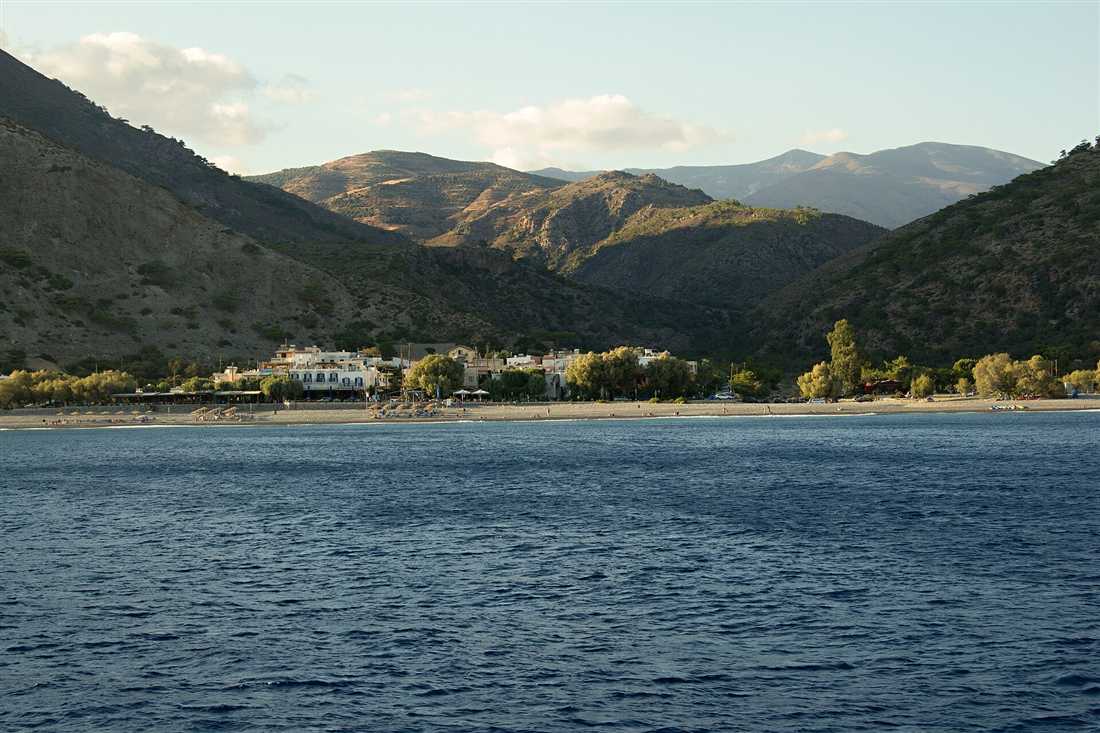
Sougia is a quiet, low-key beach village on the south-west coast of Chania in Crete, about 70 kilometres from Chania, with a long grey-pebble beach, a back-to-basics calm, and the Agia Irini Gorge finishing above it. Plan the whole trip with Greece Tours.
This guide covers Sougia in full: what and where it is, the long pebble beach, the relaxed alternative character, the ancient city of Syia, whether it suits families or peace-seekers, the Agia Irini Gorge, the coastal walk to ancient Lissos, the boats to Agia Roumeli and Paleochora, the E4 hikes, where to eat and stay, the quiet evenings, how to get there from Chania, the best time, and whether Sougia is worth visiting.
What is Sougia in Crete?
Sougia is a quiet, low-key beach village on the south-west coast of Crete, about 70 km from Chania. It fronts a long grey-pebble-and-sand beach at the mouth of the Agia Irini Gorge, and it keeps a deliberate back-to-basics feel.
Sougia sits in the Selino district of the Chania regional unit, tucked against the Libyan Sea at the foot of the Lefka Ori, the White Mountains. The village is small and low-rise: a single seafront road of tavernas, rooms and a handful of shops, with the pebble beach running the full width of the bay. There is no resort strip, no line of high hotels, and no marina. The plan of the place stays flat and open, and the mountains rise straight behind it.
The name reaches back to the ancient port of Syia, which stood on the same shore. Modern Sougia grew as a farming and fishing settlement and turned to low-key tourism without losing its scale. Visitors arrive for the swimming, the walking and the calm rather than for nightlife or crowds. The village pairs naturally with the wider coast of the Chania region, and it anchors the southern end of one of Crete’s greener gorges.
Sougia trades on quiet. The beach stretches long enough to absorb its summer visitors, the water drops away clear and deep close to shore, and the tavernas serve straight to the pebbles. It draws walkers finishing the Agia Irini Gorge, day-trippers arriving by the coastal ferry, and travellers who want the south coast without the polish. The result is a village that stays true to its scale: unhurried, unspoilt, and firmly turned towards the sea.
Sougia counts a permanent population in the low hundreds, and the number swells through July and August before it empties again in autumn. The village keeps a small church, a clutch of family-run rooms, a bakery, a mini-market and a line of tavernas, and that short list covers the whole settlement. Water taxis and the coastal ferry tie it to the roadless villages east and west, and the mountain road ties it to Chania north. Sougia works as a base for walkers, swimmers and travellers who read the south coast slowly rather than tick it off in a hurry.
Where is Sougia and how far is it from Chania?
Sougia lies on the south-west coast of Crete, about 70 km south of Chania across the White Mountains. The drive runs roughly 90 minutes on winding mountain roads, and a daily KTEL bus links the village to Chania town in season.
The road from Chania climbs south through the villages of the Selino district before it drops to the Libyan Sea. It threads the mountain passes above the Agia Irini Gorge, then descends the final kilometres to the coast in a series of tight bends. The distance measures near 70 km, and the mountain terrain stretches the journey to about an hour and a half by car. The last stretch opens onto the bay, with Sougia laid out along the shore below.
A KTEL bus connects Chania bus station to Sougia in the summer months, timed to reach the village in the middle of the day and return in the afternoon. The schedule suits walkers who ride out, cross the Agia Irini Gorge, and catch the coastal ferry along the shore. In winter the service thins, and a car becomes the practical route in and out.
Sougia also connects by sea. The Libyan Sea ferry that runs the south coast calls at the village, linking it west to Paleochora and east to Agia Roumeli, Loutro and Chora Sfakion. That coastal line turns Sougia into a hinge point for the roadless stretch of the south, where the ferry replaces the car and the villages sit beyond the reach of the highway. From Chania, the pairing of bus and boat opens the whole south-west coast to a traveller without a hire car.
What is Sougia beach like?
Sougia beach is a long, open bay of grey pebbles and coarse sand, backed by a line of tamarisk trees. The water turns clear and deep close to the shore, the swimming stays clean, and the eastern end shelves into a quiet naturist stretch.
The beach runs the full length of the bay, wide and uncrowded even in high summer. Fine grey pebbles give way to patches of sand at the waterline, and the seabed drops away fast, so the water reaches swimming depth a stride or two out. That clarity and depth make the bay a strong swimming beach rather than a paddling one, and the open aspect keeps the water clean and moving. The colour runs from turquoise at the edge to deep blue offshore.
Tamarisk trees line the back of the beach and throw natural shade across the pebbles, so a towel finds cover without a paid umbrella. A row of tavernas fronts the western end near the village, with sunbeds and loungers for hire, while the beach opens out and empties as it runs east. Sougia belongs to the character of the wider Chania beaches, though it trades the fame of the pink-sand lagoons for space and calm.
The eastern end of the bay, past a low headland, is the village’s long-standing naturist stretch, screened by the rocks and left to itself. The whole beach faces the open Libyan Sea, so afternoon breeze picks up and the water stays fresh. There is a lifeguard presence in peak season, and the gentle shelving near the tavernas suits families, while the far end rewards walkers looking for empty pebbles and clear water.
The bay holds its clarity because it drains straight into deep open sea with no river silt and no crowded resort runoff. Snorkellers work the rocky headlands at each end, where fish gather over the stones and the old submerged harbour of Syia lies in the shallows to the east. The pebbles heat under the midday sun, so beach shoes ease the walk to the water, and the tamarisk line gives a cool retreat for the hottest hours before the evening swim.
What is the relaxed, alternative character of Sougia?
Sougia keeps an alternative, back-to-basics character rooted in its free-camping past. The village stays low-rise and unpolished, the pace runs slow, and the thin phone signal turns a stay into a natural digital detox by the sea.
Sougia earned a name in the free-spirited travel years as a place where visitors pitched tents under the tamarisks and lived cheaply by the beach. That informal camping culture faded as the village grew rooms and tavernas, but the spirit stayed. Building height stays low, the seafront keeps its single unhurried road, and nobody dresses the place up for the crowds. The result reads as honest rather than styled.
The calm is the draw. Days in Sougia run on swimming, a long lunch in the shade, a walk in the gorge and a slow evening by the water. There is no club strip and no theme-park bustle, and the tavernas close early enough to leave the night to the stars. Travellers who want the polished resort experience head elsewhere; those who want quiet stay put and let the days blur together.
Patchy mobile coverage adds to the effect. The mountains block a strong signal, the pace discourages screens, and the village rewards a traveller who puts the phone away and reads the sea instead. That accidental disconnection turns Sougia into a rare digital detox on the Cretan coast, where the loudest sound stays the water on the pebbles and the cicadas in the tamarisks. The character is deliberate, and the village guards it.
What is the ancient city of Syia at Sougia?
Syia is the Greco-Roman harbour town that stood on the site of modern Sougia. It served as the port of the inland city of Elyros, and its remains include floor mosaics, an early Christian basilica, aqueduct traces and a scatter of ruins around the bay.
Syia grew as the sea gate of Elyros, the powerful ancient city set in the hills above the coast. Through Syia’s harbour moved the trade and produce of the interior, and the port town prospered under Roman and early Byzantine rule. Its wealth left a mark on the ground that survives around today’s village, where fragments of the old town lie among the houses and along the shore.
The clearest trace is the mosaic floor of an early Christian basilica, decorated with geometric patterns and animal figures, set near the modern chapel of Panagia. Cut blocks, column drums and worked stone turn up across the site, and the line of an ancient aqueduct that carried water to the town survives in the slopes behind the beach. Fishermen and divers report submerged remains in the shallows of the bay, where part of the old harbour lies under water.
The ruins sit open and unfenced, folded into the everyday fabric of Sougia rather than roped off. A walk to the eastern headland and the small chapel takes in the visible stones, and the setting ties the modern beach village directly to its two-thousand-year-old harbour. Syia gives Sougia a depth of history that its low-key present hides, and it rewards a visitor who reads the ground as well as the sea.
The town outlasted the classical age and thrived into the early Christian centuries, when the basilica went up and the bishop’s seat drew pilgrims to the coast. Raids and decline emptied Syia, and the harbour slipped back to a fishing anchorage before the modern village rose over it. That layered past turns a short walk around Sougia into a walk through the ruins of a port that fed a mountain city, carried Roman trade and hosted an early church, all within a few hundred metres of the beach tavernas.
Is Sougia good for families or for peace-seekers?
Sougia suits both families and peace-seekers. The calm, clean beach and shallow tavernas end give children a safe place to swim, while the low-key village, the empty eastern shore and the slow pace reward travellers who come for quiet above everything.
Families find the western end of the beach easy to use. The water near the tavernas shelves gently, a lifeguard works the bay in peak season, and the tamarisk shade means children stay out of the sun without a fight over umbrellas. Food, drink and rooms sit a few steps from the pebbles, so a day at the beach runs without a car and without a schedule. The absence of nightlife keeps the evenings early and simple, which suits young children and their parents.
Peace-seekers get what they came for at the far end of the bay and in the hills behind. The eastern pebbles empty out into quiet, the gorge trail starts at the village edge, and the whole place runs on stillness after dark. There are no clubs, no crowds and no pressure to do more than swim, walk and eat. The thin phone signal seals the calm.
The one caveat runs the same for both groups: Sougia offers depth and quiet, not variety. A traveller who needs a water park, a busy promenade or a wide choice of bars looks in the wrong village. A traveller who wants a clean sea, a shaded beach, honest food and long empty evenings finds Sougia close to ideal, whether they arrive with children or on their own.
What is the Agia Irini Gorge that ends near Sougia?
The Agia Irini Gorge is a 7 km walking gorge in the White Mountains that finishes on the road down to Sougia. It runs greener, shadier and easier than the nearby Samaria Gorge, and its lower mouth stands about 5 km from the village and its beach.
The gorge starts at the village of Agia Irini, south of Chania, and drops through the mountains towards the Libyan Sea. The marked path runs about 7 km with a descent of roughly 500 metres, and a steady walker crosses it in three to four hours. Plane trees, pines and running water shade much of the route, and springs and rest points break the descent, which makes the walk cooler and gentler than the harder trails of the range.
Agia Irini works as the softer alternative to the Samaria Gorge next door. It is shorter, greener and less crowded, and it opens for a longer season because it avoids the highest and most flood-prone terrain. Walkers who find the 16 km Samaria trail too long or too busy take Agia Irini instead and finish within reach of a swim.
The gorge exits near the hamlet of the same name on the Sougia road, about 5 km above the village. Walkers finish at the mouth and cover the last stretch to the beach on foot or by a short taxi and bus hop, then reward the descent with a swim in the Libyan Sea. That pairing of a shaded mountain gorge and a quiet beach in one day defines Sougia and pulls a steady stream of walkers to its shore each summer. The village equips them for it: rooms to rest the legs, tavernas to refuel, and a ferry to carry them on along the wild south coast the next morning.
What is there to do in Sougia?
Sougia rewards a slow pace: swim off the long grey-pebble bay, walk the coastal path to Lissos, board a ferry along the south coast, finish the Agia Irini Gorge, and eat under the tamarisks at the beachfront tavernas each evening.
The village works as a base for people who want the sea and the mountains within one short walk of each other. Mornings belong to the water, where the depth drops fast and the swimming stays clean straight off the shingle. The flat seafront road carries no through traffic, so the pace stays gentle from the first coffee to the last taverna table.
The activities split into three groups. The walkers take the headland path west to ancient Lissos or the E4 route east toward Agia Roumeli. The gorge crowd arrives on foot at the end of the Agia Irini walk and drops straight onto the beach. The boat travellers use Sougia as a ferry stop that links Paleochora, Agia Roumeli, Loutro and Chora Sfakion, none of which the coast road reaches by car. Sougia sits within the wider Chania region, and the Chania hub sets it beside the other south-coast villages that share this stretch of the Libyan Sea.
What is the walk from Sougia to ancient Lissos?
The Lissos walk runs roughly 3.5 km west from Sougia, climbing over a rocky headland and dropping through a short ravine into a green valley that holds the Asklepieion healing sanctuary, its floor mosaics, cisterns and rock-cut tombs above a small pebble cove.
The path starts at the far west end of Sougia harbour, beside the small jetty, and marks itself with red dots and E4 waymarks. It climbs the exposed headland first, giving a clear line back over the bay, then turns inland and descends through a narrow gorge shaded by pines. The full route takes about 1 hour 15 minutes each way on foot, and the ground stays rough underfoot, so proper shoes matter more than distance.
Lissos served as the harbour town and healing centre of the ancient city-state of Elyros, and its Asklepieion drew people seeking cures at the spring. The mosaic floors survive with geometric and animal patterns, and the valley holds a Doric temple base, Roman tombs cut into the rock, and two later Byzantine chapels. The cove below gives a quiet swim before the return climb, and a summer ferry stops at Lissos for walkers who prefer to ride one direction and walk the other.
The valley stays green year-round thanks to the spring that fed the ancient cures, and the shade under its trees gives a cool rest point at the halfway mark. The site carries no ticket booth, no fence and no crowd, so walkers reach the mosaics alone and read the ruins at their own pace. The combination of the coastal climb, the hidden sanctuary and the swim cove makes this the single walk that defines a stay in Sougia.
What boat trips run from Sougia?
Sougia sits on the Anendyk south-coast ferry line. Boats run east to Agia Roumeli, the exit of the Samaria Gorge, and on to Loutro and Chora Sfakion, and west to Paleochora, linking villages the coastal mountains cut off from the road network.
The east-bound service turns Sougia into a launch point for the Samaria Gorge. Walkers ride the morning boat to Agia Roumeli, take the bus and path up to the Xyloskalo entrance on the Omalos plateau, walk the 16 km gorge down, and catch the afternoon ferry back to Sougia. The same eastern line carries on past Agia Roumeli to Loutro, a car-free bay reached only by boat or foot, and to the port of Chora Sfakion.
The west-bound boat reaches Paleochora in under an hour, and it stops at Lissos on request, which lets walkers combine the ferry with the coastal path. Paleochora holds a longer sand-and-shingle beachfront and a Venetian castle ruin on its headland; the Paleochora node covers that village in full. Ferry frequency rises through the warm months and drops out of season, so the timetable governs any day plan built around the boat.
What hikes and gorges are near Sougia?
Sougia stands at the sea end of the Agia Irini Gorge, on the E4 European long-distance path. The E4 runs east along the coast to Agia Roumeli and west to Lissos and Paleochora, and the Samaria Gorge sits one short ferry hop away.
The Agia Irini Gorge starts near Agia Irini village on the Sougia road and drops about 7.5 km through plane trees, springs and rock walls to the coastal plain, finishing a short flat stretch from Sougia beach. Walkers ride the KTEL bus or a taxi up to the gorge entrance in the morning, walk down, and end the day with a swim in the village. The descent takes about 3 hours 30 minutes and stays cooler than the open coast thanks to the tree cover.
The E4 coastal path gives the harder walking. East, it climbs and dips along the cliffs to Agia Roumeli in about 6 hours, a remote route with no water and no shade, so it demands an early start and a full bottle. West, the same trail links Lissos and continues to Paleochora, turning Sougia into a hinge point on the long south-coast traverse. The Samaria Gorge itself, reached by the Agia Roumeli ferry, adds Crete’s most famous walk to the range within a single day trip.
Where do you eat in Sougia?
Sougia feeds you along its beachfront strip, where a line of family tavernas sets tables under tamarisk trees a few metres from the shingle. The kitchens turn out Cretan mountain dishes, grilled fish landed on the south coast, and cold local wine and raki.
The food leans on what the surrounding land and sea supply. The tavernas plate lamb and goat cooked slowly with mountain herbs, wild greens gathered from the hills, gemista, dakos rusks topped with tomato and mizithra cheese, and fresh fish grilled whole. Prices stay lower than the north-coast resort towns because the trade runs on returning walkers and villagers rather than package traffic.
The setting carries the meal as much as the plate. Tables edge the sand, the light drops over the Libyan Sea to the west, and the pace holds unhurried through a long dinner. A few relaxed bars pour cold beer, Cretan wine and cocktails into the night, and the same tables serve breakfast to walkers heading for the early gorge bus. Meze plates, house wine by the carafe and end-of-meal raki come as standard across the strip.
Where do you stay in Sougia?
Sougia takes small-scale stays only: family-run rooms, self-catering studios and apartments set back from the beach and along the single village lane. No large hotels or resort blocks stand here, which keeps the village low-built and quiet through the season.
The accommodation suits people who want simple, clean and close to the water rather than facilities and pools. Most rooms sit within a two-minute walk of the shingle, run by the families who own them, and open onto gardens or balconies facing the sea or the gorge mouth. Studios with kitchenettes give walkers a base to cook and rest between long days on the trail.
Booking ahead matters through the peak weeks because the total bed count stays low by design. Travellers who want a wider choice of hotels and larger bases pair Sougia with a night or two nearer the regional capital, and the where to stay in Chania guide sets out those options across the north coast and old town. For the south-coast leg itself, Sougia’s small rooms and studios hold the character that the bigger towns trade away.
What is the nightlife and evening like in Sougia?
Sougia keeps its evenings slow and quiet. A handful of beach bars pour drinks under the tamarisks, conversation and the sea fill the soundtrack, and the low light pollution turns the night sky thick with stars over the Libyan Sea.
The village runs no clubs and no loud strips. After dinner the crowd drifts to two or three relaxed bars on the seafront, where the music stays soft and the tables spill onto the sand. People linger over raki and wine, walkers rest tired legs, and the volume drops to match the size of the place.
The real draw of a Sougia night is the sky. With the nearest large town 70 km away over the mountains, the darkness stays deep, and the stars stand out sharp above the water. The evening ends early for most, since the gorge buses and ferries leave at first light, and the calm that settles over the bay is the exact thing that pulls people back to this stretch of coast.
The rhythm suits walkers and families rather than a party crowd. Children play on the flat seafront road while parents finish dinner, and the shingle stays warm from the day’s sun for a late swim. The village asks nothing more of the night than a cold drink, a soft breeze off the Libyan Sea and the sound of the water folding onto the stones.
How do you get to Sougia from Chania?
Sougia lies about 70 km south-west of Chania, reached by a mountain road that climbs through the Selino district and drops to the coast. The drive takes around 1 hour 30 minutes, and the KTEL bus runs the same route daily through the season.
By car, the road heads out of Chania toward the south-west, winds up through the Selino hills and villages, then descends the final stretch to the sea at Sougia. The route stays paved throughout, with tight bends on the mountain section, so the timing rests on the terrain rather than the distance. A car gives the freedom to stop at Agia Irini for the gorge on the way down, and to break the drive at the mountain villages of the Selino district for a coffee and a view over the terraced hills.
By public transport, the KTEL bus links Chania and Sougia on a daily schedule that thins outside the warm months. The bus timing pairs with the gorge and ferry connections, dropping walkers near the Agia Irini entrance and reaching Sougia in time for the beach. Travellers without a car use the bus to arrive and the south-coast ferries to reach the neighbouring villages, since the road serves Sougia as a dead-end from the north rather than a coastal through-route.
When is the best time to visit Sougia?
Late spring and early autumn suit Sougia best. May, June, September and early October bring warm sea, walkable gorge temperatures and thin crowds, while July and August deliver the hottest, busiest weeks and the fullest ferry timetable.
The shoulder months hold the balance the village trades on. In May and June the hills stay green, the wildflowers line the gorge paths, and the heat sits low enough for the long E4 sections. September and early October keep the sea warm from the summer while the day-trip numbers fall away, which returns the beach and the tavernas to a quiet rhythm.
High summer runs hot and dry, and the exposed coastal walks demand an early start and plenty of water. The ferries and buses run their fullest through July and August, so the boat-based day trips to Samaria and Loutro open up widest then, at the cost of shared space. Winter empties the village, most rooms and tavernas close, and the ferry service drops to a skeleton, which makes the cold months the wrong window for a coast built on walking and swimming.
Is Sougia worth visiting?
Sougia is worth visiting for a peaceful, unspoilt south-coast escape. The village trades resort scale for a clean deep-water bay, a walkable network of gorges and coastal paths, honest Cretan food on the sand, and the ferry links that open the whole roadless coast.
The verdict rests on what the traveller wants. People chasing nightlife, big hotels and packed beaches find the wrong village here. People who want to swim off an empty shingle bay, walk the path to ancient Lissos, finish the Agia Irini Gorge, and eat well under the tamarisks find Sougia holds exactly the mix that the north-coast towns lost to development.
Its position seals the case. Sougia sits at the meeting point of the Agia Irini Gorge, the E4 coastal trail and the south-coast ferry line, which puts Samaria, Lissos, Loutro and Paleochora within reach of a single base. For a slow week of gorge walking, sea swimming and star-filled evenings, 70 km from the nearest crowd, Sougia delivers the quiet Cretan south coast in full.
Frequently Asked Questions
What is Sougia in Crete?
Sougia is a quiet, low-key beach village on the south-west coast of Crete, about 70 kilometres from Chania. A long grey-pebble beach, clear deep water and an unspoilt, back-to-basics feel draw travellers after the peaceful side of the island, at the mouth of the Agia Irini Gorge.
What is there to do in Sougia?
Sougia rewards swimming on its long beach, the coastal walk to ancient Lissos, the Agia Irini Gorge, and boat trips to Agia Roumeli for the Samaria Gorge and to Paleochora. The relaxed tavernas and star-filled evenings suit a slow stay.
Is Sougia worth visiting?
Sougia rewards visitors after a peaceful, unspoilt south-coast escape, with a long quiet beach, gorge and coastal walks, ancient Lissos, and boats along the coast. Its calm, low-rise character suits travellers who want Crete without the crowds.