
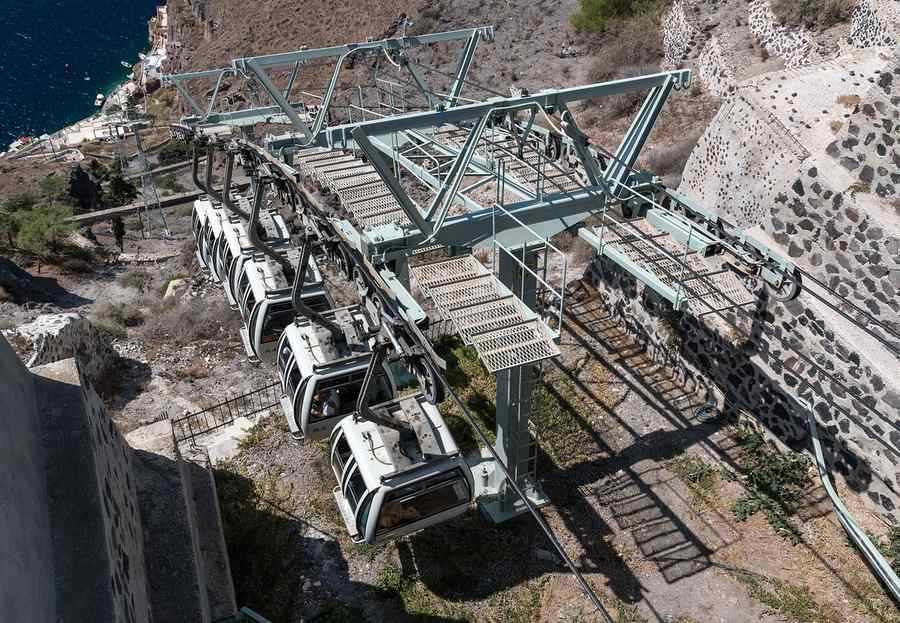
The Santorini cable car is the fastest and most scenic way between the Old Port and the capital Fira, gliding 220 metres up the caldera cliff in about three minutes. A one-way ticket costs around 10 euros, but queues build on cruise days. This guide covers the tickets, hours, the queues and the alternatives.
The cable car is an iconic ride and a practical link in the wider Santorini travel guide. It connects Fira with the sea below. The sections below cover the cable car.
What is the Santorini cable car?
The Santorini cable car links the Old Port at the base of the caldera cliff to Fira, 220 metres higher, in about three minutes. It is the fastest and most scenic way up, with views over the caldera, used mainly by cruise passengers.
The cable car is one of Santorini’s most useful and scenic rides. It links the Old Port, the small harbour directly below Fira where cruise tenders and small boats arrive, with the cliff-top capital above. The cabins rise 220 metres up the sheer caldera wall in just three minutes, giving sweeping views over the caldera, the volcano and the whitewashed town.
For arrivals by sea, the cable car is the obvious route up and down. Cruise passengers and day visitors reach the Old Port by tender, then ride the cabins straight to the heart of Fira. The system spares the steep climb on foot and connects the tavernas of the Old Port with the town’s shops and viewpoints, set within the wider Santorini cruise port. The tickets are simple.
The cable car was a gift to the island. It was funded by a shipowner’s foundation and handed to the local community, which still runs it. The cabins travel in linked pairs on a continuous cable, loading at each end in quick rotation. This steady flow is what lets the system move large numbers of cruise passengers up and down the cliff through a busy day.
How much does the Santorini cable car cost?
A one-way cable car ticket is about 10 euros for adults and 5 for children aged six to twelve, with under-sixes free. You buy separately for each direction, at the bottom or the top near the cathedral in Fira.
Riding the cable car is inexpensive and flexible. A one-way fare is roughly 10 euros for an adult and 5 for a child of six to twelve, with under-sixes travelling free. You buy separately for each direction, so a return trip means two single tickets. The fare covers the ride only, with no timed slot, so a ticket does not reserve a place in the queue.
Tickets are sold at both stations. The lower kiosk sits at the Old Port at the foot of the cliff, and the upper one stands in Fira town, close to the main Orthodox cathedral and the archaeological museum. You can also buy online in advance through the official site, which removes the purchase step at the kiosk, set out alongside the guide to Fira.
Payment is quick at either end. Cards and cash are both accepted at the kiosks, and the turnstiles read the ticket as you board. Because the fare is low and the ride short, the cable car is far cheaper than a taxi transfer up from the Old Port and faster than any walking route, which is why nearly every cruise visitor uses it at least one way.
What are the cable car hours?
The cable car runs daily, roughly from 6.30am to 11pm in peak summer, with the cabins operating through the day. Off-season the hours shorten, so the last ride comes earlier. Check the current timetable before a late-evening trip from the Old Port.
The cable car keeps long hours in the busy season. Through the summer the cabins run from roughly 6.30am to about 11pm, covering the arrival and departure of cruise ships as well as evening diners heading down to the Old Port tavernas. The service is continuous rather than scheduled, so cabins load and depart in a steady rotation whenever passengers are waiting.
Off-season the timetable contracts. In spring and autumn the cable car still runs daily, but the first and last rides move closer together, and the late-evening service ends earlier. Anyone planning to eat at the Old Port in the shoulder months should check the last ride up, or face the steep stepped path back, set out alongside the guide to a Santorini itinerary.
How long are the queues?
Queues for the cable car can stretch to 30 to 60 minutes when cruise ships are in port, typically between 9am and 4pm. Advance tickets save the purchase step but not the wait. Timing the ride to avoid the cruise rush is the key.
The cable car’s one drawback is the queue on busy days. When several cruise ships anchor in the caldera, the line can stretch to anywhere from 30 to 60 minutes in either direction. The pressure peaks between about 9am and 4pm, when cruise passengers come ashore in the morning and return to their ships in the afternoon. The queue at the Old Port before the last tender is the worst.
Advance tickets help less than travellers expect. Buying online removes the kiosk purchase, but it does not open a separate boarding lane, so you still join the same main line. The real fix is timing. Riding early, before the cruise crowds land, or in the late afternoon and evening after they re-embark, means little or no wait.
Checking the cruise schedule pays off. The port authority publishes which ships are due and when, so you can pick a quieter window or a day with fewer arrivals. Travellers staying on the island have the advantage here, since they can ride up or down outside the cruise peak, set out alongside the guide to the cruise port.
What are the alternatives to the cable car?
The alternatives are walking the steep path of 588 steps between the Old Port and Fira, or riding a donkey up, which is discouraged on welfare grounds. A common tip is to walk down the steps and take the cable car back up.
The cable car is not the only route up the cliff, though it is the easiest. The old donkey path of 588 steps zig-zags up between the Old Port and Fira. It can be walked, but the climb is steep and hot, the surface is shared with donkeys and often messy, and the route offers little shade. Grippy shoes are essential, and the ascent is hard work in summer heat.
Riding a donkey up is possible but discouraged. Animal-welfare campaigners have long criticised the practice, given the heat and the weight the animals carry, so many visitors now avoid it on principle. The steps and the cable car remain the humane choices for reaching Fira from the water.
A popular compromise splits the trip. Walk down the steps, enjoying the caldera views and saving the fare, then take the cable car back up to avoid both the tiring climb and the longest up-queue. Whichever route you choose, the views over the caldera reward the effort, set out alongside the guide to getting around Santorini.
Where does the cable car arrive in Fira?
The upper station sits on the caldera edge of Fira, a short walk from the main square, the cathedral and the shops. The lower station is at the Old Port, beside the tender dock and the harbour tavernas, linking the town with the sea.
The top station opens right onto Fira’s cliff path. Step out and the caldera view spreads west across the bay, with the pedestrian streets of Fira, its caf\u00e9s and its blue-domed churches only minutes away on foot. The bus station, the taxi rank and the road links to the rest of the island all lie within a short walk of the upper terminal.
The lower station serves the Old Port directly. It stands beside the tender dock where cruise boats land and the small harbour where day-cruise and volcano boats tie up. The Old Port’s fish tavernas line the same quay, so travellers can ride down, eat by the water and ride back up, set out alongside the guides to Santorini restaurants and the sunset.
Can you take luggage on the cable car?
You can take hand luggage and small cases on the cable car, and the cabins have room for a few bags. Large suitcases are awkward in the busy queue, so arriving passengers with big bags are better served by a taxi or transfer.
The cabins are built for people first. Each holds a small group of passengers with room for daypacks, camera bags and a case or two, and staff help load at busy times. Ferry and cruise travellers moving between the Old Port and Fira with light bags find the ride straightforward, quick and far easier than the stepped path.
Heavy luggage is a different matter. The queue, the turnstiles and the packed cabins make wrestling a large suitcase up the cliff hard work, especially at cruise peak. Travellers with full luggage usually reach their hotel from the airport or the main Athinios port instead, using a taxi or transfer, and keep the cable car for day trips down to the Old Port, set out alongside the guide to Santorini taxis.
What is the Old Port at the bottom?
The Old Port, or Fira Skala, is the small harbour below Fira at the foot of the caldera cliff. Cruise tenders land here, and volcano and sunset boats leave from the same quay. Fish tavernas line the water below the cable car.
The Old Port is the sea gateway to Fira. It is a narrow strip of quay wedged between the water and the cliff, reached only by the cable car, the stepped donkey path or a boat. Cruise ships anchor out in the caldera and ferry their passengers in by tender, so the port fills and empties with the ship schedule through the day.
The harbour is a destination in its own right. Small boats leave from here for the volcano islets, the hot springs and the sunset cruises, and the row of fish tavernas along the water draws diners down for lunch and dinner. Riding the cable car down for a meal by the sea, then back up afterwards, is one of the easiest treats in Fira, set out alongside the guide to the Santorini volcano.
Is the Santorini cable car worth it?
The cable car is worth it for the view and the time it saves. The three-minute ride up the caldera cliff is a highlight in itself, and it spares a steep climb of 588 steps. On cruise days, ride it outside the afternoon rush.
The ride earns its place on any Santorini visit. For the low fare, you gain a short, spectacular journey up the caldera wall, with the whole bay opening below the cabin. The alternative on foot is a long, steep climb in the heat, so the cable car saves both energy and time, leaving more of the day for Fira and the villages.
The value is greatest when you plan around the crowds. A cruise passenger who rides down early and back before the afternoon rush avoids the worst queues and still gets the view. Island guests can pick a quiet evening for a caldera-view dinner at the Old Port, riding down and up in minutes, set out alongside the guide to the Santorini sunset.
Families and older travellers gain the most. The stepped path is punishing in the heat, and the donkey ride is best avoided, so the cabin is the practical choice for anyone who would struggle with the climb. Parents with young children, in particular, find the quick, seated ride far easier than coaxing tired legs up hundreds of steps in the sun.
Frequently Asked Questions
How much is the Santorini cable car?
A one-way Santorini cable car ticket is around 10 euros for an adult and 5 for a child aged six to twelve, with under-sixes free, bought at each end. It links the Old Port with Fira 220 metres above in about three minutes, and runs daily from roughly 6.30am to 11pm in summer.
How long is the queue for the Santorini cable car?
The cable car queue can stretch to 30 to 60 minutes when cruise ships are in port, typically between 9am and 4pm. Riding early in the morning or in the late afternoon avoids the cruise rush, while online tickets save the purchase step but not the wait in the main line.
Is there an alternative to the Santorini cable car?
The alternatives are walking the steep zig-zag path of 588 steps between the Old Port and Fira, or riding a donkey up, which is not recommended on welfare grounds. A popular tip is to walk down the steps and take the cable car up to avoid the climb and the longest queue.
How long does the Santorini cable car take?
The cable car takes about three minutes to climb the 220 metres between the Old Port and Fira. The cabins run in a continuous rotation rather than to a timetable, so the wait to board depends on the queue, not the ride, which stays short even on the busiest cruise days.