
One call to 112 reaches ambulance, fire and police on Santorini, and the island’s main hospital is in Karterados, outside Fira.
A hike, a boat day and a quad ride each carry different risks, and the UK government travel advice for Greece treats them in separate sections. If Santorini is one of two or three stops, the Greece Tours homepage lists every other place we cover.
What do safety tips for Santorini tours cover?
Each tour day has its own risks. These safety tips for Santorini tours sort them by the kind of day you book. The UK government says no travel can be guaranteed safe. Santorini guides answer yes when they ask if the island is safe.
The safety tips for Santorini tours here draw on three kinds of source. The first is the UK government travel advice for Greece. The second is the Greek civil protection ministry page on the 112 emergency number. The third is a set of Santorini guides written by hotels and travel sites. Each fact names its type of source.
The first warning box on the UK page is about wildfires. It says there is a high risk of wildfires during the summer season from April to October. The page then says no travel can be guaranteed safe. This page builds its safety tips for Santorini tours on that advice.
The UK page sorts its advice into sections that match tour days. It has a section on swimming and water sports. It has one on quad bikes and mopeds, and one on hiking and exploring nature. Road travel and extreme weather each get a section too. The safety tips for Santorini tours below follow the same split.
The UK page also says what it cannot do. The FCDO, which writes the page, cannot give tailored advice for an individual trip. So the page asks you to do your own research before you decide whether to travel. Your own research can start with these safety tips for Santorini tours.
Crime gets a plain answer in the guides behind these safety tips for Santorini tours. One guide site says violent crime involving tourists is rare. A booking-site guide says the island has an impressively low crime rate and exceptionally rare violent incidents. A travel-safety site scores violent crime 2 on a 10-point scale, where 1 is very low risk.
The same site scores overall risk on Santorini at 3. It says serious crime is not the main concern. Everyday hassles and traffic risks are more common. It lists theft in crowds, extra charges, late-night bar risks and busy narrow roads as the main issues.
The same site says risk varies sharply by season. It also says detailed crime data for the island is limited compared with big cities. None of the pages used here gives a crime count for Santorini. These safety tips for Santorini tours report what the guides say.
A Fira hotel guide notes that the UK advice carries no warning that is specific to Santorini. It says the advice on earthquakes, wildfires and heat covers Greece as a whole and is the same everywhere. That is why this page adds island sources.
The same guide says travel advice changes. Check the date at the top of each page before you rely on it. The guide adds that local signs and closures always take priority over anything you read online.
Six kinds of tour day call for separate safety tips for Santorini tours. Four of them have a matching section on the UK page.
- A walk or hike on foot: the UK page has a section called “Hiking and exploring nature”.
- A boat trip or a swim: the UK page has a section called “Swimming and water sports safety”.
- A quad, ATV, jeep or scooter ride: the UK page has a section called “Quad (ATV) biking and mopeds”.
- A bike or e-bike ride: the UK page covers the road under “Transport risks”.
- A helicopter flight or a cable car ride: the UK page has no section on either.
- A wine or food tasting: the UK page has no section on tastings.
All six kinds of day run on the island of Santorini. The 112 number in the next section works on every one of them.
Which emergency numbers and health services belong in safety tips for Santorini tours?
Call 112 first. The UK page lists it for ambulance, fire and police. The Greek civil protection ministry says the call is free of charge. Keep 112 at the top of your safety tips for Santorini tours.
The ministry calls 112 an integrated communications service. A person in need can call it anywhere in Greece or the EU. When someone calls, all the agents who need to take part are told at the same time. The ministry adds that the caller’s location can be traced. Its video titles describe the line as open 24/7.
The UK government’s “Getting help” page lists 112 for ambulance, fire and police. It adds that a call to 999 from a UK mobile in Greece is transferred to the Greek emergency services. The UK health page tells readers to dial 112 or 166 and ask for an ambulance.
A Santorini guide site lists separate numbers: police 100, ambulance 166 and fire 199. A Santorini booking guide says 112 works from a fixed phone or a mobile. Neither that list nor the UK page gives a number for the coast guard or the tourist police.
A Santorini island guide lists landlines for the Thira police, the Oia police, the port authority and the fire brigade. Use these lines after 112, never instead of it, when you write your own safety tips for Santorini tours.
A tour group with an incident follows one order. Call 112, then call your travel provider and your insurer. The UK page gives both steps. It says to call 112 if an accident happens or you become lost. It says to contact your provider and insurer after a serious incident. They will tell you if they can help.
The UK page does not say what a tour operator must do after an incident. No page used here gives a response time for an ambulance on Santorini. These safety tips for Santorini tours cannot promise one. A travel-safety site says only that island emergency services can be stretched in high season.
The UK health page says treatment and facilities can be limited on the islands. It names a serious shortage of ambulances on a number of islands. It calls the public ambulance service basic.
A Santorini booking guide says the island has one main hospital. Santorini General Hospital is in Karterados, a little outside Fira. Its emergency department is on duty 24 hours a day, twelve months a year. Write its name in your safety tips for Santorini tours.
The same guide says a clinic in Fira has an emergency department that is open 24 hours a day. It adds that a sea ambulance and an air ambulance are available.
Another page on the same booking site lists health stations in Emporio, Kamari, Pyrgos and Oia, and on Therasia. Its safety page says a serious case can need a transfer to a hospital on the mainland.
The UK pages ask for insurance twice, so insurance belongs in safety tips for Santorini tours. The warnings page says your insurance needs to cover your itinerary, planned activities and expenses in an emergency. The health page names local treatment and unexpected medical evacuation. It says a GHIC or EHIC card is not an alternative to travel insurance.
The same page says you need a GHIC or EHIC to get medically necessary state healthcare in Greece. It warns that an uninsured traveller can be limited to public hospitals and primary healthcare centres.
It adds that on a number of islands, bar or airport staff can send you to private first aid centres. The public hospital is the other choice.
The UK health page also gives a rule for medicine. Bring prescription medicines with you and carry a letter from your doctor stating the quantity you need for your stay. Keep each medicine in its original container with the prescription label. Pack this with the other safety tips for Santorini tours before the first tour day.
How do safety tips for Santorini tours deal with heat and sun?
A travel guide wiki puts the UV index on Santorini at 9 or 10 all year and calls it extreme. Safety tips for Santorini tours start there: avoid the midday sun, carry water and cover your skin.
That wiki is Wikivoyage. It says SPF 50 sunscreen is a necessity, even under a T-shirt. It also warns that the cool sea breeze does not protect you, because the sun burns regardless. Put the cream on before the tour starts. That is the first rule in these safety tips for Santorini tours.
The wiki names the hours to avoid: 12:00 to 15:00. The UK National Health Service gives a wider window: avoid the sun between 11am and 3pm. The two sources differ by one hour. Treat 11:00 to 15:00 as the careful window on tour days.
Ask for the start time before you book. A morning start keeps you out of that window. These safety tips for Santorini tours all point the same way: the hours around noon belong in the shade.
The same wiki says that after late spring there are almost no trees to give shade. It says restaurants and other amenities close from noon to 15:00, the hottest hours of the day.
Shade and open cafes are both scarce at that hour. That shapes the safety tips for Santorini tours in the hot hours: carry your own water and a hat.
The UK government travel advice asks walkers for extra care in higher temperatures than they are used to. Your home climate sets your starting point, so the safety tips for Santorini tours differ from person to person.
The Wikipedia article on Santorini has a climate table. It lists record highs of 38.7 degrees Celsius in June, 39.4 in July and 38.6 in August. Those are the highest readings on record, not a forecast. They show why the safety tips for Santorini tours take summer heat seriously.
A Santorini cave-house hotel guide says the intense summer heat makes proper hydration essential. It warns that you can become dehydrated without realising it. It calls a water bottle carried at all times a simple but crucial precaution.
The wiki goes further: dehydration and sunburn together are the commonest health issue on the island. That is why the safety tips for Santorini tours keep returning to water. A Santorini hotel guide opens its sun and heat advice with the same order: carry water.
The UK National Health Service lists these signs of heat exhaustion:
- tiredness, dizziness and headache
- feeling sick or being sick
- heavy sweating with pale, clammy skin
- cramps in the arms, legs and stomach
- a high temperature, strong thirst and irritability
For heat exhaustion, the NHS says to move the person somewhere cool, give plenty of water and cool the skin. It gives 30 minutes as the time in which a person starts to feel better.
Heatstroke is different, and the NHS calls it a medical emergency. Its signs are hot skin without sweating, fast breathing, a fast heartbeat, confusion and loss of consciousness. Call emergency services at once. The NHS writes for UK readers, so use the local number. Learn these signs before the tour. They belong with the safety tips for Santorini tours.
The NHS names children, older people and anyone with diabetes or heart problems as more at risk. Check on them during a tour, and ask them how they feel when the group stops in the sun.
The NHS also advises light-coloured, loose clothing and more cold drinks when you are active. The cave-house hotel guide tells visitors to relax during the afternoon heat. Both lines fit the safety tips for Santorini tours.
A trip-planning site says dehydration and heatstroke are real risks. It recommends strong sunscreen and a wide-brimmed hat. Put the hat in your bag. That is the item this site adds to the safety tips for Santorini tours.
No page on safety tips for Santorini tours in this set gives a temperature at which a tour must stop. None gives a rule for how long a group can stand in the sun.
The Greek civil protection page on 112 describes alerts for natural disasters and dangerous situations. It does not name heat. Ask your tour provider about its rule for a very hot day.
For the month-by-month numbers, read the page on Santorini weather. The advice here stays with reasons, not averages.
What do safety tips for Santorini tours advise on steps, cliff edges and cobbled lanes?
Safety tips for Santorini tours begin with shoes that grip. The village paths are cobbled, stepped and close to drops. A travel guide wiki says the cliffside lanes are a poor place for heels. A visitor guide lists low walls and sudden drops.
A travel guide wiki says the village paths are paved largely with cobblestones, with steps at the cliffside. It names sneakers or comfortable walking shoes as the answer.
A cave-house hotel guide says the cobblestones are uneven. It adds that smooth stone walkways become hazardous without proper footwear. Shoes come first among safety tips for Santorini tours on foot.
A visitor guide lists the places that call for care. They are the caldera paths in Fira, Firostefani, Imerovigli and Oia, and Skaros Rock. It adds the steps to Ammoudi Bay and the Fira Old Port, and polished lanes after rain.
A trip-planning site calls the paths steep, narrow and slippery. These footing points are the base layer of safety tips for Santorini tours. They apply on a walking tour, on a food tour and on the way to a boat.
The wiki puts the path from Fira to the old port at 588 zigzagging steps. It describes the stairs as winding and narrow in parts, with only low walls.
It adds that donkeys use the same steps and make no attempt to avoid walkers. This path is where the safety tips for Santorini tours on steps get their hardest test.
The Wikipedia article on Fira says the town sits on the edge of a caldera that is 400 metres high. The wiki puts Fira 275 metres above its port.
The Wikipedia article on Santorini calls the inner coast a sheer precipice. The drop is more than 300 metres at its highest. The figures differ, so treat them as rough. All of them describe a long way down.
A cave-house hotel guide advises against donkey rides taken for fun in the intense summer heat. A travel agency page says to climb the steep steps on foot, not on an overworked animal. Both sources frame the ride as an animal welfare issue. No source in this set reports injuries to riders.
The Wikipedia article on Oia says 300 steps lead down to the port. It calls the main path cobbled and the other paths very narrow. It says they get congested in the tourist season. The safety tips for Santorini tours matter here, where the way to the harbour is both stepped and narrow.
A travel agency page describes the sunset crowd in the lanes. Hundreds jostle for one view, block the alleys and climb over each other. Stopping in a narrow lane adds to the jam.
A travel guide wiki says the cliffs and low walls that guard large drops are a danger to children. A visitor guide says the caldera villages demand close supervision of young children. Hold a child by the hand on any path that has a low wall.
A hotel guide says the caldera edge is a long drop and certain walls are low. A trip-planning site says the paths lack guardrails and tells walkers to be cautious near cliff edges. The edge of a path is where the safety tips for Santorini tours ask you to slow down.
The wiki says not to linger under cliffs, because they are prone to rockslides. A visitor guide says to stay away from cliff faces where loose rock can fall.
The wiki says to stay on the paths when you explore caves, because the tufa rock is unstable. A hotel guide gives the same order for the caldera: stay on marked paths. These are safety tips for Santorini tours that cost nothing.
A Santorini travel site advises staying in well-lit, busy places after dark, or walking with company. A visitor guide says roads between villages have no pavements, little street lighting and fast traffic. A tour that ends after sunset needs a plan for the walk back.
None of these pages gives injury numbers for the steps. None gives a legal height for a cliff wall. None sets a limit for the number of people a lane holds at sunset. Where a source is silent, the warnings above are all the safety tips for Santorini tours can offer.
Which safety tips for Santorini tours apply on boats and caldera cruises?
The UK government travel advice names three steps for water sports. Finish the paperwork, ask for a safety demonstration and learn how to call for help. Use them as safety tips for Santorini tours on a caldera cruise with a swim stop.
That advice is written for water sports centres, not for caldera cruises. No source used here gives safety tips for Santorini tours on a boat as one checklist. Each tip below comes from a separate source on life jackets, wind, sea or boarding.
A lifejacket heads every boat-day list of safety tips for Santorini tours. A Wikipedia article on drowning says it must fit well and be fastened properly. It names children who cannot swim, and others at risk, as the people who must wear one on a boat.
A Wikipedia article on life jackets says large vessels keep them for passengers to wear in an emergency. Ask the crew where they are stored before the boat leaves the port.
A Wikivoyage entry covers the boats between Fira, the Kameni islands and Thirassia. Their tickets show a vessel number, not a name. The same number is printed on the lifeboats. Check that the two match before you sit down.
Safe Water Sports is a non-profit group in Greece. The UK advice sends readers to its website for more advice. The site has pages for day-trip boats, motorboat rental, marinas, the coast guard and hospitals. Its motto has four steps: be informed, check, be careful, enjoy.
A Wikipedia article on the Hellenic Coast Guard lists search and rescue among its duties. The air force and the navy share that duty. The article also lists safety of navigation. The coast guard runs a sea rescue coordination centre at Piraeus.
Wind tests safety tips for Santorini tours afloat. A Wikipedia article on the etesian winds says they are also called the meltemi. It says they blow from late spring to about mid-September. They are strongest in the afternoon and can rise in clear weather without warning.
The article calls them dangerous to sailors. They can blow at force 7 to 8 on the Beaufort scale. The Beaufort table on Wikipedia puts force 7 at 50 to 61 kilometres an hour. At that force the sea heaps up and foam blows in streaks. Force 8 runs from 62 to 74 kilometres an hour.
The article adds that the large majority of inter-island ferries cannot sail in such wind. So the forecast belongs in safety tips for Santorini tours on any sea day.
The sources disagree on the season for these safety tips for Santorini tours. A travel-site article calls the summer wind tolerable and says it grows strong later in the year. The Wikipedia article and a hot springs guide place the strong wind in summer.
The hot springs guide names July and August. None of the three gives the wind force at which a caldera cruise stops. The travel-site article says to watch the weather forecasts.
Weather cancellations belong in safety tips for Santorini tours at sea. The hot springs guide says tour boats cancel swim stops when the sea is rough. A Wikivoyage entry says sea transport depends on the weather. It says cruise ships can delay or cancel landing shuttles, and ferries can change departure times.
Ferry bans show how the authorities act. A news report on one ban says port officials announced it ahead of the weather. The forecast was force 6 to 7, and force 8 in places across the Cyclades.
A second report says the Coast Guard told travellers to check with their ferry company for new departure times. On a ferry day, make that call part of your safety tips for Santorini tours.
Seasickness is also part of safety tips for Santorini tours on a boat. A Wikipedia article on motion sickness says going below decks is the greatest contributor to seasickness. People lose sight of the boat’s surroundings there. The article gives these measures:
- Stay on deck and look at the horizon.
- Keep your head still.
- Do not read while the boat moves.
- Breathe slowly. The article rates controlled breathing as the strongest distraction.
- Sleep well the night before. The article lists lack of sleep, and nicotine, as things that make it worse.
A Wikivoyage entry says larger boats have a bar. Drinks belong in safety tips for Santorini tours on a boat. The Wikipedia article on drowning says alcohol raises the risk, and more so at parties on boats. It says alcohol is involved in about half of fatal drownings. Plan the swim before the first drink.
Deck sun belongs in your safety tips for Santorini tours, not only sea sun. A Wikipedia article on sunburn lists reflective surfaces such as water among the causes. They reflect the sun’s rays and can cause sunburn. Cover your skin on deck, not only in the sea.
Boarding and leaving a boat also fall under safety tips for Santorini tours. Wikivoyage says White Beach has no pier. The only way in is to leave the boat and walk through waist-deep water.
The hot springs guide says swimmers use the tour boat’s ladder, since there are no steps or other ladders. It says the springs are not accessible for non-swimmers or guests with reduced mobility.
Which safety tips for Santorini tours apply to swimming, snorkelling and the hot springs?
The UK government travel advice says people drown in the sea in Greece every year. Its rules are short: learn the flag system, stay out under a red flag and never dive into unknown water. Add them to your safety tips for Santorini tours.
Hidden rocks or shallow water can cause serious injury or death, the UK page adds. Safety tips for Santorini tours with a swim need local knowledge where there are no lifeguards, flags or signs. On jellyfish the page says one thing: follow local advice.
The sources used for these safety tips for Santorini tours name no rule for jumping from a boat. The UK warning about unknown water is the closest one. Ask the crew where the water is deep before anyone jumps.
A Wikipedia article on drowning tells swimmers to be aware of waves, undertow, wind, dangerous animals and water temperature. It says rip currents can carry swimmers away with great force. A Santorini booking site says strong wind can roughen the water at Kamari Beach. It says to follow the lifeguards and the flags there.
Footwear is a plain part of safety tips for Santorini tours at the water’s edge. Wikivoyage says Santorini’s beaches are made of pebbles and that proper footwear is required. The booking site names water shoes for the rocky entry at White Beach and Red Beach. It also reports rockfalls at Red Beach and says to avoid sitting under the cliffs.
Hot sand also earns a line in safety tips for Santorini tours. A travel-site article says a number of visitors go home with serious burns and blisters on their feet. It links this to the pebbles, rocks and sand on the beaches.
The booking site says black sand holds heat and gets very hot at midday. Wear sandals or water shoes on the sand.
A Wikipedia article on sea urchins describes the injury as puncture wounds from brittle spines. It says the spines can be venomous or cause infection. It says breathing problems can signal a serious reaction. No source here says where urchins sit on Santorini’s coast. So shoes stay on your list of safety tips for Santorini tours.
A Wikipedia article on snorkelling names jet skis and speed boats as the greatest danger to snorkellers. A snorkeller can surface under a vessel. On a snorkel stop, safety tips for Santorini tours include a swim area away from boat traffic. The UK page says to book water activities only at a licensed water sports centre.
- Go with a buddy, a guide or a tour group, as the British Sub-Aqua Club recommends.
- Wear bright colours, or tow a float with a dive flag, so boats can see you.
- Do not breathe fast on purpose before you dive. It can cause shallow water blackout.
- Drink water first. The article names dehydration as a concern.
- Check the mask seal. A snorkel tucked under the strap can make the mask leak.
- Cover your back, ankles and thighs. The article says they can burn badly even when slightly under water.
A hot springs guide lists safety tips for Santorini tours that stop at the Palea Kameni springs. It says the springs sit in open sea, with no shore access, no lifeguard and no managed facility. Strong swimming ability in open water is required.
Boats anchor outside Agios Nikolaos Bay, and swimmers drop into the sea. The guide puts each swim at 2 to 5 minutes each way. It says to swim only from a properly anchored boat. It says to stay within sight of the boat and the crew and follow their instructions on timing and distance.
On the island itself, the sources give different safety tips for Santorini tours. Wikipedia says the lack of a good harbour keeps the large majority of recreational boats away. It adds that tourists can swim to the island from Nea Kameni. The hot springs guide says the opposite: do not swim ashore. Follow the crew.
The sources also split on the water. Wikipedia says the thermal water is commonly warmer than the sea by a small number of degrees. The guide gives 30 to 35 degrees Celsius for the source.
The guide gives 18 to 22 degrees for the sea in spring and autumn. In high summer it says the sea approaches 25 degrees. No source gives a reading for a given day.
The guide says dissolved iron oxide and sulphur colour the water rust orange. It says the water can stain light swimwear and silver jewellery for good. It tells swimmers to wear dark swimwear and take off valuables before entering. It says not to use soap or sunscreen in the thermal patch.
A Wikipedia article on sunburn says to apply sunscreen 15 to 30 minutes before exposure. It says to apply it again after swimming. So put it on at the port, before the boat leaves, and again after you leave the water. Timing like this keeps the thermal patch clear of it.
The Santorini hot springs page on this site explains how a visit works. Read it next to these safety tips for Santorini tours, and ask the crew about the stop before you book.
The volcano stop has its own safety tips for Santorini tours. Wikipedia says Nea Kameni is a protected scientific site that scientists watch closely. It says dozens of tourist boats visit it each summer day. Visitors climb a gravel path to the 130-metre crater rim. A full circuit of the rim is possible.
A Greek islands guide describes the walk to the crater as 20 minutes. A visitor review on the same site calls the hike strenuous because of the hot sun. The reviewer says to limit your luggage and carried only water.
Wikipedia names an active sulphur vent on the island. Wikivoyage says the steam and sulphur vents can be watched on the way, from a safe distance. A hotel guide calls the steaming vents and yellow sulphur normal for an active volcano.
No source used here gives the heat of the ground or the vents. None marks a safe distance in metres. These safety tips for Santorini tours stop where the sources stop: stay on the path and with the guide.
Which safety tips for Santorini tours cover quads, ATVs, jeeps and scooters?
The UK government travel advice says people suffer serious injury and even death in quad bike accidents every year. It asks every rider to get full instructions and training first. These safety tips for Santorini tours begin with that warning, then move to licences, helmets and insurance.
The same UK page warns riders with no practice. A quad rider shares the road with larger and faster vehicles, so the page says to proceed with caution. A Santorini hotel guide is blunter: the island is not the place to learn to ride a quad.
A travel safety site lists road accidents on scooters, ATVs and narrow roads among the risks for visitors. It tells people not to rent a scooter or an ATV unless they are experienced and properly equipped. The safety tips for Santorini tours that use a rented machine start with an honest look at your riding record.
Any list of safety tips for Santorini tours puts the licence near the top. According to the UK page, a provisional licence is not valid in Greece for driving or hiring any vehicle. A moped needs a licence of at least category A1, the light motorcycle class.
Category P, valid in the UK for mopeds up to 50cc, is not valid in Greece, the page adds. Check the class printed on your licence against the class the rental desk asks for.
On quad licences, the sources behind these safety tips for Santorini tours disagree. A quad rental site says the licence class depends on how the quad is registered. It also lists quads that take a car licence. The UK page names no quad class. The rental site advises confirming the exact class with the rental company before booking.
The permit is the least settled of the safety tips for Santorini tours. A UK photocard licence works in Greece, says the UK page. A paper licence can need a photocard update or a permit as well. Wikivoyage recommends a permit. A travel magazine page says the police ask for one at a stop or after an accident.
Among the safety tips for Santorini tours, the helmet is the clearest rule. The UK page says drivers and passengers must wear helmets on quad bikes and mopeds. Riding without one can void the insurance. Police who stop a rider will fine the rider and take the licence. The rental site calls helmets compulsory for every rider and passenger.
Wikivoyage only recommends a helmet for ATVs. The UK page says must, and the rental site says compulsory. Follow the stricter wording. Treat the helmet as a legal duty and not as a choice.
Insurance needs its own check among the safety tips for Santorini tours. Quad biking counts as an extreme sport, says the UK page. A large number of policies exclude it, so riders need specific travel insurance. The page also says the insurance sold by the hire company is third-party cover as a rule.
The same page warns of charges for damage to the rental vehicle. It says non-payment can lead to arrest. The quad rental site adds that insurance almost never covers dirt tracks or off-road riding, so it advises paved roads. Wikivoyage calls the name all-terrain misleading, because ATVs on the island are largely limited to roads.
The roads add their own risks to the safety tips for Santorini tours. Drivers across Greece regularly ignore speed limits, including in built-up areas, says the UK page. A travel magazine page describes streets too narrow for two vehicles. It also lists scarce street lights and stop signs, and potholes across the island.
Locals ride mopeds, scooters and bicycles on those streets. The travel magazine page asks visitors to give them space and not to speed. It calls a cab the safer and less stressful choice than the traffic. Wikivoyage calls the road conditions unsafe. Its reason: visitors on the island drive by the rules and habits of nearly every country.
A Santorini travel company page lists speeding, unsafe overtaking and reckless driving as quick routes to an accident. It asks drivers to allow extra time. The quad rental site gives 50 km/h in villages and up to 90 km/h on the open road. It adds that the terrain rarely lets a rider reach that speed.
No page fetched for these safety tips for Santorini tours gives a separate rule for a jeep tour. The nearest official lines are for hire cars. The UK page says hire companies set stricter terms. It names a year of driving experience, a higher minimum age and an international driving permit.
One more UK line matters on a day with a stop at a winery. Drink-driving is a serious offence in Greece. The travel safety site also links late-night drinking and scooter use to higher risk. The Santorini quad and ATV rental guide on this site covers the rental steps and the routes in detail.
What safety tips for Santorini tours matter on hikes and e-bike rides?
The caldera path from Fira to Oia is 10 to 11 km long, according to the guides and Wikivoyage. These safety tips for Santorini tours cover its timing, its loose ground and its route finding, then e-bike rides. The sources disagree on the time, the markers and the water stops.
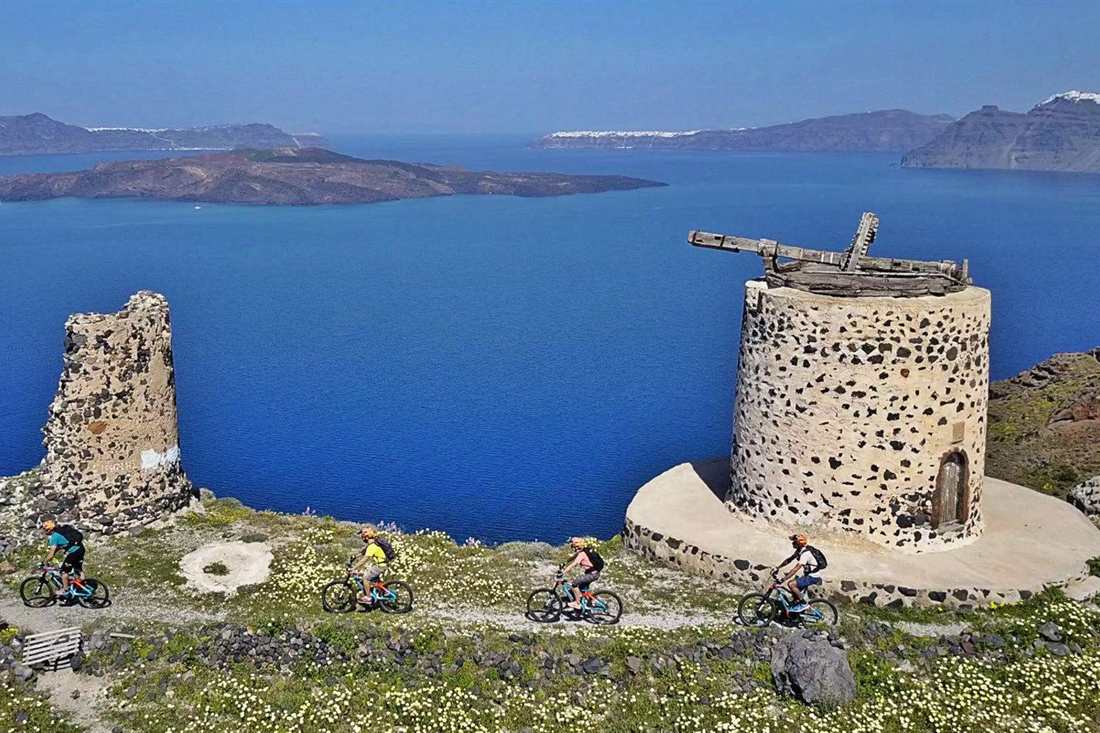
The sources behind these safety tips for Santorini tours disagree on the time. Wikivoyage’s Fira page gives both 2.5 hours and about 3 hours for the same path. Three guides give 2 to 5, 2.5 to 5 and 3 to 5 hours. Every range tops out at 5 hours. A group with photo stops needs the long end.
A travel blog splits the path in two. The first half, up to Imerovigli, is largely paved or cobbled. After Imerovigli the paved path ends. Loose volcanic rock and dirt take over, with steep climbs and descents and no shade. The blog says this stretch catches people off guard and calls proper walking shoes necessary there.
A second blog gives an elevation gain of 326 m. It describes a dusty gravel trail, with loose lava stone and pebbles in places that need more attention. Wikivoyage puts the climb from Fira at over 300 m and considers the reverse direction easier. The second blog says the ups and downs balance out either way.
The sources also disagree on markers, a point that bites hardest on a self-guided walk. Wikivoyage calls the path well-marked, with signs to Oia. The second blog calls it largely signposted. The first blog calls Imerovigli a maze with scarce markers. It took a wrong turn more than once.
The first blog adds that Google Maps tends to route walkers inland, away from the caldera. It advises an offline map, downloaded before the walk. The UK page lists a map, a GPS and a fully charged phone as options. Self-guided walkers can treat that list as the baseline for safety tips for Santorini tours.
Planning steps for any Greek hike sit on the UK page, and these safety tips for Santorini tours reuse them.
- Plan the route beforehand and weigh the distance and difficulty against your limits.
- Wear footwear that suits uneven ground.
- Avoid hiking alone if you can, and tell someone the route.
- Check that insurance covers mountain rescue and helicopter evacuation.
Water and food come next in a hiker’s version of these safety tips for Santorini tours. The first blog says to carry 2 litres of water at minimum. It calls the stretch through Firostefani the last easy place to refill. The second blog lists snack, drink and lunch stops along the trail. Cafes can close outside the season.
Start times for a hike come from three sources. The first blog says to leave Fira by 7 am in summer. By 10 am the trail is fully exposed and the villages fill with day-trippers. A hotel guide calls the walk lovely in the cool part of the day, not at noon.
The first blog adds that late afternoon works too. Daylight is short in the shoulder season.
Two side trips need extra caution under these safety tips for Santorini tours. The first blog says the right-hand path through the Skaros Rock ruins is technically closed for safety reasons. The second blog says the Skaros detour can be unsafe in strong wind.
A travel magazine page adds that falling rocks and crumbling trails injure tourists every year. It advises asking local guides before choosing a route.
The path meets the road once. The second blog says the route leaves the trail for a short stretch of road before it rejoins the trail. The UK page says drivers do not always stop at crossings, even where they are supposed to. Cross with care. The Santorini hiking guide on this site covers the other trails.
For e-bike rides, the safety tips for Santorini tours start from a weaker base. Wikivoyage calls Santorini not at all bicycle-friendly. The island has no dedicated bicycle lanes, so riders share the road with vehicle traffic. The terrain is very hilly. Wikivoyage warns that hiker trails are impassable by bicycle in general, so an e-bike belongs on the road.
A Santorini tour company page describes narrow and winding roads and congested summer traffic.
A review site describes one guided e-bike tour. It lists a helmet, a bike lesson and a group of up to 6. That tour sets a weight limit of 100 kg and a minimum height of 160 cm. It does not recommend the tour for riders over 70.
No fetched page gives a battery range, a brake check or phone signal data for Santorini e-bike rides or hikes. That gap matters for safety tips for Santorini tours. Ask the operator about the battery and the brakes before the ride starts. The second blog advises a phone and a battery pack on the hike.
Do safety tips for Santorini tours change for helicopter flights, the cable car and viewpoints?
A helicopter operator seats each guest by weight and balance. The cable car moves 1,200 people an hour. At a viewpoint, the railing is the line to respect. Operator listings, Wikipedia and visitor guides supply these safety tips for Santorini tours.
One listing for a sunset helicopter flight from Fira sets the limits that matter here. It names two aircraft. The smaller one has a maximum total weight of 340 kg with three passengers and a pilot. The larger one has 410 kg with four passengers and a pilot.
Flights are shared, so the weights of all passengers add up against that limit. The listing tells guests who think they are near it to contact the instructor. Do that before the day, not at check-in. Treat the weight limit as a hard rule among the safety tips for Santorini tours.
Seating follows weight and balance, so guests cannot pick a seat. A valid ID is needed to board, and every minor must fly with an adult. The listing includes headphones and a life jacket. At check-in, safety tips for Santorini tours turn into paperwork.
Operator pages disagree on small children. One listing lets infants from 0 to 2 years old sit on a parent’s lap. A travel-booking guide says the minimum age on its helicopter tours is three. Ask your own operator, because the safety tips for Santorini tours cannot settle the gap.
The booking guide also bans flammable and sharp objects from the cabin. The sunset-flight listing allows a water bottle but no other food or drinks, to protect the interior. Pack only what the operator allows.
- Arrive at the meeting point at least 30 minutes before take-off.
- Carry a valid ID, and bring a physical copy.
- Wear comfortable clothing and comfortable shoes.
- Choose dark clothing for photos without window reflections.
Weather changes the flight. The listing says the route and length depend on conditions and can shrink for safety. It promises a free reschedule or refund if bad weather cancels the flight. It does not recommend the flight for pregnant or disabled people. Add that warning to your group’s safety tips for Santorini tours.
No source here gives a safety record for helicopter flights over the island. The safety tips for Santorini tours cannot rank that risk. None gives a wind speed at which flights stop. The UK government travel advice says insurance needs to cover planned activities. No source says whether a standard policy covers a sightseeing flight.
Routes, aircraft and flight times sit on the Santorini helicopter tour page. These safety tips for Santorini tours stay with the rules on board.
The cable car links the Old Port to Fira. The operator’s page says the ride up takes three minutes, and Wikipedia gives three to five minutes. Both give a capacity of 1,200 passengers an hour. Wikipedia adds that each gondola carries six passengers.
At the cable car, the safety tips for Santorini tours are about time. A cruise-news guide says queue length varies with ship count, wind and maintenance. It warns against treating the ride as endless spare capacity when the stairs are closed. A visitor guide says lines at peak times can stretch beyond an hour.
A Greek news report shows what a closed path does. After a landslide blocked the footpath to the Old Port, more visitors used the cable car. The report describes long queues and severe overcrowding. Build slack into any tour that ends with the ride.
No source fetched here gives the wind speed that stops the cable car. Wind appears only as one cause of changing queues. On a windy day, ask the staff at the station before you plan the day around the ride. No source can replace that check, whatever safety tips for Santorini tours you follow.
The operator’s page says the cable car was built to Austrian regulations. Wikipedia says it adheres to Austrian safety standards and splits the capacity into 600 people per direction. No source fetched here gives an inspection record or a list of past closures.
The alternatives have limits too. Wikipedia puts the walk up the steps at one to one and a half hours. A visitor guide says donkeys help people who cannot manage the climb. It says a water taxi to the new port or Ammoudi Bay bypasses long queues.
A hotel guide calls the caldera edge a long drop and says walls are low in places. Its advice is plain: stay on marked paths and do not climb over railings for a photo. Follow it at every stop of a tour day.
A travel-safety site says heavy crowding at the Oia sunset viewpoints brings jostling and accidental falls near edges. A visitor guide says to take extra care near cliff edges at sunset, when areas become crowded. Wikipedia calls Oia’s paths very narrow and says the tourist season brings congestion.
Rooftops and terraces are not viewpoints. A tour company’s guide says these spaces can be part of someone’s home. It tells visitors to look for signs and barriers. These safety tips for Santorini tours treat a sign or a barrier as the end of the public path.
Drones need more care than a phone. The official Drone Aware GR system, built by the Hellenic Aviation Service Provider, shows flight limits and takes flight requests. A drone-law guide bans flights over people, populated areas, roads and car parks.
The same guide gives 8 km as the distance to keep from airports. It calls the zones on the DAGR map decisive. A Santorini tour company’s guide lists crowded viewpoints and sensitive parts of Oia as no-fly zones. It warns of heavy fines and seized equipment.
No official source fetched here names those Oia zones. Check the DAGR map and the posted signs. The tour company’s guide says to keep the drone grounded if flying cannot be confirmed as permitted. Follow that rule among the safety tips for Santorini tours.
Why do wine and food days need their own safety tips for Santorini tours?
Alcohol and the road home decide a tasting day. Greece sets the driver limit at 0.5 g/l of blood. One standard drink adds 0.2 to 0.3 g/l on average. These safety tips for Santorini tours put the ride home first.
A Greek spirits-industry federation sets out the limits behind these safety tips for Santorini tours. It gives 0.5 g/l by blood sampling and says a breath test halves that figure. A European road-safety group lists 0.2 g/l for novice and professional drivers. The UK government travel advice calls drink-driving a serious offence in Greece.
Plan the ride before the first glass. The spirits federation tells drinkers to decide ahead who drives or to take a cab. A wine-tour listing includes hotel pickup and drop-off, which settles the question. Choose a tour like that when you follow the safety tips for Santorini tours.
The same listing warns that pickups happen at the closest accessible point, because parts of Santorini sit on a slope. Walk to that point in sturdy shoes. A travel-safety site says to pre-book rides and not to expect a taxi after midnight in peak season.
A standard drink in the federation’s guide is 100 ml of wine at about 12 percent. Wikipedia gives an average of 13.5 percent for wines of Assyrtiko, the island’s flagship grape. That sits above the guide’s example, so count your glasses.
The federation says food slows alcohol’s absorption but cannot speed up its removal. It says coffee does not sober you up. It tells drinkers to alternate alcohol with water, which also helps the body avoid dehydration. Those safety tips for Santorini tours cost nothing.
Wikipedia says it is not considered rude to spit wine out at a winery. Add spitting to your safety tips for Santorini tours on a wine day. A spittoon is normally provided, and it is polite to ask where to spit before the tasting starts. The same article says 20 to 25 samples can still cause intoxication.
A wine-tour listing offers 12 tastings across three wineries. It serves snacks of local cheese and cold cuts and states that this is not a full lunch or dinner. No source fetched here gives the pour size, so the safety tips for Santorini tours stay general on quantity.
The UK government travel advice says it is illegal to sell or provide alcohol to anyone under 18. It tells visitors to expect age checks at points of sale. The wine-tour listing sets a minimum age of 18 and asks guests to bring a valid ID.
That listing calls the tour adults only because of alcohol and cites Greek law for minors. No source fetched here says whether a Santorini winery lets children visit without tasting. Ask the winery first. Families can read the safety tips for Santorini tours that cover children in the sections below.
The European Commission says EU rules require allergen information for food that is not prepacked, including in restaurants and cafes. No source fetched here says how this applies to a cooking class or a winery plate. Tell the host about an allergy before you eat.
A Santorini booking-site guide calls food poisoning a rare event. It adds that cooked food is sold in restaurants and street bars, not by street vendors. Sit-down meals follow the safety tips for Santorini tours on this point.
Sources split on tap water. A tour company’s guide calls it not suitable for drinking and says the island relies largely on desalinated seawater. A holiday guide says tap water is safe for washing and brushing teeth. It adds that a large number of visitors prefer bottled water for drinking.
A third guide says the island has no natural source of drinking water. It says 50 percent of homes are not connected to any water system. It recommends bottled water for drinking. Carry bottled water on every wine and food tour, as the safety tips for Santorini tours advise.
Wikipedia says Santorini’s vines are trained low in basket shapes. This protects the grapes from the fierce winds and heat of the island. Wikipedia also gives the climate as hot semi-arid. A wine-tour listing asks for comfortable walking shoes at the vineyards. No source fetched here says how warm a cave cellar is.
Late at night around clubs and bars, the UK government travel advice tells groups to watch each other’s drinks. The aim is to stop drinks being spiked. It says not to give a drunk person more alcohol. It adds that Greek police arrest people for rowdy or indecent behaviour, especially where excessive drinking is involved.
A travel-safety site says to take extra care on caldera paths and steps after dark or after drinking. It says not to walk unlit roadside stretches after drinking. The Santorini wineries page covers the estates. These safety tips for Santorini tours cover the day around them.
How do earthquakes, the volcano and wildfire alerts change a Santorini tour day?
A hazard can change a tour day quickly. For safety tips for Santorini tours, start with a phone that can receive warnings. The UK government travel advice says Greece can have earthquakes, wildfires, extreme heat and flash floods.
The UK page tells visitors to allow emergency alerts on the phone. The alerts come from the Greek government’s Emergency Communication Service and follow the location of the phone. So the phone must stay with you all day. On an iPhone, the page points to Settings, Notifications, then Emergency Alerts.
The Greek civil protection site for 112 describes the same service. 112 does more than take calls. It can warn citizens about a natural disaster or a dangerous situation. The message carries directions and instructions. Switching alerts on takes a minute. It is the base step for safety tips for Santorini tours that deal with hazards.
The Greek civil protection ministry gave the earthquake steps below, and a Santorini hotel guide quotes them. They form the quake part of safety tips for Santorini tours.
- Take cover under sturdy furniture, such as a table, and hold on to it.
- Do not go out on the balcony.
- When the shaking stops, leave by the stairs, not the lift.
- Head for an open, safe space.
The UK page adds that mysafetyplan.gov.gr shows the nearest assembly points. The map has text in Greek. The page also suggests a grab bag with passports, phones and chargers, bank cards, insurance papers and essential medicine.
The earthquake swarm is recorded in a Wikipedia article on Santorini, which says it ended in late February. The shocks came mainly from a cluster between Santorini, Anafi, Amorgos, Ios and the uninhabited islet of Anydros. The hotel guide says they centred east of Anydros, not under the villages.
The same article lists what the authorities did. They restricted access to areas near cliffs because of landslide risk. They restricted shorelines and certain ports, the old port included, because of tsunami risk.
Fira set up gathering points. The state of emergency ended on 3 March. That is how an alert reaches the safety tips for Santorini tours: a closed cliff path or harbour.
Sources disagree on the numbers, so these safety tips for Santorini tours give each figure. One Wikipedia article says about 9,000 people left an island of 15,500. A second says 11,000 were evacuated.
The hotel guide, citing a UNESCO body and the BBC, says more than 11,000 had left by 6 February. For the strongest shock, one article gives Mw 5.3 and the guide gives ML 5.2.
The hotel guide also reports a ministry decision on access, taken from a news report. Fira Old Port, the cable car and the steps are open, except for one marked zone of the port. The coastal path from Ammoudi to Cape Agios Nikolaos is closed. The measures can change if seismic or weather activity is strong.
Local signs take priority over anything you read online, the guide says. That includes these safety tips for Santorini tours.
The Santorini volcano is dormant but remains active, a Wikipedia article on the caldera says. Its last eruption came in nineteen fifty, and only gas vents are active now. A Wikipedia article on Nea Kameni adds that scientists from a monitoring institute watch the island closely. It calls the island a protected scientific site.
The hotel guide says the Greek ministry limits volcanic risk to Santorini, Nisyros and tens of kilometres around them. During the swarm, experts called the shocks tectonic, not volcanic. Later analysis pointed to the potential involvement of a deep intrusion of magma, the Santorini article says.
A small swarm followed, with shocks mostly below magnitude 3. The caldera article says the magma stayed more than 8 km underground. The swarm ended about three months after it began. For the volcano, the safety tips for Santorini tours rest on three facts: monitoring, a small swarm and deep magma.
On fire, the safety tips for Santorini tours start with the UK page. It puts the high wildfire risk between April and October. The New Zealand government page lists forest fires among the summer risks. It says to follow the instructions of local authorities.
The UK page adds that the situation can change quickly. Causing a wildfire is a crime in Greece, even by accident. Near a fire, follow the emergency services and call 112 if you are in immediate danger. Do not light barbecues, leave no litter, especially glass, and put out cigarettes fully.
No page that loaded says how a tour operator cancels a tour after an alert. None describes wildfire smoke, or wildfire road closures, on Santorini.
On cancelled travel, the UK page says: for refunds or changes to travel, contact your travel provider. Ask the operator what it does after an alert before you book. On that point, the safety tips for Santorini tours depend on the operator.
Which safety tips for Santorini tours reduce the risk of scams and theft?
Theft happens in crowds, and scams happen where a price or a ticket is unclear. Two government pages and five travel guides give the safety tips for Santorini tours below. None of them gives theft figures for tour days.
The UK government travel advice says thefts of passports, wallets and handbags are common in crowded tourist places. It singles out central Athens. The New Zealand government page says petty crime such as pickpocketing is common in Greece, and assault can happen. Neither page names Santorini, so the safety tips for Santorini tours here rest on the guides.
A Santorini tour-booking guide calls the crime rate low and violent incidents exceptionally rare. It still tells visitors to mind their belongings in crowded areas. A travel-safety site names where pickpocketing and bag theft can happen: Fira, Oia, bus stations, beaches and sunset crowds. The safety tips for Santorini tours about bags apply in those places.
Keep valuables zipped away during sunset crowds in Oia and Fira, the travel-safety site says. Do not leave bags or phones alone on beaches or café terraces. It calls the Fira bus station a tight space where bags are easier to target at peak hours.
The UK page adds two rules: split your valuables, and keep a copy of your passport photo page somewhere safe. For a parked vehicle, keep valuables out of sight, lock it and park in a well-lit area. The travel-safety site says not to leave valuables visible in rental cars or scooters.
A scam guide for Greece as a whole supplies the ticket checks among safety tips for Santorini tours. It warns about fake ticket sellers outside big attractions. They offer discounted or skip-the-line tickets that are counterfeit. It says fake ferry tickets are sold near the docks. Buy from official ticket offices, authorised resellers or the official website, it advises.
The travel-safety site lists tour add-on fees as a scam pattern. A cheap boat or excursion offer grows once transfers, drinks, equipment or port fees are added. Its advice is to ask for a written breakdown of what is included before paying. It also says to confirm the price of taxis, transfers and tours before agreeing.
Receipts count among safety tips for Santorini tours too. The UK page says restaurants must give an itemised bill by law. It tells visitors to get a receipt for any goods or services they buy. A tour booking is a service, so the advice covers it.
A community scam guide advises paying by credit card, because a card gives chargeback leverage when a service is disputed. That site is a reader-reports site, not an official source. Read its claims as reports, not as proof.
The same guide reports self-described photographers at Oia’s sunset spots. It says they quote a low price, raise it after the shoot and send photos with a watermark. It rates this scam as low risk.
Its fix covers photoshoot days. Among safety tips for Santorini tours, it says to book before the trip and avoid offers at the sunset peak. It also says to sign a contract with the price, the number of photographs and the file resolution.
The same guide says recruiters at the Athinios ferry port shout that their shuttle is the public bus. It reports the same at the Fira cruise tender drop-off. It advises checking routes and prices with the public bus operator before arrival. On transport, the travel-safety site adds a tip for tours: use official or well-reviewed providers.
The Greece scam guide also describes a friendly stranger who leads visitors to a bar with an exorbitant bill. Its advice is to be cautious of overly friendly strangers who offer unsolicited help. It names a second trick: someone throws white paste on you, then offers to clean it while a pickpocket works.
A traveller-review roundup tells visitors to read the price list beside a restaurant door before accepting an invitation inside.
No page that loaded counts fake-ticket cases or explains how to check a street seller’s licence on the spot. The travel-safety site says crime data for the island as a whole is limited.
The UK page points to separate guidance for victims of crime abroad and gives no steps itself. Those are the gaps in the safety tips for Santorini tours on scams and theft.
Which safety tips for Santorini tours suit families, older travellers and cruise passengers?
Each group needs its own safety tips for Santorini tours. Families plan around cliff edges, steps and traffic. Walkers plan around the stairs at the Old Port and on the island. Cruise passengers plan around the tender boat and the last departure time.
A travel safety website sums up the family risks in one sentence. Its main concerns on Santorini are cliff edges, crowded steps, heat and traffic, not crime. Parents can judge safety tips for Santorini tours against that list before they book.
The same website tells families to use child-safe transport rather than rent scooters or ATVs. Wikivoyage names an age rule for hotels. It says certain caldera hotels do not accept children under 13, because of the cliff location. That is a hotel rule, not a tour rule.
No source read for this guide gives a minimum age for a Santorini tour. None gives a car seat rule for a tour van. These safety tips for Santorini tours leave both gaps open. The UK government disability guide says to confirm bookings in writing. The same step works for a child’s age limit.
Beach choices and a family base sit in the Santorini with kids guide. This page stays on tour days. Parents can use it as a booking checklist.
Walkers and older travellers start with the steps. The safety section of Wikivoyage says the elderly can have problems with the steps. A Santorini booking site adds that the Old Port is closed to every vehicle. Its cable car station sits at the northern end of the dock.
Reaching that station means a climb up steps, the same site says, and boarding means more steep steps. Anyone who cannot manage stairs needs to ask the operator how a tour handles them. No source read for this guide gives a step-free route.
The UK government guide on disability and travel abroad says facilities can differ from those in the UK. For safety tips for Santorini tours, that means telling each travel provider, tour operators included, about your needs. A place can also lack accessible taxis, so the guide says to book one in advance.
Age can change a policy. The UK government insurance guide lists age restrictions, particularly on annual policies. It points to guidance for travellers over 65. Older walkers need this check as much as sturdy shoes.
The UK health page adds a point about medicines. Heat, later nights and a new diet can change how medication works. That matters on a long walking tour in summer. Older walkers can add it to their safety tips for Santorini tours.
Cruise passengers face a different chain, so their safety tips for Santorini tours start at the water. A Wikipedia article on Santorini says the ships anchor off Skala, which is the Old Port. Local boatmen carry passengers ashore. Fira is then reached by cable car, on foot or by donkeys and mules.
A Santorini booking site’s cruise guide counts two ports, Athinios and the Old Port of Fira. It says both are too small for a ship to dock, so every passenger needs a tender. Everyone returns to the ship from the Old Port, even after a bus tour that began at Athinios.
On a ship day, the clock sets the safety tips for Santorini tours. The cruise guide gives an exact rule for a volcano tour from the Old Port. The ship must arrive at least an hour before the tour starts and leave an hour after it ends. The last tender departs an hour before the ship.
For a catamaran or yacht cruise, the guide asks for a wider margin. It says the ship must arrive a couple of hours before the tour and leave 2.5 hours after it ends. Its reasons are an hour to reach the cable car and a queue of half an hour or so.
Sources disagree on the queue. The cruise guide says half an hour or so. A booking site’s port guide says five ships arriving together can stretch the trip to Fira to 2 hours. No source gives a fixed wait, so safety tips for Santorini tours here set no number. Plan the ship day with the widest figure.
The cruise guide also names meeting points. A private bus tour meets at the top of the cable car. A private cruise meets either at the top of the cable car or at the Old Port. Ask the operator which one applies.
Buses add a delay of their own. A travel safety website says to expect delays at bus stops during cruise and sunset peaks. The cruise guide says the Oia bus runs every 30 minutes in peak season. A ship day to Oia therefore needs three legs: tender, cable car and bus.
A tour company’s blog says transfers and queues eat a large part of a short ship visit. A tender takes passengers to the Old Port, then the cable car lifts them up. The chain runs in reverse for the return. Safety tips for Santorini tours on a ship day start from that chain, not from the sights.
The UK government disability guide adds one step to safety tips for Santorini tours for ship passengers with mobility needs. A travel agent or tour operator can advise, it says. A direct call to the cruise liner confirms the details.
Ship passengers get one more line from the UK government insurance guide. It says cruise policies tend to ask for an additional level of cover, because reaching a hospital is harder. It tells passengers to check the operator’s booking conditions. Tours for ship days sit in the Santorini shore excursion guide.
What do travellers ask about safety tips for Santorini tours?
Travellers ask six things: solo trips, insurance, strikes, health conditions, what to carry and who helps in an emergency. Each answer gives the safety tips for Santorini tours that a source states. Where no source gives a rule, the answer says so.
Is Santorini safe for solo travellers on tours?
A Santorini booking site calls solo travel safe, including for women. A travel safety website names intoxicated behaviour late at night and transport after dark as the main issues. The UK government asks solo travellers to leave an itinerary with someone at home.
Do safety tips for Santorini tours include travel insurance?
Yes. The UK government insurance guide says to buy cover as soon as you book the trip. It adds that sports and adventure tourism can need specialist cover or an add-on. Read the exclusion clauses for each activity.
Does insurance cover a tour day lost to a strike?
The UK government warns of strikes, called at short notice, that disrupt ferries, buses and flights. Its insurance guide says a policy can exclude strike claims, especially strikes public before you booked. Add a strike check to these safety tips for Santorini tours.
Can I take a tour with a health condition?
The UK government insurance guide says to declare existing conditions, pending treatment and pending tests. A missing declaration can invalidate the policy. For a serious condition, it points to specialist insurers listed by a broker association.
What do I carry on every tour day?
The UK government says to carry your passport, because the police can refuse a copy. Its insurance guide says to take your policy number and your insurer’s emergency helpline number. These two items belong in the safety tips for Santorini tours.
Who can help if something goes wrong on a tour day?
For British travellers, the safety tips for Santorini tours include the nearest British embassy or consulate. The UK government disability guide lists help with a local doctor, interpreters, English-speaking lawyers and the local authorities. It gives no response time.