
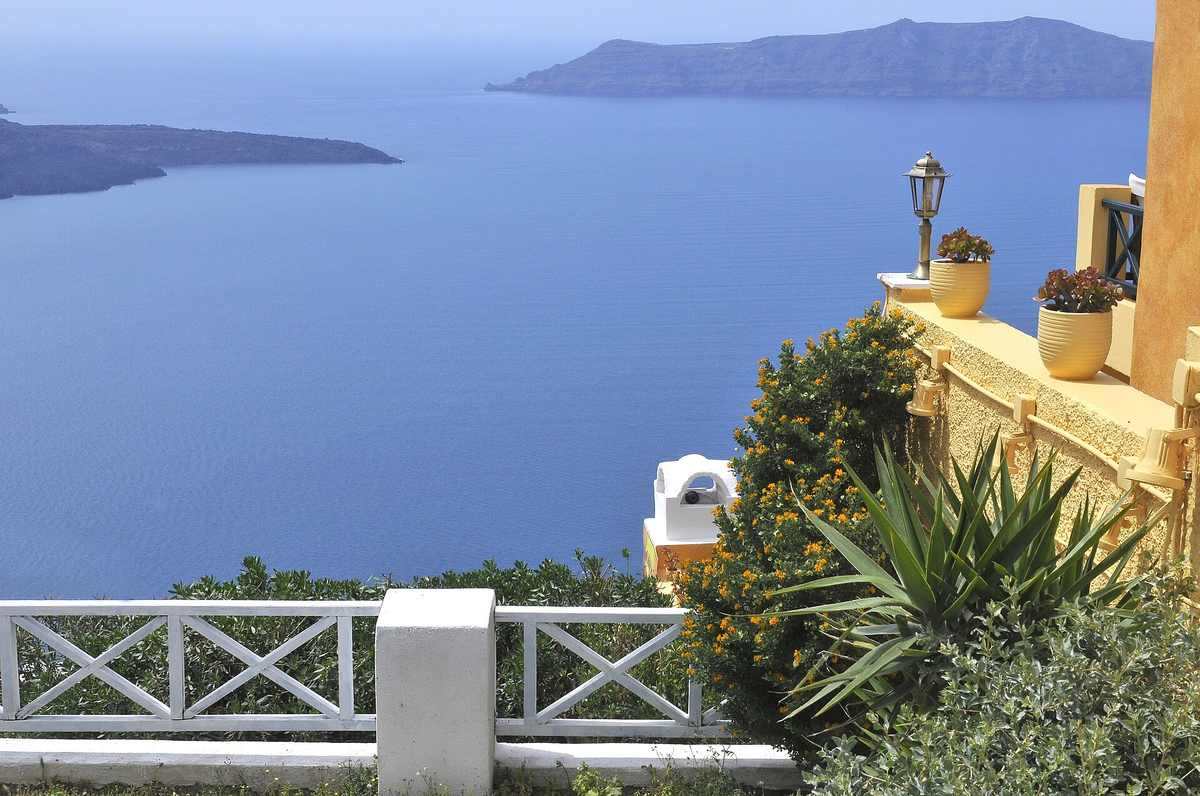
Santorini weather follows a Mediterranean pattern: hot, dry, sunny summers from June to September and mild, occasionally rainy winters from November to February, with the wind blowing year round. The spring and autumn shoulders are warm and pleasant. This guide covers the climate, the temperatures, the sea, the rainfall and the best time to visit.
Knowing the weather shapes when to visit in the wider Santorini travel guide. The seasons differ sharply. The sections below cover the weather.
What is the climate like in Santorini?
Santorini has a dry Mediterranean climate with hot, sunny summers and mild, breezy winters. Rain falls almost entirely between November and February, while May to September stays largely dry. The island is windy all year and cooled in summer by the meltemi wind.
Santorini’s climate is classic Mediterranean, with two clear faces. Summers from June to September are hot, arid and reliably sunny, with day after day of clear skies and barely a drop of rain. Winters from November to February are long, cool and mostly mild, with the island’s modest annual rainfall of around 350 to 400 millimetres concentrated in these months. A defining feature is the wind. Santorini is breezy throughout the year, and in high summer the northerly meltemi wind blows strongly, tempering the heat but occasionally disrupting ferries. Sunshine is generous, especially from late spring to early autumn, set within the wider best time to visit Santorini. Summer is hot and dry.
The contrast between the two halves of the year is the key thing to grasp. A summer visitor plans around unbroken sun and heat, packing for the beach and the caldera walk. A winter visitor plans around cool, changeable days and the chance of rain, trading the crowds for a quiet island. The wind runs through both, so a windproof layer earns its place in every suitcase. These EAV traits, hot dry summer, mild wet winter, year-round wind and low total rainfall, define the island’s weather and drive every seasonal decision below.
How hot is summer in Santorini?
Summer in Santorini is hot, with July and August the warmest at highs around 28 to 29 degrees Celsius, sometimes more, and warm nights. June and September are a little cooler and very comfortable. Rain is virtually unheard of.
The summer months deliver dependable heat. July and August are the hottest, with daytime highs around 28 to 29 degrees, occasionally pushing higher in heatwaves, and balmy evenings that stay warm well into the night, ideal for late dinners and sunsets. June and September sit a touch cooler and are widely counted the sweet spot, hot enough for the beach but easier for sightseeing and walking. Rainfall in these months is essentially nil, so you plan around constant sunshine. The strong northerly meltemi wind, most noticeable in July and August, makes the dry heat far more comfortable than the figures suggest, set out alongside the guide to the Santorini sunset. The sea warms through the season.
The heat is a dry heat, which changes how it feels on the ground. Low humidity and the near-constant breeze keep the air from feeling oppressive even when the thermometer climbs, so 29 degrees on Santorini sits easier than the same figure in a still, humid city. The trade-off is strong sun. Shade is scarce on the exposed caldera path and on open beaches, and the reflected light off white walls and pale volcanic sand is intense. Midday hours in July and August call for planning: sightseeing early or late, a long lunch or a beach umbrella at noon, and steady water intake through the day.
When is the sea warm enough to swim?
The sea around Santorini is comfortably warm for swimming from June to October, peaking at around 24 to 25 degrees Celsius in August and September. It is cool in spring, swimmable from late May, and stays mild into late October before cooling through winter.
Sea temperature lags a little behind the air. The water is at its coolest in winter and early spring, warming gradually so that by late May it becomes swimmable for the hardier, and from June through to October it is comfortably warm for everyone. The peak comes in August and September, when the sea reaches around 24 to 25 degrees, having soaked up the summer heat, which is why early autumn offers some of the best swimming of the year. The water stays pleasantly mild into late October before cooling through November, so the realistic swimming season runs roughly June to October. Outside that, the sea is too cold for most visitors, set out alongside the guides to Santorini beaches and Perissa beach. The shoulder seasons are mild.
The sea’s slow response to the calendar rewards autumn swimmers. Air temperatures ease off through September and October, yet the water is still holding the warmth banked over June, July and August. That is why a late-September swim often beats a June one, even though June air feels warmer. The black volcanic sand at Perissa and Kamari amplifies the effect, absorbing heat and radiating it back over the shallows. A short qualitative summary of the swim season:
- June to October: comfortably warm for everyone.
- Late May: swimmable for the hardier.
- August and September: warmest, around 24 to 25 degrees.
- November to April: too cold for most visitors.
What is the weather like in spring and autumn?
Spring, from April to May, and autumn, in September and October, bring warm, pleasant days, fewer crowds and lower prices. Temperatures climb comfortably into the 20s, the skies are largely clear, and the sea is swimmable by late May and into October.
The shoulder months are Santorini at its best for many travellers. From the second half of April the weather warms noticeably, and May brings pleasant, sunny days in the low-to-mid 20s with the wildflowers still out and the island far quieter than in peak summer. Autumn mirrors this, with September still genuinely summery and October mild and agreeable, the sea at its warmest from the long summer, and the crowds and prices both easing.
Rain becomes a little likelier from late October, but for most of the spring and autumn the days are warm, bright and ideal for hiking, sightseeing and beaches without the July and August intensity, set out alongside the guide to a Santorini itinerary. The month-by-month sections below break the year down further.
What is the weather like in winter in Santorini?
Winter in Santorini, from December to February, is cool, mild and windy, with the year’s heaviest rain and the quietest streets. Days stay changeable rather than cold, the sea is too cool to swim, and many hotels and tavernas close.
Winter is the wet, quiet counterpoint to the summer sun. December, January and February carry the bulk of the island’s 350 to 400 millimetres of annual rain, arriving in spells rather than as steady downpours, with bright, breezy days in between. Temperatures stay mild by northern-European standards, cool rather than cold, though the ever-present wind sharpens the feel of it on the exposed caldera rim. The sea is at its coldest and swimming is off the table for most visitors. Crowds vanish, prices fall, and the island turns inward: some cliff-side hotels, tours and tavernas shut down until spring, so a winter trip trades choice and warmth for solitude and low prices.
Winter suits a specific traveller. The empty caldera path, the quiet villages of Oia and Fira, and the dramatic light after a rain squall reward anyone who wants Santorini without the peak-season press. The trade-offs are real: shorter, cooler days, a chance of a washout, reduced ferry frequency in rough weather, and a thinner choice of open businesses. Packing shifts accordingly, toward warm layers, a proper waterproof and a windproof shell rather than swimwear and sun hats.
What is the weather like in Santorini in spring?
Spring in Santorini, from March to May, warms steadily from cool and green to reliably sunny. March stays breezy, April turns pleasant with wildflowers out, and May brings warm days in the mid-20s and a swimmable sea late in the month.
Spring is the island waking up. March is still a winter-shoulder month, cool, windy and prone to showers, but with lengthening days and green hillsides after the winter rain. April marks the real turn: the weather warms noticeably, rain grows rare, and the countryside is at its most colourful with wildflowers across the volcanic slopes. May carries the momentum, delivering warm, sunny days in the low-to-mid 20s, largely clear skies, and a sea that becomes swimmable for the hardier by the end of the month. Crowds are still modest and prices lower than peak, which is why late spring ranks among the finest windows of the year, tied to the best time to visit Santorini.
The spring arc means the month matters more than the season label. An early-March trip and a late-May trip sit at opposite ends of the same season: one packs for cool, wet, windy days and the other for warm sun and a first swim. April is the pivot, dry enough for confident sightseeing and green enough for the scenery, with the caldera walk at its most rewarding before the summer heat sets in.
What is the weather like in Santorini in autumn?
Autumn in Santorini runs warm and inviting through September and October, then cools into November. September stays summery, October is mild with the sea still warm from summer, and November brings falling temperatures and the first heavier rain as winter approaches.
Autumn is summer’s long, gentle exit. September is barely distinguishable from high summer: hot, dry, sunny days, warm nights and a sea at its yearly peak of around 24 to 25 degrees, but with the July and August crowds thinning out. October stays mild and agreeable, the days shortening yet the sea holding its summer warmth well into the month, which makes it one of the best swimming windows of the year. Rain grows a little likelier from late October, and November tips the balance toward winter, cooling steadily with the first real spells of wet, windy weather. For warmth without the peak-season crush, early autumn stands with late spring as a prime choice, linked to the Santorini itinerary.
How much sunshine does Santorini get?
Santorini enjoys long, generous sunshine, especially from late spring to early autumn. Summer days deliver near-unbroken clear skies with barely a cloud from June to September, while winter still offers plenty of bright spells between the rain.
Sunshine is one of the island’s signatures. From late spring the skies clear and stay that way, so the stretch from June to September is a run of long, sunny days with clear blue overhead and negligible cloud, the reason the caldera sunsets over Oia draw crowds every evening. Spring and autumn keep generous sunshine too, with April, May, September and October offering warm, bright days broken only occasionally by cloud. Even winter, the cloudiest season, delivers plenty of clear, bright spells between the rain squalls, so the island is rarely grey for long. The strong summer sun and reflected glare off white buildings and pale sand make sun protection important across the warm half of the year, tied to the Santorini sunset.
How windy is Santorini?
Santorini is breezy throughout the year, and in high summer the northerly meltemi wind blows strongly, peaking in July and August. The wind cools the heat, disrupts ferries, and leaves exposed north-facing beaches choppy while sheltered Perissa and Kamari stay calmer.
Wind is a constant on Santorini, not a footnote. The island sits open to the Aegean, so a breeze blows in every season, and in high summer the meltemi, a dry northerly wind, blows strongly from July into August. That wind is a mixed blessing. It cools the fierce summer heat and keeps the air fresh, yet on its windiest days it whips up the sea, occasionally disrupts ferry schedules, and makes exposed, north-facing shores choppy and gusty. Beach choice follows the wind. The long south-east coast beaches of Perissa and Kamari sit more sheltered from the northerly flow and stay calmer, while open north-facing spots take the brunt of the meltemi, set alongside the guide to Santorini beaches.
Planning around the wind pays off. On a strong meltemi day, a ferry crossing can turn rough or slip its schedule, so building slack into travel days around the peak of summer is sensible. On the beach front, choosing a sheltered south-east bay over an exposed cove turns a gusty, sand-blown afternoon into a calm swim. A windproof layer earns its place in the bag in every season, not only in winter.
What should you pack for Santorini’s weather?
Pack for strong sun and steady wind above all. Summer calls for high-factor sunscreen, a hat, sunglasses and light clothing, plus a windproof layer for breezy evenings. Winter and the shoulders add warm layers and a light rain jacket for the wetter, cooler days.
The packing list tracks the season, but two items belong in every bag: sun protection and a windproof layer. For a summer trip from June to September, the emphasis falls on beating the sun and heat, so high-factor sunscreen, a wide-brimmed hat, sunglasses and light, breathable clothing lead the list, with a light jacket or wrap for the breezy evenings and the meltemi. For spring and autumn, the same sun protection still matters, joined by warmer layers for cooler mornings and evenings and a light rain layer for the odd shower. For a winter trip, the balance tips toward warmth and waterproofing, with proper layers, a windproof shell and a rain jacket for the wettest, windiest months.
- Every season: sunscreen, sunglasses, and a windproof layer.
- Summer: hat, light clothing, swimwear, beach shoes for volcanic sand.
- Spring and autumn: warm layer for evenings, light rain jacket.
- Winter: warm layers, waterproof jacket, closed shoes.
When is the best month to visit Santorini for weather?
The best months for weather are May, June, September and early October, the shoulders around summer. They combine warm, sunny, largely dry days with a swimmable sea, thinner crowds and lower prices than the peak of July and August.
The best weather window balances warmth against crowds and wind. July and August bring guaranteed heat and sun, but also the peak crowds, the highest prices and the strongest meltemi. The shoulders solve the trade-off: May and June on the way up, and September and early October on the way down, deliver warm, sunny, largely dry days with a swimmable sea, yet with fewer visitors and gentler prices. June and September in particular hit the sweet spot, hot enough for the beach but comfortable for the caldera walk and the villages. For the full breakdown of seasons, festivals and pricing, see the guide to the best time to visit Santorini. The questions below cover the points travellers ask most.
Frequently Asked Questions
What is the weather like in Santorini?
Santorini has a dry Mediterranean climate with hot, sunny summers from June to September, highs around 28 to 29 degrees in July and August, and mild, breezy winters with most rain from November to February. The island is windy year round, cooled in summer by the meltemi.
When is the sea warmest in Santorini?
The sea around Santorini is warmest in August and September, at around 24 to 25 degrees Celsius, and comfortably swimmable from June to October. It becomes swimmable from late May and stays mild into late October, then cools through the winter, when swimming is too cold for most.
What months are best to avoid crowds in Santorini?
The spring months of April and May and the autumn months of late September and October avoid the worst crowds while keeping warm, pleasant weather. These shoulder seasons bring fewer visitors, lower prices and a swimmable sea, which makes them a favourite time to visit for many travellers.
Does it rain much in Santorini?
Santorini is a dry island, with annual rainfall of only around 350 to 400 millimetres, almost all of it falling between November and February. The summer months from June to September stay virtually rainless, so a summer trip plans around constant sunshine rather than any chance of rain.
What is the meltemi wind in Santorini?
The meltemi is a dry northerly wind that blows strongly across the Aegean in high summer, peaking in July and August. On Santorini it cools the summer heat and freshens the air, but on its strongest days it whips up the sea, can disrupt ferries, and leaves exposed north-facing beaches choppy.
Is Santorini warm enough to visit in winter?
Santorini in winter is cool and mild rather than cold, but it is the wettest, windiest and quietest season, with the sea too cold to swim and many caldera hotels and tavernas closed. A winter trip trades warmth and choice for solitude, low prices and green, dramatic scenery.