
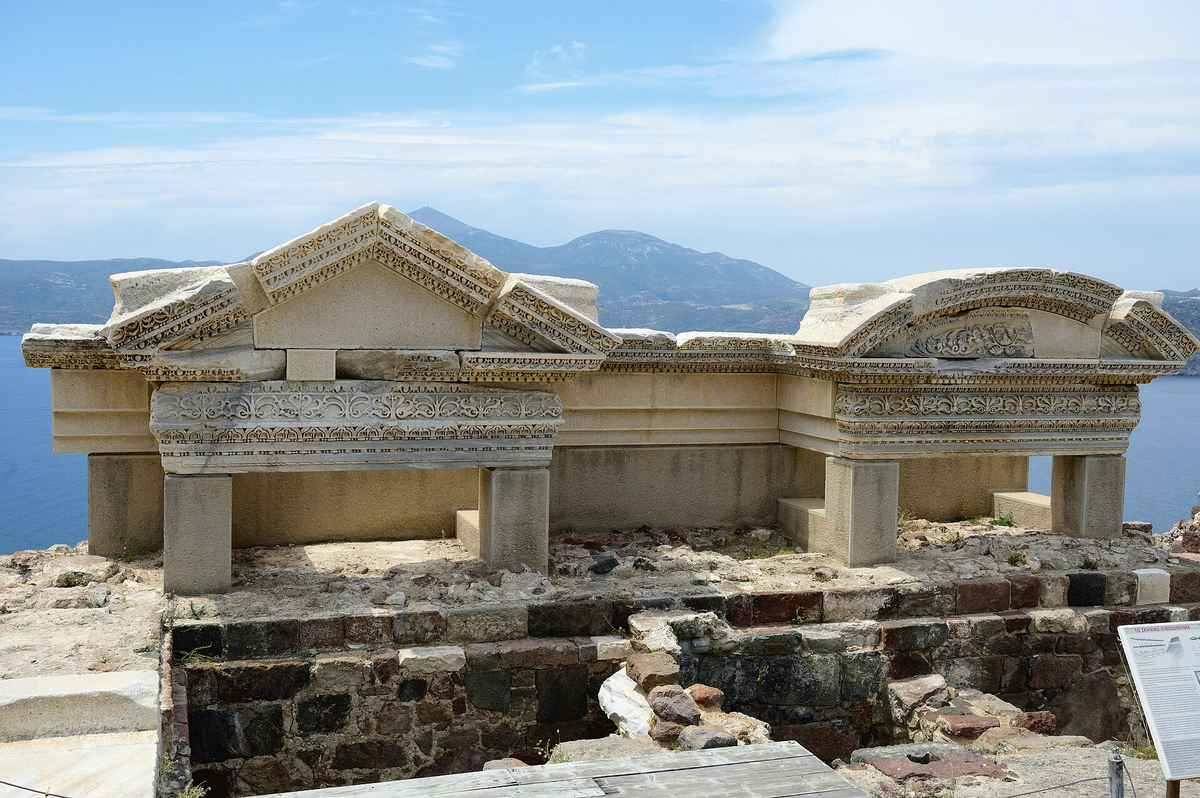
Set above the village of Trypiti, this ancient marble theatre has seven surviving rows of Parian marble and sweeping views over Milos Bay. Plan visits to the sites and book tickets through My Greece Tours.
The theatre is a highlight of the historic heart of the Milos travel guide. The sections below cover what the theatre is, how old it is, what survives today, how to visit, and the sights that surround it.
What is the Roman theatre of Milos?
The Roman theatre of Milos is an ancient marble theatre near the village of Trypiti. It stands on a hillside facing Milos Bay, built of Parian marble, and once seated around 7,000 spectators.
The theatre crowns a hill above the coast. It sits near Trypiti on the slope that drops toward Klima and the gulf of Milos. The setting gave the audience a wide view of the sea as they watched the stage. The position remains one of the finest on the island.
The structure was built to impress. Roman builders raised it from the renowned white Parian marble of the Cyclades. At its height the theatre held an audience of about 7,000 people. Its scale marked Milos as a place of wealth and culture in the ancient world.
The acoustics still work. The curved bowl of seats carries sound clearly from the orchestra to the back rows. Visitors test the effect with a clap or a spoken word from the stage. The theatre ranks among the most rewarding stops on a things to do in Milos list. The next section covers its age.
The hillside setting lifts the whole monument. The marble seats curve into the slope above Klima and the gulf. Spectators once watched the stage with the open sea behind it. The white rows catch the morning sun and the evening glow. Pine and scrub frame the ruin on every side. The position links the theatre to the ancient city that spread across these slopes. Few ancient sites in Greece pair such ruins with such a view. The combination of marble, hillside and sea makes the theatre of Milos a place to linger, not just a quick photo stop.
How old is the ancient theatre of Milos?
The theatre dates back over two thousand years. It began in the Hellenistic age, around the third century BC, then Roman builders rebuilt it larger on the same spot using Parian marble after the earlier city was destroyed.
The first theatre rose in Hellenistic times. Builders cut it into the hillside around the third century BC, in the Greek classical tradition. That original structure served the ancient city that spread across these slopes above the bay.
The Romans rebuilt on the ruins. After the old city fell in the Roman period, a grander theatre took its place on the same ground. The new builders used white Parian marble and expanded the seating to hold around 7,000 people. The marble shell you see today dates from that rebuild.
The site drew early archaeologists. Excavation work began in the early nineteenth century, led by a German architect named Carl Haller von Hallerstein. His digs uncovered the marble seats and the stage area. That work started the long study of the monument that continues to this day. The next section covers what survives.
The two-stage history gives the theatre its depth. Builders first cut a Hellenistic theatre into the slope around the third century BC. That early structure served the Greek city of the classical age. After the city fell in the Roman period, a grander theatre rose on the ruins. Roman builders used white Parian marble and widened the seating to hold 7,000. The marble shell that survives dates from that rebuild. Early excavations in the nineteenth century uncovered the seats and stage. That layered past, Greek beneath Roman, makes the theatre a rich record of the ancient story of Milos.
The layered history makes the theatre a record in stone. The Greek city cut the first theatre into this slope in Hellenistic times. Rome rebuilt it grander after the old city fell. The white Parian marble came from the quarries of nearby Paros. Each phase left its mark on the seats and the stage. Archaeologists have read that sequence from the excavated rows. The site sits among the ruins of the ancient capital of Milos. Walking the marble, you stand where audiences sat over two thousand years ago. That depth of time, set against the open sea, gives the theatre its lasting power.
What survives at the theatre of Milos today?
Seven marble rows of seats survive at the theatre of Milos, along with the orchestra and parts of the stage. The excavated section is remarkably well preserved and has been carefully restored for modern use.
The marble seating is the centrepiece. Seven rows of white Parian marble curve around the orchestra, the round performance floor at the heart of the theatre. The rows are smooth and intact enough to sit on. They give a vivid sense of the original auditorium.
The stage area adds to the picture. Parts of the stage building and the orchestra have survived and been restored. Together they show how the performance space worked. Careful conservation has stabilised the marble without overbuilding the ruin.
The theatre still hosts events. Its current capacity is around 700 people, a tenth of the ancient figure, yet it remains fully usable. Musical and theatrical performances take place here in summer, reviving the building’s original purpose. Few ancient sites on Milos feel so alive. The next section covers how to visit.
The surviving fabric rewards a close look. Seven rows of white Parian marble curve around the round orchestra floor. The smooth seats are intact enough to sit on today. Parts of the stage building stand behind the performance space. Careful conservation has steadied the marble without overbuilding the ruin. The acoustics still carry a voice from the orchestra to the back row. Visitors test the effect with a clap or a spoken line. The blend of preservation and atmosphere brings the ancient theatre to life. It remains one of the most evocative monuments on the whole island of Milos.
Where is the Roman theatre and how do you visit?
The Roman theatre sits about 1 kilometre from Trypiti and 1.1 kilometres from Plaka. You reach it in a 4-minute drive or a 15-minute walk, and a 700-metre path links it to the catacombs of Milos.
The theatre lies in the historic cluster above Klima. It stands roughly 1 kilometre from the village of Trypiti, a 4-minute drive or a 15-minute walk away. The capital Plaka sits 1.1 kilometres off, a 5-minute drive. A short paved approach leads to the site.
Walking ties the sights together. A 700-metre path connects the theatre with the early Christian catacombs just down the road. The level walk lets you see both in one easy outing. The route also passes the spot where the Venus de Milo was found.
Entry is straightforward. The site sits open in the hillside with parking nearby. Morning and late afternoon bring softer light and cooler air for the visit. The sea views over Milos Bay reward a slow look from the marble rows. The final section covers the nearby sights.
The access and timing make a visit easy. The theatre sits about 1 kilometre from Trypiti and 1.1 kilometres from Plaka. A 4-minute drive or a 15-minute walk reaches the site, with parking nearby. Morning and late afternoon bring softer light and cooler air. The open hillside has no ticket gate, so you can wander the rows freely. A level 700-metre path links the theatre to the catacombs. The same route passes the spot where the Venus de Milo was found. That short, walkable cluster lets you see three major sites in one easy outing.
What is near the ancient theatre of Milos?
Near the theatre lie the catacombs of Milos, the spot where the Venus de Milo statue was found, and the villages of Trypiti and Plaka. The whole cluster sits within a short walk above Klima.
The catacombs are the closest sight. A 700-metre path leads from the theatre to the early Christian catacombs of Milos, a network of carved tombs from the first centuries AD. The two ancient sites pair naturally in one visit.
The Venus discovery site sits between them. A sign marks the field near the theatre where a farmer unearthed the Venus de Milo, the marble statue now in the Louvre. It is a quiet but moving spot for lovers of ancient art.
The villages crown the hill. The whitewashed lanes and windmills of Trypiti rise just above, with cafes and views over the bay. From there a steep path drops to the colourful fishing village of Klima below. The historic core of Milos packs all this into a small, walkable area.
The theatre anchors the ancient heart of Milos. The early Christian catacombs lie a short walk downhill. The discovery site of the Venus de Milo sits between the two. The whitewashed village of Trypiti and its windmills rise just above. From there a steep path drops to the colourful fishing village of Klima. The whole historic core packs into a small, walkable area. A half-day links the theatre, the catacombs, the Venus site and the villages. For lovers of history, this corner of Milos offers more depth than any beach on the island.
The theatre crowns a compact cluster of ancient sites. The early Christian catacombs lie a short walk downhill. The discovery spot of the Venus de Milo sits between the two. The whitewashed village of Trypiti and its windmills rise just above. A steep path then drops to the fishing village of Klima below. A half-day links the theatre, the catacombs, the Venus site and the villages. The walkable layout packs the ancient heart of the island into one outing. For lovers of history, this corner offers more depth than any single beach on Milos, all within a short, scenic stretch.
Frequently Asked Questions
How old is the Roman theatre of Milos?
The theatre of Milos is over two thousand years old. It began in the Hellenistic age, around the third century BC, in the Greek classical tradition. After the earlier city fell in the Roman period, builders raised a larger theatre on the same hillside using white Parian marble, able to seat about 7,000 people. The marble shell that survives today dates from that Roman rebuild.
Can you still see performances at the ancient theatre of Milos?
Yes. The ancient theatre of Milos remains fully usable and hosts musical and theatrical performances in summer. Its current capacity is around 700 people, a tenth of the ancient figure of 7,000, after careful restoration of the seven surviving marble rows, the orchestra and parts of the stage. Catching an evening event under the open sky, with the bay below, is a memorable way to experience the monument.
How do you get to the Roman theatre of Milos?
The Roman theatre sits about 1 kilometre from the village of Trypiti and 1.1 kilometres from Plaka, the capital of Milos. You reach it in a 4-minute drive or a 15-minute walk, with parking nearby. A level 700-metre path also links the theatre to the early Christian catacombs and passes the spot where the Venus de Milo was found, so you can see all three sites in one easy outing.