
One of the most famous statues in the world, the Venus de Milo was found on Milos and now stands in the Louvre. Explore the island’s heritage with tours and tickets from My Greece Tours.
The Venus de Milo is the island’s claim to world fame in the Milos travel guide. The sections below cover what the statue is, its discovery on Milos, its date and artistry, how it reached the Louvre, and the spot on the island linked to it.
What is the Venus de Milo?
The Venus de Milo, also called the Aphrodite of Milos, is an ancient Greek marble statue of the goddess Aphrodite. Found on the island of Milos and now one of the most famous sculptures in the world.
Carved from Parian marble and standing over two metres tall, it is celebrated for its graceful beauty and its missing arms. Created in the Hellenistic period, it has been displayed in the Louvre Museum in Paris since 1821, where it draws millions of visitors and gives Milos lasting renown. The Venus de Milo, known in Greek as the Aphrodite of Milos, is one of the most famous and admired works of art in the entire world. It takes its name from the island where it was discovered. For Milos, this single statue is a source of enduring international fame, far out of proportion to the island’s small size.
The sculpture depicts Aphrodite, the ancient Greek goddess of love and beauty, carved from fine Parian marble and standing larger than life at over two metres tall. It is celebrated above all for its serene grace, its idealised beauty and the elegant twist of its pose, and. Famously, for its missing arms, lost at certain point in its long history, which have only added to its mystique. Created in the Hellenistic era of Greek art, the statue has been one of the star attractions of the Louvre Museum in Paris since the early nineteenth century. Where it stands among the most visited and reproduced works of classical sculpture, admired by millions.
That this masterpiece emerged from the soil of Milos is the island’s proudest historical claim, and the story of its discovery is as remarkable as the statue itself. The questions below cover what visitors ask most.
How was the Venus de Milo discovered on Milos?
The Venus de Milo was discovered on Milos in 1820, when a local farmer, Yorgos Kentrotas. Unearthed fragments of the marble statue while clearing a field near the ancient site of Klima and Trypiti.
A young French naval officer and amateur archaeologist, Olivier Voutier, who was exploring the island, saw the find and encouraged further digging. Together they uncovered more pieces, including the lower part. The statue was found broken into sections, in the area where the ancient city of Milos once stood. The discovery of the Venus de Milo is a story of chance that unfolded on the island in the spring of 1820. It can still be connected to a specific spot on Milos today. A local farmer named Yorgos Kentrotas was clearing and working a field on the hillside near the villages of Klima and Trypiti.
In the area where the ancient city of Milos once stood, when he unearthed fragments of marble statuary buried in the ground.
By coincidence, a young French naval officer and keen amateur archaeologist, Olivier Voutier. Was exploring the island that very day and noticed the farmer uncovering the upper part of a sculpture. Intrigued, Voutier encouraged Kentrotas to keep digging, and together they unearthed further fragments, including the lower part of the statue and other pieces, gradually revealing the figure of the goddess. The statue had been broken into sections over the centuries and lay buried near a niche by the ancient ruins. This accidental find by a farmer and a passing officer, in a humble field on Milos, brought to light one of the supreme masterpieces of ancient art.
Set in motion the events that would carry it to Paris. The questions below cover what visitors ask most.
What is the statue’s date and artistry?
The Venus de Milo is an ancient Greek work of the Hellenistic period, with scholars now dating it to around the late 2nd century BC, between 130 and 100 BC. It is carved from Parian marble and stands over two metres tall.
The statue is admired for its idealised beauty, the graceful spiral of its pose and the masterly carving of the drapery slipping from its hips. Its sculptor is uncertain, though an inscription once linked it to Alexandros of Antioch. The missing arms remain a famous mystery. The Venus de Milo is a product of the Hellenistic age of Greek art. The period following the conquests of Alexander the Great, when sculptors pursued grace, movement and emotional realism. Although long thought to be earlier, the modern scholarly consensus dates the statue to around the late second century BC. Between roughly 130 and 100 BC, making it over two thousand years old.
Carved from the prized white Parian marble and standing larger than life at over two metres, the statue is a masterpiece of its era. It is admired for the idealised, serene beauty of the goddess, for the subtle spiralling twist of the body that gives the figure life and movement. For the virtuoso carving of the drapery that slips low across the hips and seems to be slipping away, contrasting smooth flesh with deep folds of cloth. The identity of the sculptor is uncertain, though a now-lost inscription on the base once appeared to attribute the work to Alexandros of Antioch.
The greatest enigma, of course, is the missing arms, lost long ago and never found, leaving endless speculation about what the goddess once held or how she was posed. This blend of supreme artistry and enduring mystery is what has made the Venus de Milo so captivating for two centuries. The questions below cover what visitors ask most.
How did it reach the Louvre, and what can you see on Milos?
Soon after its 1820 discovery, the Venus de Milo was acquired by French representatives and presented to King Louis XVIII. He gave it to the Louvre Museum in Paris in 1821, where it has stayed ever since.
The original statue is therefore not on Milos. On the island, however, you can visit the area near Klima and Trypiti where it was found, see a marker at the spot. View a replica in the Archaeological Museum of Milos in Plaka, keeping the island’s connection to its famous goddess alive. The journey of the Venus de Milo from a Greek field to a Paris museum followed quickly on its discovery, in circumstances that remain a little contested. Soon after it was unearthed in 1820, the statue was acquired through French diplomatic and naval representatives on the island and shipped to France. Where it was presented to King Louis XVIII.
The king in turn donated the sculpture to the Louvre Museum the following year. The Venus de Milo has been a treasured centrepiece of that great museum in Paris ever since. Which is why the statue itself can no longer be seen on the island of its origin.
Milos, however, keeps its bond with its famous goddess, and visitors can still connect with the story on the island. You can visit the area near the villages of Klima and Trypiti where the statue was discovered, on the hillside where the ancient city once stood.. With a marker indicating the spot of the find amid the ruins and the nearby Roman theatre. In the capital, the Archaeological Museum of Milos in Plaka displays a faithful replica of the statue. Allowing you to admire the Aphrodite of Milos on her home island even though the original resides abroad. Seeing the place of discovery and the copy, set against the island’s other ancient sights.
Brings the remarkable story of the Venus de Milo full circle and deepens a visit to Milos. The questions below cover what visitors ask most.
The story of the Venus de Milo has long been bound up with questions of ownership and loss. The circumstances of its acquisition and removal to France in 1820 remain debated. The statue has become a touchstone in wider conversations about cultural heritage and the display of Greek antiquities abroad, most like the Parthenon sculptures. For Greeks, the Aphrodite of Milos is a source of pride tinged with the regret that the island’s greatest treasure resides in Paris rather than at home.
The enduring fascination of the statue also lies in its mysteries. Scholars still debate exactly how the goddess was posed and what, if anything, she held in her lost arms.. With theories ranging from an apple to a shield or a spinning thread. Its serene beauty and graceful form have influenced artists for two centuries and made it one of the most reproduced images in Western art.
For a visitor to Milos, knowing this story transforms a quiet hillside near Klima and Trypiti into a place of real significance. Standing where a farmer’s spade struck marble in 1820, amid the ruins of the ancient city and within sight of the sea. You can feel the connection between the small Cycladic island and one of the most famous artworks on earth, a connection the island proudly keeps alive.
The discovery site sits beside the colourful village of Klima and the hilltop capital Plaka. Near the early Christian Catacombs of Milos, all part of the wider things to do in Milos.
Why does the Venus de Milo have no arms?
The Venus de Milo lost its arms at an uncertain point in its long history, and the separate fragments were never recovered. The missing limbs are the result of damage, not the sculptor’s design.
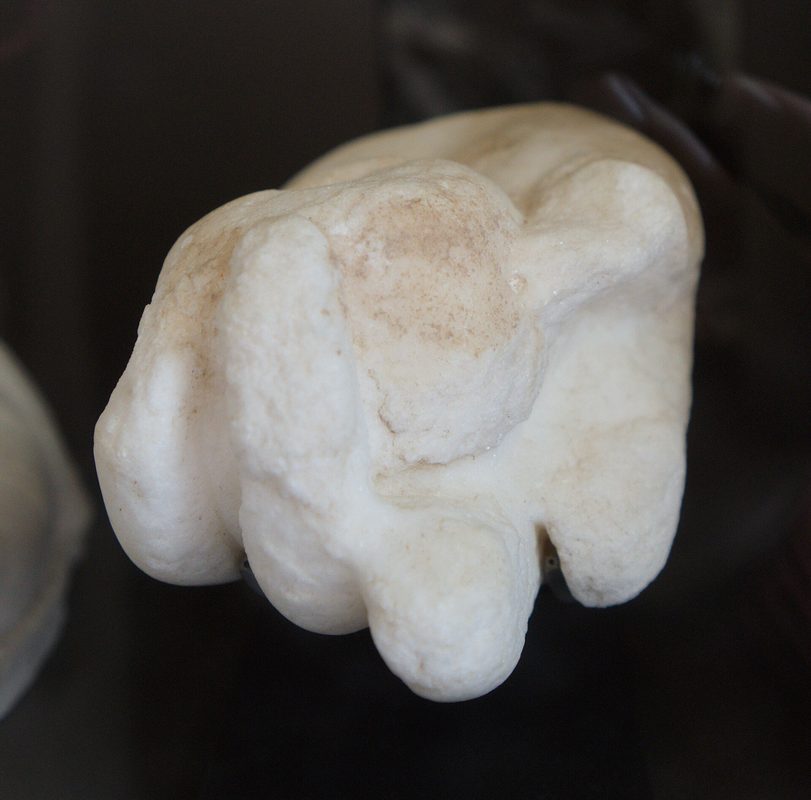
The goddess was carved as a complete figure with both arms in place. The marble broke apart during the many centuries the statue lay buried and handled, and the arm pieces separated from the torso. Fragments of an arm and a hand holding an apple turned up near the find on Milos, yet their attribution to the statue stayed disputed and they were set aside.
Scholars reconstruct the original pose from the twist of the torso and the angle of the shoulders. One reading places the goddess leaning against a pillar with a raised left arm holding an apple, a visual pun on the island name Melos. Rival readings give her a shield, a spear or a length of spun thread. The absence of a settled answer keeps the arms among the most discussed puzzles in ancient sculpture.
The blank space where the arms once reached has shaped how the world sees the statue. Artists and writers treat the loss as part of the work’s identity, and the incomplete figure reads as serene rather than broken. The mystery draws visitors to the Louvre and keeps the Aphrodite of Milos present in the story of Milos.
What is the Venus de Milo made of?
The Venus de Milo is carved from Parian marble, the fine white stone quarried on the Cycladic island of Paros. The material gave Greek sculptors a smooth, translucent surface prized across antiquity.
Parian marble carries a soft glow that suits the treatment of skin and cloth on the statue. The sculptor set the smooth flesh of the upper body against the deep folds of drapery gathered low on the hips, a contrast the pale stone renders with clarity. The figure was worked in more than one block of marble and joined, a common practice for large works of the period.
The choice of stone ties the statue to the Cyclades, the island group that includes Paros and neighbouring Milos. Sculptors carried Parian marble across the Aegean for temple statues and grave monuments, and the material became a mark of quality. The Aphrodite of Milos stands among the finest surviving examples of that tradition, its surface still holding light after two thousand years.
Can you see where the Venus de Milo was found on Milos?
Yes. The find spot sits on the hillside near the villages of Klima and Trypiti, in the area of the ancient city of Milos. A marker identifies the place amid the ruins.
The discovery ground lies within the archaeological zone that spreads across the slope above the coast. A short walk links the marked find spot to the well-preserved ancient theatre cut into the hill, and to the early Christian Catacombs of Milos carved into the soft rock nearby. The colourful fishing houses of Klima sit at the water’s edge below.
The hilltop capital Plaka holds the Archaeological Museum of Milos, where a faithful replica of the statue stands. The copy lets visitors study the pose and the drapery on the island itself. Pairing the museum replica with the marked find spot gives a full sense of the statue’s origin.
Reaching the site fits easily into a day of exploring the ancient heritage of the island, part of the wider things to do in Milos. Standing on the hillside where a farmer’s tools struck marble, within sight of the sea, links the small Cycladic island to a masterpiece admired around the world.
Frequently Asked Questions
Where was the Venus de Milo found?
The Venus de Milo was found on the island of Milos in 1820, unearthed by a local farmer, Yorgos Kentrotas. While clearing a field near the villages of Klima and Trypiti, in the area where the ancient city of Milos once stood. A young French naval officer, Olivier Voutier, saw the discovery and encouraged further digging. The statue, broken into sections, was recovered from the ground near the ancient ruins, and the spot can still be visited today.
Is the Venus de Milo on Milos?
No, the original Venus de Milo is not on Milos. After its discovery in 1820 it was taken to France, presented to King Louis XVIII, and given to the Louvre Museum in Paris in 1821, where it remains. On Milos, however, you can visit the area near Klima and Trypiti where it was found, see a marker at the spot. View a faithful replica in the Archaeological Museum of Milos in Plaka.
Why is the Venus de Milo famous?
The Venus de Milo is famous as one of the greatest surviving masterpieces of ancient Greek sculpture. Admired for the idealised beauty and graceful pose of the goddess Aphrodite, carved from Parian marble in the Hellenistic period. Its missing arms add an enduring mystery. Displayed in the Louvre since 1821 and seen by millions, it has become an icon of classical art. It gives the island of Milos, where it was discovered, lasting worldwide renown.
What does the Venus de Milo depict?
The Venus de Milo depicts Aphrodite, the ancient Greek goddess of love and beauty, known to the Romans as Venus. The figure stands larger than life, the upper body bare and drapery gathered low across the hips. The pose sets the weight on one leg and turns the torso in a gentle spiral, giving the marble a sense of movement. The idealised face and calm expression follow the conventions Greek sculptors used for the goddess.
What is the Venus de Milo made of and how tall is it?
The Venus de Milo is carved from Parian marble, the fine white stone quarried on the Cycladic island of Paros. The figure stands larger than life, rising above the height of an adult, worked in more than one block of marble and joined. The pale stone holds light across its surface and lets the sculptor set smooth skin against the deep folds of the drapery.