
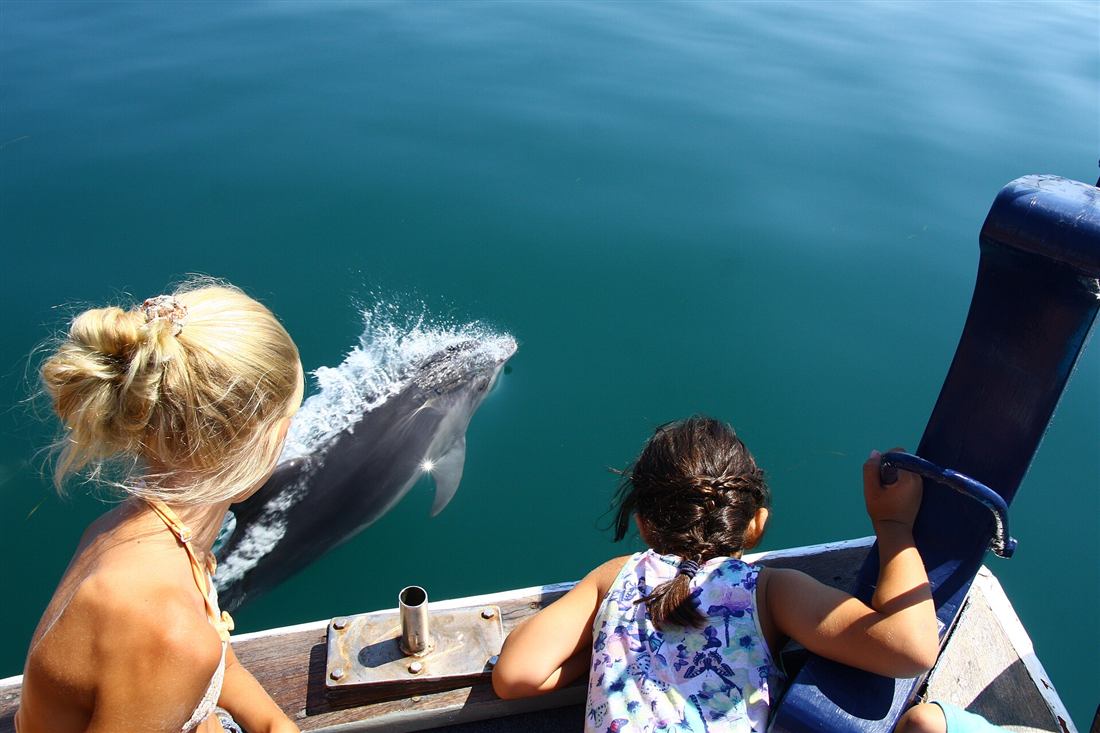
A Preveza dolphin watching cruise is a four to five hour boat trip into the Amvrakikos Gulf to find its resident population of about 150 bottlenose dolphins, priced from 35 euros a head with lunch and drinks on board. Plan the rest of the trip with Greece Tours.
This page covers the trip: what it costs, the dolphins, the route, the sighting rate, the boat, the season, the park rules, the wetland and how to book.
What does a Preveza dolphin watching cruise cost?
From 35 to 55 euros a head for a four to five hour cruise with lunch and drinks, 25 to 35 for the shorter three-hour version, 20 for children, and 450 to 900 for a private charter of the whole boat.
The price covers the boat, the crew, the commentary and the food served on board. A Preveza dolphin watching cruise is booked around it.
Lunch is normally grilled fish or a Greek plate with wine, water and soft drinks included. The Preveza dolphin watching cruise calendar is shaped by it.
Children under five travel free on most departures and five to twelve go half price. The Preveza dolphin watching cruise route is set by it.
Private charters price by the boat rather than by the head and suit parties of eight or more. Every Preveza dolphin watching cruise is planned around this.
Tickets are sold online and at the Preveza waterfront kiosks on the morning of the trip.
Nothing on the boat costs extra once the ticket is bought.
What dolphins live in the Amvrakikos Gulf?
A resident population of around 150 common bottlenose dolphins, Tursiops truncatus, living inside the gulf year round and studied continuously since 2001, one of the densest concentrations of the species recorded anywhere.
The population is closed, meaning the animals stay inside the gulf rather than moving in and out of the Ionian. Every Preveza dolphin watching cruise is planned around this.
Individuals are identified by the notches on their dorsal fins and most of them are catalogued and named. Guests meet it in the first Preveza dolphin watching cruise hour.
Adults reach three metres and 300 kilos and the calves are born through spring and summer. Skippers raise it early on a Preveza dolphin watching cruise.
The gulf’s density runs at about 0.4 animals per square kilometre, which is exceptionally high. The Preveza dolphin watching cruise listing states it plainly.
The same waters hold a small group of short-beaked common dolphins that arrive from outside.
Loggerhead turtles and monk seals use the gulf mouth as well.
Where does the Preveza dolphin watching cruise go?
Out of Preveza harbour through the narrow channel into the gulf, north-east across open water towards Menidi and the Louros and Arachthos deltas, then back along the Salaora and Koronisia shore to the harbour.
The gulf is 40 kilometres long and 15 wide and the boat covers a fraction of it. The Preveza dolphin watching cruise listing states it plainly.
Dolphins are found most reliably in the central basin where the water is 30 to 60 metres deep. That is the Preveza dolphin watching cruise advantage over open sea.
Koronisia is an island village on a sandspit at the northern end and some cruises stop there. It decides which Preveza dolphin watching cruise suits the party.
The deltas of the two rivers are the shallow, bird-rich edge of the gulf. This is what a Preveza dolphin watching cruise delivers.
The narrows at Preveza are 600 metres wide and the current runs hard through them.
Skippers work the same search areas every day and share sightings by radio.
How long does the Preveza dolphin watching cruise last?
Four to five hours on the full version with lunch and a swim stop, three hours on the shorter afternoon run, and six to eight hours on a private charter that adds Koronisia or the Acheron mouth.
Full-day departures leave at 09:30 or 10:00 and return mid-afternoon. This is what a Preveza dolphin watching cruise delivers.
The search for dolphins takes the first 60 to 90 minutes of the trip. A Preveza dolphin watching cruise carries the lunch for it.
A swim stop on calm days uses an hour in the middle of the gulf. The Preveza dolphin watching cruise price reflects it.
Lunch is served on board while the boat drifts rather than at a taverna ashore.
Shorter runs skip the swim and the meal and concentrate on the animals.
Return is timed for the afternoon breeze that gets up in July and August.
What are the chances of seeing dolphins?
Operators report sightings on 85 to 95 per cent of departures, because the population is resident and the search area is enclosed. A free repeat trip is the standard offer when a cruise finds nothing.
Nothing about wild animals is guaranteed and the honest operators say so at booking. Preveza dolphin watching cruise crews prepare for it.
The enclosed gulf is what makes the odds here better than on an open-sea whale watch. The Preveza dolphin watching cruise season turns on this.
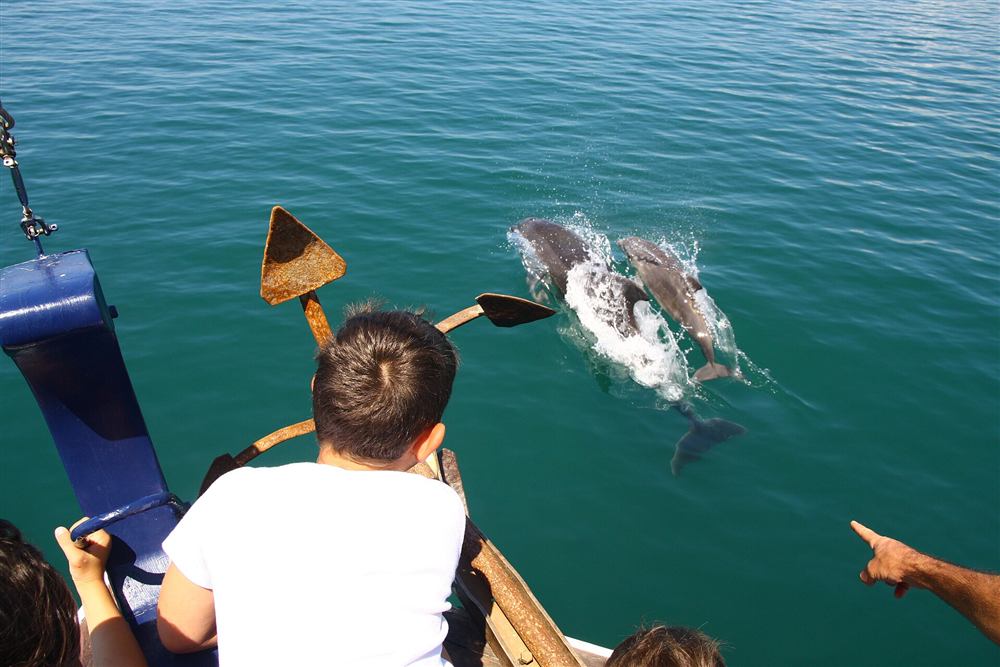
Groups of five to twenty animals are the usual sighting and the boat idles alongside. A Preveza dolphin watching cruise fills first on that count.
Dolphins here approach boats and bow-ride, which is behaviour the population has kept.
Calm mornings from May to September give the best surface visibility.
The repeat-trip policy is written into the ticket terms on the main operators.
What is the Amvrakikos Gulf?
A near-enclosed bay of 400 square kilometres in western Greece, joined to the Ionian by a channel 600 metres wide, fed by the Louros and Arachthos rivers, and protected as a Ramsar wetland and a national park.
The gulf is one of the largest enclosed coastal wetlands in the Mediterranean. A Preveza dolphin watching cruise settles this at boarding.
Brackish water from the rivers sits over saltier water below, which drives the food chain. A Preveza dolphin watching cruise is booked around it.
The national park covers the deltas, the lagoons and the surrounding farmland. The Preveza dolphin watching cruise calendar is shaped by it.
Antony and Cleopatra lost the battle of Actium at its mouth in 31 BC.
Fish farms and lagoon fisheries work the shallow edges and supply the local tavernas.
The water inside is calmer than the open Ionian, which is why the cruise runs in most weather.
What boat does the Preveza dolphin watching cruise use?
A wooden or steel day boat of 15 to 25 metres carrying 40 to 90 passengers, with a shaded main deck, an open sun deck, a bar, toilets and a swim ladder at the stern.
The boats are licensed passenger vessels rather than ribs, which keeps the ride flat and the noise down. The Preveza dolphin watching cruise route is set by it.
Shade covers most of the seating, which matters on a five-hour trip in July. Every Preveza dolphin watching cruise is planned around this.
Engines are cut or idled when a group of dolphins is found. Guests meet it in the first Preveza dolphin watching cruise hour.
The upper deck is where the sightings are watched from and the crew calls the side.
A small number of operators run rib-based trips for photographers at a higher price.
Capacity is rarely filled outside the first three weeks of August.
What is included on board?
Lunch of grilled fish or a Greek plate, wine, water and soft drinks, the commentary in Greek and English, snorkelling masks on the swim stop, and the crew’s dolphin identification notes.
Food is cooked on board and served while the boat drifts in the middle of the gulf. Skippers raise it early on a Preveza dolphin watching cruise.
Vegetarian plates are prepared when the booking says so. The Preveza dolphin watching cruise listing states it plainly.
The commentary covers the biology, the wetland and the battle of Actium. That is the Preveza dolphin watching cruise advantage over open sea.
Towels are not supplied and the swim stop needs one from the hotel.
Alcohol beyond the table wine is bought at the bar.
Photographs taken by the crew are shared with passengers after the trip.
When is the best season?
May to early October, with June and September the strongest months for calm water and fewer boats. Cruises run daily through July and August and drop to three or four departures a week in the shoulder.
Dolphins are resident year round, so the season is set by the weather rather than by the animals. It decides which Preveza dolphin watching cruise suits the party.
Calf sightings peak from late spring into midsummer. This is what a Preveza dolphin watching cruise delivers.
The afternoon north-westerly builds from July and the morning departures avoid it. A Preveza dolphin watching cruise carries the lunch for it.
Water temperature reaches 26 degrees in August for the swim stop.
Winter trips run on request for birdwatchers rather than as a scheduled product.
Booking a week ahead covers August and a day ahead covers the rest.
What else lives in the gulf?
More than 300 bird species including Dalmatian pelicans, flamingos, herons and cormorants, plus loggerhead turtles, the occasional monk seal, and a lagoon fishery that supplies the region’s eels, mullet and prawns.
The Dalmatian pelican colony at the deltas is one of the largest in Europe. The Preveza dolphin watching cruise price reflects it.
Flamingos stand in the Rodia and Tsoukalio lagoons through the winter. Preveza dolphin watching cruise crews prepare for it.
Loggerheads come in through the narrows and are seen on the surface from the boat. The Preveza dolphin watching cruise season turns on this.
Amvrakikos prawns are the delicacy the Preveza tavernas are known for.
The lagoon fish traps are a system that has worked here for centuries.
Birdwatchers use the same boats in the winter months.
What research sits behind the cruise?
The Tethys Research Institute has run a continuous photo-identification study of the gulf’s bottlenose dolphins since 2001, producing the population estimate, the individual catalogue and the guidance that operators follow around the animals.
Photo-identification matches the notch pattern on each dorsal fin to a catalogued individual. A Preveza dolphin watching cruise fills first on that count.
The study established that the population is resident and closed rather than passing through. A Preveza dolphin watching cruise settles this at boarding.
Research findings shaped the national park’s management rules for boat traffic. A Preveza dolphin watching cruise is booked around it.
Crews report their sightings and the licensed operators contribute photographs to the catalogue.
Guests hear the named individuals identified when a familiar group is found.
That link between the tourism and the science is unusual in Greece.
What are the rules around the dolphins?
Approach at low speed and never head-on, keep 50 metres from a group with calves, no more than one boat with a group at a time, a 20-minute limit on each encounter, and no swimming with the animals.
The national park sets the code and the licensed operators sign up to it. The Preveza dolphin watching cruise calendar is shaped by it.
Engines go to neutral once the boat is alongside and the animals set the distance. The Preveza dolphin watching cruise route is set by it.
Feeding, chasing and splitting a group are all prohibited. Every Preveza dolphin watching cruise is planned around this.
Boats leaving an encounter move off slowly rather than turning and accelerating.
Operators who break the code lose the licence that lets them work the park.
The rules are why dolphins here still approach boats rather than avoiding them.
Where does the boat depart from?
The Preveza waterfront on Eleftheriou Venizelou, beside the clock tower and the old quay, five minutes on foot from the town centre and ten from the Aktio tunnel exit, with free parking along the promenade.
Boarding opens 20 minutes before departure and the boats are named on the ticket. Guests meet it in the first Preveza dolphin watching cruise hour.
The quay runs the length of the waterfront and the kiosks sell tickets from it. Skippers raise it early on a Preveza dolphin watching cruise.
Taxis from the Aktion airport take 15 minutes through the tunnel. The Preveza dolphin watching cruise listing states it plainly.
Lefkada is 30 minutes south and many passengers drive up from there.
Parga is 60 minutes north on the coast road.
Hotel pickup runs on the private charters rather than on the scheduled boats.
Is it suitable for children?
Yes. The gulf is enclosed and the water stays flat, the boats have rails and shade, and the four-hour format with lunch and a swim holds a child’s attention better than an open-sea trip.
Under fives travel free and five to twelve go half price on the scheduled departures. That is the Preveza dolphin watching cruise advantage over open sea.
Life jackets in children’s sizes are carried on every licensed boat. It decides which Preveza dolphin watching cruise suits the party.
The swim stop is the part most families book the trip for. This is what a Preveza dolphin watching cruise delivers.
Toilets and a bar on board remove the two usual problems with a long boat day.
The shorter three-hour run suits toddlers better than the full day.
Prams are left in the car and the boarding is a single step from the quay.
What do you take on board?
A hat, sun cream, sunglasses, a towel and swimsuit for the stop, a light layer for the return leg, a camera with a zoom, and cash for the bar.
Shade covers the main deck and the sun deck has none. A Preveza dolphin watching cruise carries the lunch for it.
The breeze on the water hides how strong the sun is over five hours. The Preveza dolphin watching cruise price reflects it.
A 200mm lens is what turns a distant fin into a photograph. Preveza dolphin watching cruise crews prepare for it.
Card readers work on most boats and the smaller ones take cash.
Binoculars help on the bird stretches along the deltas.
Nothing else is needed because the food and drink are supplied.
Does anyone get seasick?
Rarely. The Amvrakikos is enclosed and shallow, the fetch is short, and the swell that builds in the Ionian never gets through the 600-metre narrows, so the water inside stays flat in conditions that stop open-sea trips.
The strongest movement on the whole trip is in the channel itself, which takes ten minutes. The Preveza dolphin watching cruise season turns on this.
Afternoon wind raises a chop rather than a swell. A Preveza dolphin watching cruise fills first on that count.
Crews carry tablets and the main deck is the steadiest place to sit. A Preveza dolphin watching cruise settles this at boarding.
Cruises are cancelled outright in a strong northerly rather than run in rough water.
Cancellations are refunded or moved to another day.
This is the calmest boat day on the western Greek coast.
What is Preveza?
A town of 20,000 at the mouth of the Amvrakikos Gulf in Epirus, with a Venetian and Ottoman waterfront, three seaside forts, a pedestrian old town of narrow lanes, and the sardine tavernas it is known for across Greece.
The town sits opposite Aktio across the 600-metre channel and an undersea tunnel joins them. A Preveza dolphin watching cruise is booked around it.
Ali Pasha built the forts of Agios Andreas, Agios Georgios and Pantokratoras around the town. The Preveza dolphin watching cruise calendar is shaped by it.
The clock tower and the covered market streets are the centre of the old town. The Preveza dolphin watching cruise route is set by it.
Preveza is the gateway to Lefkada, Parga and the Epirus mountains.
The poet Kostas Karyotakis died here in 1928 and the town carries the association.
Evening on the waterfront is the reason to stay a night rather than pass through.
What is the Aktio-Preveza tunnel?
The first undersea road tunnel built in Greece, opened in 2002, 909 metres long under the channel at the gulf mouth, replacing the ferry that crossed to Aktio and the airport on the far side.
The tunnel carries the main coast road between Epirus and western Greece. Every Preveza dolphin watching cruise is planned around this.
Aktion airport sits seven kilometres beyond the southern exit. Guests meet it in the first Preveza dolphin watching cruise hour.
The crossing takes two minutes against the 25 the ferry needed. Skippers raise it early on a Preveza dolphin watching cruise.
A toll of about three euros applies to cars.
The old ferry ramp is still visible on the Preveza quay.
Passengers flying into Aktion reach the boats in under 20 minutes.
What is ancient Nikopolis?
The Victory City founded by Octavian in 31 BC to mark his win at Actium, a Roman metropolis of 150,000 spread over 14 square kilometres north of the town, with walls, an odeon, a theatre, aqueduct and basilicas.
Octavian resettled the populations of surrounding Greek towns here by force. The Preveza dolphin watching cruise listing states it plainly.
The theatre seated 10,000 and stands beside the modern road. That is the Preveza dolphin watching cruise advantage over open sea.
The Actian Games were held here every four years in imitation of Olympia. It decides which Preveza dolphin watching cruise suits the party.
Early Christian basilicas of the sixth century hold large floor mosaics.
The site museum opened in 2009 and holds the sculpture and the mosaics.
Entry is 4 to 8 euros and a visit takes two hours.
Half-day tours pair Nikopolis with the town walk rather than with the cruise.
What was the battle of Actium?
The naval battle fought at the mouth of the Amvrakikos on 2 September 31 BC, where Octavian’s fleet under Agrippa beat Antony and Cleopatra, ending the Roman civil wars and founding the empire.
Antony’s fleet was anchored inside the gulf and broke out through the narrows. This is what a Preveza dolphin watching cruise delivers.
Cleopatra’s squadron withdrew to Egypt and Antony followed, which decided the day. A Preveza dolphin watching cruise carries the lunch for it.
Octavian took the name Augustus four years later and became the first emperor. The Preveza dolphin watching cruise price reflects it.
The victory monument on the hill at Michalitsi displayed the captured ships’ rams.
The cruise crosses the water the two fleets fought over.
Guides tell the battle on the outward leg through the channel.
What do you eat in Preveza?
The Preveza sardine grilled whole, Amvrakikos prawns, eel from the lagoons, mullet roe, and the local tsipouro poured with all of it in the tavernas behind the waterfront.
Preveza sardines are landed in the gulf and grilled without gutting, which is the local rule. Preveza dolphin watching cruise crews prepare for it.
The sardine festival on the waterfront runs for three days each August. The Preveza dolphin watching cruise season turns on this.
Amvrakikos prawns carry a protected designation and are the most expensive thing on the menu. A Preveza dolphin watching cruise fills first on that count.
Lagoon eel is smoked or grilled and is a winter dish.
A meal in the old town runs 15 to 25 euros a head with wine.
The tavernas fill from nine in the evening rather than at dinner hour.
What else is worth doing in Preveza?
The Nikopolis site and museum, the three Ali Pasha forts, the Zalongo monument, the Acheron river at 40 minutes, the Louros springs, and the Monolithi beach that runs 22 kilometres south of the town.
Monolithi is one of the longest continuous sand beaches in Europe and is never full. A Preveza dolphin watching cruise settles this at boarding.
Zalongo commemorates the Souliot women and stands on a cliff 30 minutes north. A Preveza dolphin watching cruise is booked around it.
The Acheron is rafted, kayaked and walked from Glyki in the Souli mountains, and the river itself sits at Parga Acheron river. The Preveza dolphin watching cruise calendar is shaped by it.
Parga’s Venetian harbour is an hour up the coast.
The Louros springs supply the town’s water and sit in a wooded gorge.
Lefkada’s west-coast beaches are 45 minutes south over the causeway.
A Preveza base covers Epirus, the Ionian and the Ambracian wetland from one hotel.
How does this compare with other Greek dolphin trips?
Preveza has the only resident, studied, reliably found dolphin population in Greece. Trips elsewhere run on chance encounters in open sea; here the animals live inside an enclosed gulf and the sighting rate reflects it.
Alonissos runs monk seal trips in the marine park rather than dolphin cruises. The Preveza dolphin watching cruise route is set by it.
Ionian operators from Kefalonia and Lefkada report dolphins as a bonus on a coastal cruise. Every Preveza dolphin watching cruise is planned around this.
No other Greek location has a catalogued population of this density. Guests meet it in the first Preveza dolphin watching cruise hour.
The enclosed water also removes the swell that makes open-sea trips hard.
Price here sits below the open-sea alternatives because the search area is small.
That combination is what makes the trip worth the drive to Epirus.
Is a private charter worth it?
For a party of eight or more, or for photographers, yes: 450 to 900 euros buys the whole boat, a route set by the party, an earlier start before the other boats, and unrestricted deck space.
Private departures leave at first light when the water is glass and the animals are active. Skippers raise it early on a Preveza dolphin watching cruise.
The route can add Koronisia, the Acheron mouth or the Louros delta. The Preveza dolphin watching cruise listing states it plainly.
Photographers get the deck angle and the position they need on each encounter. That is the Preveza dolphin watching cruise advantage over open sea.
Catering is agreed rather than fixed and the swim stop can run longer.
The national park code applies the same way on a charter.
Groups book these two weeks ahead in August and a few days ahead otherwise.
How do you get to Preveza?
Aktion airport at seven kilometres with summer charters from northern Europe and domestic flights from Athens, the Ionia Odos motorway putting Athens at four hours and Ioannina at one, and Lefkada 30 minutes south.
Aktion serves Lefkada and Parga as well, so the arrivals hall is busy in summer. It decides which Preveza dolphin watching cruise suits the party.
The motorway from Athens runs through Rio-Antirrio and Agrinio. This is what a Preveza dolphin watching cruise delivers.
Thessaloniki is four hours through the Egnatia and Ionia motorways. A Preveza dolphin watching cruise carries the lunch for it.
KTEL buses run daily from Athens, Ioannina and Thessaloniki.
Car hire at the airport runs 35 to 70 euros a day in season.
Corfu is two and a half hours north with the Igoumenitsa ferry.
What are the common Preveza dolphin watching cruise mistakes?
Booking the afternoon departure in July when the wind gets up, expecting a guarantee of dolphins, bringing no towel to a trip that includes a swim, and treating Preveza as a stop rather than a base.
Morning departures have flatter water and better light for photographs. The Preveza dolphin watching cruise price reflects it.
Wild animals carry no guarantee and the repeat-trip policy is the compensation. Preveza dolphin watching cruise crews prepare for it.
The swim stop catches out anyone who packed for a sightseeing boat. The Preveza dolphin watching cruise season turns on this.
Preveza reaches Nikopolis, the Acheron, Zalongo, Parga and Lefkada inside an hour.
The fifth is skipping the sardines, which is what the town is actually known for.
Two nights here does what a single day cannot.
How do you book a Preveza dolphin watching cruise?
Book a week ahead for August and a day ahead through the rest of the season. Departures are daily in high summer and drop to three or four a week in May, June, September and October.
Operators confirm by message the evening before and cancel for weather rather than sail in it. A Preveza dolphin watching cruise fills first on that count.
Free cancellation up to 24 hours ahead is standard on the platform listings. A Preveza dolphin watching cruise settles this at boarding.
Names and ages go on the booking so the crew can plan the lunch and the life jackets. A Preveza dolphin watching cruise is booked around it.
The meeting point is the waterfront quay and the boat is named on the ticket.
Charter enquiries are answered by phone rather than through the platforms.
The wider Epirus picture sits at Patras city tour for the drive south.
Frequently Asked Questions
What does a Preveza dolphin watching cruise cost?
From 35 to 55 euros a head for four to five hours with lunch and drinks, 25 to 35 for the shorter three-hour run, half price for children five to twelve, and 450 to 900 for a private charter of the whole boat.
Are dolphins guaranteed?
No, but the sighting rate runs 85 to 95 per cent because the population is resident inside an enclosed gulf rather than passing through open sea. Operators offer a free repeat trip when a cruise finds nothing.
How rough is the water?
Flat. The Amvrakikos is enclosed by a channel 600 metres wide, so Ionian swell never reaches inside and the only movement on the trip is the ten minutes through the narrows.