
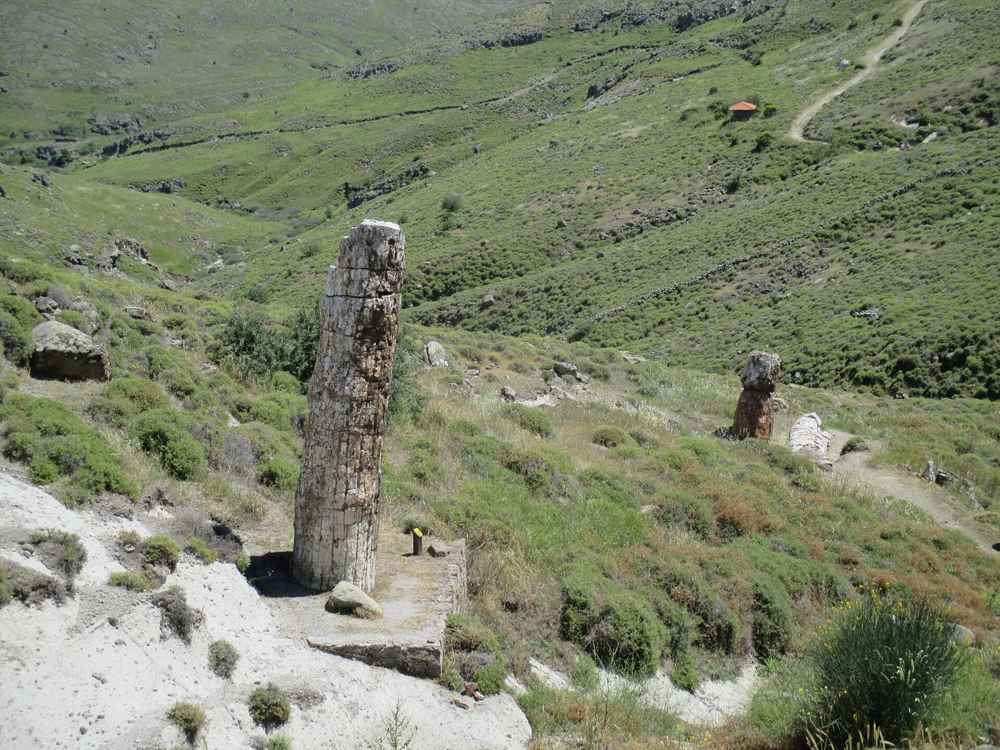
The Petrified Forest of Lesbos is one of the great natural wonders of Greece. A UNESCO Global Geopark in the barren volcanic landscape of the island’s west, near the village of Sigri. Here, millions of years ago, a volcanic eruption buried a lush subtropical forest in ash, fossilising whole tree trunks, roots and leaves that survive today as stone. Often called the Pompeii of the plant world, it is one of the largest and most important petrified forests on Earth. Protected across parks and an excellent Natural History Museum. This guide covers the Petrified Forest in full: what it is, where it lies, how it formed. Plan the whole trip with Greece Tours.
What you can see, how to visit and buy tickets, the best time to go. Why it is so remarkable.
Here you will find everything about the Petrified Forest of Lesbos: what it is, where it lies near Sigri, how it was formed by volcanic ash. What you can see in its museum and parks, how to visit and the ticket prices, the best time to go. Why this UNESCO fossil forest is so unique.
What is the Petrified Forest of Lesbos?
The Petrified Forest of Lesbos is a UNESCO Global Geopark in the west of the island, where trees from an ancient subtropical forest were fossilised into stone by volcanic ash millions of years ago.
The Petrified Forest of Lesbos is one of the most remarkable natural sights in Greece, a vast fossilised forest spread across the stark volcanic landscape of the island’s western end. Protected as a UNESCO Global Geopark, it preserves the remains of an ancient forest turned to stone, an extraordinary window into the deep past.
Millions of years ago, a subtropical forest flourished here. A series of volcanic eruptions buried it in ash and lava. Fossilising the trees so perfectly that trunks, roots, branches and even leaves survive today as stone, many still standing or lying where they fell. It is often called the Pompeii of the plant world.
One of the largest and most important petrified forests on the planet, the site is protected across parks and studied and displayed by an excellent Natural History Museum. For visitors, it offers a chance to walk among stone trees millions of years old, a unique and unforgettable experience quite unlike anything else on a Greek island.
Where is the Petrified Forest of Lesbos?
The Petrified Forest of Lesbos is in the far west of the island, in the barren volcanic landscape around the villages of Sigri and Eressos.
The Petrified Forest lies at the western end of Lesbos, in a dramatic, treeless volcanic landscape that contrasts sharply with the green, forested east of the island. This barren, wind-scoured terrain is itself a striking sight, and it is here, over a wide area, that the fossilised trees are found.
The main sites cluster around the remote coastal village of Sigri, on the west coast, and extend towards nearby Eressos. The Natural History Museum of the Lesbos Petrified Forest and the principal park lie just outside Sigri, making the village the natural starting point for a visit.
Reaching the Petrified Forest involves a scenic drive across the island from the capital, Mytilene, or from the northern resorts, taking a couple of hours through changing landscapes. A hire car is the easiest way to get there, and the journey through the volcanic west is part of the experience.
How was the Petrified Forest of Lesbos formed?
The Petrified Forest of Lesbos formed when volcanic eruptions buried a subtropical forest in ash and lava around twenty million years ago.
The story of the Petrified Forest is one of volcanic catastrophe and slow preservation. Around twenty million years ago, the western part of Lesbos was covered in a lush subtropical forest, when a series of powerful volcanic eruptions buried the trees under thick layers of ash, pumice and lava, cutting them off from the air.
Over the following ages, mineral-rich waters percolated through the volcanic material and slowly replaced the organic wood, cell by cell. With silica and other minerals, turning the trees to stone while faithfully preserving their form, right down to the growth rings, bark and leaves. This process, known as fossilisation or petrification, happened so gently that the detail survives astonishingly intact.
The result is a forest frozen in time, with fossilised trunks still standing upright where they grew, others lying where they fell. Roots, branches, seeds and leaves preserved in stone. Studying these fossils reveals the climate and vegetation of the region millions of years ago, which is why the site has such scientific value.
What can you see at the Petrified Forest of Lesbos?
At the Petrified Forest you can see fossilised tree trunks standing and lying in the parks around Sigri, including one of the largest standing petrified trunks in the world, along with the Natural History Museum, and the marine petrified forest.
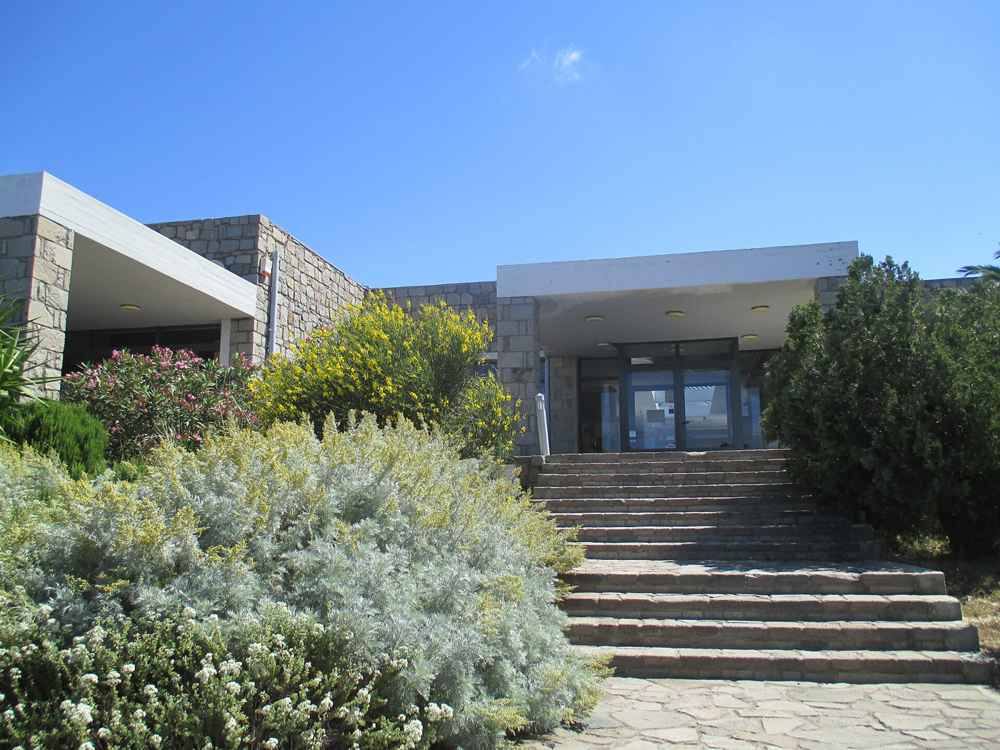
The centrepiece for visitors is the Natural History Museum of the Lesbos Petrified Forest, just outside Sigri. Which explains the geology and the fossilisation process and is built around fossilised trunks lying where they fell. Being shown around by one of the museum’s geologists greatly enriches a visit.
Adjacent to the museum, the Sigri Park spreads across a large area of volcanic hillside, where marked paths lead among standing and fallen petrified trunks in their natural setting. Here you can admire one of the largest-diameter standing petrified tree trunks in the world, with an impressive girth and root system, along with countless other fossils.
Beyond Sigri, further parks and sites are scattered across the western landscape, and offshore the islet of Nissiopi holds a marine petrified forest, where fossilised logs lie beneath the sea. This is visited by a glass-bottomed boat from Sigri, adding a memorable extra dimension to a tour of the fossil forest.
How do you visit the Petrified Forest of Lesbos and what are the tickets?
You visit the Petrified Forest via the Natural History Museum and parks at Sigri.
A visit usually begins at the Natural History Museum of the Lesbos Petrified Forest near Sigri. Where general admission is in the region of ten euros and includes entry to the museum and to the petrified forest parks, such as the adjacent Sigri Park, where you walk among the fossilised trunks.
To see the marine petrified forest on the islet of Nissiopi, a separate ticket, around fifteen euros. Is required for the glass-bottomed boat, which departs daily from the port of Sigri in the morning, weather permitting. Groups can also arrange to be accompanied by one of the museum’s geologists, which is highly recommended for a deeper understanding.
Comfortable shoes, sun protection, a hat and water are essential, as the parks are open, exposed and treeless, with little shade under the strong sun. It is wise to check current opening times, boat schedules and prices before setting out, as these vary by season. To allow a good half-day to do the museum, park and boat justice.
When is the best time to visit the Petrified Forest of Lesbos?
The best time to visit the Petrified Forest of Lesbos is spring and autumn, especially May to June and September to October, when the weather is cooler and the site less busy.
Exposed and treeless volcanic landscape with little or no shade, the timing of a visit matters. The cooler, quieter months of spring and autumn, from May to June and September to October, are the most comfortable and rewarding times to explore the parks on foot.
In these shoulder seasons the temperatures are pleasant for walking among the fossils, the light is often beautiful, and the site is far less busy than in high summer. Spring also brings a scattering of wildflowers to the volcanic hills, softening the stark landscape.
During the height of summer, in July and August. The open parks can be very hot and shadeless under the strong midday sun. A visit is best made in the cooler hours of the early morning or later afternoon, with plenty of water and sun protection. Whenever you go, allowing time and coming prepared makes for a far better experience.
Why is the Petrified Forest of Lesbos worth visiting?
The Petrified Forest of Lesbos is worth visiting as one of the largest and most important fossil forests on Earth, a UNESCO Geopark where you can walk among stone trees millions of years old.
The Petrified Forest is one of the truly unique attractions of Lesbos and of Greece, and well worth the journey to the island’s remote west. To stand among fossilised trees millions of years old, still rooted where they grew, is a genuinely awe-inspiring experience, offering a rare, tangible connection with the deep geological past.
Protected as a UNESCO Global Geopark and interpreted by an excellent museum, it has real scientific significance as well as natural drama. The combination of the fossils, the striking volcanic landscape and the offshore marine forest makes it a fascinating and varied destination.
For anyone visiting Lesbos with an interest in nature, geology or simply the extraordinary, the Petrified Forest is a highlight not to be missed. Different from the island’s beaches, villages and ouzo traditions, it adds a remarkable natural wonder to a visit and leaves a lasting impression of the island’s ancient and dramatic character.
Frequently Asked Questions
How old is the Petrified Forest of Lesbos?
The Petrified Forest of Lesbos is extraordinarily ancient, with the fossilised trees dating back around twenty million years. To the time when a lush subtropical forest that once covered the western part of the island was buried and turned to stone. The fossilisation happened after a series of powerful volcanic eruptions buried the living forest under thick layers of ash. Pumice and lava, cutting the trees off from the air and beginning the long process of petrification. Over the following ages, mineral-rich waters slowly percolated through the volcanic material and replaced the organic wood, cell by cell.
With silica and other minerals, turning the trees to stone while faithfully preserving their original form, including the growth rings, bark, roots and even leaves. The result is a forest frozen in time some twenty million years ago, an almost unimaginable span. Which survives today as one of the largest and best-preserved petrified forests on Earth. Walking among these stone trees, many still standing upright where they grew and others lying where they fell. Gives visitors a direct and humbling connection with the deep geological past of the planet. The great age and remarkable preservation of the fossils are precisely what make the Petrified Forest of Lesbos so scientifically important and so fascinating to visit.
Why it is protected as a UNESCO Global Geopark and often described as the Pompeii of the plant world.
Can you visit the Petrified Forest of Lesbos on a day trip?
Yes, you can visit the Petrified Forest of Lesbos on a day trip. For visitors this is exactly how they see it, since the site lies in the remote west of the island, some way from the main resorts and the capital. The Petrified Forest and its Natural History Museum are located near the coastal village of Sigri, in the far west of Lesbos, which is a drive of a couple of hours or so from Mytilene in the south-east, and a similar distance from the northern resort of Molyvos, through the island’s changing landscapes.
A hire car is the easiest and most flexible way to make the trip, allowing you to explore at your own pace and to combine the Petrified Forest with other sights in the west. Such as the village of Sigri itself, the beach and Sappho connections at Skala Eressou, or a stop at a taverna along the way. Organised tours are also available, including options from the northern resorts that take in the Petrified Forest along with Sigri and Eressos, which remove the drive yourself. Because the parks are open and exposed with little shade.
A park and, if you wish, the Nissiopi marine forest boat trip to fit in, it is worth allowing a good half-day at the site and setting out early, especially in the summer heat. With sensible planning, sun protection and water, a day trip to the Petrified Forest is a rewarding and memorable excursion and one of the highlights of a visit to Lesbos.
Is the Petrified Forest of Lesbos a UNESCO site?
Yes, the Petrified Forest of Lesbos is protected as a UNESCO site, forming the heart of the Lesvos Island UNESCO Global Geopark. A status that recognises its outstanding geological importance and value. UNESCO Global Geoparks are areas with geological heritage of international significance. Managed to protect that heritage and to promote education and sustainable tourism. The Petrified Forest of Lesbos qualifies as one of the largest and most important fossil forests on Earth. The site preserves, across a wide area of the island’s volcanic west, the fossilised remains of a subtropical forest turned to stone by volcanic activity around twenty million years ago.
Including standing and fallen tree trunks, roots, branches and leaves of remarkable detail, as well as a marine petrified forest offshore at the islet of Nissiopi. Its scientific value lies in what these fossils reveal about the climate, vegetation and geological history of the region millions of years ago. It has been studied and protected for decades. With a dedicated Natural History Museum and parks making it accessible to visitors. The UNESCO Geopark status underlines that the Petrified Forest is not merely a local curiosity but a natural monument of global importance. Comparable in its field to the most significant fossil sites anywhere in the world.
For visitors, this recognition is a reminder that they are seeing something genuinely rare and precious. It reinforces the importance of respecting the site and its fragile fossils during a visit.