
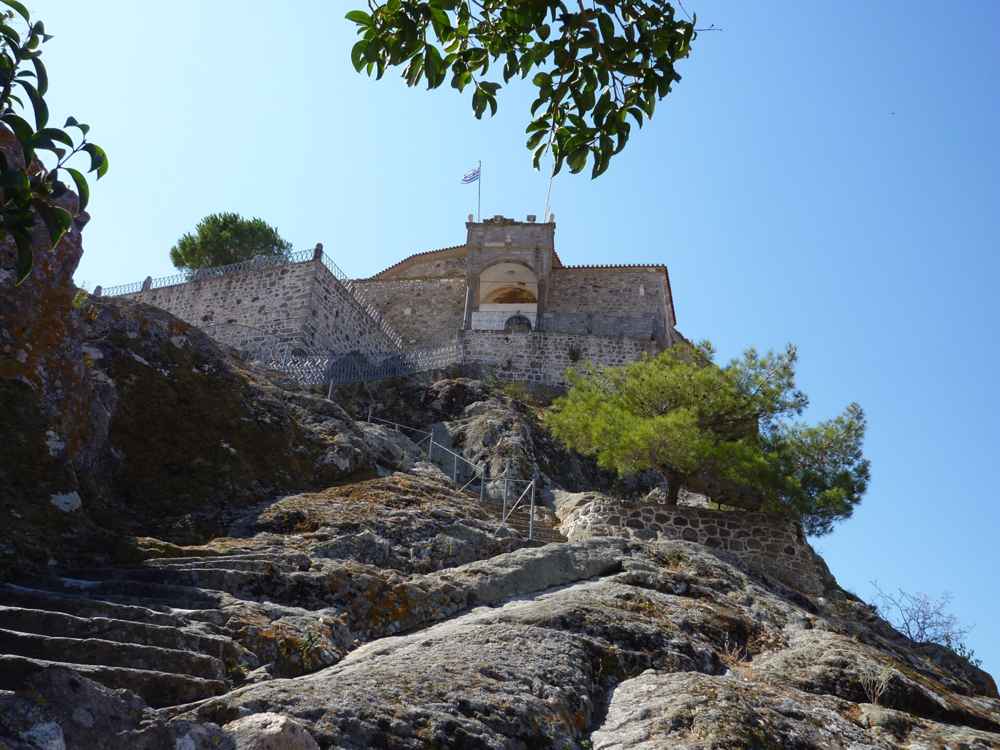
Petra is a charming seaside village on the north coast of Lesbos, a short way from Molyvos, famous above all for the church of Panagia Glykofilousa. Perched dramatically on top of a great rock at the heart of the village and reached by a flight of over a hundred steps carved into the stone. Around the rock spreads a traditional village of stone houses and a lively square, and below stretches a long sandy beach with shallow water, popular with families. With its landmark church, its beach and its authentic character, Petra makes a relaxed and rewarding base on the north coast. Plan the whole trip with Greece Tours.
This guide covers Petra in full: what it is, where it lies, the church on the rock, the village, the beach, the things to do, and how to get there.
Here you will find everything about Petra on Lesbos: what the village is like, where it lies on the north coast near Molyvos. The famous church of Panagia Glykofilousa on the rock, the village square, the sandy beach, the things to do. How to get there.
What is Petra on Lesbos?
Petra is a seaside village on the north coast of Lesbos, near Molyvos, famous for the church of Panagia Glykofilousa perched on a great rock at its centre.
Petra is an attractive coastal village on the north coast of Lesbos, a short distance along the shore from the beautiful village of Molyvos. Its name, meaning rock in Greek, refers to the great outcrop of stone that rises at the heart of the village and gives Petra its most famous landmark.
Crowning this rock stands the church of Panagia Glykofilousa, reached by a long flight of steps carved into the stone. One of the most important pilgrimage sites on the island and an unforgettable sight. Around the base of the rock spreads a traditional village of stone houses, a lively square and tavernas, backed by green hills.
Below the village stretches a long sandy beach with shallow water, popular with families, making Petra a place that combines a striking landmark, an authentic village atmosphere and easy swimming. Quieter and more traditional than a big purpose-built resort, it makes a relaxed and rewarding base for the north coast of Lesbos.
Where is Petra on Lesbos?
Petra lies on the north coast of Lesbos, near the beautiful village of Molyvos, around fifty-five kilometres north-west of the capital, Mytilene.
Petra sits on the northern coast of Lesbos, on a sandy bay a short way south along the shore from the famous hilltop village of Molyvos. The two are close neighbours, only kilometres apart, and are very easily visited together on this northern side of the island.
The village lies around fifty-five kilometres north-west of the capital and main port of Mytilene, a drive of roughly an hour and a half across the island. Backed by green hills and facing the sea, with the small rocky islets offshore. It enjoys a pretty and sheltered setting on the north coast, looking out towards the Turkish mainland in the distance.
Its position next to Molyvos and near the family beach of Anaxos makes Petra a convenient and popular base for exploring the north of Lesbos. Combining a sandy beach with easy access to one of the island’s most beautiful villages and the wider attractions of the region.
What is the church of Panagia Glykofilousa in Petra?
Panagia Glykofilousa is the famous church perched on top of a great rock in the centre of Petra, reached by over a hundred steps carved into the stone.
The great landmark of Petra is the church of Panagia Glykofilousa, whose name means the Virgin Mary of the Sweet Kiss. It stands on the summit of the huge rock, some forty metres high. That rises at the centre of the village. Is reached by climbing a flight of over a hundred steps carved into the stone, a memorable ascent.
A post-Byzantine church, with an earlier chapel said to date back centuries, it is one of the most important pilgrimage sites on Lesbos. Inside survive rare Byzantine icons and a beautifully carved wooden throne, while beneath the church a natural reservoir collects rainwater from the roof, an ingenious and unusual feature of its rocky setting.
The reward for the climb, beyond the church itself. Is the spectacular view from the top of the rock over the village of Petra, the sea and the small rocky islets offshore. The church celebrates its great feast in mid-August. Drawing pilgrims from across the island and beyond. Many visitors also come during the Good Friday service and the procession that follows. It is the defining image of Petra and a highlight of a visit.
What is the village of Petra like?
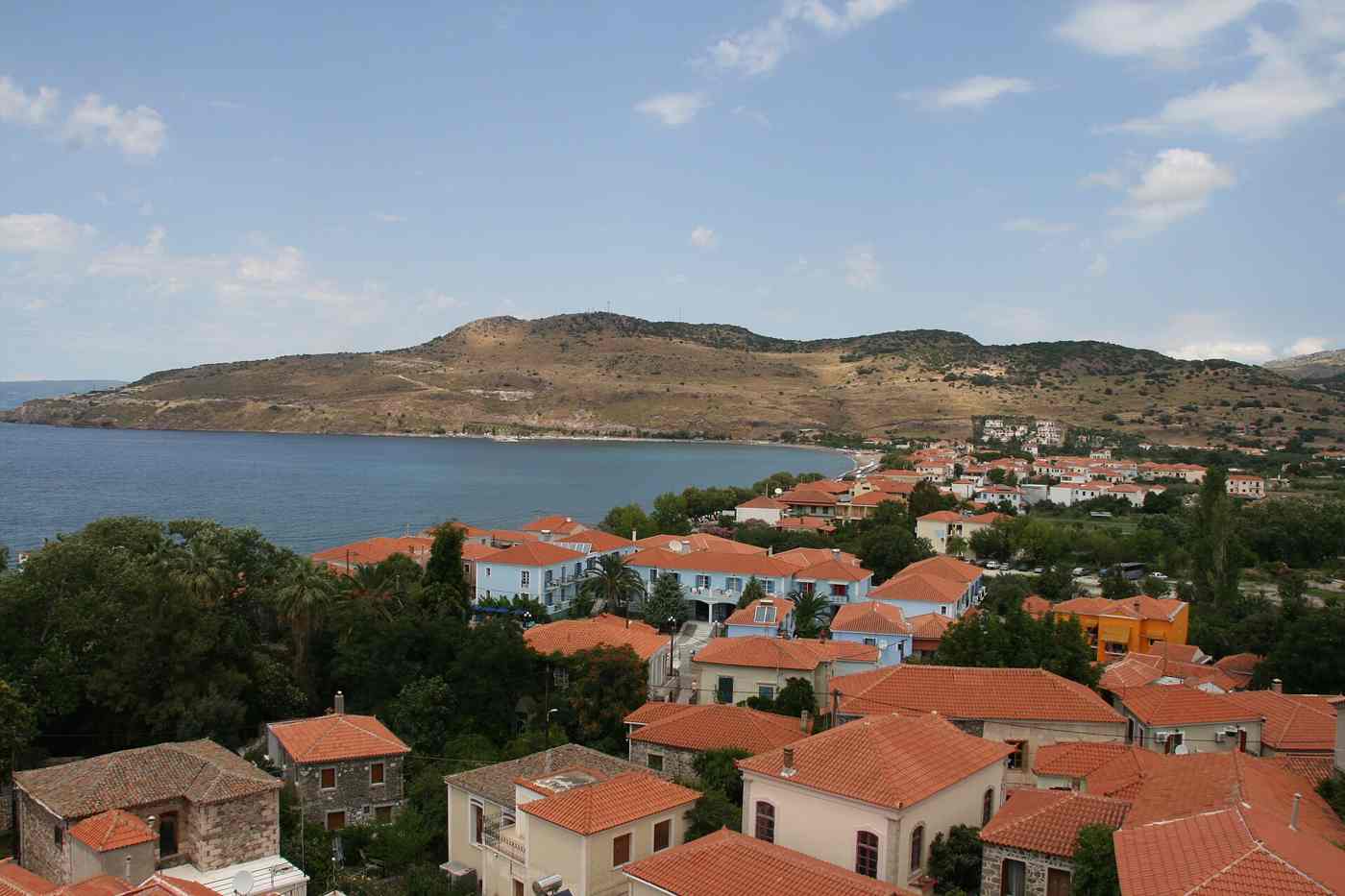
The village of Petra is a traditional, relaxed settlement of stone houses and narrow streets gathered around the great rock and a lively central square.
Around the base of its famous rock, Petra spreads out as a traditional village of stone houses. Some with fine old architecture and wooden balconies, along narrow streets and a lively central square shaded by trees. It has a genuine, lived-in character, more authentic and low-key than the larger resorts on the island.
The square and streets are lined with tavernas, cafes and shops. Petra is well known for its women’s agrotourism cooperative. A pioneering venture where local women serve traditional home cooking and sell local products, offering an authentic taste of the island’s food and hospitality. Dining here is a real pleasure.
This combination of a striking landmark, a traditional village atmosphere, good food and a sandy beach gives Petra a distinctive appeal. It is a place to enjoy the everyday rhythm of a north-coast village, wander the streets, sit in the square and soak up an authentic slice of Lesbos life.
What is Petra beach like?
Petra beach is a long stretch of sand and fine pebble below the village, with shallow, calm, clear water that is safe for children.
Below the village of Petra stretches its beach, a long shore of sand and fine pebble running along the bay. With shallow, calm and clear water that makes it especially good and safe for families with children. It is one of the better family beaches on the north coast of Lesbos.
The beach is well organised, with sunbeds and umbrellas, tavernas and cafes along the front. Facilities for water sports, while still keeping a relaxed, village atmosphere rather than the feel of a large resort. The backdrop of the village, the great rock crowned by its church, and the green hills behind adds greatly to the setting.
Combining easy, shallow swimming with the charm of the village and its landmark church, Petra beach makes for a lovely, relaxed day by the sea. For a wider choice of shores nearby, including Molyvos, Anaxos and the thermal springs of Eftalou, see our guide to the Lesbos beaches.
What is there to do in Petra?
In Petra you can climb the steps to the church of Panagia Glykofilousa for the views, relax on the sandy family beach, wander the village and square, dine at the women’s cooperative and tavernas, and use the village as a.
The essential thing to do in Petra is to climb the flight of steps up the great rock to the church of Panagia Glykofilousa. Both to see the historic church with its icons and carved throne and to enjoy the spectacular views over the village, sea and islets from the top. It is the highlight of any visit.
Down below, the long sandy beach invites relaxed swimming and sunbathing, especially for families, while the village itself rewards a wander through its stone streets and its lively square. Dining is a pleasure here, above all at the women’s cooperative renowned for its traditional home cooking, and at the tavernas around the square and seafront.
Petra also makes an excellent base for exploring the north of Lesbos. The beautiful village of Molyvos with its castle is just along the coast, the family beach of Anaxos and the thermal springs of Eftalou are close by. Boat trips along the coast and the wider attractions of the island are within easy reach. Making Petra both a destination in its own right and a convenient hub for the north.
How do you get to Petra and is it worth visiting?
You reach Petra by road from Mytilene, around fifty-five kilometres and about an hour and a half away by hire car or bus, close to Molyvos.
Petra is reached by road across Lesbos from the capital and main port of Mytilene, a drive of around fifty-five kilometres taking about an hour and a half. A hire car gives the most freedom to explore the village, its beach and the nearby north-coast attractions, though buses also connect Mytilene with Petra and neighbouring Molyvos.
The village is easily explored on foot, with the rock and church. The square and the beach all close together. It is only a short distance from Molyvos, so the two are naturally combined. Given its position on the far side of the island from the airport, visitors choose to stay in or near Petra to enjoy the north coast fully.
Petra is well worth visiting, both for its unique landmark. The church of Panagia Glykofilousa perched on its great rock. For its combination of a sandy family beach and an authentic, traditional village atmosphere. Together with neighbouring Molyvos, it makes the north coast of Lesbos one of the most rewarding parts of the island to explore.
Frequently Asked Questions
How steps are there to the church in Petra?
There are over a hundred steps leading up to the church of Panagia Glykofilousa in Petra. Carved into the great rock on which the church stands at the centre of the village, with the count usually given as around a hundred and fourteen steps. The rock rises to a height of some forty metres above the village. The flight of stone steps, cut into the rock itself. Allows pilgrims and visitors to climb to the top to reach the church and to pray to the Virgin Mary, to whom it is dedicated. While the climb involves a fair number of steps and a steady ascent, it is manageable for most reasonably fit visitors.
It is well worth the effort both for the church at the summit and for the spectacular views it offers. From the top of the rock, you look out over the rooftops of the village of Petra, the long sandy beach and bay. The open sea and the small rocky islets that lie just offshore, a sweeping panorama that is one of the finest on the whole north coast of Lesbos. It is sensible to wear comfortable shoes for the climb, to take your time, especially in the heat of the day. To carry some water. And modest dress is appropriate as the church is an active place of worship and an important pilgrimage site.
For most visitors, climbing the steps to Panagia Glykofilousa is the defining experience of a visit to Petra and a highlight of the whole region.
Is Petra a good base on Lesbos?
Petra makes a very good base on Lesbos, particularly for visitors who want to explore the north coast of the island. Combining a sandy beach, an authentic village atmosphere and easy access to the beautiful village of Molyvos and other nearby attractions. The village has its own long sandy beach with shallow, calm water that is especially good for families, along with a traditional square, stone streets. Tavernas and cafes. The famous church of Panagia Glykofilousa on its great rock, giving it both a relaxed seaside character and a striking landmark.
Its position is a key advantage: Petra lies just a short distance along the coast from Molyvos, one of the most beautiful villages in Greece with its medieval castle and cobbled streets. The two are easily visited together. And it is also close to the family beach of Anaxos and the thermal springs of Eftalou, making the north coast easy to explore from here. Because it is quieter and more traditional than a large purpose-built resort, Petra suits travellers who value authenticity and a genuine village feel, while still offering the practical benefits of a beach, accommodation and dining.
It is well known for its women’s agrotourism cooperative, which serves traditional home cooking, adding to its appeal for food-lovers. The main consideration is that Petra, like the rest of the north coast, is a fair distance, around an hour and a half. From Mytilene and the island’s airport. It best suits those who intend to focus on the northern part of Lesbos rather than dividing their time across the whole large island. For a north-coast holiday, however, Petra is an excellent and characterful choice of base.
Is Petra beach good for families?
Yes, Petra beach is a good choice for families. It is one of the better family beaches on the north coast of Lesbos. Thanks to its combination of sand, shallow water and good facilities close to the village. The beach is a long stretch of sand and fine pebble running along the bay below the village, with shallow. Calm and clear water that is safe and easy for children to paddle and swim in. Its gently shelving shore is reassuring for parents of young children. The beach is well organised, with sunbeds and umbrellas to hire, tavernas and cafes along the front for meals. Snacks and drinks.
Facilities for water sports for older children and adults, so families can spend a full, comfortable day there with everything to hand. At the same time, it keeps a relaxed, village atmosphere rather than the crowded feel of a big resort. The backdrop of the traditional village. The great rock with its church and the green hills makes for a lovely setting. Because parts of the beach have fine pebbles as well as sand, water shoes can be useful for children’s comfort. The village behind the beach adds to its family appeal, with its square. Tavernas and the famous church to visit.
The nearby beaches of Anaxos and Molyvos offer further options, while Molyvos itself makes a notable family day out. Overall, with its shallow, calm water, sandy shore, good facilities and pleasant setting, Petra beach is well suited to a relaxed family holiday on the north coast of Lesbos.