
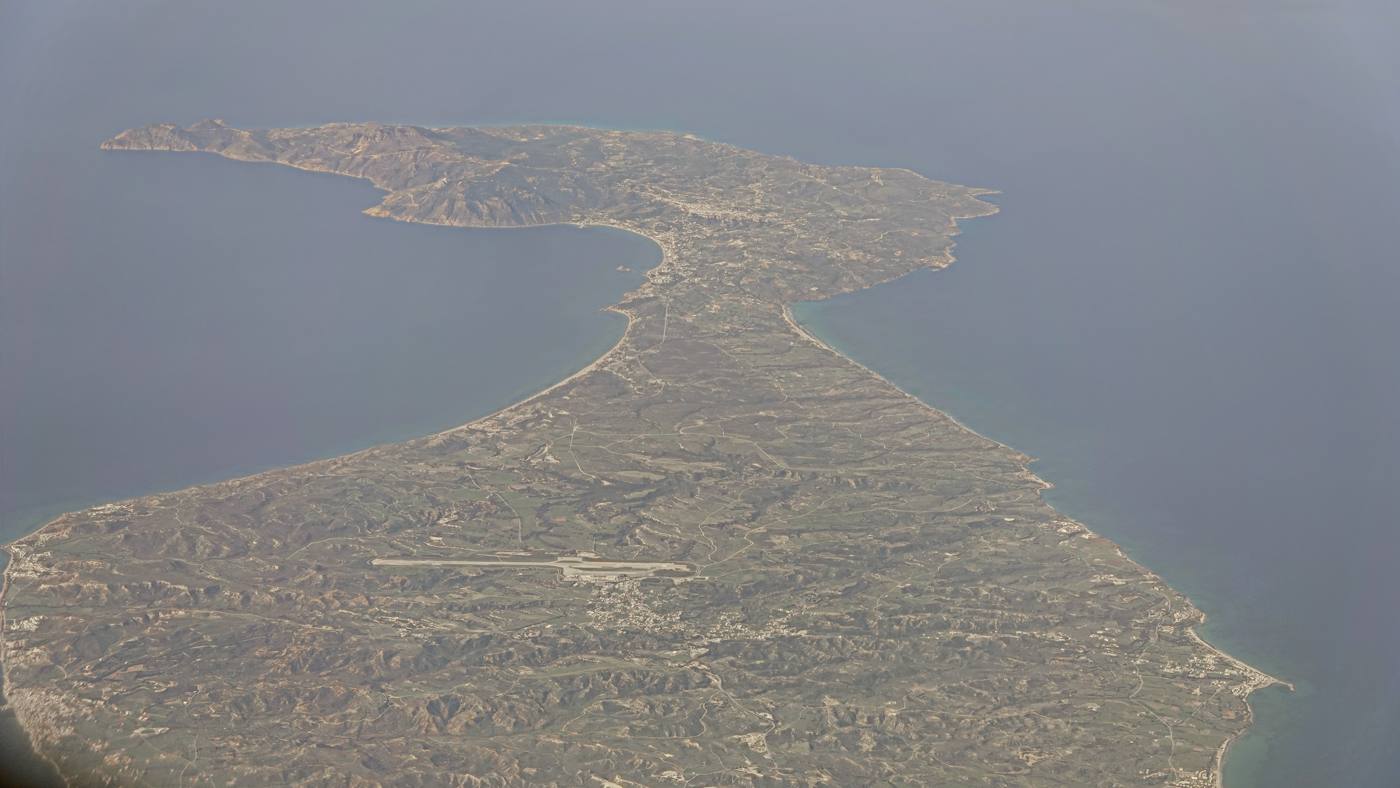
Paradise Beach, known locally and internationally as Bubble Beach, stretches along the sheltered south-facing shore of Kefalos Bay in southwest Kos, about 40 kilometres from the island capital. The beach earns its nickname from the streams of volcanic gas bubbles that rise through the shallow water near the shore. A visible reminder of the volcanic geology that links Kos to neighbouring Nisyros. Pale sand shelves gently into clear, calm water, creating ideal conditions for families with young children and snorkellers eager to watch the bubbles fizz up from the seabed. Plan the whole trip with Greece Tours.
Sunbeds, umbrellas, watersports concessions and a handful of beach bars and tavernas line the organised stretch, while the same sandy ribbon extends east and west to connect with Camel, Magic and Agios Stefanos beaches, forming one of the longest continuous sandy coastlines on the island.
The beach sits directly below the hillside village of Kefalos, the ancient capital of Kos. Draws visitors from Kos Town. Kardamena and the northern resorts who arrive by hire car, bus or organised excursion. The shallow, sheltered bay offers protection from the northern meltemi winds that sweep the Aegean in summer, though afternoon westerlies sometimes pick up, creating conditions that watersports enthusiasts welcome. Snorkellers gather at the eastern end where the bubbles cluster most densely, while families spread across the central organised zone. The beach remains one of the most popular day-trip destinations on the island. Combining natural curiosity with practical amenities and a setting that balances accessibility with a sense of distance from the busier northern coast.
What makes Paradise Beach on Kos famous as Bubble Beach?
Paradise Beach earns the name Bubble Beach from the streams of volcanic carbon-dioxide gas that rise through the shallow water near the shore, creating a continuous fizz of bubbles visible from the surface.
The bubbles emerge from cracks in the seabed between one and three metres from the waterline. Concentrated along a stretch of about 50 metres at the eastern end of the beach. Swimmers and snorkellers wade into the clear water and watch the gas rise in silvery streams, tickling skin and creating a gentle fizzing sound audible above the surface. The vents release carbon dioxide rather than sulphurous gases, so the water carries no unpleasant smell, though the gas itself displaces oxygen and bathers keep their heads above water. The bubbles rise most vigorously on calm days when wave action does not disperse them, and early-morning visitors often find the clearest views before afternoon breezes stir the bay.
The volcanic origin of the bubbles ties Paradise Beach to the broader Dodecanese volcanic arc that includes Nisyros. An active volcano visible on clear days about 16 kilometres south across the strait. The same magma chamber and fault lines that feed Nisyros crater vent gases through fissures in the seabed around Kos, with smaller bubble sites reported at Therma hot-spring beach on the east coast and offshore near Kardamena. Geologists monitor the vents as indicators of subsurface activity, though the gas flow at Paradise Beach remains steady and poses no hazard to swimmers who follow basic precautions. The phenomenon attracts snorkellers, underwater photographers and curious families, turning a geological curiosity into the beach’s signature feature.
Snorkelling over the bubble vents reveals a seabed of pale sand and scattered volcanic rock, with the gas escaping from narrow fissures that appear as dark lines in the sand. Small fish gather around the vents, seemingly unbothered by the gas, and sea grass grows in patches where the bubbles thin. The water remains shallow enough for children to stand and observe the bubbles at close range, with depths rarely exceeding two metres within 20 metres of shore. Visibility reaches 10 to 15 metres on calm days, allowing snorkellers to trace the bubble streams from seabed to surface and watch how currents bend and disperse the rising gas.
The bubbles flow year-round, though summer visitors find the warmest water and calmest conditions for prolonged observation. Spring and autumn bring fewer crowds and equally clear water, while winter swells sometimes obscure the vents under churned sand and wave action. Local taverna owners and beach-bar staff point out the best spots to wade in, and rental snorkel sets are available at the organised beach concessions. The phenomenon remains entirely natural, with no artificial enhancement or infrastructure beyond the information signs that explain the volcanic origin and remind bathers to keep their airways above water when observing the vents up close.
Where exactly is Paradise Beach located on Kos island?
Paradise Beach lies on the south-facing shore of Kefalos Bay in the southwest corner of Kos, about 40 kilometres by road from Kos Town and directly below the hillside village of Kefalos.
The beach occupies the central section of the Kefalos Bay coastline. A sweeping crescent of sand that stretches for roughly five kilometres from the Kamari headland in the west to the Agios Stefanos basilica ruins and Kastri islet in the east. Paradise Beach itself measures about 800 metres along the waterline, marked by a cluster of sunbed rows. Umbrellas and beach bars that distinguish the organised zone from the quieter stretches on either side. The access road descends from the main Kefalos-Kamari road, winding through low hills covered in scrub and ending at a dirt parking area behind the beach.
Signposts along the main road direct drivers to Paradise Beach, Bubble Beach or simply Kefalos Beach, all referring to the same location.
Kefalos village sits on a ridge about two kilometres inland and 150 metres above sea level, offering panoramic views over the bay and across the strait to Nisyros. The village serves as the main residential and commercial centre for the southwest, with supermarkets, tavernas, bakeries and a petrol station, while the beach zone below remains dedicated to tourism. The road from Kos Town follows the island’s central spine past Antimachia and the airport, then descends through Kefalos before branching toward the various bay beaches. Kefalos itself retains a traditional character, with whitewashed houses, narrow lanes and a working agricultural hinterland, contrasting with the purpose-built beach resorts along the sand.
The bay faces south and southwest, sheltered from the prevailing northern meltemi winds by the bulk of the island and the ridge on which Kefalos stands. This orientation creates calmer water than the exposed northern beaches near Tigaki and Marmari, though afternoon westerlies funnel into the bay and create choppy conditions by mid-afternoon on windy days. The seabed slopes gently, with the one-metre depth line lying 10 to 15 metres offshore and the two-metre line another 20 metres beyond. Making the beach safe for children and non-swimmers. Rocky headlands bracket the bay at either end, with the western promontory leading to Kamari village and the eastern point crowned by the ruins of the twin-aisled Agios Stefanos basilica.
Paradise Beach sits roughly midway along the island’s 40-kilometre length. With Kos Town and the main port at the northeast tip and the airport near Antimachia about 12 kilometres northeast of the beach. The location places the beach within day-trip range of all the island’s resorts, yet far enough from the capital to retain a quieter, less commercialised atmosphere. The same sandy bay hosts four named beaches, each blending into the next with no natural barriers. Visitors walking the shoreline pass seamlessly from Paradise to Magic to Agios Stefanos. Experiencing the full sweep of the Kefalos coast in a single stroll.
What facilities and services are available at Paradise Beach Kos?
Paradise Beach offers organised facilities including rows of sunbeds and umbrellas available for daily rental, three beach bars and tavernas serving drinks and meals, watersports concessions with pedal boats, canoes and stand-up paddleboards, and toilets and changing cabins.
Sunbed and umbrella sets line the beach in neat rows, with daily rental prices typically around eight to twelve euros per set, paid to attendants who circulate through the rows. The beds occupy the prime central zone closest to the access road and parking area. Leaving the eastern and western ends of the beach open for visitors who bring their own towels and shade. Beach bars operate from permanent or semi-permanent structures set back from the high-tide line, offering cold drinks, coffee, ice cream and light meals from mid-morning until sunset. Tavernas serve grilled fish, Greek salads, souvlaki and pasta, with tables under pergolas or umbrellas and menus displayed in Greek and English.
Prices reflect the beach location, running higher than equivalent meals in Kefalos village but remaining moderate by resort standards.
Watersports concessions cluster near the central beach bars, renting pedal boats, canoes, stand-up paddleboards and snorkel sets by the hour or half-day. Operators also offer banana-boat rides, ringos and parasailing, with boats launching from the beach and towing riders into the bay. The shallow, calm water suits beginners and families, though afternoon winds sometimes force suspension of towed activities. Snorkel rental includes mask, snorkel and fins, with staff directing renters to the bubble vents at the eastern end and advising on tides and currents. No scuba-diving centre operates directly on Paradise Beach, though dive schools in Kos Town and Kardamena run boat trips to sites around Kefalos Bay and the offshore islets.
Toilets and changing cabins stand near the parking area, maintained by the beach-bar operators and available to all visitors. Showers rinse off sand and salt, fed by tanks rather than mains water, so flow and pressure vary through the day. Parking occupies a rough dirt lot behind the beach, free of charge but unshaded, with space for around 60 cars and a separate area for scooters and bicycles. The lot fills by mid-morning in July and August, prompting latecomers to park along the access road or seek space at the neighbouring beaches.
No lifeguard tower or first-aid station operates on the beach, though mobile-phone coverage reaches the bay and the nearest medical centre sits in Kefalos village, about three kilometres by road.
Beach vendors occasionally walk the sand selling fruit, cold drinks, hats and sarongs, though their presence remains sporadic and low-key compared to busier Greek beaches. Massage services, hair-braiding and temporary-tattoo stalls appear on peak summer weekends but do not constitute a permanent fixture. The organised facilities concentrate in the central zone, leaving the eastern stretch near the bubbles and the western stretch toward Camel Beach quieter and less commercialised. Visitors seeking solitude walk five minutes in either direction to find open sand, while those wanting full service stay within the sunbed rows and close to the bars.
How does the sand and water quality compare at Paradise Beach on Kos?
Paradise Beach features pale golden sand, fine-grained and soft underfoot, shelving gently into clear, shallow water that remains warm from May through October.
The sand derives from the erosion of volcanic and sedimentary rocks that form the Kefalos peninsula, mixed with shell fragments and coral debris carried by currents from the offshore reefs. Grain size falls into the fine-to-medium range, creating a smooth surface that packs well when wet and does not cling excessively to skin or towels. The colour varies from pale cream to light gold depending on moisture and sun angle. The beach remains free of pebbles or coarse gravel except at the extreme high-tide line where winter storms deposit small stones. The sand extends from the backshore dunes and tamarisk scrub down to the waterline.
With a width of 20 to 30 metres at the organised central zone and narrowing to 10 metres at the eastern and western ends.
Water temperature climbs from around 19 degrees Celsius in May to 26 degrees in August, remaining swimmable through October when it cools to around 22 degrees. The shallow gradient means the first 20 metres of water rarely exceed waist depth for an adult, warming quickly under the summer sun and creating bathtub conditions by mid-afternoon. Currents remain weak within the bay, though a gentle westward drift sometimes moves surface water along the beach. Swimmers venturing beyond 50 metres from shore encounter deeper water and stronger tidal flows. The seabed slopes evenly, with no sudden drop-offs or channels, and the sandy bottom provides secure footing for waders and children.
Clarity depends on wind and wave action, with calm mornings offering the best visibility and afternoon breezes stirring up fine sediment that clouds the water. On still days, snorkellers see the seabed clearly at depths of three to four metres. Underwater photographers capture the bubble vents against a backdrop of pale sand and scattered rock. Sea grass grows in patches beyond the swimming zone, attracting small fish and providing habitat for crabs and molluscs, while the volcanic rocks near the vents host algae and occasional sea urchins. The water carries no industrial or agricultural pollution, and the bay’s south-facing orientation and distance from major ports keep boat traffic light and diesel slicks absent.
The beach holds Blue Flag status in years, though certification depends on annual water-quality testing, lifeguard presence and environmental management that varies with local-authority funding. Even without the flag, the water meets European bathing-water standards, and no health warnings or closures affect the beach in typical seasons. Jellyfish appear sporadically in late summer, usually small transparent species that cause mild stings, and bathers exit the water until the bloom drifts past. The combination of fine sand, clear shallow water and gentle slope makes Paradise Beach one of the most family-friendly Kos beaches, rivalling the northern stretches at Tigaki and Marmari for ease of access and safety.
Which other beaches sit near Paradise Beach in Kefalos Bay?
Paradise Beach forms part of a continuous sandy arc in Kefalos Bay, with Camel Beach immediately to the west, Magic Beach to the east, and Agios Stefanos Beach at the eastern end of the bay.
Camel Beach lies about 500 metres west of Paradise Beach, named either for a camel-shaped rock formation offshore or for the camels that once carried tourists along the sand. The beach remains quieter than Paradise, with fewer sunbeds and only one or two small beach bars, attracting visitors who prefer a less organised setting. The sand and water quality match Paradise Beach, and the same gentle slope and clear water prevail, though the bubble vents do not extend this far west. A narrow dirt track connects the two beaches behind the dunes, and walkers cover the distance in under 10 minutes.
Camel Beach offers ample free space for towels and umbrellas, and the western end tapers into a rockier shoreline as the bay curves toward Kamari village.
Magic Beach, also called Sunny Beach by operators, stretches east from Paradise Beach for around 600 metres. Distinguished by a cluster of sunbeds and a large beach-bar complex that hosts music events and beach parties in high season. The beach draws a younger crowd and sees more watersports activity, with jet-ski and parasailing operators launching from the sand. The water remains shallow and calm, and the sand quality mirrors Paradise Beach, though the organised zone extends further along the waterline, leaving less free-access space. Magic Beach blends seamlessly into Paradise Beach with no natural boundary, and visitors walking the shore pass from one to the other without noticing a transition.
The eastern end of Magic Beach approaches the ruins of the Agios Stefanos basilica, visible on a low promontory about 300 metres beyond the last sunbeds.
Agios Stefanos Beach occupies the far eastern end of Kefalos Bay, named for the twin-aisled early-Christian basilica that stands in ruins on the shore. The beach offers a quieter, more scenic setting than Paradise or Magic. With the basilica columns framing views of Kastri islet, a small rocky outcrop crowned by the chapel of Agios Nikolaos. The sand narrows here, and the seabed becomes rockier, with sea grass and boulders replacing the smooth sand of the central bay. Snorkelling improves around the basilica ruins and the islet, where fish gather in the clearer water and rocky substrate.
A single taverna operates near the ruins, and a small parking area serves visitors who drive directly to Agios Stefanos rather than walking from Paradise Beach.
The entire Kefalos Bay arc measures roughly five kilometres from Kamari in the west to Agios Stefanos in the east, with Paradise Beach occupying the central, most accessible section. Visitors staying in Kefalos or Kamari explore the full sweep of beaches on foot or by bicycle, while day-trippers from Kos Town and the northern resorts typically focus on Paradise Beach for its facilities and the bubble phenomenon. The bay’s south-facing orientation and shelter from northern winds create uniform conditions across all four beaches. With the main differences lying in crowd density, amenities and the specific attractions such as bubbles, basilica ruins or beach-bar entertainment.
The continuous sand allows easy beach-hopping, and a morning at Paradise Beach often extends into an afternoon stroll to Agios Stefanos or a sunset visit to Camel Beach.
How do families and snorkellers enjoy Paradise Beach on Kos?
Families favour Paradise Beach for its shallow, calm water, gentle sandy slope and organised facilities including sunbeds, beach bars and toilets.
The shallow gradient allows toddlers and young children to wade and play in water that remains knee-deep for 15 to 20 metres from shore. Parents set up base in the sunbed rows with clear sightlines to the waterline. The sandy bottom provides soft, safe footing. Free of sharp rocks or sea urchins in the main swimming zone. The absence of strong currents or sudden drop-offs reduces the risk of children drifting out of depth. Beach bars sell ice cream, soft drinks and snacks that appeal to children, and the toilets and changing cabins eliminate the return to hotels or apartments for breaks.
Pedal boats and canoes offer family-friendly watersports, and the calm bay suits first-time paddlers and young riders on banana boats or ringos.
Snorkellers concentrate near the bubble vents at the eastern end of the beach, where the gas streams create a unique underwater spectacle. Rental snorkel sets cost around five to eight euros for the day, and beach-bar staff direct snorkellers to the best entry points and the densest bubble clusters. The vents lie in water one to two metres deep, allowing snorkellers to hover above the fissures and watch the gas rise in continuous streams. Visibility reaches 10 to 15 metres on calm mornings, and the pale sandy seabed contrasts with the dark fissures and scattered volcanic rocks, making the bubbles easy to spot.
Small fish, including damselfish and wrasse, dart around the vents, and occasional octopuses hide in the rocks, adding interest beyond the geological phenomenon.
Underwater photographers bring waterproof cameras and GoPros to capture the bubbles, experimenting with angles and lighting to frame the rising gas against the sunlit surface. The best images emerge in early morning when the sun illuminates the water from the east, backlighting the bubbles and creating silvery trails. Snorkellers also explore the sea-grass beds and rocky patches beyond the bubble zone, where biodiversity increases and larger fish appear. The shallow depth and clear water make Paradise Beach an ideal beginner snorkelling site, and families introduce children to mask and snorkel in the safe, calm conditions.
Guided snorkel tours occasionally visit the beach as part of broader Kefalos Bay itineraries, though most snorkellers arrive independently and explore at their own pace.
The combination of family amenities and snorkelling interest gives Paradise Beach broad appeal, attracting multi-generational groups who split time between sunbathing, swimming and underwater exploration. The beach remains busy but not overcrowded, with enough space for both sunbed users and free-access visitors. Families appreciate the proximity to Kefalos village for additional dining and shopping options. The beach’s position within a larger bay system allows easy excursions to quieter stretches when the central zone fills. Snorkellers often combine a morning at the bubble vents with an afternoon visit to Agios Stefanos or a boat trip to Nisyros. Making Paradise Beach a starting point for wider exploration of the southwest coast and its volcanic heritage.
How do visitors reach Paradise Beach from Kos Town and other resorts?
Visitors reach Paradise Beach by hire car, scooter, public bus or organised excursion, with the journey from Kos Town covering about 40 kilometres and taking around 50 minutes by car or 70 minutes by bus.
Hire cars and scooters offer the most flexible transport, allowing visitors to explore the full Kefalos Bay coastline and stop at Antimachia Castle, Kefalos village or other beaches en route. The main road from Kos Town runs southwest through Zipari and Antimachia, passing the airport and climbing over the central ridge before descending to Kefalos. The route is well-paved and signposted, with minimal traffic outside peak hours, and the journey covers around 40 kilometres. From Kefalos, drivers follow signs toward Kamari and the beaches. Turning onto a narrow paved road that descends to the coast and then branching onto a dirt track marked for Paradise Beach or Bubble Beach.
The dirt track runs for about 500 metres, passable by all vehicles but dusty and rutted, ending at the informal parking area behind the beach.
Public buses operated by KTEL Kos connect Kos Town to Kefalos village, with around six departures per day in summer and fewer in winter. The journey takes approximately 70 minutes, with stops in Zipari, Antimachia and other villages along the route. Buses terminate in Kefalos village centre, about two kilometres uphill from Paradise Beach, and passengers walk downhill along the paved road or take a taxi for the final leg. The walk takes around 25 minutes and descends 150 metres in elevation, offering views over the bay but exposed to sun and heat in summer.
Return buses depart Kefalos in the afternoon and early evening, with the last service typically leaving around 19:00, so day-trippers plan their beach time accordingly. Timetables vary by season, and visitors confirm schedules at the Kos Town bus station or online before travelling.
Organised excursions run by tour operators in Kos Town, Kardamena and the northern resorts include Paradise Beach as part of full-day or half-day itineraries. Often combined with stops at Kefalos village, Agios Stefanos and a boat trip to Nisyros. Coaches pick up passengers from hotels and drop them at the beach for two to three hours, providing a hassle-free option for visitors without vehicles. Prices vary by operator and itinerary, typically ranging from 25 to 40 euros per adult including transport and sometimes a meal or drink voucher. The excursions suit families and groups who prefer guided commentary and fixed schedules, though they offer less flexibility than independent travel.
Some operators focus specifically on the bubble phenomenon, marketing the trip as a snorkelling or natural-wonder excursion.
Visitors staying in Kardamena, about 12 kilometres northeast of Paradise Beach, drive or take a taxi in around 20 minutes, while those in Kamari, at the western end of Kefalos Bay, reach the beach in under 10 minutes. Taxis from Kos Town to Paradise Beach cost around 50 to 60 euros one-way, making shared rides or hire cars more economical for groups. Cycling from Kos Town remains impractical due to the distance and hilly terrain, though cyclists based in Kefalos or Kardamena ride to the beach along the coastal roads. The beach’s location at the island’s southwestern extremity places it beyond easy reach of the northern resorts at Tigaki and Marmari.
Visitors from those areas commit to a full day-trip. The journey rewards the effort with one of the island’s most distinctive natural features and a beach setting that balances accessibility with a sense of remoteness from the busier northern coast, making Paradise Beach a highlight of any comprehensive things to do in Kos itinerary.
What wind and weather conditions affect Paradise Beach on Kos?
Paradise Beach benefits from shelter against the northern meltemi winds that dominate the Aegean in summer, thanks to its south-facing orientation and the ridge behind Kefalos village.
The meltemi, a strong northerly wind that blows from June through September, sweeps across the Aegean and batters the exposed northern beaches of Kos, including Tigaki, Marmari and Mastichari. Paradise Beach sits on the sheltered southern coast, protected by the island’s central ridge and the bulk of Mount Dikeos, so the meltemi’s force diminishes before reaching the bay. On days when northern beaches see whitecaps and flags warning swimmers, Paradise Beach often remains calm and swimmable, with only a gentle breeze ruffling the surface. This shelter makes the Kefalos Bay beaches popular alternatives when the meltemi blows hard, and visitors relocate from the north coast to enjoy calmer conditions and easier swimming.
Westerly and southwesterly winds develop in the afternoon as local thermal circulation draws air inland from the sea, funnelling through the gap between the Kefalos ridge and the offshore islands. These afternoon breezes pick up around midday and strengthen through the early afternoon, creating choppy water, stirring up sand and reducing underwater visibility. Watersports operators welcome the wind for windsurfing and kitesurfing, though these activities concentrate at the more exposed western end of the bay near Kamari rather than at Paradise Beach. Swimmers find the afternoon chop less pleasant than the morning calm, and snorkellers targeting the bubble vents arrive early to catch the clearest water before the wind rises.
By late afternoon, the breeze often drops, and the bay settles into a calm evening state.
Summer temperatures in Kefalos Bay range from 28 to 35 degrees Celsius, with the beach offering little natural shade beyond the umbrellas and pergolas at the beach bars. Visitors bring hats, sunscreen and water, and the beach bars sell cold drinks and ice to counter the heat. Spring and autumn bring milder temperatures, from 20 to 28 degrees, with less wind and fewer crowds, making these seasons attractive for visitors who prefer quieter conditions. Winter sees occasional rain and stronger storms, with waves eroding the beach and depositing stones along the high-tide line, though the bay remains accessible and some hardy swimmers use the beach year-round.
Water temperature drops to around 16 degrees in winter, deterring most bathers but not the local fishermen who launch boats from the sand.
Cloud cover remains rare in summer, with clear skies prevailing from May through September and sunshine averaging 12 to 14 hours per day. The south-facing orientation maximises sun exposure, and the beach receives direct light from dawn until late afternoon when the Kefalos ridge casts shadow over the western end. Sunrise occurs over the sea to the east, and early-morning visitors watch the sun climb above the horizon and illuminate Nisyros across the strait. Sunset happens behind the ridge to the west. The beach does not offer direct sunset views, though the sky colours and the silhouette of the hills create atmospheric evening light.
The combination of shelter from the meltemi, afternoon westerlies and abundant sunshine defines the weather rhythm at Paradise Beach. With mornings offering the best conditions for families and snorkellers and afternoons suiting sunbathers and watersports enthusiasts who tolerate the breeze.


What makes Paradise Beach different from other beaches on Kos?
Paradise Beach stands apart from other Kos beaches through its volcanic bubble vents, a unique geological phenomenon visible nowhere else on the island.
The bubble vents distinguish Paradise Beach from every other beach on Kos, offering a natural spectacle that draws snorkellers. Photographers and curious visitors who want to witness the volcanic gases rising through the seabed. No other beach on the island features this phenomenon, though Therma hot-spring beach on the east coast offers warm water from geothermal vents. The bubbles connect Paradise Beach to the broader volcanic landscape of the Dodecanese, linking the island to Nisyros and the tectonic forces that shape the region. This geological interest elevates the beach beyond a simple sun-and-sand destination, adding an educational and exploratory dimension that appeals to families, school groups and nature enthusiasts.
The location in Kefalos Bay, far from the commercial centres of Kos Town and the northern resorts. Gives Paradise Beach a quieter, more relaxed atmosphere than the heavily developed beaches near Tigaki, Kardamena and Psalidi. The journey from Kos Town requires commitment, filtering out casual visitors and attracting those willing to travel for a specific experience. The beach retains a balance between organisation and naturalness. With sunbeds and bars concentrated in the central zone but ample free space on either side and a setting framed by the Kefalos ridge and the open Aegean.
The south-facing orientation and shelter from the meltemi create calmer conditions than the exposed northern beaches, making Paradise Beach a reliable choice when wind disrupts swimming elsewhere on the island.
The continuous sandy arc of Kefalos Bay allows visitors to explore four distinct beaches in a single visit. Walking from Paradise to Camel, Magic or Agios Stefanos and experiencing different levels of facilities, crowds and scenery. This variety within a compact area contrasts with the more isolated beaches on the north and east coasts, where each beach requires a separate journey. The proximity to Kefalos village adds cultural and practical depth, offering traditional tavernas, shops and a glimpse of island life beyond the beach resorts. The combination of bubble vents, scenic bay setting, beach-hopping potential and access to Kefalos village creates a richer. More layered beach experience than the straightforward sun-and-swim offerings at many other Kos beaches.
Paradise Beach also benefits from its position within day-trip range of Nisyros, Kalymnos and the Turkish coast. Making it a convenient base for visitors who combine beach time with island-hopping or cultural excursions. Boats to Nisyros depart from Kardamena, a short drive northeast. The volcanic crater and traditional villages of Nisyros complement the bubble vents at Paradise Beach. Creating a thematic link between the two destinations. The beach’s family-friendly facilities, snorkelling interest and unique geological feature make it a standout choice for visitors seeking more than generic beach lounging. Its inclusion in most comprehensive Kos itineraries reflects its status as one of the island’s signature coastal attractions.
When is the best time to visit Paradise Beach on Kos?
The best time to visit Paradise Beach falls between May and October, when water temperatures reach swimmable levels and facilities operate fully.
May marks the start of the swimming season, with water temperatures climbing to around 19 to 21 degrees Celsius and air temperatures reaching 24 to 28 degrees. The beach remains quiet, with sunbed operators just opening for the season and beach bars running limited hours. Wildflowers bloom on the hills behind Kefalos, and the landscape retains the green hues of spring before the summer drought browns the vegetation. Snorkelling conditions improve as the water warms and calms, and the bubble vents appear clearly in the still morning water. June brings warmer water, around 22 to 24 degrees, and longer days, with sunrise before 06:00 and sunset after 20:00, allowing extended beach time.
Crowds build through June but remain manageable, and accommodation prices in Kefalos and Kardamena stay below peak-season rates.
July and August constitute the peak season, with water temperatures reaching 25 to 26 degrees and air temperatures often exceeding 32 degrees. The beach fills with sunbeds, and the parking area reaches capacity by late morning, prompting early arrivals or acceptance of roadside parking. Beach bars and tavernas operate at full capacity, and watersports concessions run continuous sessions from mid-morning until late afternoon. The meltemi blows strongest in July and August, though Paradise Beach’s sheltered position mitigates the wind’s impact, and the afternoon westerlies create choppy conditions that visitors find refreshing.
Families dominate the beach during these months, coinciding with European school holidays, and the atmosphere turns lively with children playing in the shallows and beach bars hosting music events.
September offers an ideal compromise, with water temperatures holding at 24 to 25 degrees. Air temperatures moderating to 28 to 30 degrees. Crowds thinning as families return home for the school year. The sea retains the warmth accumulated over summer, often feeling warmer in September than in June, and the wind drops, creating calm, clear conditions for snorkelling. Beach bars and tavernas remain open, and sunbed availability improves, allowing visitors to choose prime spots without early arrival. October extends the season for hardy swimmers, with water around 22 degrees and air temperatures from 22 to 26 degrees, though facilities close and bus services reduce frequency.
The landscape turns golden and dry, and the light softens, creating atmospheric conditions for photography and beach walks.
Within each day, early morning from 08:00 to 11:00 offers the best conditions for snorkelling the bubble vents, with calm water, clear visibility and low sun illuminating the seabed. Families arrive mid-morning and stay through lunch, while sunbathers occupy the beach from late morning until mid-afternoon. Late afternoon from 16:00 onward sees the wind drop and the beach empty, creating a quieter atmosphere for swimming and strolling. The beach receives sun from sunrise until around 18:00, when the Kefalos ridge casts shadow over the western end, so visitors seeking all-day sun position themselves toward the eastern end. The combination of seasonal and daily timing allows visitors to tailor their Paradise Beach experience to their priorities.
Whether snorkelling the bubbles in calm morning water, enjoying family beach time in the organised zone or exploring the quieter stretches in late afternoon.
Frequently Asked Questions
Are the volcanic bubbles at Paradise Beach safe for swimmers?
The volcanic bubbles at Paradise Beach pose no danger to swimmers who keep their heads above water and avoid prolonged inhalation of the gas. The bubbles consist of carbon dioxide venting from fissures in the seabed, displacing oxygen in the immediate area but dissipating rapidly into the atmosphere. Swimmers wade into the shallow water, stand or float above the vents and watch the bubbles rise without experiencing any harmful effects. The gas carries no sulphurous smell or skin irritation, and the water remains clear and clean. Snorkellers observe the bubbles from the surface, dipping their masks underwater to watch the streams rise from the seabed, and surface regularly to breathe fresh air.
Children and adults alike enjoy the tickling sensation of bubbles against skin, and the vents have operated for decades without incident. Beach-bar staff and local guides advise visitors to avoid putting their faces directly into concentrated bubble streams and to keep airways above water. Standard precautions that ensure a safe and enjoyable experience.
Can visitors walk from Paradise Beach to Agios Stefanos Beach?
Visitors walk from Paradise Beach to Agios Stefanos Beach along the continuous sandy shoreline, covering around 1.5 kilometres in approximately 20 to 25 minutes at a leisurely pace. The route follows the waterline or the backshore. Passing through the organised zones of Magic Beach and then reaching the quieter eastern end where the Agios Stefanos basilica ruins stand on a low promontory. The walk offers views of Kastri islet, the twin-aisled basilica columns and the open Aegean, with opportunities to stop for a swim or explore the rockier seabed near the ruins. The sand remains soft and even, suitable for barefoot walking, though the midday sun heats the surface and walkers bring sandals or water shoes.
The route passes beach bars and sunbed rows at Magic Beach, then opens into free-access sand as it approaches Agios Stefanos. Return walkers retrace the shoreline or follow the dirt track behind the dunes, which runs parallel to the beach and offers shade from scattered tamarisk trees. The walk suits families, couples and solo visitors seeking a scenic stroll that combines beach-hopping with cultural interest. The flat terrain and short distance make it accessible to all fitness levels.
What visitors bring to Paradise Beach for a day visit?
Visitors bring sunscreen with high SPF, hats, sunglasses, towels, water bottles and snacks for a comfortable day at Paradise Beach, as the beach offers limited natural shade and prices at beach bars run higher than supermarkets. Snorkel sets enhance the experience of observing the bubble vents, though rental sets are available at the beach for around five to eight euros. Waterproof bags protect phones, cameras and valuables from sand and water, and beach umbrellas or pop-up sun shelters provide shade for visitors who prefer not to rent sunbeds. Sandals or water shoes ease walking on the hot sand and protect feet from occasional rocks near the bubble vents.
Cash covers sunbed rental, beach-bar purchases and parking tips, as card machines are not always available. Families bring inflatable toys, buckets and spades for children, and coolers with drinks and fruit keep everyone hydrated through the day. A light beach bag holds essentials, and visitors leave valuables in hotel safes or car trunks rather than unattended on the beach. The combination of personal supplies and available facilities ensures a comfortable, enjoyable day without reliance on expensive beach-bar services.
How does Paradise Beach compare to Tigaki Beach on Kos?
Paradise Beach and Tigaki Beach offer contrasting experiences, with Paradise featuring volcanic bubble vents, a southwest location in Kefalos Bay and shelter from the meltemi, while Tigaki stretches along the exposed north coast with fine white sand, shallow water and strong afternoon winds that attract windsurfers. Paradise Beach lies 40 kilometres from Kos Town, requiring a committed journey, whereas Tigaki sits 12 kilometres west of the capital, easily reached by bus, bike or car. Tigaki offers a longer, wider beach with more sunbed operators, hotels and tavernas lining the shore, creating a developed resort atmosphere, while Paradise Beach balances organised facilities with quieter free-access zones and a more remote setting.
Tigaki’s north-facing orientation exposes it to the meltemi, creating choppy water and windblown sand in summer, conditions that Paradise Beach avoids through its south-facing position. Families seeking calm water and unique snorkelling favour Paradise Beach, while windsurfers, kitesurfers and visitors wanting easy access from Kos Town prefer Tigaki. Both beaches feature pale sand and shallow water. Paradise Beach’s bubble vents and scenic Kefalos Bay setting give it a distinctive character that Tigaki’s longer, more uniform stretch cannot match.
Are there accommodation options near Paradise Beach?
Accommodation near Paradise Beach concentrates in Kefalos village, about two kilometres uphill. In Kamari village at the western end of the bay. With options ranging from family-run studios and apartments to small hotels and villa rentals. Kefalos offers around 20 accommodation properties, including traditional guesthouses, self-catering apartments and modest hotels, most within walking or short driving distance of the beach. Prices remain moderate compared to Kos Town and the northern resorts. With studios starting around 40 to 60 euros per night in peak season and apartments for families running 70 to 100 euros.
Kamari, a quieter village closer to the western beaches, hosts a handful of small hotels and apartment complexes, popular with visitors seeking a tranquil base and direct beach access. Kardamena, 12 kilometres northeast, provides a larger selection of hotels, all-inclusive resorts and self-catering properties, with regular bus and taxi connections to Paradise Beach. Visitors staying in Kos Town or the northern resorts treat Paradise Beach as a day-trip destination rather than choosing nearby accommodation, though those planning extended exploration of the Kefalos peninsula and southwest coast find staying locally convenient. Booking ahead in July and August ensures availability, while May, June and September offer more choice and flexibility.
What other activities are available around Paradise Beach and Kefalos?
Activities around Paradise Beach and Kefalos include exploring the hillside village of Kefalos with its traditional architecture, tavernas and panoramic views. Visiting the ruins of the ancient capital at Palatia on the Kefalos headland, hiking to the Venetian castle at Antimachia. Taking boat trips to Nisyros volcano, Kalymnos or the Turkish coast. Kefalos village retains a working character, with bakeries, butchers, mini-markets and kafeneia where locals gather, offering a contrast to the beach-resort atmosphere. The ancient Astypalaia ruins at Palatia, perched on a dramatic headland west of Kefalos. Reveal remnants of the island’s classical capital, including walls, foundations and cisterns, with sweeping views over the Aegean.
Antimachia Castle, a Venetian fortress about 10 kilometres northeast, encloses two churches and offers sunset views from its ramparts. Boat excursions depart Kardamena for Nisyros, where visitors hike into the volcanic crater and explore the traditional villages of Mandraki and Nikia. Creating a full-day outing that complements the bubble vents at Paradise Beach. Cycling, windsurfing at Kamari, scuba diving and jeep safaris into the island’s interior round out the activity menu. Giving visitors based near Paradise Beach a range of options beyond beach lounging.
Is Paradise Beach suitable for visitors with limited mobility?
Paradise Beach presents challenges for visitors with limited mobility due to the dirt access track. Soft sand and absence of paved pathways or wheelchair ramps, though the shallow water and flat terrain suit those who can reach the waterline. The parking area sits on rough dirt about 50 metres from the beach, and the path to the sand crosses uneven ground without hard surfacing. The sand itself is soft and difficult to navigate with wheelchairs or walkers, though visitors with mobility aids reach the sunbed rows near the beach bars where the sand packs more firmly.
No designated accessible facilities, adapted toilets or beach wheelchairs are available, and the beach bars and tavernas operate from structures with steps or uneven thresholds. Visitors with limited mobility who reach the waterline find the gentle slope and shallow water accommodating, allowing safe entry and swimming with minimal wave action. Companions assist with transport from parking to beach, and some sunbed operators help position chairs near the waterline to reduce walking distance. The lack of formal accessibility infrastructure reflects the beach’s relatively undeveloped character. Visitors with significant mobility challenges find better facilities at the organised beaches near Kos Town. Such as Psalidi or Lambi, where paved promenades and accessible amenities operate.