
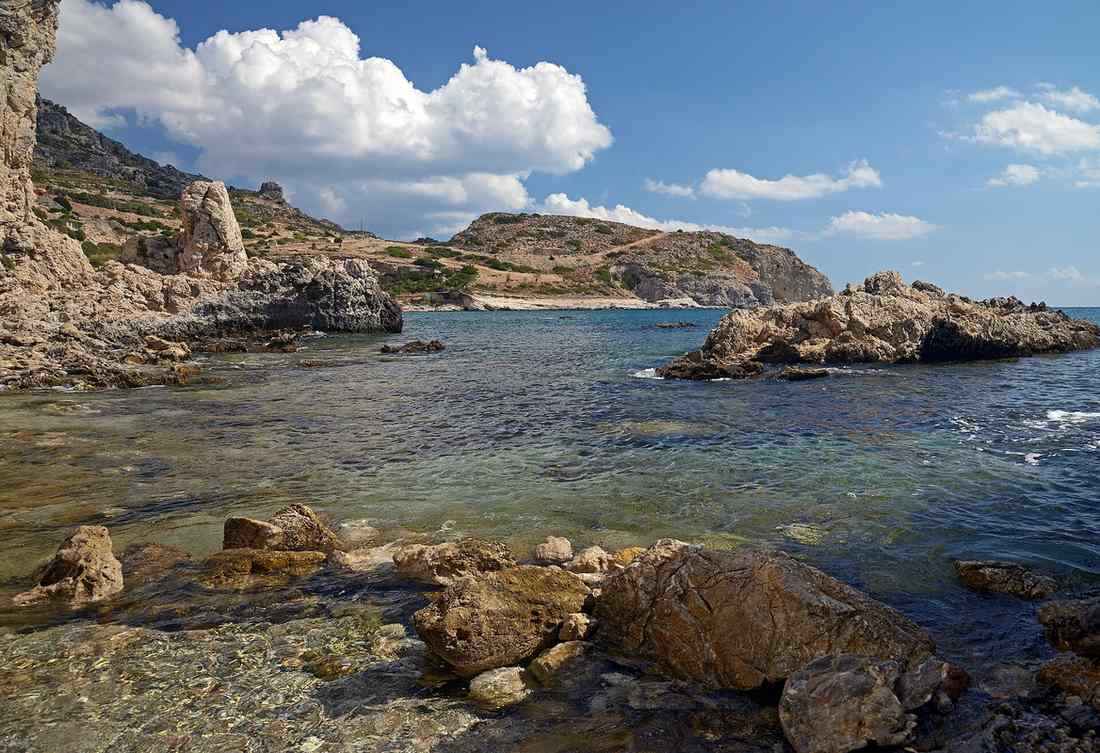
Papafragas is a tiny, spectacular cove on the north coast of Milos, where turquoise water fills a narrow channel between high white cliffs, forming sea caves and arches. Plan your visit with tours, boat trips and tickets from My Greece Tours.
Papafragas is a natural wonder of the Milos travel guide. The sections below cover what Papafragas is, the caves and channels, the ancient Phylakopi site nearby, how to visit, and tips for the descent.
What is Papafragas on Milos?
Papafragas is a small, dramatic cove on the north coast of Milos, near Pollonia and about 8 km from Adamas.
Turquoise water fills a narrow channel cut deep between high white and grey cliffs, forming sea caves, tunnels and arches that were once a hidden pirate harbour. The tiny sandy beach at the inlet is barely a handful of metres long.. But the striking rock formations and crystal-clear water make Papafragas one of the most photogenic natural sights on the island, best admired from the cliff above. Papafragas is one of the most spectacular natural sights on Milos, a tiny but dramatic cove on the island’s north coast. Close to the fishing village of Pollonia and around eight kilometres from the main town of Adamas.
Small in size yet outsized in beauty, it is a place that stops visitors in their tracks.
The cove is formed where the sea has cut a narrow channel deep inland between towering white and grey cliffs, creating a striking fjord-like inlet filled with brilliant turquoise water. Around it, the sea has carved a series of caves, tunnels and natural arches into the soft volcanic rock, three slender canals passing through the cliffs. In past centuries this sheltered, hidden spot served as a secret harbour for pirates. The actual beach is minuscule, a patch of sand barely five metres across at the head of the inlet, but two sizeable interconnected caves add room and drama. The contrast of the vivid turquoise water against the pale rock makes Papafragas intensely photogenic.
Even admired from the cliff top above it is one of the unmissable natural wonders of Milos. The questions below cover what visitors ask most.
What are the caves and channels like?
Papafragas is a cluster of sea grottoes, tunnels and arches. The main feature is a narrow channel of clear turquoise water running between sheer white cliffs into the rock, with two large interconnected caves and smaller canals branching off.
The white and grey rock contrasts vividly with the blue water. Strong swimmers sometimes swim into the channel and caves from the tiny beach, but the descent is tricky and the cove small. For most, the caves are best viewed and photographed from the clifftop viewpoint above. The caves and channels are the essence of Papafragas, a natural sculpture of rock and water. The centrepiece is the main channel, a narrow corridor of clear turquoise sea that runs from the open water deep into the cliffs through a gap in the rock. Flanked by sheer white walls that rise high on either side and frame the brilliant blue below.
Off this main inlet, the formation opens into two large interconnected caves and a set of smaller canals threading through the cliffs. The legacy of the sea slowly eroding the soft volcanic stone over millennia. The colour contrast is extraordinary, the pale white and grey rock set against the vivid turquoise and deep blue of the water. Strong, confident swimmers sometimes make their way down to the tiny beach and swim into the channel and the caves to explore them from the water, an adventurous experience.. But the descent is steep and tricky and the cove is very small, so this suits only the able and careful.
For the great majority of visitors, the safest and still utterly rewarding way to enjoy Papafragas is from the clifftop viewpoint above. Which offers a breathtaking, postcard-perfect view straight down into the caves and channels. The questions below cover what visitors ask most.
What is the ancient Phylakopi site nearby?
Right beside Papafragas lies Phylakopi, one of the most important ancient sites in the Cyclades. It was a major Bronze Age settlement, flourishing in the Minoan and Mycenaean periods, and you can still see the remains of its fortifications, houses and a sanctuary.
The site shows how significant Milos was in antiquity, thanks partly to its prized obsidian. Combining the natural drama of Papafragas with the ancient ruins of Phylakopi next door makes for a rich and rewarding stop on the north coast. One of the bonuses of visiting Papafragas is that it sits right next to a site of major historical importance. So you can pair natural beauty with deep history in a single stop. Just around the corner from the cove lie the remains of Phylakopi, one of the most significant ancient settlements in the entire Cyclades.
Phylakopi was a substantial Bronze Age town that flourished over a host of centuries, rising to prominence during the Minoan and later Mycenaean periods. When Milos was an important Aegean centre thanks in large part to its prized obsidian, the volcanic glass traded across the ancient world for tools and weapons. Today visitors can walk among the excavated ruins and make out the remains of the settlement’s fortification walls. Its houses and a sanctuary, evidence of a sophisticated community that thrived here thousands of years ago. While the ruins are modest compared with grander classical sites, their great antiquity and their setting beside the sea give them real interest.
Combining the spectacular natural drama of the Papafragas caves with the ancient story of Phylakopi next door turns a short stop into a rich and rewarding experience that captures both the natural and the historical depth of Milos. The questions below cover what visitors ask most.
How do you visit Papafragas?
Papafragas is on the north coast of Milos, near Pollonia and reached by car or scooter following signs toward Pollonia, with a paved road almost to the parking area. From the car park, a clifftop viewpoint gives the famous view down into the caves.
A steep, rough path descends to the tiny beach, but it requires care and good footwear and is not for everyone. There are no facilities, so bring water and sun protection. Combine the visit with Pollonia and ancient Phylakopi nearby. Visiting Papafragas is easy in terms of reaching it, though getting down to the water is another matter. The cove lies on the northern side of Milos, near Pollonia. You reach it by car, ATV or scooter, following the signs toward the northern part of the island and Pollonia.. With the road paved almost all the way to a designated parking area that overlooks the cove.
From the car park, a clifftop viewpoint immediately rewards you with the spectacular, postcard view looking straight down into the turquoise channel and caves. For a host of visitors this is the whole experience, safe and stunning. Those wanting to reach the tiny beach face a steep, rough path carved into the rock that demands real care, sure footing and sturdy shoes, preferably trainers rather than flip-flops. It is not suitable for everyone, particularly in slippery conditions. Because the cove has no facilities at all, you can bring your own water, sun protection and anything else you need, and carry it down.
The ideal plan is to combine Papafragas with the nearby attractions on this side of the island. The charming fishing village of Pollonia for lunch and the ancient ruins of Phylakopi right beside the cove, weaving them into a rewarding half-day on the north coast of Milos. The questions below cover what visitors ask most.
Papafragas is best appreciated with a little patience and care. The clifftop viewpoint gives the famous, postcard image looking straight down into the turquoise channel. Simply standing here to take it in, especially in the clear light of morning, is reward enough for most visitors. Those who attempt the steep path to the tiny beach can wear proper shoes, take their time, and avoid it altogether when the rock is wet or the sea rough.
The setting repays a slower visit. The colours shift through the day as the sun moves over the white cliffs and the deep channel. The surrounding north coast, with its old sulphur and manganese mining history, adds geological interest. Bring water and sun protection, as there is no shade or facilities at the cove, and combine the stop with the nearby village and ancient site for a fuller half-day.
More than anything, Papafragas captures in miniature what makes the Milos coastline so special: soft volcanic rock sculpted by the sea into caves. Arches and channels, filled with impossibly clear water. It is a reminder that the island’s beauty lies not only in its beaches but in these dramatic. Hidden formations carved by nature over thousands of years, best discovered slowly and treated with respect.
Papafragas pairs with the moonscape of Sarakiniko beach on the same coast, the fishing village of Pollonia nearby, the wider Milos beaches. The full list of things to do in Milos.
Papafragas leaves a lasting impression, and it features on most itineraries of the north coast for good reason. Even a brief stop at the viewpoint delivers one of the island’s signature images, and the surrounding area rewards a longer look. Pairing it with the fishing village of Pollonia and the ancient ruins of Phylakopi makes a rounded outing that blends natural drama. Village charm and deep history, capturing the variety that makes Milos such a rewarding island to explore beyond its beaches alone.
Frequently Asked Questions
What is Papafragas on Milos?
Papafragas is a tiny, dramatic cove on the north coast of Milos, near Pollonia. Turquoise water fills a narrow channel cut deep between high white and grey cliffs, forming sea caves, tunnels and arches that were once a hidden pirate harbour. The sandy beach at the inlet is barely a handful of metres long.. But the striking rock formations and crystal-clear water make it one of the most photogenic natural sights on the island, best admired from the clifftop viewpoint above.
Can you swim at Papafragas?
Strong, confident swimmers sometimes climb down to the tiny beach at Papafragas and swim into the turquoise channel and caves to explore them from the water. However, the descent down the rocks is steep and tricky, the cove is very small, and there are no facilities, so it suits only able, careful visitors with good footwear. For most people, Papafragas is best and most safely enjoyed from the spectacular clifftop viewpoint above the caves.
What is near Papafragas on Milos?
Right beside Papafragas lies Phylakopi, one of the most important ancient sites in the Cyclades, a Bronze Age settlement with the remains of fortifications, houses and a sanctuary. The charming fishing village of Pollonia, known for its seafood tavernas and sheltered beach, is also close by, as is the moonscape of Sarakiniko along the same north coast. Combining Papafragas with Phylakopi and Pollonia makes a rich half-day on the north coast of Milos.