
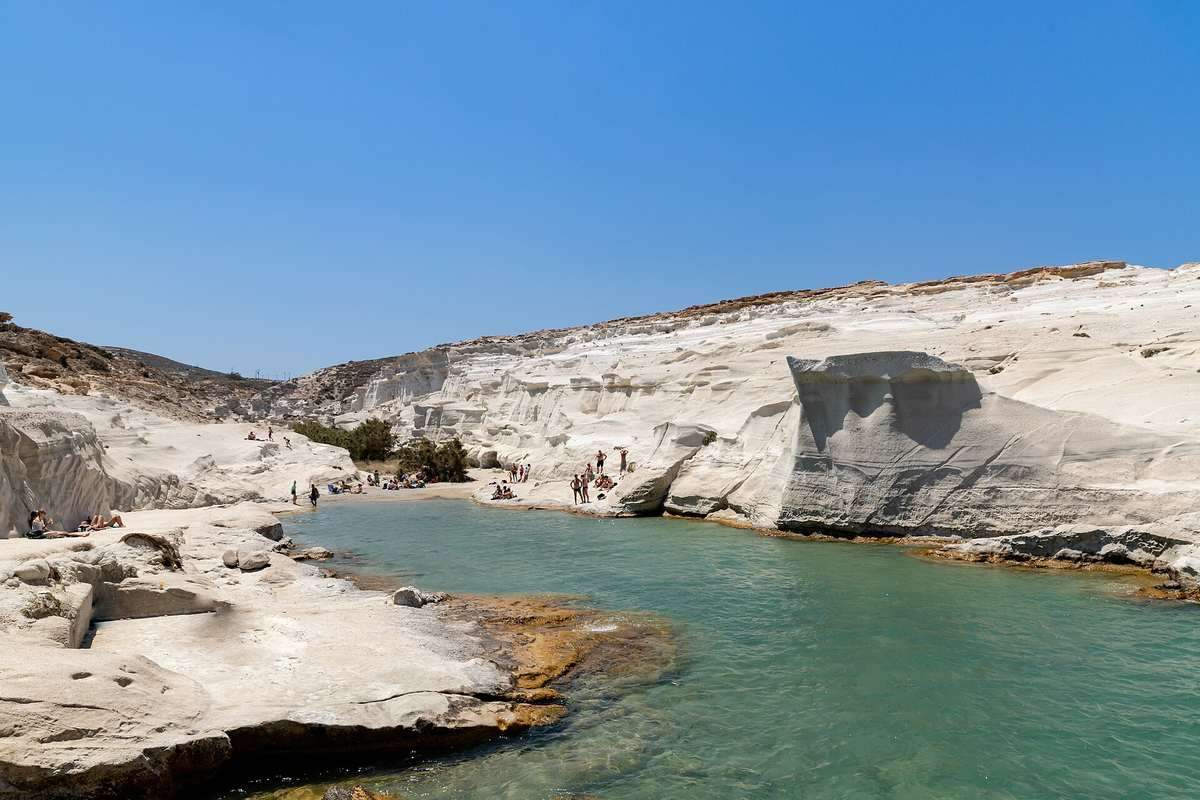
Sarakiniko is the famous moon-like beach of Milos, a surreal landscape of brilliant-white volcanic rock sculpted into curves and ridges above deep blue water. Plan your visit with tours, boat trips and tickets from My Greece Tours.
Sarakiniko is the signature sight of the Milos travel guide. The sections below cover what Sarakiniko is, getting there, when to go, swimming and cliff-jumping, and the essential visiting tips.
What is Sarakiniko beach?
Sarakiniko is the most famous beach on Milos, a surreal moonscape on the north coast where brilliant-white volcanic rock has been eroded by wind and waves into smooth curves. Ridges and hollows, resembling the surface of the moon.
Formed by ancient volcanic activity and bleached white, the rock plunges into a narrow inlet of deep blue water. There is little sand, but the dramatic landscape, swimming and cliff-jumping make it unmissable. Sarakiniko is the defining image of Milos and one of the most striking beaches in Greece. Sarakiniko is the most iconic sight on Milos and one of the most extraordinary beaches in all of Greece. A place so unlike a normal beach that it is often described as lunar. Set on the north coast of the island, it is a landscape of pure spectacle, formed by the island’s volcanic past and shaped over millennia into something genuinely otherworldly.
The story is written in the rock. Ancient volcanic eruptions laid down pale stone that the wind and the sea have since carved and smoothed into soft, rounded curves, ridges, ledges and hollows. The total absence of vegetation leaves it a brilliant, dazzling white, so that the whole terrain really does evoke the surface of the moon. Cutting into this white world is a narrow fjord-like inlet of deep, vivid blue water, the contrast between the white rock and the blue sea giving Sarakiniko its unforgettable beauty.
There is very little actual sand here, so this is a beach to marvel at and explore as most as to lie on.. With swimming in the inlet, cliff-jumping from the ledges. Wandering the white canyons among its pleasures. As the defining image of Milos, Sarakiniko is a place no visitor can miss. The questions below cover what visitors ask most.
How do you get to Sarakiniko on Milos?
Sarakiniko is on the north coast of Milos, close to both Adamas and Plaka and easy to reach.
It is about a 10-minute drive from Adamas, 10 from Plaka and 15 from Pollonia, so renting a car, ATV or scooter is the easiest way to visit. In season (April to October) a public bus runs from Adamas in around 10 minutes for a couple of euros, or a taxi costs roughly 30 euros each way. Parking by the beach is free but fills up quickly, so arrive early. One of the great advantages of Sarakiniko is how accessible it is, sitting on the north coast of Milos within easy reach of the island’s main towns. Unlike certain of the more remote beaches that require a boat or a scramble.
It sits between the old fishing hamlet of Mandrakia and the Papafragas caves. Close to everything: roughly a ten-minute drive from the port of Adamas, about ten minutes from the capital Plaka. Around fifteen from the village of Pollonia.
The easiest way to get there is with your own wheels, so renting a car. ATV or scooter on the island gives the most flexibility to come and go at the best times. For those without a vehicle, a public bus runs from Adamas during the season, generally from April to October. Taking around ten minutes and costing only a couple of euros, while a taxi is an option at roughly thirty euros each way. There is a free parking area by the beach..
But it is small and fills up quickly. So if you arrive most after the early morning you can miss a spot in the lot and have to park further away and walk a little. This is another good reason to plan your visit for early in the day, which also brings other rewards, as the next section explains. The questions below cover what visitors ask most.
When is the best time to visit Sarakiniko?
The best times to visit Sarakiniko are early morning, before about 10am, when you can have the white rocks almost to yourself. At golden hour for the sunset, when the light is most beautiful.
The best months are late spring (May to June) and early autumn (September), with pleasant weather and fewer crowds; July and August are peak and busy. Avoid windy days, as the exposed north-coast site catches the summer meltemi. Timing your visit well transforms the experience of this popular spot. Sarakiniko is popular, and choosing the right time to visit makes an enormous difference to the experience, both in terms of crowds and of light. The two finest times of day are early in the morning, before around ten o’clock. When the site is quiet and you can sometimes have the surreal white landscape almost entirely to yourself.
The golden hour around sunset, when the low sun bathes the white rock in warm light and the whole scene becomes especially photogenic.
Seasonally, the best months are the shoulder periods of late spring, May into June. Early autumn, September, when the weather is warm and pleasant but the island is far less crowded than in the peak of July and August. Which bring both the largest crowds and the strongest winds. That wind is the other key factor: Sarakiniko sits exposed on the north coast with no shelter. So on days when the summer meltemi blows from the north it can become very windy and uncomfortable. The inlet choppy, so it is worth checking the forecast and saving Sarakiniko for a calm day. By coming early or at sunset, in the shoulder season.
On a still day, you experience Sarakiniko at its serene and spectacular best, rather than battling crowds and wind, which is the secret to enjoying this remarkable place. The questions below cover what visitors ask most.
What about swimming and cliff-jumping?
Sarakiniko is great for swimming and cliff-jumping despite having little sand.
The narrow inlet of deep, clear blue water is ideal for a swim. The smooth rock ledges around it are popular for cliff-jumping, with a well-known jump of around 20 feet (6 metres) into the deep water of the cove. You can also explore the white canyons and walk through natural rock channels. Water shoes are recommended, as the rocks and inlet surface can be slippery, and there are no facilities, so come prepared. Although Sarakiniko has barely any sand, it offers superb swimming and is a playground for the adventurous.
The heart of the action is the narrow, fjord-like inlet that cuts into the white rock, filled with deep, clear, intensely blue water that is perfect for swimming. The smooth rock ledges and platforms on either side serve as natural diving boards and sunbathing spots, so people lay out their towels on the rock rather than on sand.
The most popular thrill is cliff-jumping: there is a well-known jumping spot of around twenty feet, roughly six metres, above the deep water of the cove. While it is not especially high, it is hugely popular thanks to the spectacular scenery and the gorgeous colour of the water, drawing a steady stream of jumpers in summer. Beyond swimming and jumping, you can explore the strange beauty of the place on foot. Wandering among the white rock formations and walking through the natural canyons and channels, certain large enough to pass through.
A handful of practical notes make this safer and more comfortable: water shoes are well worth bringing. As the surface of the inlet and the surrounding rocks can be slimy and slippery underfoot. Since Sarakiniko is an unorganised site with no sunbeds, toilets or reliable food, you can bring your own water, snacks, sun protection and shade. Come prepared, and the swimming and cliff-jumping add an exhilarating dimension to the otherworldly scenery. The questions below cover what visitors ask most.
What tips help for visiting Sarakiniko on Milos?
Essential Sarakiniko tips: go early morning or at sunset to beat the crowds and heat. Bring ample water, snacks, sun protection and an umbrella, as there is no shade and no facilities; wear water shoes for the slippery rocks; and avoid windy meltemi days.
Renting a car, ATV or scooter is the easiest way to get there, and parking fills early. Take care near the cliff edges and when jumping, and carry out all your rubbish to protect this fragile, unspoilt natural wonder. A handful of practical tips make a visit to Sarakiniko safe, comfortable and memorable, given that it is a wild, unorganised natural site rather than a serviced beach. Timing is everything: aim for early in the morning or around sunset to enjoy the best light, the smallest crowds and the coolest temperatures. Check the wind, avoiding the days when the strong north meltemi makes the exposed site uncomfortable.
No sunbeds and no reliable facilities, preparation is key, so bring ample water, certain snacks, strong sun protection and ideally an umbrella for shade. Wear water shoes to cope with the slippery rock surfaces around the inlet. Getting there is easiest with a rental car, ATV or scooter. Since the small free car park fills up quickly, arriving early secures both a space and the quiet of the empty rocks. Take real care near the cliff edges, which can be slippery, and assess the water depth carefully before any cliff-jumping.
Finally, treat this fragile and beautiful place with respect: carry out all your litter and tread lightly. Helping to keep Sarakiniko the unspoilt natural wonder that makes it the highlight of so a host of visits to Milos. With these simple precautions, you can fully enjoy one of the most extraordinary landscapes in Greece. The questions below cover what visitors ask most.
Sarakiniko is one stop among the wider Milos beaches. Combine it with a Milos boat tour, check the best time to visit Milos to avoid the meltemi, and arrange car or ATV rental to get there early.
How was the white rock at Sarakiniko formed?
The white rock at Sarakiniko is volcanic tuff, formed from ancient eruptions on Milos. Compacted ash, pumice and pale mineral deposits built the pale stone, and wind, salt and waves later carved it into curves.
Milos is a volcanic island, and its whole geology traces back to eruptions that laid down thick beds of ash and pumice. The pale material at Sarakiniko is a soft volcanic tuff, rich in light minerals that give it the dazzling white colour. Rain and sea salt bleach the surface further, so the rock stays bright rather than weathering grey.
Erosion did the sculpting. Wind and waves attack the soft tuff at the shoreline, wearing away the weaker layers and leaving smooth ridges, hollows and rounded ledges. The narrow inlet marks a line where the sea cut deep into the rock, forming the fjord-like channel that fills with blue water. The total lack of soil or plants keeps the whole terrain a clean, uninterrupted white.
The texture underfoot reflects this origin. Tuff is porous and slightly chalky, so it grips less than granite and turns slippery when wet. The 6-metre ledges used for cliff-jumping are the harder, more compacted bands of the same volcanic layers, which is why they hold a firm edge above the deep water of the cove.
How do you photograph Sarakiniko at its best?
Photograph Sarakiniko early in the morning or at golden hour, when low sun rakes across the white rock and adds shadow to the curves. The blue inlet against the pale stone gives the strongest contrast for the frame.
Light controls everything here. Midday sun flattens the white rock and blows out the highlights, so the moonscape looks washed out. Early morning and the hour before sunset drop the sun low, and the raking light picks out every ridge and hollow with soft shadow. That texture is what turns a flat white surface into the lunar terrain the beach is known for.
Composition rewards patience. The narrow inlet of deep blue water gives a natural line to lead the eye, so frame it cutting through the pale rock for the classic contrast. A person on the ledges adds scale and shows how large the formations are. Wide shots from the higher rock capture the canyons, while a low angle near the water exaggerates the curves closest to the lens.
Early arrival also clears the frame. Before 10am the crowds are thin, so you can shoot the empty white rock without people in the background. A polarising filter deepens the blue of the inlet and cuts glare off the wet stone, and bracketing the exposure protects the bright highlights of the tuff against the dark water.
Can you combine Sarakiniko with nearby beaches on Milos?
Sarakiniko pairs well with the north-coast sights close to it. Mandrakia, Papafragas, Plaka and Pollonia sit within a 15-minute drive, so you can build a single day around the white rock and its neighbours.
Sarakiniko sits between the fishing hamlet of Mandrakia and the Papafragas caves, and both make an easy add-on. Mandrakia is a 5-minute drive west, a tiny harbour of coloured boat garages and a taverna for lunch. Papafragas lies a few minutes east, a dramatic narrow sea channel between rock walls that pairs neatly with the Sarakiniko geology.
The capital gives the day a second half. Plaka is a 10-minute drive up the hill, with its castle viewpoint and sunset over the bay, so many people end the day there after a morning on the rocks. Pollonia, the small resort on the northeast tip, is a 15-minute drive and adds a proper sandy beach and seafront tavernas for those who want softer ground underfoot.
Order the stops around the light. Reach Sarakiniko before 10am for the empty white rock and calm inlet, then move to Mandrakia or Papafragas as the crowds build. Keep Plaka for late afternoon and the sunset. A rental car, ATV or scooter links the whole north coast, since the drives between these points run only 5 to 15 minutes.
Frequently Asked Questions
Why is Sarakiniko beach famous?
Sarakiniko beach is famous for its surreal, moon-like landscape of brilliant-white volcanic rock on the north coast of Milos. Sculpted by wind and waves into smooth curves and ridges above a narrow inlet of deep blue water. The dramatic contrast of white rock and blue sea, with no vegetation, makes it look like the surface of the moon. It is the defining image of Milos and one of the most striking and photographed beaches in all of Greece.
How do you get to Sarakiniko beach?
Sarakiniko is on the north coast of Milos, about a 10-minute drive from Adamas, 10 from Plaka and 15 from Pollonia. So a rental car, ATV or scooter is the easiest way to visit. In season (April to October) a public bus runs from Adamas in around 10 minutes for a couple of euros, or a taxi costs roughly 30 euros each way. Parking by the beach is free but small and fills up quickly, so it is best to arrive early.
Can you swim at Sarakiniko?
Yes, you can swim at Sarakiniko despite the lack of sand. The narrow inlet of deep, clear blue water is ideal for swimming. The smooth rock ledges serve as natural sunbathing and diving spots, with a popular cliff-jump of around 6 metres into the cove. Water shoes are recommended, as the rocks and inlet surface can be slippery. There are no facilities or shade, so bring water, snacks and sun protection, and avoid windy meltemi days.
Is Sarakiniko worth visiting?
Sarakiniko is worth visiting and ranks as the highlight of most trips to Milos. The white volcanic rock, sculpted into curves above a deep blue inlet, is unlike any ordinary beach and gives the site its moon-like reputation. It draws swimmers, cliff-jumpers and photographers to the same small cove. Reach it before 10am or at sunset to enjoy the empty white rock and the best light, and the visit rewards the early start.
Is there sand at Sarakiniko?
There is very little sand at Sarakiniko. The site is a bed of smooth white volcanic tuff, so visitors lay their towels on the flat rock ledges rather than on a sandy shore. A small strip of coarse sand and pebbles sits at the head of the inlet, but the appeal here is the rock landscape and the swimming, not a beach in the usual sense. Water shoes help on the slippery stone, since the surface turns slick when wet.
Are there facilities at Sarakiniko?
Sarakiniko has no facilities. The site is an unorganised natural beach with no sunbeds, no toilets, no showers and no reliable food or drink on the rock itself. A free car park sits beside the beach, but it is small and fills early. Bring your own water, snacks, sun protection and an umbrella for shade, and carry out all your rubbish to keep the fragile white rock clean and unspoilt for the next arrivals.
How long do you need at Sarakiniko?
Plan on 1 to 2 hours at Sarakiniko for a first visit. That gives time to walk the white canyons, swim in the blue inlet and take photographs of the rock formations. Add another hour if you want to cliff-jump from the 6-metre ledges or explore the natural rock channels at a slower pace. Arrive early and you can combine it with Mandrakia or Papafragas nearby to fill a north-coast morning.