
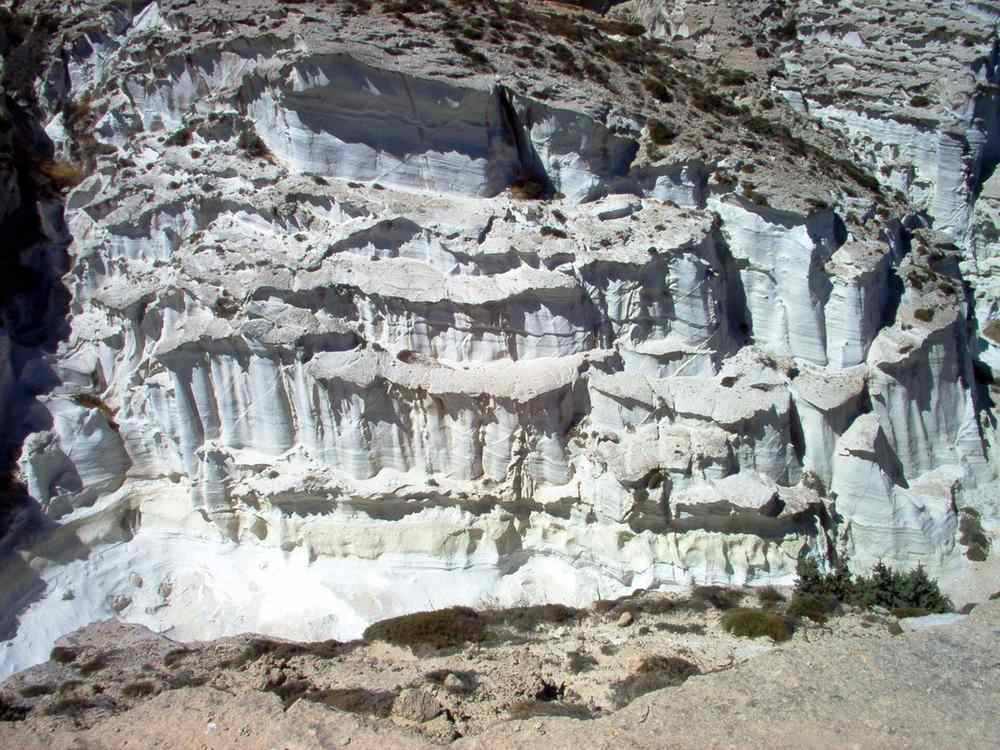
Milos is a volcanic island on the South Aegean volcanic arc, its hot springs, coloured cliffs and white moonscapes all shaped by past eruptions. Plan tours and trips through My Greece Tours.
The volcano is the foundation of the Milos travel guide. The sections below cover whether Milos is volcanic, if the volcano is still active, the volcanic sights to see, the hot springs and whether it is safe to visit.
Is Milos a volcanic island?
Yes, Milos is a volcanic island, formed by eruptions over millions of years as part of the South Aegean volcanic arc. Its entire dramatic landscape, the coloured cliffs, white rock, sea caves and hot springs, is the product of this volcanic origin.
Milos is volcanic to its core. Eruptions built the island. The arc shaped its rock. The legacy defines it.
The South Aegean arc holds it. Santorini and Nisyros share it. The same forces formed them. The geology links them.
Volcanic rock colours the coast. Reds and whites streak the cliffs. Obsidian glints in places. The fire left its mark.
The whole island shows it. Sarakiniko gleams white. Hot springs warm the shore. The volcano shaped everything.
Milos is unmistakably a volcanic island, born of eruptions over millions of years and shaped entirely by its fiery origins. It sits on the South Aegean volcanic arc, the same chain of volcanic activity that produced Santorini, Nisyros and other islands, formed where tectonic plates meet beneath the Aegean. This deep geological heritage is the single most important fact about the island.
The volcanic origin explains everything that makes Milos beautiful. Successive eruptions and hydrothermal activity stained the coast in extraordinary colours, built the cliffs and sea caves, laid down the white volcanic rock of Sarakiniko, and left rich mineral deposits that have been mined since prehistory, including the obsidian that made the island famous. Our guide to Milos geology covers the rock in detail, and the next section asks whether the volcano is still active.
Is the Milos volcano still active?
The Milos volcano is dormant rather than extinct, with no eruption in recorded history, but it remains geologically active beneath the surface. This shows in the island’s hot springs, warm ground at beaches like Paleochori, and fumaroles, signs of ongoing hydrothermal activity.
The volcano sleeps but breathes. No eruption marks recent history. Yet heat stirs below. Dormant fits it best.
Hot springs prove the activity. Warm water seeps to the shore. The ground heats the sand. The earth still simmers.
Fumaroles vent the heat. Steam and gas escape. The hydrothermal system runs. The volcano lives quietly.
Paleochori shows it plainly. The sand warms underfoot. The shallows steam. The geology surfaces.
The Milos volcano is best described as dormant rather than extinct. There has been no volcanic eruption on the island in recorded human history, so it poses no everyday threat, but it is not dead: the volcanic system beneath Milos remains geologically active, with ongoing hydrothermal activity simmering below the surface and occasional minor seismic signs, as is normal for the South Aegean arc.
This continuing activity is visible across the island. Hot springs bubble up along the coast, the ground and shallow water at Paleochori beach are warmed by geothermal heat, and fumaroles release steam and gases in places, all evidence that the volcano still breathes. Scientists monitor it as part of the wider arc, but for visitors this activity is a fascinating feature rather than a danger. Our Milos hot springs guide covers the warm waters, and the next section covers the volcanic sights.
What volcanic sights can you see on Milos?
On Milos you can see Sarakiniko’s white volcanic moonscape, the coloured cliffs of Paleochori and Firiplaka, the sea caves of Kleftiko, the Glaronisia basalt columns, hot springs and the old sulphur mines. The whole island is an open-air display of volcanic geology.
Volcanic sights fill the island. White rock gleams at Sarakiniko. Coloured cliffs streak the south. Caves pierce the coast.
Sarakiniko leads the wonders. Wind and sea carved the rock. The white moonscape stuns. The volcano made it.
Coloured beaches dazzle. Paleochori glows red and ochre. Firiplaka streaks with colour. Minerals paint them.
Basalt and caves amaze. Glaronisia stacks its columns. Kleftiko hides sea caves. The geology astonishes.
Milos is essentially an open-air museum of volcanic geology, and its sights are its main attractions. The most famous is Sarakiniko, where wind and sea have sculpted soft white volcanic rock into a smooth, dazzling moonscape unlike anywhere else in Greece. The coloured cliffs of Paleochori and Firiplaka, streaked red, orange and ochre by minerals, and the towering white rock and sea caves of Kleftiko are equally a product of the volcano.
Beyond the beaches, the volcanic story continues. The Glaronisia islets are columns of hexagonal basalt formed by cooling lava, the hot springs and warm sands reveal the living hydrothermal system, and the abandoned sulphur and mineral mines speak to the riches the volcano left behind. Touring these sights is one of the great pleasures of Milos. Our things to do in Milos guide maps them, and the next section covers the hot springs.
Are the hot springs on Milos volcanic?
Yes, the hot springs on Milos are volcanic, heated by the island’s ongoing geothermal activity.
The hot springs flow from the volcano. Geothermal heat warms them. Minerals enrich them. The earth supplies them.
Paleochori shows it best. The sand runs hot. The shallows steam gently. A taverna cooks in the ground.
Other spots warm too. Springs emerge along the coast. Bathers seek the heat. The water soothes.
The minerals add value. The waters carry sulphur. Tradition calls them healing. The volcano gives them.
The hot springs of Milos are a direct expression of its volcanic nature, heated by the geothermal activity that still simmers beneath the island. Warm, mineral-rich water emerges from the ground in places along the coast, and at Paleochori the volcanic heat is strong enough to warm the sand and the shallow sea, where steam can sometimes be seen rising and a local taverna famously cooks food slowly in the naturally hot ground.
Warm springs appear at other spots too, such as Aliki and near Provatas, where bathers seek out the heated water. These waters are rich in minerals like sulphur, and as on other volcanic islands they have long been associated with therapeutic bathing. Experiencing a warm spring or the heated shallows is a memorable way to feel the living volcano directly. The next section covers whether it is safe to visit given the volcano.
Feeling the warm sand underfoot at Paleochori is the simplest way to sense that the volcano beneath Milos is still very much alive.
Is it safe to visit Milos given its volcano?
Yes, it is completely safe to visit Milos despite its volcano, which is dormant with no eruption in recorded history.
Milos is safe to visit. The volcano stays dormant. No eruption threatens it. Travellers relax fully.
The activity is gentle. Hot springs warm the shore. Steam vents harmlessly. The signs intrigue, not endanger.
Normal care suffices. Very hot ground exists. Steam can scald. A little caution handles it.
The volcano is a draw. It shaped the beauty. It warms the springs. It rewards the visitor.
Visiting Milos is entirely safe despite, and indeed because of, its volcano. The volcano is dormant, with no eruption in recorded human history, so there is no risk of an eruption disrupting a holiday, and the ongoing hydrothermal activity is gentle and harmless, expressed as hot springs, warm sands and steaming fumaroles that are attractions rather than hazards. The island is a popular, well-developed destination welcoming visitors throughout the season.
The only sensible precaution is the everyday care you would take around any natural hot feature: the ground and shallow water at Paleochori can be genuinely hot in places, and fumaroles release steam, so it is wise to test surfaces, supervise children and avoid touching very hot rock or water directly. With that simple awareness, the volcanic features are a fascinating highlight. The volcano is the reason Milos is so beautiful, not a reason to stay away. Plan your visit through our things to do in Milos guide.
Understanding that Milos is a volcanic island transforms a visit, turning its beaches and cliffs from simply beautiful into genuinely fascinating. Every coloured rock, white moonscape, sea cave and warm spring becomes a chapter in a story of fire that began millions of years ago and still simmers gently beneath your feet. Far from being a reason for concern, the dormant volcano is the very source of everything that makes the island special, from the obsidian that drew prehistoric traders to the hot sands of Paleochori. Seen this way, a trip to Milos is a tour of a living volcanic landscape, one of the most rewarding and unusual in all of Greece.
How was the Milos volcano formed?
The Milos volcano formed on the South Aegean volcanic arc, where the African plate slides beneath the Eurasian plate. Undersea and surface eruptions built the island over millions of years, ending with rhyolitic activity that left its coloured, mineral-rich rock.
Milos rose from the seabed through plate tectonics. The African plate dives beneath the Aegean along the South Aegean volcanic arc, and the friction and melting drive the eruptions that raised the island. The earliest eruptions were dominantly andesitic and basaltic, and the later phases turned rhyolitic, a shift that helps explain the pale volcanic rock and the striking colour range across the coast today.
Hydrothermal fluids reworked the volcanic rock long after it cooled. Hot, mineral-charged water circulated through the deposits and altered their chemistry, laying down thick beds of clay minerals and ores. This alteration is the reason the cliffs streak red, white, grey and ochre, and it turned Milos into a source of bentonite, perlite, kaolin, baryte and the obsidian that prehistoric traders prized. The mining story reaches back thousands of years and continues to shape the island.
The formation left two extinct volcanic centres on the island, Firiplaka in the south and Trachilas in the north, alongside the wider altered terrain. Reading the landscape as the record of this long build-up turns a beach walk into a geology lesson. Our guide to Milos geology follows the rock in more detail across the island.
How does the Milos volcano compare with Santorini?
Milos and Santorini both sit on the South Aegean volcanic arc, yet they read differently. Santorini shows a dramatic flooded caldera from a huge eruption, while Milos spreads its volcanic story across coloured cliffs, hot springs and mineral deposits rather than one crater.
Santorini presents the arc’s most theatrical single feature, a vast caldera formed when the volcano’s centre collapsed into the sea after a colossal eruption. Visitors gaze across the drowned crater from the cliff-top towns, and boats sail to the still-steaming volcanic islets at its heart. The island wears its geology as one grand, unmistakable bowl of rock and water.
Milos tells its volcanic story in a quieter, more scattered way. Rather than one caldera, the island offers the white moonscape of Sarakiniko, the red and ochre cliffs of Paleochori and Firiplaka, the sea caves of Kleftiko, the basalt columns of the Glaronisia and the warm sands heated by the living hydrothermal system. The mineral wealth left by the volcano also gives Milos a mining heritage that Santorini lacks, from prehistoric obsidian to modern bentonite.
Choosing between them depends on the kind of volcano a traveller wants to read. Santorini rewards those after the sweeping drama of a caldera view, and Milos rewards those after the colour, hot springs and geological variety of a whole volcanic island. The two islands are complementary chapters of the same Aegean arc, each showing a different face of the same deep forces.
What are the best ways to experience the Milos volcano?
The best ways to experience the Milos volcano are a boat trip to Kleftiko and the sea caves, a swim in the warm shallows at Paleochori, a walk on the white rock at Sarakiniko, and a visit to the Glaronisia columns and old mines.
A boat trip opens the volcanic coast that roads cannot reach. Sailing to Kleftiko brings the towering white rock, arches and sea caves into view, and the same route often passes the Glaronisia basalt columns and the painted cliffs of the western shore. Swimming beneath these formations gives the clearest sense of how eruptions and the sea together sculpted the island.
The hot features let a visitor feel the volcano directly. At Paleochori the geothermal heat warms the sand and shallow water, and a walk over the smooth white rock of Sarakiniko at first light shows the volcanic stone at its most photogenic. Testing the warm ground with a hand or foot turns an abstract fact about the arc into a physical experience of a living system.
The mining and mineral heritage rounds out the story on land. The abandoned sulphur and mineral workings, the coloured quarries and the island’s small mining exhibits trace how the volcano’s ores shaped the local economy across the centuries. Pairing a boat trip, a hot-spring swim and a mine visit builds a full picture of the volcano. Our things to do in Milos guide helps assemble the route.
Frequently Asked Questions
Is Milos a volcano?
Milos is a volcanic island rather than a single volcano, formed by eruptions over millions of years as part of the South Aegean volcanic arc, the same chain that includes Santorini and Nisyros. Its entire landscape, the coloured cliffs, white volcanic rock of Sarakiniko, sea caves, hot springs and rich mineral deposits, is the product of this volcanic origin. The volcano is dormant, with no eruption in recorded history, but it remains geologically active beneath the surface, shown by the island’s hot springs, warm sands and fumaroles. The volcanic heritage is the foundation of the island’s dramatic beauty.
When did the Milos volcano last erupt?
There has been no volcanic eruption on Milos in recorded human history, which is why the volcano is described as dormant rather than active or extinct. Its major eruptions occurred in the distant geological past, over hundreds of thousands to millions of years, shaping the island’s coloured cliffs, white rock and sea caves. Beneath the surface, however, the volcanic system remains geologically active, as shown by the ongoing hydrothermal activity, the hot springs, the warm sands at Paleochori and the fumaroles that release steam. Scientists monitor this activity as part of the wider South Aegean volcanic arc.
Can you see the volcano on Milos?
You cannot visit a single crater on Milos as you can on the neighbouring active volcano of Nisyros, but you can see the volcano’s effects everywhere across the island. The white volcanic moonscape of Sarakiniko, the coloured cliffs of Paleochori and Firiplaka, the sea caves of Kleftiko, the basalt columns of the Glaronisia islets, the hot springs and warm sands, and the old sulphur mines are all direct products of the volcano. In this sense the whole island is the volcano, an open-air display of volcanic geology that forms the basis of its most spectacular sights.
Why is Milos so mineral-rich?
Milos is mineral-rich because hydrothermal fluids reworked its volcanic rock over a long period, altering the original andesite, basalt and rhyolite into thick beds of clay minerals and ores. This hydrothermal alteration laid down deposits of bentonite, perlite, kaolin and baryte, and the volcanic activity also produced the obsidian that prehistoric traders carried across the Aegean. The island became a leading source of bentonite for Greece, and mining has shaped its economy for thousands of years. The coloured cliffs and quarries that make the coast so photogenic are the visible face of this same mineral wealth, tying the island’s beauty directly to its volcanic and hydrothermal history.
Are there fumaroles and hot springs on Milos?
Milos has both onshore fumaroles and coastal hot springs, all driven by the geothermal heat of its dormant volcano. Fumaroles vent steam and volcanic gases on land, and warm, mineral-rich water rises along parts of the coast, most famously at Paleochori, where the ground and shallow sea are heated enough for a taverna to cook slowly in the hot earth. Warm water also appears near Aliki and Provatas. Offshore, submarine vents release carbon-dioxide-rich fluids into the sea. These features are the clearest everyday sign that the volcanic system beneath Milos is still active, and they rank among the island’s most memorable experiences for curious visitors.