
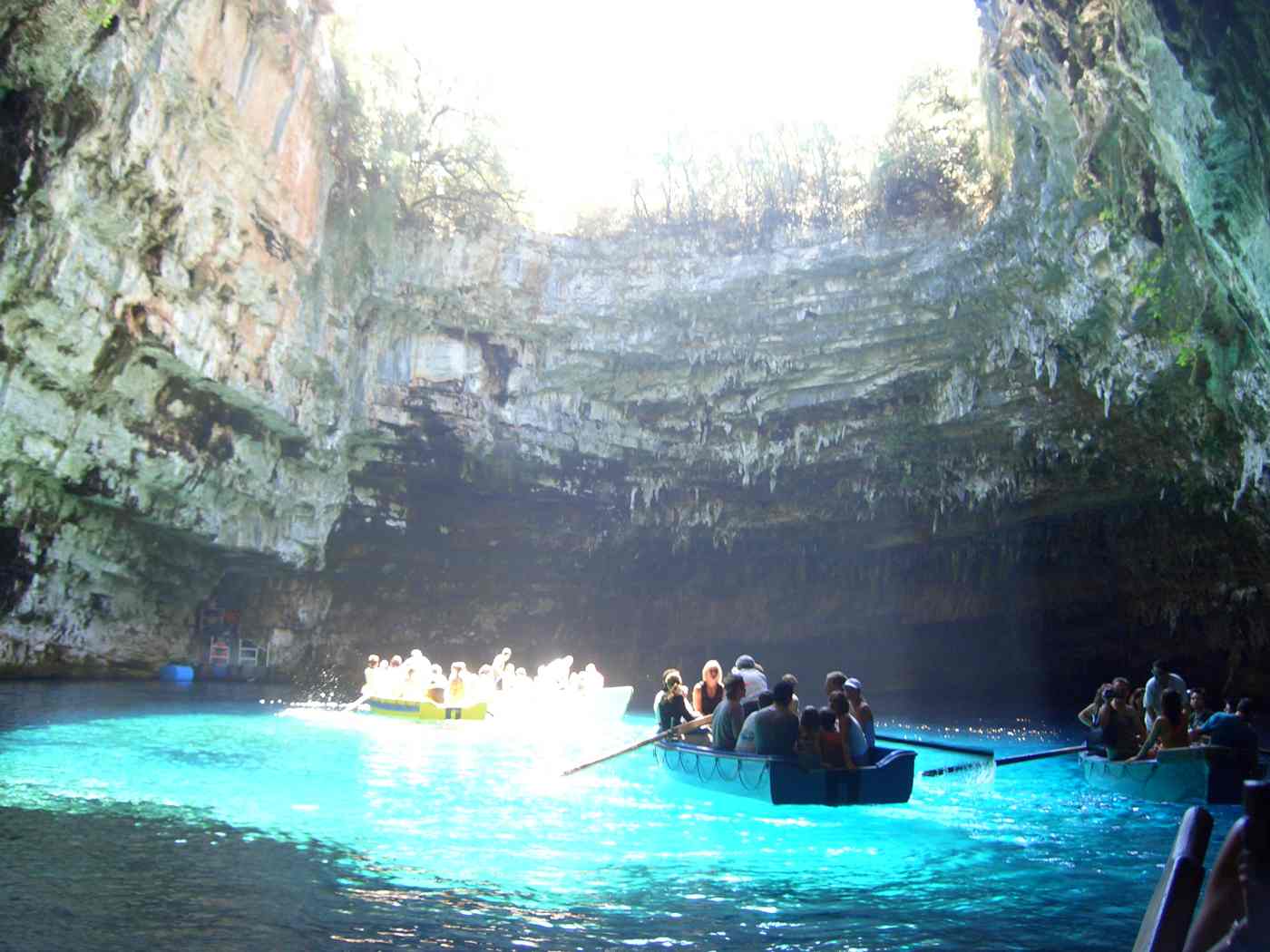
Melissani cave holds an underground lake near Karavomylos, on the east coast of Kefalonia and close to the port of Sami. Part of its rock roof collapsed long ago, leaving an open shaft above the water. Around midday the sun drops straight through this gap and turns the brackish lake a deep blue. Small rowing boats carry visitors around two chambers and a central islet. This guide covers what the cave is, why the water glows, how the boat trip works, where the water comes from. The ancient myth of Pan tied to the site. Plan the whole trip with Greece Tours.
The water inside Melissani travels a long underground road. It enters the Katavothres sinkholes on the Argostoli shore, crosses the island through limestone for about 15 kilometres, and surfaces here mixed with fresh springs. Ancient people read the hidden lake as sacred and honoured Pan and the nymphs at its edge, leaving figurines found on the islet. The cave sits about 25 kilometres from Argostoli and about 3 kilometres from Sami, near the large Drogarati stalactite cave. Read on for the geology, the light, the boats and the old worship that together define Melissani.
What is Melissani cave and where does it sit on Kefalonia?
Melissani is a cave with an underground lake near Karavomylos, close to Sami on the east coast of Kefalonia, about 25 kilometres from Argostoli. The collapsed roof lets daylight reach the brackish water inside.
Melissani cave sits in the hills above Karavomylos, a coastal hamlet about 2 kilometres north of Sami on the east side of Kefalonia. The entrance opens on a low ridge, and a short tunnel leads down to the water. Argostoli, the island capital, lies roughly 25 kilometres to the southwest, about a 35-minute drive over the central hills. The cave holds an underground lake fed by brackish water, part sea and part fresh. Its roof partly collapsed long ago, leaving an open oval well above the lake. Visitors reach the shore through the tunnel, then board small rowing boats.
The two water chambers stretch for tens of metres beneath the rock, and the lake reaches depths of around 20 to 30 metres in places along the northern chamber.
Karavomylos sits at the edge of Sami bay, where cold springs surface and feed old watermills near the shore. The village gives Melissani its everyday access point, with a car park and ticket kiosk beside the cave entrance. Sami, the east-coast ferry port, lies about 2 to 3 kilometres south and links Kefalonia with Ithaca and the Greek mainland at the port of Patras. The Drogarati stalactite cave stands roughly 4 kilometres away, near the Sami to Argostoli road, so most visitors pair the two sites in one morning. The ground here is limestone karst, riddled with fissures and hollows.
Rain and seawater work through the rock for thousands of years, dissolving passages and forming the chambers that now hold the Melissani lake below the surface today.
Reaching Melissani is straightforward from most of Kefalonia. From Argostoli the drive runs about 25 kilometres east, near 35 minutes, over the central ridge toward Sami bay. From Fiskardo in the north the distance is around 45 kilometres, close to an hour along the coast road. Kefalonia Airport lies about 9 kilometres south of Argostoli, so arriving visitors add the airport to Sami leg of roughly 30 kilometres. Sami itself is a 5-minute drive from the cave, and Antisamos beach sits about 4 kilometres further east. Tour buses, rental cars and taxis all serve the site, and the final approach climbs a short lane to the entrance.
Parking sits beside the kiosk, and the walk to the tunnel mouth takes only a minute or two.
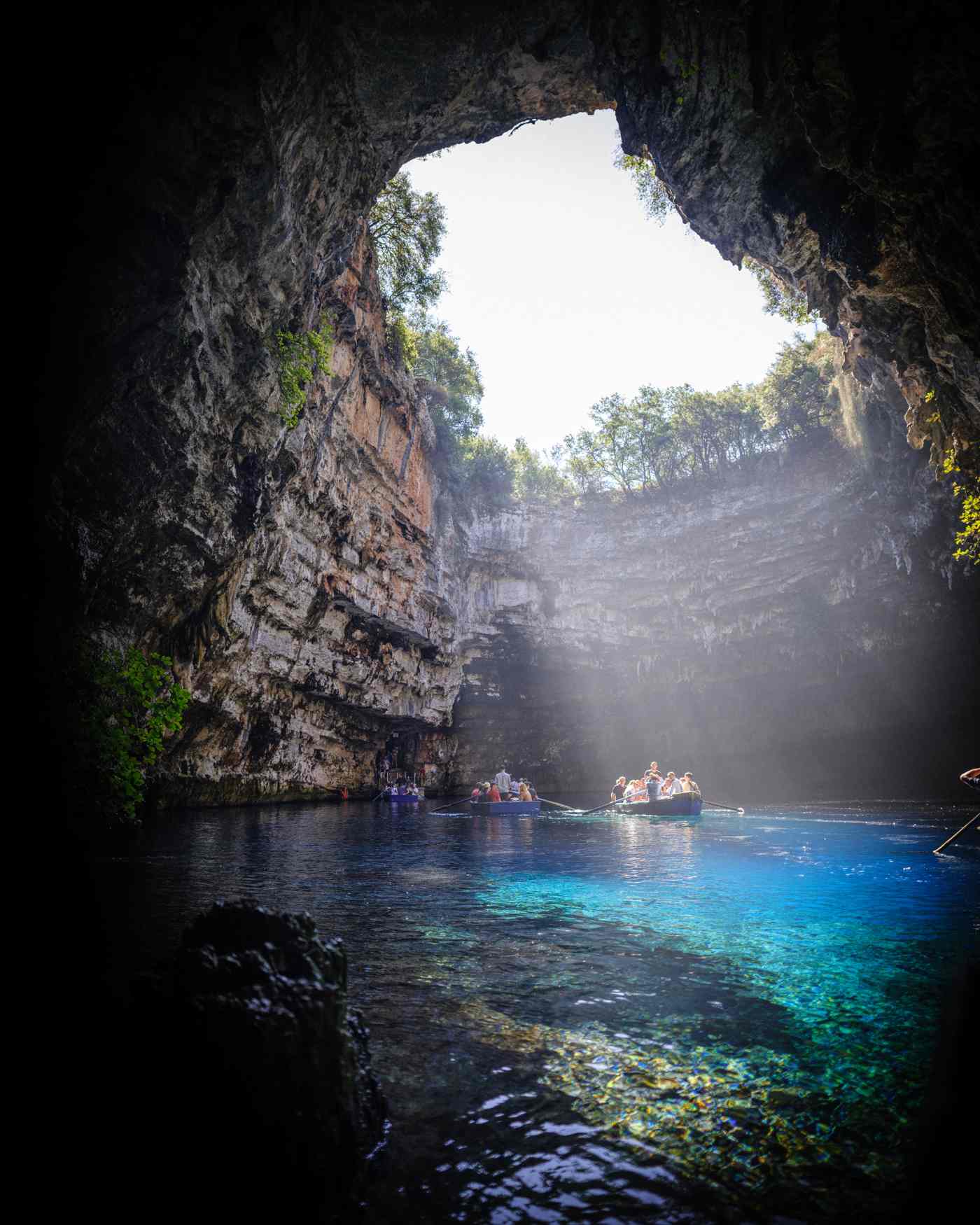
The cave interior divides into two connected chambers around a rock islet. The first chamber lies open to the sky through the collapsed roof, a near-circular shaft about 30 to 40 metres across. Sunlight pours through this gap onto the water below. The second chamber runs deeper under solid rock and stays in shadow, lit by reflected light off the lake. Stalactites hang from the ceilings of both halves, the longest reaching about 3 metres in length. The water below measures around 20 to 30 metres deep and holds a mix of sea and fresh water. The islet in the centre carries the ground where ancient finds tied to the god Pan came to light.
Marking the cave as a place of old worship as well as a work of geology.
Why does the water in Melissani cave turn blue at midday?
The collapsed roof leaves an open shaft above the lake, so around midday the sun stands high enough to shine straight down onto the brackish water. The clear water scatters the light and glows a vivid blue.
The Melissani roof did not always stand open. A section of the limestone ceiling broke away and fell into the chamber long ago, likely after an earthquake shook the fragile karst. The debris now forms the rocky islet at the centre of the first chamber. This break left an oval shaft about 30 to 40 metres wide, framed by ferns and small trees that root along the rim. Before the collapse the whole cave lay in darkness, known mainly to shepherds and worshippers. After the roof opened, daylight reached the lake and revealed the blue water. Kefalonia sits on an active fault zone.
The earthquake reshaped much of the island, so ceiling collapse in such caves fits the local geology and the record of past quakes.
Light quality inside Melissani changes hour by hour with the sun’s angle. Early and late in the day the sun sits low, so its rays strike the shaft rim and miss most of the water. Around midday, roughly between 11:00 and 13:00, the sun climbs high over the open roof and drops almost vertically onto the lake. The beam reaches the water directly and lights it from the surface down. Clear brackish water absorbs red light and scatters blue, so the lit patch glows a deep blue. The rock walls behind the open chamber take on green and turquoise tints from the reflected glow.
Guides time the short boat trips for this window, when the colour reaches its strongest across the first chamber of the cave.
Weather and season shape how strongly the blue appears. Clear skies let the full midday beam reach the water, while cloud cover softens the colour and flattens the contrast. Summer sun climbs higher than winter sun, so the vertical light of June and July lights the lake more fully than the low rays of December. The site opens through the main season from spring into autumn, with the longest, highest sun in midsummer. Calm air also helps, since a still surface holds the reflection instead of breaking it into ripples. Rain rarely falls in the Kefalonia summer, so most July and August mornings deliver the direct light.
Visitors who arrive at opening or in the early afternoon often see paler water than the sharp midday peak.
The two chambers show the colour in different ways. The first chamber lies under the open shaft, so its water takes the direct beam and glows the brightest blue. The second chamber runs beneath a solid roof and stays dim, lit only by light that bounces off the first lake and the connecting passage. There the water reads darker, a deep blue-green shading toward black at the edges. Boats pass from the bright half into the shadowed half in seconds, and the shift in colour is sharp. Stalactites overhead catch stray light and cast reflections on the surface.
The contrast between the sunlit chamber and the roofed chamber gives the trip its range, from vivid blue under the open sky to still, dark water within the solid rock.
What does the boat trip through Melissani cave near Sami cover?
Small rowing boats carry visitors from the tunnel shore around both chambers of Melissani, gliding past the central islet under the open shaft, then into the darker roofed chamber. Each trip lasts around six minutes on calm water.
Boat trips begin at a small landing stage inside the tunnel, a short walk down from the entrance kiosk near Sami. Wooden rowing boats seat about a dozen passengers each, and a local boatman rows the boat and narrates the route. Sami supplies most of the crews and serves as the base town for the site. The boats push off from the shaded shore and glide out under the open roof, where the light hits hardest. Life jackets sit under the benches, and the water stays calm because the lake lies sealed inside the rock. Queues build in peak summer late morning.
Most groups arrive by 11:00 to catch both the midday light and a shorter wait for a place on one of the boats.
The route traces a loop around the rock islet at the centre of the open chamber. Boatmen row close to the walls, then out across the sunlit water where the blue reads strongest. The islet rises about 4 metres above the lake and carries the ground where ancient finds surfaced. Passengers pass beneath the shaft rim, with ferns and sky framed overhead. The boat then slips through a low neck of rock into the second, roofed chamber. Inside that darker hall the water turns deep blue-green, and stalactites hang close over the surface. The boatman circles back toward the light and returns to the landing stage.
The whole loop covers both chambers, the islet and the connecting passage in one continuous, unhurried pass through the cave.
Timing sets what each trip shows. Around midday the vertical sun turns the first chamber vivid blue, so late-morning and early-afternoon boats see the water at its brightest. Earlier and later trips still run, but under softer, paler light. The boatmen pause the boat at the sunlit patch so passengers can look down into the clear water. Depth here reaches about 20 to 30 metres, and the bottom stays visible on calm, bright days. Cameras and phones capture the colour best when the boat sits still under the open shaft. The ride stays gentle, with no rough water inside the sealed lake.
Groups move through steadily in peak season, so each boat spends about six minutes on the water before the next one loads at the stage.
Most visitors pair Melissani with nearby sites in a single outing. The Drogarati stalactite cave stands about 4 kilometres away toward Argostoli, a large dry cavern with a chamber used at times for concerts. Antisamos beach lies around 4 kilometres east of Sami, a pebble bay backed by green hills. The east-coast ferry port at Sami links the island to Ithaca and the mainland, so day-trippers from Ithaca reach Melissani within an hour of docking. Karavomylos village, beside the cave, holds spring-fed pools and old watermills at the shore. A morning at Melissani, an hour at Drogarati and an afternoon at Antisamos fills one full day of touring.
Rental cars and organised tours from Argostoli and Lassi cover the whole loop on a single coastal road.
How do the Katavothres sinkholes at Argostoli feed Melissani cave?
Seawater pours into the Katavothres sinkholes on the Argostoli shore, then travels underground across Kefalonia for about 15 kilometres. The flow surfaces at Melissani and Karavomylos near Sami, mixing sea and fresh water in the lake.
The story starts on the far side of the island at Argostoli. At the Katavothres sea mills on the Argostoli shore, seawater flows off the bay and pours into holes in the coastal rock. For a long time this vanishing water puzzled observers, since the sea seemed to drain into the ground and disappear. Old mills once used the inflow to turn their wheels beside the channel. The Katavothres sit about 3 kilometres from the town centre, past the lighthouse of Agioi Theodoroi on the Lassi road. The water sinks below the surface and enters the limestone that underlies the whole of Kefalonia.
From there it begins a slow crossing beneath the mountains toward the east coast and Sami bay on the far side of the island.
Researchers traced where the sinking water goes by adding dye to the Katavothres flow. The colour reappeared days later on the east coast, at the springs of Karavomylos and inside Melissani, about 15 kilometres away. This proved that the water crosses the island underground, from Argostoli in the southwest to Sami in the northeast. The route runs through fissures and channels dissolved in the limestone over long ages. Along the way fresh groundwater from Mount Ainos and the central hills joins the flow. The mix of intruding seawater and inland fresh water gives Melissani its brackish lake.
The journey takes about two weeks from coast to coast, moving slowly through the dark rock before the water surfaces again beneath the open shaft of the cave.
The lake water in Melissani reads as brackish, neither full seawater nor pure fresh water. Sea water enters at the Katavothres and keeps its salt through the underground crossing. Rain and snowmelt on Mount Ainos, which rises about 1,628 metres, soak into the rock and feed fresh springs along the same channels. Where the two meet near Karavomylos, they blend into the mildly salty water of the cave lake. The level of the lake sits close to sea level, since the cave connects to the sea through the rock. Small fish and eels live in the water despite the salt.
This underground link ties the two coasts of Kefalonia into one water system, joining the vanishing sea at Argostoli to the surfacing springs at Sami.
Melissani forms one part of a wider karst network under Kefalonia. The same limestone holds the Drogarati cave nearby, a dry stalactite chamber about 60 metres deep. Rainwater and seawater have carved passages, sinkholes and underground rivers across the island for hundreds of thousands of years. The Katavothres, the cross-island channel and the Melissani lake all belong to this single system. Sinkholes like the Katavothres are called katavothres in Greek, the same word used across the country for such swallow holes. The flow keeps working today, with seawater still draining at Argostoli and surfacing near Sami.
This living plumbing under the mountains explains why an inland cave holds salty water and why its water level rises and falls in step with the distant open sea outside.
Which ancient myth connects Melissani cave on Kefalonia to Pan?
Ancient worshippers linked Melissani to the god Pan and the nymphs, treating the cave as a sacred spring shrine. Excavations recovered clay figurines, lamps and a disc showing Pan and dancing nymphs, tying the site to that cult.
Long before boats and tickets, Melissani served as a place of worship. Ancient people connected the cave to Pan, the goat-legged god of the wild, and to the nymphs, spirits of springs and water. A cave with a hidden lake and an open shaft suited a shrine to such figures. The name Melissani is linked to a nymph, and the site is sometimes called the Cave of the Nymphs. Worshippers likely descended to the water to leave offerings at the lake edge and on the islet. The cult fits a wider Greek habit of honouring Pan and the nymphs at springs and grottoes.
This role gave the cave meaning for the people of ancient Kefalonia long before its blue water drew modern visitors to the site here.
Excavation on the islet brought the old worship to light. Diggers recovered clay figurines, small oil lamps and pottery from the ground at the centre of the chamber. The best-known find is a clay disc, or plaque, showing Pan surrounded by dancing nymphs. Another shows a group of nymphs in procession across the surface. These objects date to the Hellenistic era and earlier, and they tie the cave firmly to the cult of Pan. The finds now sit in the Argostoli archaeological collection rather than in the cave. Their presence on the islet shows that people reached the lake and used the central rock as a focus for offerings.
The figures of Pan and the nymphs confirm the myth that the ancient name and stories preserved for so long.
The myth reads naturally against the cave itself. Springs, hidden water and a shaft of daylight match the places where Greeks honoured nymphs and Pan across the mainland and islands. The nymphs governed springs, and Melissani hides a spring-fed lake deep in the rock. Pan haunted lonely caves and wild hills, and the site sits below the slopes toward Mount Ainos. The open roof let light and rain reach the sacred water, linking the underground shrine to the sky above. Local people have known the cave held fresh water crossing from the far coast, a fact easy to read as the work of the gods.
The blend of geology and belief gave Melissani a double character, both a natural feature and a holy place of worship.
The ancient layer sits alongside the boat trip and the blue water. Visitors ride past the islet where the figurines came up, often without knowing its old role. The Argostoli archaeological collection holds the disc of Pan and the nymphs for those who want to see the finds. Information boards at the cave outline the cult and the excavation for arriving groups. The story links Melissani to the wider heritage of Kefalonia, from the Mycenaean tombs near Poros to the Roman mosaics at Skala. A trip that starts as a look at coloured water ends as a walk through the island’s long past.
The cave joins natural science and old myth, a spring shrine to Pan that now floats small boats beneath its open roof.
When is the best time of day and season to visit Melissani cave in Kefalonia for the blue light?
Midday hours around 11:00 to 13:00 deliver the strongest blue light inside Melissani cave, when sunshine drops through the open roof onto the lake. Sunny days from late spring to September show the water at its brightest.
The open sink-hole roof above Melissani cave lets sunlight fall straight onto the water only near midday. Between about 11:00 and 13:00 on a clear day, the beams turn the lake a vivid blue and turquoise. Earlier or later, the sun sits at a low angle and the cavern stays darker, with the colour muted. The cave lies near Karavomylos, roughly 3 km from Sami and about 25 km from Argostoli on the east coast. Drivers from the southwest resorts leave early to reach the site by late morning. Cloud cover flattens the colour, so a sunny forecast matters more than the exact clock time.
Photographers set their visit for the noon window, when the reflected light reaches the boat and the rock walls high above the calm water surface below.
Late spring through September brings the reliable sunshine that Melissani cave needs for its colour, with July and August the warmest and busiest months. Spring visitors in June find mild days and thinner crowds, while the water still glows at midday. October keeps mild warm afternoons, though the lower sun weakens the blue after the equinox. The site sits close to Sami, the east-coast port with ferries to Ithaca, so day-trippers arriving by sea add to the summer numbers. Argostoli-based travellers reach the cave in about 30 minutes by car.
Planning around a clear-sky forecast counts for more than the calendar month, because a cloudy July noon dims the lake while a bright June noon lights it fully across both chambers of the open cave.
High-summer mornings draw tour coaches from Argostoli, Lassi and Skala, so the first boats after opening and the last hour before closing hold fewer people. The midday window that gives the best light also gathers the largest queues, a trade-off every visitor weighs. Arriving around opening secures the calmer water and a shorter wait, then the colour deepens as the sun climbs toward noon. The narrow boats carry small groups, so a long line moves slowly on an August afternoon. Travellers who want both good light and space split the difference by reaching the ticket area by about 10:30. Weekdays run quieter than weekends, when Kefalonia residents and Sami ferry arrivals join the queue.
Cruise-ship days at Argostoli push the numbers higher across the whole east coast of the island.
Winter months bring rain and the occasional closure to the Sami area, so the dependable season runs roughly from late April to mid-October. The lake keeps a steady, cool temperature year-round, fed by seawater that travels underground from the Katavothres sinkholes at Argostoli, about 15 km west. Combining Melissani with other sights fills a full day, and route planners list it among the top things to do in Kefalonia for the Sami district. A midday cave visit pairs with a morning at Antisamos beach over the headland and an afternoon at the Drogarati stalactite cave, 3 km away.
Booking a car ahead in July and August matters, because rental demand across the island peaks and the east-coast roads carry heavy traffic near the Sami turn-offs during the day.
How do you combine Melissani cave with the Drogarati cave near Sami in Kefalonia?
Drogarati cave sits about 3 km from Melissani, a five-minute drive toward Sami, so the two pair naturally into one outing. Most visitors tour the underground lake at midday and the stalactite cavern before or after.
Drogarati cave is a large stalactite cavern set into the hillside about 3 km south of Melissani and roughly 4 km from Sami. A staircase descends around 60 steps into a broad chamber where stalactites and stalagmites have formed over long geological time. The main hall, also called the Sala of Apotheosis, has strong acoustics and has hosted concerts inside the rock. Air in the cave stays cool and humid, near 18 degrees, so a light layer helps even in August. The two caves differ in character: Melissani offers open sky, water and a boat, while Drogarati stays fully underground and dry underfoot.
Seeing both in one trip shows the karst geology of the Sami area, where rainwater has dissolved the pale limestone slowly for a very long span across the east coast.
A logical loop starts at Drogarati in the morning, moves to Melissani for the midday light, then continues to Sami or Antisamos beach for the afternoon. Both cave entrances sit just off the road linking Sami with the Argostoli direction, so backtracking stays minimal. The drive between the two takes about five minutes, covering roughly 3 km of paved road with signposted turn-offs. Reversing the order also works: tour the lake at noon first, then cool off inside Drogarati afterward. A car handles the short hops far better than the sparse bus service, which reaches Sami but not each cave entrance directly. Parking areas serve both sites, filling by late morning in peak season.
Combining the pair uses about half a day, leaving time for the beaches near Sami on the same east-coast outing.
Each cave charges its own separate admission, bought at the entrance rather than as a single combined ticket. Prices stay modest and the two together cost around the price of one museum visit, though exact figures change, so carrying cash helps. Drogarati opens through the main season and can close in winter or during wet spells for safety on the steps. Melissani runs its boats only in daylight, with the last trips well before sunset, so an early-afternoon finish leaves room for Drogarati. Neither site takes long individually: about 20 minutes on the Melissani boat and 30 to 40 minutes walking Drogarati. Wearing shoes with grip matters at both, because the stone stairs turn slick from dripping water.
Guides at each entrance manage the flow, sending small groups down in turn along the narrow steps.
Pairing the caves gives two contrasting looks at the same limestone landscape that shaped the Sami coast and its Kefalonia beaches. Melissani formed when a cavern roof collapsed and let daylight reach the underground lake, while Drogarati kept its roof and its slow-growing formations. The blue water at Melissani comes from sunlight refracting through clear brackish water about 20 to 30 metres deep in places. Drogarati shows the opposite process, where mineral-rich drips build columns grain by grain. Standing in both within an hour makes the geology concrete rather than abstract. The route also passes Karavomylos, a small lakeside spot near the Melissani entrance with tavernas beside a spring-fed pool.
Families with older children manage both caves, though the Drogarati stairs and the low boat suit steady footing more than strollers on the day.
Can you visit Sami and Antisamos beach on the same trip as Melissani cave in Kefalonia?
Sami sits about 3 km from Melissani, and Antisamos beach lies roughly 4 km beyond the town over a headland, so all three fit one relaxed day on Kefalonia’s east coast.
Sami is Kefalonia’s second port, on the east coast about 3 km from the Melissani entrance and roughly 24 km from Argostoli by road. Ferries link Sami with Ithaca, Astakos and the mainland, so the harbour stays busy through summer with foot passengers and cars. The waterfront lines up tavernas, cafes and a pebble town beach, giving a natural lunch stop between the caves and Antisamos. The earthquake levelled the old town, which was rebuilt low along the bay, a pattern seen across the island except at Fiskardo. Boats for Melissani leave from a jetty just north of Sami near Karavomylos, a short drive of about three minutes.
Using Sami as a base for the day cuts the distances between the underground lake, the beach and the second cave to short hops.
Antisamos beach lies over the headland east of Sami, about 4 km along a winding road that climbs and drops to the shore. The beach is a long curve of white pebbles backed by green hills, with clear deep water that shelves quickly from the shoreline. Scenes for the Captain Corelli’s Mandolin film were shot here, and the setting still draws visitors after their cave trip. Sunbeds, two beach bars and a car park serve the bay, which fills by midday in July and August. The pebbles make water shoes useful, and the quick drop-off suits confident swimmers more than small children.
Reaching Antisamos from Melissani takes about 15 minutes by car, so an afternoon swim follows a midday boat ride on the lake with ease across the short east-coast route.
A full east-coast day starts with the midday Melissani boat, moves to Antisamos for an afternoon swim, then ends with dinner on the Sami waterfront. Adding Drogarati cave in the late afternoon rounds out the loop, since it sits only 3 km back toward the Argostoli road. The total driving stays under 15 km across the four stops, all within the Sami district on the east coast. Travellers from Argostoli or Lassi drive about 30 minutes each way, roughly 25 km over the mountain road through Agia Efimia’s turn-off. Those staying in Sami, Karavomylos or Agia Efimia reach every stop in under 20 minutes.
Packing swimwear, water shoes and a light layer covers the beach, the boat and the cool cave interiors in one bag for the whole day.
Agia Efimia, a small fishing harbour about 10 km north of Sami, adds another lunch or swim option to the same east-coast route. The village keeps a quiet quay with tavernas and access to small pebble coves and clear water just south of it. North from there the road climbs toward Myrtos and Assos, though those sit on the northwest coast and suit a separate day. Keeping the Melissani day focused on Sami, Antisamos, Drogarati and Karavomylos avoids long drives and heavy midday traffic. The east coast holds more shade and pine cover than the open west, so the hillside roads stay cooler at noon.
Ending the day back in Sami lets ferry-bound travellers catch an evening boat to Ithaca without a rushed return over the mountain to Argostoli after dark.


What is the visit to Melissani cave in Kefalonia actually like, from the walkway down to the boat?
A sloping tunnel and steps lead down from the ticket area to the water, where boatmen row small groups around the two chambers for about 15 to 20 minutes beneath the open roof.
Ticket types, where to buy them and the online booking are set out on the Melissani Cave tickets page.
Entry runs through a man-made tunnel cut into the rock, sloping down from the ticket kiosk to the water’s edge inside the cave. The descent covers a short distance with a ramp and a set of steps, dropping about 20 to 30 metres below the surface. Handrails line the passage, and the concrete surface stays damp, so cautious footing matters on the way down. Daylight appears ahead as the tunnel opens onto the first chamber, where the collapsed roof frames a circle of sky. The temperature drops on the descent, and the air turns humid near the lake. Staff direct arriving visitors toward the small wooden boats waiting at a low landing stage.
The whole walk down takes only two to three minutes, but the change from bright car park to shaded cavern feels sharp.
Wooden boats hold about 8 to 10 passengers each, rowed by a boatman who doubles as a guide around the two chambers. The first chamber lies open to the sky, where midday sun turns the water brilliant blue over a depth of roughly 20 to 30 metres. The boat glides under the rock arch into the second, darker chamber, where a low ceiling of stalactites hangs close overhead. Ancient finds link the cave to a cult of Pan, and boatmen point out shapes in the rock during the loop. The ride lasts about 15 to 20 minutes and stays smooth, since the sheltered lake has no waves.
Passengers sit low near the waterline, so phones and cameras need a firm grip. The boatman pauses under the open roof for photographs at the brightest spot.
Flat shoes with grip handle the damp tunnel and the step into the low boat better than sandals or heels. A light jacket takes the edge off the cool, humid air, which stays cooler than the summer heat outside. Water, a hat and sunscreen matter for the queue, since the waiting area near Karavomylos offers little shade in July. Cash covers the entrance, because card facilities at small Kefalonia sites can be limited or slow. A phone or camera captures the blue water, though a wrist strap guards against a drop into the lake. Swimming is not allowed in the cave, so swimwear belongs at Antisamos or Karavomylos afterward rather than here.
Arriving with a plan for the midday light and a booked car keeps the visit smooth across the busy Sami stretch of road.
The visit involves stairs, a sloping tunnel and a step down into a small rowing boat, so it suits people with steady footing. Wheelchair users and travellers with limited mobility find the descent and the boat transfer difficult, given the steps and damp surface. No lift serves the tunnel, and the low boats sit close to the water with a raised edge to cross. Young children manage with a hand held on the stairs and a watchful adult in the boat. The loop stays short at 15 to 20 minutes, which helps visitors who tire on uneven ground. Staff assist at the landing stage, steadying the boat as groups board.
Anyone unsure of the steps can view the open chamber from the tunnel mouth before deciding whether to take the ride.
How do you reach Melissani cave by car from Argostoli and the Kefalonia resorts, and where do you park?
Melissani sits about 25 km from Argostoli, a 30-minute drive east over the mountain road through the Sami turn-off, with a free car park beside the ticket entrance near Karavomylos on the coast.
Argostoli, the island capital, sits about 25 km west of Melissani, a drive of around 30 minutes on the main road toward Sami. The route climbs over a wooded ridge, passes the Agia Efimia and Sami turn-offs, then drops to the east coast near Karavomylos. Signs for Melissani and Drogarati mark the final turn-offs clearly, so the last stretch stays easy to follow. Traffic thickens near the Sami junction in July and August, and slow coaches on the mountain bends add extra minutes. Leaving Argostoli by about 10:00 reaches the cave for the midday light with time to park.
The De Bosset bridge and Katavothres sinkholes near Argostoli make a short morning stop before the drive east across the island’s mountainous spine toward the coast.
Lassi and the airport area, about 27 km southwest, take roughly 35 minutes to reach Melissani by the same Sami road through Argostoli’s outskirts. Skala and the southeast beaches sit about 40 km away, a drive near 50 minutes over Poros and the east-coast route. Fiskardo and Assos in the far north lie around 45 km distant, about an hour on the coastal road through Agia Efimia. Sami, Karavomylos and Agia Efimia give the shortest approach, each within 3 to 10 km and under 15 minutes. Renting a car remains the practical choice, since buses reach Sami but not the cave entrance itself.
Roads stay paved and signposted, though the mountain sections have tight bends that slow the average speed below open-highway pace across the whole island for most drivers.
A car park sits beside the Melissani ticket entrance near Karavomylos, and parking there is generally free rather than metered. The lot fills by late morning in peak season, so the midday-light window often coincides with the busiest parking. Arriving before about 11:00 secures a space close to the entrance and shortens the walk in the heat. Overflow drivers use the roadside verges nearby, keeping clear of the boat-jetty access and the tight turn from the main road. The approach lane is narrow, so patience helps when coaches manoeuvre near the ticket booth. Karavomylos village, around 300 metres away, offers taverna parking for those combining the cave with lunch beside its spring-fed lake.
Locking valuables out of sight matters here as at any busy Kefalonia car park in the summer.
Driving in Kefalonia rewards an early start, because the midday cave light and the peak road traffic fall in the same hours. The east-coast road between Sami and Agia Efimia runs scenic but narrow, with blind bends above the sea that call for steady speed. Fuel stations cluster around Argostoli, Sami and Lixouri, so filling up before the mountain crossing avoids a low tank on the quieter stretches. A paper map or offline route helps, since mobile signal fades on the high sections of the Argostoli-to-Sami road. Combining Melissani, Drogarati, Antisamos and Sami into one loop keeps the total driving under 15 km once on the east coast.
Returning to Argostoli before dusk avoids the mountain bends in low light, when oncoming coaches and sharp curves demand extra care on the descent home.
Frequently Asked Questions
Is Melissani cave worth visiting?
Melissani cave rewards a visit for its rare underground lake lit blue by sunlight through a collapsed roof, a sight caves in Greece offer. The short boat ride, about 15 to 20 minutes, carries small groups across clear brackish water 20 to 30 metres deep in places, near Karavomylos on Kefalonia’s east coast. Timing decides the experience: midday sun between roughly 11:00 and 13:00 on a clear day turns the water its brightest blue, while early or late light leaves it muted. The site sits about 3 km from Sami and 25 km from Argostoli, so it fits easily into an east-coast day.
Pairing it with the Drogarati stalactite cave 3 km away and Antisamos beach over the headland fills the outing. Visitors who want strong light and thin crowds face a trade-off, since the best-lit hours also draw the longest queues. A car, flat shoes and a midday plan make the trip straightforward across the Sami district.
How much time do you need at Melissani cave?
Melissani cave itself takes about 45 minutes to an hour, counting the walk down the tunnel, the queue and the 15-to-20-minute boat ride around the two chambers. The descent through the rock tunnel runs two to three minutes, and the boat loop under the open roof lasts roughly a quarter of an hour. Queues stretch the visit in July and August, when midday crowds gather for the best light, so an hour is a safe allowance in peak season. Adding the nearby Drogarati cave, 3 km away, needs another 45 minutes to an hour for its 60-step descent and large chamber.
Combining both caves with Antisamos beach and lunch in Sami turns the outing into a full day on the east coast. Travellers driving from Argostoli, about 25 km and 30 minutes each way, budget the round trip on top. Arriving by about 10:30 secures parking and lets the midday light build while the queue stays short.
Can you swim in Melissani cave?
Swimming is not permitted inside Melissani cave, where visitors stay in the small rowing boats that circle the two chambers for about 15 to 20 minutes. The lake holds clear brackish water, 20 to 30 metres deep in places, fed underground from the Katavothres sinkholes near Argostoli about 15 km west. Boatmen manage the flow and keep passengers seated, so the water stays undisturbed for the blue midday light. Travellers wanting a swim head to Antisamos beach over the headland, about 4 km from Sami, or to the spring-fed lake at Karavomylos beside the cave entrance. Karavomylos offers a shaded lakeside pool and tavernas around 300 metres from the Melissani jetty.
The rule protects both the site and the calm surface that gives the cave its colour. Packing swimwear still makes sense for the same east-coast day, since Antisamos and the Sami town beach sit minutes away by car after the cave visit ends for the day.
What is the best time of day to see the blue water at Melissani?
The blue water shows best between about 11:00 and 13:00 on a clear, sunny day, when the sun stands high enough to drop straight through the collapsed roof onto the lake. At that hour the beams refract through the clear brackish water and turn the first chamber vivid blue and turquoise. Earlier morning or late-afternoon light hits the opening at a low angle, leaving the cavern darker and the colour muted. Cloud cover flattens the effect, so a sunny forecast matters more than the exact minute on the clock. This midday window also draws the largest crowds, since every visitor chases the same light, so queues run longest then.
Arriving around opening secures parking and a shorter wait, after which the colour deepens as the sun climbs toward noon. Photographers favour the noon boats, when reflected light reaches the rock walls and the boat. Karavomylos, near the entrance, sees its busiest hours in this same midday stretch.
How do you get to Melissani cave?
Melissani cave sits near Karavomylos on Kefalonia’s east coast, about 3 km from Sami and 25 km from Argostoli, and a car is the practical way to reach it. From Argostoli the drive runs about 30 minutes east over the mountain road, following signs for Sami, then Melissani and Drogarati at the final turn-offs. Lassi and the airport area, roughly 27 km southwest, take about 35 minutes, while Skala in the southeast sits near 40 km and 50 minutes away. Fiskardo and Assos in the far north lie around 45 km distant, close to an hour by the coastal road through Agia Efimia.
Buses reach Sami but not the cave entrance, so hire cars or taxis cover the last stretch. A free car park sits beside the ticket entrance, filling by late morning in peak season. Arriving before about 11:00 secures a space and still catches the midday light on the lake at its brightest blue.
What else is near Melissani cave?
Melissani sits amid a cluster of east-coast sights within a short drive, making a full day easy to plan around Sami. Drogarati cave, a large stalactite cavern, lies about 3 km away, roughly five minutes by car toward the Argostoli road. Antisamos beach, a curve of white pebbles used as a Captain Corelli’s Mandolin filming location, sits over the headland about 4 km from Sami. Sami itself, the island’s second port with ferries to Ithaca, gives tavernas and a town beach 3 km from the cave. Karavomylos, beside the Melissani jetty, has a spring-fed lake with waterside tavernas around 300 metres away.
Agia Efimia, a quiet fishing harbour about 10 km north, adds another lunch or swim stop on the same route. Together these keep the total driving under 15 km on the east coast. The northwest sights of Myrtos, Assos and Fiskardo lie farther off and suit a separate Kefalonia day trip on the northwest coast.
Is Melissani cave suitable for children and less mobile visitors?
Children with steady footing manage Melissani well, holding a hand down the sloping tunnel and steps and sitting still for the 15-to-20-minute boat ride under the open roof. The boats have no rails and sit low near the water, so an adult keeps a close hold throughout the loop. Less mobile visitors and wheelchair users find the site difficult, since the descent uses a ramp and steps with no lift. Boarding the boat means a step down onto a low deck. The tunnel surface stays damp, so grip shoes help everyone on the way down. The visit stays short, about 15 to 20 minutes on the water, which suits those who tire on uneven ground.
Staff steady the boat at the landing stage as groups board. Anyone unsure of the steps can view the open chamber from the tunnel mouth first. Strollers do not suit the descent, so a carrier works better for babies across the tunnel and boat.