
Kefalonia holds the longest, most varied coastline in the Ionian Islands, and its beaches range from white-pebble bays under cliffs to red-orange sand on the Paliki peninsula. This guide maps the Kefalonia beaches by region, from Myrtos and Antisamos to Xi, Petani, Makris Gialos and Platis Gialos. Each section covers the setting, the sand or pebbles, the water, access and facilities, with distances measured from Argostoli, the island’s capital and main base for a beach trip. Plan the whole trip with Greece Tours.
The island splits into clear beach zones. The northwest coast around Divarata and Assos holds Myrtos, the signature bay. The east coast near Sami holds Antisamos and the caves. The Paliki peninsula near Lixouri holds sandy Xi and pebbly Petani, and the Lassi coast near Argostoli holds Makris Gialos and Platis Gialos. Part one covers these five zones in depth, so a first-time visitor can match each beach to the right day, the right wind and the right drive.
How are Kefalonia’s beaches spread across the island’s regions?
Kefalonia arranges its beaches by region: Myrtos and Assos on the northwest coast, Antisamos near Sami on the east, Xi and Petani on the Paliki peninsula, and Makris Gialos and Platis Gialos near Argostoli in the southwest.
Kefalonia is the largest of the Ionian Islands, and its coastline mixes white-pebble bays with stretches of sand. The northwest coast holds the signature beaches, Myrtos and the coves below Assos, set beneath steep limestone cliffs. Travelers planning a beach tour of Kefalonia usually split the island into five zones: the northwest around Divarata, the east near Sami, the Paliki peninsula around Lixouri, the Argostoli and Lassi coast in the southwest, and the south around Skala and Lourdas. Each zone reaches the water differently. Beaches like Myrtos sit at the foot of a cliff road, while Lassi’s coves open flat behind a resort strip. Distances and driving times decide much of a daily plan here.
Mount Ainos and pine slopes rise behind the northern bays, giving the water its green and blue tones.
Sand and pebble split the island neatly. The Paliki peninsula near Lixouri holds the sandy beaches, Xi with its red-orange sand and the long bay of Petani. The northwest and east coasts run to white or grey pebbles, seen at Myrtos and Antisamos, where the water turns deep turquoise over a clean stony seabed. Argostoli’s Lassi coast keeps a softer mix at Makris Gialos and Platis Gialos, both organized with sunbeds and beach bars in the warm months. Southern beaches such as Skala and Lourdas combine sand and fine shingle over long fronts. Water shoes help on the pebble bays, since the stones stay smooth but firm underfoot, and the shelving is often steep close to the shore.
Blue Flag standards guide the busier organized beaches near Argostoli.
Argostoli works as the base for reaching most beaches by car. Myrtos lies about 30 kilometres north, roughly a 40-minute drive on the coast road past Divarata. Antisamos sits about 25 kilometres east, beyond Sami, reached over a low pass. Skala in the south lies about 40 kilometres away, near an hour on the road through Poros. The Paliki beaches add a short ferry from Argostoli to Lixouri, then a 10-minute drive to Xi or Petani. Kefalonia Airport sits about 9 kilometres south of Argostoli, near the Lassi coast, so Makris Gialos and Platis Gialos fall within a 10-minute transfer.
Buses run to the main towns, but a rental car reaches the cliff-backed northwest bays far more directly than public transport. Fuel up in Argostoli, since stations thin out on the northern route.
Summer brings the calmest water and full beach service, from June through September. The northwest bays face open sea, so an afternoon breeze often raises a swell at Myrtos while Antisamos on the sheltered east stays flat. Morning light suits photography on the west-facing cliffs above Myrtos and Assos, and the color of the water peaks under a high midday sun. Family groups lean toward the shallow, sandy Paliki beaches and the organized Lassi coast, where sunbeds, showers and tavernas sit close to the parking. Snorkelers head for the clear pebble coves near Fiskardo, Emblisi and Foki, where the seabed drops fast into deep blue.
A single day rarely covers more than two beach zones, given the mountain roads between north and south. Plan routes around the ferry and daylight.
What makes Myrtos beach on Kefalonia’s northwest coast so distinctive?
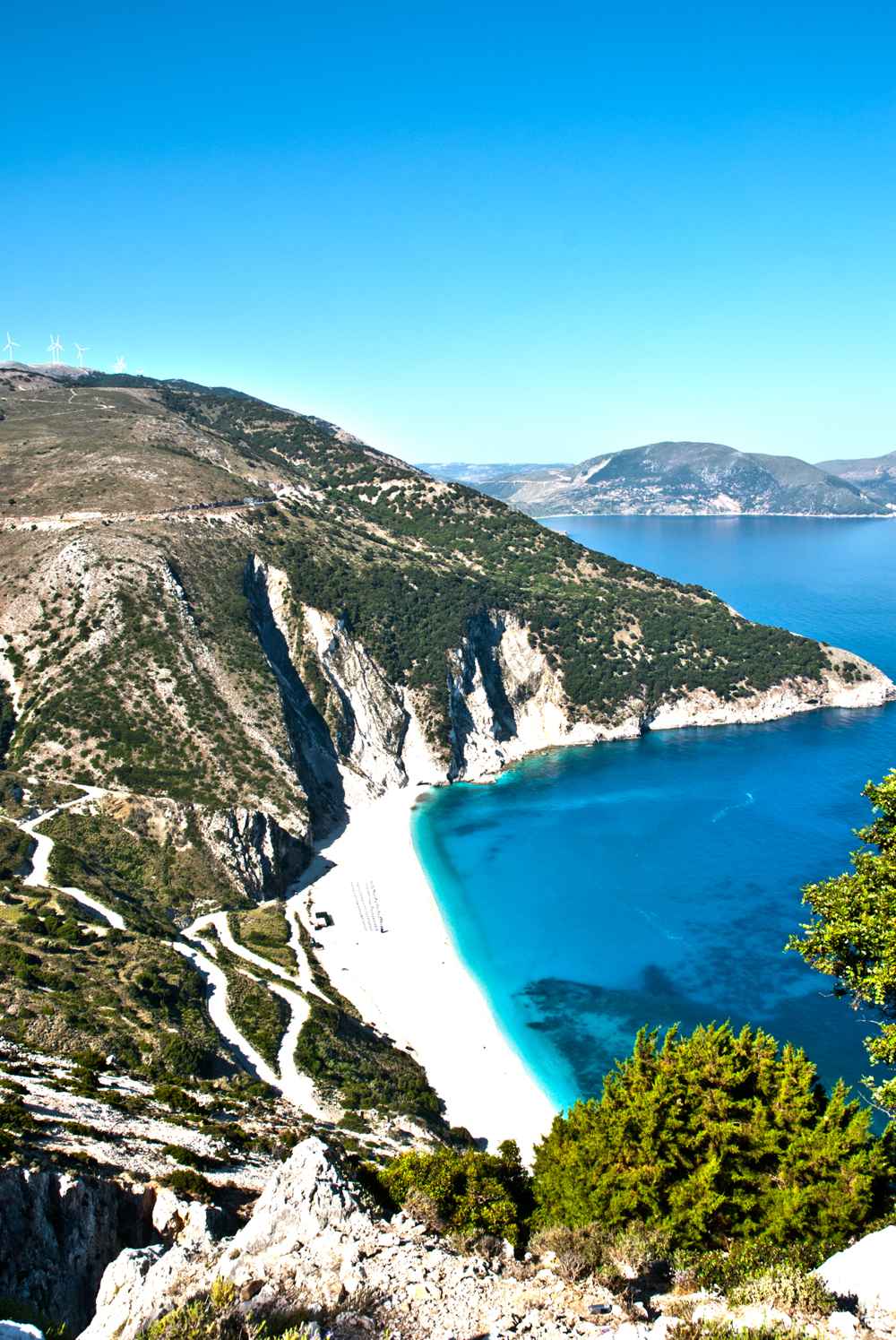
Myrtos beach curves for about 800 metres between Assos and Divarata on the northwest coast, its white pebbles and marble-like sand meeting deep turquoise water below cliffs that fall steeply to a single hairpin access road.
Myrtos sits inside a wide bay on the northwest coast, framed by the green slopes of Agia Dynati and Kalon Oros. The famous view comes from a roadside terrace on the road between Divarata and Assos, about 150 metres above the sea, where the beach appears as a bright crescent. A steep, paved road drops through a set of hairpins to a parking area behind the shore. The shoreline at Myrtos beach is white pebble mixed with coarse pale sand, and the seabed shelves quickly into shades of turquoise and dark blue. There is no natural shade, so the cliffs and the open sky leave the sand fully exposed through the middle of the day.
A canteen and sunbed rows operate near the parking through the summer season.
Reaching Myrtos means driving about 30 kilometres north from Argostoli, close to 40 minutes on the coastal road just south of Divarata. The turn drops from the main road, and the access lane runs about 2 kilometres of tight switchbacks down the cliff face. Parking sits on two levels behind the beach, and it fills by late morning in July and August. The last stretch to the water crosses loose pebbles, so flat shoes or sandals help on the walk from the car. Assos village lies about 8 kilometres further north for a lunch stop, and Fiskardo about 20 kilometres beyond that.
Drivers heading back climb the same hairpins, which run slowly when traffic builds around midday, so an early morning start eases the return.
Swimming at Myrtos means clear, cold water that deepens within about 3 metres of the shoreline. The steep shelf suits strong swimmers, while the drop and the occasional afternoon shore-break call for care with small children. Colour is the draw: the pale seabed turns the shallows milky turquoise, shading to deep blue where the bottom falls away. The pebbles reflect light, so the whole bay glows white and blue under full sun. Waves pick up when the northwest wind blows, and lifeguard cover and a first-aid point operate in peak season. Shade stays scarce, so an umbrella or a rented sunbed matters here more than on sheltered beaches.
Snorkelers find clear visibility along the rocky edges at each end of the crescent, away from the central swimming line.
The Myrtos viewpoint ranks among the most photographed spots in Kefalonia, set on the balcony bend above the descent. Camera light works best in late morning, when the sun stands over the water and lifts the turquoise. Late afternoon throws the eastern cliff into shadow, so the colour flattens before sunset. The beach faces roughly northwest, which gives a clear line to the setting sun over open sea in high summer. A small canteen near the parking sells cold drinks and snacks, and portable toilets stand by the lots. No village sits on the bay itself, so supplies come from Divarata above or Assos to the north.
Visitors combine Myrtos with the Assos castle walk and the harbour tavernas, turning the northwest corner into a full day out.
What are the beaches around Sami on Kefalonia’s east coast like?
Antisamos anchors Kefalonia’s east coast, a pebble bay about 4 kilometres from Sami backed by green hills that served as a filming location for the Captain Corelli’s Mandolin film, with Sami’s own town beaches and quieter coves nearby.
Antisamos lies in a horseshoe bay on the east coast, about 4 kilometres over a low ridge from the port of Sami. Steep green slopes wrap the shore, unusual for a Greek beach, giving a backdrop of pine and scrub instead of bare rock. The beach runs to white pebbles and clear water, with a shallower, sandier patch at the southern end that suits families. Two beach bars and sunbed rows operate along the front in summer, and a car park sits just behind the sand. The bay saw film crews arrive for the Captain Corelli’s Mandolin adaptation, and the set once stood on the flat ground near the shore.
Boats sometimes anchor offshore, and the sheltered east-facing position keeps the water calm through most summer mornings and afternoons.
The town of Sami serves as the island’s second port, with ferries to Ithaca and the mainland at Astakos and Patras. A long town beach of grey pebbles runs north from the harbour toward Karavomilos, backed by a road, tavernas and rooms. The water stays shallow and calm here, which suits an easy swim between meals rather than a scenic outing. Just north, the small cove at Agia Efimia adds a fishing-village harbour about 10 kilometres up the coast, with pebble swimming spots along the way. Sami also gives the nearest access to the Melissani cave and the Drogarati cave, both within a short drive inland.
The port setting makes the town a practical base for the east coast, combining beaches with the two famous caves and boat trips.
Reaching Antisamos means driving about 25 kilometres east from Argostoli, close to 35 minutes over the hills to Sami, then 4 kilometres along a paved road above the coast. The final descent gives a view down onto the two-lobed bay before the road reaches the car park. No village sits on the beach, so food comes from the beach bars or from Sami a short drive back. The bay divides into a livelier northern section with the bars and a calmer southern section with fewer sunbeds. Water shoes help on the pebbles, and the clear bottom suits snorkeling along the rocky headland.
The green amphitheatre of hills blocks the wind from most directions, so Antisamos often stays swimmable when the exposed northwest beaches turn choppy.
A day on the east coast pairs Antisamos with the caves near Sami into an easy loop. Morning swimming at the bay works well before the light drops behind the hills. Then Melissani takes its blue color best around midday when the sun stands over the open roof. Drogarati sits about 4 kilometres from Sami on the Argostoli road, a cool cavern of stalactites reached by a stairway. South of Sami, the ports of Poros and the beach at Skala continue the east and southeast coast, about 40 kilometres from Argostoli. Skala adds long sand-and-shingle fronts and Roman-villa mosaics near the village.
The road between Sami and Poros climbs through forest, so the drive rewards travelers who treat the east coast as a full day rather than a single stop.
Which beaches sit on the Paliki peninsula near Lixouri?
The Paliki peninsula near Lixouri holds Kefalonia’s most contrasting beaches, Xi with its red-orange sand and shallow warm water on the south side, and Petani, a long white-pebble bay between headlands on the exposed northwest coast.
The Paliki peninsula spreads west of Argostoli, reached by a 15-minute ferry across the bay to Lixouri or by a 35-kilometre drive around the lagoon. Lixouri is the island’s second town, a low waterfront rebuilt after the earthquake, with squares, tavernas and a ferry quay. From the town, Xi beach lies about 8 kilometres south and Petani about 9 kilometres northwest, on opposite coasts of the same peninsula. The ferry runs through the day and carries cars, which makes a Paliki beach trip an easy half-day from Argostoli. Roads on the peninsula are gentler than the northern cliffs, crossing farmland and low hills toward each coast.
Lixouri itself keeps a town beach of grey sand at Lepeda, a short drive south past the church of Agios Charalambos.
Xi beach stretches along the south coast of Paliki, about 8 kilometres from Lixouri, backed by low clay cliffs. The sand runs an unusual red-orange, coloured by the soft clay behind it, and the same clay is often scooped from the cliff as a natural skin mask. Water at Xi stays shallow for a long way out, warming early and staying calm, which suits families and young children. Sunbeds, umbrellas and two or three beach bars line the front, and a car park sits behind the sand. The beach faces south into the gulf, sheltered from the northwest wind that troubles the far coast.
A long, flat entry and soft footing make Xi one of the island’s rare sandy beaches, and it fills fast in August.
Petani beach lies on the northwest coast of Paliki, about 9 kilometres from Lixouri, and ranks with Myrtos among the island’s white-pebble bays. A long crescent of white pebbles and marble sand runs between two headlands, dropping into clear turquoise water. The approach descends a winding road from the hills above, opening a view over the bay much like the Myrtos overlook. Two tavernas and sunbed rows sit at the north end near the parking, while the southern stretch stays quieter. The water deepens quickly, so the swimming feels closer to Myrtos than to shallow Xi across the peninsula.
Petani faces the open Ionian, which means the same northwest wind often raises a swell on breezy afternoons, so calm mornings give the best conditions for a long swim.
Xi and Petani split the Paliki day between two very different swims. Xi gives warm, shallow, sandy water on the sheltered south coast, while Petani gives deep, clear, pebble water on the exposed northwest. Families and sunset seekers often pick Xi for the flat entry and the west-facing gulf, which catches the evening light over the water. Swimmers and snorkelers lean to Petani for the depth and the turquoise colour. Both hold sunbeds, umbrellas and tavernas, so a full beach day needs no supplies from town. The ferry timetable back to Argostoli shapes the plan, since the last crossing leaves in the evening.
Lixouri itself rewards a stop for its waterfront squares, and the Kounopetra rock and Lepeda beach round out a Paliki loop for anyone with extra hours.
What beaches lie along the Lassi coast near Argostoli?
Makris Gialos and Platis Gialos front the Lassi coast about 3 kilometres south of Argostoli, two neighbouring sandy beaches with sunbeds, beach bars and shallow turquoise water, set close to the airport and the town’s hotels.
The Lassi coast runs south from Argostoli along a strip of hotels, restaurants and small sandy beaches. Makris Gialos and Platis Gialos sit side by side about 3 kilometres from the town centre, separated by a rocky point and reached by short paths from the road. Both hold golden sand, shallow entries and clear water, backed by low cliffs and rows of sunbeds. Beach bars serve the sand through summer, and lifeguards work the busier stretches in peak season. The setting makes Lassi the most convenient beach zone for anyone staying in or near Argostoli, within a 10-minute drive or a local bus ride.
The area sits close to Kefalonia Airport, about 9 kilometres south of the capital, so these beaches fill first for arriving visitors and early risers.
Makris Gialos means the longer beach of the pair, a curve of soft golden sand facing southwest into the gulf. The water shelves gently and stays calm, which suits families and casual swimmers close to town. Sunbeds and umbrellas cover most of the sand in summer, and two beach bars sell drinks and light food behind the shore. A road runs above the beach with parking along it, and steps drop to the sand between the low cliffs. The southwest aspect turns the beach into a sunset spot, with the light falling over the sea toward the Lixouri side of the bay.
Snorkelers explore the rocky point that divides Makris Gialos from Platis Gialos, where the seabed shifts from sand to weed-covered stone, drawing small fish close in.
Platis Gialos sits just south of its neighbour, a shorter beach of pale sand below a headland crowned by a large hotel. A shallow, sandy entry and a Blue Flag record make it a steady family choice, with sunbeds, showers and a beach bar on the sand. The two beaches share a small bay divided by rocks, so a short walk or swim links Platis Gialos and Makris Gialos within minutes. The Lassi district behind the beaches packs hotels, apartments and tavernas along the road toward the Fanari lighthouse. Kefalonia Airport lies about 9 kilometres south, near the salt flats and the Katavothres sea mills on the way back to Argostoli.
Loggerhead turtles feed in the Argostoli harbour nearby, a short drive north along the waterfront from the Lassi beaches.
The Lassi beaches work best as an easy base rather than a scenic outing far from town. Makris Gialos and Platis Gialos give sand, shallow water and full service within a short drive of Argostoli, so they fit a half-day between town visits. Argostoli itself adds the De Bosset stone bridge across the lagoon, the Napier Garden and the Katavothres sea mills, all within a short reach of Lassi. Travelers based here often swim in the morning, then explore the capital and the caves or reach Myrtos for an afternoon. The beaches face southwest, so late light suits a final swim before dinner in Lassi or on the Argostoli waterfront.
For deeper turquoise and dramatic cliffs, the northwest bays and Petani repay the longer drive north.
What are the southern beaches Skala and Lourdas like in Kefalonia?
Skala and Lourdas anchor Kefalonia’s south coast. Skala stretches long with sand and pebble about 40 kilometres from Argostoli, while Lourdas runs below green hills with clear, deep water and calm swimming.
Skala sits at Kefalonia’s southeast tip, about 40 kilometres by road from Argostoli. The beach runs long, backed by pine trees, with sand near the shore and pebbles further out. The water deepens gradually, which suits families and swimmers. A cluster of tavernas and small hotels lines the road behind the sand, and sunbeds and umbrellas cover the organised central stretch. Ruins of a Roman villa with mosaic floors stand just above the village, a short walk from the beach. The southern orientation shelters Skala from the afternoon wind that hits the west coast, so the sea stays calm through the day.
Buses reach Skala from Argostoli in about an hour, though a car gives easier access to the quieter ends beyond the main strip near the headland.
Lourdas lies on the south coast, about 16 kilometres southeast of Argostoli, below the green slopes of Mount Ainos. The beach runs long and narrow, mixing sand and fine pebble, with water that stays clear and deepens a short distance out. Small tavernas and rooms sit on the hillside above, reached by a steep road that drops to the shore. The organised centre carries sunbeds and umbrellas, while the two ends stay quiet and open. Greenery reaches almost to the sand here, an unusual sight on a Greek island beach. The south-facing position keeps Lourdas calmer than the exposed western coves.
Planning where to stay in Kefalonia around the south coast puts both Lourdas and Skala within a short drive of your base along the coast road.
Both southern beaches earn Blue Flag recognition across recent seasons for water quality and facilities. Skala offers watersports along its organised strip, with equipment for paddleboards and small craft near the central access. Lourdas draws swimmers who want depth close to shore and calm mornings before any breeze builds. Tavernas at both beaches serve fresh fish and local Robola wine grown in the Omala valley inland. The drive between Skala and Lourdas takes about 30 minutes along the coast and through hillside villages. Poros, a small east-coast port with its own pebble beach, sits about 12 kilometres north of Skala for a second swimming stop.
These south-coast beaches suit travellers who want long sand, shallow entry and shade without the steep cliff descents of the northwest.
A car reaches both south-coast beaches most easily, since the coast road links Skala, Lourdas and Poros in a single loop from Argostoli. Buses run from Argostoli to Skala in about an hour and to Lourdas in around 40 minutes, though services thin outside the summer months. Parking sits close to the sand at both beaches, free along the roadside and in small lots behind the tavernas. The southeast setting means morning sun and afternoon shade under the hills at Lourdas. For a full day, combine a south-coast swim with the Roman mosaics at Skala and a drive up toward Mount Ainos national park.
Reviewing things to do in Kefalonia helps pair these beaches with caves, castles and the capital on the same short trip.
What are the northern coves near Fiskardo — Emblisi, Foki and Dafnoudi?
Emblisi, Foki and Dafnoudi are small white-pebble coves within about 3 kilometres of Fiskardo in Kefalonia’s far north. Each holds clear, deep water framed by cypress and olive, and each rewards arrival by car or on foot.
Emblisi lies about 2 kilometres northwest of Fiskardo, a compact cove of white pebbles below low cliffs. The water turns deep and clear within a metre of shore, drawing snorkellers to the rocky edges. No large resort backs the beach, only a small parking area and a seasonal drinks kiosk near the path. Trees give patches of natural shade, useful because the cove carries no long row of umbrellas. Emblisi faces west, so afternoon light fills the bay and the sunset shows over the Ithaca channel. A car covers the short drive from Fiskardo in about five minutes, and the final approach runs down a narrow lane.
Swimmers who want calm, deep water and quiet over facilities find Emblisi one of the north’s easiest coves to reach.
Foki sits just south of Fiskardo, about 1.5 kilometres along a signed track, in a bay shaded by tall cypress trees. The pebble beach meets water that shelves quickly into deep blue, clear enough to see the seabed about three metres down. A single seasonal cantina serves drinks under the trees, and a small spring once fed the cove, giving it the local name. Rocky flanks on both sides hold caves and inlets that reward snorkelling and short swims. Foki faces the Ithaca channel to the east, so it catches calm morning water and softer afternoon wind than the west coast. Parking sits in a rough lot above the beach, a two-minute walk down to the shore.
The cypress shade makes Foki a rare Kefalonia beach with cover through the hottest hours.
Dafnoudi rewards a short walk, reached by a pine-shaded footpath of about 15 minutes from a parking area near Antipata, northeast of Fiskardo. The white-pebble cove sits at the end of a green gully, with no road access and no permanent facilities. Deep, clear water fills the small bay, and a sea cave on the northern side draws swimmers who explore by mask and fins. The walk keeps crowds thin, so Dafnoudi stays among the quietest beaches in the Fiskardo area. No sunbeds or cantina operate here, so visitors carry water, shade and food down the trail. Cypress and pine scent the path, and the final descent opens onto pebbles and turquoise sea.
Dafnoudi suits confident walkers who trade facilities for one of Kefalonia’s most secluded northern coves.
Fiskardo makes the natural base for these three coves, since Emblisi, Foki and Dafnoudi all sit within a 15-minute drive of the harbour. The village survived the Ionian earthquake, keeping its Venetian-style pastel houses and a waterfront of tavernas and moored yachts. A car is close to essential here, because buses do not serve the coves and the lanes run narrow and steep. Morning visits reward swimmers with the calmest water, before the west-coast wind builds after midday. Boat trips from Fiskardo harbour also reach the coves and nearby sea caves, an option for travellers without a hire car. Each cove carries white pebbles rather than sand, so water shoes help on entry.
The far north trades broad organised sand for small, deep, tree-shaded coves and clear Ionian water.
Where do loggerhead sea turtles nest on Kefalonia, and which wild beaches stay quiet?
Loggerhead sea turtles (Caretta caretta) nest at Mounda beach in Kefalonia’s southeast and appear in Argostoli harbour. Mounda and its neighbouring wild beaches stay quiet because a car, not a bus, reaches their long, undeveloped pebble and sand shore.
Mounda beach stretches along the southeast coast near Skala, a long strip of sand and pebble backed by low dunes. Loggerhead sea turtles (Caretta caretta) come ashore here at night in early summer to lay eggs in the warm sand. Conservation volunteers mark and protect the nests, and signs ask visitors to keep the beach dark and clear after dusk. The hatchlings emerge weeks later and cross the sand to the sea, usually before dawn. No large resort lines Mounda, so the beach stays wide, open and quiet through the day. A car reaches Mounda by a track off the Skala road, about 45 kilometres from Argostoli.
Swimmers share the shallows with the turtles’ nesting grounds, so the area rewards respect over sunbeds and noise.
Argostoli harbour draws loggerhead turtles year-round, where they gather near the fishing boats at the Drapano bridge end of the lagoon. The turtles feed on scraps from the returning catch, so early morning and late afternoon give the best sightings from the quay. Local guidelines ask people not to feed or touch the turtles, keeping the animals wild and healthy. The De Bosset stone bridge, the Katavothres sea mills and the Napier Garden all sit within a short walk of the harbour front. A boat or kayak tour from Argostoli offers closer, calmer views of the turtles in the bay. The capital’s waterfront lines the lagoon, with tavernas and cafes facing the water and Lixouri across the strait.
Argostoli combines wildlife, town sights and swimming beaches within a compact southwest base.
Wild beaches ring Kefalonia beyond the organised strips, most reachable only by car down rough tracks. Atheras, on the Paliki peninsula, curves in a sheltered northern bay with a small village and shallow water. Agia Kyriaki and Agia Eleni lie on the west coast of Paliki, exposed pebble coves with strong afternoon wind and dramatic sunsets. Kimilia and Alaties, near Fiskardo, hide small white-pebble beaches below cliffs, reached by steep paths. These beaches carry no sunbeds, cantinas or lifeguards, so visitors bring water, shade and sturdy shoes. The rough tracks keep numbers low even in high summer, rewarding those who want a beach to themselves.
A hire car and an early start open the wild coves that buses and coach tours never reach on Kefalonia.
Kefalonia’s turtle populations depend on quiet, dark nesting beaches, so Mounda and the surrounding sand stay lightly developed by design. Nesting runs through the warm months, with females laying at night and hatchlings emerging weeks afterward. Visitors help by removing umbrellas and flat-packing sunbeds at dusk, filling in holes and taking litter away. Argostoli’s harbour turtles show the tamer, daytime side of the same species, feeding beside the fishing fleet. Boat operators and kayak guides in Argostoli follow rules on distance, giving views without disturbing the animals. A camera with a zoom captures the turtles better than a close approach, which stresses them.
The pairing of protected wild beaches and a working harbour makes Kefalonia one of the surest places in Greece to see loggerheads.


How do you choose a Kefalonia beach — sand or pebble, family, organised or remote, and the wind?
Kefalonia beaches split by type and access. Sand-and-pebble strips like Skala, Lourdas and Xi suit families with shallow entry; remote pebble coves reward a car; and west-facing beaches catch afternoon wind that east and south coasts escape.
Most Kefalonia beaches carry white pebble or a sand-and-pebble mix, with fully sandy stretches rarer than white pebble. Xi beach on the Paliki peninsula stands out with soft red-orange sand and shallow, warm water. Skala and Lourdas in the south blend sand near the shore with pebble further out, easy underfoot for children. Myrtos, Antisamos and the northern coves run to bright white pebble, so water shoes ease the entry. Pebble beaches keep the water strikingly clear, since no sand clouds the shallows when waves stir. Sandy beaches warm faster and feel softer for sunbathing and young children.
Matching the beach surface to your group — soft sand for toddlers, clear pebble for snorkelling — shapes the day more than distance from your base does across the island.
Families with young children favour the south and Paliki beaches, where the water shelves gently and stays calm. Xi beach offers warm, shallow sand and a natural clay that visitors use on their skin, with tavernas and sunbeds close by. Lourdas and Skala provide long, organised strips with lifeguard cover in high season, umbrellas and easy parking. Makris Gialos and Platis Gialos, just south of Argostoli, give sandy coves with beach bars and gradual entry, popular with families based near the capital. Antisamos, though pebbly, has organised facilities and calm east-coast water suited to older children who swim. West-coast and northern coves suit families less, with deep water close to shore and afternoon wind.
Choosing an organised south or Paliki beach keeps small children safe and parents supplied through the day.
Organised beaches on Kefalonia carry sunbeds, umbrellas, tavernas and parking, while remote coves offer only pebbles, trees and clear water. Myrtos, Antisamos, Xi, Skala, Lourdas and Makris Gialos rank among the organised beaches, with facilities and bus links in summer. Emblisi, Foki, Dafnoudi, Mounda and the Paliki west coast fall on the wild side, needing a car and self-sufficiency. Organised beaches suit travellers who want shade, food and drinks on hand without carrying a cool box. Remote coves reward those who prize quiet, clear water and space over amenities, and who bring their own supplies. A hire car unlocks both, letting you swap a busy strip for a hidden cove within the same afternoon.
Weighing facilities against solitude, and matching each to the day’s plan, guides the choice on Kefalonia’s varied coast.
Wind shapes the Kefalonia beach day, since most beaches face west and catch the afternoon sea breeze. Myrtos, Petani, Xi and the Paliki west coast lie exposed, calm in the morning but choppier after midday when the wind builds. East and south coasts stay more sheltered, so Antisamos near Sami and the southern beaches of Skala and Lourdas keep calmer water through the day. Morning swims give the flattest sea almost everywhere, a reason to reach exposed beaches early. The wind cools the hottest hours but stirs pebble beaches into small waves that suit stronger swimmers. Checking the forecast and the beach’s orientation before setting out avoids a windy afternoon on the wrong coast.
Planning around the breeze turns Kefalonia’s varied exposure from a nuisance into a way to always find calm water.
How do you get to Kefalonia’s beaches — by car, boat trip or bus?
A hire car reaches nearly every Kefalonia beach, including the remote coves buses miss. Boat trips from Argostoli, Sami and Fiskardo cover Myrtos, sea caves and hidden bays, while buses link only the main organised beaches in summer.
A hire car gives the widest beach access on Kefalonia, since the island spreads about 773 square kilometres of mountains and coast. Roads link Argostoli to Myrtos in about 40 minutes, to Fiskardo in around 90 minutes, and to Skala in about an hour. Remote coves sit at the end of narrow, unpaved tracks that only a car or scooter reaches. Car hire desks operate at Kefalonia Airport, about 9 kilometres south of Argostoli, and in the main towns. Fuel stations cluster around Argostoli, Sami, Lixouri and Skala, with fewer in the far north near Fiskardo. Driving lets you chase calm water, moving from a windy west beach to a sheltered east cove in one day.
A car turns the whole coastline into reachable options rather than a handful of bus stops.
Boat trips reach beaches and caves that roads cannot, running from Argostoli, Sami, Fiskardo and Agia Efimia in summer. Day cruises from Fiskardo and Agia Efimia stop at Myrtos, Emblisi and hidden northern coves for swimming from the deck. Trips from Sami visit the Melissani cave, an underground lake with an open roof reached by small rowing boat. Argostoli boat tours combine the turtle-filled harbour with swimming stops along the sheltered southwest coast. Self-drive boat rentals, needing no licence for small engines, let visitors reach quiet bays at their own pace. Boat trips also give the classic sea-level view of Myrtos, framed by its white cliffs from the water.
A cruise adds beaches beyond the road network and turns the coastline into a full day on the Ionian Sea.
Buses on Kefalonia link Argostoli with the main beaches and towns, but skip the remote coves entirely. KTEL services run from Argostoli to Skala, Lourdas, Sami, Fiskardo, Lixouri and Poros, with more departures in July and August. Beaches like Makris Gialos and Platis Gialos sit within a short bus ride or taxi from the capital. Myrtos has limited bus access, so most visitors reach it by car, tour or boat rather than public transport. Taxis fill gaps for beaches off the bus routes, though fares add up over the island’s long distances. Bicycles and scooters suit shorter hops near the towns but strain on the steep mountain roads inland.
Public transport covers the organised beaches for travellers without a car, while the wild coves stay a drive or cruise away.
Beach access on Kefalonia ranges from a short flat walk to a steep cliff descent or a wooded footpath. Myrtos reaches its sand by a paved road that switchbacks down the cliff to a car park by the beach. Foki and Emblisi sit a two-minute walk from parking, while Dafnoudi needs a 15-minute trail through pines. Wild coves on the Paliki west coast and near Fiskardo end in rough tracks and steep paths, so sturdy shoes help. Parking near popular beaches fills by mid-morning in summer, another reason to arrive early on the coast. A car, an early start and a check of each beach’s access turn a Kefalonia beach day into an easy plan.
Matching your transport to each beach’s terrain opens the island’s full range of sand, pebble and hidden coves.
Frequently Asked Questions
Which are the best beaches in the south of Kefalonia?
Skala and Lourdas rank as the best beaches in southern Kefalonia. Skala runs long, about 40 kilometres from Argostoli, with sand near the shore, pebble further out, pine trees behind and a strip of tavernas and sunbeds. Roman-villa mosaics stand above the village, a short walk from the sand. Lourdas lies about 16 kilometres southeast of Argostoli, a long beach below the green slopes of Mount Ainos, mixing sand and fine pebble with clear water. Both face south, so they escape the afternoon wind that hits the west coast and keep calm water through the day. Makris Gialos and Platis Gialos, just south of Argostoli, add sandy coves with beach bars and gradual entry.
Poros, on the east coast about 12 kilometres north of Skala, gives a quieter pebble beach and a ferry port. A car links all of them along the south coast road, though buses reach Skala and Lourdas from Argostoli in high season.
How do you reach the coves near Fiskardo — Emblisi, Foki and Dafnoudi?
A car reaches all three coves near Fiskardo within about 15 minutes of the harbour. Emblisi lies about 2 kilometres northwest, down a narrow lane to a parking area beside the white-pebble cove. Foki sits about 1.5 kilometres south along a signed track, with a rough lot above and a two-minute walk to the cypress-shaded beach. Dafnoudi needs more effort: park near Antipata, northeast of Fiskardo, then follow a pine footpath for about 15 minutes to the pebble bay. Buses do not serve these coves, so a hire car or scooter is close to essential. Boat trips from Fiskardo harbour offer another route, reaching Emblisi and the northern sea caves from the water.
None of the three carries sunbeds or a full taverna, so visitors bring water, shade and water shoes for the pebbles. Morning visits give the calmest sea and clearest water, before the west-coast wind builds after midday around the far north of Kefalonia.
Where can you see loggerhead sea turtles on Kefalonia?
Loggerhead sea turtles (Caretta caretta) appear in two main places on Kefalonia: Argostoli harbour and Mounda beach. Argostoli’s lagoon draws turtles year-round, where they gather near the fishing boats at the Drapano bridge end to feed on scraps from the catch. Early morning and late afternoon give the best sightings from the quay, and boat or kayak tours bring closer views. Mounda beach, in the southeast near Skala about 45 kilometres from Argostoli, is a nesting site where females lay eggs in the sand at night through the warm months. Conservation volunteers mark and protect the nests, and signs ask visitors to keep the beach dark and clear after dusk.
Hatchlings emerge weeks later and cross to the sea before dawn. Guidelines ask people not to feed or touch the turtles, keeping them wild. A zoom camera captures them without a stressful close approach. Respecting the nests and harbour rules keeps Kefalonia’s turtle populations healthy.
Are Kefalonia’s beaches sandy or pebbly?
Most Kefalonia beaches are white pebble or a sand-and-pebble mix, with fully sandy beaches rarer than on the Aegean islands. Myrtos, Antisamos, Emblisi, Foki and the northern coves run to bright white pebble, which keeps the water strikingly clear but calls for water shoes on entry. Xi beach on the Paliki peninsula stands out with soft red-orange sand and shallow, warm water. Skala and Lourdas in the south blend sand near the shore with pebble further out, easy underfoot for children. Makris Gialos and Platis Gialos, just south of Argostoli, add sandy coves with gradual entry. Pebble beaches stay clear because no sand clouds the shallows when waves stir, which helps snorkelling.
Sandy beaches warm faster and feel softer for young children and sunbathing. Matching the surface to your group shapes the day: soft sand for toddlers, clear pebble for snorkelling. Packing water shoes covers the pebble beaches that make up most of the Kefalonia coast.
Which Kefalonia beaches are best for families with children?
Families with young children do best on the south and Paliki beaches of Kefalonia, where the water shelves gently and stays calm. Xi beach offers warm, shallow red-orange sand, a natural clay that visitors spread on their skin, and tavernas and sunbeds nearby. Lourdas and Skala provide long, organised strips with lifeguard cover in high season, umbrellas and easy parking. Makris Gialos and Platis Gialos, just south of Argostoli, give sandy coves with beach bars and gradual entry, handy for families based near the capital. Antisamos near Sami, though pebbly, has organised facilities and calm east-coast water for older children who swim well.
West-coast and northern coves suit families less, with deep water close to shore and afternoon wind. Sand-and-pebble beaches with shallow entry beat the steep, deep coves for toddlers. Bringing water shoes, shade and an early start keeps children comfortable, since parking near popular family beaches fills by mid-morning in the Kefalonia summer.
Do you need a car to reach Kefalonia’s beaches?
A car makes reaching Kefalonia’s beaches far easier, since the island spreads about 773 square kilometres and buses serve only the main organised strips. KTEL buses run from Argostoli to Skala, Lourdas, Sami, Fiskardo, Lixouri and Poros, with more departures in July and August. The remote coves — Emblisi, Foki, Dafnoudi, Mounda and the Paliki west coast — sit at the end of narrow tracks that buses skip entirely. Myrtos has limited bus access, so most visitors reach it by car, tour or boat. Car hire desks operate at Kefalonia Airport, about 9 kilometres south of Argostoli, and in the main towns.
A hire car lets you chase calm water, swapping a windy west beach for a sheltered east cove in one day. Taxis and scooters fill remaining gaps, and boat trips reach coves and caves from the water. Travellers without a car can still enjoy the organised beaches, but a car unlocks the full Kefalonia coastline.
When is the best time of day to visit Kefalonia’s beaches?
Morning gives the best beach conditions on Kefalonia, since most beaches face west and the sea breeze builds after midday. Myrtos, Petani, Xi and the Paliki west coast stay flat and calm early, then turn choppier in the afternoon wind. Reaching these exposed beaches before midday rewards swimmers with the calmest, clearest water. East and south coasts — Antisamos near Sami, Skala and Lourdas — stay sheltered and keep calmer water through the day. Early arrival also secures parking, which fills by mid-morning at popular beaches like Myrtos in high summer. Late afternoon suits Argostoli harbour, when the turtles gather near the returning fishing boats.
Sunset shows best from west-facing beaches such as Myrtos, Emblisi and the Paliki coves, framed over the Ionian Sea. Midday sun runs strong, so shade, water and water shoes for the pebbles matter. Planning around the wind and the sun turns any Kefalonia beach day into calm, clear swimming almost anywhere on the island.