
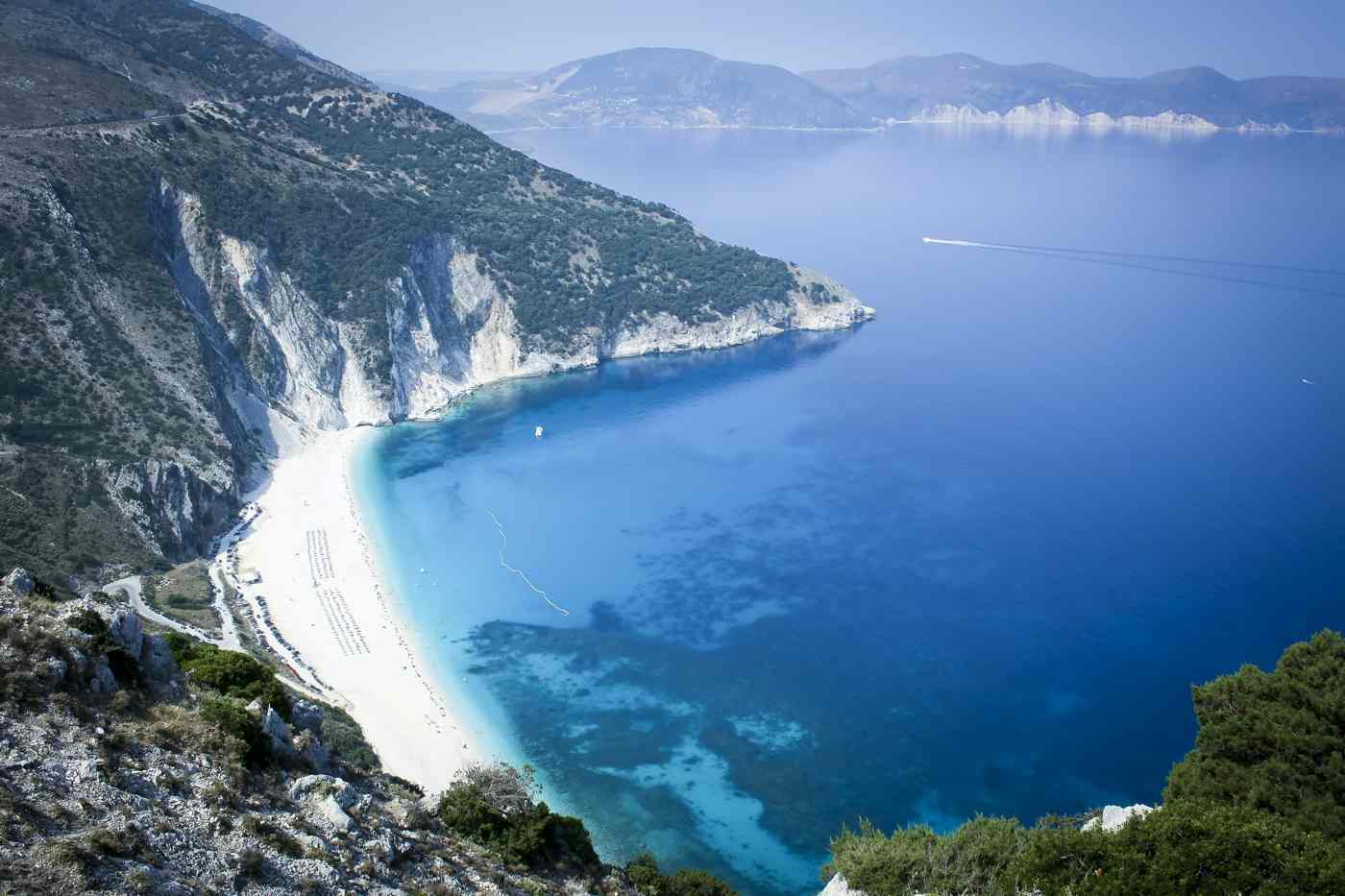
Kefalonia offers diverse accommodations, each catering to different travel needs. From bustling Argostoli to the serene northern villages, there’s a perfect spot for everyone. Plan the whole trip with Greece Tours.
Explore the island’s unique areas, their attractions, and what makes each a great base for your Kefalonia adventure. Whether you prefer beaches, culture, or nature, Kefalonia has it all.
What makes Argostoli a great place to stay in Kefalonia?
Argostoli, the island capital, gives first-time visitors the widest choice of shops, tavernas and transport on Kefalonia. The airport lies 9 km south, the Lixouri ferry leaves from the town waterfront, and the Lassi beaches sit 3 km away.
Argostoli sits on a sheltered bay in the southwest of Kefalonia and works as the island capital, main administrative town and busiest port for local traffic. The town wraps around the Koutavos lagoon, crossed by the De Bosset stone bridge that runs about 690 metres to the far shore. Loggerhead sea turtles feed beside the fish quay on most summer mornings. The Katavothres sea mills lie around 2 km north of the centre, where seawater pours into the rock. Rebuilding after the earthquake produced low concrete blocks rather than old stone lanes, so the appeal here rests on daily life.
Lithostroto, the marble-paved shopping street, runs parallel to the waterfront, and the central square fills with families after dark. Travellers who want shops, banks, pharmacies and the bus station within a five-minute walk find all of that here. Ferries to Lixouri and the Paliki peninsula leave from the same quay.
Accommodation across Argostoli covers small hotels on the waterfront, apartments in the residential grid behind Lithostroto and rooms in the streets climbing towards the ring road. Rates sit below the north of the island for an equivalent standard, because the town trades through the whole year rather than living on one summer season. A first visit suits this base: flights land 9 km away, the rental desks cluster nearby, and the town explains the island before anyone drives into the mountains. Couples who want tavernas, bars and an evening walk within reach of their room rarely need a car after dark. Beach lovers face one trade-off, since the town holds no proper beach of its own.
Swimmers walk about 20 minutes south to the flat rock platforms below the Fanari lighthouse, or drive five minutes to Lassi for sand and sunbeds. Studios with kitchens sit two streets back from the port, where street noise drops after midnight.
Beach access from Argostoli runs south along the Lassi road, where the beaches of Makris Gialos and Platis Gialos lie about 3 km from the centre. Both hold fine golden sand, organised sunbeds, showers and beach bars, and both face west for late afternoon sun. The Fanari lighthouse peninsula, closer at around 2 km, offers rock platforms and a paved coastal path used by walkers each evening. Drivers reach Myrtos in about 45 minutes on the coast road north. Antisamos takes about 40 minutes east, and Xi on the Paliki peninsula about 45 minutes by road. Kaminia and Mounda in the far south, both loggerhead nesting beaches, take around one hour.
Argostoli therefore works as a beach-hopping base rather than a beachfront one, which suits travellers planning a different cove each day of the week. Boat trips towards Myrtos and the sea caves also leave from the harbour through the season.
Transport connections concentrate in Argostoli more heavily than anywhere else on Kefalonia. The airport lies 9 km south, a drive of about 15 minutes, so taxi transfers stay short and predictable even after a delayed evening flight. The KTEL bus station sits on the southern waterfront and runs the island routes to Sami, Skala, Poros, Lixouri and Fiskardo. Most lines carry two or three departures a day and thin out at weekends. The Lixouri ferry leaves from the same waterfront and crosses the bay in about 20 minutes, replacing a 35 km drive around the head of the gulf.
Car and scooter rental offices line the port road, and parking runs free along the seafront outside the July and August peak. Travellers arriving without a booked vehicle find the widest choice of cars here, which matters on an island where buses reach a fraction of the coast.
Why choose Lassi as a base in Kefalonia?
Lassi combines sand with convenience, sitting 3 km southwest of Argostoli on the Fanari peninsula. Makris Gialos and Platis Gialos lie within walking distance of most hotels, and the airport is a 10-minute drive south.
Lassi occupies the peninsula immediately southwest of Argostoli, a strip of hotels, apartments and tavernas along one main road above the sea. The area grew as the package-holiday centre of Kefalonia, so it carries the island’s highest concentration of pools, minimarkets, car-hire desks and excursion offices. Buildings stay low among cypress and pine, and the coast road drops to sand at two points rather than running along a continuous promenade. Guests at the northern end walk into Argostoli in about 30 minutes along the lighthouse path, while the southern end sits closer to the two beaches. Evening life centres on the strip, with family tavernas, cocktail bars and shops that stay open until midnight through the summer.
Travellers who want everything reachable on foot, without needing a car to reach dinner or a supermarket, get that arrangement in Lassi. Supermarkets, bakeries and a pharmacy sit on the same road as the hotels.
Makris Gialos and Platis Gialos define the beach offer at Lassi, two neighbouring bays of pale sand separated by a low headland. Platis Gialos is the smaller of the two, backed by a hotel terrace and reached down a flight of steps from the road. Makris Gialos runs longer, holds two organised sections with sunbeds and a beach bar, and shelves gently enough for children to stand well out from the shore. Both face west, which keeps the sand in sun until late and produces the sunsets that fill the bars above. Water sports desks operate through summer, renting pedalos, kayaks and paddleboards by the hour.
Swimmers wanting quieter water walk north to the rock platforms below the Fanari lighthouse, about 1.5 km along the coast road. Numbers peak in the first three weeks of August, when arriving before ten secures a front-row sunbed. Shade comes from hired umbrellas rather than trees on both bays.
Day trips from Lassi reach most of what people come to Kefalonia to see. Melissani and Drogarati caves near Sami take about 45 minutes by car across the central ridge. Boat trips towards Myrtos and Assos leave from Argostoli harbour, a short taxi ride away. The Robola cooperative and the monastery of Agios Gerasimos sit around 20 minutes inland in the Omala valley. That road climbs into the fir belt below Mount Ainos. Excursion agencies along the strip sell seats on coaches to Myrtos, Fiskardo and Ithaca, which removes the drive mountain roads on a first visit.
Guests without a car still manage two or three organised outings in a week and fill the remaining days on the sand. That balance explains why Lassi suits first-time visitors who want the headline sights without long transfers. Boat excursions towards Ithaca leave from Sami, about 45 minutes away by road.
Distances from Lassi stay short in every direction that matters on arrival day. The airport lies about 6 km south, roughly a 10-minute drive, so a late flight causes no long transfer with tired children in the back. Argostoli’s bus station, banks and Saturday market sit 3 km north, reachable on foot, by local bus or by a short taxi ride. Sami lies around 25 km east, about 35 minutes; Skala measures 40 km southeast, about 50 minutes; Fiskardo sits 55 km north, roughly one hour and 20 minutes. Families and couples on a first week generally hire a car for three or four days rather than the full stay, using the beach on the days between.
Travellers hunting a quiet village atmosphere find Lassi too built up, and gain more from Assos, Lourdas or the Paliki villages across the bay. Petrol stations, supermarkets and a health centre sit on the Argostoli road nearby.
What are the benefits of staying in Fiskardo?
Fiskardo anchors the far north of Kefalonia, about 50 km from Argostoli. Venetian houses survived the earthquake here, and yachts, boutique rooms and harbour restaurants shape a base built for couples rather than beach families.
Fiskardo stands at the northern tip of Kefalonia, the one village whose houses came through the earthquake largely intact. Pastel Venetian facades curve around a deep natural harbour, with a Venetian lighthouse and the ruins of a Norman basilica on the headland opposite the quay. Yachts and sailing flotillas tie up along the waterfront each evening, and the restaurant terraces sit directly above the water. Room rates here run the highest on the island, matching the boat traffic and the limited stock inside the village itself. Cars stop at car parks on the approach road, leaving the harbour front to pedestrians through the day.
Guests who want to photograph old stone rather than post-earthquake concrete find Fiskardo the only place on Kefalonia that delivers it. Day-trip coaches arrive around midday and leave by five. Winter closes most of the quay, and the village returns to its permanent residents.
Swimming near Fiskardo happens in small white-pebble coves rather than on open sand. Emblisi lies about 1.5 km west, a bright bay of pebbles and clear water with limited parking and no sunbeds at the far end. Foki sits about 1 km south, backed by cypress trees and a single taverna, and works well for snorkelling along the rocky edges. Dafnoudi, reached by a 15-minute walk through pine forest from Antipata, rewards the effort with a sheltered cove that stays quiet through August. Boat hire operates from the harbour, and a small self-drive boat opens the coastline north towards Kimilia and the sea caves. Myrtos lies about 15 km south, roughly 25 minutes by road through Divarata.
Beach bags rather than buggies suit this coast, since access to most coves involves steps or a rough track down through trees. Parking near each cove fills before eleven in high season, so early arrivals travel easier.
Fiskardo suits couples, sailors and travellers who value evening atmosphere over beach convenience. Restaurants along the quay serve fish by the kilo, and reservations matter through July and August when the harbour fills with crews. Boutique studios and restored stone houses form most of the accommodation, with villas spread across the hillsides towards Antipata and Tselentata. Families with young children face a harder week here, because the village holds no sandy beach within walking distance and the shops carry a narrow range. Nightlife stays low-key, running to wine bars and late dinners rather than clubs. Assos lies 12 km south, about 20 minutes by road, and the two villages pair well across a week in the north.
Travellers on a short break lose most of a day to transfers, so Fiskardo repays stays of five nights or longer. Bakeries, two minimarkets and a pharmacy cover daily needs inside the village.
Driving defines a Fiskardo stay more than any other base on Kefalonia. Argostoli lies about 50 km south, a drive of one hour and 15 minutes on a winding coast road that climbs high above Myrtos. The airport adds another 15 minutes, so transfers run close to 90 minutes in each direction. Sami sits around 35 km south on the east coast, roughly 45 minutes, which puts the caves and the Ithaca ferry within an easy morning. Buses reach Fiskardo from Argostoli on a thin schedule, and no useful service links the northern villages to each other. Car hire therefore counts as essential rather than optional at this end of the island.
Summer ferries connect Fiskardo with Vasiliki on Lefkada and with Frikes on Ithaca, which lets island-hoppers arrive without crossing the whole of Kefalonia by road. Taxi transfers from the airport run long and expensive compared with the southern resorts.
Why is Sami a strategic place to stay in Kefalonia?
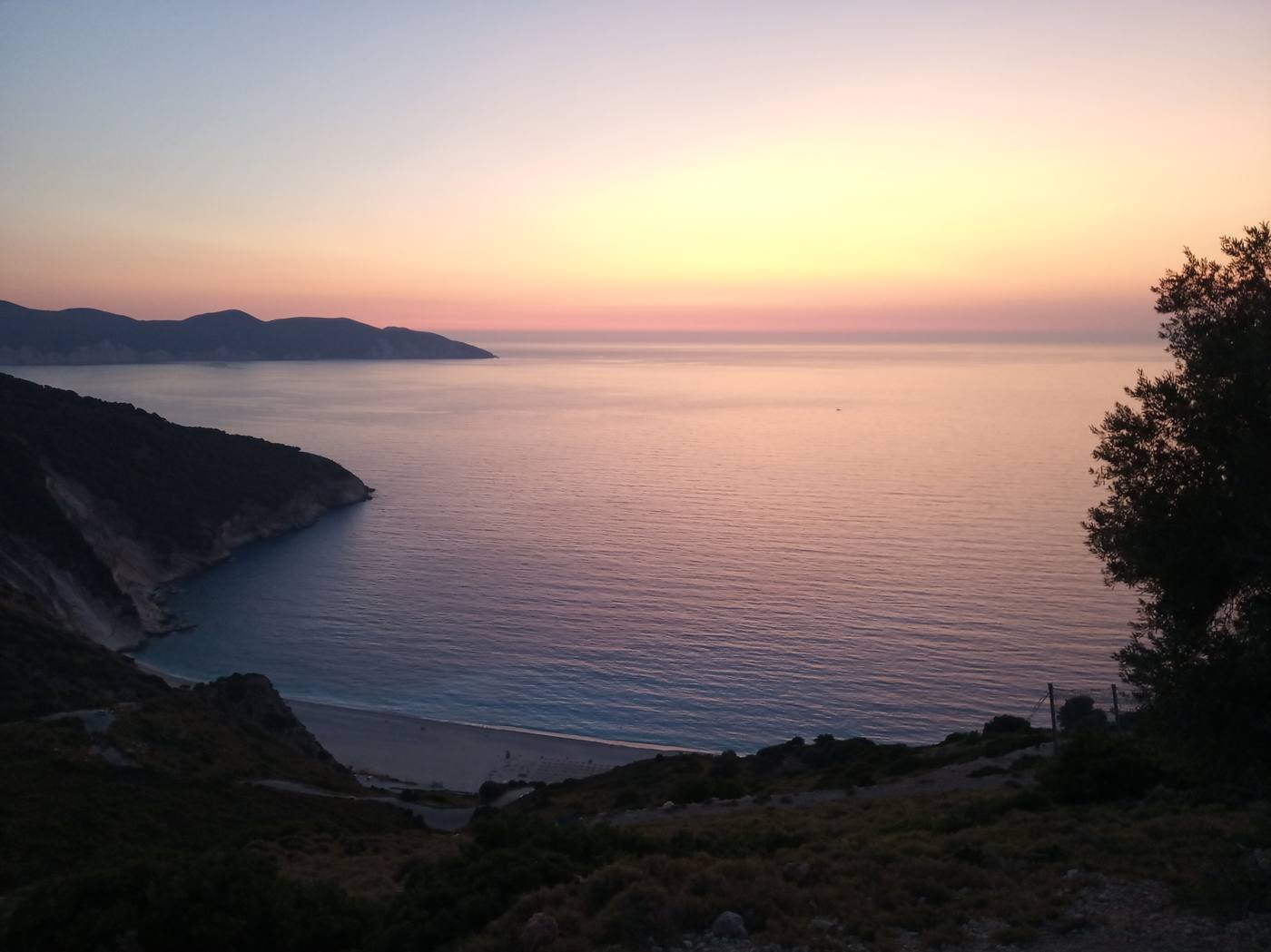
Sami works as the east-coast base on Kefalonia, 25 km from Argostoli. Ferries to Ithaca and the mainland leave from its quay, and Melissani, Drogarati and Antisamos beach all sit within 5 km of town.
Sami spreads along a wide bay on the east coast, facing Ithaca across a channel of about 5 km. The town serves as the second port of Kefalonia, with ferries to Piso Aetos on Ithaca and to Astakos and Patras on the mainland. Rebuilding after the earthquake produced a low waterfront of tavernas, ticket offices and modest hotels rather than an old town of lanes. The Captain Corelli’s Mandolin film used the bay and the streets behind it, and the location still draws visitors who watched it. Fishing boats and car ferries share the same quay, so mornings start early and the harbour works before the cafés open.
Travellers arriving by sea with their own vehicle find Sami the natural first night, since driving across the island in the dark after a late crossing serves nobody well. Ticket agencies on the quay sell crossings, and the schedule thins outside the summer months.
Cave visits explain most bookings in Sami. Melissani lies about 2 km northwest, an underground lake whose roof collapsed to leave an open shaft above the water. Rowing boats carry visitors across a surface that turns deep blue when the sun stands high. Drogarati sits about 4 km southwest on the Argostoli road, a stalactite chamber with a hall large enough for occasional concerts. Karavomilos, 1 km from the Sami waterfront, holds a small lake where the seawater that disappears at the Katavothres of Argostoli surfaces again after crossing beneath the island. Guests staying in town reach all three before the coach parties arrive, which is the practical advantage of this base over Lassi or Skala.
Walking to Karavomilos takes 15 minutes along the shore, and a steady walker continues to Melissani in about 30. Melissani opens through the day, and the boat ride across the lake lasts about 15 minutes.
Antisamos lies 4 km northeast of Sami over a low ridge, a curve of white pebbles below green hills, with organised sunbeds and two beach bars behind the shore. The water drops away quickly, which suits confident swimmers more than toddlers. Agia Efimia, a small fishing harbour 10 km north, adds a second dining option and boat rental for the coast towards Myrtos. Makriotika and Karavomilos hold quieter pebble strips within a five-minute drive of the town. Myrtos sits about 20 km northwest, roughly 30 minutes by road, so the island’s headline beach fits into a half-day from this base. Poros lies 25 km south along the coast, about 35 minutes, with its own ferry to Kyllini.
Beach variety from Sami leans towards pebbles and deep clear water rather than the sand of the south coast. Shade behind Antisamos comes from the hillside rather than trees, so umbrellas matter here.
Sami suits divers, cave visitors and island-hoppers more closely than sunbathers. Dive centres operate from the harbour, and the underwater topography off the east coast includes caverns, walls and a wreck used for training. Room stock stays modest, running to family-run hotels, apartments above tavernas and villas on the slopes behind the town. Rates sit below Fiskardo and close to Argostoli, and availability holds later into the season than the north manages. Argostoli lies 25 km west, about 30 minutes over the central ridge, so a day in the capital costs little driving time. Buses link the two towns on a limited timetable, with roughly two services on weekdays and fewer at weekends.
Ferry passengers heading to Ithaca cross in about 40 minutes and return the same afternoon, which makes a second island realistic. Tavernas along the waterfront stay open late, and supermarkets operate two streets back.
What makes Assos a unique place to stay in Kefalonia?
Assos occupies a narrow isthmus on the northwest coast below a Venetian castle. The village keeps a small permanent population, a short row of guesthouses and one pebble cove, with Myrtos beach 8 km to the south.
Assos sits on the northwest coast, where a narrow isthmus links the shore to a pine-covered peninsula crowned by a Venetian castle. The castle walls run for about 2 km around the headland, and the path up from the village takes around 30 minutes at a steady pace. Houses in ochre and pale blue step down to a small harbour, rebuilt after the earthquake with help from the city of Paris. A plaque in the square records that contribution. Fishing boats and a short row of tavernas fill the waterfront, and the access road descends in hairpins from the main coast highway above. Assos holds one of the smallest resident populations of any named base on Kefalonia.
That sets the tone of a stay: dinner beside the water, no nightlife and full darkness by eleven. Parking sits above the isthmus, and the walk down into the village takes five minutes.
Accommodation in Assos runs to guesthouses, studios and villas on the slopes above the bay rather than hotels with reception desks. Room numbers stay low, so booking early matters more here than in Lassi or Skala. Couples and photographers gain most from the setting, since the light on the castle hill changes through the evening. The village empties once the day-trip coaches leave around five. Guests trade convenience for quiet, because the nearest supermarket of useful size sits in Divarata, about 5 km uphill, and the nearest bank and pharmacy stand further still. Steps and slopes run through the village, which makes wheeled luggage awkward and rules the setting out for travellers with limited mobility.
Evening dining stays within 200 metres of the water, and the choice covers fish tavernas and two cafés rather than a restaurant scene. Breakfast comes from the tavernas rather than shops, so self-catering guests buy in Divarata.
Myrtos lies about 8 km south of Assos, roughly 15 minutes by car down a road that passes the cliff-top viewpoints above the bay. The beach itself sits at the foot of a steep access road, a curve of white pebbles between limestone headlands. Sunbeds and one canteen operate there, with no shade beyond the umbrellas. Swimmers meet a sharp shelf and a stiff afternoon breeze, so the calmest water comes before noon. Divarata, the village on the ridge above, holds the tavernas and the bus stop that serve Myrtos. Fiskardo lies 12 km north, about 20 minutes, which makes dinner in that harbour an easy evening out from Assos.
Agia Efimia sits 25 km southeast on the other coast, roughly 35 minutes, adding a second working harbour to the rotation of evening options. Divarata sits about 4 km above Myrtos, which puts the beach within 10 minutes by car. Sunbeds there sell out by midday in August.
Driving to Assos demands attention on the final descent, where the road narrows through hairpins with limited passing places. Parking sits at the top of the village and along the isthmus, and the spaces fill between eleven and four when day visitors arrive by coach and hire car. Argostoli lies about 38 km south, a drive of 50 minutes, and the airport adds a further 15 minutes to that transfer. Buses pass on the main road above rather than entering the village on most services, which leaves a 2 km uphill walk to reach them. Car hire therefore counts as necessary for a stay of more than two nights.
Guests booking a villa above the bay handle a steep private track in most cases, so a compact car makes more sense here than a large saloon. Fuel stations sit in Divarata and Fiskardo rather than in the village. Night driving needs care, since the bends carry no lighting.
Why consider Lixouri for a stay in Kefalonia?
Lixouri anchors the Paliki peninsula across the bay from Argostoli, linked by a car ferry crossing of about 20 minutes. Rooms cost less here, and Xi and Petani beaches both lie within 20 minutes by road.
Lixouri faces Argostoli across the gulf and serves as the main town of the Paliki peninsula, the western lobe of Kefalonia. The ferry crosses in about 20 minutes and runs through the day, carrying cars as well as foot passengers. That crossing turns a 35 km road journey into a short hop. Rebuilding after the earthquake left a low grid of streets around a large central square, shaded by plane trees and lined with cafés. Local families rather than tour groups fill that square in the evening, and prices for coffee and dinner sit noticeably below Lassi or Fiskardo. The Iakovatios library and the Typaldos-Iakovatos mansion give the town two indoor sights for a windy morning.
Travellers who want an everyday Greek town with beaches nearby, rather than a purpose-built resort strip, find that balance in Lixouri. Foot passengers walk onto the ferry without booking, and cars queue on the quay.
Xi beach lies about 8 km south of Lixouri, roughly 12 minutes by car, with red-orange sand and shallow water that stays warm and calm through the season. Clay cliffs behind the shore supply the mud that visitors spread on their skin, and the organised section holds sunbeds, tavernas and water sports. Petani sits 12 km northwest, about 20 minutes over the spine of the peninsula, a deep bay of white pebbles under high cliffs that faces the sunset. Kounopetra, near Xi, marks the rock that rocked with the swell until the earthquake settled it in place. Megas Lakos, next to Xi, adds a longer and emptier stretch of the same red sand.
Paliki therefore delivers two distinct beach characters within 20 minutes of one base, which no other corner of the island matches. Lepeda, 3 km from town, adds a red-rock beach reached in under 10 minutes. Sunset watchers drive out to Petani.
Lixouri suits budget-conscious travellers, returning visitors and anyone who prefers a working town to a holiday strip. Apartments and small hotels dominate the stock, with villas scattered across the farmland behind Xi and Lepeda. Rates run below the equivalent standard around Argostoli, and availability holds into August longer than the northern villages manage. Families gain from the shallow water at Xi and the short drive to reach it, while walkers use the tracks along the west cliffs above Petani. The trade-off comes in evening choice, since restaurants number fewer than in the capital and nightlife stays limited to the square and two bars.
Guests basing here for a full week generally take the ferry across to Argostoli twice, once for the Saturday market and once for dinner on the capital’s waterfront. Bakeries, banks and a health centre operate in town, which suits stays of a week or longer. Ferry tickets sell on the quay before departure.
Driving from Lixouri to the rest of Kefalonia runs through Argostoli in every direction, either by ferry or around the head of the gulf. The road route measures about 35 km and takes 40 minutes, while the ferry plus the drive into town takes about 30 minutes including boarding. The airport lies 45 km away by road. A hire car collected at the terminal reaches Lixouri in around 50 minutes by land, or 35 minutes using the crossing. Sami sits 60 km east, roughly one hour and 10 minutes, and Fiskardo needs close to two hours in each direction.
Guests planning daily excursions to the north and east lose time from this base, while those content with the beaches of Paliki lose nothing. Bus services link Lixouri with the peninsula villages on a school-term pattern, so a car remains the practical choice. Fuel stations operate on the edge of town and on the road towards Xi.
What are the advantages of staying in Skala?
Skala occupies the southeast corner of Kefalonia, about 40 km from Argostoli. A sand-and-shingle beach runs 3 km beside the village, backed by pine forest, tavernas and family apartments within five minutes on foot.
Skala stands at the southeast corner of the island, where a coastal plain meets a long beach backed by pine forest. The village rebuilt after the earthquake on flat ground near the sea rather than on its old hillside site. The result is a compact grid of streets that all reach the sand within five minutes. Two parallel lanes hold the tavernas, minimarkets, bakeries and rental desks, and the beach road carries the evening promenade. Sand mixed with fine shingle runs about 3 km northeast towards Kato Katelios, with organised sections near the village and empty stretches beyond them.
Loggerhead turtles nest on the quieter sand towards Mounda, so marked nests appear behind the tideline through the summer. Skala works as a walk-everywhere resort, which explains its steady appeal to families returning year after year. Pine forest behind the sand gives shade for cars parked along the beach road.
Roman villa mosaics sit at the edge of Skala, a short walk from the village centre. A shelter protects the floor panels, which show a sacrifice scene and geometric borders. The ruins of a temple of Apollo stand on the old village site up the hill, reached by a road that also opens a view across the southern plain. Katelios, 6 km northwest, keeps a fishing harbour and a row of seafront tavernas that draw diners over from Skala. Poros lies 12 km north, about 20 minutes, with a ferry to Kyllini on the mainland and the Drakena cave above its gorge. Ratzakli and Kaminia add quieter beaches within 10 minutes by car.
Guests basing in Skala therefore combine a resort with genuine antiquity on the doorstep, which balances beach days against something to see on cooler mornings. The old village above the resort keeps stone ruins from before the earthquake.
Families gain the clearest advantage from Skala among all the bases on Kefalonia. The main beach shelves gently for the first 20 metres, sunbed rows sit close to the tavernas, and the water stays calm through the morning, which suits younger swimmers. Apartments with kitchens and small pool complexes make up most of the accommodation, and the flat layout means buggies work here where they fail in Assos or Fiskardo. Evening entertainment stays gentle, running to taverna terraces, two bars and a beachfront where children play while adults eat. Supermarkets and pharmacies operate inside the village, so a week without a car remains workable for guests happy to use one beach.
Rates sit in the middle range, below the north of the island and close to Lassi for an equivalent room. Rental desks, bakeries and a bank sit on the main lane, so daily errands take minutes. Sunbeds fill after ten in August.
Distances from Skala favour the south and east of Kefalonia rather than the north. The airport lies about 35 km west, a drive of 45 minutes across the Livatho plain. Argostoli measures 40 km, roughly 50 minutes, and Sami sits 25 km north at about 35 minutes over the hills. Myrtos and Assos need one hour and 20 minutes in each direction, which turns the northwest coast into a full day out rather than an afternoon. Buses link Skala with Argostoli through Poros on a limited weekday timetable, useful for one trip rather than daily movement. Car hire desks operate in the village, so guests rent for two or three days instead of the whole stay.
Travellers whose plan centres on the north do better at Sami, Divarata or Fiskardo, treating Skala as a day trip. Poros, 12 km north, gives a second ferry link to Kyllini for the journey home. Fuel stations sit on the Argostoli road.
How does Lourdas cater to tourists in Kefalonia?
Lourdas sits on the south coast below Mount Ainos, 16 km from Argostoli. A 2 km beach of sand and shingle lies at the foot of a steep road, with terraced rooms and tavernas above it.
Lourdas occupies a terraced slope on the south coast, with Mount Ainos rising behind it to 1,628 metres. The village divides into an upper settlement along the main road and a lower cluster of tavernas and rooms near the sea. A steep link of about 2 km joins the two. Olive groves, cypresses and vineyards cover the hillside between the two, and the view from the upper terraces runs across the Ionian towards Zakynthos on a clear afternoon. Rebuilding after the earthquake scattered the houses rather than concentrating them, so Lourdas reads as a green hillside with buildings set into it.
Evening dining happens on terraces facing the water, and the pace stays slow through the whole season. Travellers wanting quiet and a long view, rather than a resort centre with shops, choose this stretch of coast. Two shops and a bakery cover basics on the upper road through the village.
Lourdas beach runs about 2 km along the foot of the slope, a mix of grey sand and fine shingle with clear water that deepens quickly offshore. Organised sections with sunbeds and two beach tavernas sit at the western end, and the eastern stretch stays empty even through August. Trees reach close to the shore in places, which gives natural shade rarely found on the south coast of Kefalonia. Trapezaki, 3 km west, adds a smaller sandy bay with a taverna and easier parking near the sand. Kanali and Koroni offer further coves within 10 minutes by car. Swimming here works better for adults and older children than for toddlers, given the drop offshore and the shingle underfoot.
Walkers use the beach road for the return climb, which takes about 30 minutes uphill and earns dinner on a terrace. Parking sits along the beach road, and spaces stay open even through August.
Mount Ainos National Park begins directly above Lourdas, reached by the road through Arginia and the ridge track towards the summit area. The protected forest holds the endemic Cephalonian fir, and a herd of semi-wild horses grazes the high meadows below the ridge. Driving to the park gate takes about 45 minutes from the village, and marked paths run from the gate towards Megas Soros, the highest point in the Ionian Islands. The Omala valley lies 20 km northwest at around 35 minutes, holding the Robola cooperative and the monastery of Agios Gerasimos. That pairs a wine tasting with the mountain in one outing. Birdwatchers work the lower slopes in spring and autumn.
Lourdas therefore suits walkers who want the mountain and the sea from one base, a combination the coastal resorts cannot offer. Ainos closes to vehicles above the gate, so walkers continue on foot. Water and shade run short along the ridge.
Practical planning from Lourdas depends on having a car, because the village stretches over a slope with a thin bus service. Argostoli lies 16 km west, a drive of 25 minutes. The airport sits 20 km away at around 30 minutes, the shortest transfer of any south-coast base apart from Lassi. Skala measures 25 km east, roughly 35 minutes, and Sami 30 km north at about 40 minutes. Shops in the village cover basics rather than a full supermarket, so guests stock up in Argostoli or Peratata on the drive in. Accommodation runs to studios, small apartment blocks with pools and villas on the terraces, priced below Lassi for the same standard.
Guests without a car manage the beach and two tavernas comfortably, which suits a reading holiday but limits everything beyond it. Taxis serve the village on call rather than from a rank, so booking ahead matters. Fuel comes from the Argostoli road.


What makes the north of Kefalonia appealing to visitors?
Northern Kefalonia covers Fiskardo, Assos, Divarata and the Myrtos coast, 40 to 55 km from Argostoli. Villas, boutique studios and white-pebble coves define the area, and airport transfers run close to 90 minutes.
Northern Kefalonia forms a long green finger of land between the open Ionian and the channel towards Ithaca and Lefkada. Cypress and pine cover the ridges, and the coast road from Divarata to Fiskardo runs high above the sea with viewpoints over Myrtos and Assos. Villages here stayed smaller than the southern resorts, so the building stock leans towards villas, restored stone houses and boutique studios instead of apartment blocks with pools. Fiskardo, Assos, Agia Efimia, Divarata and Tselentata each hold accommodation, and the settlement thins out between them. Rooms cost more per night than an equivalent standard around Argostoli or Lixouri, and that gap widens through August.
Travellers with a hire car and a preference for scenery over facilities choose the north, and they generally book a full week rather than three nights. Agia Efimia holds the largest concentration of rooms after Fiskardo. Rental villas book out by spring for August weeks.
Beaches in the north run to white pebbles and deep clear water rather than sand. Myrtos, between Divarata and Assos, draws the crowds with its curve of pale stones below limestone cliffs, and the water reads calmest in the morning before the wind rises. Emblisi, Foki and Dafnoudi near Fiskardo hold smaller coves reached by short tracks or forest footpaths. Agia Efimia keeps a swimming platform beside its harbour and a pebble beach 1 km south of the quay. Alaties, near Vasilikades, sits inside a rock inlet with a bar built into the stone above it. Boat rental from Fiskardo and Agia Efimia opens coves without road access, the standard way to escape peak-season numbers here.
Sand seekers are better served by Skala, Xi or Lassi in the south of the island. Shade stays scarce on the pebbles, so umbrellas travel in the boot. Water shoes help on the stones at Myrtos.
Driving in northern Kefalonia takes longer than the distances suggest, since the roads bend around every headland and climb over each ridge. Divarata to Fiskardo covers 20 km in about 30 minutes, and Fiskardo to Argostoli measures 50 km in one hour and 15 minutes. Fuel stations thin out north of Agia Efimia, so filling the tank before heading up the coast matters on a long day. Supermarkets of useful size operate in Fiskardo and Agia Efimia, while smaller villages carry a minimarket at best. Buses reach Fiskardo from Argostoli on a thin timetable and skip most intermediate villages, which leaves guests without a car dependent on taxis.
Guests booking hillside villas meet steep gravel access on most properties, and a compact hire car handles those tracks better than a large saloon. Drivers meet coaches on the Myrtos bends, where passing places sit far apart. Journey times double behind one in August.
Northern Kefalonia suits honeymooners, sailors, villa groups and repeat visitors who already know the island’s headline sights. Restaurants in Fiskardo and Agia Efimia run to a higher standard than the resort strips, and harbour dining forms the core of the evening. Guests arriving on a late flight face a 90-minute transfer, so the first night often costs a full day of the holiday. Families with toddlers and travellers without a car do better in the south, where sand, shops and bus routes cluster together. Island-hoppers gain here, because summer ferries link Fiskardo directly with Ithaca and Lefkada. A northern base pairs naturally with a split stay: three nights in Argostoli or Sami, then four in the north.
That arrangement cuts the total driving in half. Boat rental from the harbours replaces the car for a day, which suits guests tired of bends. Dinner reservations matter through August.
How accessible is Kefalonia for travelers?
Kefalonia connects by air through an airport 9 km south of Argostoli and by ferry to Kyllini, Patras, Astakos, Ithaca, Lefkada and Zakynthos. Buses cover towns rather than beaches, so most visitors hire a car.
Kefalonia Airport sits 9 km south of Argostoli on the Livatho plain, handling flights from Athens of about 55 minutes plus summer charters from across Europe. Arrivals peak between late morning and evening in July and August, and the single terminal fills quickly when two aircraft land together. Travellers comparing routes find the practical detail on how to get to Kefalonia before choosing between a flight and a ferry crossing. Transfer times from the terminal run to 10 minutes for Lassi, 15 for Argostoli, 30 for Lourdas, 45 for Skala and about 90 for Fiskardo. Car hire desks operate inside the terminal and in the car park opposite, and pre-booking matters through August when the fleet sells out.
Taxis wait outside arrivals and charge by fixed zones to the main resorts, which keeps the fare predictable. Flights from Athens run through the year, while charters operate across the summer season.
Ferries give the second route onto the island and matter to anyone bringing a vehicle. Kyllini in the northwest Peloponnese connects with Poros on the southeast coast in about 1 hour 15 minutes, and with Argostoli on a longer summer service. Patras and Astakos both link to Sami, with the crossing from Astakos running around 2 hours 30 minutes. Piso Aetos on Ithaca sits 40 minutes from Sami by boat, and summer sailings join Fiskardo with Frikes on Ithaca and Vasiliki on Lefkada. Zakynthos connects with Pesada on the south coast during the season, a route with limited departures each day.
Arrival port shapes the sensible first base: Poros arrivals point to Skala, Sami arrivals to Sami itself, and Argostoli arrivals to the capital or to Lassi. Vehicle space on the Kyllini and Astakos crossings sells out in August, so booking ahead matters. Foot passengers face fewer limits.
Bus services on Kefalonia run from the KTEL station on the Argostoli waterfront and cover the main towns rather than the beaches. Sami, Skala, Poros, Lixouri, Fiskardo and Katelios each receive services, typically two or three on weekdays, with reductions at weekends and outside the summer months. Timetables assume travel into Argostoli in the morning and back out in the afternoon, a pattern that suits residents more than visitors. Car hire consequently becomes the default, and rates fall for bookings made before June. Roads stay in sound condition on the main routes, with hairpins on the descents to Myrtos, Assos and Lourdas.
Scooters work for short hops around Lassi and Skala, though the distance between the north and south of the island makes them tiring for a full day. Bus fares stay low, and tickets sell at the station or on board. Timetables change between the summer and winter schedules.
Matching a base to an itinerary saves more time on Kefalonia than any other planning decision. First-time visitors on a week take Argostoli or Lassi, which puts the airport, the bus station, the Lixouri ferry and two beaches within 15 minutes. Beach holidays with children work best from Skala or Xi, where sand and shallow water sit beside the accommodation. Cave and ferry itineraries point to Sami, and scenery-led trips to Fiskardo, Assos or Agia Efimia in the north. Two-centre stays solve the island’s biggest weakness, its driving distances, by splitting a week between the south and the north.
Guests hiring a car for the full stay travel comfortably from any base, while guests without one need Argostoli, Lassi or Skala to keep the week workable. Guests staying seven nights or fewer gain most from a single base near the airport. Longer trips carry the split-stay pattern comfortably.
Frequently Asked Questions
What is the best time to visit Kefalonia?
Late spring, June, early September and October give the best balance on Kefalonia. Sea temperatures climb through June and hold into mid-October, while air temperatures in July and August often pass 33C on the coast. Room rates peak in the first three weeks of August, when Greek families take their own holidays and Myrtos, Melissani and Antisamos fill by ten in the morning. Late spring brings wildflowers on Mount Ainos and green hillsides that turn brown by July, so walkers and photographers gain from a late-spring or early-summer visit. Autumn keeps the water at swimming temperature while the coach parties thin out, and tavernas hold full menus until mid-October.
Flight choice narrows outside the charter season, which runs from late spring to early October, and travellers arriving in April or November route through Athens instead. Winter closes most resort accommodation in Lassi, Skala and Fiskardo, which leaves Argostoli and Lixouri as the year-round towns. Booking three months ahead secures the better rooms in August, while a fortnight of notice works in late spring or September. Ferry crossings from Kyllini and Astakos run more often through July and August.
How do I get to Kefalonia from Athens?
Flying from Athens takes about 55 minutes to Kefalonia Airport, with daily services through the year and extra frequencies across the summer. The airport lies 9 km south of Argostoli, so a taxi or hire car reaches the capital in 15 minutes and Lassi in 10. Driving from Athens covers roughly 320 km to Kyllini in the northwest Peloponnese, a journey of about 3 hours 30 minutes. The ferry from there reaches Poros on the southeast coast in 1 hour 15 minutes. Patras offers a second departure point with crossings to Sami, and Astakos on the Aetolia-Acarnania coast runs a further route to Sami of about 2 hours 30 minutes.
Coach passengers use the KTEL service from Athens, which loads onto the ferry and reaches Argostoli after roughly 7 hours in total. Travellers bringing a vehicle gain the most from the ferry routes, since a car unlocks the north of the island where buses barely run. Arrival timing matters too: a late ferry into Poros pairs better with a first night in Skala than with a drive north to Fiskardo.
What are the must-see attractions in Kefalonia?
Myrtos beach, Melissani cave, Drogarati cave, Assos, Fiskardo and the Argostoli waterfront form the core of a first visit to Kefalonia. Myrtos sits between Divarata and Assos on the northwest coast, a curve of white pebbles below high cliffs, with viewpoints on the road above the bay. Melissani, 2 km from Sami, holds an underground lake reached by rowing boat, and light through the collapsed roof turns the water deep blue around midday. Drogarati, 4 km from Sami, opens into a stalactite chamber with strong acoustics used for occasional concerts. Assos combines a Venetian castle, a pine peninsula and a harbour reached by hairpins from the coast road.
Fiskardo preserves the Venetian houses that the earthquake spared elsewhere on the island. Argostoli adds the De Bosset bridge, the Katavothres sea mills and loggerhead turtles beside the fish quay. Mount Ainos National Park protects the endemic Cephalonian fir and semi-wild horses on the highest ground in the Ionian Islands. Skala keeps Roman villa mosaics at the edge of the village. Antisamos beach, 4 km from Sami, completes a first-visit list for the east coast.
Are there hiking opportunities in Kefalonia?
Hiking on Kefalonia centres on Mount Ainos, the coastal paths of the north and the gorge near Poros. Mount Ainos National Park protects the endemic Cephalonian fir. Marked routes climb from the park gate towards Megas Soros at 1,628 metres, the highest point in the Ionian Islands. The ascent takes around 3 hours return from the gate, and semi-wild horses graze the meadows below the ridge line. Northern trails link Fiskardo with Dafnoudi and Kimilia through pine forest, each about 30 minutes one way from the parking areas above the coves. The Poros gorge cuts through limestone walls near the ferry port, a short shaded walk suited to hot afternoons.
Coastal paths run above Petani and along the west cliffs of the Paliki peninsula, exposed to sun and best walked before nine in the morning. Waymarking varies between routes, so a downloaded track helps on the higher ground. Spring and autumn deliver the workable conditions, since midsummer heat on open slopes turns long walks into hard work. Guided walks operate from Argostoli and Sami for anyone who prefers local knowledge on the ridge.
What local dishes I try in Kefalonia?
Kreatopita heads the list of Kefalonian dishes, a meat pie of lamb or beef with rice, garlic and herbs baked inside thick pastry. Bourbourelia, a soup of beans and maize kernels, appears in village tavernas through the cooler months of the season. Bourdeto pairs white fish with red pepper and garlic in a sharp red sauce, a recipe shared with Corfu across the Ionian. Aliada, the island’s garlic and potato skordalia, arrives beside salt cod on most taverna menus. Tsigaridia mixes wild greens with tomato, and riganada tops country bread with tomato, oregano and local cheese. Mandoles, almonds caramelised in red sugar, sell from stalls in Argostoli and Lixouri.
Robola, the white grape grown on the high limestone of the Omala valley, produces the wine to drink with grilled fish. The cooperative near Agios Gerasimos runs tastings through the day. Kefalonian thyme honey and the local feta reach the table alongside. Ordering the pie and the wine together gives the clearest sense of the island’s cooking. Village bakeries sell kreatopita by the slice, which suits a beach lunch rather than a taverna meal.
Is Kefalonia suitable for family vacations?
Kefalonia works well for families, provided the base matches the ages travelling. Skala offers the strongest combination: a 3 km sand-and-shingle beach beside the village, shallow water for the first 20 metres and apartments with kitchens. The flat layout suits buggies and prams alike. Lassi puts Makris Gialos and Platis Gialos within walking distance of the hotels and gives a 10-minute airport transfer, which suits arrivals with tired children. Xi beach on the Paliki peninsula holds the warmest and calmest water on the island, with red-orange sand that shelves gently for a long way out. Lourdas and Katelios add quieter alternatives with tavernas at beach level.
Melissani’s rowing boats, Drogarati’s chamber and the turtles in Argostoli harbour supply three outings that hold children’s attention without long drives. Fiskardo and Assos suit families less, because the coves need steps and driving times run past an hour to reach sand. Hire cars with child seats book out in August, so reserving the seat with the vehicle avoids a problem on arrival. Beach umbrellas and sunbeds rent by the day at Skala, Lassi and Xi.
What are the transportation options within Kefalonia?
Car hire remains the practical way to move around Kefalonia, since the island covers 773 square kilometres and the bus network serves towns rather than beaches. KTEL routes leave the Argostoli waterfront for Sami, Skala, Poros, Lixouri, Fiskardo and Katelios, usually two or three times on weekdays. Weekend running reduces, and the winter timetable thins further. Taxis operate from ranks in Argostoli, Lixouri, Sami and Skala, and airport fares follow set zones rather than a meter. The Argostoli to Lixouri ferry crosses in about 20 minutes and carries cars, cutting 35 km off the road route around the head of the gulf.
Scooters and quads rent in the resorts and handle short trips, though the mountain roads towards Myrtos and Fiskardo make them slow going. Main roads stay in sound condition, with hairpins on the descents to Assos, Myrtos and Lourdas and narrow lanes inside the villages. Boat rental from Fiskardo, Agia Efimia and Argostoli reaches coves without road access, and small engines suit visitors without boat experience. Fuel stations cluster around Argostoli, Lixouri, Sami and Skala rather than along the coast roads.