
Marathokampos is a large traditional town in the southwest of Samos, built across a hillside on the flank of Mount Kerkis, the highest mountain in the eastern Aegean. The old town rises in amphitheatrical tiers of stone houses and stepped lanes, with wide views south over the bay and the beaches below. Down on the coast, its port and beach settlement, Ormos Marathokampou, holds a fishing harbour, a small marina, a seafront of tavernas and a long beach. West along the same bay stretch the resort beaches of Votsalakia, Balos and Psili Ammos, all sheltered under the bulk of Kerkis. Plan the whole trip with Greece Tours.
This guide covers Marathokampos as a whole southwest district of Samos. From the hillside old town and its lanes to the harbour of Ormos Marathokampou and the long beaches along the bay. It explains what the town is and where it sits, what the amphitheatrical old quarter and its houses reveal, what you find at the port and beach settlement. Which beaches line the southwest coast under Mount Kerkis. How the town serves as the gateway to the Kerkis summit trail. Distances are approximate, and the focus stays on the practical layout of the area for a Samos holiday.
What is Marathokampos on Samos and where does the hillside town sit on Mount Kerkis?
Marathokampos is a large traditional town in southwest Samos, built across a hillside on the flank of Mount Kerkis. It rises above the wide southern bay, about 50 km from Vathy, the island capital.
Marathokampos ranks among the largest inland settlements on Samos, spread across the southwest slopes above the sea. The town sits on the flank of Mount Kerkis, the highest peak in the eastern Aegean at about 1,434 metres. Houses climb the hillside in tiers, and the built-up area looks south across a broad open bay. Marathokampos lies roughly 50 km by road from Vathy, the island capital and main ferry port, and about 40 km from Pythagorio and the airport. The drive from Karlovasi, the northwest town, runs around 20 km over the mountain shoulder. This position, high above the coast yet close to long beaches, defines the character of the whole southwest corner of the island.
Olive groves and terraced fields surround the settlement, and the Kerkis massif rises directly behind it.
The town divides into an upper and a lower quarter, a pattern common in old Samos settlements built for defence and shade. The upper part holds the oldest stone houses, narrow lanes and the main square, while newer homes spread down the slope. A central church anchors the square, and small kafeneia serve the local population year-round. Marathokampos keeps a working farming and grazing economy alongside summer tourism, so it stays lived-in outside the peak season. The permanent population numbers around three thousand across the wider municipal area, which includes the coastal settlements below. Water from the mountain feeds the fields, and vineyards on the lower terraces contribute to the island’s Muscat wine production.
The town reads as a genuine mountain community rather than a resort.
Access to Marathokampos comes entirely by road, since Samos has one airport and two ferry ports on the north and northeast coasts. Buses connect the town with Karlovasi and Vathy on a limited schedule, so most visitors arrive by rented car or taxi. The main road from Karlovasi climbs west over the northern flank of the mountain, then descends into the bay through the town. A second route runs along the south coast from Pythagorio through Pyrgos and Koumaradei. Driving time from the airport near Pythagorio is about an hour, and from Vathy around one hour and fifteen minutes.
The mountain roads are paved but winding, with tight bends and steep grades, so drivers cover the distance slowly and carefully. Parking sits at the edge of the old town, where the lanes narrow.
Marathokampos gives its name to the whole southwest district of Samos, one of the quietest and greenest corners of the island. The area contrasts sharply with the busier north coast around Kokkari and the harbour towns. Pine and cypress cover the lower slopes, and Mount Kerkis blocks much of the summer haze that settles over the eastern plains. Sunset light falls directly on the town and bay, since the whole district faces southwest across open water toward Ikaria and Fourni. Small hamlets such as Kallithea and Drakei lie further west along the coast road, at the mountain’s remote end.
The combination of a hillside old town, a working harbour below and long beaches makes the district a self-contained base for a Samos holiday away from the crowds.
What do the amphitheatrical lanes and old houses of Marathokampos reveal about the town?
The old town of Marathokampos rises in amphitheatrical tiers of stone houses linked by stepped lanes. Neoclassical and traditional Aegean facades face the bay, and the layout frames wide views south over the water and beaches below.
The old quarter of Marathokampos climbs the slope in curved tiers, so the lanes wrap the hillside like rows in an amphitheatre. Stepped alleys, too narrow for cars, link the levels and open onto small courtyards and squares. Many houses date from the wealthy period of the late Ottoman and early independent island, when captains and merchants built solid stone homes. Their facades carry carved lintels, wooden balconies and tiled roofs, and some rise to two or three storeys. Whitewash and pale stone dominate, with blue and green shutters typical of the Aegean. The density of the old core keeps the lanes shaded through the day, which suits the hot summers of the southern coast.
Careful restoration work has slowly revived a number of the finer buildings.
Walking the lanes reveals how the town works as a single stepped structure rather than a grid. Each level runs roughly parallel to the contour, and short flights of steps cut between them straight down the slope. Small chapels, arched passages and vine-shaded terraces appear at intervals along the route. The main square sits partway up the hillside, shaded by plane trees and lined with a church, a couple of kafeneia and a war memorial. From the square, side lanes climb toward the oldest houses at the top and drop toward the road at the base. Cats, potted basil and drying laundry mark the inhabited character of the quarter.
The scale stays human throughout, since nothing was built for vehicles, only for people and mules on foot.
The hillside position gives the town a continuous panorama over the bay of Marathokampos and the open sea beyond. From the upper lanes and the church terrace, the view runs south across the water toward the islands of Ikaria and Fourni on the horizon. The long beaches of the southwest coast spread out directly below, from the harbour east to Votsalakia and Balos in the west. Kambos, the fertile plain between town and sea, shows its patchwork of fields and olive groves. Behind and above the houses, the grey limestone summit of Mount Kerkis fills the northern sky. This layered outlook, from summit through town and plain to sea, gives almost every house and lane an open view.
Evening light turns the whole slope and bay gold.
Life in the old town follows the rhythm of a mountain community rather than a beach resort. Morning brings deliveries and errands in the square, and the kafeneia fill in the late afternoon once the heat eases. Festivals tied to the church calendar draw the surrounding hamlets to the town, with music and food in the squares. The old houses stay cooler than the coast, since the elevation of around 200 to 250 metres catches the breeze. Many families keep both a town house and a plot down in Kambos or by the sea. Traditional trades such as baking, carpentry and small-scale winemaking continue alongside seasonal rooms and tavernas.
This blend of everyday work and summer visitors keeps Marathokampos from becoming a purely tourist settlement, unlike parts of the coast below.
What will you find at Ormos Marathokampou, the harbour and beach settlement below the town?
Ormos Marathokampou is the port and beach settlement below the town, on the shore of the bay. It holds a fishing harbour, a small marina, a seafront of tavernas and shops, and a long sand-and-shingle beach.
Ormos Marathokampou sits about 4 km downhill from the old town, on the shore of the same bay. The name means the harbour of Marathokampos, and the settlement grew as the port and fishing base for the hillside town above. A stone jetty and breakwater shelter the small harbour, where fishing boats and day boats tie up. A marina section takes yachts and larger craft, since the sheltered bay gives good anchorage on the exposed south coast. The seafront runs along the water with tavernas, cafes, mini-markets and rooms to rent behind a paved promenade. Behind the harbour, the settlement spreads back toward the beach and the road up to Marathokampos.
The place works as the practical service centre for the whole southwest coast of Samos.
The harbour front is the social heart of the coast in summer, busiest in the evening. Fish tavernas line the water and serve the local catch, while cafes and bars spread tables along the promenade. Small supermarkets, bakeries, a pharmacy and rental offices cover everyday needs for visitors staying in the bay. Boats leave the harbour on day trips west along the coast to beaches reachable only by sea, such as those under the Kerkis cliffs. Other excursions cross to the small island of Samiopoula offshore or run fishing and sunset trips. The beach begins right beside the harbour and stretches east, so swimming, eating and boating sit within a short walk.
Parking spreads along the back roads, since the seafront itself stays largely pedestrian in the centre.
The harbour beach of Ormos Marathokampou is a long strip of grey sand and fine shingle, gently shelving into clear water. It runs for roughly a kilometre east of the port and holds sunbeds, showers and taverna frontage along part of its length. The bulk of Mount Kerkis rises directly behind the bay, so the beach faces open sea with the mountain at its back. Afternoon breezes off the water keep the shore comfortable in high summer heat. The gentle gradient and calm conditions in the enclosed bay suit families and weaker swimmers. Tamarisk trees give patches of natural shade above the sand.
The beach links by a coast road to the string of larger resorts further west along the bay. Small boats pull up on the sand at its quieter eastern end.
Staying at Ormos Marathokampou puts visitors on the coast with the beach, tavernas and boats on the doorstep. The settlement offers rooms, studios and small hotels behind the seafront and along the beach road, in general terms rather than large resort complexes. The bay stays quieter than the north-coast strips around Kokkari, and the pace is slow outside August. From here the whole southwest coast opens up: the beaches west toward Votsalakia lie a short drive away, and the old town sits about five minutes uphill. The harbour makes a natural base for combining beach days with boat trips and mountain walks.
Sunset over the water, framed by the bulk of the mountain, draws people to the seafront each evening. The coast suits travellers wanting sea and quiet together.
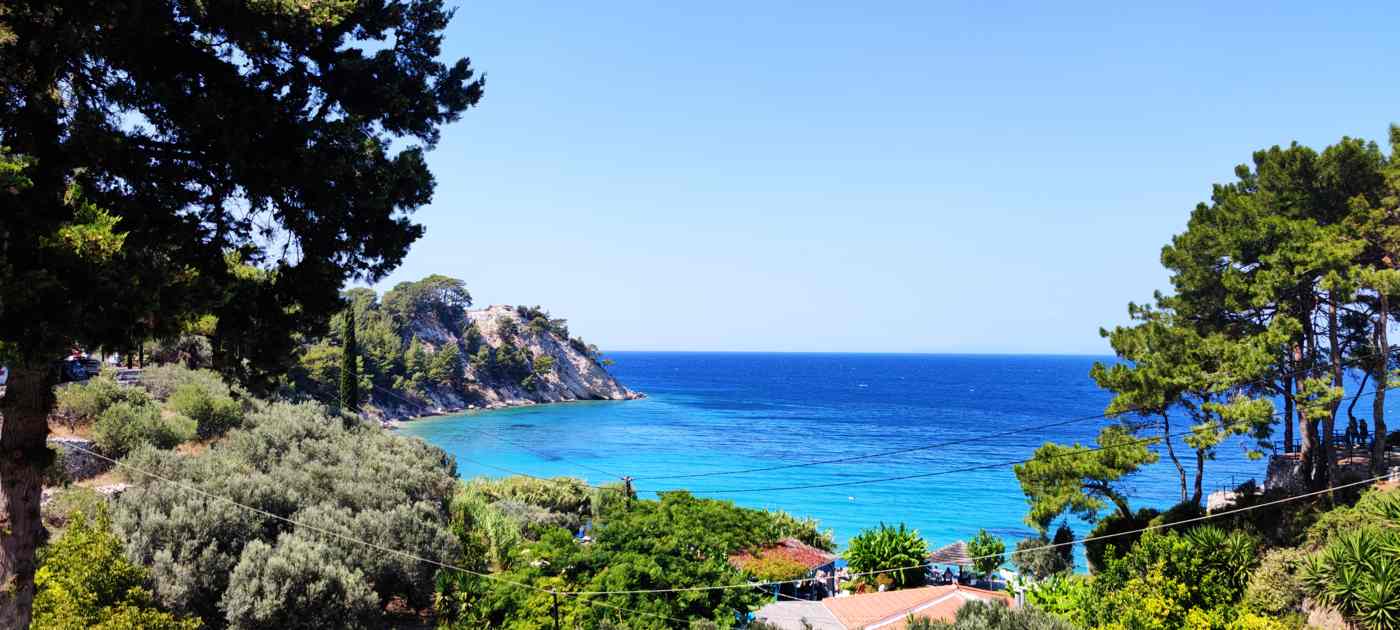
Which southwest beaches lie along the bay – Votsalakia, Balos and Psili Ammos – under Mount Kerkis?
Votsalakia, Balos and Psili Ammos stretch west along the bay under Mount Kerkis. They form the main beach strip of southwest Samos, with long stretches of sand and pebble, sunbeds, tavernas and shallow, sheltered water.
Votsalakia beach is the largest resort beach of the southwest, about 6 km west of the harbour along the bay. Its name comes from the Greek for pebbles, and the shore mixes fine grey pebbles with sand under clear, shallow water. A strip of tavernas, cafes, rooms and rental outlets backs the beach behind a line of tamarisk trees. Sunbeds and umbrellas cover the central section, while the ends stay more open. Mount Kerkis rises straight behind the resort, giving the beach a dramatic mountain backdrop over the sea. The water shelves gently and stays calm in most conditions, which suits families.
Votsalakia forms the main tourist centre of the coast, busier than the harbour but still low-key next to the north-coast resorts of Samos around Kokkari.
Balos lies just west of Votsalakia, at the far end of the developed strip along the bay. The two beaches almost merge, separated by a low headland, so walkers pass easily from one to the other. Balos is quieter and more open, with a wide sweep of sand and pebble and fewer buildings behind. A cluster of tavernas and rooms sit near the shore, and sunbeds cover only part of the beach. Mount Kerkis dominates the view inland, its slopes dropping steeply toward the coast road. The water stays clean and shallow, with the same gentle gradient as its neighbour.
Beyond Balos the surfaced road continues west toward the remote hamlets and the wild beaches at the foot of Kerkis, where development stops. Snorkelling is good around the rocky headland between the two beaches.
Psili Ammos on the southwest coast is a smaller sandy beach near the western end of the bay. It shares its name with a better-known beach in the east of Samos. The name means fine sand, and this shore lives up to it with soft pale sand and shallow, warm water. It sits in a shallow cove backed by tamarisk trees and low dunes, with a taverna or two nearby. The beach is calmer and more sheltered than the open strips, so it draws families with young children. Mount Kerkis fills the skyline behind, and the road from Votsalakia reaches it in about five minutes. Fewer sunbeds and quieter surroundings give it a more natural feel.
Together these beaches make the bay the main swimming coast of southwest Samos.
Access to the southwest beaches runs by the coast road that leaves Ormos Marathokampou and heads west along the shoreline. Votsalakia lies about 6 km from the harbour and around 10 km below the old town by road. Regular buses are limited on this coast, so a car makes reaching the different beaches much easier. Parking spreads along the back of each beach and on the roadside verges. The whole strip works together: visitors move between Votsalakia, Balos and Psili Ammos in minutes to find the conditions and crowd level they prefer. All three sit under the southern slopes of Mount Kerkis, which shelters the bay from the strong summer meltemi wind that hits the north coast.
This shelter makes the southwest the calmest swimming coast on Samos.
How is Marathokampos the gateway to the Mount Kerkis summit trail?
Marathokampos serves as the main base for climbing Mount Kerkis, the highest peak in the eastern Aegean at about 1,434 metres. Trails start from the town and nearby villages, leading up through monasteries to the rocky summit.
Mount Kerkis, also called Kerketeas, rises to about 1,434 metres and dominates the whole western half of Samos. Its grey limestone bulk stands apart from the greener Ampelos range to the east, forming a steep, rocky massif. Marathokampos and its surrounding hamlets sit on the southern flank, which makes the town the natural starting point for the climb. The mountain holds caves, monasteries and hermitages on its slopes, tied to centuries of religious use. From the summit the view reaches across the eastern Aegean to the Turkish coast, Ikaria, Fourni and Patmos on a clear day. The peak often catches cloud when the rest of the island stays clear.
Its scale and isolation make Kerkis the defining natural landmark of southwest Samos and a focus for walkers.
The main summit route to Kerkis starts near Votsalakia and the monastery of Evangelistria on the southern slope. From the monastery, a marked path climbs steeply through pine forest and then open rock toward the ridge. The full ascent to the summit and back takes most of a day and demands good fitness and proper footwear. Walkers gain more than 1,000 metres of height from the coast, so the climb is long and exposed. Water, sun protection and an early start matter, since shade thins out above the tree line. The path passes the cave church of Panagia Makrini, set in a rock overhang high on the mountain.
Marathokampos and Votsalakia provide the beds, food and parking that make a Kerkis day walk practical from this coast.
The Kerkis slopes above Marathokampos also offer shorter walks suited to a half-day, apart from the full summit push. Paths link the monasteries of Evangelistria and Panagia Makrini with the cave churches set into the cliffs. The Cave of Pythagoras, where the philosopher is said to have hidden, lies on the southern flank above the coast and draws walkers up a stepped path. Trails also cross to the remote western hamlets of Kallithea and Drakei, through terraced land and old chestnut groves. These lower routes give mountain views over the bay without the full summit effort. Spring brings wildflowers and running streams, while autumn stays warm and clear for walking.
Marathokampos works as the hub for all of this, holding the roads, parking and services that feed the trail network.
The pairing of mountain and coast defines what Marathokampos offers a visitor to Samos. From one base, walkers can climb toward the highest summit in the morning and swim off the bay beaches in the afternoon. The old town supplies the traditional character, the harbour the food and boats, and Kerkis the walking and views. This range suits active travellers who want more than a beach, yet still want the sea close by. The southwest coast stays quieter than the north, so the trails and beaches rarely feel crowded outside peak August. Marathokampos anchors the whole district, linking summit, town, harbour and beaches within a short radius.
For hikers, the town is the recognised gateway to Mount Kerkis, and the clearest starting point for the long climb to its rocky top.
What is the Cave of Pythagoras above Marathokampos on Samos?
The Cave of Pythagoras sits on the southern slopes of Mount Kerkis above Marathokampos, a set of caves that tradition ties to the philosopher, said to have hidden here from the tyrant Polycrates.
A steep, marked footpath climbs to the site from a car park on the slopes above Marathokampos. It winds upward through pine and bare rock. The way to the Cave of Pythagoras takes about 20 to 40 minutes uphill. Firm shoes and carried water suit the loose, stony ground. Two features stand at the top of the climb. A larger open cavern sits in the cliff face. Beside it stands the tiny cave-chapel of Panagia Sarantaskaliotissa, reached by carved stone steps. The chapel name points to the forty steps cut into the rock below it. No shops, taps or shade wait beyond the chapel, so walkers carry food and water up.
The signed trailhead lies a short drive above the town. The path rewards effort with widening sea views.
The cave-chapel of Panagia Sarantaskaliotissa clings to the rock face, a whitewashed shrine squeezed into a natural hollow above Marathokampos. Carved steps and a short iron handrail lead up to its low door, and a spring seeps from the stone nearby. Pilgrims and walkers light candles inside the cramped space, which holds room for a handful of visitors at a time. The larger cavern beside it opens into the cliff, cool and shadowed after the hot climb. The tradition that Pythagoras sheltered here from Polycrates gives the place its name and its pull for visitors. The setting mixes faith, legend and raw mountain rock in one spot.
Morning light falls straight onto the shrine, making the cool early hours the calmest time to make the climb from the town below.
Wide views open across the whole climb, stretching over Marathokampos bay and the southwest coast toward the open Aegean. Kampos and Votsalakia spread along the shoreline far below, and the sea shades from turquoise to deep blue past the headlands. On clear days the peaks of nearby islands break the horizon to the west. The exposed path holds no shade, so a hat, sunscreen and two litres of water cover the round trip in summer heat. The rock underfoot turns slippery after rain, and the drop beside the upper steps calls for care. Children who walk well manage the climb, though the exposure suits sure feet. Early starts beat the midday sun on the open slope.
The reward is a viewpoint that few beach visitors reach, high over the quiet southwest corner of the island.
The cave pairs with a day on the southwest beaches under Mount Kerkis, since the trailhead sits above the coast. Walkers climb in the cool morning. They drop to the shore for a swim through the warm afternoon. The road that serves the beaches of Kampos and Votsalakia branches uphill toward the car park below the site. A full loop links the hillside town of Marathokampos, the cave and the coast within about three kilometres. Drivers with a rental car cover the ground with ease. Buses reach the coast rather than the upper slopes. The climb also connects with the longer Mount Kerkis summit routes for stronger hikers.
This blend of legend, mountain and quiet sea sums up why the southwest rewards a full day rather than a rushed stop.
What are tavernas and daily life like in Marathokampos town and at Ormos?
Daily life splits between the hillside town of Marathokampos and its coast settlement, Ormos Marathokampou. The upper town keeps a working square and old lanes, while the harbour below fills with fish tavernas, cafes and moored boats.
The hillside town of Marathokampos runs on a slow, local rhythm far from the resort crowds. A central square shaded by plane trees holds a church, a kafeneio or two, and benches where older residents gather through the day. Narrow amphitheatrical lanes climb between old stone houses, and washing lines and flowerpots mark the doorways. A bakery, a butcher and small grocers cover daily needs for the year-round community. Farmers bring olives, honey and vegetables down from the terraces on the mountain slopes above. Church bells and the clatter of the kafeneio set the pace rather than any nightlife. Visitors who wander up from the coast find a town that lives for its own people first.
It offers a glimpse of everyday Samos above the tourist shoreline below.
Ormos Marathokampou, the harbour settlement on the coast, gathers the area’s tavernas and evening life along the waterfront. Fishing boats and small yachts line the marina, and the day’s catch reaches the grills straight from the water. Waterside tables serve grilled octopus, fresh fish, revithokeftedes and Samos Muscat under the masts and rigging. Cafes and ouzeri terraces spread along the quay, filling slowly through the warm evening as the light fades over the bay. The harbour stays relaxed rather than loud, with families, sailors and beachgoers sharing the seafront. A short strip of shops covers beach kit, groceries and supplies for the surrounding coast. Ormos works as the practical hub of the southwest.
It ties the fishing tradition of the port to the summer trade of the beaches nearby.
The southwest kitchen leans on the sea below and the mountain terraces above Marathokampos. Boats land fish and octopus for the harbour grills, while the slopes yield olives, thyme honey, wild greens and Muscat grapes. Tavernas serve slow-cooked goat, stuffed vine leaves, giouvetsi and the local white cheese alongside the daily catch. Meals close with sweet Samos Muscat, the wine grown on the terraced vineyards of Mount Ampelos across the island. Village cooking here stays simple and seasonal, built on produce carried down from the farms above. Prices ease away from the busy north-coast resorts, and portions match the appetite of walkers back from the mountain.
The pairing of harbour fish and mountain produce gives the area a distinctive table. It reflects both halves of the landscape, sea and steep green slope.
The day in the southwest follows an easy pattern between the town and the shore. Mornings bring quiet lanes in Marathokampos and cool coffee in the square before the heat builds. Middays empty toward the beaches of Kampos and Votsalakia, where families settle under the tamarisk and the tavernas fill for lunch. Late afternoons draw walkers back from the mountain and swimmers up from the water. Evenings centre on Ormos, where the harbour tavernas light up and the marina reflects the last of the sun. Nights fall dark and calm, with talk on the terraces rather than music and clubs. The pace suits visitors who want the working life of a Greek island town over a packaged resort.
The bay and the mountain shape the hours of the day.
How do you reach the southwest and Marathokampos from Vathy and Pythagorio?
Marathokampos sits at the southwest corner of Samos, about 50 km from the capital Vathy and a similar distance from Pythagorio and the airport. A paved road crosses the Ampelos foothills to the bay under Mount Kerkis.
The drive from Vathy, the northeast capital and main ferry port, runs about 50 km southwest across the island. The route climbs through the Ampelos foothills, passes above Karlovasi, then curves around the western flank of Mount Kerkis to drop toward Marathokampos bay. The journey takes about an hour and a quarter by car at an easy pace. The road stays paved throughout, though it twists and climbs on the mountain sections. Drivers pass olive terraces, pine slopes and long sea views on the way down to the coast. A rental car or scooter gives the surest access, since the southwest lies at the quiet end of the network.
The distance rewards an early start, leaving the full day free for the beaches and the mountain around the bay.
From Pythagorio and the airport in the southeast, the road to Marathokampos measures a similar distance across the middle of the island. Drivers cross the interior past the plain of Chora, then join the western route toward Karlovasi before turning down to the bay. The airport transfer suits visitors basing in the southwest for a beach-first stay away from the busy east and north. The paved road carries the traffic with ease, climbing and falling through green country most of the way. A short inland junction links the southwest with Pythagorio, Vathy and the airport, keeping navigation simple. The run takes about an hour and a quarter, matching the drive from the capital.
Arriving in daylight helps first-time drivers judge the mountain bends before the light fades behind the peak.
The paved coast road strings the southwest beaches west of the harbour along Marathokampos bay. Kampos and Votsalakia share one long strand under the mountain, backed by tavernas and rooms. The tarmac thins past them toward the quieter coves. Balos beach lies at the far end, tucked under the steep slopes near the close of the road. Beyond it the surface breaks up, and rough tracks or footpaths reach the last inlets that no bus serves. Drivers coming for a swim follow the shoreline route below the peak for the final kilometres. The distances between the beaches stay short, letting visitors sample three or four bays in a single day.
The southwest shore rewards a car, which unlocks the whole run from the harbour at Ormos out to the wild western edge.
Public KTEL buses link Marathokampos and Ormos with Vathy, Pythagorio, Karlovasi and the airport a handful of times each day in summer. The service runs cheaply but infrequently, and connections thin in the shoulder season and on Sundays. Buses reach the town and the main beaches of Votsalakia and Kampos, then stop short of the smaller coves and the mountain trailheads. Taxis wait at the harbour and town square for door-to-door trips across the southwest. A rented car or scooter remains the surest way to reach the Cave of Pythagoras, the Kerkis routes and the far western beaches. The bus does not serve them. Fuel stations cluster around Marathokampos and Votsalakia rather than the remote coves.
A full tank before the final leg saves a long backtrack across the bay.


Where do you stay around Marathokampos and the southwest of Samos?
Accommodation in the southwest gathers at the harbour of Ormos Marathokampou and along the beach strip of Votsalakia and Kampos. The hillside town holds a handful of rooms, while the coast covers the bulk of the stays under Mount Kerkis.
Ormos Marathokampou, the harbour settlement, offers rooms, studios and small hotels around the marina and the seafront tavernas. A stay here puts fishing boats, cafes and the daily catch on the doorstep, with the beaches of the bay a short drive west. The harbour keeps a working, local feel rather than a resort polish, which draws visitors after an authentic base. Evenings centre on the waterfront, where the marina lights reflect on the calm water. Families, sailors and walkers share the quay through the warm season. The port also serves as the practical hub for supplies, boat trips and bus links across the southwest.
A base at Ormos ties the fishing tradition of the coast to easy reach of the mountain and the cave. The long beaches stretch west along the shore.
Votsalakia and Kampos form the linked beach strip west of the harbour. They hold the bulk of the southwest’s rooms and small hotels along the shore road. Studios and low-rise hotels back the long sand-and-pebble strand, most within a short walk of the water. The beach-first setting suits families and swimmers who want sunbeds, tavernas and shallow water steps from the door. Mount Kerkis rises directly behind for walks to the summit and the cave, while the quieter coves lie a short drive west. The strip stays relaxed and low-rise, far calmer than the north-coast resorts around Kokkari. A run of tavernas and mini-markets covers meals and daily needs.
This shoreline base under the peak gives the simplest match for a beach holiday in the southwest corner of the island.
The hillside town of Marathokampos holds a scattering of rooms and guesthouses for visitors after a quieter, more local stay above the coast. A base in the old lanes trades beach access for views over the bay, cool mountain air and the working life of the square. Walkers value the town for its closeness to the Kerkis trailheads and the Cave of Pythagoras on the slopes above. Cars matter here, since the town sits back from the beaches and the bus runs to the coast rather than the upper lanes. Evenings stay calm, with a taverna or two and the kafeneio rather than any nightlife.
This upper base suits travellers who want the mountain and the village over the shoreline. They wake above the bay, the sea spread out far below.
Booking ahead pays off across the peak weeks of July and August, when the southwest rooms fill despite the area’s quiet reputation. Spring and autumn open easier availability, cooler weather and lower rates along the coast and in the town. Winter closes most of the tourist rooms, leaving the southwest to the year-round community of Marathokampos. A car helps at any base here, unlocking the beaches, the mountain and the harbour from one spot. Visitors choose between the harbour buzz of Ormos, the beach convenience of Votsalakia and Kampos, and the local calm of the hillside town. The southwest rewards those who settle in for two or three nights over a quick stop.
The slow rhythm of the bay and the huge mountain backdrop set the pace of the stay.
Who does a southwest base at Marathokampos suit and when is the best time to visit?
A Marathokampos base suits walkers, families and calm-seekers who want beaches, a mountain and a working harbour over a lively resort. Late spring and September bring warm sea, thin crowds and easy access under Mount Kerkis.
Walkers gain the most from a southwest base. The Mount Kerkis summit routes, the Cave of Pythagoras and the coastal paths all sit close at hand. Families settle in well at the shallow, sheltered beaches of Votsalakia, Kampos and the quieter coves west along the bay. Couples and calm-seekers value the harbour tavernas of Ormos and the slow rhythm of the hillside town. Swimmers and snorkellers find clear, meltemi-sheltered water under the mountain through the summer. Visitors chasing beach clubs, water sports and nightlife head north to Kokkari or east to Pythagorio instead. The southwest rewards those who trade organised buzz for space, quiet and a dramatic natural setting.
A car unlocks the full range, turning the bay into a base for mountain, sea and the old town above.
The southwest works best for travellers who want a working Greek island over a packaged resort. The harbour of Ormos ties fishing boats and fish tavernas to the summer beach trade, while the town lives its own year-round life above. Drivers gain the most, since a rental car reaches the cave, the mountain trailheads and the western coves the bus cannot serve. Beach-first visitors settle at Votsalakia and Kampos, walkers and history-seekers head for the slopes, and calm-seekers pick the quiet coves. The corner suits a stay of two or three nights rather than a rushed day, letting the range of beaches and trails unfold.
Nightlife-hunters and those without transport find the southwest limiting compared with the busier north and east. Resorts and buses cluster closer together there along the coast.
Late spring turns the mountain slopes green and warms the sea enough for the first long swims of the year. June and early July bring reliable sun, calm water and space on the shore before the peak rush arrives. August fills the beaches, the harbour tavernas and the rooms, yet the southwest stays quieter than the northern resorts even then. September holds warm sea, thinner crowds and softer light over the bay, which regulars often rate the finest month. October cools the air while the water stays swimmable on calm days. Winter closes most facilities, leaving the town to its year-round life and the trails to walkers.
The shoulder months reward visitors who want the mountain, the beaches and the harbour with room to spare under the peak.
A southwest stay rewards a little planning, since the corner lies at the quiet end of the island and facilities stay modest. A rental car or scooter turns Marathokampos into a hub for the beaches, the cave and the Kerkis trails. Water, firm shoes and sun cover suit the exposed coastal and mountain paths through the heat of summer. Cash helps at the smaller tavernas and the harbour grills, where card machines cannot always be relied on. Morning starts beat the midday sun on the open slopes and secure the coolest beach spots. The meltemi shelter of the bay makes the southwest a steady choice when the north-coast beaches churn.
Visitors who slow down and give the area two or three days find the fullest reward from this calm corner under the mountain.
Frequently Asked Questions
Is Marathokampos worth basing yourself in on Samos?
Marathokampos rewards visitors who want the quiet southwest of Samos over the busier north and east. The area splits three ways. It covers the hillside town, the harbour of Ormos Marathokampou and the beach strip of Votsalakia and Kampos. Each mood sits within a short drive of the others. Walkers gain the Mount Kerkis summit routes, the Cave of Pythagoras and the coastal paths close at hand. Families settle at the shallow, sheltered beaches under the mountain. Couples value the fish tavernas along the harbour at Ormos. The base suits drivers, since a rental car unlocks the cave, the trailheads and the western coves that buses cannot reach.
Visitors chasing nightlife, beach clubs and water sports find the corner limiting. They head north to Kokkari or east to Pythagorio instead. Marathokampos rewards a calm, active stay of two or three nights over a rushed day trip. The bay sits under Mount Kerkis on a working Greek island.
What is the difference between Marathokampos town and the port at Ormos?
Marathokampos town and Ormos Marathokampou sit apart, one on the mountain and one on the coast, linked by a short winding road. The town spreads across a hillside on the flank of Mount Kerkis. It forms an amphitheatrical cluster of old stone houses, narrow lanes and a shaded central square. It keeps a working, year-round life built around the church, the kafeneio and the farms on the terraces above. Wide views open over the bay below. Ormos Marathokampou, the harbour settlement on the shore, gathers the marina, the fishing boats and the area’s fish tavernas along the waterfront.
Ormos holds the summer trade, the seafront cafes and the practical services for the beaches, while the town lives for its own residents first. Visitors after nightlife and dining base at the harbour, while those seeking cool air, views and local calm choose the upper town. The two together cover both halves of southwest life, sea and steep green slope.
Is Marathokampos good for a holiday with kids?
Marathokampos suits families with children who want calm, shallow beaches and a relaxed base over a busy resort. The southwest beaches of Votsalakia and Kampos sit west of the harbour. They offer shallow, gently shelving water and long sand-and-pebble shores backed by tavernas and sunbeds. The bay lies on the sheltered side of the island. It stays calmer than the north coast on the days when the meltemi wind blows. Ormos Marathokampou gives families a harbour with fish tavernas, cafes and moored boats to watch through the warm evening. Older children who walk well climb to the Cave of Pythagoras or explore the lower Mount Kerkis paths. Water shoes help small feet on the pebble sections.
Umbrellas matter under the strong southwest afternoon sun. A car eases family life here, reaching the beaches, the town and the quiet coves with ease. Late spring and September bring the warmest water and the thinnest crowds for a family stay. The setting rewards families who value space and calm over water parks and nightlife.
Which beaches are nearest to Marathokampos?
The nearest beaches to Marathokampos spread west of the harbour along the bay under Mount Kerkis. Votsalakia, also called Kampos, forms one long sand-and-pebble strand a short drive from Ormos. It is the main resort beach of the southwest, with sunbeds, tavernas and shallow water. Further west the road passes Psili Ammos, a quieter southwest strand. It then reaches Balos, a calm pebble-and-sand cove tucked under the steep slopes near the close of the road. Beyond Balos the tarmac breaks up. Rough tracks or footpaths lead to the last remote inlets that no bus serves. The harbour of Ormos itself has a small beach beside the marina for a quick swim.
The southwest bays sit close together, letting visitors sample three or four in a single day by car. The whole strip catches afternoon sun and shelters from the meltemi on calm days. This gives the area a steady swimming coast through the summer season.
How do you reach the Mount Kerkis trail and the Cave of Pythagoras from Marathokampos?
The Mount Kerkis trail and the Cave of Pythagoras both start on the slopes just above Marathokampos. Each sits within a short drive of the town and the coast. The main summit route climbs from the village of Votsalakia or the monastery of Evangelistria on the mountain’s flank. It is a demanding full-day walk to the peak at about 1,434 m. Water, firm shoes and an early start matter for the climb. The Cave of Pythagoras sits on the southern slopes above the town. A steep, marked footpath climbs from a car park, about 20 to 40 minutes through pine, to the cave-chapel of Panagia Sarantaskaliotissa. A rental car or scooter reaches both trailheads with ease.
The bus serves the coast rather than the upper slopes. Walkers climb in the cool morning. They drop to the southwest beaches for a swim in the afternoon. Cash, sun cover and two litres of water suit the exposed mountain paths in summer heat.
How do you get to Marathokampos on Samos?
Getting to Marathokampos means driving to the southwest corner of Samos. The town lies about 50 km from the capital Vathy. It sits a similar distance from Pythagorio and the airport. From Vathy the route climbs southwest through the Ampelos foothills and passes above Karlovasi. It then curves around the western flank of Mount Kerkis to drop toward the bay. The drive takes about an hour and a quarter by car. From Pythagorio and the airport in the southeast, the road crosses the middle of the island past Chora. It joins the western route down to the coast for a similar run.
Public KTEL buses link the town and Ormos with Vathy, Pythagorio, Karlovasi and the airport a handful of times each day in summer. They run cheaply but infrequently. A rental car or scooter gives the surest access to the beaches, the cave and the mountain trails. Arriving in daylight helps first-time drivers judge the mountain bends before the light fades.
Is Marathokampos quiet or busy in summer?
Marathokampos stays quieter than the northern and eastern resorts of Samos even through the peak of summer. The southwest lies at the far end of the island network. It sits away from the airport, the main ferry ports and the crowds around Kokkari and Pythagorio. July and August fill the beaches of Votsalakia and Kampos, the harbour tavernas at Ormos and the local rooms. The pace still stays relaxed compared with the busy north coast. The hillside town keeps its working, year-round rhythm, lived for its residents rather than the summer trade. Late spring and September bring the finest balance of warm sea, open facilities and thin crowds.
Easy parking and space on the shore follow in these months. October and the shoulder weeks turn the area calmer still. Winter leaves it to the community and the walkers. Visitors seeking a lively scene find the corner too quiet. Those after calm and space rate the southwest among the most restful parts of Samos.