
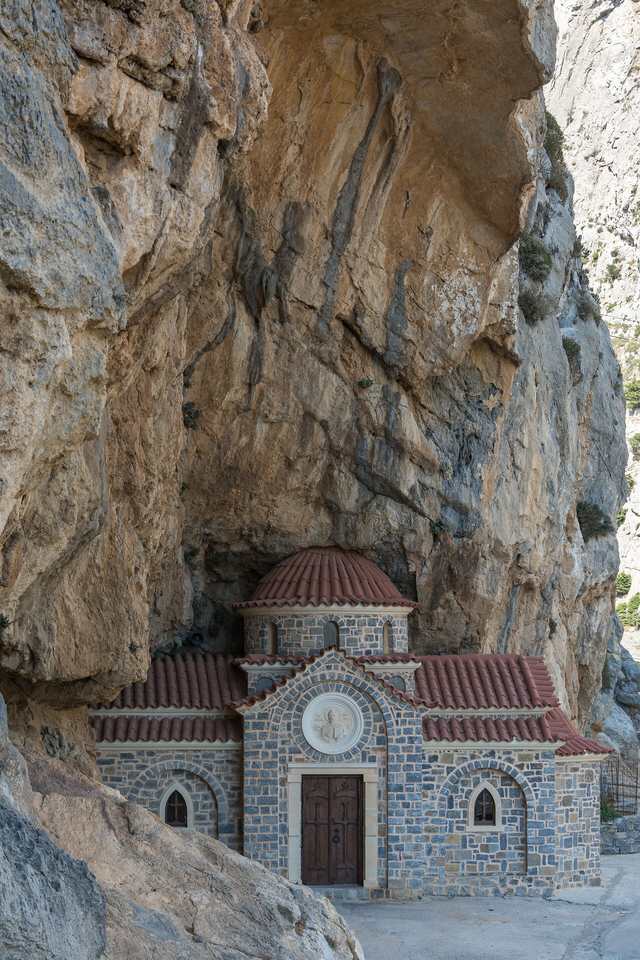
The Kotsifou gorge is a short limestone canyon in the Rethymno region of southern Crete, threaded by a narrow paved road that runs between the village of Sellia and the coast at Plakias. Sheer rock walls rise high above the road, and a stream bed cuts along the canyon floor below. A whitewashed chapel of Saint Nicholas stands built into the base of one cliff. Drivers pass straight through the canyon, making it far easier to reach than the long walking gorges of the island. Griffon vultures nest on the cliffs and circle the thermals overhead. Plan your drive across southern Rethymno with My Greece Tours.
This page sets out what the Kotsifou gorge is, where it sits on the map, how the road passes through it, and how it pairs with the neighbouring canyons on the way to the Libyan Sea. The sections below cover the route from Sellia to Plakias, the chapel of Saint Nicholas at the cliff base, the griffon vultures on the thermals, and the scenic loop down to the south coast. For wider planning across the island, the Crete travel guide gives the full regional picture around this canyon.
Where is the Kotsifou gorge in Crete?
The Kotsifou gorge sits in the Rethymno region of southern Crete, on the road that links the hillside village of Sellia with the coast at Plakias. The narrow canyon lies inland of the Libyan Sea beaches, threaded by one paved road.
The canyon cuts through the limestone hills of southern Rethymno, between the village of Sellia on the heights and the coastal resort of Plakias below. The paved road enters the gorge from the north and drops toward the sea, running the full length of the ravine along a stream bed on the canyon floor. Sheer rock walls rise high on both sides, closing in above the tarmac at the narrowest points. The setting places the gorge on the direct route from the north-coast towns down to the Libyan Sea, so travellers pass through it on the way to the beaches.
Among the wider things to do in Crete, a drive through this three-kilometre canyon ranks among the quickest gorge scenery to reach by hire car anywhere on the island.
The gorge belongs to the southern edge of the Rethymno region, one of the four regional units that make up the island. The regional capital of Rethymno lies on the north coast, and the road south crosses the interior hills before dropping through the canyon to the shore. This position gives the gorge its role as a gateway: it channels the descent from the plateau villages to the coastal plain around Plakias and Preveli. The stream that carved the canyon runs on a seasonal rhythm, filling after winter rain and drying through the long summer months.
The limestone walls hold caves and rocky ledges used by nesting birds, and the road follows the natural break in the rock straight down toward the open sea below the cliffs.
What is the Kotsifou gorge like to drive through?
The Kotsifou gorge carries one narrow paved road straight through the canyon floor. Drivers pass between sheer rock walls that rise high overhead, following the stream bed below, which makes the canyon far easier to reach than the long walking gorges.
The road through the Kotsifou gorge is single-lane in places, with passing spots where the walls widen. Vehicles enter at one end and emerge at the other, tracing the canyon floor beside the dry stream bed. The rock closes in overhead at the tightest points, throwing the tarmac into shade even at midday. This drive-through access separates the Kotsifou gorge from canyons that demand a full day on foot: the visit takes minutes rather than hours, and it suits travellers who want the scale of a gorge without a hike. Cyclists and motorcyclists use the same route down to the coast.
The narrow road and blind bends call for slow, careful driving, and a small pull-off near the chapel lets drivers stop and look up at the walls.
The southern end of the road opens onto the coastal plain around Plakias, where the canyon gives way to the wide bay and its sand beach. From the gorge exit the road runs the short remaining distance to the resort and its seafront tavernas. The northern approach climbs to Sellia and the villages of the interior, so the drive links two contrasting landscapes across three kilometres of road. A car passes straight through, and the gorge draws climbers, photographers and travellers heading to the south coast without the commitment of a marked walking trail. Rockfall barriers and warning signs line the tightest sections, and the surface stays paved throughout, keeping the route open to ordinary hire cars.
The two ends sit at different heights, so the descent links cool upland air with the warm coastal plain on the way down.
What can you see inside the Kotsifou gorge?
Inside the canyon a tiny whitewashed chapel of Saint Nicholas stands built into the base of the cliff. Sheer limestone walls rise high overhead, a stream bed runs along the floor, and griffon vultures nest and circle above.
The chapel of Saint Nicholas is the landmark feature of the gorge, set into a recess at the foot of the towering rock wall. Whitewashed and small, it sits directly beside the road, so drivers reach it without leaving the tarmac. The cliff rises sheer behind and above it, and the contrast between the bright chapel and the grey rock draws the eye and the camera. The building marks the canyon as a place of devotion as well as a through-route, and visitors light candles inside. Stone steps lead up to the entrance from the roadside.
The chapel gives the Kotsifou gorge a focal point that most drive-through canyons lack, and it stands on this stretch as the natural place to pause on the long descent.
Above the road the limestone walls hold ledges and caves where griffon vultures nest, and the large birds circle on the thermals that rise off the sun-warmed rock. The stream bed on the canyon floor carries water after winter rain and lies dry through the summer, its bed strewn with boulders washed down from the heights. Wild flowers and low shrubs grow from cracks in the cliff face. The gorge counts among the hidden gems in Crete for travellers who want dramatic scenery reached by car rather than on foot.
The play of light down the narrow slot changes through the day, and the deep shade of the walls keeps the floor cool even when the coast below bakes. The vultures range over the surrounding hills in search of carrion, returning to the cliff ledges to roost above the road.
How does the gorge connect to Plakias and the south coast?
The Kotsifou gorge road runs directly down to Plakias and the Libyan Sea beaches. The canyon forms the final descent from the interior villages to the coastal plain, delivering drivers to the bay, its sand beach and the seafront resort.
From the southern mouth of the gorge the road drops the last stretch to the bay of Plakias, a wide south-coast beach backed by tavernas, rooms and a seafront promenade. The canyon acts as the gateway to this coast, funnelling traffic from the Rethymno hills down to the shore. Past the final walls, drivers reach open views over the Libyan Sea and the full sweep of the bay ahead. The resort makes a base for the beaches of the south-west, and the gorge road is the scenic way in from the north.
Boats and buses serve the coast in season, and the short run from the canyon exit to the sand takes five to ten minutes by car, linking the wild interior directly to the warm swimming of the south shore.
The Kotsifou gorge pairs with the neighbouring Kourtaliotiko Gorge on a scenic loop through southern Rethymno. The two canyons sit close together on the roads down to the coast, and drivers link them in a single outing that ends at the sea. The loop reaches Preveli beach, where a palm-lined river meets the Libyan Sea below a clifftop monastery. Together the gorges and the beaches make a full day of driving and swimming across the southern edge of the region. The route rewards an early start, as the coast roads narrow and the beach car parks fill by midday in the summer season.
The distance between the two canyons is short enough that a driver visits both and still reaches the sand for an afternoon swim.
What is the best time to visit the Kotsifou gorge in Crete?
Spring and autumn suit the Kotsifou gorge in Crete best, with soft light, a stream still running on the floor and quiet coast roads. Summer works too, and the shaded canyon stays cool while the beaches below warm up.
Spring brings running water to the stream bed and wild flowers to the cliff cracks, and the temperatures stay mild for the drive and for stops along the way. The griffon vultures are active on the thermals through the warmer months, and the softer light of morning and late afternoon deepens the shadows in the narrow slot. Autumn offers the same quiet roads once the peak-season crowds thin out, with warm sea temperatures still holding for a swim at Plakias below. These shoulder seasons also mean the beach car parks stay open and the coast roads carry less traffic.
A morning visit catches the best light down the canyon and lets you reach the south-coast beaches before the midday heat and the day-trip crowds arrive.
Summer turns the gorge into a cool corridor: the high walls throw deep shade over the road even as the coast bakes, so the drive-through stays comfortable in the hottest months. The stream bed dries out by then, leaving a boulder-strewn floor beneath the cliffs. Winter brings rain that feeds the stream and can send rockfall onto the road, so the tightest sections carry barriers and warning signs, and drivers check conditions after storms. The chapel of Saint Nicholas stays open year-round for a brief stop. For a fuller sweep of the region’s canyons and coast, the wider network of southern-Rethymno drives links the Kotsifou gorge with the beaches, monasteries and hill villages of this descent.
The chapel, the vultures and the sheer walls hold their character across the whole year, so the canyon rewards a visit in every season.
Frequently Asked Questions
Can you drive through the Kotsifou gorge?
Yes. A narrow paved road runs the full length of the Kotsifou gorge, entering from the Sellia side and dropping toward the coast at Plakias. Vehicles pass straight along the canyon floor beside the stream bed, between sheer rock walls that close in overhead at the narrowest points. This drive-through access sets the canyon apart from the long walking gorges of the island, which demand a full day on foot. The road is single-lane in places, with passing spots where the walls widen, and blind bends that call for slow, careful driving. A small pull-off near the whitewashed chapel of Saint Nicholas lets drivers stop and look up at the towering cliffs above.
The paved surface holds throughout, so ordinary hire cars manage the route without difficulty rather than needing off-road tyres. The gorge sits on the direct road from the Rethymno hills down to the Libyan Sea, and a car reaches its scenery in minutes rather than after a marked hike from the roadhead.
What is the difference between the Kotsifou and Kourtaliotiko gorges?
Both canyons lie in southern Rethymno on the roads down to the Libyan Sea, and travellers link them on a single scenic loop. The Kotsifou gorge is a short limestone canyon threaded by a paved road, with a whitewashed chapel of Saint Nicholas built into the cliff base and griffon vultures nesting on the walls overhead. Drivers pass straight through it on the way from Sellia to Plakias. The neighbouring Kourtaliotiko gorge sits close by on the route toward Preveli, and the two form a natural pair on the descent to the south coast. Visitors combine them in one outing that ends at the beaches.
The loop reaches the coast around Plakias and Preveli, delivering a full day of driving and swimming across the southern edge of the region. Taking both canyons in a single drive shows the range of scenery packed into this corner of the island, from shaded rock corridors to wide open sea views over the Libyan Sea below.
What is near the Kotsifou gorge for a day out?
The gorge sits at the heart of a compact day out across southern Rethymno. The road south from the canyon reaches Preveli, where a palm-lined river meets the Libyan Sea below a clifftop monastery, one of the signature spots on this coast. The resort of Plakias, minutes from the gorge exit, offers a wide sand bay, tavernas and a base for the south-west beaches of the region. The neighbouring Kourtaliotiko gorge rounds out the loop of two canyons on the drive. For travellers seeking quiet scenery reached by car, the area ranks among the emptiest corners of the coast, away from the busiest north-coast resorts.
An early start suits the outing, as the coast roads narrow and the beach car parks fill by the middle of the day in summer. Together the gorges, the beaches and the clifftop monastery make a full day of driving and swimming at the southern edge of the region, close to the road down from Sellia to the sea.