
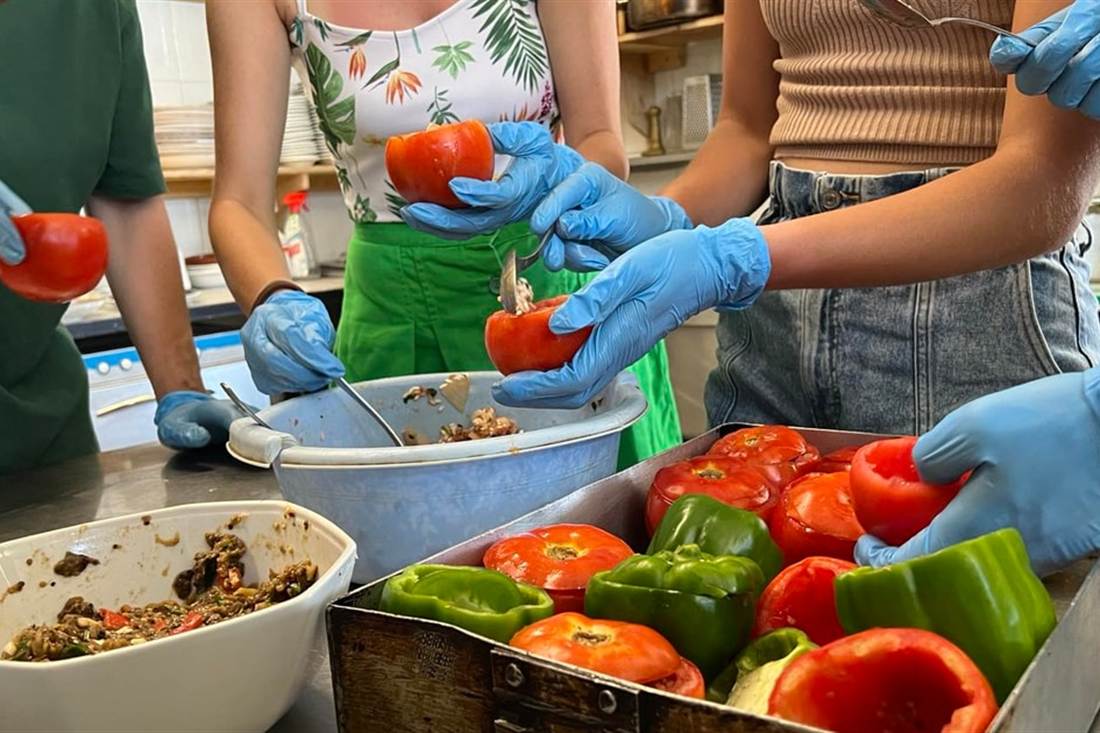
A Kos cooking class is a hands-on lesson in a family kitchen on Kos, where guests cook traditional Greek dishes such as stuffed tomatoes and vine leaves, taste the family olive oil and sit down to eat what they made. Tours across the rest of the country are listed on Greece Tours.
The sections below cover the classes, the place, the host, the steps, the dishes, the olive oil tasting, the ingredients, the meal, recipes, who it suits, inclusions, getting there, timing and booking, with links into the Kos pages. The class shown is checked on GetYourGuide.
What is a Kos cooking class?
A Kos cooking class is a hands-on lesson in Greek home cooking on a family farm on Kos. Mama Kontessa, also written Contessa, leads the cooking, and the day adds a farm walk, an olive oil tasting and a full meal of the dishes you make.
The class runs at the family’s property in Marmari, on the north coast of the island. The family grows its own produce and bottles its own olive oil in a small factory on the site.
A Kos cooking class is practical. Guests wash, chop, stuff and roll the food themselves, with the host showing each step at the work table.
Every dish ends up on the table. The class finishes with a complete meal of what the group cooked, eaten together on the farm.
Which Kos cooking classes can you book?
GetYourGuide lists Kos Cooking Classes by Mama Contessa, and the family also takes bookings on its own website. The same farm runs an olive oil tasting and cooking class sold through other booking sites. A private class also runs at a women’s cooperative tavern in Marmari.
- Kos Cooking Classes by Mama Contessa: the farm class on GetYourGuide.
- Kos Cooking Classes website: direct bookings with the family.
- Olive Oil Tasting and Cooking Class: the farm visit with a guided tasting.
- Private Greek cooking class in Marmari: a 3-hour class with lunch at the Ambrosia tavern.
The GetYourGuide listing opens with Greek finger food and coffee, then a tour of the property where the family makes its products. Guests taste the extra virgin olive oil and see the family factory.
The farm class and the tasting class share the same place and the same family, so guests choose by how long they want to spend in the kitchen.
The Ambrosia class takes place in a tavern run by a women’s cooperative, a group of local women who cook and sell traditional food together.
Where does a Kos cooking class take place?
The Kos cooking class with Mama Kontessa takes place on the family farm at Marmari, at the 15th kilometre of the main road to Kos airport. The farm has its own kitchen, olive grove and small olive oil factory, all part of the visit.
Marmari is a beach village on the north coast, between Tigaki and Mastichari. Its long sandy shore looks across the sea to the islands of Pserimos and Kalymnos.
The farm sits beside the main road, so it is easy to find by car or taxi.
Kos Town lies to the east of Marmari, and the mountain village of Zia sits on the slopes inland. The island’s capital is covered on the Kos Town page.
Who hosts the Kos cooking class?
Mama Kontessa hosts the Kos cooking class and teaches the recipes. Her family runs the farm and the olive oil business, and Stelios, a third-generation farmer, leads the olive oil tasting. The family grows and makes the products used in the kitchen.
The class is a family business from field to plate. The ingredients come from the farm, grown under the Aegean sun, and the oil comes from the family’s own mill.
Third-generation means the farm has passed through three generations of his family. The tasting draws on that family knowledge of the trees and the harvest.
The family’s home cooking is the core of the Kos cooking class. Guests learn the dishes as they are made in a Greek kitchen, not as restaurant versions.
What happens step by step in a Kos cooking class?
A Kos cooking class starts with Greek finger food and coffee, then a walk around the farm and the olive oil factory. An olive oil tasting follows. The group then cooks with Mama Kontessa and ends by sitting down to a full meal of the dishes.
- Arrive at the farm for Greek finger food and coffee.
- Walk around the property where the family grows its produce.
- Visit the olive mill and factory where the oil is bottled.
- Taste the farm’s oil with Stelios.
- Cook four recipes and a Greek dessert with Mama Kontessa.
- Eat the meal together and take home the recipes and oil.
The order of the day moves from field to table. Guests see the plants and the trees first, then the mill, and only then pick up a knife, so every ingredient has a story before it reaches the pan.
The olive oil part of the day links to the island’s wider oil culture, covered on the Kos food tour page along with the island’s markets and tavernas.
Which dishes do you cook in a Kos cooking class?
A Kos cooking class covers four classic Greek recipes and a Greek dessert. Photos from the class show guests stuffing tomatoes and peppers, rolling vine leaves and filling courgette flowers. Copies of the listing also name tzatziki and moussaka.
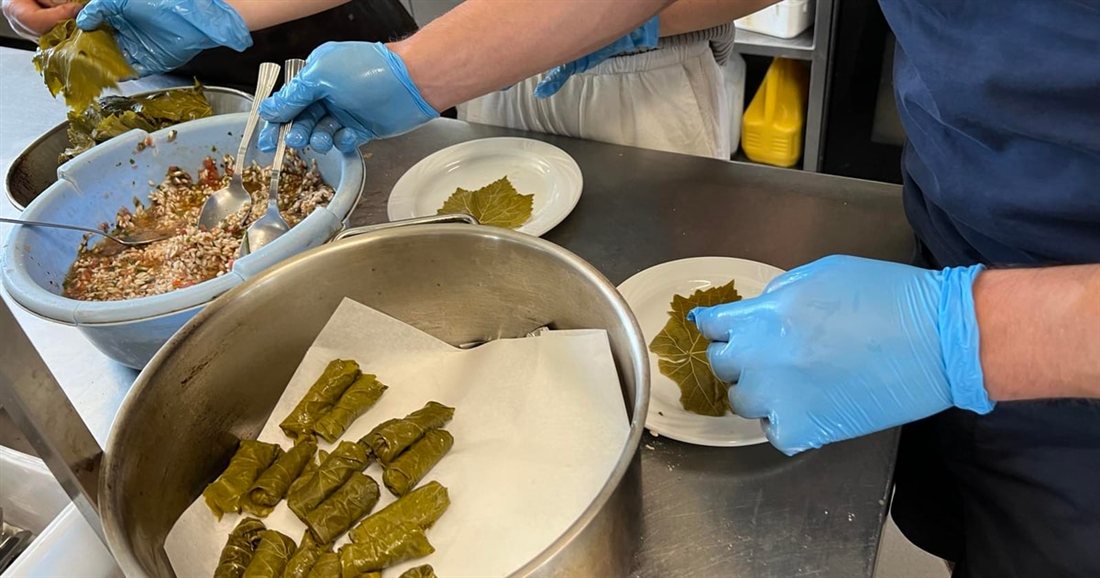
- Gemista: tomatoes and peppers stuffed with rice and herbs, then baked.
- Dolmades: vine leaves rolled around a rice filling and simmered.
- Stuffed courgette flowers: soft yellow blossoms filled with rice and herbs.
- Tzatziki: yoghurt with cucumber, garlic and olive oil.
- Moussaka: layers of aubergine, minced meat and a creamy white sauce.
Tzatziki needs thick yoghurt. The grated cucumber is squeezed dry first, then mixed in with garlic and olive oil, so the dip stays firm on the plate instead of turning watery.
The stuffed vegetables are the heart of Greek summer cooking. In a Kos cooking class, the filling is mixed in big bowls and pressed into each vegetable by hand.
Rolling vine leaves takes practice. The leaf goes shiny side down, a spoon of filling sits near the stem, and the sides fold in before the roll tightens.
The dessert closes the meal. Greek desserts lean on honey, nuts, filo pastry and fruit, and the host chooses the sweet of the day.
What does the olive oil tasting add to a Kos cooking class?
The olive oil tasting shows where the key ingredient of the Kos cooking class comes from. Stelios guides guests through the family’s extra virgin olive oil after a visit to the mill where it is bottled. Guests learn to judge the oil by smell and taste.
Extra virgin is the top grade of olive oil. It comes from the first cold pressing of the olives, with no heat or chemicals, and it must taste fresh and free of faults.
Tasters warm a little oil in the hand or a small cup, smell it, then sip and draw in air. A peppery bite in the throat and a bitter edge are signs of fresh oil.
Fresh oil from a new harvest tastes greener and sharper, while older oil turns mild and flat. A tasting on the farm shows the difference between a lively oil and a tired one.
The island has its own tasting visits too. They are covered on the Kos olive oil tasting page, along with the groves of the island.
Which Kos ingredients appear in a Kos cooking class?
The ingredients in a Kos cooking class come from the family farm at Marmari, grown under the Aegean sun. Vegetables, herbs and the family’s own extra virgin olive oil go into every dish. The tour of the property shows where they grow.
Summer vegetables carry the stuffed dishes: tomatoes, peppers and courgettes, with their flowers picked in the morning. Fresh herbs such as mint, dill and parsley flavour the fillings.
Kos has its own food traditions beyond the farm. The island is known for krasotyri, a cheese ripened in red wine sediment, and for its wines, covered on the Kos wine tasting page.
Olive oil links every course of a Kos cooking class. It goes into the fillings, over the vegetables before baking and into the tzatziki, so guests taste the same oil they tried at the tasting.
What do you eat and drink at a Kos cooking class?
At a Kos cooking class, guests are welcomed with small Greek bites and a coffee, and finish at the table eating everything the group cooked. Guests sit down together on the farm to eat the stuffed vegetables, the other recipes and the dessert.
- Arrival: Greek finger food and coffee.
- Tasting: the family’s extra virgin olive oil.
- Meal: the four recipes cooked in the class.
- Dessert: the Greek sweet made on the day.
Greek coffee is boiled in a small pot called a briki and served with the grounds at the bottom of the cup. Guests sip it slowly and leave the last mouthful.
Eating what you cooked is the reward of a Kos cooking class. For an evening out after the class, the island’s tavernas are compared on the Kos restaurants page.
Do you take the recipes home from a Kos cooking class?
Yes. Every guest on the Kos cooking class leaves with a booklet of Greek recipes and a bottle of the family’s olive oil as a souvenir. The booklet lets you cook the same dishes at home, with the same steps you practised on the farm.
The recipes use ingredients sold outside Greece too: rice, tomatoes, peppers, vine leaves in jars and yoghurt. Vine leaves in brine work well when fresh leaves are out of season.
The bottle of oil is a standard bottle from the family’s own production. It goes in checked luggage on the flight home, wrapped in clothes.
Guests who travel on to other islands find more classes on the Rhodes cooking class and Crete cooking class pages.
Who suits a Kos cooking class?
A Kos cooking class suits food lovers, couples, friends and families who want a hands-on morning or afternoon on a farm. No cooking skill is needed. Guests with food allergies or special diets tell the host at booking, since the menu is set in advance.
- Beginners: no experience needed; the host shows each step.
- Couples and friends: a shared table and a shared meal.
- Families: hands-on tasks such as stuffing and rolling.
- Vegetarians: the stuffed vegetables suit a meat-free diet.
Greek home cooking leans on vegetables, so a vegetarian guest still cooks the stuffed dishes. Moussaka uses minced meat, and the host can advise on a swap.
Guests who avoid dairy can skip the tzatziki and still share the main dishes, since the stuffed vegetables rely on rice, herbs and oil.
Families planning the rest of the holiday find more ideas on the Kos with kids page.
How long does a Kos cooking class last, and what is included?
A Kos cooking class lasts two to four hours, depending on the format. The price covers the welcome snacks, the farm and factory visit, the tasting, the cooking itself, the shared meal and two souvenirs to take home: a recipe booklet and a bottle of oil.
- Welcome: snacks and a Greek coffee.
- Visit: the property, the olive mill and the family factory.
- Tasting: the farm’s oil, guided by the third-generation farmer.
- Cooking: the recipes of the day, with a dessert.
- Meal: everything the group made, served at one table.
- Souvenirs: a recipe booklet and a bottle of oil.
The Ambrosia class at the women’s cooperative in Marmari lasts three hours and includes lunch. It suits guests who want a short private class in a tavern kitchen.
A Kos cooking class fills half a day, so it pairs well with a beach afternoon. The Kos itinerary page shows how to fit it into a week.
How do you get to a Kos cooking class?
The Kos cooking class with Mama Kontessa sits beside the airport road at Marmari, so guests drive, take a taxi or come from the nearby beach resorts. The farm lies close to Tigaki, Marmari and Mastichari on the north coast.
A hire car gives full freedom on the island. Car options are compared on the Kos car rental page.
From Tigaki, the farm is a short drive west along the coast. From Kos Town, the route heads west across the island towards the airport.
Guests staying in the south, around Kardamena, cross the middle of the island to reach Marmari. A taxi saves the drive back after a long meal.
When does a Kos cooking class run, and how do you book and cancel it?
A Kos cooking class runs on the dates and times shown on each listing. You book on GetYourGuide or on the Kos Cooking Classes website. The family office takes calls from 09:00 to 21:00 for questions about dates and diets.
Each listing shows the free dates once you choose a day. Book early in high summer, when the island is busiest.
Cancellation terms appear on the listing at checkout. Guests who booked direct contact the family by phone or email to change a date.
The island’s coach tours stop at villages and viewpoints along the same roads; see the Kos bus tour page for their routes.
Frequently Asked Questions
Do you need cooking skills for a Kos cooking class?
No. The host shows every step at the work table, from mixing the filling to rolling the vine leaves. Guests copy her hands and ask questions as they go. Beginners and confident cooks work side by side, and every pair of hands helps the group finish the meal.
Can children join a Kos cooking class?
Ask the family when you book and give the ages of the children. The hands-on parts, such as stuffing tomatoes and rolling vine leaves, suit young cooks, while knives and the oven stay with the adults. A Kos cooking class at a family farm has room to move between the kitchen and the grove.
Can you buy more of the family olive oil after a Kos cooking class?
Yes. The family produces and stores its oil on the property, and each guest already takes one bottle home. Ask at the end of the class about extra bottles. Oil travels well in checked luggage when the bottle is sealed, wrapped and packed upright.
What do you wear to a Kos cooking class?
Wear light, comfortable clothes that can take a splash of oil or tomato juice, and closed shoes for the farm walk. Tie long hair back in the kitchen. A hat helps on the walk around the property in summer, before the group moves inside to cook.
What does gemista mean?
Gemista is Greek for “filled”. The word covers any vegetable hollowed out, filled with rice and herbs and baked, with tomatoes and peppers the usual choice. Greek homes cook gemista in summer, when the vegetables are ripe, and serve them warm or at room temperature with bread and feta.
How do you store the olive oil you take home?
Keep the bottle closed, in a cool, dark cupboard away from the cooker and the window. Light and heat age olive oil, while a closed, dark place keeps its fresh, peppery taste. Use the bottle from your Kos cooking class within months, for salads and the recipes in the booklet.
What is the difference between dolmades and dolmadakia?
Dolmadakia are simply small dolmades, rolled thin enough to eat in one or two bites. Both are vine leaves wrapped around a filling of rice and herbs, sometimes with minced meat, and cooked slowly in water, oil and lemon. A Kos cooking class teaches the rolling by hand.