
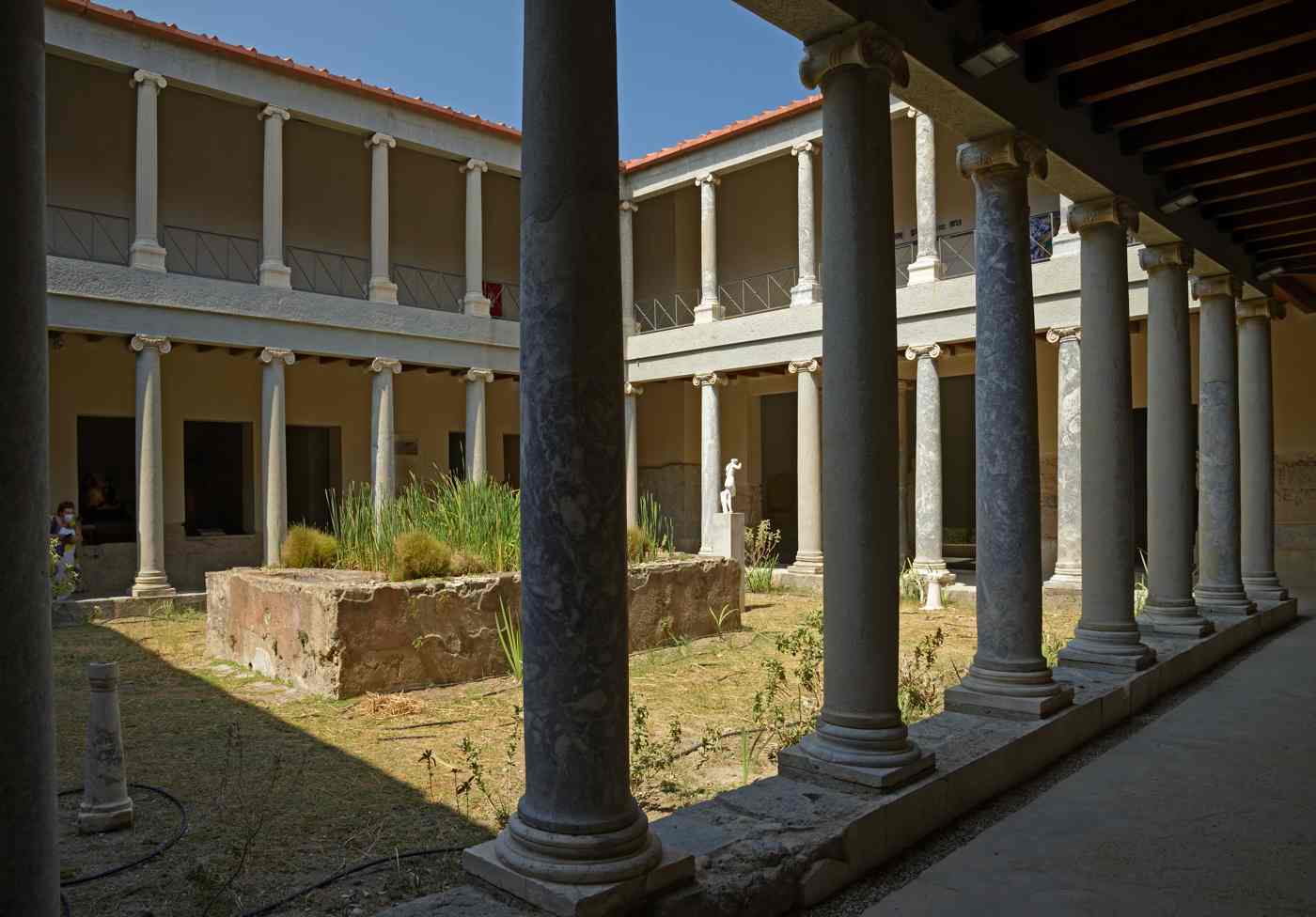
The Archaeological Museum of Kos stands on Plateia Eleftherias in the heart of Kos Town, gathering the island’s most important sculpture, mosaics and artefacts in an elegant Italian-era building. Opened during the Italian administration of the Dodecanese, the museum organises finds from excavations across the island into galleries arranged around a central atrium. Visitors encounter marble statues from the Hellenistic and Roman periods, intricate floor mosaics depicting mythological scenes, and objects recovered from the Asklepion, the ancient agora and domestic villas. The collection tells the story of Kos from the Archaic age through the Byzantine era, with particular strength in works from the island’s golden age under Hellenistic and Roman rule. Plan the whole trip with Greece Tours.
The museum occupies a prime location steps from the ancient agora ruins. The market hall and the harbour waterfront where the Castle of Nerantzia and the Plane Tree of Hippocrates anchor the town’s historical core. Its compact galleries allow a focused visit that complements a walking tour of Kos Town’s archaeological sites and Italian architecture. The building itself reflects the rational planning and neoclassical taste of the Italian colonial period, with high ceilings. Marble floors and an open courtyard that provides natural light and a serene setting for the sculpture displayed within. The museum serves as the principal repository for portable antiquities found on the island, preserving pieces that range from monumental statuary to delicate terracotta figurines.
What is the Archaeological Museum of Kos and where does it stand?
The Archaeological Museum of Kos is the island’s central antiquities collection, housed in an Italian-era building on Plateia Eleftherias in Kos Town.
The museum building dates to the Italian administration of the Dodecanese, constructed in a neoclassical style that echoes the archaeological heritage it was designed to protect. Architects working for the Italian colonial government created a symmetrical structure with high ceilings, marble floors and large windows, ensuring adequate light for viewing sculpture and inscriptions. The central atrium functions both as circulation space and as a gallery for freestanding statues, allowing visitors to view pieces from angles. The building sits on Plateia Eleftherias, the main square of Kos Town, surrounded by palm trees and caf\u00e9s. With the market hall immediately adjacent and the ancient agora ruins visible across the street.
This location places the museum at the intersection of modern civic life and ancient history, reinforcing the continuity of settlement on the site.
Excavations conducted by Italian archaeologists during the early twentieth century uncovered thousands of objects from sites across the island, creating the need for a dedicated repository. The museum opened to display these finds in a systematic arrangement, with galleries devoted to different periods and types of material. Sculpture occupies the central atrium and several side rooms, while mosaics are displayed on walls and in protective cases. Smaller objects including pottery, coins, jewellery and medical instruments fill vitrines arranged chronologically. The layout guides visitors through the island’s history from the Mycenaean and Geometric periods through the Archaic, Classical, Hellenistic and Roman eras to the early Christian and Byzantine centuries.
Each gallery includes explanatory labels in Greek and English, identifying provenance and dating for individual pieces.
The building’s architecture reflects the Italian colonial vision of the Dodecanese as a bridge between Europe and the eastern Mediterranean, blending classical references with modern construction techniques. Marble from Kos quarries lines the entrance hall and atrium floor, connecting the structure to the island’s geological resources. The atrium features a colonnade that recalls ancient stoas, creating a contemplative space for viewing sculpture against a backdrop of natural stone. Windows positioned high on the walls admit indirect sunlight, reducing glare on polished marble surfaces. The museum’s compact footprint makes it accessible for visitors exploring Kos Town on foot, with all galleries reachable within a short circuit from the entrance.
The building remains one of the most intact examples of Italian institutional architecture in the Dodecanese, preserved in its original function as a public museum.
Plateia Eleftherias serves as the civic heart of Kos Town, a pedestrian square lined with caf\u00e9s, shops and municipal buildings. The museum anchors the eastern side of the square, its fa\u00e7ade set back behind a low fence and a small garden planted with Mediterranean shrubs. The market hall, another Italian-era structure, stands immediately to the west, creating a cultural and commercial precinct. From the museum entrance, the ancient agora ruins lie less than one hundred metres to the north, visible across the square and the modern street grid. The harbour waterfront runs two hundred metres to the northeast, where the Castle of Nerantzia and the Plane Tree of Hippocrates mark the historical port.
This concentration of sites within a compact area allows visitors to combine the museum with a walking tour of Kos Town’s major landmarks in a single morning or afternoon.
What statue of Hippocrates does the Archaeological Museum of Kos display?
The museum displays a marble statue traditionally identified as Hippocrates, the father of medicine born on Kos in the fifth century BC. The statue depicts a bearded man in draped robes, carved in a style consistent with Hellenistic portraiture.
The statue stands approximately life-size, carved from white marble with fine attention to the folds of the himation draped over the left shoulder and wrapped around the torso. The figure adopts a contrapposto stance, weight shifted onto one leg, with the head turned slightly to the left. The face features a full beard, deep-set eyes and a high forehead, characteristics common in Hellenistic portraits of philosophers and physicians. The right arm hangs at the side, while the left arm crosses the body beneath the drapery. The sculptor employed a naturalistic approach to anatomy and fabric, creating a sense of volume and movement within the static marble.
The surface retains traces of weathering, indicating the statue stood outdoors for a period before entering the museum collection.
Tradition associates the statue with Hippocrates. The physician born on Kos around the middle of the fifth century BC who established medicine as a discipline grounded in observation and rational inquiry. No contemporary portraits of Hippocrates survive, and all later images represent idealised reconstructions based on literary descriptions and the conventions of philosophical portraiture. The Kos statue follows these conventions, depicting a mature man of intellectual gravitas rather than a specific individual. The identification rests on the statue’s provenance from Kos and its stylistic similarity to other Hellenistic portraits of physicians and scholars.
Some archaeologists propose the statue represents a priest of Asclepius or a later physician associated with the Asklepion, the healing sanctuary where medical training continued for centuries after Hippocrates. Regardless of the subject’s identity, the statue embodies the island’s reputation as a centre of medical knowledge.
The statue occupies a prominent position in the central atrium, mounted on a pedestal that elevates it to eye level and allows viewing from all sides. Museum labels present the traditional identification as Hippocrates while acknowledging the scholarly debate, providing visitors with context for the island’s medical history. The piece serves as a focal point for tours and a popular subject for photography. Its association with the father of medicine resonating with visitors familiar with the Hippocratic Oath and the legacy of ancient Greek science.
The statue’s presence in the museum complements the nearby Plane Tree of Hippocrates and the ruins of the Asklepion, creating a network of sites that together celebrate the island’s contribution to the history of medicine. The marble’s cool surface and the figure’s serene expression convey the calm rationality that characterised Hippocratic medicine.
Hellenistic sculptors working in the eastern Aegean developed a distinctive style of portraiture that combined idealised features with individualising details, creating images that conveyed both specific identity and universal virtues. The Kos statue exemplifies this approach, balancing naturalistic anatomy with a dignified composure that elevates the subject above the mundane. The drapery falls in deep folds that create strong contrasts of light and shadow, a technique that enhances the three-dimensional presence of the figure. The sculptor’s skill in rendering fabric and flesh demonstrates the high level of craftsmanship available on Kos during the Hellenistic period, when the island prospered under Ptolemaic and later Roman patronage.
The statue remains one of the finest examples of Hellenistic portraiture in the Dodecanese, a testament to the artistic and intellectual culture that flourished on the island.
What mosaic showing Asclepius does the museum in Kos Town hold?
The museum holds a floor mosaic depicting the arrival of Asclepius on Kos, welcomed by Hippocrates and other figures. The mosaic, executed in polychrome tesserae, shows the god of healing stepping from a ship, greeted by the physician and attendants.
The mosaic measures several square metres and originally paved a room in a Roman-era villa or public building, later lifted and transferred to the museum for preservation. The composition centres on the figure of Asclepius, identifiable by his staff entwined with a serpent, the symbol of healing. The god stands on the deck of a ship rendered in profile, with oars and rigging indicated by dark tesserae against a lighter background. To the right, Hippocrates extends a hand in greeting, dressed in a himation and accompanied by attendants who carry medical instruments and offerings. The background includes architectural elements suggesting a harbour setting, with columns and a portico framing the scene.
The artist employed a palette of white, black, red, yellow and blue tesserae, creating subtle gradations of tone that model the figures and suggest depth.
The mosaic illustrates a foundation myth that connected the worship of Asclepius with the historical practice of Hippocratic medicine on Kos. According to tradition, the god arrived on the island to establish his cult, bringing divine sanction to the healing arts practised by mortal physicians. The Asklepion, the terraced sanctuary southwest of Kos Town, served as the principal centre of Asclepius worship and medical training, attracting patients and students from across the Greek world. The mosaic conflates mythological and historical time, placing Hippocrates in the presence of the god to emphasise the sacred origins of medical knowledge.
This blending of divine and human agency reflects the ancient understanding of medicine as both a technical skill and a religious vocation, requiring piety and ritual alongside empirical observation.
The tesserae vary in size from less than one centimetre to centimetres, with finer pieces used for faces and hands where detail matters most. The mosaicist employed the opus tessellatum technique, setting small cubes of stone and glass into a bed of mortar to create a durable and waterproof surface. The colour palette derives from natural materials including limestone, marble, terracotta and coloured glass, with blue tesserae made from Egyptian or Syrian glass paste. The mosaic’s survival depends on the stability of its mortar bed, and conservators have reinforced the backing and cleaned the surface to reveal the original brightness of the stones. The piece now hangs on a wall in one of the museum’s galleries.
Protected by a barrier that prevents visitors from touching the fragile surface while allowing close inspection of the craftsmanship.
Roman-era mosaics from Kos demonstrate the island’s prosperity and cultural sophistication during the imperial period, when wealthy families commissioned elaborate floor decorations for their homes. The Asclepius mosaic belongs to a tradition of mythological scenes that adorned dining rooms, reception halls and baths, providing visual entertainment and signalling the owner’s education and taste. The choice of subject reflects local pride in the island’s medical heritage, a theme that recurs in inscriptions, coinage and public monuments. The museum’s collection includes additional mosaics with geometric patterns, floral motifs and scenes from daily life, all recovered from excavations at the Casa Romana and other Roman villas.
Together, these works illustrate the range of decorative programmes available to Kos patrons and the skill of the craftsmen who executed them. Many of whom trained in workshops that served clients across the eastern Mediterranean.
What Hellenistic and Roman sculpture fills the Archaeological Museum of Kos?
The museum holds an extensive collection of Hellenistic and Roman marble sculpture, including statues of gods, athletes, portraits and funerary reliefs.
The central atrium displays freestanding statues arranged on plinths, allowing visitors to walk around each piece and appreciate the sculptor’s treatment of anatomy, drapery and surface texture. A statue of Hermes, the messenger god, stands nearly two metres tall, carved from fine-grained marble with the god’s characteristic winged sandals and traveller’s cloak. The figure adopts a relaxed pose, weight on one leg, head turned to the side, embodying the grace and ease associated with Hellenistic sculpture. Another notable work depicts a draped female figure, a goddess or a priestess, with elaborate folds of fabric cascading from shoulder to ankle.
The sculptor used a drill to create deep channels in the drapery, producing strong contrasts of light and shadow that animate the surface. Fragments of colossal statues, including a marble foot and a hand holding a scroll, hint at the monumental scale of sculpture that once adorned public spaces in Kos Town.
Hellenistic sculptors working on Kos drew inspiration from the major artistic centres of the eastern Mediterranean, including Alexandria, Pergamon and Rhodes. The island’s prosperity under Ptolemaic rule during the third and second centuries BC funded ambitious building projects and attracted skilled craftsmen. Sculptors employed local marble from quarries on Kos and imported stone from Paros and Naxos, selecting material based on grain, colour and suitability for fine detail. The Hellenistic style favoured dynamic compositions, realistic anatomy and emotional expression, moving beyond the idealised restraint of Classical sculpture. Works from this period often depict gods and heroes in moments of action or repose, capturing a sense of movement frozen in stone.
The museum’s Hellenistic pieces include athletic figures, portraits of rulers and private individuals, and votive reliefs dedicated at sanctuaries.
Roman-era sculpture on Kos continued Hellenistic traditions while incorporating new subjects and styles introduced by imperial patrons. Portraits of emperors, officials and wealthy citizens proliferated, serving both political and commemorative functions. The museum displays several portrait heads with the distinctive hairstyles and facial features of the first and second centuries AD, carved with meticulous attention to wrinkles, bone structure and expression. Funerary reliefs depict the deceased in idealised form, often reclining at a banquet or standing in heroic nudity, accompanied by family members and servants. Architectural sculpture includes fragments of friezes, pediments and column capitals decorated with acanthus leaves, rosettes and mythological figures.
These pieces come from temples, stoas and other public buildings that lined the agora and the streets of Roman Kos, creating a monumental urban landscape.
The museum’s sculpture galleries illustrate the evolution of style and technique over six centuries, from the late Classical period through the end of Roman rule. Labels identify the provenance of each piece, linking statues to specific excavation sites including the agora, the Asklepion, the gymnasium and private houses. Visitors exploring Kos gain insight into the island’s artistic production and the networks of trade and patronage that connected it to the wider Greek world. The quality of the carving, the variety of subjects and the preservation of pieces make the collection a valuable resource for understanding Hellenistic and Roman sculpture.
The museum staff periodically rotate works between display and storage, ensuring that fragile pieces receive appropriate conservation while maintaining a representative selection for public viewing.
How does the Archaeological Museum of Kos connect to the island’s ancient sites?
The museum gathers finds from excavations across Kos, including the Asklepion, the ancient agora, the Casa Romana and rural sanctuaries. Objects displayed in the galleries come from these sites, providing context for visitors who explore the ruins.
The Asklepion, the terraced sanctuary of Asclepius located four kilometres southwest of Kos Town, yielded sculptures, inscriptions and votive offerings now housed in the museum. Excavations at the site uncovered statues of the healing god, his daughter Hygieia and other deities, along with marble reliefs depicting patients and priests. Medical instruments including scalpels, forceps and cupping vessels demonstrate the practical side of ancient healing, while inscriptions record dedications from grateful patients and lists of priests who served the sanctuary. The museum displays these objects in cases that explain their original function and placement within the Asklepion’s three terraces.
Visitors who tour the sanctuary first gain a deeper appreciation for the museum’s holdings, while those who begin at the museum arrive at the Asklepion with a clearer understanding of its religious and medical activities.
The ancient agora of Kos Town, located immediately north of the museum, served as the civic and commercial heart of the Hellenistic and Roman city. Excavations in the agora uncovered column drums, inscribed bases, altars and fragments of public monuments that now stand in the museum’s sculpture collection. Mosaics from nearby houses and public buildings illustrate the decorative programmes that adorned the urban core. The proximity of the museum to the agora allows visitors to move easily between the two sites, comparing the in situ ruins with the portable finds displayed indoors. The agora’s open-air remains include the foundations of stoas, temples and administrative buildings, while the museum preserves the sculpture and inscriptions that once decorated these structures.
Together, the two sites reconstruct the appearance and function of the ancient city.
The Casa Romana, a restored Roman villa blocks west of the museum, contributed mosaics, frescoes and household objects to the collection. The villa’s floor mosaics, featuring geometric patterns and figural scenes, exemplify the domestic luxury enjoyed by Kos’s elite during the imperial period. The museum displays fragments of frescoes with painted garlands, architectural motifs and mythological figures, recovered from the villa’s walls. Pottery, glassware and bronze utensils from the Casa Romana illustrate daily life, while marble statuary from the villa’s courtyard and reception rooms demonstrates the owner’s wealth and taste. Visitors who tour the Casa Romana encounter the architectural context for these objects, seeing how mosaics paved specific rooms and how sculpture adorned peristyle gardens.
The museum provides the complementary experience of close inspection and detailed labelling.
Rural sanctuaries, tombs and farmsteads across the island have contributed additional material to the museum’s collection, broadening the geographical scope beyond Kos Town. Votive offerings from sanctuaries dedicated to Demeter, Apollo and other gods include terracotta figurines, miniature vessels and inscribed plaques. Grave goods from chamber tombs and cist graves include pottery, jewellery and coins that illuminate burial practices and beliefs about the afterlife. The museum organises these finds chronologically and thematically, allowing visitors to trace the development of religious and funerary customs over time. The collection as a whole reflects the diversity of ancient life on Kos, from the monumental public architecture of the capital to the modest offerings left at rural shrines.
Exploring things to do in Kos reveals how the museum ties together the island’s scattered archaeological heritage into a coherent narrative.
What layout and galleries does the Archaeological Museum of Kos offer visitors?
The museum arranges galleries around a central atrium, with sculpture displayed in the open courtyard and side rooms devoted to mosaics, pottery and smaller objects.
The entrance hall opens directly onto the central atrium, a rectangular courtyard surrounded by a colonnade that supports the upper floor. Marble statues stand on plinths arranged along the colonnade and in the centre of the atrium, creating a sculpture garden illuminated by natural light from above. The atrium’s floor, paved with marble slabs, reflects the Italian neoclassical design, while the columns and capitals echo ancient Greek architectural orders. Visitors enter the atrium and proceed clockwise through the galleries, each room dedicated to a specific period or category of material. The first rooms display Archaic and Classical pottery, terracotta figurines and bronze objects, establishing the chronological framework for the collection.
Labels in Greek and English identify each piece, providing dates, provenance and brief descriptions.
Side galleries branching from the atrium hold mosaics mounted on walls and in protective cases, allowing close inspection of the tesserae and composition. The Asclepius mosaic occupies a prominent wall in one gallery, with lighting positioned to highlight the colours and details. Additional mosaics show geometric patterns, floral borders and scenes from mythology, all recovered from Roman villas and public buildings. The mosaic galleries include explanatory panels that describe the techniques of opus tessellatum and opus vermiculatum, the types of stone and glass used, and the workshops that produced such work.
Benches placed in the centre of each room allow visitors to sit and study the mosaics at leisure, a welcome feature in a museum that rewards careful observation.
Upper-floor galleries, accessed by a staircase from the atrium, house smaller objects including coins, jewellery, medical instruments and inscriptions. Vitrines display pottery arranged by type and period, from Mycenaean stirrup jars to Roman terra sigillata. Coins minted on Kos and other Dodecanese islands illustrate the island’s participation in regional trade networks, with images of gods, rulers and local symbols. Medical instruments including scalpels, probes and surgical needles demonstrate the tools used by physicians trained at the Asklepion, connecting the museum’s holdings to the island’s medical heritage. Inscriptions carved on stone stelae record dedications, decrees and epitaphs, providing primary evidence for political, religious and social history.
The upper galleries receive less foot traffic than the atrium, offering a quieter environment for visitors interested in detailed study.
The museum’s compact footprint makes it accessible for visitors with limited time, while the depth of the collection rewards extended exploration. A complete circuit of all galleries takes approximately ninety minutes at a moderate pace, with additional time for reading labels and photographing highlights. The central atrium serves as a reference point, allowing visitors to orient themselves and return to specific galleries. The museum lacks a caf\u00e9 or gift shop, but the surrounding Plateia Eleftherias offers numerous caf\u00e9s and restaurants within a short walk. Restrooms and a small cloakroom are located near the entrance.
The building’s Italian-era architecture, with high ceilings and large windows, maintains comfortable temperatures even during the summer heat, making the museum a pleasant refuge from the midday sun.
What visiting information applies to the Archaeological Museum of Kos?
The museum stands on Plateia Eleftherias in central Kos Town, open throughout the year with reduced hours in winter. Admission requires a ticket, with discounts for students and seniors. Photography without flash is permitted.
The museum entrance faces Plateia Eleftherias, marked by a sign in Greek and English. Visitors purchase tickets at a small booth inside the entrance hall, with staff available to answer questions and provide information about the collection. The museum does not publish fixed opening hours online, as schedules vary seasonally and adjust for public holidays and maintenance. Travellers planning a visit confirm current hours by enquiring at their hotel or the municipal tourist office in Kos Town. The museum typically opens mornings and afternoons during the high season from spring through autumn, with shorter hours and occasional closures during the winter months. Arriving early in the day ensures access and avoids the midday heat.
Admission fees remain modest, consistent with Greek archaeological museums, with reduced rates for students holding valid identification, seniors over sixty-five and children under eighteen. European Union citizens over sixty-five enter free on certain days. The museum does not accept credit cards, so visitors bring cash in euros. Tickets grant access to all galleries and the atrium, with no additional charge for photography. Flash photography and tripods are prohibited to protect the fragile mosaics and painted surfaces. Visitors store large bags and backpacks in the cloakroom to prevent accidental contact with sculpture and vitrines. The museum staff enforce these rules politely but firmly, ensuring the preservation of the collection for future generations.
The museum’s location on Plateia Eleftherias places it at the centre of Kos Town’s pedestrian network, reachable on foot from the harbour, the main hotel district and the bus station. From the harbour and the Castle of Nerantzia, the museum lies approximately three hundred metres south, a five-minute walk along Vasileos Pavlou street. The ancient agora ruins occupy the block immediately north of the museum, visible from the entrance. The Casa Romana stands four hundred metres to the west, accessible via pedestrian streets lined with shops and caf\u00e9s. The Plane Tree of Hippocrates and the adjacent mosque are two hundred metres northeast, near the harbour.
This concentration of sites allows visitors to design a walking route that includes the museum and the major landmarks in a single itinerary. Typically requiring three to four hours including breaks.
Guided tours of Kos Town often include a stop at the museum, with local guides providing context for the sculpture and mosaics. Independent visitors benefit from the museum’s labels and explanatory panels, which offer sufficient information for a self-guided tour. Audio guides are not available, but printed brochures in languages are sometimes provided at the entrance. The museum’s compact size and clear layout make navigation straightforward, with the chronological arrangement guiding visitors through the collection without confusion. Combining the museum with the nearby archaeological sites creates a comprehensive introduction to the island’s ancient history, linking the portable artefacts to the ruins where they were found.
Visitors interested in the medical heritage of Kos extend their itinerary to include the Asklepion. Located four kilometres southwest of the town centre and accessible by taxi, rental bicycle or local bus.
How does the museum building reflect Italian colonial architecture in Kos Town?
The museum building exemplifies the neoclassical style favoured by Italian architects during the Dodecanese administration, with symmetrical fa\u00e7ades, high ceilings, marble floors and a central atrium.
Italian architects working in the Dodecanese during the early twentieth century designed public buildings that combined classical references with contemporary construction techniques, creating a distinctive colonial style. The Archaeological Museum of Kos follows this approach, with a symmetrical fa\u00e7ade divided by pilasters and crowned by a simple cornice. The entrance, framed by columns, recalls ancient temple fronts, while the large windows and reinforced concrete structure reflect modern engineering. The building’s proportions and materials convey permanence and authority, qualities the Italian administration sought to project through its public works.
The use of local marble for floors and wall cladding connected the new structure to the island’s geological and cultural heritage, while the neoclassical vocabulary aligned the building with European architectural traditions.
The central atrium, the museum’s defining feature, derives from Roman domestic architecture, where open courtyards provided light and ventilation to surrounding rooms. The Italian architects adapted this ancient model to create a flexible exhibition space that accommodates large sculpture while maintaining a sense of order and clarity. The colonnade surrounding the atrium supports the upper floor and frames views of the statues, creating a rhythmic sequence of arches and columns. The atrium’s floor, paved with white and grey marble in a geometric pattern, enhances the sense of formality and elegance. Natural light enters through a glazed roof or high clerestory windows, illuminating the sculpture without the harsh contrasts of direct sunlight.
The atrium functions as both a circulation hub and a gallery, allowing visitors to appreciate the sculpture from multiple vantage points.
The building’s exterior presents a restrained fa\u00e7ade to Plateia Eleftherias, with minimal ornamentation and a focus on proportion and symmetry. The entrance is set back slightly from the street, creating a small forecourt planted with shrubs and palms. The fa\u00e7ade’s horizontal emphasis, achieved through continuous cornices and aligned window sills, conveys stability and balance. The materials, including plastered masonry and marble trim, weather well in the Mediterranean climate, requiring minimal maintenance. The building’s scale, neither monumental nor modest, fits comfortably within the urban fabric of Kos Town, complementing the market hall and other Italian-era structures. The design avoids the grandiose rhetoric of fascist architecture, instead adopting a more measured classicism that emphasises function and dignity.
The museum building remains one of the best-preserved examples of Italian institutional architecture in the Dodecanese, maintained in its original use and largely unaltered since construction. The interior retains its marble floors, plaster mouldings and wooden doors, creating an authentic period atmosphere. The building’s design influenced later museum projects in Greece, demonstrating the effectiveness of the central atrium layout for displaying sculpture. The structure’s durability and adaptability have allowed it to serve continuously as a museum, housing an expanding collection without major renovations. The building stands as a testament to the Italian administration’s investment in cultural infrastructure, preserving and presenting the island’s archaeological heritage in a purpose-built facility.
Visitors interested in the colonial history of Kos recognise the museum building as an integral part of the town’s architectural heritage. Alongside the market hall, the administrative buildings and the waterfront promenade.
What role does the museum play in preserving Kos’s archaeological heritage?
The museum serves as the central repository for portable antiquities found on Kos, protecting sculpture, mosaics and artefacts from weathering, theft and damage. Conservation staff clean, repair and stabilise objects, while climate-controlled storage preserves pieces not on display.
Excavations on Kos continue to uncover new material, adding to the museum’s holdings and expanding knowledge of the island’s past. Each excavation season produces pottery, coins, architectural fragments and occasional sculpture that require cleaning, cataloguing and conservation before entering the collection. The museum’s storage facilities house thousands of objects not currently on display, organised by type, period and provenance. Archaeologists and researchers access the storage areas to study unpublished material, compare finds from different sites and prepare scholarly publications. The museum staff maintain detailed records of each object’s discovery context, including the excavation trench, stratigraphic layer and associated finds.
This documentation ensures that objects retain their scientific value, allowing future researchers to reconstruct ancient contexts and test new hypotheses.
Conservation work at the museum addresses the deterioration of marble, bronze, pottery and other materials caused by burial, weathering and handling. Marble sculpture requires cleaning to remove soil encrustations, salts and biological growth, followed by consolidation of fragile surfaces and repair of broken pieces. Bronze objects undergo desalination to remove chlorides absorbed during burial, preventing further corrosion. Mosaics lifted from archaeological sites receive new backing and grouting to stabilise the tesserae and prevent loss. The museum collaborates with conservation laboratories in Athens and international institutions, accessing specialised expertise and equipment for complex treatments. The goal of conservation is to stabilise objects in their current condition, avoiding over-restoration that obscures original surfaces or introduces modern materials that age poorly.
The museum’s role extends beyond preservation to education and public engagement, making the island’s archaeological heritage accessible to residents and visitors. Temporary exhibitions highlight recent discoveries, specific themes or individual sites, drawing attention to aspects of the collection not represented in the permanent galleries. Educational programmes for schools bring local students into the museum, fostering appreciation for the island’s history and the importance of protecting archaeological sites. The museum collaborates with the Ephorate of Antiquities, the Greek government agency responsible for archaeology in the Dodecanese, coordinating excavation permits, conservation projects and site management. This partnership ensures that the museum’s activities align with national policies for heritage protection and that resources are allocated effectively.
The museum also functions as a cultural landmark, attracting visitors who contribute to the local economy through admission fees, tourism spending and extended stays. The presence of a well-curated museum enhances Kos’s reputation as a destination for cultural tourism, distinguishing the island from purely beach-oriented resorts. The museum’s collection provides content for guidebooks, websites and tour itineraries, raising awareness of the island’s archaeological richness. By preserving and presenting the material evidence of Kos’s past, the museum supports the island’s identity as the birthplace of Hippocrates and a centre of Hellenistic and Roman culture. The building and its collection together embody the continuity of human settlement on the island.
Linking the ancient city to the modern town and the marble statues to the living community that values them.
How does the museum enhance a visit to Kos Town’s other historical sites?
The museum provides context for the ruins scattered across Kos Town, displaying the sculpture, inscriptions and mosaics that once decorated the agora, temples and villas.
The ancient agora, located immediately north of the museum, preserves the foundations of stoas, temples and public buildings that framed the civic centre of Hellenistic and Roman Kos. Walking through the agora, visitors encounter column bases, paving stones and fragmentary walls, but the sculpture and inscriptions that once adorned these structures now stand in the museum. Seeing the statues and reliefs indoors provides a sense of the agora’s original appearance, when marble figures of gods, emperors and benefactors lined the colonnades and filled the temple pediments. The museum’s labels identify which pieces come from the agora, allowing visitors to mentally reconstruct the site’s decorative programme.
This back-and-forth between museum and ruins deepens appreciation for both, revealing how ancient public spaces combined architecture, sculpture and inscriptions to convey political and religious messages.
The Castle of Nerantzia, the Knights Hospitaller fortress guarding Kos harbour. Represents a later chapter in the island’s history. Its construction incorporated ancient marble blocks and columns taken from ruined temples and public buildings. Visitors who explore the castle notice these spolia embedded in the medieval walls, evidence of the recycling of ancient materials. The museum’s collection includes inscriptions and architectural fragments that escaped reuse, preserving the original context and function of these pieces. Understanding the relationship between the ancient city and the medieval fortress requires recognising how successive occupants adapted and repurposed the island’s built heritage. The museum provides the archaeological background, while the castle illustrates the continuity and transformation of settlement at the harbour.
The Plane Tree of Hippocrates, a massive tree near the harbour traditionally associated with the father of medicine, serves as a symbolic link to the island’s medical heritage. The tree stands beside a small Turkish fountain and the Gazi Hassan Mosque, creating a picturesque corner that attracts visitors and photographers. The museum’s Hippocrates statue and the objects from the Asklepion provide the historical substance behind the legend, grounding the romantic tradition in archaeological evidence. Visitors who begin at the Plane Tree and proceed to the museum gain a richer understanding of Hippocrates and the medical culture that flourished on Kos.
The museum’s displays of medical instruments, votive reliefs and inscriptions from the Asklepion document the practices and beliefs that made the island a centre of healing for centuries.
Combining the museum with a walking tour of Kos Town creates a layered experience that moves between different periods and types of evidence. A typical itinerary begins at the harbour, visiting the Castle of Nerantzia and the Plane Tree. Then proceeds south to the museum and the agora. Continues west to the Casa Romana. This route covers approximately two kilometres, easily walkable in a morning or afternoon, with breaks at caf\u00e9s along the way. The museum serves as the intellectual anchor, providing the artefacts and interpretive framework that make sense of the ruins. The ruins, in turn, supply the spatial and architectural context that brings the museum’s objects to life.
Together, the sites form a coherent narrative of Kos’s history from the Classical period through the Roman era. With the museum preserving the finest examples of the island’s artistic and cultural achievements.
Frequently Asked Questions
What are the opening hours and admission fees for the Archaeological Museum of Kos?
The Archaeological Museum of Kos operates with seasonal hours that vary between the high season from spring through autumn and the quieter winter months. With specific schedules subject to adjustment for public holidays and maintenance. The museum does not publish fixed hours online. Visitors confirm current opening times by enquiring at their hotel reception. The municipal tourist office in Kos Town or by telephoning the museum directly. During the high season, the museum typically opens mornings and afternoons, allowing visits before or after exploring nearby archaeological sites. Winter hours are shorter, and the museum occasionally closes on certain weekdays. Admission fees remain modest, consistent with Greek archaeological museums.
With standard adult tickets priced affordably and reduced rates available for students holding valid international student identification, seniors over sixty-five and children under eighteen. European Union citizens over sixty-five enter free on designated days, and all visitors enter free on specific national holidays including the first Sunday of certain months. The museum does not accept credit cards, so visitors bring cash in euros. Tickets grant access to all galleries, the central atrium and temporary exhibitions when available, with no additional charge for photography provided visitors do not use flash or tripods.
How long does a visit to the Archaeological Museum of Kos take?
A visit to the Archaeological Museum of Kos typically requires between sixty and ninety minutes for a complete circuit of all galleries at a moderate pace. With additional time for visitors who wish to read labels in detail, photograph highlights or sit and study the mosaics and sculpture. The museum’s compact layout, organised around a central atrium with side galleries branching off, makes navigation straightforward and allows visitors to cover the entire collection without backtracking. Travellers with limited time focus on the central atrium’s sculpture, the Hippocrates statue and the Asclepius mosaic, completing a highlights tour in approximately forty-five minutes.
Those with a deeper interest in archaeology, ancient art or the history of Kos extend their visit to two hours. Examining the pottery, inscriptions and smaller objects displayed in the upper-floor galleries. The museum’s benches and the atrium’s open space provide opportunities to rest and reflect, making the experience comfortable even during a longer visit. Combining the museum with the nearby ancient agora, the Casa Romana and the harbour sites creates a half-day itinerary that covers the major historical attractions of Kos Town. With the museum serving as the centrepiece that contextualises the ruins and provides the finest examples of the island’s artistic heritage.
Can visitors photograph the exhibits at the Archaeological Museum of Kos?
Visitors are permitted to photograph the exhibits at the Archaeological Museum of Kos for personal, non-commercial use. Provided they do not use flash, tripods or other equipment that damage the artefacts or obstruct other visitors. Flash photography is strictly prohibited because the intense light can fade pigments on painted pottery, degrade the surface of mosaics and cause cumulative damage to marble and other materials. The museum staff enforce this rule to protect the collection, and signs in Greek and English remind visitors to disable flash on their cameras and smartphones. Tripods and monopods are not allowed in the galleries, as they create obstacles in the narrow spaces between vitrines and sculpture plinths.
Posing a risk to both the objects and other visitors. Handheld photography is welcome, and the museum’s natural lighting from the atrium and large windows provides sufficient illumination for capturing the sculpture and mosaics without artificial light. Visitors who wish to use photographs for publication, commercial purposes or academic research must obtain written permission from the museum administration and the Ephorate of Antiquities. The Greek government agency responsible for archaeological heritage. The museum’s policy balances public access and engagement with the imperative to preserve fragile antiquities for future generations. Allowing visitors to document their experience while protecting the collection from avoidable harm.
What other sites in Kos Town combine well with the Archaeological Museum?
The Archaeological Museum of Kos combines seamlessly with the ancient agora ruins located immediately north of Plateia Eleftherias, the Casa Romana four hundred metres to the west. The Castle of Nerantzia and the Plane Tree of Hippocrates near the harbour three hundred metres northeast. The Asklepion four kilometres southwest of the town centre. The ancient agora, an open archaeological site accessible without admission, preserves the foundations of stoas. Temples and public buildings that formed the civic heart of Hellenistic and Roman Kos, with column bases, paving stones and fragmentary walls visible among the modern streets. The Casa Romana, a restored Roman villa with floor mosaics, frescoes and a peristyle courtyard.
Illustrates domestic architecture and daily life during the imperial period, providing context for the household objects and mosaics displayed in the museum. The Castle of Nerantzia, the Knights Hospitaller fortress guarding the harbour, offers views over Kos Town and the sea, with medieval walls incorporating ancient marble blocks taken from ruined temples. The Plane Tree of Hippocrates, a massive tree beside the harbour traditionally associated with the father of medicine. Serves as a symbolic landmark, while the nearby Gazi Hassan Mosque and Turkish fountain add Ottoman-era layers to the town’s history. The Asklepion, the terraced sanctuary of Asclepius, requires a short taxi ride.
Bicycle trip or local bus journey but rewards the effort with well-preserved ruins and panoramic views, completing the narrative of Kos’s medical heritage begun in the museum.
Is the Archaeological Museum of Kos accessible for visitors with mobility limitations?
The Archaeological Museum of Kos, housed in an Italian-era building constructed before modern accessibility standards. Presents challenges for visitors with mobility limitations, particularly those using wheelchairs or who have difficulty with stairs. The entrance from Plateia Eleftherias involves a short flight of steps leading to the entrance hall. The upper-floor galleries are accessible only by a staircase with no lift or ramp. The central atrium and the ground-floor galleries, which contain the majority of the sculpture and the most important mosaics. Are accessible to visitors who can manage the entrance steps, as the floor is level and the spaces between plinths and vitrines are wide enough for wheelchairs.
Visitors with mobility concerns contact the museum in advance to enquire about assistance, as staff can sometimes provide support or suggest alternative access routes. The museum’s compact size means that even visitors who cannot reach the upper floors see the highlights of the collection. Including the Hippocrates statue, the Asclepius mosaic and the major Hellenistic and Roman sculpture. Travellers planning a visit assess their individual needs and capabilities. Those who find the museum inaccessible focus on the open-air archaeological sites in Kos Town. Such as the ancient agora and the Casa Romana, which offer level or gently sloped paths.
The museum administration recognises the importance of accessibility and works within the constraints of the historic building to accommodate as visitors as possible.
What is the best time of day to visit the Archaeological Museum of Kos?
The best time to visit the Archaeological Museum of Kos is early morning shortly after opening or late afternoon an hour before closing, when the galleries are less crowded and the natural light in the central atrium is at its most flattering. Early morning visits, particularly on weekdays outside the peak summer months, offer the quietest experience. Allowing visitors to study the sculpture and mosaics without competing for space or waiting for other tourists to move. The morning light entering the atrium from the east illuminates the marble statues with a soft glow that enhances the modelling of drapery and anatomy. Ideal for photography and close observation.
Late afternoon visits benefit from the warm light of the descending sun, which casts long shadows across the atrium and creates dramatic contrasts on the sculpture. Midday visits during the summer are less comfortable, as the heat outside drives more visitors indoors and the overhead sun can create harsh lighting conditions, though the museum’s thick walls and high ceilings maintain cooler temperatures than the streets. Visitors who arrive during the middle of the day find the museum a welcome refuge from the heat, but the galleries be busier with tour groups and cruise-ship passengers.
Combining the museum visit with the rhythm of the day in Kos Town, travellers explore the outdoor sites in the cooler morning or late afternoon hours and retreat to the museum during the midday heat. Creating a balanced itinerary that maximises comfort and enjoyment.
Does the Archaeological Museum of Kos offer guided tours or audio guides?
The Archaeological Museum of Kos does not regularly offer guided tours or audio guides as part of its standard visitor services. Private guides licensed by the Greek tourism authorities are available for hire in Kos Town and can accompany visitors through the museum. Providing detailed commentary on the sculpture, mosaics and the island’s archaeological history. These professional guides, many of whom hold degrees in archaeology or history, offer tours in languages including English. German, French and Italian, tailoring the content to the interests and knowledge level of their clients. Visitors arrange guided tours through their hotel, local travel agencies or online platforms that connect travellers with certified guides.
Group tours organised by cruise lines and package-holiday operators sometimes include a stop at the museum as part of a broader Kos Town itinerary. With the guide providing an overview of the highlights in a limited time. Independent visitors rely on the museum’s labels and explanatory panels. Which are printed in Greek and English and provide sufficient information for a self-guided tour, identifying the provenance, date and significance of major pieces. Printed brochures or leaflets are occasionally available at the entrance, offering an introduction to the collection and a suggested route through the galleries. The museum’s clear layout and chronological organisation make self-guided exploration straightforward, and the compact size ensures that visitors do not miss important works.
Travellers who prefer expert interpretation invest in a private guide, while those comfortable with independent exploration find the museum accessible and rewarding without additional assistance.