
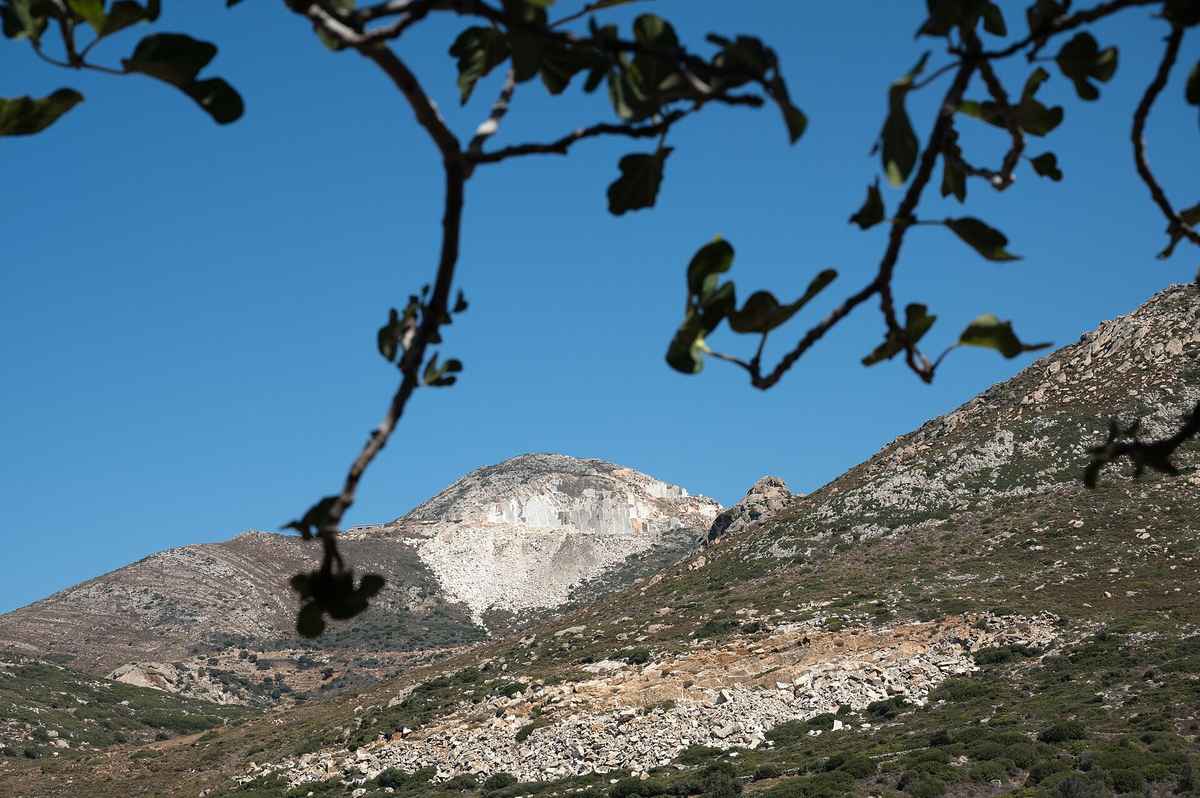
Kinidaros is a lively mountain village in the green interior of Naxos, set among terraced slopes, running springs and the working marble quarries that give the whole area its distinctive white glow. It sits well inland from the coast, roughly in the centre of the island, where the land rises into oak and plane trees and the air stays cooler through summer. The village is a working community rather than a resort, known across Naxos for its craftsmen, its musicians and its warm, unhurried welcome. Its stone houses, shaded platia and taverna terraces reward travellers who venture off the beaches. You can reach it easily on a day out from the coast, and it features on a wide range of inland guided tours with My Greece Tours.
For the wider island context, planning tips and every inland route, use our Naxos travel guide alongside this page. The sections below cover what Kinidaros is as a mountain village, why it is the marble-quarrying heart of Naxos, its famous tradition of violin music and panigyria festivals, the springs, greenery and village life you find there, and exactly how to reach it on a Naxos villages loop.
What is Kinidaros on Naxos?
Kinidaros is a lively working mountain village in the central interior of Naxos, built on green terraced slopes near active marble quarries. It is a community of craftsmen and musicians, prized for its authentic character, springs and shaded tavernas rather than beach tourism.
Kinidaros sits inland at moderate altitude, cradled by hills that stay greener and cooler than the Naxian coast even at the height of summer. The village grew where fresh spring water, fertile terraces and rich seams of marble met. It still earns its living from the land and the stone rather than from resorts. Whitewashed and bare-stone houses cluster around a central square shaded by plane trees, where older residents gather at the kafeneio and children play late into the evening. The rhythm here is genuinely local: tractors, quarry trucks and the occasional flock share the narrow lanes.
Travellers who arrive find a settlement that feels lived-in and proud, a real Naxian village that has never rebranded itself for visitors.
Kinidaros offers a different experience from the harbour town or the popular beaches because it is a working place. You come for the atmosphere, the food, the music and the scenery, not for sunbeds. The village is a natural anchor for exploring the mountainous heart of the island, and it pairs well with nearby settlements on a scenic drive. A host of visitors treat it as one memorable stop among a series of, linking it into a wider circuit of the mountain and hillside communities. That approach lets you sample the interior at an easy pace and see how everyday Naxian life unfolds away from the sea.
It also sets up the next question naturally, because the single thing Kinidaros is most famous for is its marble.
Why is it the marble-quarrying heart of Naxos?
Kinidaros holds the island’s most active marble quarries, and marble-working remains a living local industry rather than a museum piece. The white stone is still cut, shaped and exported here, continuing an ancient Naxian tradition.
Naxos has been synonymous with fine white marble since ancient times. Today the extraction is concentrated around Kinidaros, whose hillsides are scored with pale working faces where blocks are still cut and lifted. The quarries are a genuine part of the modern economy: you will see stone yards, saws, cranes and trucks moving dressed slabs down toward the coast. This is not a heritage attraction but a functioning industry, which is exactly what makes it compelling. The same marble that built temples and sculptures in the classical world still comes out of these slopes, connecting the village directly to Naxos’s deep artistic past.
That long lineage of stone-carving on the island is also traced through the exhibits at the Naxos Archaeological Museum in Naxos Town.
For the traveller, the marble gives the whole area a striking character. Piles of white offcuts glint on the roadside, workshop yards display finished pieces, and the dust of the stone settles into the landscape and even the light. Certain local craftsmen still carve by hand, and marble troughs, thresholds and church fittings across Naxos often trace back to Kinidaros stone. Viewing the quarries from the road is straightforward and safe, but the active sites themselves are workplaces, so admire them from a respectful distance rather than wandering in.
The industry has shaped not only the economy but the culture of the village, breeding a community of skilled, hard-working people who also happen to be famous for something quite different after hours, which brings us to the music.
What is its music tradition?
Kinidaros is celebrated across Naxos for its music, above all the violin, together with the laouto, singing and impromptu dancing. The village is best known for its exuberant summer panigyria, religious feast-day festivals where the whole community eats, plays and dances until dawn.
Music runs deep in Kinidaros, and the village has produced and nurtured respected violinists and singers whose reputation carries far beyond the island. The Naxian violin style, paired with the plucked laouto, provides the driving melodies for local dances. Evenings in the square can turn into spontaneous sessions where instruments appear and neighbours join in. This is a place where the tradition is genuinely alive, passed from older players to younger ones rather than staged for an audience. The songs, a wide range of in the island dialect, tell of love, emigration, work and village life, and they form part of a shared cultural memory that Kinidarians clearly treasure.
Encountering this music in its natural setting, unplanned and unamplified, is one of the most rewarding things a visitor to the Naxian interior can stumble upon.
The tradition reaches full voice at the panigyria, the feast-day festivals tied to the calendar of local churches and saints. On these nights the village fills with long tables, grilled meat, local wine and citron liqueur. The music and dancing continue late into the night in a warm, welcoming atmosphere that draws people from across Naxos. Visitors are made to feel included, and joining a circle dance is encouraged rather than merely tolerated. It is well worth attending, as it shows the community at its most joyful and generous if your trip coincides with one of these celebrations.
This festive, sociable spirit is inseparable from the everyday setting of the village, the springs, greenery and tavernas that shape daily life, which is the next thing to explore.
What is the setting and village life like?
Kinidaros enjoys a green, well-watered setting with springs, plane trees and terraced gardens. Village life centres on the square and family-run tavernas, giving it an authentic, unhurried farming character.
The abundance of spring water is fundamental to Kinidaros and explains most of its appeal. Fountains and running water feed gardens, orchards and grazing land, and the greenery is noticeably richer here than in the drier lowlands and coastal fringe of Naxos. Plane and walnut trees shade the lanes, and the sound of water is a constant background in the cooler upper parts of the village. This natural fertility supports small-scale farming and animal husbandry. The local diet leans on genuinely local ingredients: island cheeses, honey, vegetables, wild greens, meat from nearby flocks and the famous Naxos potatoes.
Sitting on a shaded terrace with a plate of grilled meat and a carafe of local wine, listening to water and cicadas, captures the essence of the place better than any list of sights.
Daily life is centred on the platia and its kafeneia and tavernas, where the pace is deliberately slow and conversation is the main event. The village keeps its authentic character precisely because it has resisted turning itself into a tourist product, so prices are fair, welcomes are sincere and traditions endure. Walking the lanes reveals old stone houses, small churches, working yards and the marble that is never far away. It is a place to linger rather than tick off, ideally over a long lunch or an evening meal. Understanding this rhythm makes the practical business of getting there more meaningful.
The final thing to cover is how you actually reach Kinidaros and fit it into a wider exploration of the island.
How do you visit Kinidaros?
You reach Kinidaros by driving inland from Naxos Town, a scenic route of roughly half an hour into the central hills.
From Naxos Town (Chora) you head inland on the road toward the interior, climbing gradually through olive groves and terraces until the greener uplands and the marble quarries announce the approach to Kinidaros. Driving takes around half an hour depending on the exact route and stops, and the journey itself is part of the pleasure, with wide views back toward the coast. A hire car gives you the most freedom to pause for photographs and to press on to neighbouring settlements afterwards. Public buses do serve inland Naxos but are infrequent, so most independent travellers choose to drive.
You come, aim to arrive with time to walk the lanes, see the quarries from the road and enjoy a meal. The village rewards an unhurried visit far more than a quick photo stop.
Kinidaros sits perfectly on a circuit of the villages of Naxos, and the classic pairing is to combine it with the beautiful marble-built mountain village of Apeiranthos higher in the ranges, along with other inland stops, to make a full and satisfying day. Bring water, wear comfortable shoes for the lanes, respect the working quarry sites, and time your visit for late afternoon if you hope to catch the village at its liveliest, especially during the summer festival season. Guided tours handle the driving and add local context, which a wealth of visitors prefer for the interior. Plan your visit and tours through our Naxos travel guide.
Frequently Asked Questions
Is Kinidaros worth visiting on a Naxos trip?
Yes, Kinidaros is well worth visiting if you want to experience the authentic, working interior of Naxos rather than only its beaches and harbour town. It offers a rare combination of a living marble-quarrying industry, a genuinely strong music tradition and a lush, green mountain setting fed by springs, all wrapped in the unhurried atmosphere of a real Naxian village. Travellers who value character, local food and scenery over resort facilities tend to love it. You can see the pale quarry faces from the road, walk shaded stone lanes, and eat well at family-run tavernas using local produce.
It is not a place of famous monuments, so it suits those who enjoy soaking up daily village life and landscape. You do not need long there, which is why most people fold it into a wider inland circuit alongside other mountain villages because it is compact. The experience becomes truly memorable, showing the community’s music and hospitality at full strength if your dates align with a summer panigyri festival.
Can you see the marble quarries at Kinidaros?
You can readily see the marble quarries at Kinidaros, since they are among the most active on Naxos and lie right beside the roads approaching and surrounding the village. The pale working faces, stone yards and stacks of white blocks are highly visible from public viewpoints. Simply driving the route gives you a clear sense of the scale of the industry. This is a genuine, functioning operation rather than a tourist attraction, which is precisely what makes it so interesting to witness. Cutting and moving of stone, you should view them from a safe, respectful distance rather than entering the active sites. Always follow any signage because the quarries are real workplaces with heavy machinery.
Marble-working here continues a Naxian craft that stretches back to antiquity, and understanding that long lineage adds real depth to the visit. A portion of local workshops display finished carved pieces, and you will notice marble troughs, thresholds and church details throughout the region, a great deal of it sourced from these very slopes.
When is the best time to visit Kinidaros for the festivals?
The best time to catch Kinidaros at its most festive is during the summer, when the village hosts its panigyria, the feast-day celebrations tied to the calendar of local churches and saints. On these evenings the community lays out long tables of grilled meat, local wine and citron liqueur. The famous violin-led music and dancing carry on late into the night in a warm, inclusive atmosphere. Summer generally offers the highest concentration of these events, along with pleasant, cooler mountain evenings that make the interior especially appealing when the coast is hot.
It is wise to ask locally, at your accommodation or through a tour operator, to find out which nights celebrations are planned during your stay because exact festival dates follow the religious calendar and vary. Even outside a formal panigyri, the square and tavernas come alive on summer evenings, and impromptu music sessions can break out at any time. Arriving in the late afternoon and staying for dinner gives you the best chance of experiencing the village’s lively, musical spirit firsthand.