
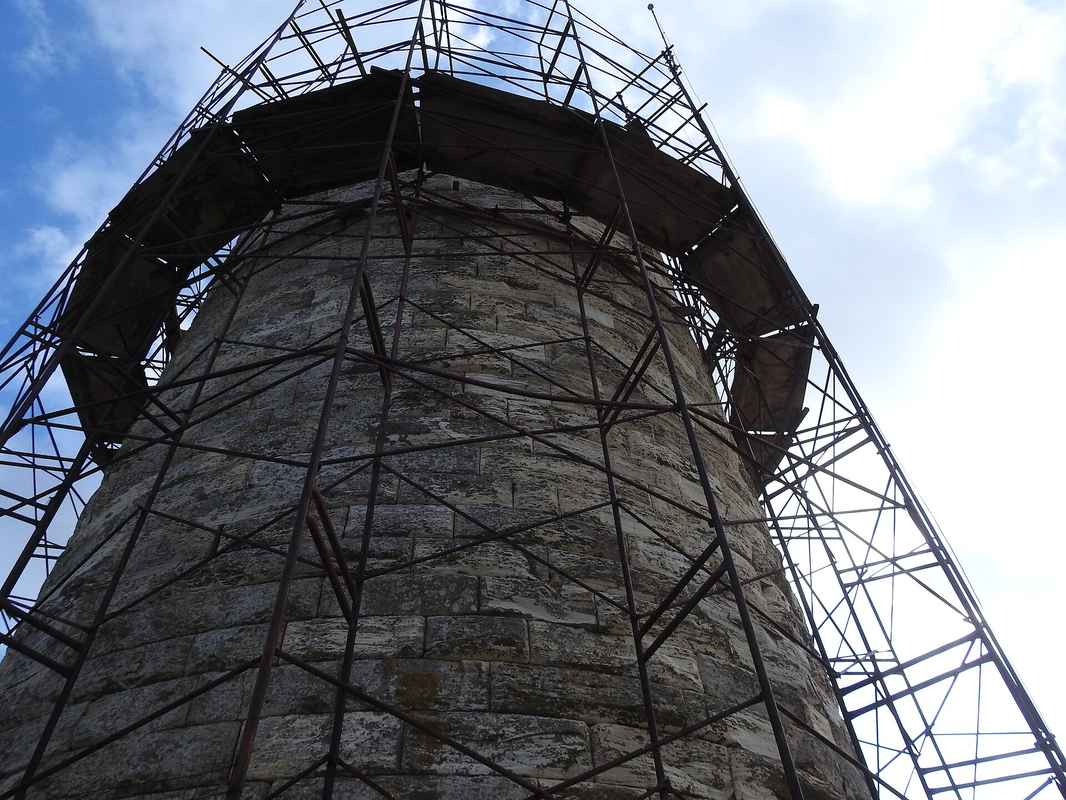
The Cheimarros Tower, known locally as Pyrgos Cheimarrou, is one of the most striking ancient monuments on Naxos and one of the best-preserved round towers left standing anywhere in Greece. Rising from a lonely mountainside in the island’s rugged south, it was built from finely fitted white marble drums that still glow against the grey schist and thyme-scented slopes around it. For centuries it served as a fortified watchtower and refuge, guarding a fertile valley far from the coast. Reaching it takes a scenic drive and a short walk, which makes the visit feel like a genuine discovery, and it is easily combined with a guided tour of southern Naxos arranged with My Greece Tours.
This page sits within our wider Naxos travel guide and focuses entirely on the Cheimarros Tower, so you can plan a confident, well-timed visit. The sections below cover what the Cheimarros Tower is, how it was built and how well it survives, what its original purpose was, the mountain setting and the hike that leads to it, and exactly how to reach it by car and on foot.
What is the Cheimarros Tower?
The Cheimarros Tower is an ancient Hellenistic round tower on Naxos, built of white marble on a remote southern mountainside. It once served as a fortified watchtower and refuge and now ranks among the island’s finest monuments.
The Cheimarros Tower is a free-standing circular tower of the Hellenistic period, set high in the mountainous interior of southern Naxos near the Cheimarros gorge that gives it its name. Unlike the whitewashed medieval pyrgoi found in Naxian villages, this is a genuinely ancient structure, raised a wealth of centuries before the Venetian era from local Naxian marble. Its perfectly round plan, thick walls and commanding position mark it out as a serious piece of ancient engineering rather than a simple lookout.
Travellers who reach it are often surprised by both its scale and its solitude, standing alone on the slope with only grazing goats, drystone terraces and sweeping views for company across the wild, unspoiled south of the island.
The tower belongs to a family of ancient Aegean towers, yet limited others survive in such complete form. It rises in a handful of storeys of neatly coursed marble, still tall enough to convey the confidence and wealth of the community that commissioned it. Archaeologists connect it with an estate or fortified refuge controlling the surrounding countryside, and its careful construction suggests it mattered a great deal to whoever owned it. For visitors, it is a rare chance to touch un-restored ancient masonry in a dramatic natural setting rather than behind museum ropes. It pairs beautifully with other outdoor highlights among the dozens of things to do in Naxos.
Understanding what makes it so special begins with a closer look at how it was actually built and why it has lasted so remarkably well.
How was the Cheimarros Tower built and how well is it preserved?
It was built from large, finely fitted drums of white Naxian marble, laid in neat courses without mortar. A great deal of its circular wall still stands to a considerable height, making it one of the best-preserved ancient towers in Greece.
The builders of the Cheimarros Tower used blocks and drum-shaped pieces of white Naxian marble, cut and dressed so precisely that they fit together tightly without any mortar between them. This dry-stone technique, relying on the sheer accuracy of the masonry and the weight of the marble, is a hallmark of high-quality ancient Greek construction. The result is a smooth, gently curving wall that has resisted earthquakes, storms and the passing of dozens of centuries. Standing at the base and looking up, you can trace how each course was carefully levelled and how the joints line up, clear evidence of skilled craftsmen who understood both geometry and the local stone quarried on this very marble-rich island.
What amazes most visitors is how a great deal of the tower still stands. Large sections of the circular wall survive to an impressive height, along with traces of the internal floors and openings that once divided it into storeys. This exceptional state of preservation places it among the finest surviving ancient towers anywhere in Greece. This makes it far more rewarding to see in person than a low heap of foundations. What you look at is genuinely old fabric, weathered but intact and honest because it has never been heavily reconstructed.
That authenticity naturally raises a question every visitor asks while standing beneath those marble walls, namely what such a strong, isolated tower was actually built to do out here.
What was the purpose of the Cheimarros Tower?
The tower worked as a fortified watchtower and refuge, controlling a fertile inland valley and its routes toward the coast. Its height gave wide views, while its strong marble walls offered secure shelter for people, produce and valuables in unsettled times.
The Cheimarros Tower was built to watch, to warn and to protect. From its upper storeys, lookouts could survey a broad sweep of the southern Naxian landscape, including the fertile Cheimarros valley below and the approaches leading down toward the sea. In an age of piracy, raids and rival powers moving across the Aegean, such a vantage point was invaluable. The tower let those who held the land see trouble coming long before it arrived, giving farmers and their families time to gather livestock, grain and belongings and retreat behind thick, defensible walls. Its position, deliberately chosen on high ground, ties directly into the long story told in our wider history of Naxos.
Beyond defence, the tower almost certainly anchored a working rural estate, overseeing cultivation, storage and the movement of goods across the countryside. A structure this solid could safely house harvests, tools and valuables, functioning as both stronghold and secure warehouse. Control of the productive valley meant control of real wealth, and the tower stamped that authority onto the landscape for everyone to see. This blend of surveillance, refuge and estate management explains why so considerable marble and effort went into a building so far from any town. Appreciating that role is far easier once you experience where it stands, because the remote setting and the walk up to it reveal exactly why this particular spot was chosen.
What is the setting and the hike to the Cheimarros Tower like?
The tower stands on a remote mountainside deep in southern Naxos, reached by a scenic drive and then a walk over rough ground. The route rewards you with quiet countryside, drystone terraces and wide views over valleys and distant sea.
The setting of the Cheimarros Tower is a large part of its magic. It sits far from the busy beaches and harbours, high in the arid, beautiful mountains of the island’s south. Terraced slopes, low stone walls and grazing goats define the landscape. The drive to the trailhead is genuinely scenic, winding past small chapels, olive groves and dramatic ridgelines as the coast falls away behind you. The last stretch to the tower is done on foot, following a rough path across open hillside when the paved road runs out. The walk is not long, but it is uneven and exposed, so sturdy shoes, sun protection and water make all the difference to your comfort along the way.
The tower appears and disappears among the folds of the mountain, until it finally rises ahead in full, pale and monumental against the sky as you climb. The views on the way are superb, taking in the deep Cheimarros gorge, patchworks of old fields and the shimmer of the sea in the distance. It is a place that rewards slowing down, listening to the wind and the goat-bells and imagining ancient lookouts scanning the same horizon. The scenery here ranks among the finest mountain walks on the island, and it sets the scene perfectly for the last practical question of all.
Knowing exactly what the terrain demands leads naturally to how best to organise the visit itself, from the drive south to the final track on foot.
How do you visit the Cheimarros Tower?
Drive south from Naxos Town toward Filoti and the island’s southern interior, then follow signs and a rough final track before walking the last stretch on foot. Go early, bring water and good shoes, and allow ample time.
Most visits to the Cheimarros Tower begin in Naxos Town and head inland and south, passing through the mountain villages of the interior. The pretty village of Filoti makes a natural gateway and a good place to fuel up with coffee, water and snacks before continuing toward the tower. From there the route works its way deeper into the southern hills, where the surfacing gradually gives way to a rough, unpaved track. A high-clearance vehicle is helpful on the final stretch. If the track looks too demanding it is perfectly sensible to park safely and simply walk a little further, adding it to a wider itinerary of things to do in Naxos.
Timing and preparation make the trip far more enjoyable. Set out early in the day to avoid the strongest heat, since the walk is exposed with little shade, and carry more water than you think you will need. Wear proper walking shoes for the uneven ground, use sun protection and keep an eye on the weather, as the mountains can feel very different from the coast. There are no facilities at the site, so treat it as a self-sufficient excursion and take all litter away with you. A guided southern-Naxos tour is an easy, stress-free option if you prefer to relax and let someone else handle the driving and the rough track.
Plan your visit and tours through our Naxos travel guide.
Frequently Asked Questions
Is the Cheimarros Tower the same as the Venetian towers in the Naxos villages?
No, and this is a common point of confusion. The whitewashed pyrgoi you see in and around Naxian villages are medieval and later towers, dozens of built in the Venetian era as fortified homes and estate centres. The Cheimarros Tower is far older, an ancient monument of the Hellenistic period constructed from finely cut white marble long before those medieval structures existed. What makes it stand out is both its age and its round plan, which is quite different from the square, plastered look of the later village towers. It sits alone on a remote southern mountainside rather than within a settlement, and it has never been converted into a modern dwelling.
The word pyrgos, meaning tower, is used for both, yet the Cheimarros Tower belongs to a completely different and far earlier chapter of the island’s long history. This is exactly why archaeologists and history lovers value it so highly and travel so far to see it in person.
How difficult is the walk to the Cheimarros Tower?
The walk itself is fairly short, but it should not be underestimated, because the ground is rough, uneven and exposed to the sun. The final approach involves an unpaved track and then a footpath across open hillside, with loose stones and a portion of gentle climbing after the drive south from Naxos Town toward the interior. Reasonably fit walkers of most ages manage it comfortably, provided they wear proper walking shoes rather than sandals and take their time on the rocky sections. The main challenges are heat, sun and lack of shade rather than steepness or technical difficulty. Setting out early and carrying ample water are the two most important things you can do.
There are no facilities, no cafe and no shop at the site, so bring everything you need and plan to carry your litter back out. Anyone uneasy about the rough final track can join a guided tour instead and let an experienced local driver handle all the logistics.
Why is the Cheimarros Tower worth visiting?
The Cheimarros Tower rewards the effort of reaching it in a handful of ways. First, it is one of the best-preserved ancient round towers in Greece. You get to stand beside genuine, un-restored marble masonry that has survived for dozens of centuries, rather than a scatter of low foundations. Second, the setting is unforgettable, a wild and quiet mountainside deep in southern Naxos with sweeping views over the Cheimarros gorge, terraced fields and distant sea. Third, the journey itself, a scenic drive followed by a walk, turns the visit into a small adventure and a welcome contrast to crowded coastal sights.
For history lovers it offers a tangible link to the island’s ancient past and its story of watchtowers, refuge and estate control. For hikers and photographers it delivers dramatic scenery and marvellous light. Combined with the mountain villages nearby, it makes an outstanding half-day excursion into the authentic, less-visited heart of Naxos.