
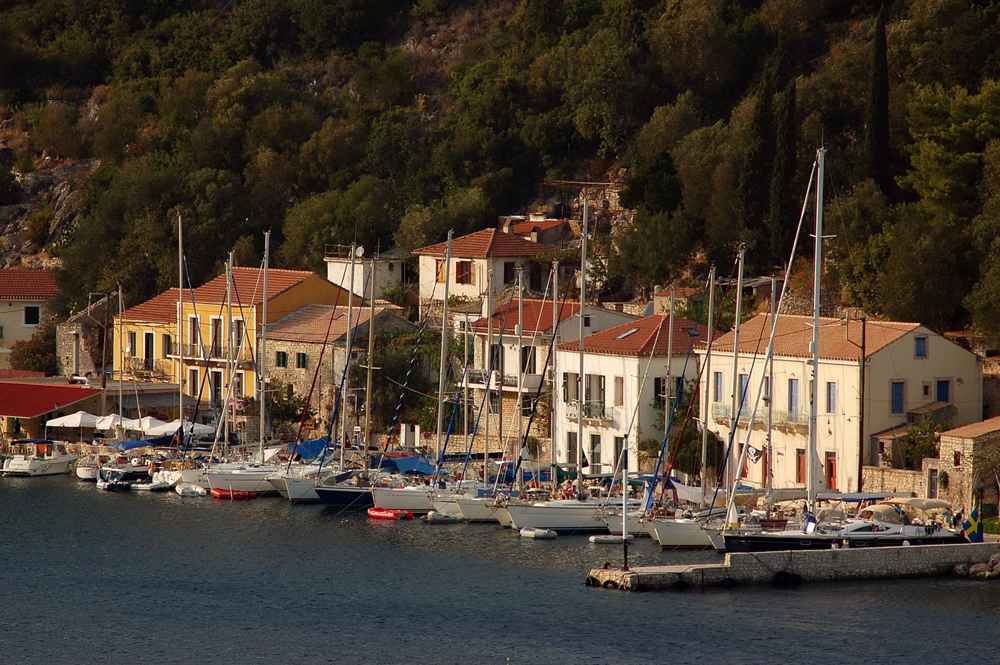
Kefalonia with kids works because the island pairs shallow sandy bays with short drives and a calm evening pace. Argostoli, the capital, sits about 9 kilometres north of the airport and keeps children occupied with loggerhead turtles that feed beside the fishing quay. Sandy beaches at Lassi, Skala and Lourdas slope gently into warm water, while the caves near Sami turn a hot afternoon into a cool boat ride under an open roof. Plan the whole trip with Greece Tours.
Planning matters more here than on a small island, because Kefalonia covers about 773 square kilometres of mountain roads and deep bays. A hire car and a base near the beaches you use most remove the long transfers that wear children down. This guide sets out the gentlest beaches, the turtle spots in Argostoli, the two caves near Sami. The boat trips that suit short attention spans and the practical detail that makes each day run without friction.
What makes Kefalonia work for a family holiday?
Kefalonia combines shallow sandy beaches, short driving distances between towns and a quiet evening rhythm, so a family moves through a day without long transfers. Argostoli, Lassi, Lourdas, Skala and Sami all sit within about 40 kilometres of one another.
Kefalonia is the largest of the Ionian Islands, about 773 square kilometres of mountains, fir forest and deep bays. That scale sounds daunting with children, yet the family core of the island stays compact. Argostoli, Lassi, Lourdas and Skala run along the south and southwest coasts, inside a 40-kilometre arc. Sami and its caves lie about 25 kilometres east of the capital, a drive of around 35 minutes on a good road. Families who plan a week on Kefalonia around that southern axis rarely spend more than an hour in the car on any single outing, which keeps small passengers calm.
The evening pace separates Kefalonia from the party islands of the Aegean. Argostoli keeps its main square free of traffic after dark, and families walk the Lithostroto pedestrian street past bakeries, toy shops and ice cream counters. The waterfront runs flat for about a kilometre, which suits pushchairs and scooters. Fiskardo, Assos and Agia Efimia hold the same rhythm, with harbour tavernas instead of clubs. Children who wake at seven still get a full beach morning, because nothing on the island depends on a late night. Lixouri adds a second square with playground equipment and a shaded promenade facing Argostoli across the bay.
Beach variety keeps a two-week stay from repeating itself. The south coast delivers wide sand at Skala, Lourdas, Trapezaki and Ammes, while Lassi holds the two organised bays closest to the capital. The Paliki peninsula, across the water, adds the red sand of Xi and the cliffs of Petani. The northwest coast turns dramatic, with white pebbles at Myrtos below a high cliff road. Parents choosing between Kefalonia beaches match each bay to the age of the children, keeping the sandy south for toddlers and saving the deep pebble coves for stronger swimmers.
Sea conditions on the south and southwest coasts stay calm through the morning hours. The Ionian warms from late May and holds its temperature into October, which stretches the family season either side of the August peak. Afternoon breezes build on exposed coasts such as Petani and Myrtos, so families with young children swim early and move inland after lunch. Organised beaches at Makris Gialos, Platis Gialos, Skala and Lourdas rent umbrellas and sunbeds, and each keeps tavernas within 100 metres of the sand. Shade is the scarce resource on this island, and booking an umbrella matters more than picking the perfect bay.
Which beaches on Kefalonia are shallowest and safest for young children?
Xi on the Paliki peninsula holds the gentlest water on Kefalonia, with red-orange sand and a floor that stays shin-deep far out. Makris Gialos, Platis Gialos, Skala and Lourdas add long sandy stretches with organised facilities close to the towns.
Xi lies on the south shore of the Paliki peninsula, about 8 kilometres from Lixouri, and gives the gentlest entry on the island. The sand runs red-orange, a colour drawn from the clay cliffs behind it, and the water stays shin-deep for 30 to 40 metres. Families reach it by the Argostoli to Lixouri ferry, a crossing of about 20 minutes, then a drive of ten. Xi beach has sunbeds, two beach bars and a wide sandbank where small children stand and dig. Wind arrives from the west after midday, so mornings suit toddlers best.
Makris Gialos and Platis Gialos sit below Lassi, about 3 kilometres from Argostoli, and act as the default family beaches for anyone based near the capital. Both run to golden sand, both slope gradually, and both split into organised sections with sunbeds, showers and snack bars. Makris Gialos is the wider of the two and holds more space at the back of the beach for shade. Platis Gialos is shorter and rockier at its edges. Families without a car walk down from the Lassi ridge in around 15 minutes. The airport road passes 6 kilometres away, which makes both bays workable on an arrival day.
Skala spreads along the southeast corner, about 40 kilometres from Argostoli, and holds the longest organised sand on Kefalonia. The beach runs for roughly 3 kilometres, backed by pine trees that drop real shade at its western end. Entry is sand over fine shingle, and the slope stays gentle for 20 metres out. The village behind keeps supermarkets, pharmacies and tavernas within a five-minute walk of the sand, which removes the mid-morning drive for supplies. The Roman villa with its floor mosaics stands at the edge of the old village, ten minutes on foot from the beach and flat the whole way with a pushchair.
Lourdas faces south below the slopes of Mount Ainos, about 16 kilometres from Argostoli, and mixes coarse sand with fine shingle across a 2-kilometre bay. The water deepens faster than at Skala, so it suits confident paddlers rather than crawling toddlers. Tavernas sit on terraces above the sand, reached by a steep access road that needs care in a hire car. Trapezaki and Ammes, both within 10 kilometres of Argostoli, give smaller sandy alternatives with parking beside the water. Families who rotate between three or four southern bays sidestep the crowding that hits any single beach in August.
Where do children see the loggerhead turtles of Argostoli?
Loggerhead turtles feed in Argostoli harbour beside the fishing quay and drift through the Koutavos lagoon behind the De Bosset bridge. Children watch from the seawall in the morning, when the small boats land and clean their catch.
Loggerhead turtles gather in Argostoli harbour, and the fishing quay on the northern waterfront puts children within metres of them. The animals move in behind the boats, and a head breaks the surface every minute or two as they circle. Watching costs nothing, needs no booking and takes ten minutes, which matches the attention span of a four-year-old. The story of the sea turtles of Kefalonia centres on Caretta caretta, a protected species that nests on Ionian beaches at Kaminia, Mounda and Skala. Mornings, when the day boats unload, give the steadiest sightings from the quay wall.
The Koutavos lagoon behind Argostoli holds calm, shallow water and a second chance at a sighting. The De Bosset bridge crosses it as a low stone causeway of roughly 700 metres, closed to cars and surfaced well enough for a pushchair. Herons and egrets stand in the shallows on the town side, and eucalyptus trees shade the eastern bank. The circuit from the waterfront, over the bridge and back through the Napier Garden covers about 2 kilometres on flat ground. Children who miss the turtles at the quay often find one drifting under the bridge arches instead, moving slowly in water a metre deep.
Conduct at the quay protects the turtles and keeps the encounter calm. Feeding is discouraged, swimming beside the animals is not permitted, and flash photography is avoided. Adults hold small children back from the unfenced edge of the quay, which drops straight into the harbour water. Volunteers from local conservation groups work along the waterfront and answer questions about the nesting beaches south of the capital. Turtles surface to breathe rather than to perform, so patience is part of the outing. A folding chair and a cold drink make the twenty-minute wait easier on the parents than on the children.
Argostoli stacks three short outings around the turtles inside one morning. The Katavothres sea mills sit about 2 kilometres north on the coast road, where seawater pours into holes in the rock and travels under the island to Karavomylos near Sami. The Agioi Theodoroi lighthouse, a round colonnaded rotunda, stands 1 kilometre further, with flat rocks and open views across the strait. The archaeological and folklore collections in town take under an hour between them. Ice cream on the Lithostroto closes the loop, and the whole circuit runs on foot from a central base with one short drive at the start.
Are the Melissani and Drogarati caves near Sami good outings with children?
Melissani gives children a rowing-boat ride across an underground lake lit through an open roof, and Drogarati adds a stalactite chamber reached by steps. Both stand within about 5 kilometres of Sami and fit into one morning.
Melissani is a collapsed cave near Karavomylos, about 2 kilometres from Sami, and the visit works as a boat ride rather than a walk. A tunnel leads down to the water, where wooden rowing boats carry 8 to 10 passengers around an underground lake. Sunlight falls through the open roof and turns the water an intense blue between about eleven and one. The circuit inside the Melissani cave lasts around 15 minutes, short enough for restless children. Boatmen point out the stalactites and the inner chamber, and children sit on the bench seats between adults.
Drogarati stands about 4 kilometres from Sami on the road towards Argostoli, and delivers a different kind of cave. A long flight of steps descends into a chamber roughly 60 metres across, hung with stalactites and lit for visitors. Air inside holds around 18 degrees while the coast bakes, which makes it a genuine escape from the afternoon sun. The acoustics are strong enough that the main hall has been used for concerts. The steps stay damp, the handrail earns its keep, and a pushchair stays in the car park. Children over four manage the descent holding an adult hand.
Both caves fit into one morning, with a swim afterwards at Antisamos. Sami sits about 25 kilometres from Argostoli, a drive of around 35 minutes. Melissani opens earliest and fills by mid-morning, so families who arrive by half past nine wait the shortest time for a boat. Drogarati takes about 30 minutes including the steps. Antisamos lies 4 kilometres east of Sami in a green bay with white pebbles, clear deep water and two canteens. Water shoes matter there, because the pebbles are large and the shore drops away within 3 metres of the waterline.
Cave visits carry practical limits that matter with young children. Neither cave takes pushchairs past the entrance, and both involve stone steps that stay wet through the season. Toddlers travel in a carrier rather than on foot. Tickets are bought at each gate, and the two caves are priced separately rather than as one combined entry. Photography works best at Melissani around midday, when the shaft of light reaches the water. Karavomylos, 1 kilometre from Melissani, has a small freshwater lake ringed by tavernas where the underground flow returns to the surface. The ducks there hold children for another half hour.
Which boat trips and easy days out suit families on Kefalonia?
Short coastal boat trips from Agia Efimia and Fiskardo suit children better than long crossings, and the Argostoli to Lixouri ferry doubles as a 20-minute ride. Day trips to Ithaca leave from Sami and Fiskardo.
The Argostoli to Lixouri ferry turns a routine crossing into a boat trip. The small vessel carries cars and foot passengers across the bay in about 20 minutes, against a road detour of roughly 35 kilometres around the head of the gulf. Children stand on the open deck, watch the gulls and see the town shrink behind them. Departures run through the day in high season, and the return follows the same pattern. Families pair the crossing with Xi, the Lixouri square and Petani, which builds a full day out of a short ride and one tank of patience.
Small-boat trips leave from Agia Efimia and Fiskardo along the northeast coast, and these fit children better than long crossings. Routes hug the shore, stop at coves that no road reaches, and return inside three or four hours. Self-drive boats that need no licence are rented in both harbours, with engines limited to low power. Morning departures give flat water, because the Ionian breeze builds after midday and turns the swell choppy on exposed stretches. Fiskardo sits about 50 kilometres north of Argostoli, a drive of around 70 minutes, so families based in the south treat it as a whole-day plan.
Ithaca makes a straightforward day trip from the east coast. Ferries cross from Sami to Pisaetos in about 40 minutes, and from Fiskardo to Frikes over a similar stretch of water. Vathy, the Ithacan capital, sits on a deep horseshoe bay with a waterfront that children walk end to end in 15 minutes. The island of the Odyssey gives older children a story to attach to the trip, and the beaches at Dexa and Filiatro shelve gently over sand and small pebbles. Crossings thin outside high season, so the outing runs best between June and September with the return time checked before boarding.
Land days balance the boat days without long drives. Mount Ainos national park rises to 1,628 metres, the highest point in the Ionian Islands, and the forest road from Digaleto reaches a car park inside the fir woods. Semi-wild horses graze the upper meadows, and children spot them from the track without a long walk. Assos, on its narrow isthmus, has a shaded square, a pebble cove and a 25-minute path up to the Venetian castle walls. The Robola vineyards at Omala and the monastery of Agios Gerasimos fill a quiet hour, with a cave under the church that older children climb into.
Where do families base themselves on Kefalonia, and what is the driving like?
Lassi and Argostoli give families the shortest reach to sandy beaches, the turtles and the airport. Skala and Lourdas suit a quieter southern base, while Sami puts the caves and the Ithaca ferry within 5 kilometres.
Lassi and Argostoli suit first-time families and stays of a week. Makris Gialos and Platis Gialos sit 3 kilometres away, the airport is 9 kilometres south, and the turtles, the bridge and the supermarkets stand inside the town. Apartments in Lassi cluster along one ridge road with sea views and a 15-minute walk down to the sand. Argostoli itself puts pharmacies, the island hospital, bakeries and a playground inside a flat circuit, which counts on the day a child wakes with a temperature. Drives to Sami, Skala and Lourdas all finish under 45 minutes from this base.
Skala and Lourdas give the southern alternative, quieter and closer to open sand. Skala, 40 kilometres from Argostoli, works as a self-contained resort village where the hire car stays parked for two days at a time. Lourdas, 16 kilometres out, spreads across a hillside above its bay, so the return from the beach is a climb rather than a stroll. Both put Poros and the Kato Katelios nesting coast within 15 kilometres. Families who also want the caves, Myrtos and Fiskardo in the same week accept longer drives, because the north of the island sits 70 to 90 minutes away.
Sami and Agia Efimia work for families who put the caves and the boats first. Melissani and Drogarati are within 5 kilometres, Antisamos is 4 kilometres east, and the Ithaca ferry leaves from the Sami quay. Agia Efimia, 10 kilometres north, keeps a small harbour with fishing boats, a pebble swimming area and rental boats along the front. Myrtos and Assos lie 25 to 30 kilometres up the coast road. The trade-off is sand, because the east coast runs to pebbles, so families with toddlers pair this base with day trips south rather than swimming outside the door.
Driving is the part of Kefalonia that catches parents out. Roads are paved and signed, yet they climb, twist and drop, and the descent to Myrtos runs through hairpins with a cliff on one side. Children prone to travel sickness do better in a front row with a window open, and the coast roads reward slow speeds. Child seats are booked with the hire car rather than assumed, because stock runs short in August. Fuel stations concentrate around Argostoli, Lixouri, Sami and Skala, and thin out in the north. Night driving on unlit mountain roads adds time to every estimate.
What practical tips make family days on Kefalonia easier?
Beach mornings before eleven and a second swim after five handle the heat, sandy southern bays replace the deep pebble beaches at Myrtos and Petani for toddlers, and tavernas serve an early table from about seven.
Heat management shapes the family timetable more than any other factor. A beach morning from eight to eleven, a long lunch, then a second swim after five keeps children clear of the strongest sun. Natural shade is thin at Xi, Makris Gialos and Lourdas, so a rented umbrella with two sunbeds becomes the base for the whole day. Skala holds pines at its western end, which is the closest the island comes to free shade over sand. Water bottles refill at the tavernas, and parking sits beside the sand at every organised beach, which shortens the walk from a hot car.
Deep pebble beaches deserve a clear look before a family drives to one. Myrtos, between Divarata and Assos, drops steeply within 5 metres of the waterline and takes a shore break that knocks adults off balance. Petani on the Paliki peninsula behaves the same way. Antisamos and Emblisi hold large pebbles that heat up and shift underfoot. These bays swim well for strong swimmers over ten and photograph better than anything else on the island, so treat them as a viewpoint stop with toddlers. The layby above Myrtos delivers the view without the 2-kilometre descent and the climb back.
Eating out with children runs smoothly on Kefalonia, with one timing adjustment. Tavernas open their kitchens from about seven in the evening, and Greek families arrive from nine, so an early table stays quiet and the food comes fast. Grilled meat, fish, chips, tomato salad and tzatziki cover young palates, and portions are shared across the table rather than ordered per head. Bakeries in Argostoli, Lixouri and Skala sell cheese pies from early morning for a beach breakfast. Supermarkets in the towns stock nappies, formula and familiar brands, though the shelves thin in villages such as Assos and Agia Efimia.
Public buses cover Kefalonia thinly, which pushes families towards a hire car. The KTEL network links Argostoli with Skala, Poros, Sami, Fiskardo and Lixouri, running about two departures a day on the main routes and fewer at weekends. Those timetables suit a one-off day trip rather than beach hopping with a cool box. Taxis wait in Argostoli, Lixouri, Sami and Skala, and are ordered by phone from villages. Pharmacies operate in the four main towns, and the island hospital stands in Argostoli, roughly 40 kilometres from Skala. Booking a car for the full stay removes the daily timetable puzzle.
Frequently Asked Questions
Is Kefalonia a good island for a holiday with a toddler?
Kefalonia works for toddlers when the base sits on the sandy south or southwest coast. Xi, Makris Gialos, Platis Gialos, Skala and Lourdas all shelve gently over sand, and each has sunbeds, umbrellas, showers and a taverna within 100 metres. Argostoli adds the turtles at the fishing quay and a flat 2-kilometre walking circuit over the De Bosset bridge, both of which suit a pushchair. The limits are real as well: the island covers about 773 square kilometres, the roads wind. The famous cliff beaches at Myrtos and Petani drop into deep water over pebbles.
Families with toddlers who stay near Lassi or Skala keep every daily drive under 30 minutes and save the northern coast for one long day out. A carrier handles the cave steps that a pushchair cannot.
Which Kefalonia beach is best for small children?
Xi on the Paliki peninsula gives the shallowest and calmest water for small children. The red-orange sand runs into a floor that stays shin-deep for 30 to 40 metres, so a three-year-old walks out and still stands. Xi lies about 8 kilometres from Lixouri, reached by the Argostoli ferry in around 20 minutes plus a short drive, and it has sunbeds, umbrellas and two beach bars. Makris Gialos and Platis Gialos below Lassi come second, 3 kilometres from Argostoli, with golden sand and full facilities on an easy slope. Skala offers the longest sand on the island, roughly 3 kilometres, with pine shade at its western end and a village behind it.
Lourdas suits confident paddlers rather than crawlers, because the bottom drops away sooner than at Skala or Lassi.
When can children see the turtles in Argostoli harbour?
Morning is the reliable window, because loggerhead turtles move into Argostoli harbour behind the fishing boats as the catch is landed and cleaned. Children watch from the quay wall on the northern waterfront, where a head surfaces every minute or two while the animals circle in water a couple of metres deep. The viewing costs nothing and needs no ticket, and ten minutes is usually enough for younger children. The Koutavos lagoon behind the De Bosset bridge gives a second option, with turtles drifting under the arches and herons standing in the shallows.
Feeding is discouraged, entering the water beside the turtles is not permitted, and the quay edge is unfenced, so small children stay held or held back. Caretta caretta nests on the southern beaches at Kaminia, Mounda and Skala through the summer.
Is the Melissani cave suitable for young children?
Melissani suits children from about four upwards, because the visit is a short rowing-boat ride rather than a walk through tunnels. A stepped passage descends to the water. Where wooden boats take 8 to 10 passengers around the underground lake for roughly 15 minutes. Sunlight through the collapsed roof turns the water bright blue between about eleven and one. Children sit on bench seats between adults while the boatman points out the stalactites and the inner chamber. Pushchairs stay in the car park, so a toddler travels in a carrier down the entrance steps.
Drogarati, 4 kilometres away, involves a longer flight of damp steps into a chamber around 60 metres across, at an air temperature near 18 degrees. Both caves sit within 5 kilometres of Sami and combine into one morning.
Do families need a hire car on Kefalonia?
A hire car is close to essential for a family on Kefalonia, because the public bus network is thin. KTEL services link Argostoli with Skala, Poros, Sami, Fiskardo and Lixouri at about two departures a day on the main routes. With fewer at weekends, which fits a single day trip rather than daily beach hopping. Taxis wait in the four main towns and are ordered by phone from the villages. Distances also argue for a car: Skala sits 40 kilometres from Argostoli, Fiskardo about 50 kilometres, and Sami around 25 kilometres. Child seats are reserved with the booking rather than assumed, since stock runs short in August.
The roads are paved and signed, yet they climb and twist, so allow more minutes than a map suggests and avoid unlit mountain routes after dark.
How days does a family need on Kefalonia?
Seven nights cover the family core of Kefalonia without rushing children through it. That plan gives three or four unhurried beach days at Xi, Makris Gialos, Skala or Lourdas, one morning for the turtles and the De Bosset bridge in Argostoli. One cave day at Melissani and Drogarati with a swim at Antisamos. One longer drive north to Myrtos viewpoint, Assos and Fiskardo. Ten nights add an Ithaca crossing from Sami, a Mount Ainos forest drive to see the semi-wild horses, and a slow day on the Paliki peninsula around Lixouri and Petani. Families with a toddler benefit from the extra nights, because every plan then absorbs a nap, a bad night or a wind day.
Under five nights, base in Lassi and keep the northern coast for a single outing.