
Istanbul tours start in Istanbul, the largest city of Turkey, which spreads over both shores of the Bosphorus and was once Byzantium and Constantinople. The routes cover Hagia Sophia, the Blue Mosque, Topkapı Palace, the Basilica Cistern, the bazaars, the Ecumenical Patriarchate in Fener, the Bosphorus and the Princes’ Islands. Greece Tours lists the trips that start from Greece.
This page covers what Istanbul tours see in the old city and across the Golden Horn, which cruises and day trips leave from the shore, what food the tours taste, how visitors reach Istanbul from Greece, and which season suits each route. The tours below are checked on GetYourGuide and Viator and leave from Istanbul.
What do Istanbul tours cover?
Istanbul tours cover the historic peninsula of the Fatih district, where Hagia Sophia, the Blue Mosque, the Hippodrome and Topkapı Palace stand within walking distance of each other inside the Historic Areas of Istanbul, a UNESCO World Heritage Site listed in 1985.
Istanbul is the largest city in Turkey and straddles the Bosphorus between the Sea of Marmara and the Black Sea. About two-thirds of its people live in Europe and the rest in Asia. Istanbul tours of the old city stay on the European shore, on the peninsula between the Golden Horn and the Sea of Marmara.
Greek settlers from Megara founded Byzantium around 660 BC. Constantinople became the capital of the Roman Empire in 330, and Sultan Mehmed II captured the city in 1453 after a 55-day siege. Istanbul tours trace both eras across four UNESCO zones, from the Archaeological Park at the tip of the peninsula to the Theodosian land walls.
Istanbul tours also extend to the coast of Ionia: the ancient Greek city of Ephesus lies in present-day Selçuk, in İzmir Province, and tours of Ephesus from Istanbul reach it by air.
- Population: over 15 million people, 18% of the population of Turkey.
- Visitors: 13.4 million foreign tourists in 2018, fifth among world cities that year.
- Name: Constantinople became İstanbul officially on 28 March 1930.
What do Istanbul tours see at Hagia Sophia?
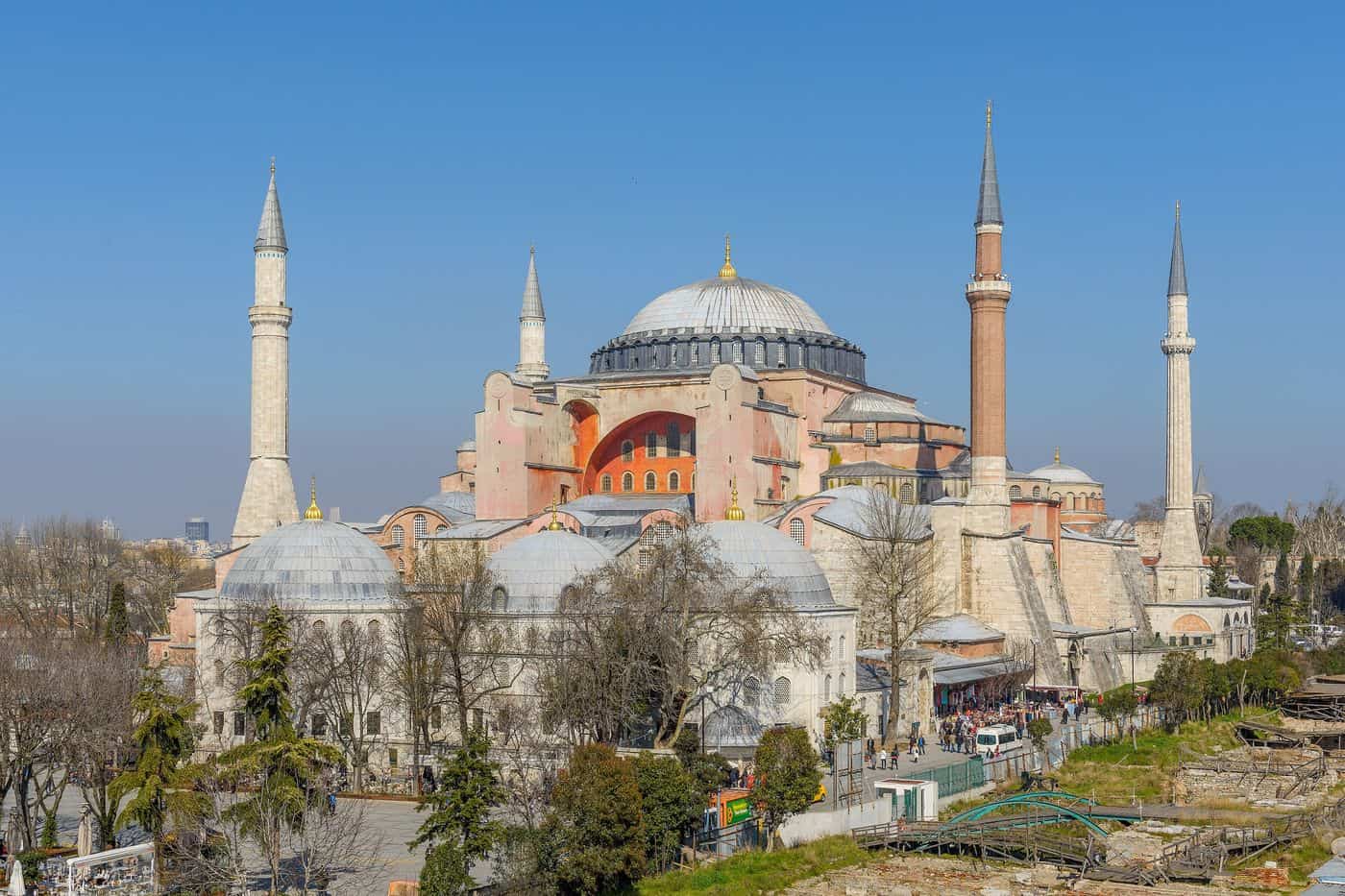
Istanbul tours at Hagia Sophia see the church that Emperor Justinian I built between 532 and 537, with a central dome rising 55.6 metres above the floor, Byzantine mosaics in the upper galleries and four Ottoman minarets around the building.
The Greek geometers Isidore of Miletus and Anthemius of Tralles designed it, and Justinian and Patriarch Menas inaugurated it on 27 December 537. It was the largest interior space in the world and stayed the largest church for over 500 years, until the abbey church at Cluny. Repairs have left the dome elliptical, between 31.24 and 30.86 metres across.
Hagia Sophia served as the cathedral of Constantinople from 360 until 1453. Mehmed the Conqueror converted it into a mosque, Atatürk turned it into a museum in 1935, and the Council of State made it a mosque again in 2020. Istanbul tours now enter the Hagia Sophia Grand Mosque outside prayer times, and women visitors wear a headscarf.
The Deësis mosaic in the upper galleries marked the end of 57 years of Latin Catholic use and shows the Virgin Mary and John the Baptist pleading with Christ Pantocrator. The Empress Zoe mosaic in the southern gallery dates from the 11th century. Istanbul tours find the apse mosaic of the Virgin and Child covered by white drapes.
- Minarets: the two western minarets, designed by Mimar Sinan for Selim II, stand 60 metres high.
- Lustration urns: two Hellenistic marble urns from Pergamon, brought under Sultan Murad III.
- Viking inscription: a 9th-century text in the southern section reads “Halvdan was here”.
What do Istanbul tours see at the Blue Mosque and the Hippodrome?
Istanbul tours at the Blue Mosque see the Sultan Ahmed Mosque of 1609 to 1617, with six minarets and 21,043 Iznik tiles, then cross to the Hippodrome, now Sultanahmet Square, where the Obelisk of Theodosius and the Serpent Column from Delphi stand.
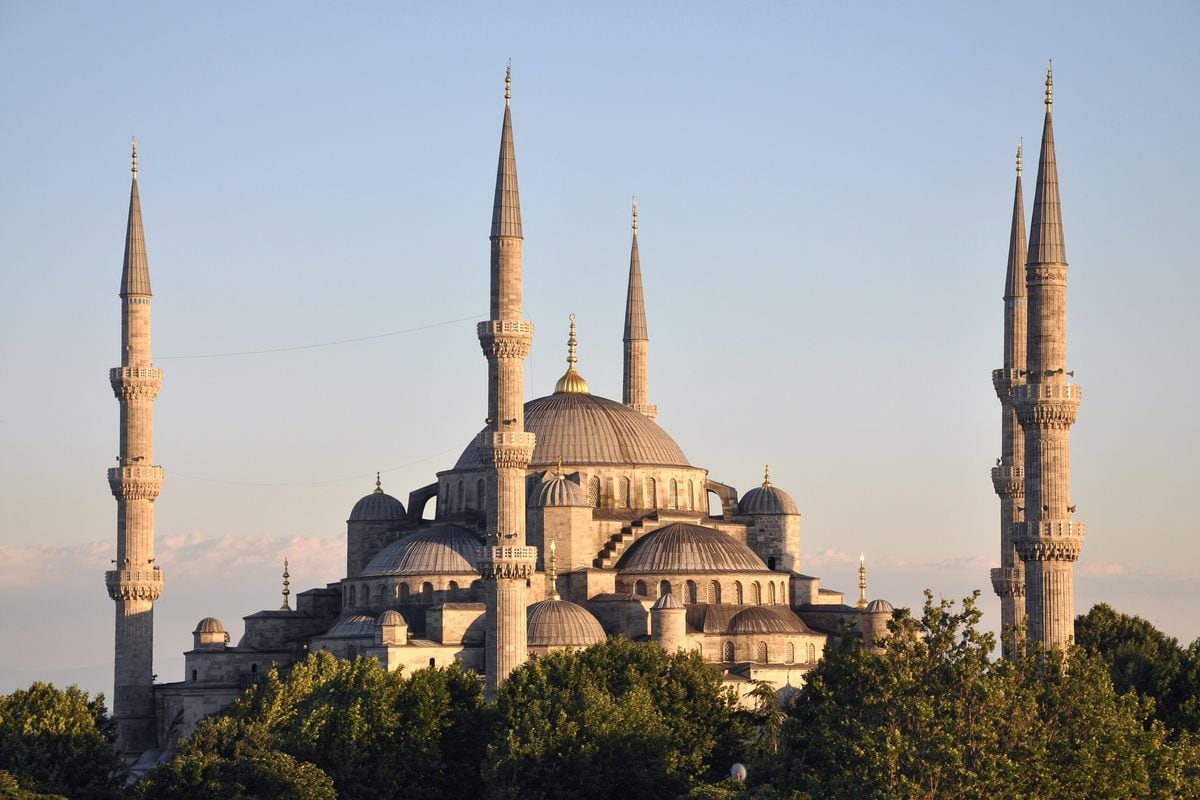
Sultan Ahmed I ordered the mosque, and his architect Sedefkar Mehmed Agha built it on the southeast side of the old Hippodrome, across from Hagia Sophia. The central dome is 23.5 metres wide and 43 metres high. Istanbul tours enter from the large courtyard in front of the prayer hall.
The tiles show over fifty designs, with cypress trees, flowers and fruit. In 1613 Ahmed I banned the production and sale of tiles for any other purpose, so that his order was finished on time. Blue paintwork above the tiles gives the mosque its popular name, and Istanbul tours see the hall lit by about 260 windows.
Septimius Severus gave the city a hippodrome in AD 203, and Constantine the Great enlarged it to about 450 by 130 metres, with stands for around 100,000 spectators. Pharaoh Thutmose III first raised the Obelisk of Theodosius around 1450 BC, and Theodosius I set it up here in 390. The Serpent Column, an 8-metre bronze of three intertwined snakes, honoured the 31 Greek city-states that fought at Plataea in 479 BC, and Constantine moved it from Delphi in 324.
- Walled Obelisk: built by Constantine Porphyrogenitus in the 10th century at the other end of the track.
- German Fountain: an octagonal neo-Byzantine fountain of 1900 that marks the visit of Kaiser Wilhelm II in 1898.
- Old seats: early 20th-century excavations found ancient Hippodrome seats in the courtyard of the mosque.
What do Istanbul tours see at Topkapı Palace?
Istanbul tours at Topkapı Palace see the main residence of the Ottoman sultans from the 1460s to 1853, its four courtyards on the Sarayburnu promontory, the Imperial Harem, the Imperial Treasury with the Spoonmaker’s Diamond, and the Chamber of the Sacred Relics.
Mehmed the Conqueror ordered construction in 1459, on the site of the acropolis of ancient Byzantion. The palace took the name Topkapı, meaning Cannon Gate, in the 19th century, and a decree of 3 April 1924 made it a museum. Istanbul tours enter by the Imperial Gate of 1478 into the First Courtyard, the largest, beside the Byzantine church of Hagia Irene.
The Gate of Salutation leads to the Second Courtyard, where the Grand Vizier met the Imperial Council under a dome called the Kubbealtı. The Gate of Felicity opens the Third Courtyard, which no one passed without the authority of the sultan. Istanbul tours then visit the Harem, added at the end of the 16th century and home to the Valide sultan, the wives, concubines and children of the sultan.
The Imperial Treasury, in the Conqueror’s Pavilion, shows the Topkapı Dagger, made in 1747 for Nader Shah of Persia, and the Spoonmaker’s Diamond, set in silver with two ranks of 49 cut diamonds. The Chamber of the Sacred Relics holds the cloak of Muhammad, two swords, a bow and the Staff of Moses, which Istanbul tours see in dim light.
- Kitchens: 10 domed buildings that fed about 4,000 people, with a staff of more than 800.
- Chimneys: two rows of 20 wide chimneys, added by Mimar Sinan after the fire of 1574.
- Baghdad Kiosk: built after 1638 for the Baghdad Campaign of Murad IV, with a silver stove from King Louis XIV of France.


What do Istanbul tours see at the Basilica Cistern?
Istanbul tours see the Basilica Cistern, a 6th-century underground reservoir built under Emperor Justinian I, 150 metres southwest of the Hagia Sophia. Visitors walk among 336 marble columns, each 9 metres high, and reach two column bases carved with the face of Medusa.
The Turkish name is Yerebatan Sarnıcı, the “Subterranean Cistern”, and the name Basilica comes from the Stoa Basilica, the public square above it. Historical texts claim that 7,000 enslaved people built it, and water came from the Belgrad Forest, 19 kilometres north, through the Valens Aqueduct.
Istanbul tours descend 52 stone steps into a chamber 138 metres long and 65 metres wide, with room for 80,000 cubic metres of water. The columns stand in 12 rows of 28. Their capitals are mainly Ionic and Corinthian, and one column carries carved hen’s eyes, slanted branches and tears.
The two Medusa heads lie in the northwest corner, and their origin is unknown. The French traveller Petrus Gyllius recorded the cistern in 1565 and was rowed between the columns. The 2020–2022 restoration revealed the original Byzantine brick floor, and Istanbul tours now cross a new steel walkway.
- Walls: a firebrick wall 4 metres thick, coated with waterproofing mortar, encloses the chamber.
- Film: the 1963 James Bond film From Russia with Love used the cistern as a location.
- Novel: Dan Brown’s 2013 novel Inferno features the inverted Medusa pillar.
Which Istanbul tours visit the Grand Bazaar and the Spice Bazaar?
Istanbul tours of the walled old city visit the Grand Bazaar, or Kapalıçarşı, one of the largest and oldest covered markets in the world, with 61 covered streets and over 4,000 shops, and the Spice Bazaar in Eminönü, named Mısır Çarşısı, the “Egyptian Bazaar”.
Construction of the bazaar’s core started in the winter of 1455/56, after the Ottoman conquest of Constantinople, when Sultan Mehmed II built the Cevâhir Bedestan, the “Bedesten of Gems”, for textiles and jewels. The complex took its final shape in the early 17th century.
Istanbul tours enter a market of 30,700 square metres that draws between 250,000 and 400,000 visitors daily and employs 26,000 people. Fires struck it in 1515, 1548 and 1701, and a strong earthquake hit it in 1894. The last restoration took place in 1980.
The Spice Bazaar belongs to the complex of the New Mosque, and rents from its shops paid for the mosque’s upkeep. Sultana Turhan Hatice, mother of Sultan Mehmed IV, commissioned it after the Great Fire of 1660, and revenues from the Ottoman eyalet of Egypt built it. Istanbul tours find 85 shops selling spices, Turkish delight, dried fruits and nuts.
- Gold: jewellers and gold bracelet sellers line Kalpakçılar Caddesi.
- Carpets: carpet dealers trade along Sahaflar Caddesi.
- Leather: leather goods fill Perdahçılar Caddesi.
What do Istanbul tours see at the Süleymaniye Mosque and the Chora Church?
Istanbul tours climb the Third Hill to the Süleymaniye Mosque, the largest Ottoman-era mosque in the city, designed by Mimar Sinan for Suleiman the Magnificent. They continue to the Chora Church in Edirnekapı, known for its Late Byzantine mosaics and frescoes.
An inscription gives 1550 as the foundation date and 1557 as the inauguration date. The central dome rises 53 metres and has a diameter of 26.5 metres, exactly half its height. Four minarets stand at the corners of the courtyard with ten balconies in total, said to mark Suleiman as the 10th Ottoman sultan.
Istanbul tours continue behind the qibla wall, where an enclosed cemetery holds the octagonal mausoleums of Suleiman and his wife Hürrem Sultan. Suleiman’s tomb, dated 1566, holds his daughter Mihrimah Sultan and the sultans Suleiman II and Ahmed II. The tomb of Mimar Sinan stands just outside the complex walls, to the north.
The Chora Church began in the early 4th century as part of a monastery outside the walls of Constantinople. Maria Doukaina rebuilt it in 1077–1081, and the statesman Theodore Metochites endowed its mosaics and frescoes between about 1310 and 1317. Istanbul tours visit a building that became a mosque in the 16th century, a museum in 1945 and a mosque again in 2020.
- Anastasis: a fresco in the side chapel shows Christ pulling Adam and Eve out of their tombs.
- Donor mosaic: Theodore Metochites presents a model of his church to the enthroned Christ.
- Deesis: a monumentally scaled mosaic of Christ and the Virgin Mary stands in the inner narthex.
Which Istanbul tours visit the Ecumenical Patriarchate in Fener and Balat?
Istanbul tours of the Golden Horn visit Fener, where the Church of St. George has been the seat of the Ecumenical Patriarchate of Constantinople since about 1600, and neighbouring Balat, home to the Bulgarian St. Stephen Church and to brightly repainted houses.
The Ecumenical Patriarch holds the status of “first among equals” among Eastern Orthodox prelates, and Bartholomew I has held the office since 1991. The small church largely dates from the rebuilding that Patriarch Gregory V began in 1797. Istanbul tours pass strict security screening to see its patriarchal throne, believed to date from the 5th century, and the relics of Saints Basil the Great, Gregory the Theologian and John Chrysostom.
Near the church stands the red-brick Phanar Greek Orthodox College, known in Greek as the Great School of the Nation. Patriarch Gennadius Scholarius established the school in its current form in 1454. Konstantinos Dimadis designed the present building, erected between 1881 and 1883, and its dome holds an observatory with a large antique telescope.
Istanbul tours follow the Golden Horn shore to the Bulgarian St. Stephen Church, also called the Bulgarian Iron Church. Its 500 tons of prefabricated cast-iron parts were made in Vienna between 1893 and 1896 and shipped through the Danube and the Black Sea. Exarch Joseph inaugurated the church on 8 September 1898.
Balat was historically the centre of the Jewish community in Istanbul. At its peak it had 18 synagogues, and three, Ahrida, Istipol and Yanbol, are still in use. Its back streets hold small stone houses of two and three storeys, repainted in bright colours and turned into cafes. Istanbul tours reach Balat by the T5 tram or the Golden Horn ferries.
- Epiphany: every 6 January, the Patriarch tosses a cross into the Golden Horn for swimmers to retrieve.
- Easter: crowds, including visitors from Athens, gather at the Patriarchate for Greek Orthodox Easter.
- St Mary of the Mongols: this Fener church was never turned into a mosque, even after 1453.
Which Istanbul tours cruise the Bosphorus?
Istanbul tours on the Bosphorus sail the 31-kilometre strait that links the Black Sea with the Sea of Marmara and divides Europe from Asia. The cruises pass Dolmabahçe Palace, the Ortaköy Mosque, Rumelihisarı fortress, the Maiden’s Tower and the Bosphorus bridges.
The strait narrows to 700 metres between Kandilli Point and Aşiyan. It is the world’s narrowest strait used for international navigation, so the tour boats share the water with freighters and tankers.
Public ferries leave Eminönü and sail as far as Anadolu Kavağı near the Black Sea, calling at both shores. Shorter Istanbul tours on private boats from Eminönü turn back at one of the first two bridges, and tourist cruises also start at Ortaköy.
On the European shore, Istanbul tours pass Dolmabahçe Palace, built between 1843 and 1853 for Sultan Abdülmecid I. It served as the main administrative centre of the Ottoman Empire from 1853 to 1887 and from 1909 to 1922. The Neo-Baroque Ortaköy Mosque of 1854 to 1856 stands beside the European pylon of the first bridge.
Sultan Mehmed II built Rumelihisarı, the “strait-cutter” fortress, in 1451 and 1452, opposite Anadoluhisarı on the Asian bank. At the southern entrance, the Maiden’s Tower stands on an islet 200 metres off Üsküdar and appeared in the James Bond film The World Is Not Enough.
- 15th July Martyrs Bridge: 1,074 metres long, completed in 1973 as the Bosphorus Bridge.
- Fatih Sultan Mehmet Bridge: 1,090 metres long, completed in 1988.
- Yavuz Sultan Selim Bridge: 2,164 metres long, completed in 2016 near the northern end of the strait.
Which Istanbul tours go to the Princes’ Islands?
Istanbul tours to the Princes’ Islands cross the Sea of Marmara to an archipelago of nine islands, with ferries calling at Kınalıada, Burgazada, Heybeliada and Büyükada. Motor traffic is banned except for service vehicles, so visitors walk, cycle or ride electric vehicles.
The islands cover 11 square kilometres and form the Adalar district. Out-of-favour Byzantine princes and other royals were exiled here, followed after 1453 by members of the Ottoman sultans’ family, hence the name. Istanbul tours board ferries at Kabataş for a crossing of about 25 minutes by fast ferry or 40 minutes by vapur.
Büyükada, the largest island, rises to the Hill of Jesus (164 metres) and Yücetepe (202 metres). Istanbul tours walk past its 19th-century mansions on Çankaya Caddesi. Leon Trotsky lived on the island from 1929 to 1933, his first station in exile.
Heybeliada, the second-largest island, takes its Greek name Halki from the word for copper. The Halki seminary opened on its Hill of Hope on 1 October 1844 and served as the main theological school of the Ecumenical Patriarchate until a 1971 law banned private higher education. Patriarch Bartholomew has since announced its reopening.
Horse-drawn phaetons were the only transport on the islands until 2020, when tourism and animal-rights pressure brought electric vehicles. Istanbul tours now explore on foot, by rented bicycle or by electric taxi.
- Kınalıada: the closest island to the city, named “Henna Island” after the colour of its earth.
- Ayia Yorgi: a church and monastery on Büyükada dating back to the sixth century.
- Kamariotissa: the last church built before the conquest of Constantinople, on Heybeliada.
What do Istanbul tours see in Galata and Beyoğlu?
Istanbul tours in Galata and Beyoğlu climb the Genoese Galata Tower, cross the Galata Bridge over the Golden Horn and walk the 1.4-kilometre İstiklal Avenue, where a nostalgic tram runs between Tünel Square and Taksim Square, the heart of modern Istanbul.
Beyoğlu was long known as Pera, Greek for “across” or “beyond”, because it faces the old city across the Golden Horn. Pera and its port of Galata formed a Genoese colony from 1273 to 1453.
The Genoese built the Galata Tower in 1348 as the Christea Turris, or Tower of Christ. The nine-storey tower is 62.59 metres tall, and its observation deck at 51.65 metres gives Istanbul tours a 360-degree view of the city.
The Galata Bridge links Eminönü with Karaköy. The current bascule bridge of 1994, the fifth on the site, is 490 metres long, with the T1 tram down its middle. Istanbul tours pass the anglers who fish from the bridge and the restaurants beneath it.
İstiklal Avenue, the former Grande Rue de Péra, runs from Tünel Square to Taksim Square. The Tünel funicular, opened on 17 January 1875, is the second-oldest underground urban railway in the world after the London Underground. At Taksim Square, Istanbul tours see the Republic Monument by Pietro Canonica, inaugurated in 1928.
- Galatasaray Square: the middle of the avenue, home to Galatasaray High School, the oldest secondary school in Turkey.
- Çiçek Pasajı: the Flower Passage, full of restaurants and taverns.
- Nostalgic tram: reinstated on İstiklal Avenue in 1990.
Which local food do Istanbul tours taste?
Istanbul tours taste simit sesame rings, balık ekmek fish sandwiches at Eminönü, döner and Beyti kebab, meze plates with rakı, baklava and Turkish delight, then finish with Turkish coffee brewed in a cezve or black tea served in small tulip-shaped glasses.
Simit, a ring of bread crusted with sesame seeds, has been baked in Istanbul since 1525, and Evliya Çelebi counted 70 simit bakeries in the city in the 1630s. Istanbul tours buy it from street trolleys and eat it with tea, the traditional pairing.
At Eminönü, balık ekmek comes straight from the boat where it is cooked: fried or grilled mackerel or a similar oily fish with vegetables in Turkish bread. Carts on İstiklal Avenue and at Eminönü also sell midye dolma, mussels stuffed with herbed and spiced rice.
The vertical döner rotisserie was invented in the 19th-century Ottoman Empire, and Beyti Güler made döner famous in Istanbul at his restaurant, first opened in 1945. Beyti kebab, ground lamb or beef grilled on a skewer, traces back to the Beyti kebab house. In the evening, Istanbul tours share meze such as haydari, acılı ezme and cacık with rakı.
For dessert, Istanbul tours taste baklava; the Sultan presented trays of it to the Janissaries every 15th of Ramadan in the Baklava Alayı procession. Turkish delight is a gel of starch and sugar flavoured with rosewater, mastic or lemon.
- Turkish coffee: very finely ground coffee boiled in a cezve and served unfiltered in small cups.
- Turkish tea: brewed in a çaydanlık, two stacked teapots, and served in “slim-waisted” ince belli glasses.
- Tea habit: Turks drink 3.16 kilograms of tea per person a year, almost four glasses a day.
How do visitors reach Istanbul on Istanbul tours?
Istanbul tours start at Istanbul Airport (IST) on the European side or at Sabiha Gökçen Airport (SAW) on the Asian side. Turkish Airlines and Aegean Airlines fly there from Athens and Thessaloniki, and the Egnatia Odos motorway from Greece ends at the Kipoi border crossing.
Fly-in Istanbul tours land first at Istanbul Airport, in the Arnavutköy district near the Black Sea coast. It is the largest airport in Turkey and the hub of Turkish Airlines, and its control tower takes the shape of the tulip, the Turkish national flower. The M11 metro line, opened on 22 January 2023, runs east to Gayrettepe and west to Halkalı.
Sabiha Gökçen International Airport lies 32 km southeast of the city centre and serves as the base for AJet and Pegasus Airlines; the M4 metro line from Kadıköy reached it on 2 October 2022. From Athens, Aegean Airlines, Sky Express and Turkish Airlines fly to Istanbul, and Pegasus Airlines flies to Sabiha Gökçen. From Thessaloniki, Istanbul tours fly direct with Aegean Airlines or Turkish Airlines.
Road-trip Istanbul tours from Greece follow the A2 Egnatia Odos, a 670 km tolled motorway from Igoumenitsa via Thessaloniki and Alexandroupolis to Kipoi on the Evros river. İpsala, the Turkish town opposite Kipoi, is the busiest of the three Greece–Turkey border crossings and ranks among the busiest checkpoints in the world. From İpsala, the E84 runs through Keşan and Tekirdağ to Silivri, where the Istanbul metropolis begins.
A second road crossing passes the Greek town of Kastanies on the way to Edirne, a city 7 km from the border that served as the second Ottoman capital until 1453. Its Selimiye Mosque, built in 1575 to a design by Mimar Sinan, became a UNESCO World Heritage Site in 2011. From Edirne, the 245.1 km O-3 motorway, the only Turkish motorway entirely in Europe, carries Istanbul tours the rest of the way.
- Marmaray: a 76.6 km commuter rail line from Halkalı in Europe to Gebze in Asia, running through the world’s deepest undersea immersed tube tunnel.
- Istanbul Metro: eleven lines, with eight on the European side, three on the Asian side and none crossing the strait.
- Şehir Hatları: 30 municipal ferries on 32 lines between 53 piers, run by a company founded in 1851 as the Şirket-i Hayriye.
- İDO: 26 high-speed passenger ferries and 22 vehicle ferries, sailing across the Sea of Marmara to Bursa and Yalova.
When do Istanbul tours run best?
Istanbul tours run best in June and September, which comfort indices rate above July and August with their persistently high dew points. April adds the tulip festival in Emirgan Park, and winter brings the wettest weather, lake-effect snow and cloudy skies.
Winter Istanbul tours meet frequent rain: the city logs 131 rainy days a year, and January alone averages 20 days with at least a trace. More than 60 cm of snow falls yearly around the airport, making Istanbul the snowiest major city in the Mediterranean basin. The damp northeasterly Poyraz drives that weather, while the warm southwesterly Lodos brings the odd day above 15 °C and severe windstorms.
Spring Istanbul tours meet the tulip, the flower that gave its name to an Ottoman era from 1718 to 1730. Emirgan Park, on the European shore near the Fatih Sultan Mehmet Bridge, has hosted an international tulip festival every April since 2005. The Istanbul Film Festival, the oldest international film festival in Turkey, screens every April too.
Summer Istanbul tours line up with the Istanbul Music Festival of classical music, ballet and opera, held every June and July since 1973, and the Istanbul Jazz Festival every July. The Istanbul Foundation for Culture and Arts also runs the Istanbul Biennial, held every two years since 1987. Each November, the Istanbul Marathon runs the only marathon course spanning two continents.
Istanbul tours during Ramadan, the ninth month of the Islamic calendar, meet a 29- to 30-day month that starts with the sighting of a new crescent moon. Turkey calls it Ramazan; the fast runs from dawn to sunset and ends with the iftar meal. Ramazan Bayramı, also called Şeker Bayramı, closes the month, and the Islamic year runs 10 to 11 days shorter than the solar year.
- Spring: March runs colder than December in large parts of the city, with the last coastal frost around late March.
- Summer: daytime highs sit between 25 °C and 32 °C, and 38 °C arrives only about once every ten years.
- Autumn: thunderstorms peak again in September, and November keeps milder averages than March.
- Winter: daytime highs run from 2 °C to 14 °C, and February averages 5–6 °C as the coldest month.
Frequently Asked Questions
Can Greek citizens join Istanbul tours with an ID card?
Yes. Turkey lets Greek citizens on Istanbul tours enter with a national ID card instead of a passport, for stays of up to 90 days within any 180-day period. The same ID card rule covers citizens of Belgium, Bulgaria, France, Germany, Hungary, Italy, Luxembourg, Malta, the Netherlands, Poland, Portugal, Romania and Spain.
Which time zone do Istanbul tours run on?
Istanbul tours run on Turkey Time (TRT), fixed at UTC+03:00 all year since 8 September 2016. Greece uses Eastern European Time, UTC+02:00, and switches to UTC+03:00 from the last Sunday in March to the last Sunday in October, so Istanbul runs one hour ahead of Athens in winter.
Which travel card works on Istanbul tours?
The Istanbulkart, a contactless smart card introduced on 23 March 2009, pays fares on buses, trams, funiculars, the metro, Marmaray trains and İDO ferries. Cash payment on these systems is not possible. The tourist version of the card serves up to five people, and it replaced the Akbil ticket system, phased out in 2015.
Which currency do Istanbul tours use?
Istanbul tours use the Turkish lira, sign ₺, ISO code TRY and abbreviation TL, which is also legal tender in Northern Cyprus. One lira divides into 100 kuruş. The current lira is the second Turkish lira, which replaced the first lira in 2005; the first lira had replaced the Ottoman lira in 1923.
Do Istanbul tours still use Atatürk Airport?
No. Atatürk Airport in Yeşilköy, built in 1912 as an Ottoman military airfield, closed to commercial passenger flights on 6 April 2019 and handed its IST code to Istanbul Airport. Turkish Cargo moved all cargo flights out on 5 February 2022, and the first areas of the Atatürk Airport National Garden opened in 2023.