
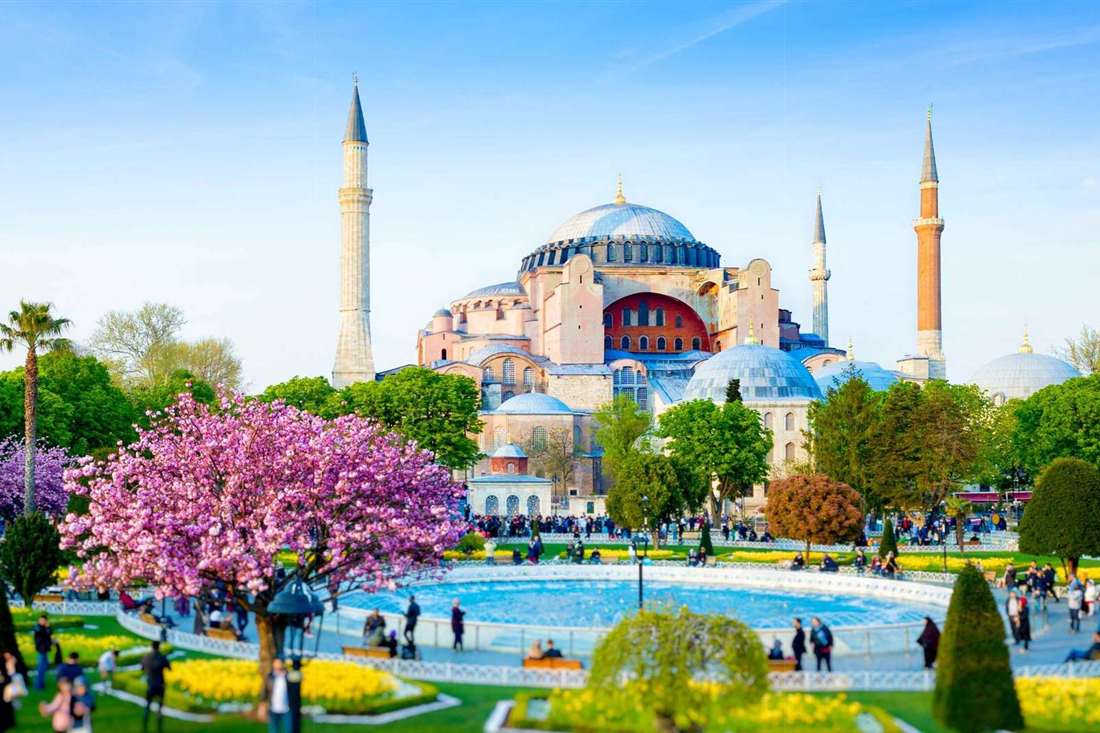
Hagia Sophia tickets fall into six groups on the seller sites checked for this guide, from booth entry to city passes. A visit runs from 45 minutes to 2 hours, and children under 8 enter free with an adult.
The hours and the prayer pauses change by season, so the official page decides before you pay. Anyone building a longer Turkey trip can start from the Greece Tours homepage, which sorts our tours by region.
What are Hagia Sophia tickets and who needs them?
Hagia Sophia tickets are entry passes for the visiting route of the Hagia Sophia Grand Mosque in Sultanahmet, Istanbul. Foreign visitors pay for them. The official visit page waives the fee for a child under 8.
The building is a working mosque. The official visit page says a Turkish court reversed the decree that had made it a museum. Wikipedia’s article on Hagia Sophia says the mosque opened for Friday prayers on 24 July of twenty twenty. So Hagia Sophia tickets buy a visit to a place of worship.
The official visit page splits the running of the site between two bodies. The Religious Affairs Directorate, called Diyanet, runs the religious activities. The Ministry of Culture and Tourism keeps the conservation and restoration work and the relics inside. The page lists an email address at Diyanet as its contact.
Wikipedia says entry was free at first. It adds that foreign nationals have paid an entrance fee since 15 January of twenty twenty-four. The official page agrees. It says visitors from foreign countries use a gate and booth set up from that date. Rules have changed before, so the official page decides who needs Hagia Sophia tickets today.
- Foreign visitors: they buy a pass at the booth or online, as the official page and Wikipedia state.
- Young children: the official page waives the entry fee for a child under 8 who comes with an adult.
- Worshippers: a seller site says entry for worship is free, and the official page gives praying visitors their own door.
- Turkish citizens: the official page names a separate Turkish Citizen Entrance.
- Press cards and the ICOMOS and IPC cards: the official page says they do not open the visiting area.
A ticket is a booking for entry, so it ties to a day. One GetYourGuide listing for a skip-the-line pass lets you walk in whenever the site is open. It sets no time slot. That listing still asks for a booking 15 minutes ahead. Hagia Sophia tickets can therefore carry a date without a slot.
The buying paths split three ways. The official page says tickets sell at its booth and on the web through a seller it links. Seller sites add audio guides or guides to the same entry. GetYourGuide listings are the third path. If you are still planning the other days, our Istanbul tours page covers the rest of the old city.
Read each card for what it sells. A card named Hagia Sophia tickets can mean plain entry, a guide, or a bundle of sights. The next section sorts those kinds one by one.
Which kinds of Hagia Sophia tickets exist?
Seller pages sort Hagia Sophia tickets into six groups. They are booth entry, skip-the-line entry, audio-guide entry, guided entry, combos and city passes. The official page confirms only the booth ticket and the online skip-the-line ticket.
The standard ticket is the booth ticket. The official page says you can buy it at the ticket booth on the day. It sits across from the Sultan Ahmed III Fountain, near the Imperial Gate of Topkapı Palace. The page describes one visiting route and names one admission.
The skip-the-line kind is the same entry bought online. The official page says it sells through an official seller, and it calls this option Skip-the-Line. Three GetYourGuide listings sell skip-the-line Hagia Sophia tickets too. One lists a ticket and a museum option. The others bundle an audio guide with the entry.
The audio-guide kind adds a recorded commentary. One GetYourGuide listing makes the audio guide optional. Another includes a free audio guide for Hagia Sophia and for the Blue Mosque. The official page names its own option. It is an augmented reality guide in 23 languages. You play it on your phone with headphones from the booth.
One seller site shows how wide the range is. Nine of the sixteen cards on its first page name Hagia Sophia in the title. They run from plain skip-the-line entry to a guided tour and combos with other sights. A second seller site lists eight cards in a row, from a skip-the-line ticket to a city pass.
The guided-tour kind adds a person. A GetYourGuide listing for Hagia Sophia and the Blue Mosque says the entry tickets and headsets are included. It offers tours in English, German or Spanish. A seller table shows a guided Hagia Sophia ticket that lasts 1 hour.
Combos pair the visit with other sights. Seller pages list Hagia Sophia tickets with the Blue Mosque, with the Basilica Cistern and with Topkapı Palace. One seller adds the Suleymaniye Mosque on a walking tour.
Another seller pairs the entry with the Hagia Sophia History Museum, a second venue with its own exhibits. That museum also has an entry ticket of its own. Read the card title twice before you pay.
One GetYourGuide listing for the Blue Mosque and Hagia Sophia tour offers a Basilica Cistern upgrade. Choose a combo only for sights you plan to visit. Each extra sight lengthens the day and changes what your Hagia Sophia tickets include.
City passes are the sixth kind. One seller lists an Istanbul pass that covers more than 100 attractions. Another lists a guided museums pass for five sights. The card text does not say whether either pass opens the mosque. The official page is plain: museum passes are not valid for Hagia Sophia.
Sources differ on the upper gallery. One seller page says its Hagia Sophia tickets include the mosque and the upper galleries. The same page later says access to the upper galleries is chargeable.
The official page describes a ramp from the gate to the gallery floor on the same route. Wikipedia says the upper galleries reopened to visitors in twenty twenty-four.
The entry gate can also change. The official page calls the current gate temporary, because restoration work continues at the Bayezid II minaret. When that work ends, the gate under the minaret becomes the main entrance. Read the official page again before each trip, since the kinds of Hagia Sophia tickets follow those rules.
A short rule helps you choose. Take the booth ticket if you want the plain visit and can queue. Take the skip-the-line kind if you want a fixed plan.
Add the audio guide or a guide only if you want commentary. Choose a pass only after its card names the mosque. Compare any two Hagia Sophia tickets by what the card lists, not by its title.
Where do you buy Hagia Sophia tickets online?
Hagia Sophia tickets come from the official ticket page, the ticket booth at the site, or a third-party seller. The official page says the booth and an online skip-the-line sale both sell admission. Sellers and GetYourGuide listings add packages of their own.
Start with the official page. A seller page calls muze.gen.tr the state channel run by the Ministry of Culture and Tourism. Its footer names Muze Istanbul. It says admission sells at the booth and online through an official seller that it links. It also says no museum pass works at Hagia Sophia.
None of the pages we read lists the steps of the official online system. We cannot tell you whether it asks for a date, names or passport details. Read each screen at checkout before you pay for Hagia Sophia tickets. Treat any seller page that claims to know the steps with care.
The ticket booth sells Hagia Sophia tickets on site, as the official page states. Online sale is the other official route. One seller page strongly recommends online purchase. It says this secures the day you chose and spares you the ticket office line.
Third-party sellers differ in size. One lists 5 products, one lists 8, and one lists 16, of which 9 name Hagia Sophia. Two seller sites say plainly that they are not the official site. One calls itself an independent guide and an authorised reseller.
One seller page frames the choice for Hagia Sophia tickets in two parts. You can buy entry only, or entry plus a guided route and a fixed time. It adds that a licensed operator is someone responsible if plans change. That is the seller’s own view, so weigh it as such.
GetYourGuide carries listings for Hagia Sophia tickets too. We read four listing frames, and all four carry a skip-the-line label. One independent site marks its entry products “Pay the Same as On-Site”. No page we read tests that claim, so compare the booth rate on the day.
No source gives a number of days for how far ahead slots fill. A seller page highly recommends advance booking from April to October. It says queues in those months can exceed one to two hours. Another seller page says early and late slots fill. The official page we read says nothing about slots.
No page we read says whether the name on Hagia Sophia tickets must match your passport. Ask the seller before you pay.
One seller page calls card payment the norm for Hagia Sophia tickets. The official page says the fee for foreign visitors is set in euros. The booth converts it into lira at a rate that it displays.
Another seller page tags its products “Secure payment”, “Instant confirmation” and “Mobile ticket”. The first seller page tells you to keep your confirmation where you can open it offline. It says phone signal around the square is unreliable at busy times. No page we read describes a receipt.
When is Hagia Sophia open and how do prayer times affect Hagia Sophia tickets?
Hagia Sophia is open every day, but the hours change with the season and the prayers. The official page lists an 08:00 or 09:00 opening, a 19:30 closing and a Friday prayer pause. Read that page before you pay for Hagia Sophia tickets.
The official page splits the year in two. Summer runs from 1 April to 1 October, with doors open from 08:00. Winter runs from 1 October to 1 April, with doors open from 09:00. Both periods close at 19:30, and the box office closes at 19:00.
The sources do not agree. Text lower on the official page gives 09:00 to 19:30 as the daily range. Two seller pages give other numbers:
- One seller page: opening at 08:00 from April to October and at 09:00 from November to March, last entry at 18:30, exit by 19:00.
- Another seller page: 09:00 to 19:30 in summer and 09:00 to 17:00 in winter.
Check the hours for your date before you buy Hagia Sophia tickets. The official page is the one that decides.
Wikipedia’s article on salah times lists five daily prayers: Fajr, Dhuhr, Asr, Maghrib and Isha. Their times follow the sun, so they shift through the year. In a mosque, the muezzin gives the call to prayer at the start of each interval.
Wikipedia’s article on Hagia Sophia says visits to certain areas happen outside prayer times. A seller page says the visitor route pauses around the five prayers. It adds that the pauses are not published as fixed clock times. Another seller page says visitors wait in the courtyard or near the entrance until the service ends.
Pick a gap between two prayers for your Hagia Sophia tickets. A seller page advises the middle of a gap, not the minutes before a prayer. It says a visitor who arrives fifteen minutes before a prayer can queue through it.
Wikipedia’s article on salah times says Friday prayer takes the place of the Dhuhr prayer. It adds that people hold it in a group. The official page closes the visiting area from 12:00 to 14:00 for it. A seller page gives 12:00 to 14:30 instead. Another calls Friday noon the longest prayer pause.
The official page says the prayer area closes to visits for daily cleaning and maintenance until 10:00. Its info box answers the closed days line with “Open Every Day”. No page we read lists holiday closures. Check the official page for notices before you travel with Hagia Sophia tickets in hand.
One seller page says weekdays are calmer than weekends. It calls spring and autumn the milder seasons for walking Sultanahmet. It tells visitors to book Hagia Sophia tickets online before they arrive at weekends, on holidays and in summer. An independent site adds that midday can be busy.
Wikipedia’s article on Hagia Sophia adds a detail about the call to prayer. It says that two of the minarets already carried the call regularly in the museum years.
The official page links a prayer time table for Istanbul. An independent site tells visitors to use official channels for prayer times, temporary closures and gallery availability. It also marks its entry products “Immediate Confirmation”. Read the official page and that table together on the day you go.
The hours test is simple. Look up the season on the official page. Find the prayer table for your date. Leave a gap on both sides of each prayer. Then choose Hagia Sophia tickets that fit the gap.
What do Hagia Sophia tickets let you see inside?
The visiting route starts on the upper gallery. The official museum page says a ramp lifts visitors to the gallery floor. From there they look down on the prayer hall, pass the Marble Door and study the Byzantine mosaics.
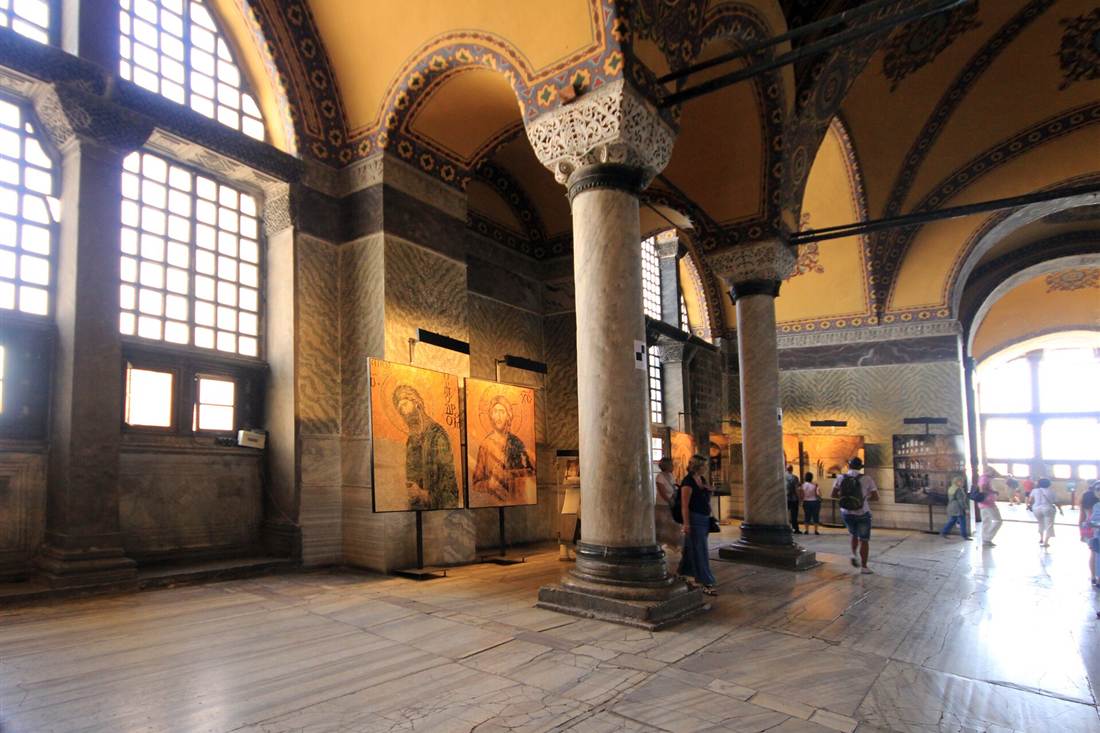
The same official page gives the order of the route. Visitors enter at the gate, climb the ramp and see the sanctuary floor and the Ottoman-period annexes. They then pass the Marble Door and reach the mosaics. The exit is a second ramp on the northeast side. Hagia Sophia tickets follow this one-way path.
A seller page makes the same point. It says the paid visitor route is the upper gallery, and the views down into the nave come from there. Wikipedia says worshippers keep a large share of the ground floor and that the galleries opened again to visitors.
The Empress’s Loge sits in the middle of the gallery, above the Imperial Gate and opposite the apse. Wikipedia says the empress and her court ladies watched the services below from this spot. A green stone disc of verd antique marks where her throne stood. Your Hagia Sophia tickets bring you to it.
The Marble Door stands in the southern part of the gallery. Wikipedia says its panels carry fruit and fish motifs and that synod members used it. The official page says one side stands for heaven and the other for hell. It adds that a synod met there under Emperor Manuel Komnenos in the twelfth century.
The eastern wall of the southern gallery holds the Comnenus mosaic. It shows the Virgin Mary with the Christ Child. Emperor John II Comnenus stands on her right and Empress Irene on her left. Their son Alexius stands on a pilaster beside them.
The eastern gallery holds a marble marker for Enrico Dandolo, the Doge of Venice. Wikipedia says he is buried there, probably. It says an Italian team placed the cenotaph in the nineteenth century. People mistake it for a medieval artifact. The original tomb is gone.
From the gallery rail, the dome looks as if it floats. Wikipedia says it rests on an arcade of 40 arched windows. Hagia Sophia tickets put you on the gallery level, which is the route the official page describes.
The wall discs come from a nineteenth-century restoration. Eight of them hang from the cornice. They sit on the four piers and beside the apse and the west doors. The calligrapher Kazasker Mustafa Izzet Efendi designed them. They carry the names of Allah, Muhammad, the first four caliphs, Hasan and Husayn.
Wikipedia also says Sultan Suleiman the Magnificent placed two colossal candlesticks on either side of the mihrab. He brought them from his conquest of the Kingdom of Hungary. The mihrab sits in the apse, where the altar stood. No source says whether the gallery route gives a view of it.
The official page adds a phone feature to the route. Visitors scan a QR code and use their own headphones. An augmented reality application gives information in 23 languages. Headphones are on sale at the ticket booth. Compare this feature with an audio-guide listing before you pick Hagia Sophia tickets.
Parts of the building stay shut. A site that says it is not official reports that areas close for prayers or restoration. Follow the staff signs. The official page also asks visitors not to stare at worshippers or take pictures of Muslims at prayer.
How long does a visit with Hagia Sophia tickets take?
Plan 45 to 90 minutes by one seller page, or 1 to 2 hours by a GetYourGuide listing. Another site puts a gentle loop at 60 to 90 minutes. A guided visit that adds the Blue Mosque runs 2 to 3 hours.
One seller page says a typical visit takes 45 to 90 minutes. That time covers the upper gallery, the central dome, the mosaics, the calligraphy panels and the marble details. The page adds that an audio guide or a tour needs more time. This is the shortest range any source gives for Hagia Sophia tickets.
A second seller page gives 45 minutes to one and a half hours, depending on your interest. It says the gallery with the mosaics takes longer. A third site, which says it is not the official page, splits the visit in three levels.
On that third site, the essentials take 60 to 90 minutes. A balanced loop of dome, aisles and galleries takes 2 to 3 hours. A deep look at the history and the mosaics fills half a day. Match one of these levels to the Hagia Sophia tickets you want.
GetYourGuide listings state their own lengths. One entry listing says 1 to 2 hours and lets you enter at any time in opening hours. Another listing gives 1 hour. A guided listing that pairs the mosque with its neighbour across the square gives 2 to 3 hours.
Each figure belongs to its own listing. It is not a rule for the whole market of Hagia Sophia tickets.
Queues add to the clock. A seller page says a booked time slot removes the wait to buy a ticket, but not the security check. It also says the desk line and the entry line are separate waits.
For the high season from April to October, the same page says queues can run past one to two hours. For the off-season, it says tickets can be bought on site without a long wait. So the season changes how long Hagia Sophia tickets take in practice.
The same page names the crowd peaks. Late morning is the heaviest time, because cruise groups and organised tours arrive together. The lightest times are opening and the last hour before closing. Pick Hagia Sophia tickets for one of those windows.
A second seller page names early morning and late afternoon as calmer. It says Fridays at noon are busy because of the weekly prayer. A site that says it is not official lists weekends, holidays and high-season mornings as the days to book ahead.
Think about the floor. That site describes the first steps inside as cool marble and says to carry a light layer in cooler months. Wikipedia says the floor was hidden beneath a turquoise carpet from 22 July of the reconversion year.
The same seller page says the gallery route has its own signs. Follow them, not old advice. Hagia Sophia tickets do not change these floor rules.
The Blue Mosque stands across the square. One GetYourGuide listing says entry to the Blue Mosque is free, to be visited whenever you like. It adds a free audio guide for it. A seller page also calls the Blue Mosque free to enter.
Take the 2 to 3 hours of the guided listing as your morning budget for both buildings. Then add your queue time. That sum is the real length of a morning with Hagia Sophia tickets and the Blue Mosque.
What dress code and rules apply to visitors with Hagia Sophia tickets?
Shoulders and knees stay covered, and women cover their hair. Seller pages and the official ticket site agree on this. The official site adds that general mosque etiquette binds every visitor, so Hagia Sophia tickets waive none of it.
The building works as a mosque, so the dress rules are mosque rules. The official ticket site is muze.gen.tr, as a seller page names it. It says general mosque etiquette is required of all visitors. It says women wear a head covering to enter.
Three seller pages repeat the shoulders-and-knees rule for the whole building. One of them adds a clothing line for men and women alike: no shorts and no sleeveless tops. Hagia Sophia tickets do not change that line.
Wikipedia states the head rule in one line. It says women visitors are required to wear headscarves to enter.
Sources differ on where a scarf comes from. The official site says headscarves and body covers are sold at the ticket booth for a fee. One seller page says a scarf is free at the entrance. Another says you can bring one or buy one locally.
Carry your own scarf and the question never comes up. The entry pass covers admission. No source says it also covers a scarf. Pick your clothes at the hotel. The etiquette line applies to every visitor, and no source sets an exception for guided or combo passes.
Shoes are the next rule. A seller page says shoes come off for the prayer area. The same page says the paid gallery route has its own signs. Visitors follow the signs rather than assume. None of the pages read for this section mentions shoe bags.
Respect for people at prayer is a written rule for every holder of Hagia Sophia tickets. The official site asks visitors to respect Muslim rules of worship. It asks them to avoid staring at worshippers or taking pictures of them while they pray. It also recommends walking inside the mosque.
A second seller page says photography is allowed, with the same limit: no pictures during prayer times. No page read for this section says anything about tripods. Ask the seller of your Hagia Sophia tickets about a tripod before you pack one.
The quiet rule has a tool behind it. The official site says visitors get information in 23 languages through a QR code app on their own phones. The page says this works without disturbing the worshippers. It adds that the app needs headphones and that the ticket booth has them.
Parts of the building stay closed to visitors. Wikipedia says the larger part of the ground floor remains restricted to worshippers. It adds that the upper galleries were reopened to visitors. One seller page says the ground floor is open to everyone without a ticket. The two descriptions do not match.
That clash is a reason to read the official page before you travel. Hagia Sophia tickets sold today follow rules that changed after the building returned to worship. A line in an older guide can already be out of date.
Bags and security get little detail. None of the pages read here lists banned bags or camera gear. One seller page says a booked time slot does not remove the security check. Plan for a check at the gate and read your voucher for the rest.
Can children and visitors with limited mobility use Hagia Sophia tickets?
Children under 8 enter free when an adult goes along with a passport or ID card. The official site sets that rule. The same site says the visitor ramps and stairs do not suit disabled visitors. Hagia Sophia tickets for these groups need a check first.
The free-entry rule starts with the official site. It says children under the age of 8 enter free. An adult goes with them and presents a valid passport or ID card. Two seller pages repeat the age limit, and one of them adds that a passport is required.
The seller page that adds the passport rule also gives a warning. It says the exemptions are set by the administration and are revised from time to time. It tells readers to verify any age they find online. The official page decides.
Listings draw the line at a different age. Three GetYourGuide listing frames split travellers into Adult for ages 7 to 99 and Child for ages 6 and younger. A seven-year-old is free by the official rule and falls in the Adult group on those listings. Check the age line before you pay for Hagia Sophia tickets.
A fourth listing offers one Adult category for ages 99 and younger, so it has no child line at all. Read the traveller categories on the booking page before you enter any names. Bring the document of the child to the gate, as the official site asks.
Strollers have their own rule. The official site asks visitors to fold and carry a stroller inside the visiting area. The reason it gives is the protection of the historic floors. A seller page repeats the rule. Hagia Sophia tickets do not change it, and a baby carrier is the easier tool for the visit.
Now the route to the upper gallery. The official site says visitors reach the gallery floor by a ramp after the entrance gate. They leave by a ramp in the northeast. Wikipedia describes a long ramp that rises from the northern part of the outer narthex to the upper gallery. Neither source gives a length or a slope.
The official site then says the visiting-area ramps and stairs do not suit disabled people or people with walking difficulties. It asks those visitors to use the Turkish citizen entrance with their tickets. A seller page repeats this as a first-floor entrance for Turkish citizens and worshippers.
One GetYourGuide listing carries a wheelchair-accessible label. Its frame gives no detail about the route, and it does not name a gate. The label and the official warning do not match. Ask the seller what the label covers before you buy Hagia Sophia tickets.
Wheelchair users and slow walkers decide before booking Hagia Sophia tickets, not at the gate. A seller page says the ground-floor prayer entrance and the upper gallery entrance are separate. Check which entrance your pass names. The wrong line costs time that a slow walker does not have.
Floor and seating details are thin. Wikipedia says a turquoise carpet was laid on 22 July to prepare the mosque for worshippers. No page read for this section describes benches, the light level in the gallery, or advice for older visitors.
The same goes for small children. The official site gives no quiet rule for them beyond the general etiquette that binds all visitors. If one of these points decides your visit, ask the seller of your Hagia Sophia tickets in writing. Keep the answer with your voucher.
Which Hagia Sophia tickets come as a guided tour or a combo with the Blue Mosque?
A guided entry adds a live guide or headsets to Hagia Sophia tickets, and a combo adds a second site. Seller pages and GetYourGuide listings sell both kinds. Read the inclusions line first, because the word guided does not always cover Hagia Sophia itself.
A GetYourGuide listing for guided Hagia Sophia tickets with the Blue Mosque gives a length of 2 to 3 hours. It lists an expert guide, entry tickets and headsets. The guide speaks English, German or Spanish. The listing also offers an upgrade with a guided visit to the cistern.
Seller pages show how loose the word guided is. One seller pairs a guided Blue Mosque tour with a skip-the-line ticket to Hagia Sophia. Its page says the guide does not lead the Hagia Sophia part. That makes these Hagia Sophia tickets entry only.
A second seller lists a walking tour of the Blue Mosque, Hagia Sophia and the Süleymaniye Mosque. Its table marks Hagia Sophia admission as not included. Another seller lists a guided Hagia Sophia tour with an entry ticket and a length of 1 hour.
Combo Hagia Sophia tickets with the Blue Mosque work differently. One seller lists a Hagia Sophia and Blue Mosque combo with an audio guide and a validity of 3 days. A seller guide and a GetYourGuide listing both call Blue Mosque entry free. That combo pays for a guide and a route, not for entry.
Another combo pairs the mosque with the Hagia Sophia History and Experience Museum. A seller page describes two sights that you explore on your own with an audio guide. Seller pages also bundle the cistern and the palace. This page leaves those two sights to their own ticket guides.
The museum pass is the one product that does not apply to Hagia Sophia tickets. The museum pass page on muze.gen.tr says the Istanbul Museum Pass gives one entry to over 10 museums. The pass lasts 5 days. It adds that passes stopped being valid for Hagia Sophia once the building became a mosque again.
A seller guide says the same. The Hagia Sophia page on muze.gen.tr says no museum pass is available for the visit. One seller page still lists a tourist pass for more than 100 attractions among its options. Its card does not say whether the pass opens Hagia Sophia, so ask before you pay.
A guided entry does not skip the security check. The museum pass page says pass holders skip ticket lines in museums but not security lines. Plan the same order for guided Hagia Sophia tickets and expect a short check at the gate.
Compare the options on three points. Ask who leads the Hagia Sophia part. Ask whether admission sits inside the price line. Ask for how long the voucher stays valid. Those points decide which of these Hagia Sophia tickets fits your morning.
How do you reach the entrance and avoid resellers with Hagia Sophia tickets?
Take the T1 tram to Sultanahmet, then walk to the gate across from the Sultan Ahmed III Fountain. Buy Hagia Sophia tickets from the official site, or from a seller that says plainly that it is a reseller.
Hagia Sophia stands in Fatih, and Wikipedia calls Sultanahmet a neighbourhood of that district. Wikipedia’s article on the Blue Mosque places that mosque across from Hagia Sophia, next to the old Hippodrome. Seller pages say only that the Blue Mosque is across the square. No page gives a walking time.
Wikipedia’s station list for the T1 tram counts Sultanahmet as the eighth of 31 stops, after Gülhane. Sirkeci, two stops earlier, links to the Marmaray rail line. One seller page puts the walk from the Sultanahmet stop to the entrance area at 5 minutes. Another names the bus stops Sarayburnu and Akbiyik.
The ticket site at muze.gen.tr names a temporary visitor gate across from the Sultan Ahmed III Fountain. The ticket booth stands across from the same fountain. The site says to find both by walking to the Imperial Gate of Topkapı Palace.
That site lists the Ministry of Culture provincial directorate in its footer. One seller guide calls it the official state channel. It says the gate under the Bayezid II minaret becomes the main visiting entrance when restoration work ends. The gate can move, so read that note again before you go.
A seller guide adds that the prayer entrance and the visitor entrance are separate. It calls the wrong line the commonest avoidable mistake. Check which entrance your Hagia Sophia tickets name before you join any queue.
Seller pages send arrivals from Istanbul Airport to a shuttle or the metro, then to the tram. They send Sabiha Gökçen arrivals through Kadıköy or Taksim first. Our Turkey tours page lists the other ways to reach the country.
UK government advice on travel in Turkey calls a lift from an unofficial taxi highly risky. It says to take a registered taxi, note the registration number and check that the fare is metered. It adds that pickpocketing and street robbery are common in tourist areas of Istanbul. Keep your belongings secure in the queue.
That section of the advice names no fake ticket sites. No government source backs a claim about fake Hagia Sophia tickets. The muze.gen.tr museum pass page does speak to the risk. It says tickets are sold only on museum premises and online.
It also says the ministry sites carry no duty for faulty, counterfeit or second-hand tickets. It names street dealers, food kiosks and newspaper desks. That points you to the booth and the website, not to a stranger in the square.
Resellers are not the same as street dealers. A seller guide calls the official channel and a licensed operator both legitimate. It says the operator sells a time slot, a guide and support, so the price differs. It tells readers to leave any page that hides whether it is official or a reseller.
Another site says on its own page that it is an independent platform. It adds that it is not the official website of Hagia Sophia. That kind of line is what you want to find. Run each page through these checks before you pay for Hagia Sophia tickets.
- Domain: the page says plainly whether it is the state channel or a reseller.
- Inclusions: the line names Hagia Sophia entry, a guide or an audio guide.
- Visitor area: the page names the area that the ticket covers, as a seller guide advises.
- Time slot: the page sets a slot or says you can enter at any time during opening hours.
- Refund wording: the page states its cancellation terms before you pay.
The GetYourGuide frames read for this page carry no meeting point. Open the listing page and read the meeting point there before you book a guided entry. The official page decides the rules. A seller guide says the ticketing rules have changed more than once. Use one dated page for each choice about Hagia Sophia tickets.
What happens at the gate once you hold Hagia Sophia tickets?
At the gate, staff check your pass for the visiting area. The official Ministry of Culture and Tourism page names one identity check. Children under eight enter free with an adult and a valid passport or ID card. Sellers add timing and cancellation terms.
Start with identity. The official page asks for a passport or ID card from the adult with a child under eight. It names no identity check for adults. No seller page that was read names one either. A seller that wants a name for your Hagia Sophia tickets says so on the booking page.
Next comes the pass itself. The four GetYourGuide listing frames do not say how the pass reaches you. They carry no meeting point either. The words “QR code” appear on the official page only for the audio guide app. Your booking message shows what kind of pass you hold.
Not every card opens the gate. The official page says press cards are not valid for the visiting area. Treat Hagia Sophia tickets as a paid pass that you bought, not as a card that you already carry.
- Official page: children under eight enter free with an adult and a passport or ID card.
- Official page: press cards do not open the visiting area.
- Listing frames: no meeting point and no delivery method are named.
- Seller pages: terms for change and refund differ by ticket.
Now the time slot. One GetYourGuide listing calls its pass a flexible ticket for entry at any time during opening hours. It adds “no time slot stress”. A seller page says its skip-the-line Hagia Sophia tickets work for entry from 09:00 to 19:00. Last entry falls one hour before closing.
Other pages tie the visit to a clock. A seller page describes a guided product with a fixed time slot. The same page says plain entry leaves the timing to you and does not promise a place at peak hours. Hagia Sophia tickets for a guided visit follow the guided slot.
Early or late arrival is a gap. No source gives a grace period or a penalty. The listings say only how far ahead you must book. Two of them show the line “Must book at least 15min in advance”. A third shows a validity of 1 day.
Changes and refunds come next. Three of the four listing frames show the label “Free cancellation”. The frame for the one-hour entry listing does not show it. None of the frames gives a cut-off time, so the booking page decides.
The gate itself can move. The official page says a temporary gate serves foreign visitors during restoration work at the Bayezid II minaret. Once the work ends, it says, the gate under that minaret becomes the main entrance. Read the meeting details of your Hagia Sophia tickets on the day.
Groups are a gap. One seller page has a “Group Requests” link in its menu. It states no group size, no group rule and no group entry. Write to the seller before you pay if you travel with a large party.
A code that will not scan is a gap too. No official page and no seller page gives steps for it. The official page puts the ticket booth beside the visiting gate. Start there, and then contact the seller that issued your Hagia Sophia tickets.
Foreign Muslims who come to pray use a different door. The official page sends them to the main gate at Hagia Sophia Square before prayer times. A visitor pass is for the visiting area, not for that prayer entrance.
Skip-the-line wording needs a closer read. One seller page says the pass lets you avoid long waits and enter the mosque directly. Another says high season brings two waits, one at the ticket desk and one at the door. A pass that skips the desk leaves the door queue.
Guided products work differently at the gate. The guided GetYourGuide listing offers tours in English, German or Spanish and lists 2 – 3 hours. Its frame names no meeting point. Guided Hagia Sophia tickets therefore start from the point in your booking message, not from the plain entry line.
One seller page gives a short list to check before you leave the hotel. The booking page of your Hagia Sophia tickets answers each item.
- What the ticket includes.
- Which visitor area it covers.
- The cancellation rules.
- The meeting point details.
- The latest opening hours.
The official page closes its rules with one line: by entering, you agree to follow them. That line applies to every holder of Hagia Sophia tickets, whichever seller issued the pass.
What do travellers ask about Hagia Sophia tickets?
Do Hagia Sophia tickets include an audio guide?
The seller decides. One GetYourGuide listing includes a free audio guide, and another lists it as optional. The official page offers an augmented reality guide in 23 languages, which needs headphones. The ticket booth also supplies headphones.
Do Hagia Sophia tickets work on a second day?
One listing shows a validity of 1 day. A seller page ties its pass to entry between 09:00 and 19:00. No page read for this guide offers a plain entry pass that works on a second day.
Can you buy Hagia Sophia tickets at the entrance?
Yes. The official page says passes are sold at the ticket booth and online. A seller page adds that plain entry carries no promise of a place at peak hours. Booking online first removes that risk.
Do children need Hagia Sophia tickets?
The official page says children under eight enter free when an adult brings a valid passport or ID card. A seller page says exemption rules are set by the administration and change, so check the age before you travel.
Are Hagia Sophia tickets refundable?
The terms differ by ticket. One seller page says a first group of tickets allows no refund and no change of date. A second group allows free cancellation up to 24 hours before the visit. Another seller page says policy depends on the provider.
Is photography allowed with Hagia Sophia tickets?
Yes, with limits. One seller page says photography is allowed but asks you to avoid photos during prayers. Another says to check whether it is restricted. The official page asks visitors not to stare at or photograph worshippers.