
Bursa tours start in Bursa, the city of north-western Turkey below Mount Uludağ that served as the first capital of the Ottoman state. The routes cover the Grand Mosque, the Green Mosque and Green Tomb, the tombs of Osman and Orhan, the silk market of Koza Han, the village of Cumalıkızık and the cable car to Uludağ. Greece Tours lists the trips that start from Greece.
This page covers what Bursa tours see in the old city and on the mountain above it, which day trips continue to İznik and the coast, what food the tours taste, how visitors reach Bursa from Istanbul and Greece, and which season suits each route. The tours below are checked on GetYourGuide and leave from Istanbul and Bursa.
What do Bursa tours cover?
Bursa tours cover the old core of the first Ottoman capital, on the north-western slopes of Mount Uludağ: the Grand Mosque, the Green Mosque and Green Tomb, the tombs of Osman and Orhan at Tophane, and the sultans’ külliye complexes around them.
The route lies inside the UNESCO World Heritage Site “Bursa and Cumalıkızık: the Birth of the Ottoman Empire”, on the list since 2014. Bursa tours follow the plan that UNESCO describes: five focal points where Orhan Ghazi, Murad I, Yıldırım Bayezid, Çelebi Mehmed and Murad II built külliyes of mosques, madrasahs, hamams, public kitchens and tombs.
The central district of Osmangazi holds about 1,800 registered historical buildings, so Bursa tours keep to a short circuit: the Grand Mosque in the heart of the old city, the Green complex in eastern Bursa and the founders’ tombs inside the castle walls at Tophane.
Day trips leave from Istanbul, across the Sea of Marmara, and daily buses and ferries connect the two cities, so travellers add Bursa tours to Istanbul tours on the same trip.
- Orhan Gazi Mosque: founded by Orhan in 1339–40 as part of a charitable complex, one of the oldest surviving Ottoman monuments.
- Bayezid I Complex: built by Bayezid I between 1390 and 1395 around the Bayezid I Mosque.
- Muradiye Complex: a mosque, madrasah, school, soup house and bath, with more than twenty tombs, among them those of Murad II and Cem Sultan.
What do Bursa tours see at the Grand Mosque?
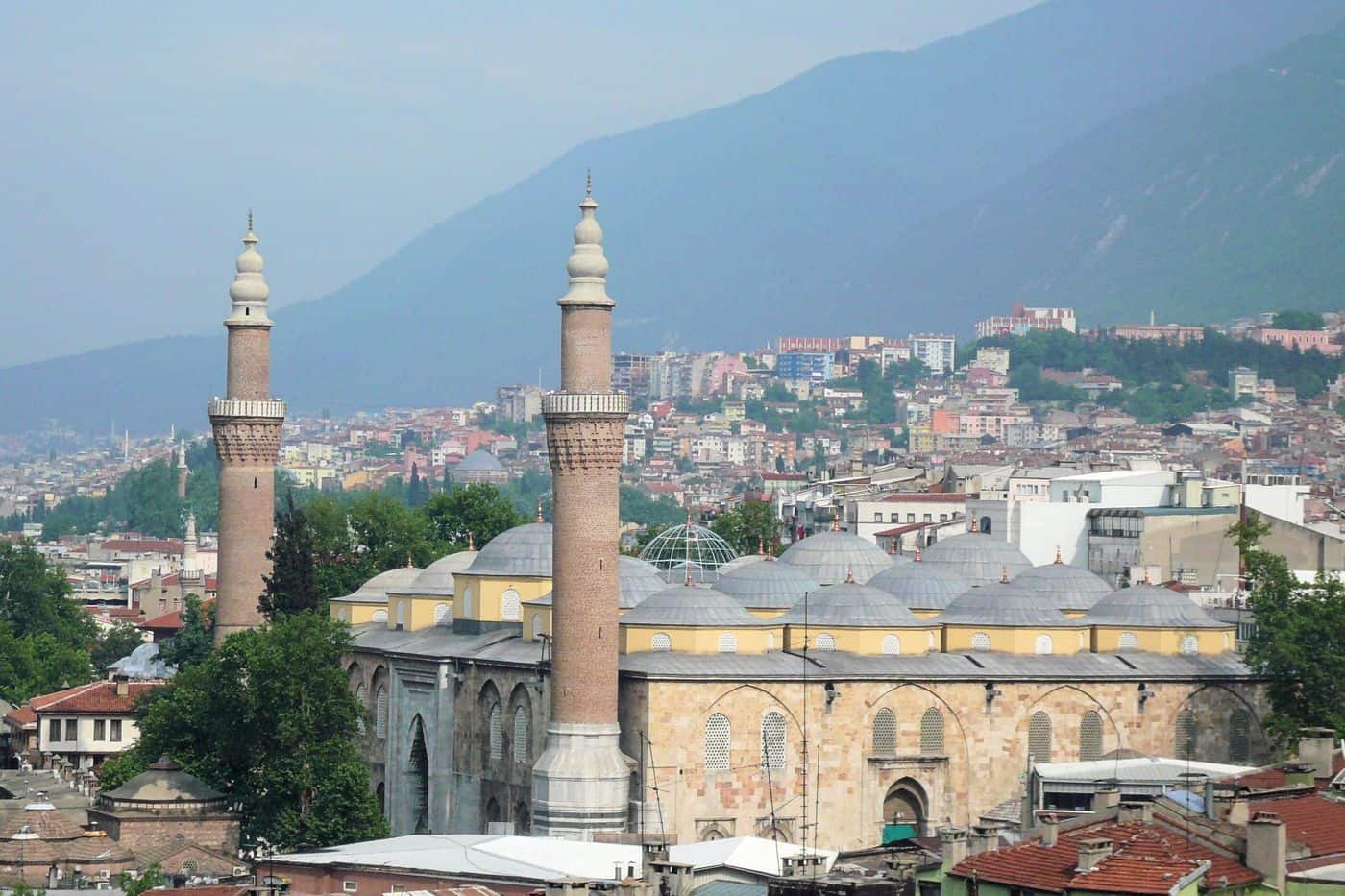
Bursa tours see the Ulu Cami, the largest mosque in Bursa, built for Sultan Bayezid I in 1396–1399: twenty domes in four rows of five on twelve columns, a şadırvan fountain under a glass-covered skylight dome, and 192 monumental wall inscriptions.
Architect Ali Neccar designed the building for Bayezid I, the fourth Ottoman ruler, to mark his victory at the Battle of Nicopolis in 1396. Tradition says the sultan had promised twenty mosques for that win and built one mosque with twenty domes instead. Bursa tours enter a rectangle of 55 by 69 metres with room for 5,000 worshippers.
Bursa tours stop at the şadırvan in the centre of the prayer hall, set over a water basin with eighteen corners in a form that dates from the 19th century. The dome above it is open to the sky, now closed with glass, and lights the dark interior.
The mosque has been called a “calligraphy museum”. In all, 41 Ottoman calligraphers wrote its 87 compositions, the bulk of them between 1778 and 1938, on walls, columns, plates and medallions. The texts on view during Bursa tours include Qur’anic verses, hadiths, the 99 names of Allah and the names of the Prophet Muhammad.
- Mihrab: carved with a muqarnas canopy in 1572 by a craftsman named Mehmed, with painted and gilded decoration added in 1905.
- Minbar: made in 1400 by Hacı Mehmed of Antep in the kundekari technique, from interlocking wood with no nails or glue.
- Minarets: two towers, the western one from the time of Bayezid I and the eastern one standing detached.
What do Bursa tours see at the Green Mosque and the Green Tomb?
Bursa tours see the Yeşil Camii, which Sultan Mehmed I began in 1412 and completed in 1419 or 1420, and the Yeşil Türbe across from it, where Mehmed I is buried; both buildings take their names from green and blue tiles.
Vizier Hacı İvaz Pasha supervised the work, and an inscription above the entrance niches honours him as the designer. Bursa tours walk through a two-storey building on an inverted T-plan; under the central dome, the highest in the mosque, an octagonal white marble fountain stands in a pool lit by a lantern.
The artist Ali bin Ilyas Ali finished the decoration in 1424, and the mihrab tiles carry the signature “work of the masters of Tabriz”. Bursa tours see black-line tiles in green, blue, turquoise, white, yellow and purple, dark green hexagonal tiles with gold overlay in the iwans, and gilded star and polygon tiles in the sultan’s loge.
The Green Tomb stands on a raised mound across from the mosque, among cypresses. Murad II built it for his father, who died in 1421, to a design by Hacı İvaz Pasha. Its dome spans 15 metres, and the green-blue tiles outside are mainly Kütahya replacements, fitted after the 1855 Bursa earthquake.
Past the carved wooden doors, Bursa tours find the sultan’s catafalque on a central platform among seven other tombs: his sons Mustafa, Mahmud and Yusuf, his daughters Selçuk, Ayşe and Sitti, and his wet nurse, Daye Hatun. The tiled mihrab niche shows a garden of roses, carnations and hyacinths.
What do Bursa tours see at the tombs of Osman and Orhan?
Bursa tours see the tombs of Osman Gazi, founder of the Ottoman Empire, and his son Orhan Gazi, its second sultan, at Tophane inside the old castle walls, with the Tophane Clock Tower behind them and a panoramic view over Bursa.
Osman told his son: “My Son, when I die, bury me under that silver dome in Bursa.” His body lay first in the tomb of his father, Ertuğrul, at Söğüt; after the conquest of Bursa, Orhan moved it to the Gümüşlü Kümbet, also named Aya Elia, in the castle’s Osmaniye Square. Bursa tours visit the grave in the Tophane neighbourhood.
The tomb on view dates from the reign of Sultan Abdulaziz (1861–1876): the 1855 earthquake destroyed the first building, and Abdulaziz rebuilt it. Bursa tours then reach the tomb of Orhan, who died in Bursa in 1362 at the age of eighty and rests with his wife and children, among them his daughter Fatma Hatun.
Behind the tombs rises the Tophane Clock Tower, 33 metres tall on six floors. Work began on 2 August 1904 and ended on 31 August 1905, on the site of an earlier tower from the reign of Abdulaziz. The view from the spot made the tower a fire lookout, and the same panorama over the city closes the stop on Bursa tours.
- Square: the tower stands in Tophane Square, once called Meydan-ı Osmaniye.
- Opening: Governor Reşit Mümtaz Pasha opened the tower with a ceremony honouring the accession of Abdulhamid II.
- Castle walls: the Bithynians first built them on natural rock in the 1st century BC, and restoration work began in 2004.
Which Bursa tours visit the Covered Bazaar and Koza Han?
Bursa tours walk the historic market district, home to the Bedesten, a covered market hall built by Sultan Bayezid I, and to Koza Han, the silk caravanserai that Sultan Bayezid II ordered in 1490. Both buildings still serve as places of trade.
Bursa tours open with silk: the city was the Ottoman centre of silk production and trade, distributing silk from the East, above all Ming China, to Genoa and Florence. Hans, bazaars and a bedesten rose in the city centre between the 14th and 16th centuries, and at least 13 of these structures survive.
Sultan Yıldırım Bayezid I built the Bedesten between 1389 and 1402. Its name comes from the Persian bazzāzestān, “place of drapers”: bedestens began as halls for textile sellers, then guarded gold and jewellery behind doors locked at night.
Bursa tours then enter Koza Han, the “inn of the silk cocoon”, which opened next to the Orhan Gazi Mosque in September 1491. In the early 16th century, the commercial agent of the Medicis of Florence kept his office here; today the han holds silk shops, cafés and tea gardens.
- Courtyard: the Koza Han courtyard measures 45.9 by 37.5 metres, with 50 rooms below and 54 above.
- Mescit: an octagonal prayer room stands on 8 pillars above an ablution fountain.
- Emir Han: the caravanserai of Orhan was restored in 1963 after a fire in 1958.
- Market customs: UNESCO records the first sale of the day and bargaining in the Khans Area.
Which Bursa tours visit Cumalıkızık?
Bursa tours drive 10 kilometres east to Cumalıkızık, an Ottoman village at the foot of Mount Uludağ. Oghuz Turks founded it in the 1300s as a vakıf village honouring Sultan Orhan Gazi, and UNESCO calls it the best preserved waqf village in Bursa.
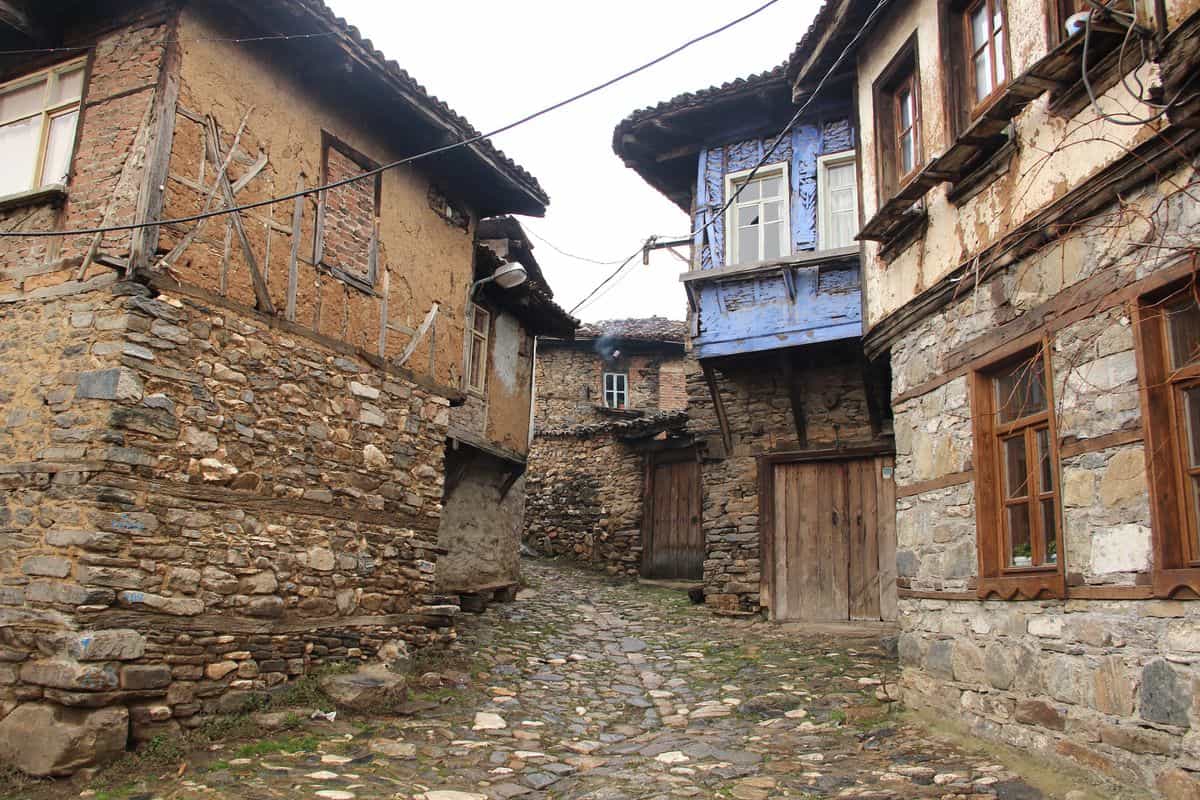
Bursa tours walk lanes of Ottoman homes two or three storeys high, with upper levels that overhang the street and timber frames of local chestnut and oak. Middle floors have low ceilings for winter and upper floors high ceilings for summer, and the homes keep a small courtyard called a hayat, Turkish for “life”.
Bursa tours explore on foot, because no motorised vehicles enter the village, whose streets narrow to 60 centimetres in places. Large stones line the middle of each street and small stones run beside the houses to drain rainwater. The mosque of 1396 stands in the square with a single minaret.
Bursa tours find 270 protected buildings here, 180 of them still homes for 707 residents. Electricity arrived only in the 1970s and tourists in the 1980s, and yearly visitors grew from 150,000 in 2010 to 500,000 in 2015.
- Name: cuma means Friday, the day the kızık villagers gathered here for prayers.
- Founders: Oghuz settlers founded seven kızık villages, and five survive.
- Materials: local stone forms the ground floors and wood the upper floors.
- Film set: Turkish historical film and television commonly use the village as a setting.
Which Bursa tours ride the cable car to Uludağ?
Bursa tours ride the Bursa Teleferik, an 8.8-kilometre gondola lift from Teferrüç station at 395 metres to Oteller at 1,870 metres on Mount Uludağ. The journey takes 22 minutes, and the line ranks as the world’s longest gondola lift.
Bursa tours board at Teferrüç, in southern Bursa. The cabins stop at Kadıyayla at 1,230 metres and Sarıalan Yaylası at 1,630 metres, then reach Oteller, where the hotels stand. Before the extension, visitors reached the hotels and ski areas only by taxi or bus from Sarıalan Yaylası.
Bursa tours ride a system equipped by Leitner Ropeways of Italy: 174 eight-seat gondolas on 45 support towers carry 1,500 passengers an hour, with VIP cabins of four seats. Yamaç Korfalı from Bursa, who had worked with the architect Zaha Hadid in London, designed the stations.
The first line, an aerial tramway by the Swiss company Von Roll Holding, opened on 29 October 1963, the 40th anniversary Republic Day. Its two 20-seat cabins carried 120 passengers an hour over 4.5 kilometres, and the service ended on 29 October 2013.
- Summit: Uludağ, “great mountain” in Turkish, is the highest mountain of the Marmara region, at 2,543 metres on Kartaltepe.
- Ski resort: the biggest ski area in Turkey hosted CEV Snow Volleyball European Tour events in 2017 and 2018.
- National park: oak, beech and fir forests rise to alpine meadows, about 22 kilometres south of Bursa.
- Wildlife: golden eagles, lammergeiers and more than 20 other raptor species live in the park.
What history do Bursa tours tell?
Bursa tours tell four chapters: ancient Prusa, founded by King Prusias I of Bithynia; the Byzantine city that grew into a silk centre; the Ottoman conquest of 1326, which made Bursa the first Ottoman capital; and the UNESCO listing of 2014.
Bursa tours trace the city back to the Ilıpınar Mound, settled in c. 6000 BC. Prusa followed in 183 BC as Prusa ad Olympum, at the foot of the Bithynian Olympus, and passed to the Roman Republic in 75/74 BC under the will of Nicomedes IV, the last king of Bithynia.
Bursa tours then turn to the Byzantine era, when Emperor Justinian I built a palace in Prusa and made it a garrison city in 562; by the mid-6th century, it was a famous silk textile centre at the end of the Silk Road. The Seljuks took it in the 11th century, and the Byzantines recovered it during the First Crusade.
Bursa tours reach the Ottoman siege, which ran from 1317 until the city fell on 6 April 1326. Orhan, son of Osman I, made Bursa the first official Ottoman capital, and the city gained the first official Ottoman mint. Edirne replaced it as capital in the 1360s. Ibn Battuta, visiting in 1331, praised its “fine bazaars and wide streets”.
Bursa tours end with the city’s UNESCO listing, under which Bursa stands as the reference that later Ottoman cities followed.
- Name: Prusa evolved into Mprusa, which later became the modern name Bursa.
- Karagöz and Hacivat: UNESCO records the shadow-play pair as workers on the Orhan Ghazi Kulliye.
- Greek period: Greek troops took Bursa in 1920, and the Turkish army recaptured it on 11 September 1922.
Which local food do Bursa tours taste?
Bursa tours taste İskender kebap, the döner dish that İskender Efendi created in Bursa in 1867, and pideli köfte, the same dish made with meatballs. Stops add İnegöl meatballs, Kemalpaşa dessert from Mustafakemalpaşa and kestane şekeri, the candied chestnuts that are a speciality of Bursa.
İskender kebap is sliced meat topped with hot tomato sauce over pieces of pita bread, with melted sheep’s milk butter and yogurt. The melted butter is poured over the plate at the table. Bursa tours can eat it at the restaurant of the İskenderoğlu family, who hold the “Kebapçı İskender” trademark and still run the restaurant in Bursa.
In 1867, İskender Efendi, son of Mehmet, served lamb on pide bread with tomato sauce and yoghurt in his shop in Kayhan, Bursa. He took his idea from the Cağ kebab, and the döner kebab itself was invented in Bursa in the 19th century. Restaurants across Turkey sell the dish as “Bursa kebabı” or “Uludağ kebabı”, while Bursa tours taste it in its home city.
Pideli köfte puts small meatballs on pide, pours hot butter and tomato sauce over them and serves yogurt on the side. The Turkish Patent and Trademark Office registered Bursa pideli köfte as a geographical indication on 25 October 2021. Bursa tours that reach İnegöl taste İnegöl köfte, grilled meatballs seasoned with salt alone, each weighing 12 to 15 grams.
Mustafa Efendi, born in 1842 in Pazarcık in Ottoman Bulgaria, moved to İnegöl in 1892 and began selling the meatballs in 1893 at the bazaar on the Ankara-Bursa road. His family-run shop is still in business.
- Kestane şekeri: candied chestnuts, a speciality of Bursa, whose Turkish name means “chestnut candy”.
- Kemalpaşa dessert: fried balls of flour, unsalted cheese, semolina and egg, boiled in syrup and served with kaymak in winter and ice cream in summer.
- Gemlik olives: small to medium-sized black olives with a high oil content, hand-picked between November and February.
Which Bursa tours visit the thermal baths?
Bursa tours to the thermal baths go to Çekirge, the quarter famous for its hot springs. Visitors bathe in the Eski Kaplıca, first built by Murad I on Byzantine foundations, and Rüstem Pasha’s Yeni Kaplıca of 1552, both still in use.
The spa tradition starts with Prusa, the Bithynian city whose hot springs were dubbed the “royal waters”. Pliny the Younger, the governor of Bithynia and Pontus, wrote to Emperor Trajan about a site for the baths that the emperor allowed at Prusa. Bursa’s thermal baths have served therapy since Roman times, and Bursa tours follow that tradition.
Çekirge lies 210 metres above sea level, on a fault line near the edge of the Bursa plain where the thermal water rises. Bursa tours meet its Byzantine past too: the settlement at the springs took the name Pythia, “the place of Apollo”, the god of health. Emperor Leo, Empress Irene and her son came to the Pythia baths in the 8th century.
The Hüdavendigar complex of Murad I gave Çekirge two more names, Hüdavendigâr and I. Murat. The Eski Kaplıca stands on the foundations of an old Byzantine bath and belonged to the endowment that Murad I drew up for the complex in 1385.
Bursa tours that add a city hamam choose from the early Ottoman baths of Bursa: the Orhan Bey Hamam of around 1339, the 14th-century Demirtaş Hamam, the Mahkeme Hamam of 1421 and the Emir Sultan Hamam of 1426. In 1814, Henrietta Liston, wife of a British ambassador, visited a hammam in Bursa and wrote about it in her diary.
- Hüdavendigar complex: Murad I built it between 1365 and 1385, with a madrasa, a soup kitchen, a Koran school and its own hamam.
- Çelik Palas: a thermal bath on the list of Bursa springs, with Kükürtlü, Karamustafa and Kaynarca.
- Thermal therapy: hotels run their own baths, and Uludağ University has a physical therapy centre that uses thermal water.
Which Bursa tours continue to İznik or Mudanya?
Bursa tours continue 80 kilometres by road to İznik, ancient Nicaea, where the First Council of Nicaea met in 325, or to Mudanya on the Sea of Marmara, where Turkey, Italy, France and Britain signed the Armistice of Mudanya on 11 October 1922.
İznik stands on the site of Nicaea, a Hellenistic city founded by Antigonus in 316 BC, at the eastern end of Lake İznik. Its walls once ran 5 kilometres, rose about 10 metres and carried over 100 towers behind a double ditch. Bursa tours walk the surviving stretches, and the Lefke Gate opens the east side of the town.
Emperor Constantine I convened the First Council of Nicaea, which sat until the end of July 325. At least 200 bishops attended, wrote the first part of the Nicene Creed and set one date for Easter. Bursa tours then reach Hagia Sophia in the town centre, which hosted the Second Council of Nicaea in 787 and became the Orhan Mosque after Orhan took the town in 1331.
Bursa tours also look for İznik tiles. From the last quarter of the 15th century to the end of the 17th century, potters here made fritware painted in cobalt blue under a clear lead glaze, later adding turquoise, bole red and emerald green. Their tiles decorated mosques designed by Mimar Sinan, and slight traces of the kilns remain.
Mudanya, a district of Bursa Province on the Gulf of Gemlik, stands on the site of ancient Apamea Myrlea and produces olive oil; a railway linked it with Bursa from 1875 to 1948. Bursa tours stop at the Mudanya Armistice House, a two-storey stone house on Oniki Eylül street by the sea. The museum keeps the marble table that İsmet İnönü, head of the Turkish delegation, broke when he struck it during a heated discussion.
After the population exchange, the Greeks of Mudanya moved to Greece and named their new settlement Nea Moudania, on the Chalkidiki peninsula. Bursa tours also reach Tirilye, 12 kilometres west of Mudanya on the Marmara shore, home to the Byzantine Haghios Stefanos Church of 780, now the Fatih Mosque.
- Lake İznik: about 32 kilometres long, 10 kilometres wide and up to about 80 metres deep.
- Underwater basilica: 4th-century ruins dedicated to St. Neophytos, spotted from the air in 2014 and named one of the top 10 discoveries of the Archaeological Institute of America.
- Nilüfer Hatun Imaret: a soup kitchen of 1388, restored in 1955 and now a museum.
How do visitors reach Bursa on Bursa tours?
Bursa tours from Istanbul cross the Sea of Marmara by ferry to Güzelyalı, Mudanya or Yalova, or drive the O-5 toll motorway over the Osman Gazi Bridge. Total journey time from Istanbul is 3 hours by either main ferry route.
İDO, the Istanbul Sea Buses company, carries the main sea leg of Bursa tours. Its ferries start at Kabataş, pick up at Kadıköy and then Yenikapı, and reach Güzelyalı in just under two hours. İDO car ferries also sail every 2 hours from Yenikapı to Yalova and take 75 minutes, while the hourly sailings from Pendik on the Asian side take 45 minutes.
BUDO ferries sail from the Eminönü pier to Mudanya in just under two hours, a route that suits Bursa tours whose guests stay in the Sultanahmet and historical peninsula area. Mudanya and Güzelyalı lie 20 km north of Bursa, and dolmuşes and buses run from the piers to the Organize Sanayi and Emek metro stations. Yalova is a one hour bus ride north of Bursa.
Coaches on Bursa tours follow the Kocaeli Gebze-Bursa-İzmir Motorway, the O-5, whose 105.5 km section from Gebze to Bursa crosses the Osman Gazi Bridge. The bridge spans the Gulf of İzmit at its narrowest point, 2,620 m, opened on 1 July 2016, and has a main span of 1,550 m.
Scheduled buses serve independent Bursa tours. Pamukkale buses run from Harem to Bursa in 2 hr 10 min non-stop, and the BBBus of Bursa’s municipal government links Istanbul Airport and Sabiha Gökçen with the Bursa Otobüs Terminali, 10 km north of the city centre on the D575. Travellers coming from northern Greece reach Istanbul from Thessaloniki by road in about 8 hours on the A2 and E90.
Yenişehir Airport (IATA: YEI) lies 49 km from the centre of Bursa. Inside the city, Bursa tours ride the Bursaray light metro, which opened for passenger service on 24 April 2002 and runs two lines over 38.9 km of route with 39 stations, 7 of them underground.
- Topçular ferry: İDO car ferries cross from Eskihisar near Gebze to Topçular around the clock in 45 minutes.
- Orhangazi Tunnel: the O-5 runs through this 3,586 m tunnel on its way to Bursa.
- Tram T2: the Burtram line T2 runs between the city centre and the main bus station.
- Ferry bus 1-M: this bus links Emek metro station with the İDO ferry terminal.
When do Bursa tours run best?
Bursa tours fit every season: hot, dry summers last from June until September, the Bursa International Festival runs from 1 June to 1 July, and the Uludağ ski area keeps snow cover from mid-December through March for winter day trips from Istanbul.
Bursa has a Mediterranean climate (Csa) under the Köppen classification, and summer Bursa tours meet hot, sticky days with little breeze and thundery downpours. Winters are cool and damp and hold the year’s heaviest rainfall, and snow can stay on the ground for a week or two.
Winter Bursa tours meet nights as cold as -10 °C, while daytime readings sit around 5-10 °C. A winter month brings 10 days of rain and 5 days of snow, which melts quickly in town but builds up on the heights. Winter also sees the strongest Lodos, the southwesterly gales of the region.
Spring is mild and wet, though the mountain catches the bulk of the rain to feed its green forests and upland meadows, and the city sits in a rain shadow. On Uludağ, frost arrives by September and the trees change colour.
Uludağ shapes winter Bursa tours. It was the first winter sports resort of Turkey, with guesthouses opening from the 1930s, and became a national park in 1961. The snows come in October, turn heavy by December to build a base for skiing, and a thaw begins in April.
The Bursa International Festival (Uluslararası Bursa Festivali) has run since 1962 and covers all branches of music, the performing arts and the plastic arts. The Bursa Culture and Art Foundation has organised it since 1988, so Bursa tours in June can add a festival concert or stage show.
- Ski terrain: the pistes run between 2,322 m and 1,767 m altitude, and the longest is 2 km.
- Summer slopes: trekking and camping replace skiing in the warm months.
Frequently Asked Questions
Which museums do Bursa tours add to a city day?
Visitors can add the Bursa Archaeological Museum, the Bursa City Museum, the Bursa Karagöz Museum and the Bursa Museum of Turkish and Islamic Art. Car fans pick the Tofaş Museum of Cars and Anatolian Carriages, while the Museum of Ottoman House, the Bursa Forestry Museum and the Bursa Energy Museum widen the choice further.
Where do Bursa tours meet in the city centre?
City walks centre on Heykel, meaning “the statue”, the colloquial name of the main square with its equestrian statue of Kemal Atatürk, founder of the Turkish Republic. The steep foothills of Uludağ forced the city to grow along an east–west strip, so the downtown main street runs 7 km, with the D200 highway to the north.
Which other landmarks do Bursa tours include?
Beyond the mosques, the list includes Bursa Castle, the Irgandı Bridge and the İnkaya Sycamore, a massive 600-year-old oriental plane tree (Platanus orientalis). Green stops cover the Bursa Zoo and Botanical Garden and the Bursa Hüdavendigar Kent Park, and the Bursa Turkish Architecture Museum rounds off a heritage day.
Can Bursa tours include a football or basketball match?
Yes. Bursaspor, the professional football club of the city, plays its home games at the Timsah Arena, the “Crocodile Arena”, which seats 45,000; the crocodile is the team mascot. The club won the Süper Lig in the 2009–10 season, the second Anatolian champion after Trabzonspor. Basketball side Tofaş S.K. plays at the Tofaş Nilüfer Sports Hall.
What wildlife do Bursa tours meet in Uludağ National Park?
Uludağ National Park, about 22 km south of Bursa, is a refuge for the lammergeier, the golden eagle and more than 20 other raptor species. Its fir forest holds Tengmalm’s owl and the white-backed woodpecker, Krüper’s nuthatch lives near the western edge of its range, and wolf packs roam the mountain.