
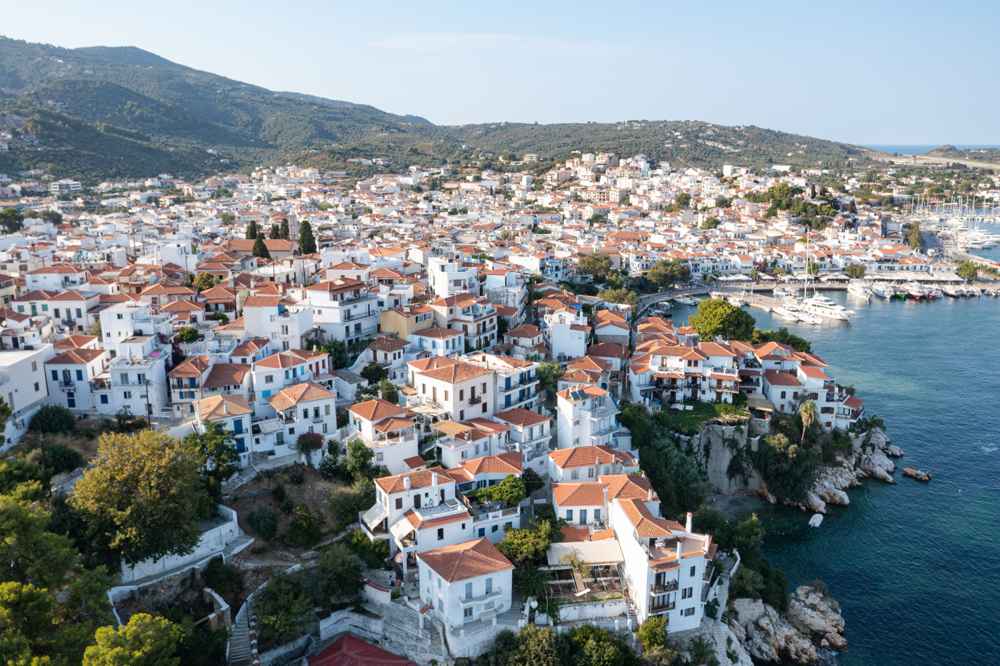
Getting around Skiathos rewards visitors with a rare gift for a Greek island: you barely need a car. One bus line, a fleet of water taxis, a harbour taxi rank and a compact, walkable town cover most of what a holiday demands. The island measures about 12 km long, so distances stay short and transfers stay quick from the first day. Plan the whole trip with Greece Tours.
This guide walks through each option in turn. The south-coast bus and its numbered stops come first, followed by bus frequency and the basics of riding. Water taxis leave the old port for beaches and Tsougria, while taxis wait at the harbour and airport. The wild north coast and the boat-only sights need a rental or a boat, and those exceptions are flagged along the way.
How do you get around Skiathos without a car?
Skiathos runs one public bus line along its south coast, so getting around without a car works well. Buses, water taxis and harbour taxis together reach the town, the resorts and the main beaches.
The island of Skiathos measures about 12 km long and 6 km wide, so nowhere sits far from the harbour capital. This compact scale is why car-free travel across Skiathos is realistic rather than a compromise. Almost every hotel, studio and beach on the developed south coast lines up along one paved road between the town and Koukounaries. A single bus route threads that road, harbour taxis fill the gaps, and water taxis add a sea route to the same coast. The wider destination guide to Skiathos clearly maps how the town, the airport and the resorts fit together for first-time planning.
Visitors who base themselves in town reach cafes, the old port and the ferry quay entirely on foot, without any vehicle at all.
Four transport modes cover Skiathos, and each suits a different need. The bus is the cheapest way to shuttle along the south coast between town and Koukounaries. Water taxis leave the old port for the same beaches and for Tsougria islet, trading road time for a short sea crossing. Harbour and airport taxis give door-to-door rides for luggage, late nights or early flights. Rented scooters, quads and cars unlock the unpaved north coast, where no bus goes. Walking handles the town itself, which is compact and largely pedestrian around the two harbours. Choosing between them comes down to distance, luggage and how far off the main road a beach lies.
A visitor can mix all four across a week without ever needing a permanent car.
Distances on Skiathos stay short, which keeps every transfer quick. The airport sits about 2 km from Skiathos Town, and the far end of the bus line at Koukounaries lies roughly 12 km away. A bus ride from town to the last stop takes around 30 minutes with all its halts. A taxi covers the town-to-airport hop in under 10 minutes outside peak traffic. The old-port water-taxi jetty and the bus terminal stand a short walk apart. Because the numbers are small, a wrong bus or a missed water taxi costs little time. This forgiving geography lets first-time visitors improvise instead of planning every leg in advance.
Families with children value the short hops, since nobody sits in a vehicle for long between the beach, the hotel and dinner in town.
Skiathos Town rewards walking above every other mode inside its own streets. Papadiamantis Street, the pedestrian spine, runs from the harbour past shops and cafes toward the back lanes. Cars are banned or impractical through much of this core, so a vehicle becomes a liability rather than a help. The two harbours, the ferry quay, the bus terminal and the taxi rank all sit within a flat 10-minute walk of each other. Visitors staying in or near town rarely start the engine before their first beach day. A comfortable pair of shoes and a refillable water bottle handle the daytime heat on the paved lanes.
This walkable heart is the reason most arrivals delay any rental decision until they have seen how little driving the island demands.
How does the Skiathos bus line and its numbered stops work?
The Skiathos bus follows one paved south-coast road from Skiathos Town to Koukounaries, halting at numbered stops from 1 near town to 26 at the end. These numbers double as the island’s everyday addresses.
One bus line defines public transport on Skiathos, and it runs the length of the south coast. The route starts at the terminal beside the new port in Skiathos Town and ends at Koukounaries beach, roughly 12 km west. Numbered stops sit at short, regular intervals along the way, climbing from stop 1 near the town to stop 26 at the final beach. Locals and hotels give directions by stop number, so an address like stop 14 means a fixed, well-known point. The low stops cover Megali Ammos and Achladies close to town, the middle stops reach Kanapitsa, Vromolimnos and Troulos, and the high stops serve Agia Eleni and Koukounaries.
Learning your own stop number is the single most useful fact for riding the line.
The numbered-stop system turns the whole south coast into an easy grid. Each beach, hotel and taverna sits at or near a known stop, so planning a day means choosing numbers rather than street names. A rider heading to Vromolimnos asks for the Kolios area stops in the low-teens range, then walks down to the sand. Koukounaries, Banana and Agia Eleni all share the cluster around the final stop 26, where the road ends at the pine forest. This logic also works in reverse, since telling a driver your stop number avoids any confusion over unfamiliar place names. Maps posted at the terminal and inside the buses list the stops in order.
This sequence stays simple to follow even on a first ride along the coast.
The bus line serves the developed south coast and nothing beyond it. Wild north-coast beaches such as Aselinos, Kechria and Mandraki lie off unpaved tracks that no public bus reaches. Lalaria on the northeast tip has no road at all and stays boat-only. Kastro, the medieval site on the north cliffs, needs a car plus a footpath or a boat approach. Travellers who plan to see this rugged half of Skiathos pair the bus with a rental or a boat trip. The single line, then, is complete for the resort strip yet deliberately limited for the interior and the north.
Understanding that boundary early prevents the mistake of expecting a bus to a beach that only a track, a trail or a boat can reach.
Riding the line follows a simple routine that repeats all day. Buses stop at each numbered shelter, load waiting passengers, and continue west toward Koukounaries or east back to town. Boarding happens at the marked stops rather than by flagging the bus anywhere along the road. The final stop at Koukounaries is where the beach crowd builds in high summer, so the last outbound buses fill first. Sitting on the right side heading west gives sea views over the south-coast bays. A printed or photographed stop list helps a first-timer recognise the approaching beach. Because the whole run takes around 30 minutes end to end, even a missed bus rarely derails a beach day.
The rhythm becomes second nature after one or two rides along this single coastal road.
How often do the Skiathos buses run and how do you ride them?
Skiathos buses run frequently through the day in high summer and drop to fewer departures in shoulder season. Riders wait at numbered stops, board when the bus halts, and ride between town and Koukounaries in about 30 minutes.
Bus frequency on Skiathos rises and falls with the season rather than a fixed clock. High summer sees the most departures, with buses leaving town for Koukounaries at short intervals through the day and into the late evening. Shoulder months thin the timetable, so gaps between buses stretch and the last evening service comes earlier. Winter cuts the line to a basic skeleton for residents. Exact times shift each season, and the current schedule is posted at the town terminal and at the main stops. Checking that board on arrival is the reliable way to learn the whole day’s pattern.
Planning a beach return before the last bus matters most in shoulder season, when a late swim can outlast the final service back to town.
Riding a Skiathos bus asks little of a newcomer. Passengers gather at the numbered shelter, wait for the bus to pull in, and board through the front. Fares are paid on the bus, so carrying small change keeps boarding quick when the vehicle is full. Buses grow crowded on peak August afternoons, especially the Koukounaries-bound services after the morning beach rush. Standing room fills fast at that hour, and travellers with young children or heavy bags gain from riding earlier or later. Announcing your numbered stop, or watching the posted list, tells you when to signal for the exit. Buses run both directions along the same road, so the return to town uses stops on the opposite side.
This straightforward pattern makes the bus the default choice for the south coast.
The bus alone covers a large share of a typical Skiathos holiday. A visitor who wants town, the main sandy beaches and the evening scene rarely needs anything more than the line and their own feet. Sunbathers reach Megali Ammos, Achladies, Vromolimnos, Troulos, Agia Eleni and Koukounaries directly from numbered stops. Diners return from beach lunches to town for the night on the same buses. The line falls short only for the boat-only and unpaved-track sights, and for very late nights after the last service. A rider who accepts those two limits treats the bus as the backbone and calls a taxi or books a boat for the exceptions.
This mixed approach keeps costs low while still opening the wilder corners of the whole island.
A little planning smooths any bus day on Skiathos. Morning outbound buses carry beachgoers, so an early start beats the mid-morning crush toward Koukounaries. Water, a hat and sun cover matter at the open shelters, which offer limited shade in July heat. Timing the return around the posted last service protects against a stranded evening, above all in spring and autumn when the line thins. A taxi covers any gap the bus leaves, though the harbour rank empties quickly on busy nights. Riders who note their stop number, keep small change ready and check the terminal board rarely hit trouble.
Treated this way, the single bus line handles the daily rhythm of beach, lunch and town with almost no friction across a normal Skiathos week.
How do water taxis from the Skiathos old port work?
Water taxis depart the old port of Skiathos Town for south-coast beaches and the islet of Tsougria across the harbour channel. These small boats trade road time for a short, scenic sea crossing along the coast.
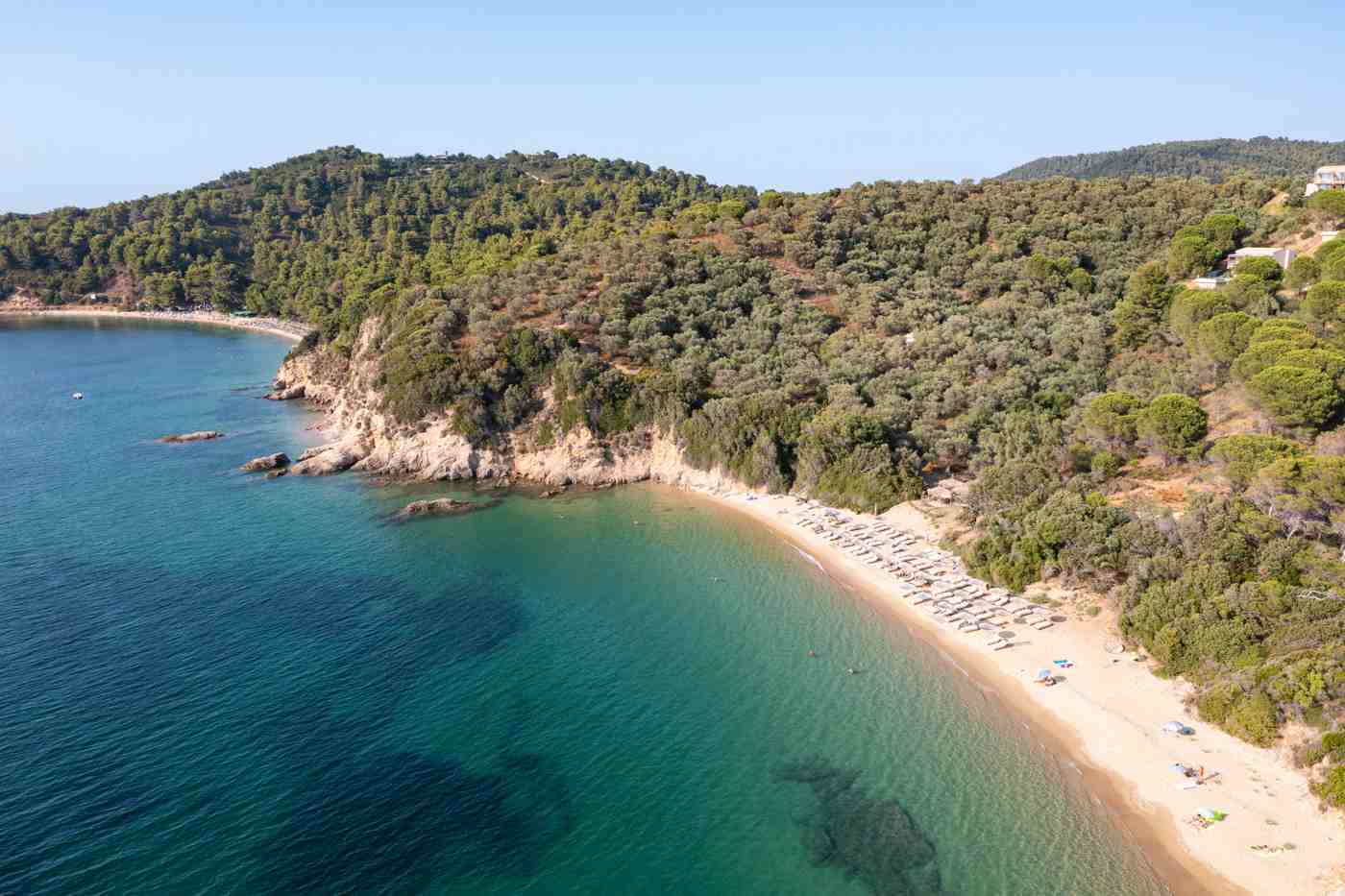
Water taxis give Skiathos a second, waterborne way to reach the coast. Small open boats wait along the old port quay in Skiathos Town, the harbour arm east of the Bourtzi islet. From there they shuttle across calm water to south-coast beaches and to Tsougria islet opposite the town. A ride swaps the bus and the road for an open-air crossing with views back toward the harbour and the aircraft on approach. Signboards at the old port list the served beaches, and boats leave through the day in high summer. For a fuller picture of where each boat lands, the island’s Skiathos beaches guide sets out the south-coast bays in order.
The old port sits a short walk from the bus terminal, so switching between the two is easy.
Tsougria is the classic water-taxi destination from the old port. The green, uninhabited islet faces Skiathos Town across the harbour channel, and the crossing takes about 15 to 25 minutes. Boats leave through the morning in summer and return day-trippers in the afternoon on the same service. The main sandy beach on the northwest side has clear, shallow water, a seasonal taverna and a row of sunbeds. A quieter cove rewards those who walk over the low ridge. No roads or cars exist on Tsougria, so the boat is the only way across and back. Views run to the town, the Bourtzi and the low aircraft on final approach.
A morning out and an afternoon return make the islet an easy half-day trip within a Skiathos itinerary.
Beyond Tsougria, water taxis link the old port with sandy beaches along the south coast. The service turns a boat into a floating shuttle for swimmers who prefer arriving by sea. Popular drop-offs include the bays around Achladies, Kanapitsa and Vromolimnos, where the boat meets the same beaches the bus reaches by road. A crossing spares the walk down from a road-side stop and lands passengers close to the sand. Weather governs the timetable, since the meltemi north wind can chop the water and pause departures. Calm summer mornings favour the smoothest rides, and the sheltered south bays stay usable when the north coast closes.
Boats return in the afternoon, so agreeing the pickup time before setting off keeps the whole beach day on track.
Water taxis suit travellers who value the crossing as much as the destination. The open-boat ride adds sea air, coastal views and a change of pace over a road journey. Families enjoy the novelty, and beach-hoppers use the boats to sample bays without backtracking through town. The old-port departure point stands within a short walk of the cafes, the ferry quay and the bus terminal. This makes the switch between transport modes quick. A light bag, water and sun protection cover the exposed deck on a hot crossing. Reading the day’s board at the quay confirms which beaches the boats serve and roughly when. This sea route rounds out the car-free toolkit.
A visitor reaches the south coast by land or by water as the mood and the wind allow.
Where do you find taxis on Skiathos, at the harbour and airport?
Taxis wait at a rank on the Skiathos Town harbour and meet arrivals at the airport about 2 km away. These cars give door-to-door rides for luggage, early flights, late nights and trips the bus misses.
Taxis form the third public option on Skiathos, filling the gaps the bus and boat leave. The main rank sits on the waterfront in Skiathos Town, beside the harbour where ferries and excursion boats dock. Drivers take passengers door to door across the island, along the south-coast road and up the inland lanes the bus skips. A taxi earns its place with luggage, in the midday heat, or after the last bus has gone. Details on reaching the island in the first place sit in the companion guide to how to get to Skiathos by air and sea. The rank empties fast on busy August nights.
Ordering ahead or waiting in line becomes part of the plan for a late return to a distant resort.
The airport is the other reliable place to find a taxi on Skiathos. Alexandros Papadiamantis Airport sits on the isthmus about 2 km from Skiathos Town, and taxis meet incoming flights on the forecourt. A ride to a town hotel takes under 10 minutes, while resorts along the south coast toward Koukounaries run 15 to 25 minutes. Arriving families with cases, car seats and beach gear favour the taxi over the bus for the first transfer. Peak-season arrivals bunch when flights land together, so a short queue forms at the busiest hours. Sharing a taxi with fellow travellers heading the same way spreads the cost on that first leg.
The short distances keep every airport transfer brief by island standards, which makes the taxi an easy start to a Skiathos holiday.
A taxi answers the moments a bus and a boat cannot. Late nights after the last bus, dawn departures for early flights, and heavy luggage all point to a door-to-door car. Taxis also reach inland and off-strip addresses the bus route never touches, from hillside villas to the monastery roads. A group splitting one fare often pays little more per head than four separate bus tickets. Rain, which arrives in spring and autumn, tips the balance toward a dry car as well. The trade-off is availability, since the island runs a limited number of taxis that thin out on peak nights. Booking a pickup through your hotel in advance secures the ride for an early airport run.
Walking to the rank and waiting then wastes precious morning time.
Taxis complete a transport picture that needs no rental for most stays on Skiathos. The bus handles the daily beach run, water taxis add a sea route, walking covers the town, and a taxi plugs every remaining gap. Sensible habits keep it smooth. Note the harbour rank location, ask your hotel to call ahead for early flights, and expect a wait on peak nights. Distances stay short, so no single fare turns a day upside down. Reserving the wilder north and boat-only sights for a rental or an excursion frees the taxi for transfers, late returns and heavy-bag days. Combined this way, buses, water taxis, taxis and your own feet move a visitor around Skiathos.
This works through a whole holiday without the cost and parking hassle of a hire car.
When is renting a scooter, quad or car worth it on Skiathos?
Renting a scooter, quad or car on Skiathos pays off when plans reach the unpaved north, cross four distant beaches in one day, or begin before the first morning bus.
A rental earns its cost when one day covers Aselinos, Kechria and the monastery road, distances the south-coast bus never reaches. That single bus line serves the paved south from Skiathos Town to Koukounaries, so coves off the corridor stay unreachable without your own wheels. Families carrying beach gear, coolers, umbrellas and pushchairs gain from a car boot that a crowded seat cannot match. Couples chasing a northern sunset value the freedom to leave after dark, long past the final scheduled departure. Weigh the daily rental rate against repeated taxi fares across a full week of trips. The arithmetic often favours a small car for three or more active days.
Drivers who plan to island-hop by boat can skip the rental and lean on public transport instead.
Comparing a scooter, a quad and a car sharpens the choice for Skiathos terrain. A scooter suits one or two riders on the paved south coast and slips through the narrow harbour lanes. A quad grips the loose gravel toward Aselinos and Mandraki, where a scooter loses traction on the steep unpaved descents. A compact car shelters passengers from midday heat, carries luggage to the airport and locks valuables out of sight. Book early through Skiathos car rental during peak weeks, because the small island fleet empties fast. Confirm the insurance excess, the fuel policy and whether the rate permits driving on the north’s unsurfaced tracks before you sign.
Most contracts exclude dirt roads, so read that clause with care. Two adults on a scooter still pay less per day than a compact car.
Fuel, parking and licences shape the real cost of driving on Skiathos. Petrol stations cluster near the town and the airport road, so top up before heading toward the empty north. Parking in Skiathos Town is scarce in high summer, and drivers leave cars in the large lot near the new port and walk in. A scooter or a small car threads the tight streets and parks where a saloon cannot. Riders of scooters and quads carry the correct category on their licence, since checks happen at the harbour. A helmet stays compulsory on two wheels, and the fine for skipping one erodes any saving.
Factor in one refuel across a week of touring, plus the paid parking near the waterfront. Then compare wheels against the bus and the occasional taxi.
Timing the rental to your itinerary keeps the budget lean on Skiathos. Base days spent on Koukounaries, Banana and Big Banana beach need only the bus, which drops walkers at the western stops. Reserve the car for the two or three days that target Kechria, Aselinos and the Evangelistria monastery, then return it. Hourly and half-day scooter hire covers a single northern run without paying for a full week you barely use. Peak weeks in high summer drain the fleet, so a booking made in advance beats hunting for a spare quad on arrival. Drop-off at the airport removes a final taxi on departure day, a detail that trims the total.
Match the wheels to the specific days that need them, and the island rewards the planning with lower spend and wider reach.
How do you reach the unpaved north of Skiathos at Aselinos, Kechria and Mandraki?
Reaching Aselinos, Kechria and Mandraki demands your own wheels, because no bus serves the north. Rented quads and cars handle the gravel tracks; boat trips and marked footpaths add car-free routes to these remote north-coast beaches.
The north coast of Skiathos sits beyond the bus network, so a rented vehicle unlocks Aselinos, Kechria and Mandraki. A signed road climbs inland from the Skiathos Town ring, crests the wooded spine and drops toward Megalos Aselinos, the widest northern bay. Mikros Aselinos lies a short track east, quieter and framed by pines that run down to the sand. Kechria beach waits west along a rougher gravel route that rewards careful driving with a broad, sheltered cove. A car reaches these bays in about twenty-five to forty minutes from town, depending on the surface and your pace.
Signposting thins on the dirt sections, so a phone map loaded offline keeps you on the correct fork toward each beach. Fuel up in town first, since no petrol station serves the north.
A quad or a compact car handles the northern tracks that defeat a road scooter on Skiathos. The final approach to Mandraki, the Bourtzi of the north, runs across packed earth and loose stone that grip poorly under narrow tyres. Drivers keep the speed low, watch for oncoming vehicles on blind bends and pull wide where the track narrows to one lane. Kechria’s descent tightens near the shore, and a second’s inattention costs a scraped underside on a small hire car. Confirm before renting that the contract permits these unsurfaced roads, since a breakdown off the paved network voids the cover.
Carry water, since no beach bar operates on the remotest northern sands and the nearest shop sits back in town. A spare-tyre check before departure spares a stranded afternoon.
Boat trips open the north Skiathos coast to travellers who prefer to leave the driving to a skipper. Day cruises from the old port round the island, pause at Lalaria beach beneath its cliffs and anchor off Kastro, the ruined medieval capital. These caiques reach coves that no road touches, including sea caves that a car can never approach. A hired small boat or a place on a scheduled excursion turns the wild north into a swimming stop rather than a driving challenge. Passengers walk down to the old harbour, board within the hour and skip the gravel entirely. The route also frames the north cliffs from the water, a perspective the inland roads never grant.
Book the cruise the day before in peak weeks, when the popular caiques fill by mid-morning.
Walkers reach parts of the north on marked footpaths that thread the pine forest above Skiathos Town. A signed trail climbs to Kastro, the abandoned fortified town on the north headland, in about two to three hours each way. Shorter paths link the Evangelistria monastery, the island’s flag-birthplace, with tracks that continue toward Aselinos for fit hikers. Sturdy shoes, a full water bottle and an early start beat the midday heat on the exposed upper sections. The routes trade the speed of a quad for silence, forest shade and views over the strait toward the mainland. A guided walk removes the navigation worry where the waymarks fade under summer growth.
Combine a morning hike to Kastro with an afternoon boat pickup, and the north opens without a single kilometre of driving.
What is walking around the pedestrian centre of Skiathos Town like?
Walking defines Skiathos Town, whose harbour core bans most cars along flagstone lanes. Flat waterfront strolls link the two ports in ten minutes, while stepped alleys climb to churches, tavernas and viewpoints above the marina.
The heart of Skiathos Town runs on foot, since vehicles stay out of the marble-paved lanes behind the waterfront. Papadiamantis Street, the main artery, threads north from the harbour past shops, bakeries and travel desks in a straight ten-minute walk. Side alleys branch left and right into a grid of whitewashed houses draped with bougainvillea and hanging lamps. The old port and the new port sit at either end of a flat quay, about a ten-minute stroll apart along the sea. Bus stop one and the taxi rank both anchor the new-port end, so arrivals reach the lanes without a ride.
A stroller or a wheeled case rolls the level waterfront easily, though the stepped upper alleys demand carrying. Signs at the new port point straight to the main lane.
The upper town climbs in tiers of steps that reward the effort with views across the harbour on Skiathos. Lanes narrow and rise toward the Trion Ierarchon church, whose bell tower marks the skyline above the roofs. Cats doze on doorsteps, and small squares open suddenly with a taverna, a well or a painted chapel. The gradient rules out wheels here, so plan the ascent for the cooler morning or the hour before sunset. Flat shoes grip the polished stone better than sandals, which slide on the worn treads after rain. Benches at the Bourtzi headland, a short flat walk from the old port, give a rest and a wide sea view.
Every climb ends at a viewpoint, so the town doubles as a walking circuit rather than a mere transit.
Distances inside Skiathos Town stay short enough that no traveller needs wheels to cross it. The waterfront runs about eight hundred metres end to end, a stroll of twelve to fifteen minutes at an easy pace. Papadiamantis Street reaches the ring road in under ten minutes, where the north road and the airport road begin. The fish market, the small squares and the two ports all sit within this compact grid beside the water. Evening brings a promenade, when families and visitors fill the flat quay between the tavernas and the moored yachts. The pedestrian core empties of engines, so children walk freely and the noise drops to conversation and rigging.
A single unhurried loop of the town takes under an hour and passes almost every landmark on foot.
Practical habits make walking the town centre of Skiathos easier through a long summer day. Carry water, since the marble lanes trap heat by mid-afternoon and shade thins on the open quay. A sun hat and light shoes beat the reflected glare off the pale stone and the bright harbour water. Deliveries use the lanes early, so the calmest walking hours fall before nine and after the evening rush. Signposts point to the two ports, the bus stop and the main church, which keeps first-time visitors oriented. Landmarks such as the Papadiamantis house museum and the clock give fixed reference points within the grid. Keep a rough map of the ring road in mind.
That paved loop is where taxis, buses and rental collection all connect to the walkable core.
How can you plan a car-free day on Skiathos using the bus and a water taxi?
A car-free Skiathos day pairs the south-coast bus with a water taxi. Ride the bus out to a beach, swim, then catch a boat from the old port back to town, skipping every road entirely.
A car-free day on Skiathos starts at bus stop one beside the new port in town. Board an early departure toward Koukounaries, watch the numbered stops tick by and step off at your chosen beach along the south coast. Stops around eighteen to twenty-one serve Troulos, Agia Paraskevi and Platanias, each a short walk to soft sand. The bus runs frequently through the summer day, so a missed departure costs a wait rather than the whole plan. Carry small change or a card as the fare system allows, and keep your bag on your lap in the busy midday runs.
Reaching the far western beaches takes roughly twenty-five to thirty-five minutes, so an early start buys the quiet morning sand before the crowd builds. An aisle seat keeps the beach bag close.
Midday on a car-free plan suits a slow lunch and a swim before the afternoon return on Skiathos. Beach tavernas at Troulos and Agia Paraskevi sit steps from the bus stop, so no transfer breaks the rhythm. A shaded lounger, a swim and a plate of grilled fish fill the hottest hours without any driving. The bus back toward town passes each numbered stop again, so timing the return means noting the general daytime frequency, not a fixed clock. Travellers who want a different route home walk down to the old port in town first, then swap the road for the sea.
This pivot from bus to boat turns a simple beach trip into a loop that samples both the coast road and the water.
A water taxi completes the car-free loop by carrying you from the old port across the bay on Skiathos. Small boats leave the old harbour through the day for south-coast beaches such as Tzaneria and Kanapitsa, and for the islet of Tsougria. The crossing to Tsougria takes about fifteen to twenty minutes and lands on a sheltered swimming beach with a seasonal canteen. Sitting on deck, you trade the dusty coast road for sea breeze and a view back over the town’s rooftops and marina. Board at the old port, confirm the general return times with the skipper and keep a dry bag for phones and cameras.
The boat drops you back at the same harbour, a flat two-minute walk from the tavernas and the bus stop.
Chaining the bus and the boat needs only loose timing, not a printed schedule, on Skiathos. Ride out early by bus, spend the middle of the day at one beach and return by water taxi in the late afternoon. Reverse the order on a second day, taking the boat out to Tsougria first and the bus home from a south-coast stop. Keep the plan flexible, since both the bus and the water taxis run on general daytime frequencies rather than to-the-minute times. Ask at the old port kiosk and the bus stop for the last general departures, so the evening return never strands you.
A day built this way skips fuel, parking and the rental desk, yet reaches sand, an islet and the harbour on foot and afloat.
How do you get to and from Skiathos airport?
Skiathos airport sits about two kilometres northeast of town, near the sea. Taxis wait outside arrivals for the short ride, rental desks hand over cars on site, and the town-bound road is walkable in around thirty minutes.
Skiathos airport lies close to Skiathos Town, so no transfer eats a large slice of the day. The single runway edges the sea about two kilometres northeast of the harbour, a five to ten-minute drive on the ring road. Taxis line up outside the terminal on most flight arrivals, and the fixed short hop into town costs little time. A pre-booked hotel transfer waits with a name board where guests prefer a guaranteed seat after a long flight. Rental collection often happens at or beside the terminal, so drivers pick up wheels and skip the taxi altogether. The proximity keeps a delayed flight from wrecking the evening.
Check-in at most town hotels sits minutes away rather than across the island. A quick hop covers the whole airport transfer.
Taxis handle most airport runs on Skiathos, waiting kerbside as passengers clear the compact arrivals hall. The rank fills on scheduled landings, and the ride to a central hotel or the new port takes under fifteen minutes. Fares to town stay modest given the short distance, though a night arrival or a public holiday can lift the general rate. Travellers heading to a west-coast beach hotel near Koukounaries face a longer ride along the south road, priced by distance. Confirm the approximate fare with the driver before setting off, since meters and fixed zones vary across the island’s cars.
A group splitting one taxi often matches or beats separate seats, so families gather at a single rank car with the luggage. Cash and a card both cover the short fare.
Public transport touches the airport only indirectly, so plan the last leg with that in mind on Skiathos. The main bus line runs the south coast from the new port to Koukounaries and does not serve the terminal directly. The nearest stop sits back toward the town ring road, a walk of roughly twenty to thirty minutes with luggage from the airport. Budget travellers with light bags sometimes walk the flat airport road into town in about half an hour. Anyone carrying heavy cases or arriving in the midday heat takes the waiting taxi instead of the walk. Weigh the short taxi fare against the effort of wheeling a case along the roadside.
Choose how to cover this final stretch to your bed before you land.
Departure day runs smoothly when the airport’s closeness shapes the timing on Skiathos. Allow a short taxi or drive from a central hotel, plus the standard check-in window the airline sets for the flight. A rental returned at the terminal removes the final taxi and lets drivers use the car right up to departure. Plane spotters gather along the road at the runway threshold, where low approaches pass close overhead before landing. Travellers with an afternoon flight leave the morning free for a last swim, since the beach-to-terminal hop stays short. Keep a little slack for the single-runway airport, where one delayed inbound plane can nudge the whole day’s schedule.
Reach the airport terminal early with time in hand rather than a rushed final dash.
Frequently Asked Questions
Do you need a car on Skiathos?
A car is optional on Skiathos, not essential, because one bus line serves the entire south coast. That route links Skiathos Town with Koukounaries and stops at the numbered points that reach the busiest beaches, from Megali Ammos to Banana. Visitors who base themselves on the south coast and swim at Troulos, Agia Paraskevi or Koukounaries manage well on the bus, water taxis and the occasional taxi. A rented car or quad earns its keep only when plans push into the unpaved north at Aselinos, Kechria and Mandraki, which no bus reaches. Drivers also gain on beach days that string together three or four distant coves, or on evenings that run past the final scheduled departure.
Weigh the daily rate and parking against repeated taxi fares before deciding. For a short beach-focused stay near the bus line, skip the rental; for exploring the wild north, book wheels for the days that truly need them. Ask your hotel about the nearest bus stop before writing off the bus entirely.
How do you get to Koukounaries beach on Skiathos without a car?
Koukounaries beach sits at the western end of the south-coast bus line, so the bus reaches it directly from Skiathos Town. Board at stop one beside the new port and stay on until the final stops, around twenty-six, where the pine forest meets the long golden bay. The ride covers the full south coast and takes roughly twenty-five to thirty-five minutes, depending on the number of beach stops the driver serves. Buses run frequently through the summer day, so a missed departure means a short wait rather than a stranded afternoon. The same line drops walkers at Banana and Big Banana beach, a signposted stroll over the low headland from Koukounaries.
A water taxi from the old port offers an alternative sea route to nearby south-coast beaches on a calmer day. Carry water, small change or a card for the fare, and start early to claim shade under the pines before the crowd arrives. Sit on the right side heading out for the clearest sea views along the coast.
When is the last bus back to Skiathos Town in the evening?
The last bus back to Skiathos Town runs in the evening, though the exact hour shifts with the season and is not fixed here. In high summer the south-coast line keeps going well after sunset, giving beachgoers at Koukounaries and Troulos a late ride home. In the shoulder months the service thins and the final departure falls earlier, so an afternoon check saves an awkward wait. Confirm the general last-departure time at bus stop one, at your beach stop or with the driver on the way out, rather than trusting a memorised figure. Missing it leaves a taxi as the fallback, which costs more from the western beaches priced by distance.
Note the numbered stop nearest your lounger, since drivers halt on request along the route. A simple habit of asking early in the day removes the risk, letting you stay for the sunset swim and still catch a seat back into town. Keep a taxi number saved as a backup for the nights you linger past the last bus.
Can you reach the north beaches of Skiathos without a jeep?
The north beaches of Skiathos open to travellers without a jeep, through boats and footpaths rather than four-wheel drive. Day cruises and hired small boats leave the old port and anchor off Lalaria, Kastro and coves that no road touches, turning the wild north into a swimming stop. A quad or even a careful compact car also handles the gravel tracks to Aselinos and Kechria in dry conditions, so a full off-roader is not compulsory. Confirm the rental contract allows unsurfaced roads before driving north, since the fine print excludes dirt tracks. Marked footpaths add a third route, climbing through pine forest to Kastro in about two to three hours each way for fit walkers.
Combine a morning hike with an afternoon boat pickup and the north unfolds without any driving at all. Carry water and start early, because no beach bar serves the remotest northern sands and shade thins by midday. A guided walk removes the route-finding worry where the waymarks fade under summer growth.
Can you take luggage and beach gear on the Skiathos bus?
Luggage and beach gear travel on the Skiathos bus, though space tightens on the busy midday runs of high summer. The south-coast buses carry standard sizes, and passengers keep bags on their laps or in the aisle floor space beside their seats. Beach essentials such as a folded umbrella, a cool bag and towels ride without trouble on a normal daytime service. Large suitcases fit better on a quieter early or late departure than in the packed noon crowd heading for Koukounaries. Travellers moving between the airport, town and a west-coast hotel with heavy cases often prefer a taxi for that single transfer.
Keep valuables in a bag on your lap rather than out of reach, and hold children close in a full standing aisle. For a routine beach day the bus copes easily; for a full holiday’s worth of cases, a taxi or a rental smooths the heavy-luggage legs. Fold pushchairs before boarding, since an open frame blocks the narrow aisle on a full bus.
Is public transport on Skiathos accessible for reduced mobility or pushchairs?
Public transport on Skiathos serves reduced-mobility and pushchair travellers unevenly, since the terrain varies sharply across the island. The flat waterfront between the two ports rolls easily for a wheelchair or a stroller, and the south-coast bus stops sit beside the road at level points. The upper town, by contrast, climbs in stepped marble lanes that rule out wheels and demand carrying. Bus steps and crowded midday services can challenge a wheelchair user, so a taxi or a booked accessible transfer often serves better for door-to-door trips. Beaches such as Koukounaries and Troulos reach close to the bus stop, cutting the walk over sand.
Water taxis need a step down into a moving boat, which suits steadier passengers more than those needing firm support. Plan the stepped upper town and boat boarding with care, lean on level waterfront routes and taxis, and much of the south coast stays within reach. Book an accessible transfer ahead for the airport run, since the fleet is small.
Can you get a taxi at night on Skiathos?
Taxis operate at night on Skiathos, gathering at the harbour rank in Skiathos Town and answering calls after dark. The island runs a modest fleet, so late-evening demand around bar-closing time or a delayed flight can stretch the wait. Booking ahead through your hotel or a saved driver’s number beats hoping for a free car at a busy rank near midnight. Night runs to distant west-coast hotels near Koukounaries cover a longer south-coast distance and cost more than a short hop within town. Confirm the approximate fare before setting off, since a night arrival or a public holiday can lift the general rate.
Groups leaving a beach bar together share one car and split the cost rather than competing for separate seats. Keep a little patience and a backup number in peak weeks, when the small fleet handles the whole island, and the late ride home stays reliable enough to plan around. Agree the fare before the door closes, since a night rate can climb without a meter.