
To get from Chania to Santorini, take the seasonal high-speed ferry from Souda port near Chania, or sail from Heraklion for more frequent crossings; there is no direct flight, so flying means a connection through Athens. Plan the whole trip with Greece Tours.
This guide covers Chania to Santorini in full: whether a direct ferry runs, the crossing time and the fare, sailing from Souda versus Heraklion, the fly-via-Athens option, what the high-speed ferry is like and how to beat seasickness, when the boats run through the season, whether Santorini works as a day trip, and how to plan the port transfer at Souda and the arrival on Santorini, part of getting to and around Chania and beyond the usual day trips.
How do you get from Chania to Santorini?
Two routes link Chania to Santorini. In summer a seasonal high-speed ferry sails from Souda port near Chania across the Aegean in roughly two to four hours. Outside the ferry season, travellers fly from Chania to Athens and connect onward to Santorini.
Chania sits on the north-west coast of Crete, and Santorini lies to the north-east across open sea in the Cyclades. The direct link between them is water. High-speed catamarans operate the crossing during the warm months, departing Souda, the deep-water harbour a short drive east of Chania town. These vessels carry foot passengers, vehicles and luggage, and they reach Santorini’s port at Athinios on the island’s western caldera cliff.
When the seasonal ferry stops for winter, the practical alternative is air travel with a change of plane in the capital. There is no direct flight between Chania and Santorini, so the route runs Chania Airport to Athens, then Athens to Santorini. For orientation on reaching the region first, the guide to how to get to Chania sets out the airport and port arrivals that feed this onward journey.
The choice between sea and air turns on the calendar. Between late spring and early autumn the ferry is the fastest single-leg option and the most scenic. In the low season, the two-flight connection through Athens becomes the reliable way to bridge the two islands.
Is there a direct ferry from Chania to Santorini?
Yes. A seasonal high-speed catamaran sails directly from Souda port near Chania to Santorini during the summer timetable. The service runs on selected days each week through the warm season, and it pauses entirely once the winter schedule takes over.
The direct Souda-to-Santorini crossing is a summer fixture rather than a year-round line. High-speed operators position fast catamarans on Cretan routes for the tourist season, and the Chania departure is one of the connections that opens up when demand rises. Because the vessel is a passenger-and-vehicle catamaran, it takes cars, motorbikes and cyclists as well as foot passengers.
The direct sailing does not run every day. Departure days shift with the operator’s seasonal timetable, so the frequency thins at the shoulders of the season and thickens through peak summer. Part of the roster runs as a straight crossing, and other sailings call at Rethymno or Heraklion en route, which lengthens the journey. Booking the exact date well ahead secures a place, because the fast ferries fill on the busy mid-summer dates.
Travellers who miss the direct Chania sailing have a strong fallback on the same island: Heraklion, Crete’s largest port, runs high-speed ferries to Santorini across a broader stretch of the season and on more days of the week. That makes Heraklion the busier gateway from Crete to the Cyclades.
How long is the ferry from Chania to Santorini?
The high-speed ferry from Chania to Santorini takes roughly two to four hours. A straight catamaran crossing runs near the lower end, and a sailing that calls at Rethymno or Heraklion adds time at each stop, pushing the total towards the upper end.
Crossing time depends on the vessel and the routing. A modern high-speed catamaran covers the open-sea distance between north-western Crete and Santorini quickly, and a direct sailing lands close to two and a half hours. The exact figure moves with the specific ship on the route, its cruising speed and the sea state on the day.
Intermediate calls change the arithmetic. A ferry that stops at Rethymno, then Heraklion, before striking north to the Cyclades spends time manoeuvring in and out of each harbour and loading passengers, so the door-to-door time stretches. Travellers who want the shortest possible crossing check the timetable for a sailing marked as direct rather than one that threads the Cretan north coast first.
Sea conditions also shape the ride. The stretch of Aegean between Crete and Santorini catches the summer meltemi wind, and a strong northerly slows a fast craft and lengthens the crossing. Calm mornings deliver the quickest and smoothest runs, which is one reason early departures are prized.
How much does the Chania to Santorini ferry cost?
A one-way high-speed ferry fare from Chania to Santorini falls in a band of roughly 60 to 90 euros per adult foot passenger, set by seat class and demand. Vehicles, cabins on longer sailings and premium seating add to the base fare.
Fast-ferry pricing sits above conventional ferry pricing because the catamarans trade fuel for speed. The base economy fare covers a numbered airline-style seat in a passenger lounge. Upgrades to a business or club cabin buy a wider seat, more space and quieter surroundings, and each step up lifts the price. Children and infants travel at reduced rates, and student or resident discounts apply on selected fares.
Vehicles carry their own charge on top of the passenger ticket. A car costs a substantial supplement, a motorbike less, and a bicycle a modest fee. Peak mid-summer dates and weekend sailings price higher than quiet shoulder-season crossings, so flexible travellers who shift a date by a day trim the cost.
Booking early protects both price and availability. The cheapest seat classes sell first on popular dates, and last-minute buyers pay the top of the band or find the sailing full. Reserving the ticket weeks ahead locks the lower fare and a confirmed place on the vessel.
Is it better to sail from Chania or Heraklion to Santorini?
Heraklion suits most travellers better. Crete’s main port runs more frequent and faster high-speed ferries to Santorini across a longer stretch of the season. Chania’s Souda departure wins only when it saves a long road transfer for travellers already based in the west of the island.
Heraklion is the busiest ferry gateway on Crete and the closest major port to the Cyclades. Multiple high-speed operators compete on the Heraklion-to-Santorini line, so departures run on more days, at more times, and the fastest sailings clear the crossing in around two hours. The frequency means a missed or cancelled sailing has a same-day alternative, which matters when a wind day disrupts the schedule.
Chania’s advantage is geography for western Crete. Travellers staying in Chania town, the Akrotiri peninsula or the villages along the west coast reach Souda port in minutes rather than driving two and a half hours east to Heraklion. For them, the seasonal Souda sailing removes a long transfer, and the shorter land leg offsets the thinner timetable.
The verdict follows the base. A western-Crete traveller catches the Souda ferry when the date and timetable line up. A traveller who wants the widest choice of departures, the fastest crossing and the best cancellation cover heads to Heraklion, even at the cost of the road transfer across the island.
Do flights connect Chania and Santorini?
No direct flight links Chania and Santorini. The air route runs Chania to Athens, then a connecting flight from Athens to Santorini. Each leg lasts under an hour, but the airport change and layover stretch the door-to-door time to half a day.
Chania International Airport on the Akrotiri peninsula flies to Athens frequently, and Athens flies to Santorini frequently, yet no carrier joins the two islands nose to tail. Both airports funnel through the capital’s hub. The first leg from Chania to Athens takes about fifty minutes, and the Athens-to-Santorini leg takes about forty-five, but a connection is never the sum of the two flight times alone.
The layover dominates the clock. A comfortable connection at Athens allows time to change gates, and a tight itinerary risks a missed second flight if the first slips. Adding check-in, security, boarding and baggage collection at both ends, the flying option consumes four to six hours in total, against a single ferry leg of two to four.
Flying earns its place in the low season. Once the seasonal ferry stops, the two-flight connection through Athens is the dependable way to move between Chania and Santorini, and winter travellers rely on it despite the layover.
What is the ferry from Chania to Santorini like?
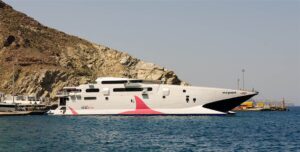
The crossing runs on a modern high-speed catamaran with airline-style numbered seating, indoor air-conditioned lounges, a bar and toilets. The ride is fast and smooth on calm days, and lively when the summer meltemi wind stirs the open Aegean.
High-speed catamarans are enclosed, stabilised craft built for speed rather than open-deck cruising. Passengers sit in assigned seats inside climate-controlled cabins, with a snack bar for coffee, drinks and light food. Outside deck access is limited on fast ferries, so most of the journey passes indoors watching the sea through the windows. Luggage stows on racks near the entrance, and vehicles ride on the car deck below.
The exposed stretch of sea between Crete and the Cyclades tests the ride. When the meltemi blows from the north through high summer, the catamaran pitches on the swell and the crossing turns bumpy. Travellers prone to seasickness take an early departure before the wind builds, sit low and central near the vessel’s midpoint where motion is least, and use a motion-sickness remedy before boarding rather than after symptoms start. Looking at the horizon steadies the stomach; reading on a phone worsens it.
On a still morning the same route is effortless, gliding across flat water with Santorini’s caldera rising ahead. The difference between a rough and a smooth crossing rests on the wind and the departure time, which rewards booking the earliest sailing of the day.
When do the Chania to Santorini ferries run?
The seasonal high-speed ferry from Chania to Santorini runs from late spring through early autumn, roughly mid-spring to late October. Sailings operate on selected days each week, thickening to near-daily at peak summer and thinning at the shoulders of the season.
The timetable is a summer pattern rather than a fixed year-round line. Operators publish the schedule ahead of the season, and departures cluster on the days of heaviest demand. Through July and August the direct Souda sailing runs at its fullest frequency, while spring and early autumn carry a lighter roster with fewer weekly departures.
Winter closes the direct sea link. From November to March the fast catamarans withdraw from the Chania route, and no direct ferry crosses. Travellers in that window fall back on the Heraklion routes where they still operate, or on the two-flight air connection through Athens.
Booking ahead is the rule on this route. High-speed ferries sell out on popular mid-summer dates, and schedules shift with weather and operator changes, so reserving the ticket weeks in advance secures both the sailing and the preferred seat class. Confirming the exact departure day close to travel guards against a timetable change.
Is a day trip from Chania to Santorini realistic?
A day trip from Chania to Santorini strains against the distance and timetable. The crossing runs two to four hours each way, and the ferry schedule rarely offers a same-day return that leaves useful hours on the island. An overnight stay is the sensible plan.
The arithmetic defeats the single-day idea from Chania. A morning sailing that reaches Santorini around midday leaves only a few hours before the return departure, and the last fast ferry back to Crete on a given day frequently leaves too early to justify the round crossing. Add the port transfers at both ends, and a day visitor spends more time in transit than on Santorini itself.
Heraklion’s denser timetable makes a Cretan day trip to Santorini marginally more feasible, yet even from there the day is long and rushed. From Chania specifically, the thinner schedule and longer land approach tip the balance firmly towards staying over.
One or two nights on Santorini transform the visit. An overnight stay opens the caldera-edge villages of Oia and Fira, a sunset without a ferry deadline, and the volcano and beaches at a human pace. Travellers set on a single-day outing find far better value in the day trips from Chania that stay within western Crete, saving Santorini for a trip with a night on the island.
Organised tours handle the early coach from Chania and the ferries in both directions. Our Santorini day trip from Crete page covers the guided tours from Chania, Rethymno, Heraklion and Agios Nikolaos.
How do you plan a Chania to Santorini trip?
Book the high-speed ferry weeks ahead for a summer date, arrange the short transfer to Souda port, arrive at the harbour ahead of departure, and prepare for Santorini’s steep Athinios port, where the uphill road to Fira and Oia climbs the caldera cliff.
Planning starts with the ticket. Reserving the fast ferry early on the chosen summer date locks the fare and the seat class, and confirming the exact departure time close to travel guards against a schedule shift. Printed or digital tickets speed boarding, and passengers travelling with a vehicle arrive earlier to load the car deck.
The land leg to the port is short. Souda lies a few kilometres east of Chania town, reachable by taxi, the local bus or a hire car in well under half an hour from the centre. Foot passengers arrive at the harbour at least thirty to forty-five minutes before departure to clear the boarding queue, and vehicle passengers arrive earlier still. For the broader context of the town, its beaches and its base for onward travel, the Chania hub sets out where to stay and how the port fits the wider trip.
Arrival on Santorini demands its own plan. The high-speed ferry docks at Athinios, the working port at the base of the caldera, not in Fira. A steep switchback road climbs from the quay to the clifftop towns, served by port buses timed to the ferries, taxis and pre-booked hotel transfers. Arranging the onward transfer before boarding avoids the crush for a taxi at the quayside when a full ferry unloads.
What do you see on the ferry crossing from Chania to Santorini?
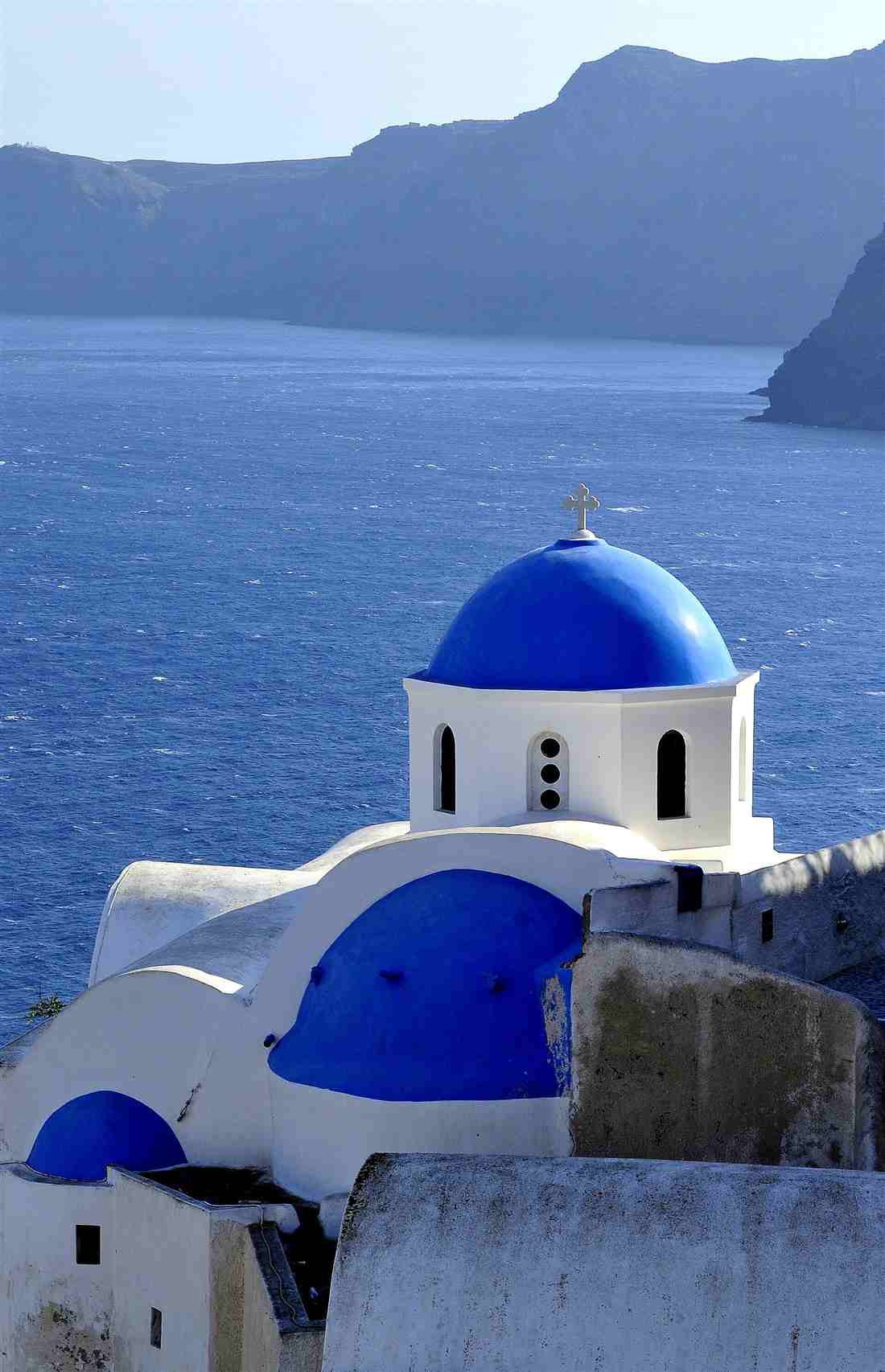
The crossing opens with Crete’s north coast falling away astern, then hours of open Aegean, and a finale as Santorini’s caldera rises ahead: red and black cliffs crowned by the white towns of Fira and Oia stacked along the rim.
The first stretch tracks the Cretan shoreline. Leaving Souda, the vessel passes the sheltered bay and the headlands of the Akrotiri peninsula, and the White Mountains stand inland behind Chania. On a sailing that calls at Rethymno or Heraklion, the Venetian harbours and fortress walls of those ports slide past before the ferry turns north into deep water.
The middle hours are pure sea. The catamaran crosses the Sea of Crete with no land in view, cutting a straight line towards the southern Cyclades. Smaller islands prick the horizon as Santorini nears, and the volcanic outline of the archipelago sharpens against the sky.
The arrival is the reward. Santorini presents its caldera face to incoming ferries, a sheer wall of banded rock formed by the ancient eruption, with Fira and Oia perched hundreds of metres above the water. The ship threads past the volcanic islets of Nea Kameni and Palea Kameni before docking at Athinios beneath the cliff, and the scale of the caldera fills the view on the approach.
How does the meltemi wind affect the Chania to Santorini crossing?
The meltemi, a dry northerly that blows across the Aegean through high summer, roughens the Chania to Santorini crossing. It builds swell on the exposed sea between Crete and the Cyclades, slows the catamaran, and forces cancellations on the windiest days.
The meltemi strengthens through July and August, gusting hardest in the afternoon and easing overnight. The route between north-western Crete and Santorini runs straight into or across this wind, so the open middle stretch takes the full swell. A strong meltemi day turns a smooth two-and-a-half-hour glide into a pitching, slower ride, and an extreme day grounds the fast ferries at the harbour.
The wind rewards early travel. Morning departures leave before the meltemi peaks, so the first sailing of the day delivers the calmest water and the steadiest ride. Travellers who book an early crossing and keep the return date flexible ride out a wind day with the least disruption, and checking the forecast the night before flags a rough morning in advance.
What documents and luggage rules apply on the Chania to Santorini ferry?
Foot passengers board with a valid ticket and photo identification. Luggage travels free within a reasonable allowance, stowed on racks near the entrance. Vehicle passengers present the vehicle booking and load the car deck ahead of foot passengers at the gate.
Boarding is straightforward on the fast ferries. The ticket names the passenger and the seat class, and staff check identification at the gate. Foot passengers carry bags aboard themselves and stow them on open racks by the doors, so a labelled bag and a small day pack kept at the seat keep valuables to hand for the crossing.
Vehicles follow their own drill. A car, motorbike or bicycle carries a separate booking, and drivers arrive early to queue for the car deck and load before foot passengers board. Pets travel under the operator’s animal policy, and passengers with reduced mobility arrange assistance with the operator ahead of the sailing to smooth the steep gangway at Athinios on arrival.
What is the best way to get from Chania to Santorini?
The seasonal high-speed ferry from Souda is the best route in summer for a western-Crete traveller: one leg, two to four hours, and caldera views on arrival. In winter, the two-flight connection through Athens is the only dependable option.
For most summer travellers the answer is the direct fast ferry. It joins Chania to Santorini in a single leg, avoids an airport change, carries vehicles, and delivers the classic sea approach to the caldera. A western-Crete base that puts Souda minutes away seals the case, because the short port transfer offsets the thinner Chania timetable.
The picture shifts for travellers who want maximum flexibility. A visitor based in central or eastern Crete, or one who needs departures on more days and a same-day backup, drives to Heraklion and takes its faster, more frequent high-speed ferries. The trade is a longer land transfer against a wider, more resilient schedule.
Season decides the rest. From late spring to early autumn the ferry rules, whether from Souda or Heraklion. Once the seasonal sailings stop for winter, the route reverts to air, flying Chania to Athens and connecting on to Santorini, the sole reliable way across when the fast ferries are laid up.
Frequently Asked Questions
Is there a ferry from Chania to Santorini?
A seasonal high-speed ferry runs from Souda port near Chania to Santorini through the summer. Sailings are less frequent than from Heraklion, so travellers check the timetable and book ahead, or connect through Heraklion for more daily options.
How long is the ferry from Chania to Santorini?
The high-speed ferry from the Chania area to Santorini takes about two to four hours depending on the vessel and the stops at Rethymno or Heraklion. The fast catamarans make the crossing in the shorter time when they run direct.
Can you fly from Chania to Santorini?
No direct flight links Chania and Santorini. Flying means a connection through Athens, which takes most of a day with the transfer and wait, so the seasonal high-speed ferry is the faster and simpler way across in summer.