
To get from Chania to Loutro, drive or take the KTEL bus about 72 kilometres south to the port of Chora Sfakion, then board the ANENDYK ferry west to the car-free village of Loutro, a crossing of 10 to 15 minutes. Plan the whole trip with Greece Tours.
This guide covers the trip from Chania to Loutro in full: where it is, how to get there by road and ferry, why there is no road, the crossing from Chora Sfakion, the coastal walk, how long the trip takes, the village, its history, the Aradena gorge, its own beach and the nearby coves, the best time, where to stay and eat, the return, and whether this day trip is worth it.
Where is Loutro from Chania?
Loutro is a car-free village on the south coast of Crete in the Sfakia region, on the Libyan Sea between Chora Sfakion and Agia Roumeli, about 75 km south of Chania by road to the ferry port at Chora Sfakion.
Chania sits on the north-west coast of Crete, facing the Aegean Sea and the Gulf of Chania. Loutro faces the opposite way, south towards the Libyan Sea and the coast of North Africa. Between the two lies the White Mountains range, the Lefka Ori, which rises above 2,400 metres and splits the island into a green north and a dry, cliff-lined south. To travel from Chania to Loutro you cross that range from one sea to the other.
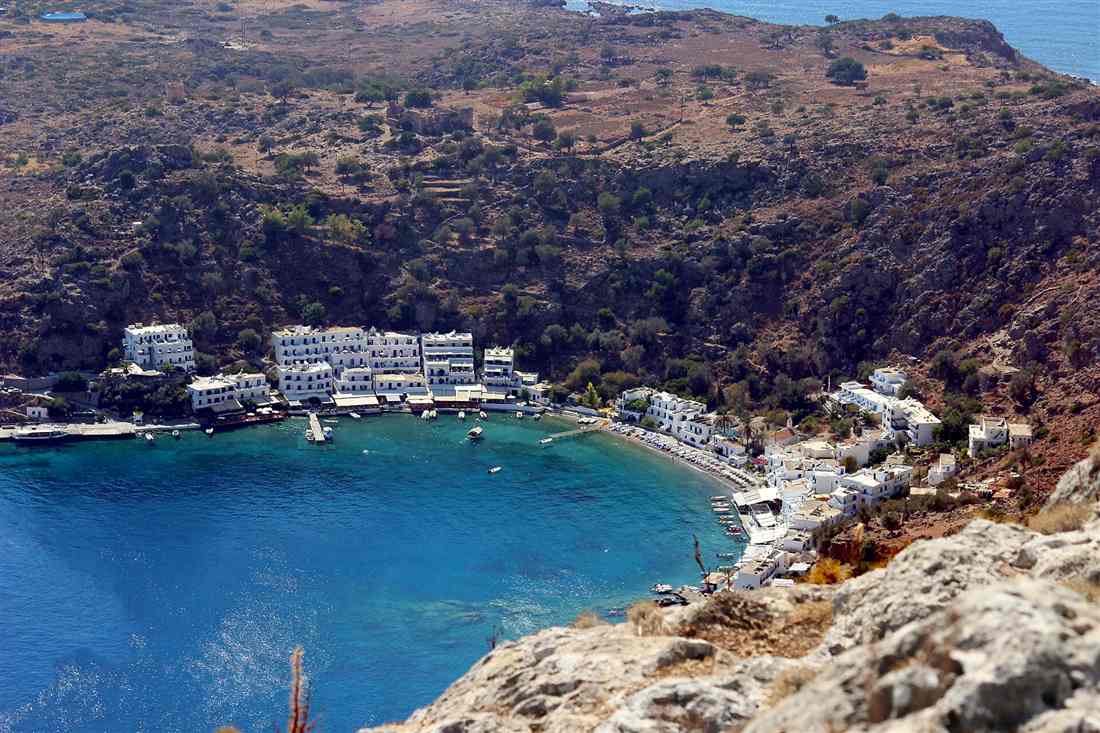
Loutro occupies a small crescent of flat ground at the foot of the mountains, wrapped around a sheltered natural bay. The village is a tight row of whitewashed houses with blue shutters, built at the waterline where the cliffs step back just far enough to leave room for a street of tavernas and rooms. On either side the coast returns to bare rock and steep slopes, which is the reason the settlement stays compact and hemmed in by the sea and the mountain.
The nearest road ends at Chora Sfakion, the small ferry port 12 km to the east of Loutro along the coast. From Chania the drive to Chora Sfakion runs 72 km south over the mountains through the villages of Vryses and Imbros. Loutro itself sits beyond the last stretch of road, on a roadless section of shoreline, so the map distance of 75 km from Chania ends at a quay rather than at the village door.
How do you get from Chania to Loutro?
Drive or take the KTEL bus 72 km south from Chania to the port of Chora Sfakion over the mountains, then board the ANENDYK coastal ferry west to Loutro, a crossing of 10 to 15 minutes. A footpath of about an hour links the two by land.
The journey splits into two clear legs. The first leg is by road across the island: a car or the public KTEL bus carries you from Chania bus station south through Vryses, up the Imbros gorge road and down the far side to Chora Sfakion on the Libyan Sea. This leg covers 72 km and takes about 1.5 hours by the mountain route. The bus runs a scheduled service each day and drops passengers at the Chora Sfakion quay beside the ferry ticket office.
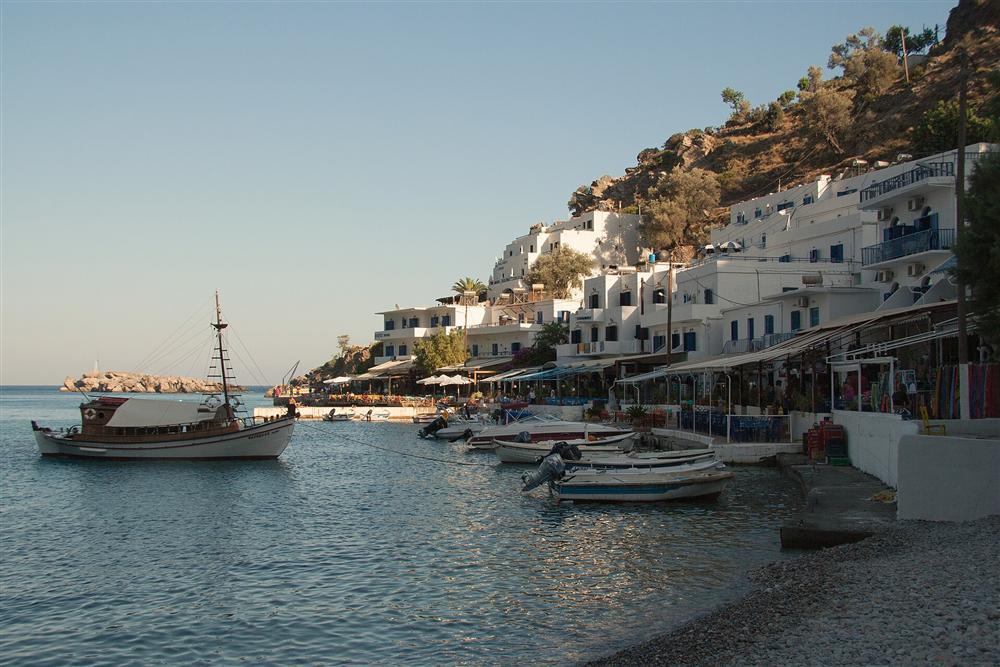
The second leg is by sea. Loutro has no road, so the ANENDYK ferry takes over where the tarmac stops. From the Chora Sfakion quay the boat sails west along the base of the cliffs to Loutro in 10 to 15 minutes. You buy the ticket at the kiosk on the quay before boarding, then step off at the small jetty in the centre of Loutro village, a few metres from the waterfront tavernas.
The land alternative to the boat is the coastal footpath. From Chora Sfakion a marked trail climbs over the headland and drops towards Loutro, a walk of about an hour that passes the Sweetwater beach on the way. Walkers who miss a ferry take this path instead, and hikers on the long-distance route reach Loutro on foot from either direction. Boat and footpath are the two ways in; no road serves the village.
Why is there no road to Loutro?
Loutro has no road connection of any kind. The village sits on a roadless stretch of the south Cretan coast, walled in by the cliffs of the White Mountains, and is reached only by boat or on foot. No car enters the village, which is why it stays quiet and free of traffic.
The south coast of the Sfakia region is one of the least built-up shorelines in Crete. Between Chora Sfakion and Agia Roumeli the mountains fall straight into the Libyan Sea, leaving no shelf of flat land wide enough for a coastal road. Loutro sits on a rare pocket of level ground in that wall of rock, cut off on both sides by slopes too steep to carry tarmac. Engineers never pushed a road through, and the village grew around the harbour instead of a highway.
The absence of a road shapes daily life in the village. Supplies arrive by boat at the jetty and move the last few metres by hand or by small barrow along the single pedestrian street. Building materials, food, luggage and post all cross the water. There are no cars, no motorbikes and no car park, because there is nowhere for a vehicle to go once it lands.
That isolation is the reason Loutro keeps its calm. With no through-traffic and no engine noise, the village stays silent apart from the sea and the tavernas. Visitors leave their cars at Chora Sfakion and arrive with only what they carry. In a busy island where most beaches sit beside a road, a settlement reached solely by sea and trail is a genuine rarity, and the lack of a road is exactly what protects it.
How do you take the ferry from Chora Sfakion to Loutro?
The ANENDYK coastal ferry runs from Chora Sfakion west to Loutro through the day, a crossing of 10 to 15 minutes. Buy the ticket at the kiosk on the Chora Sfakion quay, leave the car in the port, and board; the same line continues to Agia Roumeli and Sougia.
ANENDYK is the ferry company that serves the whole south-west coast of Crete, and Chora Sfakion is its eastern hub. The boats are open-deck passenger ferries built for the short coastal hops, with room for foot passengers, luggage and hikers. Loutro is the first stop west of Chora Sfakion, so the crossing is the shortest on the line and the most frequent, with sailings spread across the day from morning to evening.
To take the ferry, drive into Chora Sfakion and park in the port, where roadside and car-park spaces sit within a short walk of the quay. Walk to the ANENDYK ticket kiosk on the waterfront, buy a one-way ticket to Loutro, and wait at the marked jetty. The fare for the Loutro leg is a few euros. Board when the boat ties up, and it casts off for Loutro within minutes.
The same westbound service links a chain of roadless villages, so the boat that stops at Loutro carries on to Agia Roumeli, the exit point of the Samaria gorge, and further west to Sougia and Paleochora. This makes the Chora Sfakion ferry the spine of south-coast travel: passengers ride one leg to Loutro or string the stops together into a longer coastal route, all from the same quay and the same ticket office.
Can you walk from Chora Sfakion to Loutro?
Yes. A coastal footpath, part of the E4 European long-distance trail, runs about 5 km from Chora Sfakion to Loutro in about 1.5 hours. It passes the Sweetwater beach, known in Greek as Glyka Nera, along an exposed cliff route that calls for sturdy shoes and water.
The path leaves Chora Sfakion at the western edge of the port and climbs onto the headland above the sea. It follows the E4 waymarks, the European trail that crosses Crete along this southern coast, and stays high on the cliffs for the first stretch before dropping towards the shore. The distance runs about 5 km, and walkers cover it in around 1.5 hours at a steady pace, longer with stops at the beach on the way.
The midpoint of the walk is Sweetwater beach, Glyka Nera, a shingle cove where fresh spring water seeps up through the pebbles at the shoreline. The beach sits below the trail, reached by a short descent, and makes a natural break for a swim before the second half of the route. From there the path continues west along the coast and rounds the last headland into Loutro bay.
The route is scenic but exposed, with steep drops to the sea, loose stone underfoot and little shade on the open cliff sections. Walkers carry water, wear firm shoes with grip, and set out in the cooler hours rather than the midday heat. Those who prefer the sea take the ferry one way and walk the other, arriving in Loutro on foot from the east while their car waits back at Chora Sfakion.
How long does the trip from Chania to Loutro take?
The road leg from Chania to Chora Sfakion takes about 1.5 to 2 hours across the mountains, and the ferry from Chora Sfakion to Loutro adds 10 to 15 minutes. End to end the trip fills a half-day each way, which suits an overnight stay far more than a rushed day return.
The first cost in time is the drive. The 72 km from Chania to Chora Sfakion crosses the White Mountains on winding roads through Vryses and the Imbros pass, so the distance takes about 1.5 hours by car and closer to 2 hours by the KTEL bus, which stops in villages along the way. The mountain bends keep the average speed low, and the descent to the coast is slow and twisting.
The second cost is the wait and the crossing. At Chora Sfakion the ferry runs to a fixed timetable, so the real delay is the gap between arriving at the port and the next scheduled sailing to Loutro. The crossing itself is quick at 10 to 15 minutes, but a mistimed arrival adds an hour of waiting on the quay. Checking the ANENDYK departure times before leaving Chania keeps the connection tight.
Added together, the drive, the wait and the boat turn one direction into a half-day of travel, and the return doubles it. A same-day round trip leaves only a couple of hours in the village before the last ferry back, and missing that boat strands a day-tripper for the night. For this reason Loutro rewards an overnight stay, giving time for the bay, the beaches and the walks rather than a race against the timetable.
What is Loutro village like?
Loutro is a car-free crescent of blue-and-white houses wrapped around a sheltered natural harbour, with tavernas and small hotels lined along the waterfront. There are no roads, no cars and no airport noise; the village is reached only by sea, a quiet retreat below the mountains on the Libyan Sea.
The village curves around one of the calmest bays on the south coast, a horseshoe of deep blue water protected from the open sea by the shape of the shoreline. The buildings follow that curve in a single tight row: whitewashed walls, blue shutters and blue doors, stacked two or three storeys against the base of the cliff. A paved footpath runs the length of the front, the only street in the place, wide enough for people and hand-barrows and nothing more.
Along that front sit the tavernas and the small family hotels that make up the village. Tables spill onto the waterside a few steps from the moored fishing boats, and rooms look straight out over the harbour to the mountains behind. There are no large resorts, no chain signs and no traffic, because everything and everyone arrives by boat and stays on foot within the compact grid of the settlement.
The setting gives Loutro its stillness. Behind the houses the White Mountains rise in a bare grey wall; in front stretches the Libyan Sea towards Africa. With no road, no engines and no flight path overhead, the sound is the water, the boats and the tavernas. Below the mountains and open only to the sea, Loutro stays a quiet harbour retreat, the kind of car-free village that has grown scarce across the rest of Crete.
Is Loutro worth the trip from Chania?
Loutro rewards the trip from Chania because it is a car-free whitewashed village wrapped around a sheltered bay, with no road in, clear Libyan Sea water, and short walks to hidden beaches. The trade-off is a long bus-and-ferry journey of about four hours each way.
Loutro sits on the south coast of Crete in the Sfakia region, reached only by boat or on foot. No road descends to the village, so the bay stays free of traffic, engine noise and coach parties. The buildings are painted white with blue shutters and step back from a curved waterfront where fishing boats and the coastal ferry tie up. The water in the bay is clear to the seabed, sheltered from the north wind by the headland, and warm from late spring onward.
The journey is the cost of that quiet. From Chania you ride the bus 72 kilometres south over the mountains to Chora Sfakion, then board the ferry that runs west along the coast to Loutro, a crossing of 10 to 15 minutes. The full trip takes close to three hours in each direction, so a rushed same-day return leaves under two hours in the village. The reward is a place that keeps its calm precisely because it is hard to reach.
Loutro works as one stop in a wider itinerary of day trips from Chania, and it pairs with the Sfakia coast walks, the Samaria Gorge finish and the beaches strung along the shore. For a full picture of the village itself, the walks around it and the boat timetable, the Loutro guide sets out the detail.
Is Loutro a day trip or an overnight stay?
Loutro rewards an overnight or a few nights more than a rushed day trip, because the journey from Chania fills a half-day each way. A day trip works best from Chora Sfakion, 20 minutes by ferry, or as a stop on a coastal boat tour, but staying over delivers the quiet evenings.
Measured from Chania town, a same-day return spends close to six hours in transit against a short window on the ground. The last ferry back to Chora Sfakion and the last bus north set a hard cut-off, so a day-tripper watches the clock through lunch. That pressure undoes the reason to come: Loutro is a place to slow down, not to tick off between departures.
The village earns its keep after the last ferry leaves. The day boats depart, the beach crowds thin, and the waterfront tavernas fill with the few dozen people staying the night. The bay turns glassy at dusk, the swifts work the cliffs above the white houses, and the only sounds are cutlery and water. That evening is the part a day trip never reaches.
A day trip still has its place. From Chora Sfakion the ferry hops across in 10 to 15 minutes, so a base there or at Frangokastello puts Loutro within an easy afternoon. Coastal boat tours from Agia Roumeli or Sougia also call at the bay for a swim and a meal. For a first proper visit, though, book a room and give Loutro two or three nights.
What is there to do in Loutro?
Loutro is built around swimming in the clear bay, taking the taxi-boat or walking to Sweetwater and Marble beaches, hiking the coastal path to Phoenix and Chora Sfakion or up to Anopoli, and eating at the waterfront tavernas. It is the base for the Sfakia coast walks.
The bay itself is the first draw. The water sits sheltered and clear, the seabed shelves gently off the pebble shore, and swimmers cross to the small chapel headland or float off the tavernas. Sun loungers line part of the front, and the calm surface holds through the morning before the afternoon breeze picks up.
Walking defines the rest. The old coastal path runs east to Glyka Nera (Sweetwater) beach in about 45 minutes and continues to Chora Sfakion in roughly two hours, cut into the cliff above the sea. West of the village the trail reaches Phoenix cove in 20 minutes and Marmara (Marble) beach at the mouth of the Aradena gorge in about 90 minutes. A steeper zigzag climbs 600 metres up to the mountain village of Anopoli behind the coast.
For those who want the sea without the walk, a taxi-boat shuttles from the Loutro jetty to Sweetwater and Marble through the day, so a beach afternoon costs one short crossing. Between the swims and the trails, the tavernas on the front serve long lunches, and the pace stays deliberately unhurried. Loutro is a base for the wider Sfakia coast rather than a place of set attractions.
Which beaches are near Loutro?
Three beaches ring Loutro: Glyka Nera (Sweetwater) to the east, fed by freshwater springs that bubble up through the pebbles; Marmara (Marble) to the west at the mouth of the Aradena gorge; and Phoenix cove just around the headland. Each is reached by taxi-boat or on foot through clear Libyan Sea water.
Glyka Nera lies about 45 minutes east along the coastal path, or a five-minute taxi-boat hop. Cold freshwater springs seep up through the shingle at the shoreline, so the shallows run noticeably cooler than the open sea, and digging a hollow in the pebbles fills it with drinkable water. The beach faces open to the Libyan Sea below a sheer cliff, with a single seasonal canteen.
Marmara, or Marble beach, sits at the western end where the Aradena gorge meets the coast, about 90 minutes on foot or a 10-minute taxi-boat. Smooth pale rock frames a small cove of turquoise water, with caves and arches worn into the stone at the waterline and a taverna above the beach. Walkers finishing the Aradena gorge arrive here at the sea.
Phoenix, or Finix, is the closest, a 20-minute walk west around the headland into a quiet cove with a couple of tavernas and a scatter of rooms. The water off all three reads the deep clear blue of the Libyan Sea, warmest from June onward. The taxi-boat from Loutro links them through the day, so a swimmer picks a different beach each morning without touching a road.
When is the best time to visit Loutro?
The best time for Loutro runs from late spring to early autumn, with May, June and September giving warm sea and a quiet village. High summer brings the fullest ferry timetable and the busiest bay, while the cooler shoulder months suit the coastal walks and the gorge hikes.
May and June open the season. The sea has warmed past 20 degrees by June, the hillsides behind Anopoli still carry spring green, and the village holds only a light scatter of visitors. Daytime temperatures sit in the mid-20s, comfortable for the cliff paths to Sweetwater and Marble that turn punishing under the July sun.
July and August are the peak. The bay fills with day boats and swimmers, every waterfront room books out, and the ferries between Chora Sfakion, Loutro and Agia Roumeli run their fullest daily timetable. The sea reaches its warmest, past 24 degrees, but the midday heat and the crowds push the walks to dawn or late afternoon.
September resets the balance. The sea stays warm from the summer, the crowds fall away after the middle of the month, and the light turns softer for the coastal trails and the Aradena and Samaria gorges. The ferry frequency tapers through October as the season closes, so a late visit needs the timetable checked in advance. For warm water with room to breathe, June and September are the pick.
Where do you stay and eat in Loutro?
Loutro offers small family-run hotels, rooms and studios strung along the waterfront and around the bay, with no large resorts and no road access. Tavernas on the seafront serve Sfakian dishes and fresh fish, supplies arrive by boat, and rooms book out through the summer, so reserve well ahead.
Accommodation is deliberately small in scale. A line of two- and three-storey guesthouses, painted white, sits directly behind the waterfront, most with a dozen rooms or fewer and a balcony over the bay. Studios and apartments fill the slopes at either end. No coach reaches them and no car, so every bag is carried the last stretch on foot or landed off the ferry.
The tavernas cluster along the front, tables set at the water’s edge. The kitchens turn out Sfakian staples: Sfakian pie with honey, slow-cooked goat, wild greens, and the day’s catch grilled whole. Because the village has no road, every crate of vegetables, every gas bottle and every case of drink comes in on the ferry from Chora Sfakion, which shapes both the menus and the prices.
Booking ahead matters more here than in a road-served resort. The total number of beds is small, July and August fill months out, and a walk-in arrival off the last ferry with no reservation risks a night without a room. Contact a guesthouse directly before travelling, confirm the ferry connection, and pack light for the final approach on foot.
What is the history of Loutro?
Loutro stands on the site of ancient Phoenix, the harbour of the mountain town of Anopolis and the winter port of Sfakia. Its sheltered bay served ships through the Roman and Venetian eras, and remains of the old harbour and a Turkish-era fort sit around the modern car-free village.
The bay’s shelter is the reason for its long history. Loutro holds the one calm, deep anchorage on this cliff-bound stretch of the south coast, protected from the north wind by the headland, so ships have used it since antiquity. The ancient settlement of Phoenix, the port of the mountain town of Anopolis above, occupied the same ground, and the name Finix survives on the neighbouring cove to the west.
Through the centuries Loutro worked as the winter harbour of Sfakia. When rough seas closed the exposed landing at Chora Sfakion, boats sheltered in Loutro’s bay, and the village served as the safe port for the whole district. Traces of that maritime past ring the settlement: the low ruins of ancient walls, a Venetian-era chapel, and the remains of a fort from the Turkish period on the headland above the houses.
The village also carries a place in the Cretan revolts. Loutro served as a meeting point for the Sfakian rebels who used the roadless coast to move fighters and supplies by sea beyond the reach of the occupying garrisons. That same inaccessibility, a virtue in war, is what keeps the modern village quiet: no road ever reached the old harbour, so Loutro entered the tourist era as a car-free relic of the sea-based life of Sfakia.
What is the Aradena gorge near Loutro?
The Aradena gorge is a deep ravine that drops from the abandoned village of Aradena in the mountains above Loutro to Marmara beach on the coast to the west. A high iron bridge spans its mouth at Aradena, and the walk down the gorge ends at the sea a short boat hop from Loutro.
The gorge cuts through the Lefka Ori behind the coast, its sheer walls funnelling walkers from the deserted stone village of Aradena down to the Libyan Sea. The descent runs about 6 km and takes 3 to 4 hours over a rocky bed, with an iron-rung ladder fixed to the rock at one steep step. It ranks among the finest walks of the Sfakia coast, quieter than Samaria and reached from Loutro rather than from Chania directly.
The Aradena bridge spans the ravine at the top, a tall single-arch iron bridge that carries the road to the abandoned village and draws bungee jumpers who leap from its deck into the gorge below. The bridge and the ghost village of Aradena, emptied by an old blood feud, make the trailhead a destination in its own right above the coast.
The gorge delivers its walkers to the sea at Marmara, or Marble beach, at its mouth, where smooth pale rock frames a turquoise cove a short walk or taxi-boat west of Loutro. Hikers finish the ravine, swim at Marmara, and ride the taxi-boat back to Loutro rather than climbing out, which ties the gorge, the beach and the car-free village into a single day on foot and by boat.
Does Loutro have its own beach?
Loutro’s own bathing is off the pebble shore of its bay and a small beach beside the village, rather than a broad sandy strand. Swimmers enter from the waterfront, the loungers and the chapel headland, while the wider sandy and turquoise beaches sit a short walk or taxi-boat away along the coast.
The village fronts a horseshoe bay of clear, sheltered water, and the main swimming is straight off that front. A narrow pebble beach runs beside the houses, sun loungers line part of the shore, and the calm, deep water off the jetty and the tavernas gives an easy swim within the village itself. The headland with its small chapel marks the eastern arm of the bay, a short paddle from the centre.
The bay’s shelter is the draw over its size. Protected from the north wind and clear to the seabed, the water holds calm and warm from late spring, so the village beach suits an easy morning swim between meals rather than a full sandy beach day. Families settle on the loungers within sight of the tavernas, and swimmers cross the bay in flat water.
For the postcard beaches the village sends its visitors out along the coast. Glyka Nera to the east, Marmara to the west and Phoenix around the headland carry the sand, the springs and the turquoise coves, all reached on foot or by the taxi-boat that shuttles from the Loutro jetty. Loutro trades a big beach of its own for a car-free base within minutes of the finest beaches on the south coast, each a short taxi-boat or a walk along the shore path away from the village.
How do you get back from Loutro to Chania?
To return from Loutro to Chania, take the ANENDYK ferry east to Chora Sfakion, a 10 to 15 minute crossing, then the KTEL bus or your car 72 km north over the mountains to Chania, about 1.5 hours. Time the ferry to the last northbound bus, which leaves in the afternoon.
The return reverses the way in. The ferry runs east from the Loutro jetty to Chora Sfakion through the day, and passengers buy the ticket on the Loutro waterfront before boarding. At Chora Sfakion the boat lands beside the bus stop and the car park, so the change from sea to road is a walk of a few metres up the quay.
From Chora Sfakion the KTEL bus climbs north over the Imbros pass and the Askifou plateau to Chania, the same 72 km mountain route in reverse, taking about 1.5 hours by car and closer to 2 hours by bus. Drivers collect the car left in the port; bus passengers board the northbound service, which is timed to meet the arriving ferries in the main season.
The critical link is the last connection. The KTEL bus to Chania departs Chora Sfakion in the afternoon, so a traveller returning the same day catches a ferry from Loutro that lands in time to meet it. Missing that bus means an overnight on the coast, which is another reason Loutro rewards a planned stay over a tight same-day return. Confirm both the ferry and the bus timetables before setting the return. Drivers who left a car at Chora Sfakion have the freedom of a later start, while bus travellers plan the whole chain around that single afternoon departure north over the mountains.
How does Loutro fit a Sfakia trip from Chania?
Loutro sits at the centre of a Sfakia loop from Chania, linked by the coastal ferry to Chora Sfakion, the Samaria Gorge finish at Agia Roumeli, the Aradena gorge and Frangokastello. It works as the quiet overnight base between the gorge hikes and the coastal beaches.
The coastal ferry is the thread that ties it together. One boat runs the roadless south shore between Agia Roumeli in the west, through Loutro, to Chora Sfakion in the east, and Loutro sits in the middle of that line. That position lets a walker finish the Samaria Gorge at Agia Roumeli, sail east to Loutro for the night, and carry on to Chora Sfakion the next day without a car.
The gorges frame the base. The Aradena gorge drops from the stone bridge at Aradena to Marmara beach a short walk west of Loutro, so a hiker descends the ravine and steps straight onto the coastal path home. Frangokastello, with its Venetian fortress on a shallow sandy shore, lies a short bus or boat run east of Chora Sfakion, a gentler counterpoint to the cliffs.
Assembled from Chania, the trip becomes a hub-and-spoke: the town as the gateway, the bus over the mountains to Chora Sfakion, the ferry to Loutro as the still centre, and the gorges and beaches radiating out. Explore the full range of day trips from Chania, or start from the town itself on the Chania guide, and Loutro slots in as the overnight heart of the Sfakia coast.
Frequently Asked Questions
How do you get from Chania to Loutro?
Drive or take the KTEL bus about 72 kilometres south from Chania to the port of Chora Sfakion over the mountains, then board the ANENDYK coastal ferry west to Loutro, a crossing of 10 to 15 minutes. Loutro has no road, so the boat or a footpath is the only way in.
Why is there no road to Loutro?
Loutro sits on a roadless stretch of the south coast where the White Mountains fall straight into the Libyan Sea, leaving no flat ground for a road. The village is reached only by boat or on foot, which is why it stays quiet and free of cars and traffic.
Is the trip from Chania to Loutro worth it?
The trip from Chania to Loutro rewards visitors with a car-free whitewashed village on a sheltered bay, clear Libyan Sea water and walks to hidden beaches. The long bus-and-ferry journey is the trade-off, so Loutro rewards an overnight stay over a rushed day return.