
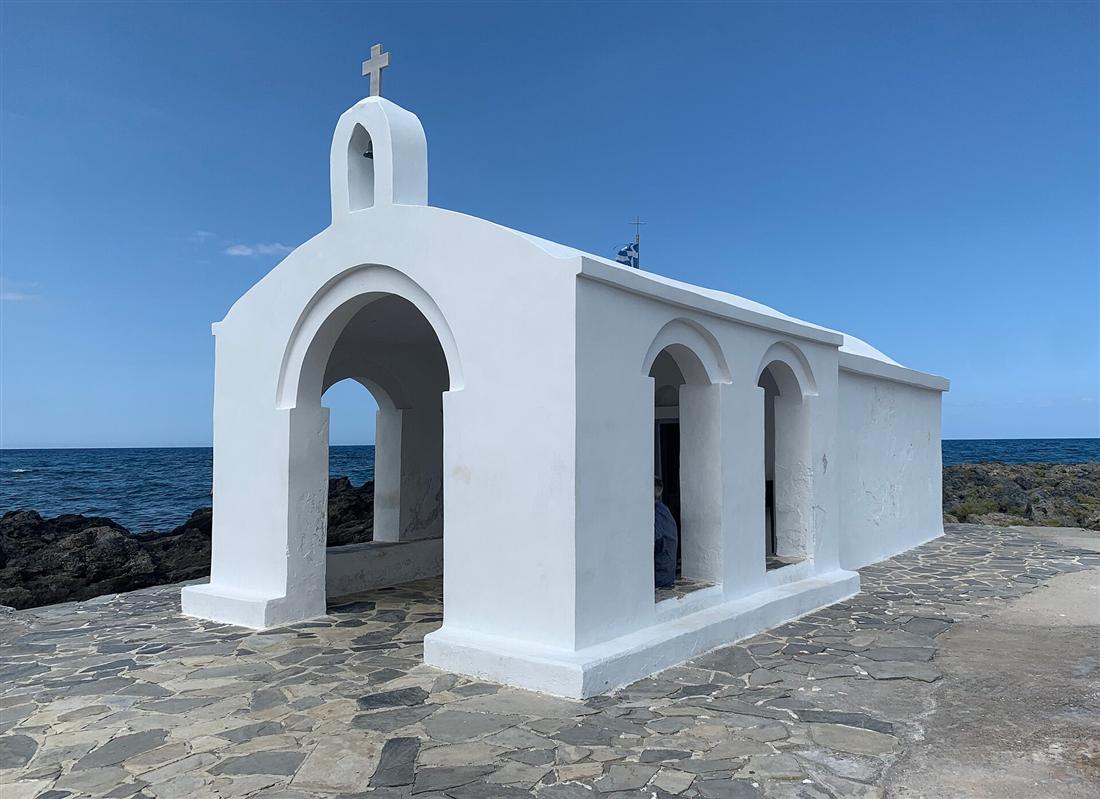
To get from Chania to Georgioupoli, drive east on the E75/A90 national road about 40 kilometres in 35 to 45 minutes, or take the KTEL bus towards Rethymno, to the resort town with its long sandy beach, the chapel of Agios Nikolaos and Lake Kournas nearby. Plan the whole trip with Greece Tours.
This guide covers the trip from Chania to Georgioupoli in full: where it is, how to get there by car and bus, the drive time, the town and its 9-kilometre beach, the chapel of Agios Nikolaos on its causeway, families, Lake Kournas, the Almyros river, what there is to do, the best time and where to stay, the Apokoronas nearby, and whether this east-coast day trip is worth it.
Where is Georgioupoli from Chania?
Georgioupoli, also written Georgioupolis, sits on the north coast of Crete in the Apokoronas district of the Chania region, 40 km east of Chania on the national road towards Rethymno. It rests at the mouth of the Almyros river below the White Mountains.
The town marks the eastern edge of the Chania region, where Apokoronas meets the border with Rethymno. Kavros lies just to the east along the same bay, and the resort strip of Rethymno itself is 20 km further on. Chania old town and the Venetian harbour sit due west, a straight run along the coast.
The setting pairs sea and mountain in one frame. The Almyros river drains cold spring water from the foothills of the White Mountains into the bay, and the massif rises behind the town to 2,454 m at the summit of Pachnes. Eucalyptus trees line the road into the square, planted along the river banks and the approach from the national road.
Lake Kournas, the only freshwater lake on Crete, sits 4 km inland from Georgioupoli in the hills above the coast. The town works as a base for the lake, the long beach, and day trips west to Chania or east to Rethymno, with both regional capitals inside a 45-minute drive.
How do you get from Chania to Georgioupoli?
Drive east on the E75/A90 national road for 35 to 45 minutes, take the KTEL bus from Chania towards Rethymno and alight at Georgioupoli in 45 minutes to 1 hour, or book a transfer from Chania airport. A car suits the beach, Lake Kournas, and the surrounding villages best.
The car route runs the full length of the northern coastal artery. From Chania the road passes Souda, climbs past the Souda Bay junction, and continues east through the Vamos and Vryses exits before the short slip road drops down to Georgioupoli. The turning is signed for the town and the beach, and the descent to the square takes 2 minutes off the main road.
The KTEL bus service links Chania bus station with Rethymno and Heraklion, and the Georgioupoli stop sits on the national road above the town. Buses run through the day at 30 to 60 minute intervals in the summer timetable, with the fare between Chania and Georgioupoli at 4 to 5 euros. From the highway stop the walk down into the square covers 1 km.
Chania International Airport at Akrotiri lies 55 km from Georgioupoli, a 50-minute transfer by taxi or pre-booked car. A fixed-price taxi from the airport rank runs 65 to 80 euros. Hire cars collected at the airport or in Chania town reach Georgioupoli by the same E75/A90 route, and a car unlocks Lake Kournas and the inland villages that the bus does not serve.
How long does it take to drive from Chania to Georgioupoli?
The drive takes 35 to 45 minutes over 40 km on the E75/A90 national road heading east. The route passes Souda Bay and the Vamos junction on a fast dual carriageway, then leaves the highway on a short slip road down into the town, an easy and direct run.
The national road holds two lanes in each direction for most of the distance, with a 90 to 110 km/h limit on the open stretches. Traffic thins east of Souda, and the road carries steady flow rather than congestion outside the town centres. The 40 km cover in well under an hour at legal speeds.
Landmarks mark the progress east. Souda Bay and its naval harbour open on the left within 10 minutes of Chania, the Vryses and Vamos exits pass at the halfway point, and the Georgioupoli sign appears as the road bends towards the coast. The exit ramp curves down through eucalyptus trees to the plane-shaded square at the river mouth.
Timing shifts with the season and the hour. Midsummer afternoons add 5 to 10 minutes through the Souda approach as beach and airport traffic builds, while an early departure clears the whole route in 35 minutes. The road stays open and driveable year round, with no mountain passes or single-lane sections between the two towns.
What is Georgioupoli town and beach like?
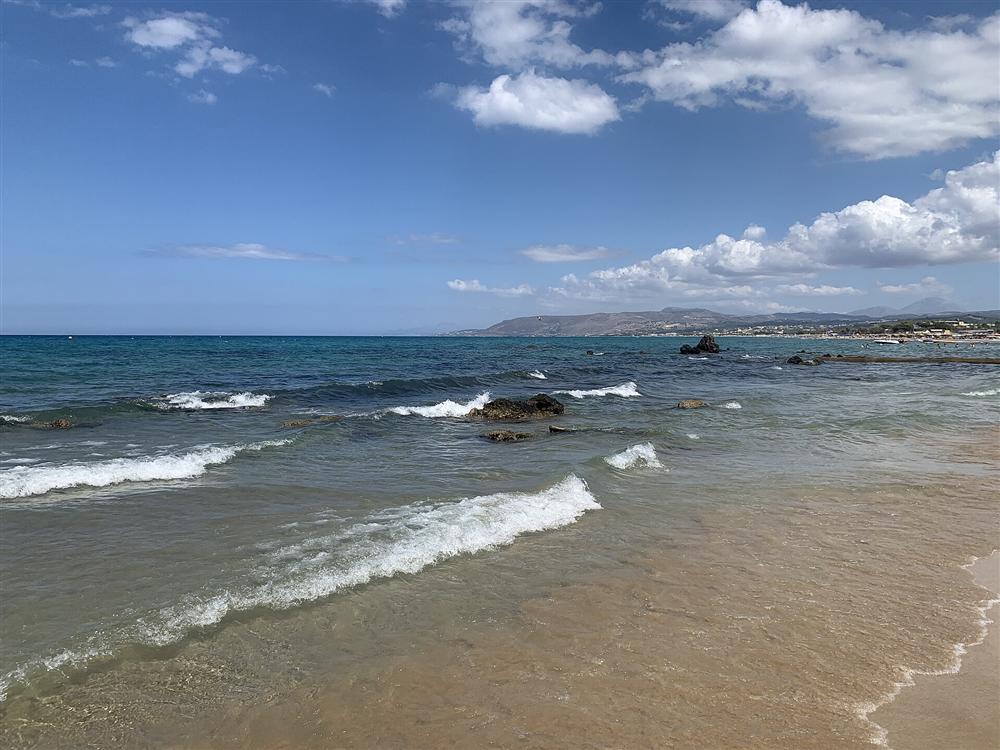
Georgioupoli is a relaxed resort at the Almyros river mouth, built around a plane-shaded central square ringed by tavernas. Its beach ranks among the longest on Crete, a band of sand running 9 km east towards Kavros, with the chapel of Agios Nikolaos offshore on a stone causeway.
The square forms the heart of the town, shaded by mature plane and eucalyptus trees, edged by fish tavernas, cafes, and small shops. The Almyros river runs through on its way to the sea, its cold spring water carrying ducks and terrapins past the bridge. Streets of low guesthouses and rooms spread back from the front, and the scale stays small and walkable.
The main beach starts at the river mouth and stretches east in an unbroken line towards Kavros and the Rethymno border. Fine sand backs a shelving shore, with sunbeds and umbrellas along the town section and open stretches further out. The 9 km length means space away from the busy centre for a longer walk or a quiet swim.
The water changes character along the shore. Near the river mouth the sea stays shallow and calm, cooled where fresh spring water meets the salt, which suits families and young children. The open eastern end catches the north wind and builds waves, drawing swimmers and bodyboarders to the surf. A blue flag marks the maintained central stretch.
What is the chapel of Agios Nikolaos at Georgioupoli?
Agios Nikolaos is a tiny white chapel standing on a rock just offshore at Georgioupoli, reached by a narrow stone causeway of piled boulders running out into the sea. It is the iconic image of the town, the leading photo spot, and a favourite point to watch the sunset.
The chapel sits alone on its rock at the northern end of the town beach, a single whitewashed cell topped with a small cross. Dedicated to Saint Nicholas, the patron of sailors, it faces the open bay and the White Mountains behind the shore. Its white walls against the blue water form the picture that defines Georgioupoli on postcards and screens.
The causeway links the chapel to the beach across 100 m of piled rock and stone, a raised path built out through the shallows. The walk out crosses uneven boulders with the sea breaking on both sides, and the far end reaches the chapel platform. North wind and high seas send spray over the stones, and the crossing turns wet and slippery in rough weather.
The rock draws people through the day and holds a crowd at dusk. Photographers frame the chapel against the mountains in the morning light, swimmers use the calm water beside the causeway, and the western view over the bay turns the whitewash gold as the sun drops behind Chania. The short walk out and back rewards the effort with the defining view of the resort.
Is Georgioupoli good for families?
Georgioupoli suits families well. The long soft sandy beach shelves gently, the water beside the Almyros river mouth stays shallow and calm, and the plane-shaded square sits a two-minute walk from the sand, with tavernas, sunbeds and shade all within reach of small children.
The main beach runs for 9 kilometres from the town east towards Kavros, and the western end by the river mouth holds the calmest water. Parents set up on the sunbeds there while children paddle in knee-deep shallows that warm through the day. The gradient stays soft for 15 to 20 metres out, so the drop-off never arrives underfoot.
The open-sea end draws waves and a pull of current when the wind rises from the north, so families keep to the sheltered river-mouth stretch and the roped swimming zones. Lifeguard flags mark the safe water in the peak weeks. The tavernas on the plane-shaded central square put food, toilets and shade 100 metres from the sand.
Georgioupoli reads as a relaxed family resort rather than a party town, which sets it apart from the busier north-coast strips. For a wider pick of sheltered shores within a short drive, the Chania beaches guide maps the calm bays and the family-graded sands across the region.
What is Lake Kournas near Georgioupoli?
Lake Kournas is the only natural freshwater lake in Crete, set 4 kilometres inland from Georgioupoli and ringed by the Lefka Ori foothills. Pedal boats cross the water, a shallow shore lets you wade in, tavernas line the north bank, and terrapins bask on the rocks.
The lake measures about 1 kilometre across and reaches 22 metres at its deepest point in spring. Its water shifts from turquoise to deep green and blue as the season and the light change, fed by underground springs and the winter rains off the mountains that rise straight behind the far shore.
Visitors hire pedal boats and rowing boats by the hour from the north shore, circle out to the quiet coves, and swim off the boat in the middle. The shallow rim near the tavernas suits children, and freshwater terrapins gather where the reeds meet the shingle. Ducks work the same edge.
Reaching Lake Kournas from Georgioupoli takes 8 minutes by car up a signposted lane, which makes it a half-day trip paired with a morning on the beach. The tavernas along the bank serve grilled meat and fish with the whole lake in view, and the drive back to the coast runs downhill through olive groves.
What is there to do in Georgioupoli?
Georgioupoli offers the 9-kilometre beach, the walk out to the Agios Nikolaos chapel on its stone causeway, a half-day at Lake Kournas, a stroll up the Almyros river past ducks and cold springs, watersports on the sand, and eating on the plane-shaded square.
The signature walk crosses the low stone causeway that runs 100 metres into the sea to the whitewashed chapel of Agios Nikolaos. Waves break either side of the path, and the chapel stands alone on its rock at the end \u2014 the image that fills every postcard of the town. The crossing takes 3 minutes on foot.
The Almyros river enters the sea at the west edge of the beach, and a shaded path follows its bank inland past ducks, reeds and springs that keep the water cold through summer. The central square, roofed by old plane trees, holds the tavernas, a church and the bus stop, and the beachfront lays on jet skis, paddleboards and sunbed hire.
From this base the whole west of the island opens up, from Rethymno old town 20 minutes east to the Chania waterfront 40 minutes west. The day trips from Chania guide sets out the full run of coast, gorge and beach excursions that use Georgioupoli as a stepping stone.
When is the best time to visit Georgioupoli and where do you stay?
Late spring to early autumn is the window, from May to October, when the shallow river-mouth water warms fast. Georgioupoli holds hotels, studios and apartments around the town and along the Kavros strip, with tavernas on the plane-shaded square. Book ahead for July and August.
The sea by the river mouth reaches swimming temperature in May, ahead of the exposed north-coast beaches, because the shallows heat through in the morning sun. September and October keep warm water and thinner crowds, and the plane trees on the square hold their shade into the autumn evenings.
Accommodation splits between the town itself, a short walk from the sand and the square, and the Kavros strip that runs 3 kilometres east along the dunes with larger beachfront hotels and apartment blocks. Studios with kitchens suit families staying a week, while the town-edge rooms put the tavernas and the bus stop on the doorstep.
Georgioupoli stays quieter than the big resorts at Platanias and Rethymno, which is the draw for travellers after a calm base with a beach at the door. Rooms fill through the peak weeks, so reserve early for the summer holidays and confirm parking if you arrive by car from Chania airport, 45 minutes to the west.
What is the Almyros river at Georgioupoli?
The Almyros is a short, cold, spring-fed river that runs through Georgioupoli and empties into the sea at the west end of the beach. Ducks and terrapins live along its reed-lined banks, a shaded footpath follows it inland, and its cold fresh water cools the shallows where it meets the salt.
The river rises from powerful springs at the foot of the White Mountains a short way inland and reaches the sea within a couple of kilometres, so it runs cold and clear even through the height of summer when other Cretan rivers dry up. The name Almyros means “salty”, a nod to the brackish water where the spring flow meets the tide at the river mouth.
A shaded riverside path follows the Almyros inland from the town, past reeds, eucalyptus and plane trees, and the cold water draws ducks, terrapins and small fish that visitors watch from the bank and the bridges. The walk gives a cool, green counterpoint to the open beach, a few minutes from the square.
At the river mouth the cold fresh water spreads into the sea and drops the temperature of the shallows, which is why the swimming beside the mouth reads cooler than the open beach further east. The mix of river, springs and sea in one spot gives Georgioupoli its particular setting, and the ducks paddling out among the swimmers are part of the picture.
What watersports and activities are at Georgioupoli?
Georgioupoli’s long beach carries jet skis, paddleboards, pedal boats and banana rides, and the resort runs boat trips, horse riding along the sand, and a road train up to Lake Kournas. The Almyros river walk and the causeway chapel add the on-foot activities in the town.
The beachfront hires out the standard watersports through the summer: jet skis and stand-up paddleboards off the town section, pedal boats and canoes on the calm river-mouth water, and towed rides such as the banana and the ringo for older children. The long open sand gives room for the gear well clear of the swimming zones.
Beyond the water, a stable near the town offers horse riding along the beach and the river valley, and a seasonal road train runs day trips inland to Lake Kournas for those without a car. Boat excursions leave the coast for trips along the shore, and the flat terrain around the town suits cycling on the quiet back lanes through the olive groves.
The town itself supplies the low-key activities that fill the gaps: the walk out along the stone causeway to the Agios Nikolaos chapel, the shaded stroll up the Almyros river bank, and the evening on the plane-shaded square. Between the beach sports, the lake and the walks, Georgioupoli fills a family week without a long drive each day.
What is near Georgioupoli in the Apokoronas?
Georgioupoli sits at the edge of the Apokoronas, a green district of stone villages and olive groves below the White Mountains. Lake Kournas, Kavros beach, the villages of Vamos, Gavalochori and Vryses, and the coastal resorts of Almyrida and Kalyves lie within a short drive.
Inland, the Apokoronas rolls up towards the mountains in a patchwork of olive terraces and traditional villages. Vamos, the old district capital, keeps its stone houses and a cooperative of restored guesthouses; Gavalochori holds a folklore museum and Venetian wells; and Vryses, on the river, is known for its plane-shaded cafes and its yoghurt with honey.
Along the coast east and west of Georgioupoli lie more beaches and resorts. Kavros continues the long sand strip east towards Rethymno, while Almyrida and Kalyves to the west offer sheltered sandy bays on the Drapano peninsula, both an easy drive on the coast road. The whole Apokoronas shore strings together calm swimming and taverna villages.
The setting makes Georgioupoli a base for more than its own beach. Lake Kournas sits 4 kilometres up the lane, Rethymno old town lies 20 minutes east, Chania 40 minutes west, and the mountain villages of the Apokoronas rise directly behind, so a stay here reaches the coast and the interior of western Crete alike. Few resorts on the island sit so evenly between a long sandy beach, a freshwater lake, a river walk and a ring of traditional villages, which is what makes the short drive east from Chania open onto more than a single beach day.
Is the trip from Chania to Georgioupoli worth it?
Yes. Georgioupoli is a relaxed resort with one of the longest beaches in Crete at 9 kilometres, the iconic chapel of Agios Nikolaos on its causeway, and Lake Kournas 4 kilometres inland \u2014 all an easy 40-minute drive east of Chania.
The route runs the E75 national road straight along the coast, so the drive stays fast and flat the whole way, and the buses on the Chania to Rethymno line stop at the Georgioupoli junction through the day. That short, simple journey puts the town among the easiest day trips out of the city.
A single day covers the beach, the causeway chapel, the river walk and lunch on the square, and a longer stay adds the pedal boats on Lake Kournas and the tavernas along its bank. The town works as a base for the wider west just as readily as a day out from the harbour.
Georgioupoli closes the loop between the Chania hub and the coast to its east, and it pairs naturally with the sheltered swimming laid out on the Georgioupolis beach guide. For a first taste of east-of-Chania Crete on a half-tank of fuel, the trip earns its place on the itinerary. The short, flat drive, the long shallow beach and the lake within a few minutes of each other make it one of the least demanding and most rewarding days out from the city. Families in particular find the shallow river-mouth water, the shaded square and the lake within a short reach of one another the easy answer to a day east of Chania.
Frequently Asked Questions
How do you get from Chania to Georgioupoli?
From Chania to Georgioupoli, drive east on the E75/A90 national road about 40 kilometres in 35 to 45 minutes past Souda and Vamos, or take the KTEL bus towards Rethymno and alight at the Georgioupoli junction in 45 minutes to 1 hour. A car suits the beach and Lake Kournas best.
How far is Georgioupoli from Chania?
Georgioupoli lies about 40 kilometres east of Chania on the north coast, in the Apokoronas district towards Rethymno. The drive takes 35 to 45 minutes on the fast E75/A90 national road; the KTEL bus stops at the Georgioupoli junction on the highway above the town.
Is the trip from Chania to Georgioupoli worth it?
The trip from Chania to Georgioupoli rewards visitors with one of the longest beaches in Crete, the iconic chapel of Agios Nikolaos on its causeway, and Lake Kournas 4 kilometres inland, all an easy 40-minute drive east of Chania. It is among the easiest day trips from the city.